Showing posts with label STEM. Show all posts

Sunday, February 24, 2019

Amazon Aims To Reach 50% Of All Shipments To Be Carbon Neutral By 2030. Really?


Source: Pick My Solar


There are two major avenues by which to promote large scale change in societies.  The first is through government action.  While the second is through private sector investment.  At any given moment in time, advances in technology are driven by either one.  One (i.e. government) will drive change followed by the private sector once the confidence in the market has been established.  Or the private sector is driving change which then encourages the government to jump on board through establishing the same bar of confidence in the market.  Does this work for the transition toward renewable energy? Yes.


In the present situation, the government (i.e. Trump Administration) is unwilling to promote renewable energy -- to deal with the growing concern about climate change.  Therefore, the private sector is being charged through consumer demand to transition toward a renewable, more sustainable, society.  This includes the manufacturing/supply chain too.  Amazon announced recently that 50% of all shipments will be made by carbon neutral sources on its blog site:


Amazon has a history of commitment to sustainability, through innovative programs such as Frustration Free Packaging, Ship in Own Container, our network of solar and wind farms, solar on our fulfillment center rooftops, investments in the circular economy with the Closed Loop Fund, and numerous other initiatives happening every day by teams across Amazon. In operations alone, we have over 200 scientists, engineers, and product designers dedicated exclusively to inventing new ways to leverage our scale for the good of customers and the planet.
Amazon has a long-term goal to power our global infrastructure using 100% renewable energy, and we are making solid progress. With improvements in electric vehicles, aviation bio fuels, reusable packaging, and renewable energy, for the first time we can now see a path to net zero carbon delivery of shipments to customers, and we are setting an ambitious goal for ourselves to reach 50% of all Amazon shipments with net zero carbon by 2030. We are calling this project "Shipment Zero” – it won’t be easy to achieve this goal, but it’s worth being focused and stubborn on this vision and we’re committed to seeing it through.


Amazon is in a perfect position to implement this change.  First, Jeff Bezos has built this company up to a fortune (now worth $255 billion).  Second, he started the company out of his garage -- sending off packages in bulk (at the end of every day) to customers.  He has been thinking about sustainability for quite a while.  Also, the public is in a position to demand change on the part of corporations through purchasing power.


Currently, the transition toward renewable (sustainable, clean) energy is being driven by the private sector.  Which is a result of consumer demand.  Consumers are tired of corporations choosing cost-saving measures which potentially damage the environment while boosting their shareholders bottom line.  The time has come where consumers have taken control through social media to demand more environmentally friendly (sustainable) products. 


Here in America, we look toward our European consumers and notice that the same corporations are making changes for the European marketplace based on consumer demand.  Why should we be using unsafe/unhealthy second rate products?  When our European counterparts are forcing companies to make changes?  This revelation is nothing new.  Look at the ingredients which McDonald's uses overseas to replace unhealthy ingredients which are still infused in Americans meals.  More will be written about this later.


The point is that the private sector has the unique opportunity to lead the transition toward a future where renewable energy plays a dominant role in our society (and world).  Government is slowly catching on.  With the recent 3 hearings in Congress over the last month with a bipartisan admission that climate change is not only real but caused by us (humans), the change is on the horizon.  The private sector should be confident in trail-blazing the pathway forward.  Trust me.  Consumers will remember your lead.  Keep up the great work private corporations in not only taking ownership for the pollution, but transitioning toward cleaner - renewable energy. 


Related Blog Posts:


Los Angeles Finally Joins the Transition Away From Fossil Fuel Investment


John Dingell: Longest Serving Senator, Environmentalist and Avid Climate Change Supporter Dies At 92


Parameters: Germany Plans To Cut Coal Dependence By 2038


Parameters: Amazon Go Will Seek To Understand How You Feel About A Grocery Product?


Ralph Nader: An Open Letter to Jeff Bezos, CEO of Amazon


What was the last book you read?


How many trash carts can be filled with 80 billion pounds of trash?


Monday, February 18, 2019

Los Angeles Finally Joins the Transition Away From Fossil Fuel Investment


Source: Carbon Brief


Last October, Governor Jerry Brown signed into law the realization that by 2045 California will be a net zero (carbon neutral) economy/state.  That rocked the news for a while, and news circulated about the transition.  Speculation as to whether that transition was even possible came from the conservative side of the state, whereas the more liberal side of the state claimed that the law was not enough to make the Paris Agreement targets.


Further criticism circulated in the news regarding Governor Brown's treatment of the fossil fuel industry.  Critics charged that he was not being tough enough on them.  These critics included those in favor of shutting down Aliso Canyon Gas Storage Facility located in Porter Ranch, California (the Valley).  The following news from Mayor Garcetti last week in an article from the 'Los Angeles Times' titled "Los Angeles ditches plan to invest billions in fossil fuels, Mayor Eric Garcetti says" outlined the plan to achieve transition away from fossil fuels:


Los Angeles has steadily moved away from coal for electricity, divesting from the Navajo plant in Arizona three years ago and announcing plans to stop buying power from Utah’s Intermountain plant by 2025. But with coal, the most polluting fossil fuel, now nearly removed from the city’s energy mix, it’s time to start planning for a future with zero planet-warming energy sources, Garcetti said Monday — and that means no natural gas.
“It’s the right thing to do for our health. It’s the right thing to do for our Earth. It’s the right thing to do for our economy,” Garcetti said. “And now is the time to start the beginning of the end of natural gas.”
“This is the Green New Deal,” he added, referring to the sweeping climate change policies championed by Rep. Alexandria Ocasio-Cortez (D-N.Y) and endorsed by several contenders for the Democratic presidential nomination. “Not in concept, not in the future, but now.”
The mayor’s decision comes several months after state lawmakers passed a bill requiring California to get 100% of its electricity from climate-friendly sources by 2045, up from a previous target of 50% renewable by 2030.


This comes at the news from Los Angeles Department of Water and Power to the Mayor's office regarding the cost associated with repairing (rebuilding) the seven water cooled (ocean cooled) natural gas power plants along with three other plants at a cost of $3.8 billion.  Whereas the cost to rebuilding the three other plants with solar and energy efficiency would be $2.2 billion.  The time has come to transition toward total (carbon neutral) clean energy.


The Mayor has challenged LA DWP with the task and he is right to do so.  Not just to make incremental adjustments.  A new leader should be bold and insist on LA DWP moving at another speed, preferably WARP speed compared to their normal GOVERNMENT speed -- which is filled with obstacles and potential funding limitations.  I commend Mayor Garcetti for taking a bold action step which is in line with Germany and other nations around the world.  I have written on the obvious fact that the transition toward renewable clean energy is inevitable.  Plus, the capital available for investment was small a few years ago, but has been growing over time.


European nations are taking bold steps to change their dependence on dirty energy.  China has liberated us with the ever dropping price of solar.  Solar is dropping in price as we speak.  In a few years, photovoltaics will be a dominant source of energy generation.  Clean solar photovoltaic energy is on its way.  Current limitations in the renewable energy sector which are screamed by the opposition are 'STORAGE'.  How are we (as a nation) going to efficiently store the clean renewable energy to meet off hours demand?  Batteries?  More research needs to be done, but is not far off.


Both the government and the private sector are racing to meet the demands of the future transition toward renewable energy.  A sustainable environment is what is being asked of our nation's residents.  Now, both the private sector along with the government need to make this happen.  Typically, throughout history, when the pressure is applied to an industry, change happens.  In this case, a range of industries are responding to a global pressure and similar to the improvements which are made during war time, the current global investment is exciting and should yield some amazing results.


The future is exciting.


Related Blog Posts:


Parameters: Germany Plans To Cut Coal Dependence By 2038


Over 600 Environmental Groups write letter to Congress to phase out fossil fuels


Governor Jerry Brown Leads The U.S. With Ambitious Calls For 100% Renewable By 2045 -- Wow!!!


Update: Congress asks Federal Agencies about Dangerous Chemicals -- PFOA and PFOS


Parameters: GM Lays Off Thousands Of Workers -- Why? People Are Not Buying Cars?


EPA Estimates Of Methane - GHG - are off by 60%


135 Climate Scientists Urge Prime Minister Theresa May to Challenge President Trump on his Climate Stance during visit to the UK


Parameters: Oil vs. Corn based Ethanol - A Tug-Of-War between Trump Administration and Congressional Leaders


French President Macron Calls On U.S. Congress To Save The Planet


Parameters: Shells Oil Corporation Invests In Renewable Energy Infrastructure


Parameters: South Korea Uses Renewable Energy For Olympic Games


French President Macron Organizes Climate Conference With Pledges Of Trillions Of Dollars For Climate Risk Management From World Organizations


Do You Need Clean Air To Breathe? An Introduction To Environmental Justice


Environmental Entrepreneurs Weigh In On Repealing The Clean Power Plan


EPA Blatantly Suppresses Scientific Results Regarding Climate Change?


EPA Director Finally Realizes Reality Of Trying To Roll-Back Obama Era Clean Air Act Regulation


Wednesday, February 6, 2019

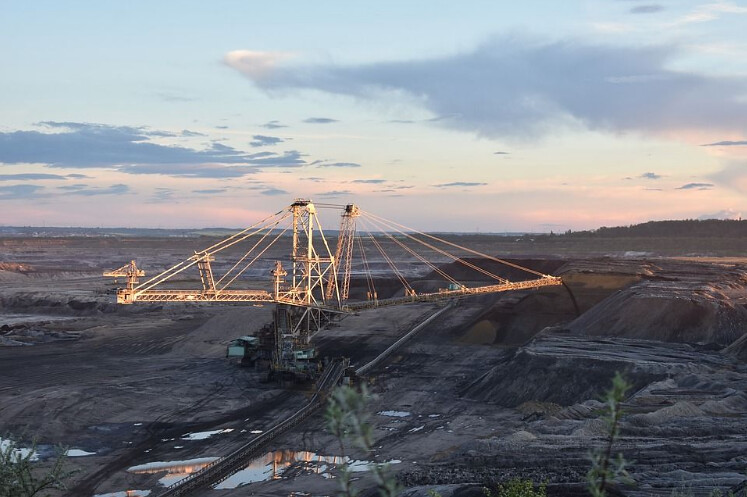
Parameters: Germany Plans To Cut Coal Dependence By 2038


Whenever the transition toward renewable energy is brought up in discussions, people typically tighten up showing a large amount of uncertainty about the topic.  Regardless of their knowledge of the process or the timeline, one certainty exists in today's world:  A large number of countries, local governments, states along with industries are starting to make the transition toward a renewable energy-based system in the future.  Each might possess an individual pace.  But ultimately, each are headed in the correct direction: away from a fossil fuel dependent economy (and world).


Renewable Energy Not Fossil Fuels


The transition toward renewable energy has been under fire to different degrees in different nations.  In the European countries, renewable energy is becoming more favorable with the political will emerging.  Just recently, an article in 'The Ecologist' stated that Lithuania received the European Commission's support to transition toward renewable energy:


International renewable energy industry experts predict that within the next two decades, traditional energy sources such as gas, coal, and oil due will be replaced 100 percent by renewables as a result of their current slow-to-non existent growth rates.
In light of these findings, Lithuanian energy experts believe that by continually meeting EU energy directives, incentivising electricity production, and pursuing corporate responsibility targets where companies aim to be powered 100 percent by renewables, then Lithuania can set an example to policy makers and solar energy suppliers in neighbouring Latvia and Estonia on how to reduce the entire Baltic region’s need for Russian energy and pursue its own energy autonomy.


European investors have been increasingly committing more over time as banks are reassured by technologists and policy makers along with industry analysts that the transition is not only going to happen -- but that the transition will have ample funding with more on the way.  Not to mention that political will is increasing slowly but surely.


Now, Germany recently announced a major change (Big News!!!) to take place by 2038.  The organization 'Climate Action' presented the news as follows:


The Federal Government in Germany has announced plans to phase out coal by 2038.
The Commission on Growth, Employment and Structural Change released a 20-year report which has agreed to cancel out coal by 2038.
With only one vote against, the commission agreed on a total of 40 billion euros in aid for the states affected by the coalition exit. The federal Government will now turn the commission report into a reliable energy concept.
Olaf ScholzIf, Federal Finance Minister, said: “If we do not lose sight of the common goal, we can develop Germany into an exemplary state of energy policy."
In the years 2023, 2026 and 2029, the Commission will undertake a review by an independent panel of experts.
In response to this review, the power plant capacity will be reduced to 17 gigawatts of brown coal and hard coal in 2030, more than halving it. Depending on the report, the withdrawal of coal could take place, according to the recommendation of the commission, by 2035.
Greenpeace have called for this target to be brought forward to 2030 to ensure that carbon emissions are reduced sooner.
It was reported that, in 2018, the production of coal accounted for 38 per cent of Germany’s energy generation. This move away from fossil fuel generation will put Germany back on track to meet the targets set at the Paris Agreement.
This news follows a report that found that the immediate phase-out of fossil fuels is crucial to meet important climate targets.
The report found that if carbon intensive technologies were replaced by carbon-free alternatives, carbon emissions would steadily decline, dropping to near zero in 40 years. This would result in a 64 per cent chance of limiting global warming to 1.5 degrees Celsius.


Great.  Everything stated above is encouraging.  Germany is taking the lead in changing the entire system of nations.  The rest of Europe are on board too as reported in the article before the above statement.  The European Commission must continue to offer assurance (i.e. support).  From the news reports over the last couple of years, the support not only seems to be building, but nations are actually taking action in the European Union.


Although, the size of Germany has always been brought up in discussions here in the United States.  The argument is that a smaller nation is able to make sweeping changes more easily than larger ones can.  Alright.  I can see that.  But that is no excuse for not making changes here -- especially on a state by state basis -- which is comparable to the size of Germany.


Size -- California vs. Germany??


Right after the article above was published (and I read the article), I was talking with my colleague who holds German citizenship.  She was born in Germany.  In a prior discussion about Germany moving toward the use of natural gas, she warned that the move could be potentially dangerous considering the main source of gas presently -- Gazprom -- from Russia.  This would put Germany at the hands of Russian gas giants (effectively Russia) for a stable and steady gas supply.


Although, since that discussion, the natural gas industry has started to boom (in the sense of shipping).  Technology has improved the ability to ship liquified natural gas all around the world.  Now, back to the discussion at hand.  This massive shift in dependence on fossil fuels in a reasonable amount of time makes other countries uneasy.  Some here in the United States view this transition as 'short sighted' since the infrastructure and change is occuring on such a short time scale.


But is the timescale that short?  What kind of transition plan is reasonable? How long should the U.S. or Germany rely on coal/fossil fuels?


The change that Germany is embarking on reminds me of the recent (as in the past few months) commitment to renewable energy made by then Governor Jerry Brown regarding the state of California.  Governor Brown signed into law last year the commitment to have California on a carbon neutral (net zero) program for energy by 2045.  This was ambitious to say the least.


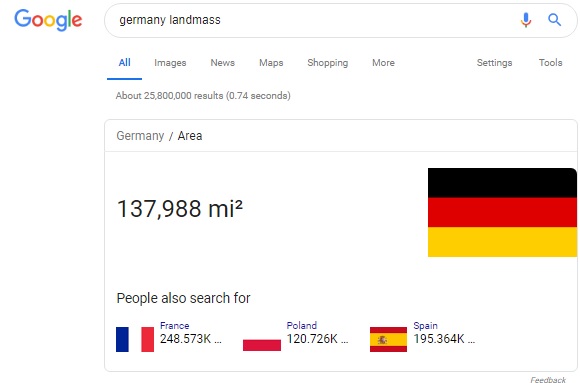
Remember that California's economy is the fifth largest in the world.  Which may cause someone to immediately draw parallels between Germany's transition and California's transition.  Let's look at the size (landmass) difference between the two for a closer comparison.  First, Germany's landmass is shown below:


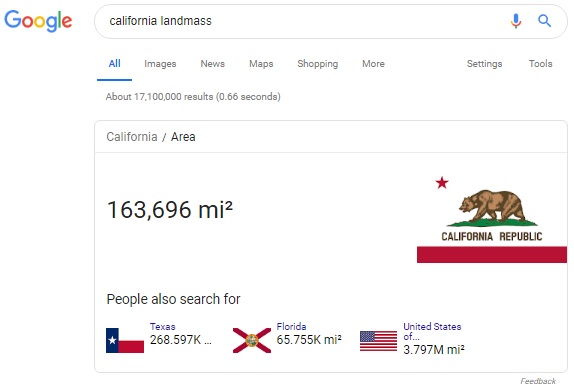
Next, California's landmass is shown below:


As you can see, California has a larger landmass than Germany.  With Governor Jerry Brown signing into law the transition to a carbon neutral economy by 2045, the current announcement above for Germany by 2038 is not too far fetched.  Especially given the size of the two landmasses.  Additionally, Germany is probably better suited to the transition toward renewable energy -- which is why the date is set for a complete transition earlier.


Regardless, the news above is exciting to those who are big fans for the transition toward a greater dependence on renewable energy.  As this post is published (Wednesday morning), a subcommittee is gathering in the U.S. Congress --House Committee on Energy & Commerce -- is meeting to discuss action for the United States of America.  I will write a follow up post on the hearing in the near future.  We should watch and note these commitments of transitioning toward renewable energy.  Further, these commitments should serve as a motivation to build momentum toward change.  The future of transitioning toward renewable energy is turning into a reality and is really exciting.


Related Blog Posts:


Governor Jerry Brown Leads The U.S. With Ambitious Calls For 100% Renewable By 2045 -- Wow!!!


Parameters: GM Lays Off Thousands Of Workers -- Why? People Are Not Buying Cars?


EPA Estimates Of Methane - GHG - are off by 60%


135 Climate Scientists Urge Prime Minister Theresa May to Challenge President Trump on his Climate Stance during visit to the UK


Parameters: Oil vs. Corn based Ethanol - A Tug-Of-War between Trump Administration and Congressional Leaders


French President Macron Calls On U.S. Congress To Save The Planet


Parameters: Shells Oil Corporation Invests In Renewable Energy Infrastructure


Parameters: South Korea Uses Renewable Energy For Olympic Games


French President Macron Organizes Climate Conference With Pledges Of Trillions Of Dollars For Climate Risk Management From World Organizations


Do You Need Clean Air To Breathe? An Introduction To Environmental Justice


Environmental Entrepreneurs Weigh In On Repealing The Clean Power Plan


EPA Blatantly Suppresses Scientific Results Regarding Climate Change?


EPA Director Finally Realizes Reality Of Trying To Roll-Back Obama Era Clean Air Act Regulation


Monday, January 14, 2019

Over 600 Environmental Groups write letter to Congress to phase out fossil fuels


Last November, voters came to the polls in America and voted to change the House of Representatives from a republican majority to a democratic majority.  Over the last two years, the erosion of the federal agencies oversight to enforce regulations to protect Americans from harm by corporate entities has ensued without major obstacles.  Which is problematic for important issues such as climate change -- which spans over decades not just one election cycle.  Although, action needs to be continuously optimized by encouraging our elected leaders in Congress to have our best interest in mind and keep steering toward sustainable goals which have a positive effect on our planet looking into the future.


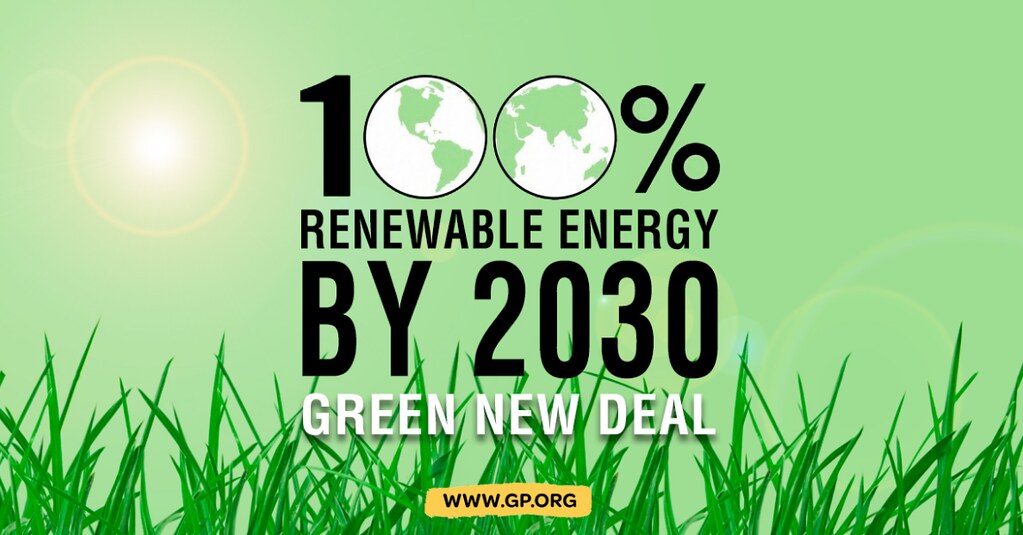
One such plan that has emerged with the change of the majority on Capitol Hill is the Green New Deal.  Over 600 environmental groups have written to express support for the Green New Deal and work toward finding solutions in general by forming committees along with passing legislation.  Negotiations are starting to happen which is encouraging to say the least.  Whenever I read about a large number of organizations sending letter to elected officials, I am alway curious about the content of such letters.  What do elected officials receive in letters in the form of information/persuasion toward their argument?  That is what this short blog post is about - persuasive content.


With that being said, the letter is shown below without the signatures:


January 10, 2019
Re: Legislation to Address the Urgent Threat of Climate Change
Dear Representative:
On behalf of our millions of members and supporters, we are writing today to urge you to consider the following principles as the 116th Congress debates climate change legislation and momentum around the country builds for a Green New Deal. As the Intergovernmental Panel on Climate Change recently warned, if we are to keep global warming below 1.5°C, we must act aggressively and quickly. At a minimum, reaching that target requires visionary and affirmative legislative action in the following areas:
Halt all fossil fuel leasing, phase out all fossil fuel extraction, and end fossil fuel and other dirty energy subsidies.
The science is clear that fossil fuels must be kept in the ground. Pursuing new fossil fuel projects at this moment in history is folly. Most immediately, the federal government must stop selling off or leasing publicly owned lands, water, and mineral rights for development to fossil fuel producers. The government must also stop approving fossil fuel power plants and infrastructure projects. We must reverse recent legislation that ended the 40-year ban on the export of crude oil, end the export of all other fossil fuels, and overhaul relevant statutes that govern fossil fuel extraction in order to pursue a managed decline of fossil fuel production. Further, the federal government must immediately end the massive, irrational subsidies and other financial support that fossil fuel, and other dirty energy companies (such as nuclear, waste incineration and biomass energy) continue to receive both domestically and overseas.
Transition power generation to 100% renewable energy.
As the United States shifts away from fossil fuels, we must simultaneously ramp up energy efficiency and transition to clean, renewable energy to power the nation’s economy where, in addition to excluding fossil fuels, any definition of renewable energy must also exclude all combustion-based power generation, nuclear, biomass energy, large scale hydro and waste-to-energy technologies. To achieve this, the United States must shift to 100 percent renewable power generation by 2035 or earlier. This shift will necessitate upgrading our electricity grid to be smart, efficient, and decentralized, with the ability to incorporate battery storage and distributed energy systems that are democratically governed. In addition, Congress must bring the outdated regulation of electricity into the twenty-first century, encouraging public and community ownership over power infrastructure and electricity choice, as well as permitting distributed energy sources, including rooftop and community solar programs to supply the grid.
Expand public transportation and phase out fossil fuel vehicles.
As the transition away from fossil fuels occurs, our transportation system must also undergo 100 percent decarbonization. To accomplish a fossil-fuel-free reality, Congress must require and fund greater investment in renewable-energy-powered public transportation that serves the people who need it most. The United States must also phase out the sale of automobiles and trucks with internal fossil fuel combustion engines as quickly as possible and phase out all existing fossil fuel mobile sources by 2040 or earlier. Federal credits for electric vehicles must be expanded.
Harness the full power of the Clean Air Act.
The Clean Air Act provides powerful tools that have proven successful in protecting the air we breathe and reducing greenhouse pollution. It can also serve as an important backstop to ensure climate targets are met. Congress should harness the full power of the statute by setting strict deadlines and providing adequate funding for EPA to carry out all its duties under all applicable sections of the Act, including implementing greenhouse pollution reduction requirements for cars, trucks, aircraft, ships, smokestacks and other sources, as well as a science-based national pollution cap. The Act has successfully reduced many air pollutants and can do the same for greenhouse pollution.
Ensure a Just Transition led by impacted communities and workers.
In effectuating this energy transformation, it is critical to prioritize support for communities who have historically been harmed first and most by the dirty energy economy and workers in the energy sector and related industries. We support a comprehensive economic plan to drive job growth and invest in a new green economy that is designed, built and governed by communities and workers. Building new energy, waste, transportation and housing infrastructure, designed to serve climate resilience and human needs; retrofitting millions of buildings to conserve energy and other resources; and, actively restoring natural ecosystems to protect communities from climate change, are but a few ways to build a sustainable, low carbon economy where no one is left behind during this change.
Uphold Indigenous Rights
The United Nations Declaration on the Rights of Indigenous Peoples (UNDRIP) must be upheld and implemented, along with treaties, instruments and decisions of international law that recognize that Indigenous Peoples have the right to give or withhold “free, prior and informed consent” to legislation and development of their lands, territories and/or natural resources, cultural properties and heritage, and other interests, and to receive remedies of losses and damages of property taken without consent. 
Further, we will vigorously oppose any legislation that: (1) rolls back existing environmental, health, and other protections, (2) protects fossil fuel and other dirty energy polluters from liability, or (3) promotes corporate schemes that place profits over community burdens and benefits, including market-based mechanisms and technology options such as carbon and emissions trading and offsets, carbon capture and storage, nuclear power, waste-to-energy and biomass energy. Fossil fuel companies should pay their fair share for damages caused by climate change, rather than shifting those costs to taxpayers.
We look forward to working with you to address the gravest environmental crisis humanity has ever faced, to protect all present and future generations around the world, while centering the rights of those communities and workers most impacted.
Sincerely,


The above letter was signed by over 600 environmental groups.  The names of which can be found at the end of the letter hyperlinked -- here.   There is no question that if various elected officials on both sides consider climate change to be a threat to our national security (to our planet on a much larger scale), then negotiation needs to start happening soon if change is going to follow in the future.


There are people who do not think that climate change is real or a major threat.  As a scientist, I can just defer to a non-scientist's reasoning.  Recently, I was listening to a podcast titled "Mike Drop" which was an interview between two former Navy Seals about all aspects of life.  Mike Ritland interviews Andy Stumpf about all aspects of life spanning from gun control to climate change.  When the topic of climate change came up, here is what was agreed upon (at 3:02:16 into podcast):


". . . I'm trying to close the loop on that yeah ... I mean I would say I'm probably similarly ignorant to it other than the fact that to me common sense would tell you you know basically what you said but then also just ... just take automobiles as an example is that you know if you can shut your garage door, turn your car on and be dead in a matter of minutes like chances are with (Andy Stumpf breaks in with "you know I think you need a hose for that too") ... but you know ... ya I got your fucking hose ... yeah you know chances are that having ... you know hundreds of millions of vehicles billions you know driving ... or if you know is probably not that great for us you know and that's one example"


That was a great example offered up from interviewer Mike Ritland.  Common sense would tell you that if you can close the door of your garage with the car still running, eventually, the fumes will kill you.  Therefore, having billions of tons of CO, CO2 spewing into your environment are probably not that good.


With that being said, the new change to the House of Representatives seems to be on the right track with the emerging Green New Deal in discussion.  A discussion is where change starts to happen.  And as has been highlighted in the last couple of years, changes are greatly needed in the direction toward sustainable energy while steering us clear of our dependence on fossil fuels.  Keep asking your elected officials to consider clean energy along with the environment when a vote is under consideration on capitol hill.


Related Blog Posts:


Senator Carper Blasts Environmental Protection Agency For Considering Relaxing 'Mercury and Air Toxics Standard'?


What does a Government Shutdown look like?


What is the difference between General Anxiety Disorder and Trump Anxiety Disorder?


Congress Gets Involved In Beef Recall


How Effective Are Poultry Corporations At Reducing Salmonella In Their Products?


NIDA Director Nora Volkow: How Health Communicators and Journalists Can Help Replace Stigma with Science


Governor Jerry Brown Leads The U.S. With Ambitious Calls For 100% Renewable By 2045 -- Wow!!!


Thoughts: An example letter of opposition to repealing the 2015 Clean Waters Rule


EPA Estimates Of Methane - GHG - are off by 60%


Chemical Safety Board's Future Uncertain as Hurricane Season Approaches


Update: Congress asks Federal Agencies about Dangerous Chemicals -- PFOA and PFOS


Congress Asks Defense Department and Environmental Protection Agency about Dangerous Chemicals


President Trump Just Allowed Greater Environmental Risk To Children's Health


Thoughts: Senator Bernie Sanders Asks Public To Get Involved In The Public Process At Any Level


Do You Need Clean Air To Breathe? An Introduction To Environmental Justice


French President Macron Organizes Climate Conference With Pledges Of Trillions Of Dollars For Climate Risk Management From World Organizations


Coal Magnate Murray Shames Fossil Fuel Industry For Being "Forward Thinkers" For Energy


Democrats Question EPA Adminstrator Scott Pruitt On Historical Job Cuts At EPA


There Is No Climate Debate -- Scientific Facts Have Settled The Issue?


Tuesday, January 8, 2019

The Futuristic Visit To The Physician Is Here!


Source: IUVM TECH


The world is in the midst of a gigantic 'data revolution' right now.  What does that entail?  There is a massive collection of data going on around us at any given moment.  From the geographical location at which you are located to the subject matter which you are searching for using a search engine such as Google or Bing.  What benefits might arise out of such a revolution?  Many have been proposed.  The overall concept to understand why such benefits arise was written about in an article titled "The 7 Industries That Benefit Most From Big Data" on the website 'Smart Collective' in 2016:


Generally, the more data you have, the more specific and accurate insights you’ll be able to generate, which is why big data has become such a powerful tool (and buzzword) in recent years


More data points equals more accuracy.  Which promotes the largest benefit which serves as a feedback into all of the industries mentioned in the article above:  'artificial intelligence.' A pathway toward the benefits of artificial intelligence exists and is currently being taken by technology groups around the world.  On this pathway toward 'artificial intelligence' playing a larger role in our society has been the concept of 'deep learning':


Deep learning (also known as deep structured learning or hierarchical learning) is part of a broader family of machine learning methods based on learning data representations, as opposed to task-specific algorithms. Learning can be supervised, semi-supervised or unsupervised.[1][2][3]
Deep learning architectures such as deep neural networks, deep belief networks and recurrent neural networks have been applied to fields including computer vision, speech recognition, natural language processing, audio recognition, social network filtering, machine translation, bioinformatics, drug design, medical image analysis, material inspection and board game programs, where they have produced results comparable to and in some cases superior to human experts.[4][5][6]
Deep learning models are vaguely inspired by information processing and communication patterns in biological nervous systems yet have various differences from the structural and functional properties of biological brains (especially human brains), which make them incompatible with neuroscience evidences.[7][8][9]


Again, the amount of data which serves as an 'input' will greatly affect the accuracy of the 'output' the intelligent (computation) answer given to us after the algorithm is executed.


How does all of this play out in the immediate future?


One example is the field of medicine.  During a recent break, I was perusing through Facebook and found the following video by an organization called 'Forward'.  The video below gives us a glimpse into technology which has already been developed and is out on the market right now.  A glimpse of a 'future visit to the doctor' for a health check up.  The video is less than 10 minutes in length and worth watching.


Wow right?  For those who are uninterested in viewing the entire video here are the basics:


1) No receptionist to check in with.  Just an equivalent of an iPad.

2) A Body scan with infrared radiation.  While placing a single hand on a sensor, blood oxygen levels, heart rate, metabolic rate, and a body composition -- fat tissue, muscle and bone tissue.

3) Up to 3 visits normally to the center per month.  Although, a patient may come and get a body scan anytime.  Remember, more data more accuracy.

4) A Body scan creates a 3D model of your body.

5) The Information gathered in the body scan is synced with exam room digital display (i.e. monitor, tv screen) at which time the patient can view results with a physician.  Additionally, the information is also synced with the mobile app on your smartphone.

6) Patient goes into exam room and discusses data.

7) Patient and physician review body scan data and blood work (all on the same day) to come up with a plan to achieve health goals which lead to better health.

8) Planning is individual based.  No two plans are equal.


Having the ability to reduce time or redundancy with having an on site laboratory (for blood work), a visit to the 'futuristic physician' provided by 'Forward' is greatly enhanced.  Plus, as pointed out in the video above, the language which enters into the patient file is the patient's own language -- which is recorded on the screen during discussion with physician.  Additionally, all data and discussion is forwarded to your mobile app for your personal viewing and stay plugged into continuously.  Awesome.  This is the future of medicine.


Conclusion...


The data revolution has the ability to transform our daily lives in many ways.  As shown in the video above, the access of big data in real-time is effective in treating an individual patient with the patient's own needs based on the data collected.  Additionally, that data is compiled with the ability (upon patient approval) to be used in conjunction with other patients for research and discovery purposes.


One main obstacle with the deluge of big data are the different file types in which the data exists currently.  In order to make meaningful discoveries using the big data files, the processing/algorithms need to be able to read the file format.  With the collection of data in this forma (a single format), this represents a solution to an existing problem.


Of course, that means still processing old data from decades in the past.  Although, after processing old data and combining it with new data compiled in the new format, powerful advances will be able to be made by mining the data for medical research and drug discovery purposes (to name just two).  The future of medicine is truly exciting and should be embraced by each of us.


Related Blog Posts:


What is the difference between General Anxiety Disorder and Trump Anxiety Disorder?


NIDA Director Nora Volkow: How Health Communicators and Journalists Can Help Replace Stigma with Science


NIH Director Francis Collins Makes A Statement Regarding Sexual Harassment In Science


National Institutes of Health - Anti-Sexual Harassment Web site


National Science Foundation Sexual Harassment of Women Study


Thoughts: What Does National Institute of Health Director Francis Collins get asked in front of Congress?


Parameters: What is the 'mission' of the National Institute for Aging?


NIH Director Updates Congress On Research Progress


Dr. Francis Collins and Bill Gates Discuss Global Health And Genomics


How Much Do New Drugs Cost To Bring To The Pharmacy Counter?


Is Disease Or Treatment Different In Women?


Unraveling The Resistance Of Antibiotics!


How Do Chemists Discover New Drugs? A Brief Introduction!


Thursday, November 8, 2018

Want To Improve Science Communication: Add Artists!


Why is communicating science to the public so difficult?  At least that is a major perception by the science community.  There is a 'disconnect' between the public and science community when any topic of science is raised in a public forum.  Regardless, science communication to the public seems rather difficult.  I believe that should not be the case.  In fact, inside each of us is a scientist at heart.  But the world does not revolve around my belief's now does it.  Thank goodness for that.


With that being said, scientists much continually reach out to the community and demystify science for the public.  I have tried through writing on this blog to do my part.  Recently, I read about another distinct avenue by which science is being disseminated -- through art.  I was fascinated by the scope of the project and want to introduce this avenue to you (the reader).  Enjoy!


Science and Art Merge?


Over the last few years, the fields of science, technology, engineering, and mathematics have been seen expanding to incorporate the Arts too.  Meaning that the recent acronym "STEM" is changing to "STEAM" to include the arts.  Why?  According to  a recent article from the website 'ScienceMagazine' titled "Tuning into the channel" the addition of the arts is becoming more prominent and is in the experimental phase already.  Last December, graduate student Kelsey Bisson (at University of California at Santa Barbara), received a grant to document the daily rhythm of the plankton life in the Santa Barbara channel -- which is rich with marine life.


The only caveat with the award of the grant was to incorporate the findings with four artists who will join the trip to contribute to an interdisciplinary project called -- ROAM: Rendering Ocean in Artistic Mediums.  While on the exploration, the four artists will have the following goal:


 Four artists — a creative writer, a videographer, an illustrator and a musician — will join the expedition to collaborate with one other and the scientists aboard. The goal? To translate scientific efforts in ways that are compelling and relatable, including the production of a documentary, an illustrated novella and a public art science installation.


Remember, these four artists will be working along side scientists collecting data to publish in research journals.  The original intent of the ROAM project is:


"ROAM was designed to leverage the strengths of art and science to motivate a love for the deep ocean across a range of communities," Bisson said. "By translating the science experience through art, ROAM will build empathy and wonder for our ocean — and ultimately spark a commitment to marine stewardship."
Huynh and Bisson will be joined by 14 students and five faculty members from three universities, including UCSB biogeochemist David Valentine. The team will characterize how marine microbes influence and are influenced by their geochemical environment on hourly time scales by employing a wide range of oceanographic methodologies and technologies from water incubations to autonomous underwater vehicle surveys to remote sensing.
"We will look at processes such as rates of photosynthesis, herbivory, decomposition and infection, zooplankton migration up and down the water column and water mass circulation," Bisson explained.

The scientists plan to make their data publicly available after publishing their results in peer-reviewed journals. All members of the expedition will blog about their experiences during the voyage. The online efforts, according to Bisson, will make the ocean more accessible to people who live far from it, which in turn will breed concern for ocean health, stimulate interest in the deep ocean and perhaps inspire careers in oceanography.


Aside from a deep love of the ocean emerging from this exploration, the participants on the journey will be able to express their work in terms of creativity.  This is a major avenue through which we can connect distinctly different disciplines together in a project.  That is right -- through the shared love for 'creativity' -- which is an underlying factor in any endeavor.  Some might argue against this realization, but I would counter by asking them to take time to think deeply about 'creativity' and the educational process.  Especially here in the United States of America.


International Students Learn U.S. Students are very creative?


Creativity is the distinct quality of United States students compared to students from other countries.  I have mentioned this briefly in previous posts -- talking about the benefits of integrating graduate students from different countries.


Through numerous hours of discussion during my graduate and post-doctoral years with international students, one overarching quality which students from the United States express freely is their creative energy.  Students have told me this time and time again from other countries -- which to me is disappointing to say the least.


With this being said, the merging of two seemingly different fields through a common project as described above will come rather naturally.  At first sight, this might not be the predicted conclusion from either participants.  Just wait.  The blog posts along with the documentary will reveal a fruitful learning adventure from both sides.  Especially, through the communication channel which is formed between scientists and artists who must work together to achieve a common goal -- track the beauty and rhythm of the marine life in the Santa Barbara channel.


The study results will be sought after along with the documentary, blog posts, and other documentation.  This could be a start to a new way of conducting science -- that is -- humanizing science.  Which is much needed at this time in our history.  Additionally, the outcome will inevitably be artists with a much richer understanding and respect for science and scientists with a much deeper respect for visual instruction along with different perspectives from which to view science and the world around themselves.  Overall, the expedition is a win win for society.  Stay tuned for the results.


Conclusion....


Art is not separate but intertwined with science.  They are indistinguishable.  Even though there exists two different fields of study, the love for each is a love for one and the same -- the inner workings of the world around us.  How do we view the world around us?  How do we study the world around us?  More often than not, scientists are thought of a 'rigid people' in lab coats.  When in reality, scientists are creative and curious people.  Adding art will only enlighten the scientists more and make society a better place as a result.


Related Blog Posts:


Science Topics, Thoughts, and Parameters Regarding Science, Politics, And The Environment!


Wednesday, October 17, 2018

Soybean Farmers Are Storing Too Much Soybean, Although Chemical Industry Is Greenlighting Trade Deals?


Source: Post Bulletin


Depending on your exporting destination or importing origin along with the industry type, the response to the Trump Administration's tariffs program and emerging trade war is different.  For the chemical industry which heavily relies on good relations with local (North and South) neighboring countries, life is acceptable - as reported recently in the chemical news.  At the same time, if you are a soybean farmer or a farmer who relies on storing product in elevators for an extended period of time, trouble is approaching quickly due to trade coming to a 'stand still'.   The two different scenarios are listed below - briefly.


Soybean Storage?


Early on after trade tariffs were set to take effect, I wrote a blog post discussing (briefly) the benefits of global free trade.  In which, I highlighted the obvious fact that all commodities are connected to each other in some manner. Recently, the news site 'Politico Agriculture' has shed light on the connectivity which the trade industry relies on:


HIDDEN TRADE WAR IMPACT: CROP STORAGE SHORTAGE: Retaliatory tariffs have weighed down commodity prices for months. With the harvest well underway, the trade dispute with China is dealing another blow to U.S. soybean producers: a shortage of space in grain elevators that's causing major backups in states like North Dakota, Minnesota and Louisiana — and driving down prices even more.
China, the biggest market for U.S. soybeans, slapped 25 percent duties on the crop in retaliation for President Donald Trump's tariffs on Chinese high-tech products. Now it's effectively closed for business to American soy growers. Some farmers are gathering more soybeans than they can sell or store, jam-packed silos are running out of room, and the trains that usually carry soybeans to the Pacific Northwest for shipping to China aren't moving.
"In Southwest Minnesota and the Dakotas, you now have elevators that are storing all their beans because there's no market to the West. There is absolutely no bid," said Bill Gordon, a farmer in Worthington, Minn., and member of the American Soybean Association board of directors.
Gordon said some storage sites are piling corn outside to make room for soybeans, and that his local grain elevator is expected to be full after just one week of the month-long harvest.
Cash prices falling: The demand for storage space is also widening the gap between the market commodity price for soybeans and the cash price farmers receive for their crops at the elevator. Grant Kimberley, director of market development for the Iowa Soybean Association, said the drop-off — or "basis" — is normally 30 to 50 cents per bushel in central Iowa. Now it's about $1 per bushel.
Downstream problems: There's also a surge of Midwestern crops being shipped down the Mississippi River to New Orleans, where they're sold to Europe, South America and elsewhere. That's putting extra strain on growers and exporters in Louisiana.
"Everything is choking up right here on the Mississippi River on the barges and the elevators," Abraham said. "Every elevator that we have is full of soybeans right now and can literally take no more on."


Soybeans are taking up space which might be used for other crops which need to be stored too.  The states being affected - North Dakota, Minnesota, and Louisiana - have around 130,000 farms (combined in 3 states).  Not all of those farms serve the soybean industry.  Although, that enormous number of farms could be impacted by the connectivity to other crops which need to use the same storage space used temporarily for soybean crops held up by trade tariffs.


On top of the elevators being filled up are the barges (storage boats) which are filled up with soybeans being transported to other states to be stored.  Shown below is an example of a barge filled with soybean being filled.  Just think of all the transportation, space, and time -- which equates to money burned -- waiting to be moved, stored, or shipped.  All of the jobs which are on hold due to trade tariffs.  Not cool.


Source: Feed Stuffs


Additionally, the mere fact that China can just shut down and refuse any crops from the United States shows how reliant the United States is on other countries.  Which is dangerous to say the least.  Our reliance to other countries for crop sales or technology processing is becoming a major issue which going forward into the future will have be heavily weighed by those in elected office who make the large decisions in Washington D.C.


Although, they are elected positions therefore, your input is imperative in driving their respective vote.  With that being said, keeping up with the status of trade talks and disenfranchised farmers is important in moving forward participating in democracy.  Below, the conversation shifts from grave concern now to the chemical industry.  The chemical industry is quite pleased with the changes - which is strange.


Chemical Industry Is Good!


As I mentioned in the introductory paragraph, the chemical industry is one which has flourished since a deal has been arrived at between Canada, Mexico and the United States.  According to the Chemistry trade journal 'C&E News' titled "U.S. chemical industry reacts positively to revised trade pact with Canada, Mexico" the deal is being cast in a positive light:


The U.S.-Mexico-Canada Agreement (USMCA) is an overhaul of the 24-year-old North American Free Trade Agreement (NAFTA), which underpins $1.2 trillion in total trade between the three countries.
The trilateral accord is critically important to U.S. chemical manufacturers because Canada and Mexico are the industry’s two largest export markets. Approximately 46,000 chemical industry jobs in the U.S. now depend on trade between the North American neighbors.
Although ACC and its member companies are still reviewing the provisions of the updated trade pact, the industry group says the agreement “appears to include several enhancements long sought-after by the U.S. chemical sector,” including greater regulatory cooperation.


That is not to say that other industries reliant on chemicals and pharmaceuticals are not hurting with the trade war emerging with other international countries.  Noted in the article above that 46,000 jobs depend on trade.  That is just one single industry - chemical industry.  Imagine all other industries across the board which contribute to global trade which are being negatively impacted.  The total amount of jobs which are tied to the trade of those industries.  When all is considered, the numbers are enormous and difficult to comprehend.


Conclusion...


Just today in 'Politico Agriculture' was the following news:


TRADE DISPUTES LOOM OVER GLOBAL FOOD SECURITY: Trade protectionism and climate change are among the factors weighing on international food security, according to the Economist Intelligence Unit's Global Food Security Index, a benchmark used to measure individual countries' level of food security.
The report, released Tuesday by EIU and DowDuPont's Corteva Agriscience, cited China's retaliatory tariffs on U.S. soybeans as an example of trade turmoil that can raise prices for consumers and hit low-income families the hardest.
"Protectionist trade policies can contribute to world food price increases and limit agricultural competitiveness," EIU wrote.
The benchmark has the U.S. tied for third place with the United Kingdom — and down in the rankings for the second year in a row. The result doesn't indicate a worsening situation in the U.S. but, rather, slower progress on food issues than other nations. Singapore ranks No. 1, followed by Ireland in second. The Netherlands rounds out the top five.


In light of the news above, get ready for prices to change due to changing demand both internationally and within our nation.  As highlighted, each of these avenues of export are tied to one another in some manner.   Typically, the thought of total impact never crosses each of our minds.  That needs to change with the changing times.


Instead of thinking in terms of an 'isolationist' country, the United States needs to again open up trade avenues to disseminate the crops which are stored and hindering profit margins of families (farm families) along with all of the other players in the trade game: tractor drivers, truckers, dock workers, mariners - captains of ships, ship manufacturers, shipping companies, traders, diplomats, local store owners, foreign store owners, Chinese supply chain.  All of these players have families to support.   Not to mention the amount of energy needed to move goods across supply routes nationally and internationally. 


Related Blog Posts:


"Trade Not Aid" -- The Answer For Trade War!


Trade War Hurts Farmers -- From The Farmer's Mouth Directly


Parameters: How many sticks of butter are contained in 7.5 million pounds of butter?


How many cows are needed to generate 50,000 tons of beef exports?


How Many Cherries Are In 1.5 Million Shipping Boxes?


Parameters: Trade Tariffs Will Affect International Science


Parameters: Steel And Aluminum Tariffs Are Not Isolated - They Are Tied To Trading Of Other Vital Goods


Parameters: Tariffs Affect Trade In Both Directions -- In And Out Of The USA


Friday, August 31, 2018

Reader Question: How far would 291 billion Goodyear Blimps reach end to end?


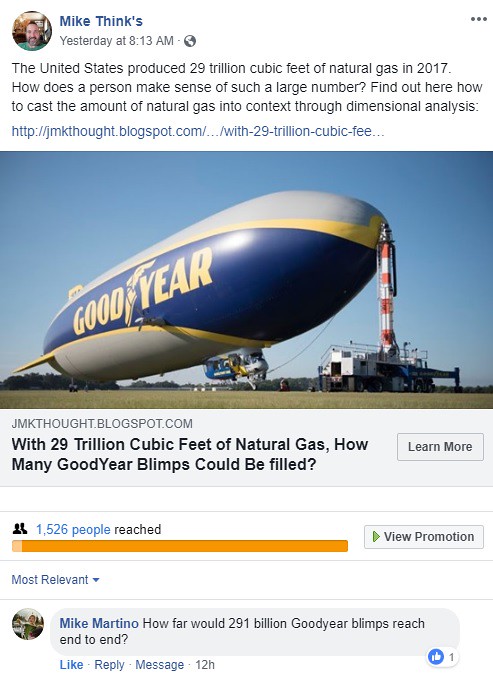
Recently, I had a reader respond on Facebook to a blog post titled: With 29 Trillion Cubic Feet of Natural Gas, How Many GoodYear Blimps Could Be filled? as shown below:


According to the image above, the reader asks the following question: How far would 291 billion Goodyear Blimps reach end to end?   In the blog post below, the answer will be revealed in comparison to three distances:


1) Would the distance be enough to travel around planet Earth?  

2) Would the distance reach from the Earth to the Moon?

3) Would the distance reach from the Earth to Mars?


The answers are outlined and solutions shown below.  Enjoy!


Line up 291 billion Goodyear blimps


In order to start the analysis above up, we need to refer to the 'data' page for the Goodyear Blimps which I provided from the last post -- which can be found here.  If the overall length is searched for on the web page, the answer is the length of a Goodyear Blimp is 264.4 feet long or 81% of the length of a football field.  Wow!  That is shown below:


With this number representing a single blimp, the total distance asked by the reader above can be found by simply multiplying two values together.  The first is the total amount of Goodyear Blimps by the length of a single Blimp (the second value) as shown below:


Obviously, the resulting distance is very long considering that a single blimp is around 80% of the length of a football field.  That is, the total length expressed in units of 'feet' is 71,300,000,000,000-feet.  Or 71.3 trillion feet long.  For distances that are expressed in units of feet that are so enormous, converting the unit into a larger unit (say a mile) makes sense for dimensional analysis.  Especially when the metric will most likely be expressed in units of 'mile'.


To do so, we need to know the amount of feet which are in a mile.  The answer can be found by asking a search engine like 'Google.com' the following question: How many feet are in a mile?  The answer is shown below:


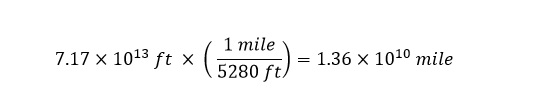
The answer indicates that for every mile, there are 5,280 feet.  With that conversion value in mind, the following unit conversion from feet to miles can be accomplished as shown below:


The number of total miles which would be reached if 291 billion Goodyear Blimps were lined up end to end would be around 13.6 billion miles in total distance.  That number is shown below:


The only remaining question is how to make sense of such a large number?  What is an appropriate metric to use for comparison?  How about if we choose the following three distances:


1) Trips around planet Earth

2) Trips from planet Earth to the Moon

3) Trips from planet Earth to the planet Mars


Lets see how these distances compare to 13.6 billion miles.


1) Trips around planet Earth:


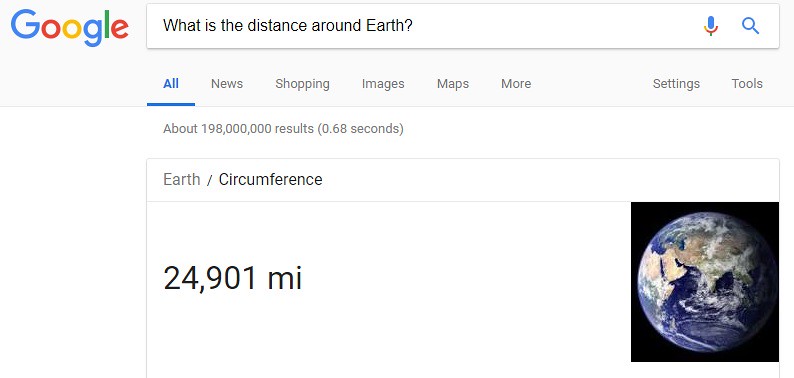
To find out how 13.6 billion miles compares to the number of possible trips around Earth, the circumference of Earth needs to be known.  The fastest way to obtain the circumference is to ask Google the following question:  What is the distance around Earth?   The answer is shown below:


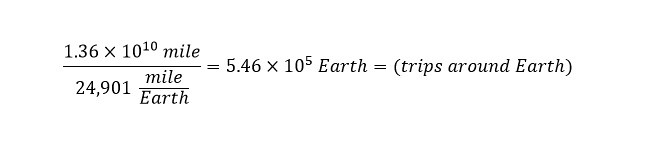
Once we have an answer -- which is 24,901 miles around Earth, a quick inspection is performed to make sure units of measurement are the same.  Yes, both values, 13.6 billion miles and 24,901 miles are both expressed in units of 'mile'.  Therefore, dividing the total number of miles which equates to lining up end to end 291 Goodyear Blimps by the distance around Earth will yield the number of trips that would be made possible as shown below:


Wow!  The answer indicates that with 13.6 billion miles, we could travel around Earth 546,000 times.  Wow!


2) Distance from Earth to the Moon:


The last analysis of distances -- using the circumference around the Earth -- gave us a large number: 546,000 trips around the Earth.  I do not know about you, but trying to imagine that number is too difficult for me.  Therefore, a new metric needs to be created in order to make sense of this enormous number -- 13.6  billion miles -- with which we are left with to untangle.


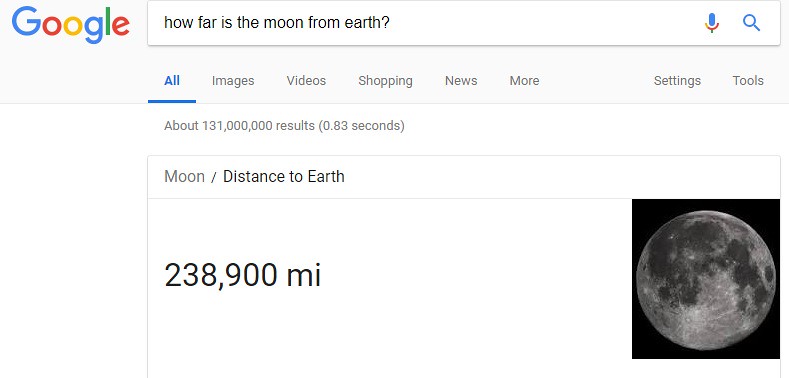
Another possible metric would be to use the distance between Earth and the moon.  If Google is consulted by asking the following question: How far is the moon from earth? -- then the answer below appears:


From the last analysis, the remainder of the calculation is straightforward as shown below:


According to the calculation above using the numbers mentioned, the total number of trips from Earth to the Moon would be approximately 56,900 one way trips.  Wow!  Looking at the answer, the number of trips is still quite large.  Lets consider a larger metric -- the distance to Mars for a final analysis.


3) Distance between Earth and Mars:


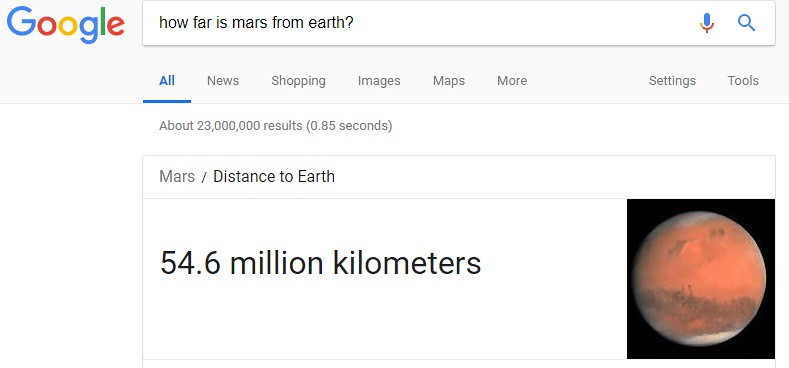
As a final analysis, a yet larger metric is chosen -- which is the distance between Earth and Mars -- to cast the enormous distance of 13.6 billion miles into perspective.  Again, to start the analysis, the distance from Earth to Mars needs to be obtained.  Using the handy search engine Google with the following question: How far is Mars from Earth? -- will yield an answer: 


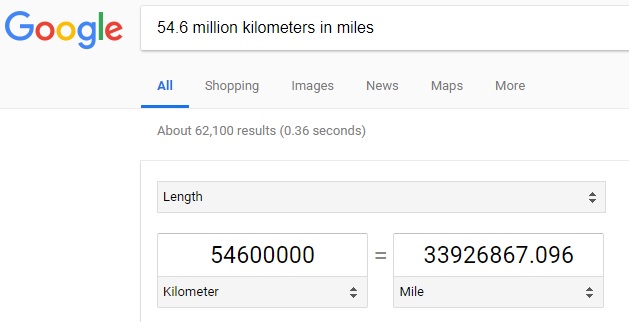
The answer gives us a slight problem.  Following a quick inspection of 'units of measurement', the answer is given in units of 'kilometers' whereas the distance which is used in the above analysis is expressed in units of 'miles'.  Therefore, Google needs to be consulted with the following question: 54.6 million kilometers in miles -- which yields the following conversion shown below:


Notice how usually the inquiry for unit conversion entails getting a conversion factor.  In this case, the distance of concern was in question to save time.  Now, the final analysis can be carried out -- which is to find the number of trips from Earth to Mars that would be made possible using the distance of 13.6 billion miles.  The analysis is shown below:


The calculation indicates that 401 trips would be possible between Earth and Mars.  Wow!


Conclusion...


In the analysis above, the question from a reader was entertained: how far would 291 billion Goodyear Blimps reach end to end?  The answer was astounding.  Much longer than I even imagined.  Although, using dimensional analysis allowed us to cast the value (i.e. total distance) into a manageable perspective.  The metrics chosen were distances within our galaxy.  If larger metrics were needed for an extremely larger number, the a 'light-year' could have been chosen to which compare astronomically large numbers too.  In the future post, there will be such large numbers which require truly long distances.


For the time being, I am thankful to the reader Mike Martino for asking such a great question.  I have had a wonderful time making sense of the distance calculated along with walking readers through the analysis.  Now, powered with the ability to perform similar analysis, choose different metric and arrive at different answers.  Use the numbers above to explore different analyses.  Feel free to comment on different analyses in the comment section below.


Related blog posts:


Dimensional Analysis Of Statistics And Large Numbers - Index Of Blog Posts


What is dimensional analysis?


How many trash carts can be filled with 80 billion pounds of trash?

How many people would be killed if 1,485 pounds of Fentanyl were distributed onto the streets in the U.S.?


What Is Dimensional Analysis?


Was The Recent Oil Spill in China The Largest In History?


LimeBike Dockless Bikeshare Riders Travel A Distance Of 13,000 Miles In Just Over 3 Weeks?


How Many Cigarettes Can You Roll With 18,000 Pounds Of Marijuana?


How Many Turkey's Are Served On Thanksgiving Day? How Many People Served?


How Much Trash Would Be Required To Fill The Great Wall Of China?


How Many Birds Per Minute Can Be Processed On A Single Line At A Poultry Processing Plant?


Hurricane Harvey Drops Enough Rain On Houston To Fill 560 Dallas Cowboy Stadiums


If Technology Fails, Use Basic Math Skills - Count Manually!!


How Much Water Is Contained In All Oceans Around The Globe?