Showing posts with label Research. Show all posts

Friday, April 5, 2019

ARPA-E Should Not Ever Be Shutdown Period.


The Trump Administration has waged war to close the Advanced Research Projects Agency-Energy Program (of division) over the last two and a half years.  Why?  In large part because President Obama created ARPA-E which immediately sets the organization into the crosshairs of the Congressional budget committee each year.  The behavior of the President is strange given that both Republicans and Democrats feel that funding for ARPA-E as an organization is critical to meet the energy needs of the future of the United States.


To understand the motivation further of the Trump Administration, let's take a look at the Wikipedia page description of the Agency:


Legislative history 
The concept of ARPA-E was initially conceived by a report by the National Academies entitled Rising Above the Gathering Storm: Energizing and Employing America for a Brighter Economic Future. The report recognized a U.S. need to stimulate innovation and develop clean, affordable, and reliable energy.[1] ARPA-E was officially created by the America COMPETES Act , authored by Congressman Bart Gordon,[2] within the United States Department of Energy (DOE) in 2007, though without a budget. The initial budget of about $400 million was a part of the economic stimulus bill of February 2009.[3] Then in early January 2011, the America COMPETES Reauthorization Act of 2010 made additional changes to ARPA-E’s structure; this structure is codified in Title 42, Chapter 149, Subchapter XVII, § 16538 of the United States Code.
Among its main provisions, Section 16538 provides that ARPA-E shall achieve its goals through energy technology projects by doing the following:
(1)Identifying and promoting revolutionary advances in fundamental and applied sciences;
(2)Translating scientific discoveries and cutting-edge inventions into technological innovations; and
(3)Accelerating transformational technological advances in areas that industry by itself is not likely to undertake because of technical and financial uncertainty. 
Mission 
Like DARPA does for military technology, ARPA-E is intended to fund high-risk, high-reward research that might not otherwise be pursued because there is a relatively high risk of failure.[4] Like DARPA, it is intended to fund projects involving government labs, private industry, and universities. ARPA-E has four objectives:
(1)To bring a freshness, excitement, and sense of mission to energy research that will attract the U.S.'s best and brightest minds;
(2)To focus on creative, transformation energy research that the industry cannot, or will not support due to its high risk, but that has high reward potential;
(3)To utilize an ARPA-like organization that is flat, nimble, and sparse, capable of sustaining for long periods of time those projects whose promise remains real, while phasing out programs that do not prove to be as promising as anticipated; and
(4)To create a new tool to bridge the gap between basic energy research and development/industrial innovation.[4] 
Launch 
President Barack Obama announced the launch of the Advanced Research Projects Agency–Energy (ARPA-E) on April 27, 2009 as part of an announcement about federal investment in research and development and science education. Soon after its launch, ARPA-E released its first Funding Opportunity Announcement for the new agency, offering $151 million in total with individual awards ranging from $500,000 to $9 million. Applicants submitted eight-page "concept papers" that outlined the technical concept; some were invited to submit full applications.[5]
Arun Majumdar, former deputy director of the Lawrence Berkeley National Laboratory, was appointed the first director of ARPA-E in September 2009, over six months after the organization was first funded.[6] U.S. Secretary of Energy Steven Chu presided over the inaugural "ARPA-E Energy Innovation Summit" on March 1–3, 2010 in Washington, D.C..[7]


After reading the above excerpt, who would not want to provide funds for the research initiatives conducted by ARPA-E.  With that being said, the only real reason which I can find for shutting down the program (aside from Obama's vision) is that the funding is for renewable/clean energy for the future of the United States.  ARPA-E is a spin-off from DARPA (Defense Advanced Research Projects Agency).


DARPA projects are specifically aimed at the military.  Years ago in graduate school, I had a research project which was funded by DARPA.  The research project was centered around the understanding of limits of quantum computation (quantum information processing) using Solid-State Nuclear Magnetic Resonance Spectroscopy (SSNMR).  Members of the public might think that there is no connection between the SSNMR spectroscopy and the military.


Although, the progress made on the project would indirectly improve the measurement known as Magnetic Resonance Imaging (MRI) in the hospital setting.  Funding for DARPA projects is usually aimed to fund projects which are high risk with large pay-offs along with high failure rates.  The range and scope of projects which are supported by DARPA are large.  Which is partly why a specific agency was created -- aimed explicitly at renewable energy research.


Additionally, the need to fund renewable energy projects which pose a large pay-off with a high risk of failure is essential.  As I emphasized earlier, the need to have a broad portfolio of diverse research projects is critical.  Casting as wide of a net as possible ensures a diverse range of technologies which result from the initial plans.  Therefore, keeping the funding source open and increasing the level of funding annually, ensures a healthy nation which keeps up with the pace of developing (and researching) new technologies.


In light of the obvious, universities and private organizations have banded together to show support for the continuation of ARPA-E funding into the future.  Here is the letter of support from many organizations (corporations and universities) for the extension in arpa-e financing (and program):


Dear Chairman Alexander, Ranking Member Feinstein, Chairwoman Kaptur and Ranking Member Simpson,
As diverse organizations interested in the Department of Energy’s Advanced Research Projects Agency – Energy (ARPA-E) program, we thank you for the significant funding for this vital program in Fiscal Years 2018 and 2019. ARPA-E plays a unique and critical role in maintaining America’s global leadership in energy technologies. As you begin drafting the Fiscal Year 2020 Energy and Water Appropriations bills, the undersigned organizations, companies and institutions urge you to enhance our competitiveness and energy security by supporting robust funding for ARPA-E in the Fiscal Year 2020 appropriations bill.  We support funding ARPA-E at least at $400 million in Fiscal Year 2020. This is roughly $35 million higher than in Fiscal Year 2019 and would allow for one additional program solicitation to pioneer advances in a high-impact energy technology area.
ARPA-E is a highly innovative and effective program which enjoys strong bipartisan congressional support. Since its inception, ARPA-E has successfully sponsored a dynamic range of research, including technologies with potentially profound benefits for the nation’s future energy security. Modeled after the highly successful Defense Advanced Research Projects Agency (DARPA), ARPA-E supports “high-risk, high-reward” research which has the potential to drastically alter how we make and use energy in the future. The program utilizes a unique organizational structure and highly successful selection process to identify innovative technologies, pushes them to meet aggressive milestones and helps them to cross the valley of death so the private sector can then commercialize them.
Despite being just ten years old, ARPA-E is already fostering technological breakthroughs in energy storage, transportation fuels, and industrial efficiency. To date, 136 of more than 340 completed projects supported by ARPA-E have attracted over $2.6 billion in private sector follow-on funding, and 71 projects have gone on to form new companies. The enthusiasm for ARPA-E’s vision and quality of work is evidenced by its ability to repeatedly draw more than 2,000 entrepreneurs, state and federal government officials, state and federal agencies and large numbers of investors to its annual Energy Innovation Summit.
The importance of U.S. leadership in energy technologies to our economic and energy security makes ARPA-E a tremendous competitive advantage for our nation. Stable and sustained funding growth is necessary to ensure this successful program continues to enhance America’s ability to pioneer the energy technologies of tomorrow. 


and the signers were from the following organizations:


American Chemical Society
American Council for Capital Formation (ACCF)
American Geophysical Union
American Society of Agronomy
Association of American Universities
Association of Public and Land-grant
Universities
BASF Corporation
Bettergy Corp.
BPC Action
Brayton Energy
Citizens for Responsible Energy Solutions
Clean Energy Business Network
Clean Energy Trust
Cleantech Alliance
ClearPath Action
Copper Development Association
Crop Science Society of America
Dioxide Materials
Duke University
E2 (Environmental Entrepreneurs)
Elemental Excelerator, Inc.
Energy Technology Savings, Inc.
Environmental Defense Fund
Fearless Fund
Flash Steelworks, Inc
Florida State University
General Electric
Georgia Institute of Technology
Gnosys, Inc.
Greentown Labs
Industrial Microbes, Inc.
Information Technology and Innovation
Foundation
Intel Corporation
Introspective Systems
Ionic Materials, Inc.
LEEDCo
Malta Inc
Marine BioEnergy, Inc.
Massachusetts Institute of Technology
Michigan State University
Michigan Technological University
National Audubon Society
National Venture Capital Association
National Wildlife Federation
Natron Energy, Inc.
Natural Resources Defense Council
Newton Energy Group LLC
Nuclear Energy Institute
Onboard Dynamics, Inc.
Otherlab
Pajarito Powder, LLC.
Penn State University
Powerhouse
Princeton University
Prospect Silicon Valley
RedWave Energy, Inc.
SAFCell
SixPoint Materials, Inc.
Soil Science Society of America
Solar Energy Industries Association
Spruce Capital Partners
SSTI
Starfire Energy
Stony Brook University
Swift Coat, Inc.
TechNet
Tenley Consulting
The Nature Conservancy
The State University of New York System
The Texas A&M University System
Third Way
United Technologies Corporation
University of California System
University of California, Berkeley
University of California, Los Angeles
University of California, Merced
University of California, San Diego
University of Colorado Boulder
University of Houston System
University of Illinois at Urbana-Champaign
University of Illinois System
University of Maryland, College Park
University of North Carolina System
University of Oregon
University of Rochester
Urban Future Lab/ ACRE Incubator
US Chamber of Commerce
Vanderbilt University


The above signatures (organizations) represent a massive research consortium.  From industry to academia, there is full support for ARPA-E.  Especially, since investment in energy projects will undoubtedly return dollars to the market in one form or another (either directly or indirectly).  Congressional leaders realize the importance of funding a diverse portfolio of projects both aimed at improving the military side of the nation along with projects aimed at society in general.  More often than not, investment in either pays off in some manner.


Investing money into research might seem pointless at times.  Although, if we look back into history and see the numerous advances which have come out of research spending, funding projects into the future would not ever be questioned.  That is not to say we (as a nation) should throw money at any given research project being proposed.


To close the loop on this conversation, check out this short video about ARPA-E which introduces a few of the concepts which drive research at the organization:


A nation with a diverse and appropriate funding scheme which supports a wide range of projects stands to gain the most.  The United States spends most of GDP on research compared to other nations.  Although, the United States also benefits the most from their investments.  The correlation is obvious.  Spend more and get more.  But spend smart too.


Related Blog Posts:


Congress Intervenes And Asks For No More Oil Drilling Off Of Florida


President Trump Is Out Of Touch With The Transition Toward Renewable Energy


EPA Director Finally Realizes Reality Of Trying To Roll-Back Obama Era Clean Air Act Regulation


Environmental Groups Question Environmental Protection Agency (EPA) Cuts


President Trump's Immigration Rhetoric Damages International Science Student Enrollment


What Promises Did President Trump Make Science Research During His Campaign?


Can The President Prevent The Public From Learning About Scientific Research???


President Trump's Understanding of the Paris Agreement


World Goes Left, While Trump Leads Right - On Climate - Why?


Is This Behavior Presidential - President Trump?


Paris Climate Agreement Is A Start Toward The Renewable Energy Future


READ THIS BEFORE VOTING -- Presidential Science (WORLD) Issues!


Brings Jobs Back By Promoting Renewable Energy!


Wednesday, April 3, 2019

My Husband Has Parkinson's Disease; I Can Smell It On Him!


Photo: Image by LawrenceLeeArt from Pixabay


A wife and her husband enter the doctor's examining room and sit quietly waiting for the doctor to arrive. Upon arrival, the physician asks nicely: "What can I help you with today?" To that the wife responds "Doctor, my husband has Parkinson's Disease; I can smell it on him" and stops talking abruptly after that. How is that for a self-diagnosis or diagnosis by Spouse?


The story did not precisely follow that flow, but researchers were able to confirm a wife's suspicion of being able to smell the presence of Parkinson's disease on her husband. Having that ability landed her in the study labeled as "super smeller." Researchers describe her ability in the study, published in ACS Central Science, as "Joy has an extremely sensitive sense of smell, and this enables her to detect and discriminate odors not normally detected by those of average olfactory ability." When the sebaceous glands in the upper back and forehead overproduce sebum (a waxy, lipid-rich) biofluid, a process known as seborrhea, the overproduction is associated with the non-motor symptom of Parkinson's Disorder.


Who would have known had Joy not been born and honed in on a very particular smell on emanating on her husband? Joy started realizing that the 'musky' odor was not unique to just her husband while attending Parkinson's Disease patient support groups. That is when she made the connection between the smell and Parkinson's Disease.


The study was conducted with 64 participants: 42 Parkinson's Disease Patients and 21 Control Patients. The patients were chosen from across 23 different geographical areas across the UK. The analysis went as follows: Patients were swabbed across their backs and foreheads to collect the sebum. The sample (sebum in gauze) was introduced into a Gas Chromatography-Mass Spectrometer (GC-MS). The GC-MS in our chemistry department is shown below:


Photo: Kayla Kaiser - FLCKR


The Gas Chromatography-Mass Spectrometer has two main components to the instrument. First is an oven in which a long column around 100 meters in length as shown below:


Photo: Kayla Kaiser - Flickr


In the images above, the column which is around 100 meters in length sits inside of an oven.  A sample (of a chemical mixture or single chemical) is injected into the column shown in the image above.  As the substances travel down the column, the mixture starts to separate into individual compounds based on their weights.  The heavier chemicals tend to fall behind, whereas the lighter chemicals start to progress ahead.  Time spent inside of the column allows separation of a chemical mixture based on properties such as mass.


As the mixture heads toward the end of the column, the next (second component) to the GC-MS is encountered, which is the Mass Analyzer.  The Mass Analyzer portion is to the left of the oven in the first image and is shown below:


The second component of the GC-MS instrument is the Mass Analyzer as shown above.   The GC-MS instrument has a Mass Analyzer which detects different masses of chemicals by breaking them down into ion fragments. The instrument software can then determine the molecular weight of a given chemical structure by analyzing the pieces which flow off of the separating column.  A typical chromatogram of a mixture of chemicals is shown below:


An example chromatogram generated by a CSUN student for the blog post.  Photo: Kayla Kaiser - Flickr


The study revealed the molecules present in Parkinson's Disease patients from the use of a similar GC-MS instrument.  From this instrument, the researchers were able to detect, identify, and quantify the following chemicals associated with Parkinson's Disease: eicosane, hippuric acid, and octodecanal were present in significant concentrations.


Whereas, other chemicals, such as perillic aldehyde were present in smaller amounts in patients with Parkinson's Disease. Joy was able to detect the differences in concentrations which led her to believe that these differences in odor were associated with the onset of Parkinson's Disease.


The study highlights the use of biomarkers (chemicals) as a non-invasive detection method of diseases such as Parkinson's Disease.  Joy has challenged scientific researchers to expand their arsenal of detection methods with her unique ability to act as a "Super Smeller."  Future plans include the use of canines as additional detectors of disease.  The present research has opened up new mechanisms by which Parkinson's Disease afflicts the human body. 


Related Blog Posts:


Dimensional Analysis Of Statistics And Large Numbers - Index Of Blog Posts


Science Topics, Thoughts, and Parameters Regarding Science, Politics, And The Environment!


Monday, April 1, 2019

IVF from a husband’s point of view (Part 1): Should we do it?


                        Image by Elena Έλενα Kontogianni Κοντογιάννη from Pixabay


The flow of the conversation usually would start with: “Mike, you know the beginning for a man is easy…just give a semen sample.  Your part is easy compared to the beginning for a female.”  To which I would pose zero opposition toward doing.  The entire conversation was not long,  with an ending along the lines of “I have no problem with starting, I am just waiting for Kayla to want to start IVF.  When she is ready, I am too.”


That was partly true, except for two intervening hopes on Kayla and my part: (1) After Kayla was ready (mentally and physically) along with (2) the place where we were financially stable – we both hoped that we would naturally get pregnant.  The reality was, any day now, we just needed to bite the bullet and start the In Vitro Fertilization (IVF) process.   Let’s back up a bit and give a little context up to this point for clarity.


Wait Until You Start Your Career


Kayla (my partner) and I met in graduate school at the University of California at Riverside.  Both of us were in the doctorate program in chemistry.  I was 34 years old at the time while Kayla was 27 years old.  I had been in the doctorate program for 4 years already when Kayla joined the department to become an analytical chemist.


Life was easy at the time for two graduate students without children living a life of studying and working in a laboratory while hitting the clubs at night.  Not a healthy life, but a busy life and living at full throttle.  The thought of undergoing an IVF treatment was the furthest outside of my mental orbit.


Any person who has enrolled in a graduate program to obtain a degree understands that a substantial amount of time is required on a student's part to earn a degree (i.e., a Ph.D.).  That being said, there are many ways to live a life worth living as a graduate student.  Just like there are many ways to live a good life.   Getting a higher education degree is one way to do so.  Although, obtaining a degree is not required to live a good life.


While Kayla and I were in graduate school, the advice from both her advisors along with mine landed squarely on the following line: Wait Until You Start Your Career To Have Children.  Many students take that advice to heart.  Including women such as Kayla who are under the added pressure women feel as opposed to men.  I will say very bluntly -- academic (research) advisors do not necessarily have your best interest in mind.  Yes.  I did just say be careful how you process the advice that your advisor disseminates to you regarding the path leading to your career.


Spoiler Alert: Now would be a great time to have a discussion with your partner about starting the IVF treatment process.  At least considering pursuing the process of harvesting eggs and retrieving them to freeze for later.  In part 2, the reason will be revealed.  The drawback is the cost, although, loans are possible to get -- specialty loans for the IVF treatment exclusively.  Back to the story.


Our take away at the time was that research advisors are treated on the same level as "God" -- which would result in using contraception instead of having children while in graduate school.  That is not to say having children will be easy or allow a person to graduate on time.  Again, there are a variety of ways to get through graduate school successfully.


I will say at the time, Kayla and I were living a life which was intertwined with alcohol addiction which is not necessarily the perfect atmosphere to have children. Basically, during the years of graduate school, the thought of having children was a big NO.  For us, the decision to have children was not on the table during graduate school.


Photo by Charles DeLoye on Unsplash


Career Starts Now!


I was ahead in my graduate time-line than Kayla which would make my graduation happen two years sooner.   As a result, I found a temporary position as a Post Doctoral Fellow conducting research down at the University of California at San Diego.  Living in La Jolla is excellent.  Although, under the stress of having dual households along with a Post Doctoral research position is not.  I was stressed out along with Kayla.  Money was tight.  We were still trying to party like rockstars -- which was now at full throttle.  Life was fast - career was beginning.  No time for babies yet.


At the same time, my colleagues (fellow PostDocs as they are called) were having children.  But with a dual household (one in La Jolla and one in Riverside), there was zero chance at having a child.  Another excuse right?  Yep.   This lasted a year and a half until Kayla was near graduating and found a job for me at the California State University at Northridge.  I currently work here along with Kayla.


I managed (with the help of my wonderful wife) to start a career as a full-time position as an instrument manager at a university in the North Los Angeles area (California State University at Northridge).  Whereas Kayla initially bounced around trying to build up a teaching career by teaching part-time at various colleges.  Again, she was holding out on having children until she found a 'full time' position.  When were we going to have children?


Just around 6 years ago, Kayla and I decided to give up alcohol and other vices.  Which was great if we were planning on having children right?  The process has been more straightforward with the assistance of Alcoholics Anonymous (AA).  Which is not for everyone.  AA has helped us tremendously in keeping sobriety and preparing our lives for having children.  Sounds crazy right?  In actuality, the process has been an educational journey which has opened our eyes toward progress which extends beyond child rearing.  Success in life in general -- maintaining peace from within.


Right about now, you may be thinking ... "Who are these crazy AA people?"  That is the furthest from the case. The program (and its success) of Alcoholics Anonymous speaks for itself.  That is all that will be said on the matter moving forward.  This change was part of a more significant difference -- one toward having children.


Throughout the process of getting sober, Kayla and I made changes to make our lives much more straightforward.  One realization of Kayla's part was that driving around Southern California to many community colleges teaching part-time was not the desirable lifestyle she had wished for herself.  She came to the realization that both of us working at the same institution (university) would be much simpler.  And it was indeed.


Therefore, she started teaching part-time at CSUN in the same department as me.  This allowed us to move closer to our work (across the street) and have a more sustainable lifestyle.   At the same time, she seemed to be settling down into a career mindset.  Over the last few years, she has definitely arrived at a more relaxed state of mind and become much more secure with herself.  All indications that the next move would be to try to start a family.


We definitely thought that having unprotected sex for a couple of years would do the trick.  Nothing happened.  Recently, Kayla downloaded the app called "Clue" to help her realize when the most 'Fertile' day would be -- still nothing.  We went to the doctor to get a referral to see a fertility physician.  Throughout the process, we were told to lose weight and try naturally.


There is a point at which this advice does not work anymore.  To all of the men out there pay attention to the history of your relationship and take note.  Eventually, you may be the person deciding to start the IVF treatment.  Having to step up and spearhead the operation is not fun, but finally needed to be done.


Late last year, we never went to see the fertility specialist.  On top of that, Kayla suddenly said to me out of the blue ... "Mike, we need to get pregnant now to align the delivery with summer?"  This turned into a massive conversation which ended with a decision -- to have IVF - In Vitro Fertilization.  What was the timeline going to look like?  How long would the process take to see the right physician?  What was the next step?  Oh My Goodness.  What do I do?  How did I (as the husband) miss the prominent notice -- time to have children - NOW.


Go To A Baby Shower For Advice?


As a husband, the goal is to respect and help my wife have as great of a life as possible.  Of course, we both need to be happy.  Both are possible.  I am 46 years old and thinking about when a potential baby would be born and turning 20 years old.  That would make me 66 years old.
Meanwhile, my friends have grandchildren.  Oh My Goodness.  I made choices - none of which I regret.  Now, where do we go from here?  How to get started?


Luckily, an old friend from graduate school reached out on Facebook and informed Kayla about an upcoming baby shower.  This particular friend had married my former roommate.  Perfect.  Let's catch up on old times.  She recently went through IVF (over the past year and a half).  Wow.  This interaction at the party was a godsend.  My old roommate informed me of the difficulty and challenges which were stated as minimal.  Both mentioned the most challenging aspect were the many doctor visits.  Yes, there are many.  As I will tell about in part 2 of the series.


The result of attending the baby shower was a definite decision to go to the same reproductive center as they had used.  Why wouldn't we try the same place?  This party happened last July.  We just started the process in January.  I had to put my foot down and say: "The time has come to try IVF"  That is if we were going to try at all.  To all of the husbands out there, do not be afraid of starting to initiating the conversation.  Many men would like to stay as far away as possible from the discussion.


Unfortunately, the longer that you wait to begin, the more risk that you have toward not having (harvesting) enough eggs to make embryos which turn into children.  I will talk about that in part 2.  I hope that men will read this and be strong enough to have a conversation about children, further, about the process of IVF.  There is a financial aspect, but the central part is the decision to commit to the process.  The two of you are experimenting with your partner’s body to produce a beautiful child.


Therefore, if the conversation has not begun, have it.  The reality is that (as you will see), there are more people in a similar dilemma like yourself.  And that you may regret not dealing with this sooner.  Above all else, men are not alone.  Other men are going through the same experience and having similar or worse thoughts.  Women, I cannot speak for you.  Nor do I wish to.  I will say this about the process; thus far...this has been the right decision to just jump into it and not wait.  Part two will cover the first part of IVF from a husband's perspective -- up to the embryo testing.


Related Blog Posts:


Science Topics, Thoughts, and Parameters Regarding Science, Politics, And The Environment!

Friday, March 22, 2019

"Just Make A Generic (Cheaper Version) Of The Drug"? Not So Easy...


The cost of prescription medications is among the most contested political issues right up there with the associated cost of health insurance.  Anytime health insurance is mentioned, just wait -- a discussion is about to unfold linking that to the cost of prescription medications.  Why are medicines so expensive?  Simple answer: the cost of bringing a new drug to market is around $1 billion along with around 20 years of research/approval process.  What?  Yes.  If you happen to have $1 billion laying around, then you too can create a new medication.  Well, not really.  But in theory (based only on cost).


With this being known, why are generic medications cheaper?  Further, why are generic medications not sought out sooner (i.e. released to marketplace sooner)?  The answer to the second question is that the first medication (the expensive) one has 'ownership rights' -- patent rights -- for a given number of years.  As to why after the patent expires, the generic medication cannot be rolled out sooner -- ask the Food and Drug Administration commissioner.  FDA Commissioner just resigned.  Although, before he resigned, he managed among other many changes to leave a public statement regarding the status of expanding access to generic medications.  Included in the statement are the reasons/parameters which are considered or serve as obstacles to the roll-out of generic medications.  These considerations might clarify for the public the complicated generic drug landscape.


Below is the statement taken from the FDA website on expansion of 'generic medications' into the marketplace:


As part of the FDA’s efforts to promote drug competition and patient access, we’ve advanced many policies aimed at making it more efficient to bring generic competition to the market. We’ve been especially focused on a category of medicines known as complex drugs. These are drugs that, by nature of their formulation, delivery systems or the complexity of their active ingredients, for example, are harder to “genericize” under traditional approaches. As a result, these complex drugs often face less competition.
As a category, there are a number of complex drugs that are no longer protected by patents or exclusivities that would forestall generic approval, yet they continue to face no generic competition owing to the difficulty of developing generics. The agency has advanced many new policies to help promote generic competition to complex medicines once patents and exclusivities have lapsed, and we’re planning additional policy steps in 2019.
To understand the challenges posed by complex generics, we need to go back to the pathway developed in 1984 under the Hatch-Waxman Amendments. This legislation put into place the framework for generic drug review at a time when brand drugs were often simple small molecules requiring straightforward and reproducible manufacturing processes. They were generally easy to characterize and evaluate through traditional methods, including human bioequivalence studies. In many cases, a drug’s activity correlated directly with how quickly it got into the bloodstream and how long the drug stayed in the body, so it could have its intended effect on the anticipated site of action.
In contrast, complex drugs involve cases where the drug is often harder to develop and manufacture because it has a complex formulation or complex active ingredient. In other cases, the drug acts locally on the tissue rather than through the concentration in the blood. This includes, for example, inhaled drugs that act directly on the lungs, a topical patch that is activated directly on the skin, or eye drops that act on the surface of the eyes. The therapeutic effect of these types of drugs does not necessarily correlate directly to the amount of drug in the blood, or it can be difficult to measure through the blood. They can raise other issues that make the traditional, metrics generally used to develop generic drugs harder to employ. In other words, it can be more difficult to meet the standards for generic approval.
In 2019, we’ll advance additional policies to promote generic competition for complex drugs. Among other steps, we intend to issue additional guidance documents for developing specific complex generic drugs, as well as address categories of complex drugs that are hard to copy because of their complex formulation or mode of delivery. This will include the publication of a series of guidances to address regulatory and scientific challenges that make it generally more difficult to develop complex generics. As part of this, we intend to issue draft guidance with recommendations on establishing active ingredient sameness. In addition, we’re going to help advance the development of new analytical tools and in vitro tests that may provide additional accurate, sensitive and reproducible tools to support approval of complex generic drugs. Better tools can reduce complex generic drug development time and cost and can inform regulatory decisions.
These are just some of the new steps that we’re going to be taking in 2019 to promote access to complex generic medicines.
These new policy efforts are aimed at ensuring that we provide as much scientific and regulatory clarity as possible with respect to complex generic drugs. This focus is critical because, first and foremost, these drug products provide important therapies to patients. We believe that they’re also becoming increasingly important to the economic stability of the generic drug industry. Being able to “genericize” a complex medicine can be a high-value opportunity for a generic drug developer.
Addressing the challenges related to complex generics, and promoting more generic competition to these medicines, is a key part of our Drug Competition Action Plan, and the agency’s efforts to promote patient access and more affordable medicines.
The FDA, an agency within the U.S. Department of Health and Human Services, protects the public health by assuring the safety, effectiveness, and security of human and veterinary drugs, vaccines and other biological products for human use, and medical devices. The agency also is responsible for the safety and security of our nation’s food supply, cosmetics, dietary supplements, products that give off electronic radiation, and for regulating tobacco products.


The generic drug approval process seems to have changed over the last few decades with the development of new types of medications.  Traditional routes of administration have changed.  Which is to say, become much more specific (precision medicine).  This change has caused an uproar among approval authority.  Old medicines use old approval processes.  New medicines require new approval processes.  Precision medicine will ultimately speed up the approval process by causing federal agencies such as the Food and Drug Administration (FDA) along with the National Institutes of Health (NIH) and the Department of Health and Human Services (HHS) to update review/approval/funding processes.


Currently, these changes are under consideration by federal agencies.  Recently, FDA Commissioner Scott Gottlieb gave an outgoing interview with the journal 'Politico' -- which is embedded below:


Ultimately, the new landscape brought about by changes in medicine along with the collection of medical data (All of Us - NIH trial) will result in better medical practices for the public.  Stay tuned, the future is exciting.


Related Blog Posts:


 How Much Do New Drugs Cost To Bring To The Pharmacy Counter?


How Do Chemists Discover New Drugs? A Brief Introduction!


Update: On FDA's Policy Agenda For Combatting Opioid Crisis


Have You Ever Heard A Song About Personalized Medicine? Here Is A Scientist Singing A Song.


The future: Making Medicines in your kitchen?


The Futuristic Visit To The Physician Is Here!


NIDA Director Nora Volkow: How Health Communicators and Journalists Can Help Replace Stigma with Science


NIAID Director Anthony Fauci: How Should We Communicate About Crises?


What is going on in the FDA for Fall 2018 - message from Director Scott Gottlieb


NIH Director Francis Collins Makes A Statement Regarding Sexual Harassment In Science


Saturday, March 2, 2019

Canada Comes Up With Energy Savings List For K-12 School Buildings


Do you know how much energy is lost through the average building?  What do I mean by lost energy through a building?  Think about the home improvement shows which have grown in popularity in recent years.  One major restriction on these types of shows which is commonly unknown -- there is a limit on how many windows which can be installed in a house renovation project.  The reason is due to the amount of energy which can be lost through the window during the cold season.  Not to mention the ability to 'cool' the house during the summer season -- depending on the geographical region.


A tremendous amount of energy is lost through the windows, walls, and attics -- along with every other crease, crack, joint inside buildings.  A building is quite 'porous' - meaning the energy is easily - very easily lost through the structure.  Which results in an increased energy consumption.  Therefore, in any transition toward clean (sustainable) energy, a major part must be concerned with the improvement of building materials and construction to reduce energy usage/consumption.


In addition to the lost energy through poor energy construction, there are other factors which are impacted by the construction of a building.  Ambiance is typically noted as a dominant factors such as ventilation, lighting, air flow, along with overall feeling inside the room/building.  Recently, Canada came up with benchmarks for K-12 schools to aim for to reduce energy consumption.  Here is the announcement shown below:


Energy benchmarking for K-12 schools
Improve learning outcomes with energy benchmarking
Studies have shown that physical environment contributes to learning and productivity. Schools that are well lit, well ventilated, and in good repair create a healthy, comfortable learning and teaching environment, which leads to better performance and achievement.
In 2005, the U.S. Environmental Protection Agency found that a typical school district spends more on energy than on any other expense except salaries. Energy costs are higher than the total for computers and texbooks combined. Furthermore, one third of the energy is often wasted due to poorly functioning equipment, poor insulation and outdated technology. Energy benchmarking can help shrink the waste and reduce the costs, especially if students are actively engaged in monitoring and finding ways to reduce energy use. Benefits that can arise from regular energy benchmarking include the following:
-- Schools can use savings from improved energy performance to help pay for building improvements and other upgrades that enhance the learning environment.
-- Energy improvements can help free up resources so they can be redirected towards educational materials.
-- A more energy efficient structure will simultaneously help pay for those investments through cost savings over time.
-- Improving the energy efficiency of the school can serve as a key learning tool for students in terms of science, math, the environment, and social and fiscal responsibility.
-- By being more energy efficient, schools across Canada can help reduce greenhouse gas emissions. 
Collect the data you need to benchmark your school
The ENERGY STAR® Score for K-12 Schools in Canada applies to a building or campus of buildings used as a school for Kindergarten through Grade 12. It does not apply to CEGEP, college or university classroom facilities and laboratories, or vocational, technical, trade schools or daycare facilities. These schools will still benefit from energy benchmarking and can obtain an energy use intensity (EUI) value to identify energy-saving priorities.

To obtain a 1-100 ENERGY STAR score, in addition to your school’s basic tombstone information, you need the following building data:
-- Gross floor area for each building
-- Gross floor area of gymnasium
-- Student seating capacity
-- Number of employees
-- Percent of each building that is cooled
-- Percent of each building that is heated
-- High school (yes/no)
-- Energy Use

Specific energy billing information for each building for all purchased energy. You will need to begin with at least 12 consecutive months for each energy source and update regularly with monthly usage data.
Note that the above information is not required to start benchmarking. You can start using the tool to track your energy performance no matter how much data you have. However, in order to obtain the 1-100 score or an energy use intensity value, you need the details above.

Apply for certification
If your school earns a score of 75 or higher and meets certain other criteria, it could be eligible for ENERGY STAR certification. Learn more about certification and how you can apply.


The plan outlined above might be brief but is a great starting point.  As countries around the world move toward renewable/clean energy, all factors should be considered to improve the overall transition.  Thinking deeply about each energy contribution (and loss) will only result in a greater outcomes (in terms of energy efficiency).  Opponents may argue that more or less needs to be done.  Regardless, a conversation needs to be started on the transition toward a better more efficient building construction.


Getting toward a cleaner energy economy will take both time and energy.  Although, if the conversation does not start now on various paths toward achieving greater energy efficiency, no progress will be made in years to come.  The European Union has been at the forefront of financing (giving confidence) to various countries who start to make the transition.  Here in the United States, the conversation has begun.  That is good progress given the size and scope of the transition for our nation.


Related Blog Posts:


Amazon Aims To Reach 50% Of All Shipments To Be Carbon Neutral By 2030. Really?


How many Olympic size swimming pools per day would be filled with 890,000 barrels of oil?


A Good Start: Republicans Accept Climate Change As Real


Thoughts: Pause before reacting to news regarding 'Proposed Changes' to EPA and other Federal Agencies


French President Macron Organizes Climate Conference With Pledges Of Trillions Of Dollars For Climate Risk Management From World Organizations


A Good Start: Republicans Accept Climate Change As Real


What Is Going To Be Discussed At The G-20 Summit in Hamburg, Germany?


Trump Goes Right On Paris Agreement, Part Of U.S. And World Head Left


How Can The Paris Climate Agreement Be "More Favorable To The U.S."???


Judge Suggests Revisiting Environmental Concerns Of The Dakota Access Pipeline


President Trump's Understanding of the Paris Agreement


Trump Goes Right On Paris Agreement, Part Of U.S. And World Head Left


World Goes Left, While Trump Leads Right - On Climate - Why?


Paris Climate Agreement Is A Start Toward The Renewable Energy Future

Friday, February 22, 2019

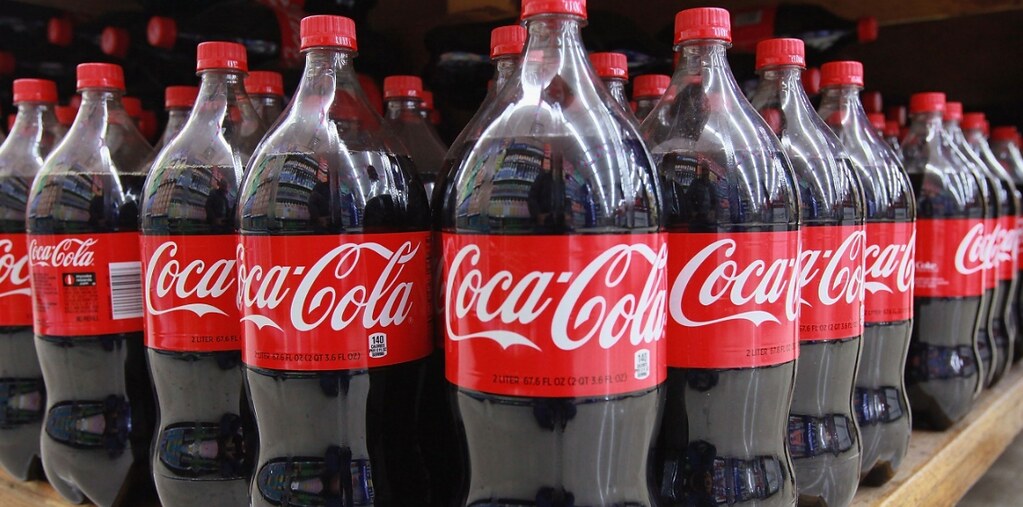
Coca Cola Tries To Shape Nutritional Value Within The CDC?


Source: WV Record


U.S. citizens hope that the government will keep the country safe and healthy at the very least.  How is that accomplished?  Through the work of an entire government workforce at all of the various federal agencies around the nation.  Agencies such as the U.S. Food and Drug Administration (FDA), Centers for Disease Control and Prevention (CDC), Environmental Protection Agency (EPA), Department of Human and Health Services (HHS), National Science Foundation (NSF), and the National Institutes of Health (NIH) -- to name a few.  That is why when you read the title of the blog post above, you have to step back and ask yourself: Did I read that title correctly?  Did Coca Cola really influence (corruption) the CDC to shape the nutritional value of their products?


Yes, you have read the title correct as I did a couple of weeks ago in a summary sent via email by Politico Agriculture as follows:


STUDY: COCA-COLA AIMED TO INFLUENCE CDC ON OBESITY: A report in a peer-reviewed health journal highlights emails and other efforts in which Coca-Cola tried to influence public health officials on policies.
The study was based on email correspondence between Coca-Cola and the CDC, obtained through FOIA requests, documenting efforts by the company to gain access to agency staff, build relationships and shape policy on nutrition and artificial sweeteners, our Jesse Chase-Lubitz reports.
Highlights: The report includes details about lobbying the World Health Organization; meetings between company and agency officials to discuss research on low-calorie beverages; and a CDC official recommending a colleague for a job at Coca-Cola.
— The company said it has been transparent about its actions and that the emails "pre-date a commitment we made in 2015 to disclose our funding for well-being scientific research and partnerships publicly on our website."
— CDC said it has "extensive ethical and scientific-integrity checkpoints internally and externally" to balance its recommendations.


The news comes as a surprise to most people.  Even though we (as consumers) would like to think that the government has our back in terms of nutrition (healthy products), there typically is a large amount of negotiation involved in marketing, approval, and relations in any consumer market.  The full report can be accessed here -- which includes hundreds of pages of e-mails detailing negotiations between the Centers for Disease Prevention and Control and the Coca Cola Corporation.


Let me pause and just say a little more about the negotiation process between the government and corporations about bringing products to the marketplace.  Another example can be taken from the pharmaceutical industry.  As I note in a post with an embedded video explaining that after a pharmaceutical industry decides to take the therapeutic target discovered at a university and develop a drug to hit that target (i.e. a medicine), there are significant number of hurdles.


One of which is negotiating the process of completing all of the paperwork required by the FDA.  Which includes clinical trial information along with other tests required by the FDA to ensure compliance on behalf of the corporation that the drug is ready to be released to the marketplace.  This process involves a tremendous amount of communication back and forth between the FDA and the pharmaceutical corporations.  The process under scrutiny can include a fine line under which these negotiations result in the approval of a medicine to the marketplace.  Sometimes, the questionable negotiation will result in a medication's recall from the marketplace.


A second example is concerned with the big tobacco companies withholding scientific evidence which proved that nicotine is in fact -- addictive.  Yes, nicotine is addictive.  Dr. Jeffrey Wigand was a vice president of research and development at a large tobacco company.  He observed obvious fraud to hide the fact that nicotine was indeed addictive and that the companies had prior knowledge of this while taking advantage of the data.  Dr. Wigand eventually became the largest whistleblower in history which resulted in the enormous tobacco lawsuit (the largest in history) in 1998.  Corruption is always lingering around the corner.  The issue of scientific evidence and addiction of nicotine is still a point of contention -- check out the article.


Congress Gets Involved?


After the report was made available to the public, eventually Congress got a hold of it and decided to take action by sending a letter to the Inspector General which is shown below:


Dear Inspector General Levinson: 
We are writing to request investigatory action following the release of a report in The Milbank Quarterly detailing communications between the Centers for Disease Control and Prevention (CDC) and representatives from Coca-Cola. 
The report, "Public Meets Private: Conversations Between Coca-Cola and the CDC," published an analysis of 295 pages of emails dated between 2011 and 2015, obtained through Freedom of Information Act requests.  The emails show a troubling pattern of the company using access to high-level CDC officials to shape debates over public health policy directly involving the nutritional value of its products. 
In one example, Coca-Cola used self-funded epidemiological studies on low and no calorie beverages to argue to CDC staff that "associations between diet beverages and weight...is likely the result of reverse causality."  It is deeply concerning to see CDC engage with data coming from the company on a question so fundamental to its bottom line -- especially when data show that outcomes from industry-sponsored research differ significantly from independent studies. 
In another exchange, a Coca-Cola executive requested and received advice from a CDC official on how to best approach the World Health Organization director-general perceived as a "threat to our business" for naming soft drink manufacturers as contributors to global obesity. 
Though we recognize the role of public-private partnerships in advancing the agency's broad public health goals, this report demonstrates Coca-Cola's conflicts of interest in engaging with CDC staff on nutrition policy.  CDC's Guiding Principles for Public-Private Partnerships advices staff to avoid partnerships with a representative of "any product that exacerbates morbidity or mortality when used as directed."  Given that decades of peer-reviewed research has established links between soft drink consumption and negative health outcomes like obesity, heart disease, and type 2 diabetes, it is clear that the Coca-Cola's influence is inappropriate and must be probed further. 
The CDC has an essential mission.  Its pursuit of evidence-based public health policy is fundamental to the safety and well-being of all Americans.  As we face an unprecedented obesity epidemic, we must ensure that the public can trust the agency to promote quality and objective data -- particularly when it conflicts with powerful industry interests. 
Therefore, in your capacity as Inspector General, we ask that you investigate the relationship between the CDC and Coca-Cola outlined in this report, determine whether there is a broader pattern of inappropriate industry influence at the agency, and make recommendations to address this issue. 
We appreciate your prompt attention to this matter.  If you have any questions, please do not hesitate to contact our staff.

Sincerely,

Chellie Pingree
Member of Congress
Rosa L Delauro
Member of Congress


Letters such as the one shown above should instill a sense of honesty and sincerity from members of Congress.  Many people in the United States of America do not realize that members of Congress get involved in such inquiries which is sad to say the least.  Congress is charged with an enormous amount of duties which span a wide range from setting 'boxing regulations' to 'quantum computation' which greatly impact the U.S.A. -- in different ways.


Keeping the corporations which hold an enormous amount of influence in check is extremely important.  At the same time, negotiations between corporations and federal agencies are extremely important in setting rules for any free market economy.  Although, such a blatant transaction on behalf of Coca-Cola in trying to promote self-funded research (especially when the benefit is obvious) is extremely illegal and needs to be dealt with from a legal standpoint.


One major problem with communications between organizations (corporations) and federal agencies is the amount of information which is given to the federal agencies to support claims of consumer safety.  As you can see, if a federal agency were to accept research which was funded by the corporation as evidence-based decision making policy, corruption would be without question and consumer confidence in federal agency would be diminished.  The public is already very skeptical of such transactions prior to knowledge of this one.  The current revelation only solidifies the public's fears already -- which is sad.  Although, the action on behalf of the public by Congress is a breath of fresh air.


Related Blog Posts:


FDA Director Scott Gottlieb Addresses Public On Eliminating E-Cigarette Use Among Youths


Congress Gets Involved In Beef Recall


Senator Carper Blasts Environmental Protection Agency For Considering Relaxing 'Mercury and Air Toxics Standard'?


How Effective Are Poultry Corporations At Reducing Salmonella In Their Products?


https://jmkthought.blogspot.com/2018/11/how-effective-are-poultry-corporations.html


One Unknown Fact Which Should Cause Consumers To Be Careful About Handling Meat Before Cooking!


NIDA Director Nora Volkow: How Health Communicators and Journalists Can Help Replace Stigma with Science


Should you consider science while before voting next Tuesday?


Thursday, February 14, 2019

Parameters: What Research/Science Is Affected During A Government Shutdown?


Later today -- members of Congress will be voting on a bill to avoid another government shutdown.  I am sure that each of you are pretty tired of hearing about a government shutdown.  Making pawns out of federal workers is growing old and needs to be mitigated by Congress.  What are the fall outs aside from the obvious -- 0.11% of the U.S. population out of work?  Some people try very hard to downplay the hostage crisis with government workers held in between.  What the majority of the U.S. population does not realize is that the total effects of an extended government shutdown are very serious.  Let me show you a couple of angles to view the present situation which are quite different than what is normally considered by the average person.


Government Shutdown Affects Science?


The other day I was reading the latest issue of the trade journal 'Chemical & Engineering News' which contained a guest editorial titled "A Case For Compromise" by Dr. Willie E. May.  Among other disparate and dangerous aspects of a government shutdown, he made the case for three separate areas of science which were greatly devastated (and potentially have long term damage) by the shutdown:


(1) The morale of the finest scientific workforce on this planet. Government scientists are working on critically important problems, including cures for diseases, the safety of our food supply, cybersecurity, and next-generation quantum computers. The current lapse in funding has cut scientists off from their labs and the work that they have devoted their lives to, which could cause many of our best and brightest to move on to different positions. That would be a severe loss for our country.
(2) Research in the world’s best collection of universities. A marked reduction in grant processing and funding drawdowns at agencies such as the National Science Foundation have stalled progress in all scientific fields.
(3) Critical NASA space missions. Delays in work at NASA affect our knowledge of other planets, the stars, and beyond.
(4) US industrial productivity and innovation. For example, work has been brought to a halt at my former agency, NIST, including the world-renowned labs where ­cutting-edge research has yielded five Nobel Prizes and many other awards. In addition to lacking the results of NIST’s intramural research, US industry does not have access to NIST’s calibration services for precision instruments, 1,200 cataloged standard reference materials, reference data sets that get more than 225,000 downloads per year, and unique user facilities that are in demand 24 hours a day, 365 days a year.


Dr. Willie May is the former Director of the National Institute for Standards and Technology along with the former UnderSecretary of Commerce for Standards and Technology.  He is currently the vice president of Research at the Morgan State University.  The above excerpt outlines concisely the negative impact a government shutdown would have on science research and technology.  The negative reach could be catastrophic.  Why?


Imagine if a pharmaceutical company was in the midst of gathering a round of funding to move a drug forward to evaluation by the Food and Drug Administration.  Part of that funding might come from the National Institutes of Health (through a specific grant).  I wrote about this process briefly in a previous post about government funding pharma drug development (see videos in post).  What negative impact could happen if the government shutdown occurred and tied up potential funding for the company used in the example?  Quite possibly, the remaining funding from venture capitalist might fall through and disappear.


The timeline on funding is variable when the government is working normally.  Insert a government shutdown to put a freeze on all operations and now all other components of that funding could be impacted which could result in research projects being canceled or put on hold.  That could hold up progress in developing downstream technology in certain cases.  Which is why in the statement above by Dr. Willie May -- the impact on U.S. innovation and technology is right spot on the money.


What About Agriculture?


Above, the negative impact on technology and research was briefly discussed.  What about the agriculture sector?  In a previous post, I alluded to the negative impact a government shutdown might have on federal agencies.  This week, a brief in Politico Agriculture highlights the potential negative impact on the agriculture sector a government shutdown could have:


Another prolonged shutdown would be especially painful for agriculture, and it's unclear if USDA could take steps to mitigate some of the headaches that accompanied the previous closures. If agencies' work on commodity data publications (including a large backlog from December and January) is frozen, it could leave crop farmers in the dark once again as they make planting decisions for the year.


The last sentence tells all -- in that the government shutdown which occurred over Christmas and into the New Year has already had a negative impact on farmer's ability to plan for the upcoming season.  And yes, that is tied into the crops which produce the food which is sold in the store.  Your grocery store, the food which potentially sits on your shelves and in your refrigerator.  Do I have your attention now?


Government workers need to work.  It's more obvious than that.  We (the American people) need government workers to work and for the government agencies to work on a day to day basis.  I did not even get a chance to discuss the potential negative impacts on agencies like NASA - with hundreds of millions (if not billions) of research equipment floating in the skies above us which rely on personnel here on Earth to run, collect, and process data.  Not to mention, the scientists needed to process and transmit that data back into policy or new technology to serve the U.S. population.  Again, government workers need to work.


Related Blog Posts:


What does a Government Shutdown look like?


What is the difference between General Anxiety Disorder and Trump Anxiety Disorder?


Dimensional Analysis Of Statistics And Large Numbers - Index Of Blog Posts


Science Topics, Thoughts, and Parameters Regarding Science, Politics, And The Environment!


Sunday, January 27, 2019

How Large Is The Neural Circuitry In The Human Brain Compared To City Blocks In Los Angeles?


Source: First Post


Your brain is composed of 1.6 billion neural connections.  That much is known.  What is not known is such simple questions like -- how does our brain go on 'autopilot' while maintaining a fixed position?  Have you ever caught yourself day dreaming at your desk while supposedly you were working?  Scientists are trying to untangle that phenomenon.  Although, that entails analyzing an enormous amount of neural connections at once as described in an article found in 'Nautilus' titled "Brain on Autopilot: How the architecture of the brain shapes its functioning":


The structure of the human brain is complex, reminiscent of a circuit diagram with countless connections. But what role does this architecture play in the functioning of the brain? To answer this question, researchers at the Max Planck Institute for Human Development in Berlin, in cooperation with colleagues at the Free University of Berlin and University Hospital Freiburg, have for the first time analyzed 1.6 billion connections within the brain simultaneously. They found the highest agreement between structure and information flow in the “default mode network,” which is responsible for inward-focused thinking such as daydreaming.


The neural connections make up different networks.  Roughly 20 different networks exist.  At any given time during consciousness, one can be operating at once.  To wrap my head around the different neural networks which are composed of roughly 1.6 billion neural connections, I decided to compare the 'neural connections' to city blocks.  City blocks are arranged to compose different cities.  Specifically, I wondered how large the city would be if made up of the equivalent 'connections' to our neural circuitry described in the paper above.  The answer to my question is shown below in a brief analysis.


City blocks?


How does one begin to scale up neural connections to city blocks?  First a city is needed to compare neural connections too.  Since I live in North Los Angeles, I chose Los Angeles city -- Downtown.  Shown below is a picture of a section of Downtown Los Angeles -- right in the heart of L.A.:


Source: Google Maps


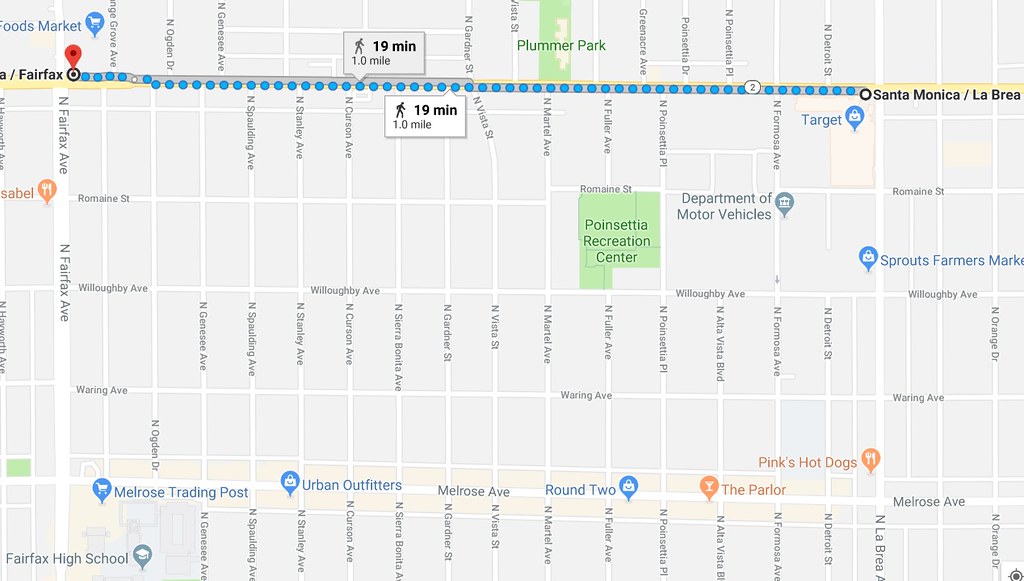
As you can see the area chosen has a number of city blocks within the square marked by the following streets: Melrose Blvd., Santa Monica Blvd., North Fairfax Blvd, and North La Brea Blvd.  To determine the distance around the perimeter of the square, two measurements were made.  The first is shown below of one leg of the rectangle along Santa Monica Blvd.


Source: Google Maps


The distance across is equal to 1.0 mile.  Next, the distance along with width of the rectangle is shown with a measurement marked below:


Source: Google Maps


The distance of the width of the rectangle along North La Brea Blvd is equal to 0.5 mile.  To determine the area of a rectangle, the length (equal to 1.0 mile) is multiplied by the width (equal to 0.5 mile) as shown below:


The result of the calculation indicated that the total area of the rectangle covered by the four streets in Downtown Los Angeles is equal to 0.5 square miles.  Next, I needed to determine the number of city blocks within the rectangle.  If count them by hand, the number is approximately equal to 64 city blocks in a 0.5 square mile area as shown below:


Next, the number of nodes (or neural connections) needed to be determined.  On each city block, there are potentially a maximum of 4 nodes.  Although two city blocks next to each other would share two nodes (i.e. neural connections).  From the Google Maps image, I counted a total of 79 nodes located within a 0.5 square mile section of Los Angeles as shown below:


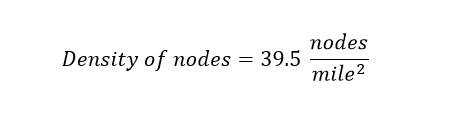
If the number of nodes is divided by the square mile listed above, the density of nodes within a square mile will be determined as shown below:


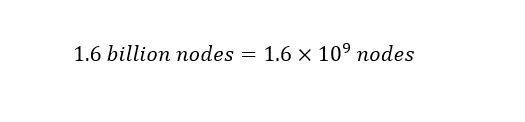
The density of nodes (or density of neural connections) is a 'conversion factor'.  This 'conversion factor' allows the scaling up of neural connections to the equivalent city blocks.  Remember, according to the article from 'Nautilus,' the total number of neural connections is equal to 1.6 billion neural connections (or nodes) as represented below:


To use the number 1.6 billion in a calculation, the conversion of the written number to the number expressed in scientific notation is needed as shown below:


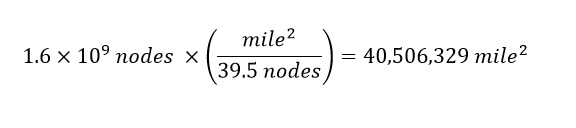
The number of decimal places is shown at the end of the number.  A number shown in scientific notation also indicates the significant figures in the number.  Next, to determine the total square area (in miles) of the neural connections (as scaled up from the article), the number of nodes is multiplied by the conversion factor as shown below:


Wow.  The calculation revealed that scaling up the total number of neural connections from the article to compare toward city blocks gives a total of 40.5 million square miles.  How much land is that equivalent in relation to the land available on Earth?  To begin with, how about checking to see, how many land mass area equivalent to the United States would be required to equal 40.5 million square miles.  Below is the analysis.


How Many United States?


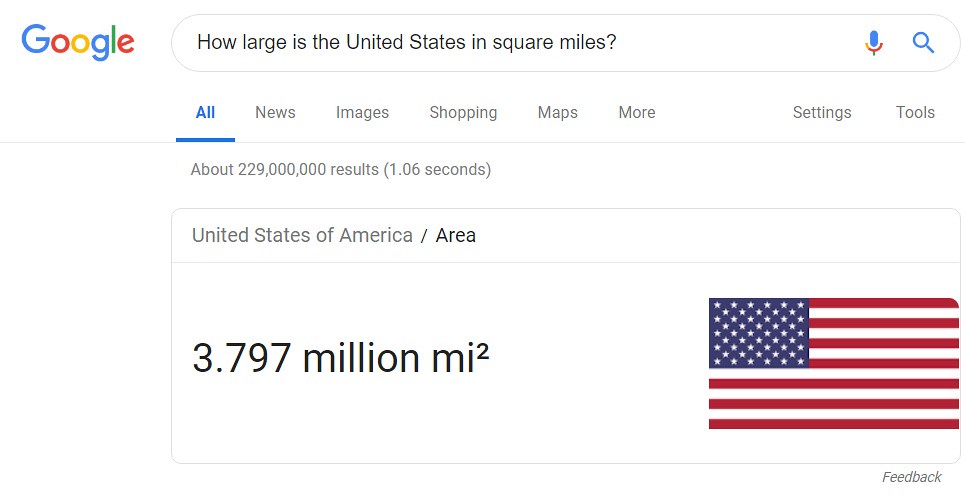
If we use the United States as a 'metric' - the total land mass in square miles needs to be determined.  Asking Google with the following question: How large is the United States in square miles?  The answer is shown below:


If the total square miles which are equivalent to the total number of neural connections scaled up are divided by the total land mass of the entire United States (3.797 million square miles), then the answer would indicate the amount equivalent as shown below:


For those readers who are experiencing difficulty visualizing 10.7 landmasses (equivalent in size to the United States of America) pieced together, another metric to cast the large area into are the continents across the Earth.  According to an article from 'Thought.Co.' titled "The 7 Continents Ranked by Size and Population," the top 7 continents are listed below with their respective land mass in square miles:


1) Asia: 17,139,445 Square Miles

2) Africa: 11,677,239 Square Miles

3) North America: 9,361,791 Square Miles

4) South America: 6,880,706 Square Miles

5) Antarctica: About 5,500,000 Square Miles

6) Europe: 3,997,929 Square Miles

7) Australia: 2,967,909 Square Miles


Looking at the land mass area of the top 7 continents on Earth, choose a combination that approximates the total square miles of the result above = 40.5 million square miles.  The first combination I chose were the following: Asia + Africa + South America + Antarctica  = 41.2 million square miles.  Try for yourself.  Add up and combination to equal 40.5 million square miles.  Leave your combination in the comments section below.


Analyses such as those above shed light on the magnitude of numbers (in this case neural connections) reported in the news.  That is a large area which represents the enormous amount of neural machinery which each of us holds inside our heads.  Wow.  What a trip?  Right to think of scientists analyzing such a vast array of neural connections to understand how the human brain sends us into 'autopilot' or other brain functional states.  The human brain is once again shown to be quite amazing from a simple calculation/analysis.


Related Blog Posts:


How Many Women Are Needed To Form A Chain 400 miles Long?


Parameters: How Much Ice Is Melting In The Antarctic? Enough To Cover Texas?


How many cows are needed to generate 50,000 tons of beef exports?


How many Soy Latte coffee drinks can be made with 135,000 tons of Soybeans?