Showing posts with label Dimensional Analysis. Show all posts

Thursday, February 28, 2019

Hurricane Maria Destroys Puerto Rico's Science Programs Then Presents Unusual Research Opportunities?



The devastation caused by Hurricane Maria is still being revealed nearly a year and a half after the storm ripped through the island.  Of course, anyone who has lived through a disaster like this will tell you that the island will probably never recover.  Not to mention that the loss of life can never be replaced.  With that being said, any community (or island) must find the courage to recover and re-establish life as it were if possible.  


Under normal conditions, agencies such as FEMA (Federal Emergency Management Agency) would provide sufficient funds to help the island start the journey toward recovery.  Unfortunately, we do not live in normal conditions at the current moment under the current administration.  Funding agencies are being stressed beyond reach for existing funds and when this occurs, areas like scientific research usually suffer the most. 


How Did Maria Impact Science?



At the very least, the lightest impact (which actually may not be true due to PTSD), the lab members may undergo treatment to make sure that there are no residual medical issues after a storm has hit the island.  Of course, if you have no laboratory staff: graduate students, undergraduate students, postdoc's, professional researchers -- then you have no lab.  Meaning, all the best equipment can occupy the lab, but without scientists to run and monitor the instruments, then there is no lab.


The second critical component of any scientific laboratory are the scientific instruments and infrastructure in which these along with the supplies (beakers, tubing, cell cultures, glove boxes, etc.) needed to conduct good/sound science.  This is sometimes the perceived most critical component of any scientific laboratory.  Although, I would argue that the scientists which occupy any laboratory are the most critical components to any scientific instruments.  I have yet to see any scientific instrument just start collecting data by itself without any scientist's intervention/initiation.


A recent article in 'The Scientist' titled "Science in Puerto Rico Still Recovering After Hurricane Maria" details some of the disastrous consequences to a scientific laboratory after a storm of a magnitude such as Hurricane Maria.  The human damage alone can be irreplaceable not to mention the buildings and local municipal utility grid.  And when the destruction to the infrastructure is considered, parameters such as mold and water damage can set a laboratory recovery back several months to years:


Giray’s lab is among 14 or so in the Julio Garcia Diaz biology building, which was among those severely damaged, particularly as it was already undergoing roof repairs when the storm hit. Water seeped in through the roof and windows, damaging costly research equipment, furniture, and lab materials. Toxic mold thrived in the moist, hot climate, creating hazardous conditions that made the building uninhabitable. Power outages cut off researchers’ freezers and fridges, destroying precious genetic and tissue samples for good. The damages are estimated to range from $250,000 up to $2.5 million dollars per lab in that building, says Giray, a behavioral biologist whose main focus is honeybees.


Even more important are samples which are collected outside of the laboratory or purchased for several thousand dollars which are sensitive to temperature/humidity/vibrational fluctuations:


Some of the casualties from the hurricane are less easy to restore: “Collections take much longer time and may never be replaced,” says Giray’s colleague Riccardo Papa, who lost almost all of his DNA samples documenting the diversity of butterflies across South America when his lab’s –80 °C freezer lost electricity. Papa, an evolutionary biologist, didn’t have a lab again until a week ago, and until recently has been meeting with his students and postdocs at coffee shops or places around campus to discuss research. He has been able to do some experiments and genetic analyses in another building. Repairs are still underway for the damaged insectary, in which his team raises butterflies.


Research must go on.  With or without the infrastructure.  Here in California, after the Northridge Earthquake in 1994, FEMA set up temporary 'mobile homes' to serve as both classrooms and temporary offices along with laboratories in certain circumstances.  To hear that 'group meetings' were still being held at coffee shops is a testament to the pace of recovery.  In a majority of cases after a disaster, classroom recovery comes first, then eventually research laboratories.  Although, it is worth remembering that each research laboratory group is made up of students and research professors who take years (applying for individual grants/writing publications) to acquire the appropriate funding to purchase research scientific instrumentation.  Therefore, to put a price on the total loss in the event of a disaster like Hurricane Maria proves extremely difficult.


The total cost to a researcher is really unknowable for years to come.  Some researchers never recover and decide to shut down their laboratories after such a storm.  Which leaves current graduate students without an end in sight to their degrees (M.A. and PhD).  Additionally, staff (professional researchers) might quickly find themselves out of work and have to leave regions like Puerto Rico and find work elsewhere.  Which means transplanting their families and children's education to a different geographical location.  The cost can be severe not just to the researcher themselves.


More can be written in future articles on this theme of disasters and research laboratories.  Either together or separately.  The total cost to a geographical location from a disaster such as Hurricane Maria can only be estimated at the beginning (a very rough approximation).  The price tag evolves over time with the disbursement of emergency funds by organizations such as FEMA along with other federal organizations or the Congress.  The terrible destruction to a scientific institution is terrible to say the least.  Restoring science should be a high priority among others on the island of Puerto Rico.


Sunday, December 23, 2018

Happy Holidays!!.....Here are some fun facts to share with family about the holidays


With the holidays rapidly approaching, last minute shopping is all around us.  Hysteria at the malls with frantic shoppers trying to wrap up their gift giving expedition.  On top of that weight are the decorations needed for the season.  By now, neighborhoods around the nation are adorned with Christmas lights while Christmas trees are on full display through front windows of houses all around us.  For this year, a couple of fun facts are in order to spread the Christmas cheer.  The two categories will be: Christmas trees and Christmas lights.


How many Christmas Trees are purchased?


Each Christmas season, trees can be spotted on the top of cars as they are transported from the farm to the house to be decorated.  I always have wondered about the number of trees on average which are sold during Christmas.  Therefore, I decided to search Google with the following question: How many Christmas Trees are sold each year?   The answer is shown below:


Source: Google


According to the National Christmas Tree Association, there are between 25 and 30 million Christmas trees sold each year in the United States.  What was fascinating is the total number of Christmas trees grown in the U.S. each year are 350 million.  The information highlighted in the box above comes from the National Christmas Tree Association's website which has a few more fun facts about Christmas trees shown below:


There are approximately 25-30 million Real Christmas Trees sold in the U.S. every year.
There are close to 350 million Real Christmas Trees currently growing on Christmas Tree farms in the U.S. alone, all planted by farmers.
North American Real Christmas Trees are grown in all 50 states and Canada. Eighty percent (80%) of artificial trees worldwide are manufactured in China, according to the U.S. Commerce Department.
Real Trees are a renewable, recyclable resource. Artificial trees contain non-biodegradable plastics and possible metal toxins such as lead.
There are more than 4,000 local Christmas Tree recycling programs throughout the United States.
For every Real Christmas Tree harvested, 1 to 3 seedlings are planted the following spring.
There are about 350,000 acres in production for growing Christmas Trees in the U.S.; much of it preserving green space.
There are close to 15,000 farms growing Christmas Trees in the U.S., and over 100,000 people are employed full or part-time in the industry.
It can take as many as 15 years to grow a tree of typical height (6 - 7 feet) or as little as 4 years, but the average growing time is 7 years.
The top Christmas Tree producing states are Oregon, North Carolina, Michigan, Pennsylvania, Wisconsin and Washington.


I immediately wondered why there was such a large difference between the amount of Christmas trees planted each year and those that are sold.  Sounds like there are only 1 in 10 trees which actually make the cut to be sold in order to end up in a living room for display with decorations and lights.  The industry requires a significant workforce to support the retail which comes along with the Christmas celebration.  Just take the amount of trees grown to be sold are staggering by itself.


To understand the magnitude of the number of trees which are planted along with the amount that are sold, let's imagine that each tree is stacked on top of one another.  How high would that stack of trees reach? The analysis below will show the answer to that question.  In order to start, an assumption regarding the average height of a Christmas tree needs to be introduced.  For the purpose of this analysis, the assumption will be made that the average height of a Christmas tree is 6 feet tall.


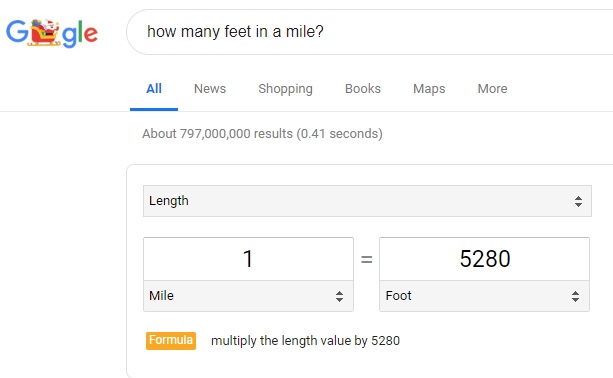
First, the amount of trees which are sold annually in the United States is large.  Therefore, choosing a 'unit' of measurement which will appropriately shed light on the magnitude of the values is essential.  A common unit of measurement for large distances on Earth is the 'mile'.  If Google is consulted with the following question: 'How many feet are in a mile?'  The answer is shown below:


Source: Google


There are 5,280 feet in every mile.  To begin analyzing the values, let's look at the numbers which we are interested in.  Each year, there are between 25 million and 30 million Christmas trees sold in the United States.  That is out of a total of 350 million Christmas trees growing across 15,000 farms.


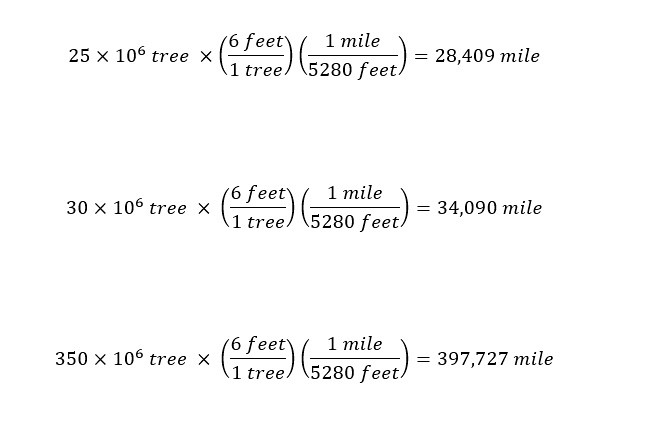
First, each of the amount of trees sold (and grown) in the United States must be converted to units of miles -- using the assumption that each tree is on average 6 feet tall.  The unit conversion is shown below:


The results above indicate that the range 25-30 million trees sold equal to the distance of 28,409-34,090 miles.  Additionally, the total number of Christmas trees grown annually would equal a total distance of 397,727 miles.  In order to understand the magnitude of these distances, a metric is needed to compare the distances with.  What if we took the total distance of stacked Christmas trees and wrapped the line around a sphere (the Earth)?  How many times could the line of trees circle around the Earth?


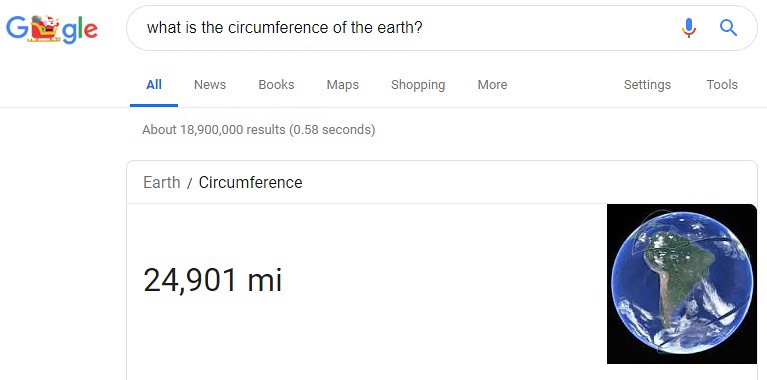
We need to determine the total distance around the Earth.  If we consult Google with the following question: What is the circumference of Earth?  The answer is shown below:


Source: Google


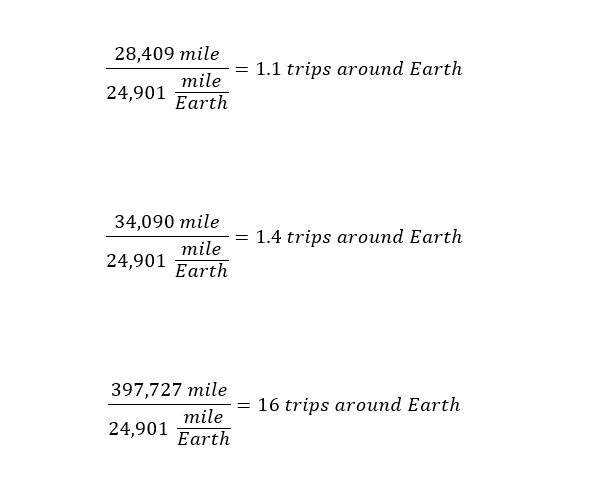
One trip around Earth (at the center) is equal to traveling a total distance of 24,901 miles.  The three distances of Christmas trees can be divided by the circumference of the Earth -- 24,901 miles as shown below:


The answers indicate that the amount of Christmas trees sold in the United States each year would stack up to a range of 28-34 thousand miles -- which would equal just over 1.4 trips around the Earth.  Additionally, the total number of Christmas trees grown in the United States would stack up to a distance equal to 16 trips around the Earth.  These numbers really drive home the magnitude of the amount of Christmas trees needed for the Christmas holiday.  Here is a great idea for recycling parts of the Christmas tree -- click here.


How about Christmas light?


In the next section, an analysis will be carried out to highlight the total number of Christmas lights which are purchased each year in the United States.


How about Christmas Light?


On top of all of the Christmas trees which are sold annually and would wrap around the circumference of Earth are Christmas lights -- at the very least to provide the minimum amount of decoration.  In order to wrap a few strands of Christmas lights around a given tree, either one must store Christmas lights in the garage or choose to purchase new strands.  There is nothing wrong with purchasing new lights in a given year.  Especially when the old lights break or strands of bare exposed wire show -- which could easily cause danger when voltage is applied to them (i.e. plugged into the wall socket).  How many strands are sold in the United States each year?


If a Google search is conducted with the question above, the following answer appears below:


Source: Google


According to our search, there are 150 million strands of Christmas lights sold each year in the United States.  If the same analysis from above is used, the first step will be to convert the strands of lights into a distance.  For this, an online store needs to be consulted to find out the distance sold.  The Christmas lights (clear, no color) sold at Target are shown below:


Source: Target


The length of the Christmas lights in the picture above (100 count) is 24.7 feet.  If the total number of strands of Christmas lights is multiplied by the length (in feet) of a single strand, the total distance would be yielded:


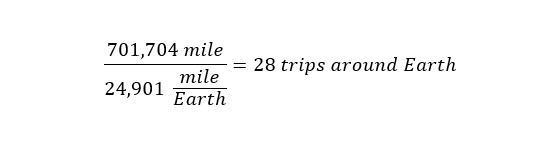
The answer indicates that the total number of strands of Christmas lights would add up to a total distance of 701,704 miles in length.    Last, if the total distance of Christmas lights sold is divided by the circumference of the Earth, the total number of trips around Earth will be yielded as shown below:


The total amount of Christmas lights sold in the United States each year would equal traveling around the Earth 28 times.  Wow!  That is an enormous amount of Christmas light sold each year.  The enormous number made me question the total amount of Christmas lights which are sitting in boxes in closets, attics, and garages in American houses across the country.  Additionally, a certain percentage of this enormous amount of purchased Christmas lights must be recycled.


If the Wikipedia page for Christmas Lights is consulted regarding the recycling of Christmas lights, the following information can be found:


Christmas lighting does lead to some extensive recycling issues. Every year, more than 20 million pounds of discarded holiday lights are shipped to Shijiao, China (near Guangzhou), which has been referred to as "the world capital for recycling Christmas lights".[28] The region began importing discarded lights around 1990 in part because of its cheap labor and low environmental standards.[28] As late as 2009, many factories would simply burn the lights to melt the plastic and retrieve the copper wire, releasing toxic fumes into the local environment.[28] A safer technique was then developed that involved chopping the lights into a fine sand-like consistency, mixing it with water and vibrating the slurry on a table causing the different elements to separate out, similar to the process of panning for gold.[28] Everything is recycled: copper, brass, plastic and glass.
More and more cities in the U.S., for example, are setting up sensible alternatives and schemes to recycle Christmas lights, with towns organizing drop-off points for handing in old or discarded lights.[29][30]
Installing holiday lighting may also be a safety hazard when incorrectly connecting several strands of lights, repeatedly using the same extension cords, or using an unsafe ladder during the installation process.


The total amount of Christmas lights (in weight) which are shipped to China each year is around 20 million pounds.   I wonder how much material (copper, brass, plastic, and glass) -- percentages of each are recovered.  And used for what?  The process of recycling is interesting and worth reading about for further information.


Conclusion...


The Christmas holiday is a time of celebration.  At the same time, the holiday is an opportunity for families to gather together and catch up on life.  The fun facts calculated and gathered surrounding the Christmas holiday are perfect to add into a trivia game or dinner conversation.  The analysis above showed that the enormous amount of Christmas trees would add up (stack up to) to enough miles to equal 1.4 times traveling around the Earth.  Further, the total number of Christmas trees planted on farms would equal a distance equivalent to traveling around the Earth 16 times.  That is amazing to say the least.  That is a large amount of wood to recycle or burn.


And what about the Christmas lights which are sold each year in the United States?  The total distance of all of the strands of lights sold in the United States each year would be equivalent to traveling around the Earth 28 times.  My goodness that is quite a large amount of Christmas lights sold each year.  Imagine the total amount of Christmas lights which are sitting in boxes in closets, attics, and garages around the United States.  To add to that, 701,704 miles are purchased each year.  Christmas time is a very popular holiday of the year.  Have a great holiday celebration!!


Related Blog Posts:


Parameters: How Much Ice Is Melting In The Antarctic? Enough To Cover Texas?


Parameters: How many sticks of butter are contained in 7.5 million pounds of butter?


South Carolina Governor Henry McMaster asks lawmakers for $1,228,000,000 For Recovery from Hurricane Florence?


Boston Natural Gas Explosion Reveals Old Piping Needs Replacement - Enough To Travel To Colorado?


A Forecaster Predicts That Hurricane Florence Will Drop Enough Rain To Fill 18,400 Mercedes-Benz Superdomes

Hurricane Harvey Drops Enough Rain On Houston To Fill 560 Dallas Cowboy Stadiums


How Much Water Is Contained In All Oceans Around The Globe?


Storm Raises Water Level In Lake Cachuma By 31 feet, How Much Water Is That?


How To Make Sense Of Water Flowing At 100,000 Cubic Feet Per Second


Can 11 Trillion Gallons Of Water Fill 14,000 Dallas Cowboys Stadiums?


How Much Rain Did The East Coast Receive From Hurricane Matthew?


How Much Rain Did Haiti Really Receive?


How Much Rainfall Has Dropped On Louisiana?


How Big Was The "Water Bomb" Of Rainfall In Macedonia?


How Much Rain Did Huauchinango (Mexico) receive?


How Much Rain Did Elliot City (Maryland) Really Receive?


If The Mosul Dam Breaks, The City Of Mosul Would Be Under 65 Feet Of Water?


What is the volume of water in a few inches of rain?


Volume of Waste in the Mine Spill (in Brazil) Equivalent to 78 Deepwater Horizon Oil Spills


Wednesday, September 26, 2018

Was Enough Coal Ash Spilled Into A Local Lake To Fill Up 2/3 Of An Olympic Sized Swimming Pool?


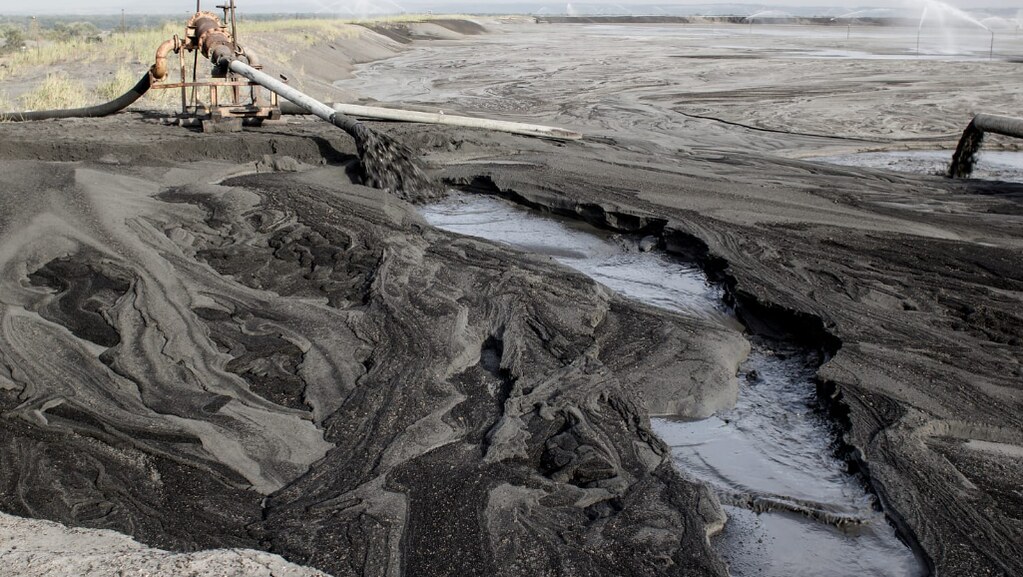
Hurricane Florence has no doubt had a devastating and long lasting impacts on the East Coast which will unveil themselves over time.  Already at the outset, a forecaster predicted that nearly 17 trillion gallons of rain would fall over four states - which has partially come true.  The damage has caused lawmakers to call or write elected politicians in Washington D.C. for around $1.2 billion - just for South Carolina alone.  Unknown to most, is that additionally, other potentially dangerous spills have occurred which have not made the popular news cycle.  As noted in an e-mail from Politico Energy, a coal ash pit broke and spilled a fair amount of toxic solution into a lake as stated below:


Coal ash collapse: Duke Energy said Saturday that heavy rains from Florence had caused the collapse of a slope in the coal ash landfill at a closed plant outside Wilmington. About 2,000 cubic yards of the toxic waste was displaced, the company said in a statement — roughly enough to fill two-thirds of an Olympic-sized swimming pool — although it could not say how much reached a lake that the plant used as a cooling pond or if any coal ash reached the Cape Fear River. Environmental groups that have been fighting in court to force the cleanup of coal ash pits pointed out that the lake is used for recreation and fishing. "After this storm, we hope that Duke Energy will commit itself to removing its ash from all its unlined waterfront pits and, if it refuses, that the state of North Carolina will require it to remove the ash from these unlined pits," Frank Holleman with the Southern Environmental Law Center said in a statement.


In the blog post below, we will verify the statement: "About 2,000 cubic yards of the toxic waste was displaced, the company said in a statement -- roughly enough to fill two-thirds of an Olympic-sized swimming pool..."  Additionally, another potential disaster -- a coal ash spill will be analyzed at the very end of the blog post from South Carolina.


What Is The Volume Of An Olympic-sized Swimming Pool?


In a recent blog post regarding the amount of oil flowing through a pipeline in Canada, the Olympic-sized swimming pool was used as a metric -- i.e. a volume which to compare other large volumes too.  A typical Olympic-sized swimming pool is shown in the picture below:


The volume of an Olympic-sized swimming pool is 660,430 gallons as noted in the previous blog cited above.  With the metric -- i.e. Olympic-sized swimming pool -- defined in terms of volume, we can proceed to verify the statement above -- to prove that the amount of coal ash spilled would fill nearly 2/3 of an Olympic-sized pool.  Let's get on with the analysis...


In order to compare the amount of coal ash which spilled to the volume of an Olympic-sized swimming pool, both values (statistic and metric) need to be defined in uniform (the same) units of measurement.  The author states the volume of coal ash in units of 'cubic yards' whereas the volume of an Olympic-sized swimming pool was cited above in units of 'gallons'.  Therefore, to proceed forward, a unit conversion is necessary: change units from 'cubic yards' to 'gallons'.


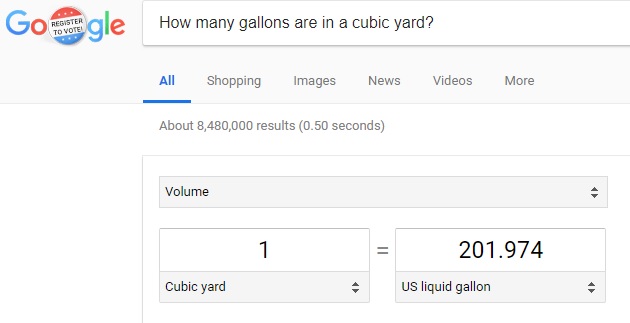
To determine the unit conversion factor from units of 'cubic yards' to 'gallons', first we consult Google with the following question: How many gallons are in a cubic yard?   The answer is shown below:


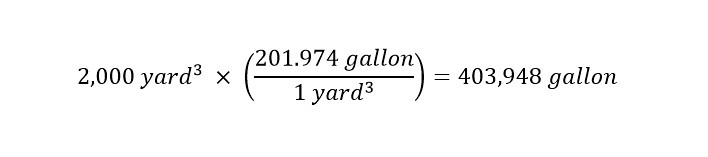
The answer indicates that there are 201.974 gallons in a single cubic yard.  With this unit conversion factor in hand, the conversion from 'cubic yards' to 'gallons' is accomplished below:


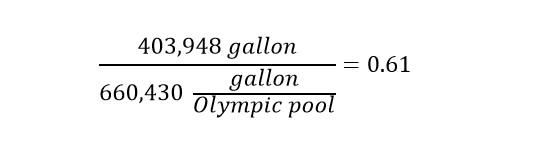
Now that both statistics (coal ash spill and metric) are expressed in the same units of measurement, a simple division of the two values will yield the number of Olympic-sized swimming pools which could be filled with 2,000 cubic yards of coal ash as shown below:


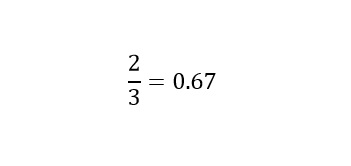
How do we make sense of the answer shown above?  Comparing the amount of coal ash which spilled to the volume of an Olympic-sized swimming pool yields the number 0.61 -- but remember the author states that the amount which spilled is around 2/3 of an Olympic-sized swimming pool.  Therefore, compare 0.61 to 2/3 -- a fraction computed below:


The answer indicates that the two numbers -- calculated 0.61 and 0.67 (2/3) are within 10% of one another -- which is good.  The author was good in his assertion in the excerpt above.  Readers of this blog site might inspect the answer and think critically about the size of the spill relative to other spills discussed in previous blogs.  Why worry about a volume of coal ash equivalent to 2/3 the size of an Olympic-sized swimming pool?


The fact of the matter is that any sizable amount of coal ash which leaks into a natural waterway could harm the public and future damage down the line.  Which is unacceptable.  As you will learn below, the analysis goes further and identifies a much larger volume of coal ash which could potentially cause an unbelievable amount of damage to waterways.


South Carolina - Potential Spill?


Recently, in the news, the statistic was reported from South Carolina which caused me to wonder how the reported number compares to the reported one above.  The article was titled "SC coal ash pit with 200,000 tons of waste could start taking on water Tuesday":


A pit of coal ash holding some 200,000 tons of toxic sludge in Conway could start taking on water Tuesday as the Waccamaw River sloshes over its banks.


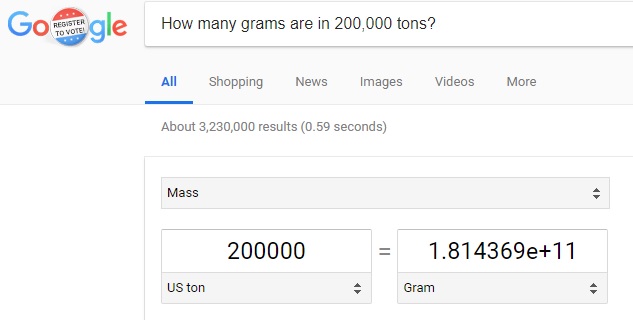
How does the reported number or value of 200,000 tons compare to 2,000 cubic yards?  To start the analysis, a unit conversion factor is needed.  We can consult Google with the following question: How many grams are in 200,000 tons?  The answer is shown below:


In previous blog posts, the methodology follows that above, which is to determine a 'unit conversion factor' then convert initial numbers to the desired units.  For the purposes of brevity, taking a slightly different route, we just asked Google to help us convert from units of 'ton' to 'gram'  directly.


With the mass determined in units of 'grams', the proper way to extract a volume of a given mass of a substance is to use the density of a substance.  Using the density, a volume can be determined as shown below:


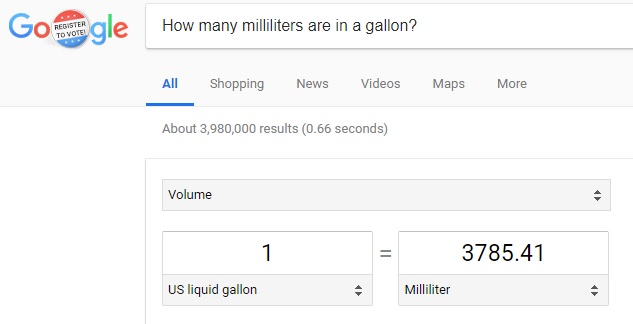
The answer is expressed in units of 'milliliters'.  A couple remaining steps are needed to arrive at a final answer.  First, we need to consult Google with the following question: How many milliliters are in a gallon?  The answer is shown below:


Next, the desired units are 'gallons' which can be determined using the conversion factor above.  The number of gallons in 200,000 tons is where we would like to travel towards in the present analysis.  To get there, the conversion of mass to a volume needs to be accomplished.  This can be done by using the concept of a substances' density -- amount of mass per volume.  Below, the conversion of the mass of coal ash (mass) is converted to a volume (milliliters) is shown:


The approximation above is that the density of water was used in place of the density of 'coal ash' which is closer to 1.6 gram/mL.  Readers might be slightly disappointed, although, the final value will not change dramatically.  The conversion from 'milliliter' to 'gallon' is shown below:


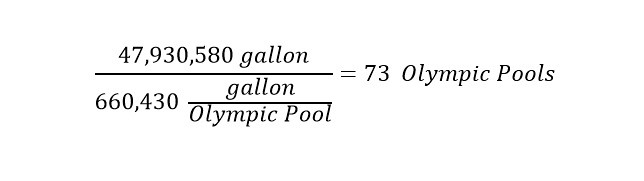
Last but not least, the total amount of Olympic-sized swimming pools which could be filled with 47.9 million gallons of coal ash - potentially which might spill in South Carolina is shown below:


The answer indicates that the potential spill of 200,000 tons would have been equivalent to 73 Olympic-sized pools.  Compared to the amount which spilled in North Carolina, the above value is very large and could cause an unbelievable amount of damage to the environment.  The analysis above has shed light on two very different volumes of coal ash.  At the same time, the analysis gives the reader the ability to analyze the amount of coal ash which could damage the environment and is reported in two different news articles.


Conclusion...


Looking at this value might not seem large compared to the total quantity of rain which fell as a result of Hurricane Florence.  Although, the toxic nature of coal ash could have much greater damage than flooding.  Not to say that flood damage is not bad too to residents.  Contaminating the local water supply for decades could be a much greater risk.  For the present time being, the dams have held up.  That could be temporary given the tremendous amount of rain which has already fallen.


Never the less, the spill in Wilmington is dangerous enough to have potentially damaging effects which might not be realized for quite a while.  The potential amount under threat in other areas should be concerning.  Mining companies should be regulated to a greater extent regarding the large storage pools of coal ash which are commonly stored near mining sites.  The analysis above drives home the point which is that the potential spills along with those already occurring can be quite devastating to the surrounding ecosystems and natural resources on which residents rely.


Related Blog Posts:


South Carolina Governor Henry McMaster asks lawmakers for $1,228,000,000 For Recovery from Hurricane Florence?


Boston Natural Gas Explosion Reveals Old Piping Needs Replacement - Enough To Travel To Colorado?


A Forecaster Predicts That Hurricane Florence Will Drop Enough Rain To Fill 18,400 Mercedes-Benz Superdomes

Hurricane Harvey Drops Enough Rain On Houston To Fill 560 Dallas Cowboy Stadiums


How Much Water Is Contained In All Oceans Around The Globe?


Storm Raises Water Level In Lake Cachuma By 31 feet, How Much Water Is That?


How To Make Sense Of Water Flowing At 100,000 Cubic Feet Per Second


Can 11 Trillion Gallons Of Water Fill 14,000 Dallas Cowboys Stadiums?


How Much Rain Did The East Coast Receive From Hurricane Matthew?


How Much Rain Did Haiti Really Receive?


How Much Rainfall Has Dropped On Louisiana?


How Big Was The "Water Bomb" Of Rainfall In Macedonia?


How Much Rain Did Huauchinango (Mexico) receive?


How Much Rain Did Elliot City (Maryland) Really Receive?


If The Mosul Dam Breaks, The City Of Mosul Would Be Under 65 Feet Of Water?


What is the volume of water in a few inches of rain?


Volume of Waste in the Mine Spill (in Brazil) Equivalent to 78 Deepwater Horizon Oil Spills

Monday, September 17, 2018

Typhoon Mangkhut Drops Enough Rain On Philippines To Fill 25,000 Superdomes per hour?


Source: Time


As Americans were watching Hurricane Florence ravage the East Coast of the United States over the weekend, residents of the Philippine Islands were experiencing an equivalent destruction of their country from Typhoon Mangkhut.  According to the New York Times article titled "See Inside Typhoon Mangkhut in 3-D" at the height of maximum rainfall over the Philippines, the rate of rainfall reached 11.7 inches as shown in the excerpt below:


Rain tends to be heaviest near the center of a storm, in what is known as the eyewall, visible here in red. The highest rainfall rate for Typhoon Mangkhut reached 11.7 inches per hour inside the southern wall on Friday.


With this astounding rate of rainfall in mind, regular readers of this site will naturally ask themselves the following question:


How many Superdomes were filled per hour by Typhoon Mangkhut?


In the paragraphs below, the amount of Superdomes are calculated using dimensional analysis.  The result as indicated (potentially 25,000 Superdomes per hour) is astonishing.  Following the analysis is a video confirming the astounding number which should blow your mind.


How Many Superdomes Per Hour?


Basically, for the current blog post, the same methodology which was used to calculate the number of Superdomes which could be filled with the predicted rainfall due to Hurricane Florence - which I posted last Friday.  The Mercedes-Benz Superdome is located in Louisianna and has an interior volume of 125,000,000 cubic feet.  Shown below is a picture of the Mercedes-Benz Superdome:


Source: The Advocate


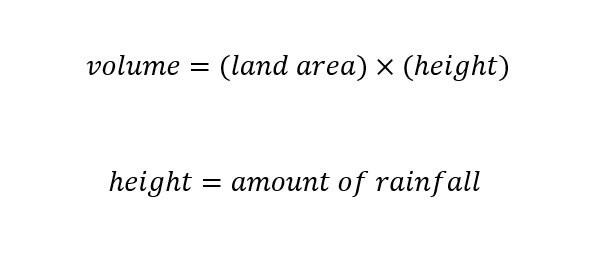
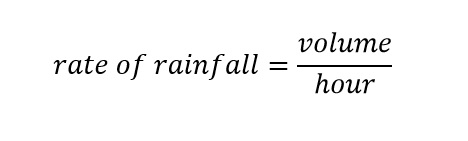
Superdomes can be a 'metric' which are commonly used to cast large (enormous) values of volumes or statistics popularly reported in the news.  The maximum rate of rainfall reported in the New York Times article above is a perfect candidate along with the landmass of the Philippine Islands -- which makes a volume -- to be used in an analysis with the metric above used.  The volume of rainfall can be expressed as an equation as shown below:


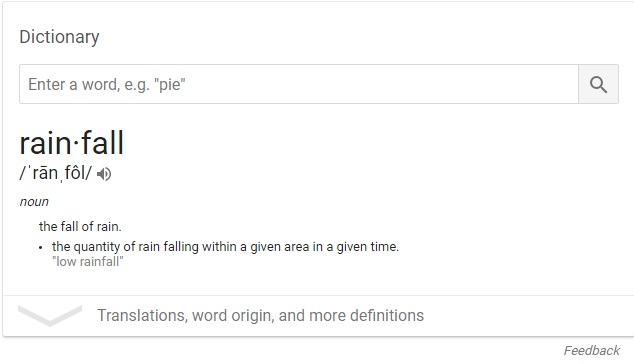
The volume for a geographic area is the land mass area multiplied by the amount of rainfall over the given land mass area.  If we consult Google with the following question: Rainfall?  The definition of the term 'rainfall' is shown below:


The definition of rainfall is 'the quantity of rainfall falling.'  To begin the analysis (with actual numbers) the land mass (total area) of the Philippine Islands needs to be determine.  As usual, Google is consulted with the following question: Philippine Area?   The answer is shown below:


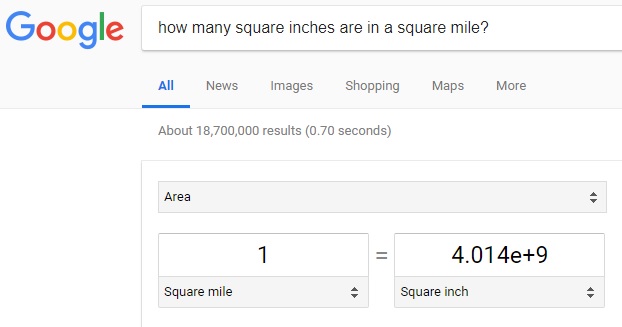
Notice that the area (land mass) is expressed in units of measurement of 'square mile'.  When the maximum rainfall is reported in units of 'inches', a decision to convert one number to the other needs to be made.  For this analysis, 'inches' will be the unit of measurement for analysis -- at least the beginning of the analysis.  In order to convert the land mass area of Philippine Islands from units of 'inch' to 'mile' the following question needs to be asked in a search engine like Google: How many square inches in a square mile?  The answer is shown below:


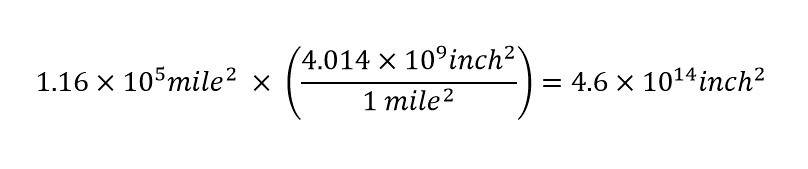
For every single square mile, there are 4.014 billion square inches.  The conversion of units from 'square miles' to 'square inches' is shown below:


The answer above shows that Philippines is around 116 thousand square miles which when converted to square inches turns out to be 460 trillion square inches.  Now that the land mass area is converted to units of square inches, the volume of rain which fell at a maximum on Friday due to Typhoon Mangkhut can be calculated using the expression for volume from above:


Wait?  The above equation is 'rate of rainfall' -- whereas I stated that the volume was being computed above?  Why the difference?  As I stated above, the amount of rain falling over and hour was reported to be 11.7 inches/hour.  Which is a rate.  Therefore, the volume is actually the rate of volume of rainfall over a given time as shown below:


With 11.7 inches/hour of rainfall pouring down due to Typhoon Mangkhut, the total amount (volume) of rain would be 5,400 trillion cubic inches per hour of rain.  Wow!  Based on the calculations in the previous blog post regarding the total amount of rain predicted (by a forecaster) due to Hurricane Florence, lets cast the rate of rainfall into comprehensible units.  To do so, a unit conversion needs to be accomplished from units of 'cubic inches' to 'gallons'.  A conversion factor needs to be determined.


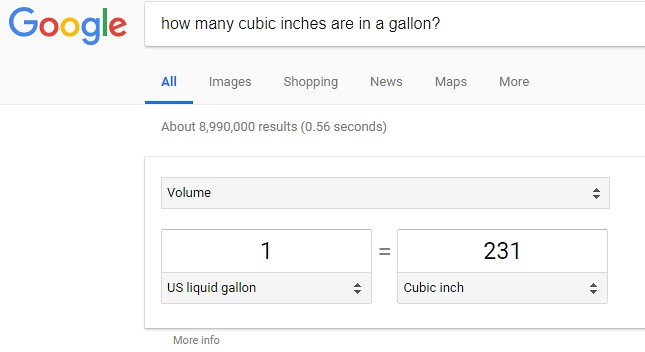
If the following question is typed into Google: How many cubic inches are in a gallon?  The answer is shown below:


With the conversion factor known, the conversion is carried out by using the same methodology as above:


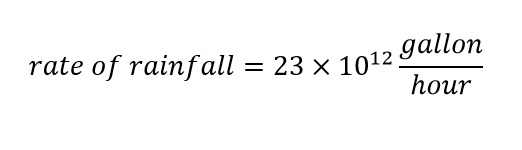
Therefore, the amount of rainfall over the Philippine Islands at maximum rainfall is shown below:


Wow!  23 trillion gallons in a single hour.  In my previous blog post about the predicted amount of rainfall over four states (in a few days) was expected to be 17 trillion.  The difference shows that Typhoon Mangkhut is larger than Hurricane Florence.  This is not to say that Hurricane Florence is not inflicting a large amount of damage in the United States over the weekend.  The East Coast is in terrible shape and we are keeping the residents there in our thoughts.  Be safe.


The metric which has been used to visualize large volumes of rain is the Mercedes-Benz Superdome as shown above.  With a volume of 125,000,000 cubic feet, the Superdome is a perfect metric to which compare the large volume of rain falling over a given region in a storm.  To calculate the number of Superdomes which could be filled with 23 trillion gallons/hour, first a unit conversion needs to be accomplished.  In order to compare the 23 trillion gallons/hour to 125,000,000 cubic feet, a unit conversion from 'gallon/hour' to 'cubic feet/hour' needs to be accomplished.


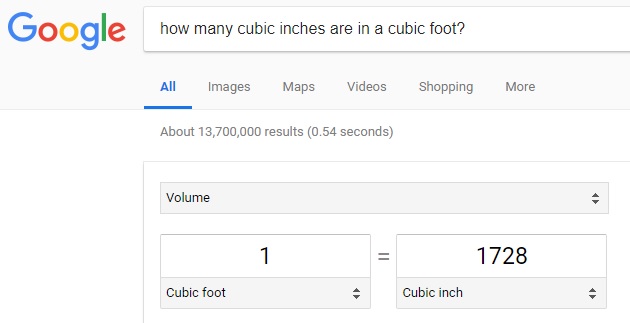
To determine the number of 'cubic inches' are in a 'cubic feet', we type into Google the following question: How many cubic inches are in a cubic foot?  The answer is shown below:


The conversion of units between 'cubic inch' and 'cubic feet' is shown below:


Next, to determine the number of Superdomes which could be filled with the amount of rain falling over an hour over the Philippine Islands is shown below:


Wow!  The total amount of Superdomes which would be filled at the rate of rainfall equal to 3.1 trillion cubic feet per hour is a whopping 25,000 Superdomes per hour.


The final question is the following:


Does the amount of rainfall -- 3.1 trillion cubic feet per hour over the Philippine Islands make sense?


To answer the question above, lets view the video from YouTube below taken over the weekend during the storm - Typhoon Mangkhut:


Wow!   I am left speechless by the video above.


Conclusion...


Oh my goodness?  The amount of rain is enormous and unparalleled.  Between the total number of storms hitting the globe over the weekend, the amount of rainfall is historic and unparalleled in volume.  The rainfall must be surging into the hundreds of trillions of gallons of water falling on land masses like Philippine Islands and the East Coast of the United States of America.  Destruction is inevitable.  Just think of the amount of time and effort which will be required to restore basic resources like power and water?  The destruction is huge and should not be understated.  Keep the residents experiencing these terrible storms in our thoughts and prayers.


Related Blog Posts:


A Forecaster Predicts That Hurricane Florence Will Drop Enough Rain To Fill 18,400 Mercedes-Benz Superdomes

Hurricane Harvey Drops Enough Rain On Houston To Fill 560 Dallas Cowboy Stadiums


How Much Water Is Contained In All Oceans Around The Globe?


Storm Raises Water Level In Lake Cachuma By 31 feet, How Much Water Is That?


How To Make Sense Of Water Flowing At 100,000 Cubic Feet Per Second


Can 11 Trillion Gallons Of Water Fill 14,000 Dallas Cowboys Stadiums?


How Much Rain Did The East Coast Receive From Hurricane Matthew?


How Much Rain Did Haiti Really Receive?


How Much Rainfall Has Dropped On Louisiana?


How Big Was The "Water Bomb" Of Rainfall In Macedonia?


How Much Rain Did Huauchinango (Mexico) receive?


How Much Rain Did Elliot City (Maryland) Really Receive?


If The Mosul Dam Breaks, The City Of Mosul Would Be Under 65 Feet Of Water?


What is the volume of water in a few inches of rain?


Volume of Waste in the Mine Spill (in Brazil) Equivalent to 78 Deepwater Horizon Oil Spills


Friday, September 14, 2018

A Forecaster Predicts That Hurricane Florence Will Drop Enough Rain To Fill 18,400 Mercedes-Benz Superdomes


Source: Axios


Hurricane Florence has arrived on the East Coast of the United States with a force which seems unparalleled compared to previous storms.  The category has changed with time, though, without dispute, hurricane Florence is present and causing damage which will take years to recover from.  To comprehend the predictions from weather forecasters, dimensional analysis is necessary to cast the enormous predictions into light.  How much rain is going to fall on the East Coast from hurricane Florence?  Here is an excerpt from a weather forecaster interviewed by 'Mashable' in an article titled "Hurricane Florence is forecast to dump a historic amount of rain. Here's how much" which states the huge amount of potential rain to be dropped:


Meteorologist Ryan Maue of WeatherModels tweeted some projections on Thursday morning. 
Maue's models suggest that around 17 trillion gallons of rain will fall across North Carolina, South Carolina, Virginia, and Georgia with some spots receiving as much as 30 inches of rain before Florence is finished. 


According to the excerpt shown above, 17 trillion gallons is predicted to fall on North Carolina, South Carolina, Virginia, and Georgia over the next few days.  This will cause terrible damage to the infrastructure in cities lining the coast and displace many thousands of residents from services (which are much needed) such as electricity, emergency services, and make returning to work nearly impossible.  In order to understand the terrible destruction of the storm, the amount of rain (17 trillion) should be placed into context.  In the paragraphs below, dimensional analysis is used to compare the amount of rain to the number of Mercedes-Benz Superdomes which could be filled with 17 trillion gallons.


How Much Space Occupies The Mercedes-Benz Superdome?


The metric which has been chosen to compare the enormous amount of rain that is expected to fall over the 4 states mentioned above on the East Coast over the next few days is the Mercedes-Benz Superdome.  The Superdome is located in Louisianna and has an interior space (volume) equal to 125,000,000 cubic feet of space.  Yes, I said 125,000,000 cubic feet of space as shown below:


Which fills the Superdome shown below:


Source: The Advocate


That is an large space indeed.  Football games are played in the Superdome and at max capacity will hold a total of 73,000 people.  Although, during a super bowl, the capacity has expanded beyond capacity to hold upwards of 79,000 people.  Needless to say, when an HUGE volume is reported of liquid such as the amount of rain which will fall over the next few days, a perfect metric to compare is that of the Mercedes-Benz Superdome.


According to the excerpt taken from the news, the amount of rain expected to fall is 17 trillion gallons.  First, lets look at the amount of zero's after 17 -- trillion.  If 'Wikipedia' is consulted for the page defining 'trillion', the following definition is shown below:


Trillion (short scale) (1,000,000,000,000; one million million; 1012; SI prefix: tera-), the current meaning in both American and British English.


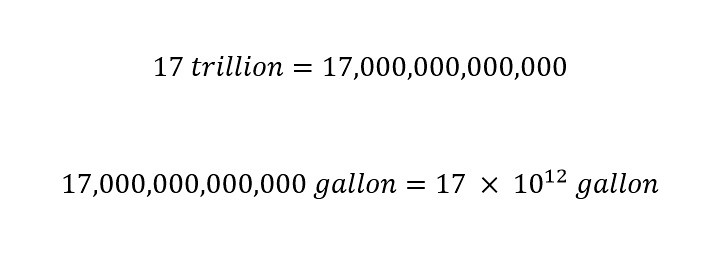
Therefore, if the number 17 trillion is written out in entirety, the number would appear as follows:


The first line above shows 17 trillion in long form.  For the purpose of shortening up a number to move around in calculations used in dimensional analysis, the value 17 trillion could be expressed in 'Scientific Notation' as shown in the second line above.  Which makes writing and expressing the number much easier.  Compared to writing out all of the unnecessary zero's involved.


Notice that the unit of measurement in which the amount of rain projected to fall are expressed in units of 'gallons'.   Remember that the interior space of the Superdome is expressed in units of 'cubic feet'.  Therefore, if the two numbers are going to be used in the same analysis (the purpose of the blog post), then a 'unit' conversion is necessary.  For this blog post, I will arbitrarily use the units of 'cubic feet' as a comparison.  We just as well could have converted over the units of 'cubic feet' to 'gallon's in order to compare the two values of interest (i.e. volume of Superdome and volume of rain).


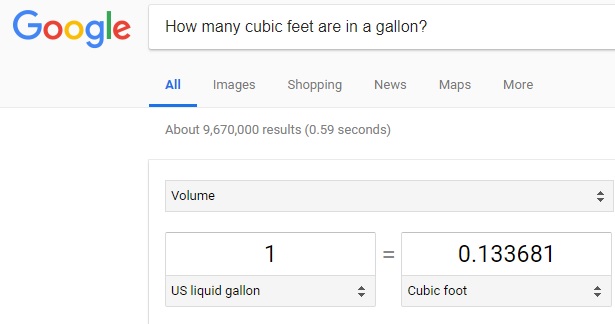
In order to convert the units of measurement from 'gallon' to 'cubic feet', a conversion factor is needed.  To simplify the search for a conversion factor, consult Google with the following question: How many cubic feet are in a gallon?  The answer is shown below:


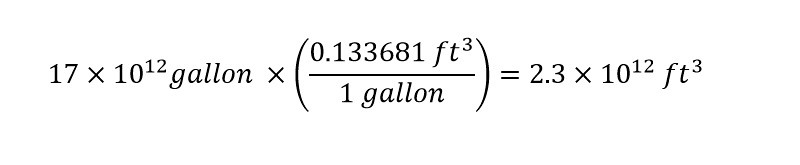
For every gallon, there are 0.133681 cubic feet.  Written as a conversion factor, the unit conversion from gallon to cubic feet is shown below:


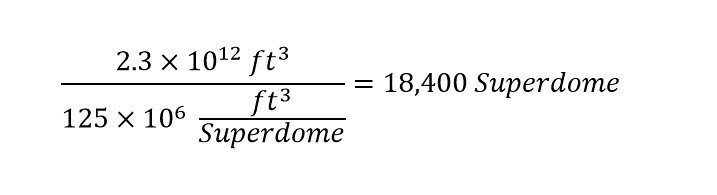
The answer to the conversion shows that 17 trillion gallons is equivalent to 2.3 trillion cubic feet.  Which means that 17 trillion gallons of water is equivalent to 2.3 trillion cubic feet of water.  Same volume, different units of measurement. Now that both values are in the same units of measurement -- 'cubic feet' -- a simple division of two values (total volume of rain divided by total volume of a single Superdome) yields the total number of Mercedes-Benz Superdomes which would be filled with 17 trillion gallons of rain:


The answer indicates that if 17 trillion gallons were poured into 18,400 Superdomes, there would be no water remaining.  Wow.  With this enormous amount of Superdomes as a result, there should be no wonder why residents should be concerned about their health and safety.  That enormous amount of rain will inevitably wreak havoc on the four states listed above.


Conclusion...


In the blog post above, the number of Mercedes-Benz Superdomes were calculated which would be needed to hold a total volume of rain of 17 trillion gallons.  At this moment, you may be wondering how 17 trillion gallons compares to the amount of rain that Hurricane Harvey dropped on Houston (Texas).  Hurricane Harvey dropped 58.3 billion cubic feet of rain.  That is enough to fill 560 Dallas Cowboy Stadiums.  Note that the total amount of rain is distributed across very different amounts of land masses.  Different amounts of rain across different proportions of land.  Still, these hurricanes are dropping enormous amounts of water (in the form of rain) which is wreaking havoc on the surrounding land.


Hopefully, the blog post above along with other dimensional analysis blogs on this site shed light on the severity of storms hitting the world over the past two years.  In the index of blogs below, other storms have been analyzed in a similar fashion.  Regardless of the size of the storm, any loss of life is tragic and unacceptable.  Please keep the residents of hurricane Florence in your thoughts over the next few days (and months).  If you are in the path of hurricane Florence, stay safe please.


Related Blog Posts:


Hurricane Harvey Drops Enough Rain On Houston To Fill 560 Dallas Cowboy Stadiums


How Much Water Is Contained In All Oceans Around The Globe?


Storm Raises Water Level In Lake Cachuma By 31 feet, How Much Water Is That?


How To Make Sense Of Water Flowing At 100,000 Cubic Feet Per Second


Can 11 Trillion Gallons Of Water Fill 14,000 Dallas Cowboys Stadiums?


How Much Rain Did The East Coast Receive From Hurricane Matthew?


How Much Rain Did Haiti Really Receive?


How Much Rainfall Has Dropped On Louisiana?


How Big Was The "Water Bomb" Of Rainfall In Macedonia?


How Much Rain Did Huauchinango (Mexico) receive?


How Much Rain Did Elliot City (Maryland) Really Receive?


If The Mosul Dam Breaks, The City Of Mosul Would Be Under 65 Feet Of Water?


What is the volume of water in a few inches of rain?


Volume of Waste in the Mine Spill (in Brazil) Equivalent to 78 Deepwater Horizon Oil Spills


Friday, August 31, 2018

Reader Question: How far would 291 billion Goodyear Blimps reach end to end?


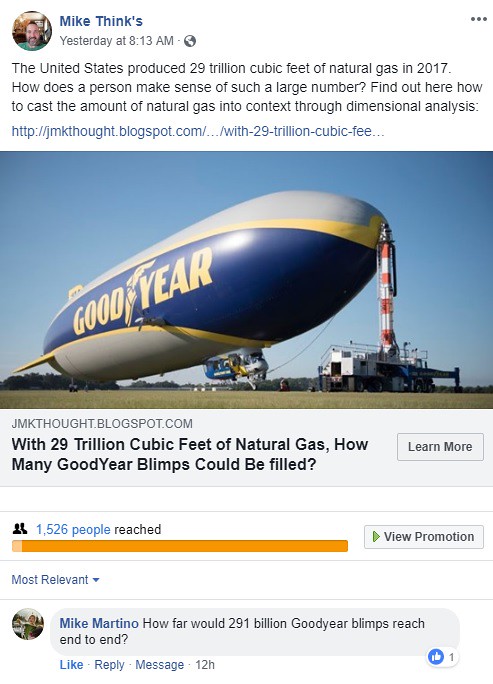
Recently, I had a reader respond on Facebook to a blog post titled: With 29 Trillion Cubic Feet of Natural Gas, How Many GoodYear Blimps Could Be filled? as shown below:


According to the image above, the reader asks the following question: How far would 291 billion Goodyear Blimps reach end to end?   In the blog post below, the answer will be revealed in comparison to three distances:


1) Would the distance be enough to travel around planet Earth?  

2) Would the distance reach from the Earth to the Moon?

3) Would the distance reach from the Earth to Mars?


The answers are outlined and solutions shown below.  Enjoy!


Line up 291 billion Goodyear blimps


In order to start the analysis above up, we need to refer to the 'data' page for the Goodyear Blimps which I provided from the last post -- which can be found here.  If the overall length is searched for on the web page, the answer is the length of a Goodyear Blimp is 264.4 feet long or 81% of the length of a football field.  Wow!  That is shown below:


With this number representing a single blimp, the total distance asked by the reader above can be found by simply multiplying two values together.  The first is the total amount of Goodyear Blimps by the length of a single Blimp (the second value) as shown below:


Obviously, the resulting distance is very long considering that a single blimp is around 80% of the length of a football field.  That is, the total length expressed in units of 'feet' is 71,300,000,000,000-feet.  Or 71.3 trillion feet long.  For distances that are expressed in units of feet that are so enormous, converting the unit into a larger unit (say a mile) makes sense for dimensional analysis.  Especially when the metric will most likely be expressed in units of 'mile'.


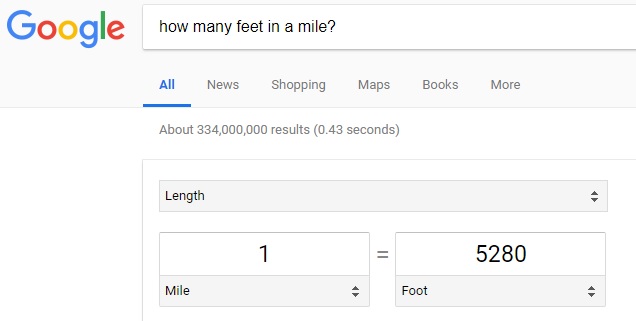
To do so, we need to know the amount of feet which are in a mile.  The answer can be found by asking a search engine like 'Google.com' the following question: How many feet are in a mile?  The answer is shown below:


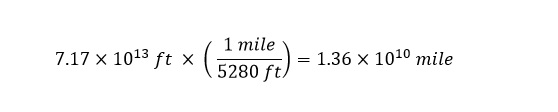
The answer indicates that for every mile, there are 5,280 feet.  With that conversion value in mind, the following unit conversion from feet to miles can be accomplished as shown below:


The number of total miles which would be reached if 291 billion Goodyear Blimps were lined up end to end would be around 13.6 billion miles in total distance.  That number is shown below:


The only remaining question is how to make sense of such a large number?  What is an appropriate metric to use for comparison?  How about if we choose the following three distances:


1) Trips around planet Earth

2) Trips from planet Earth to the Moon

3) Trips from planet Earth to the planet Mars


Lets see how these distances compare to 13.6 billion miles.


1) Trips around planet Earth:


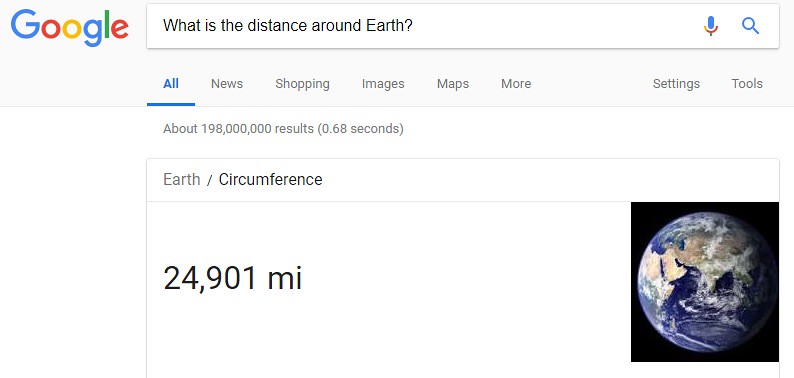
To find out how 13.6 billion miles compares to the number of possible trips around Earth, the circumference of Earth needs to be known.  The fastest way to obtain the circumference is to ask Google the following question:  What is the distance around Earth?   The answer is shown below:


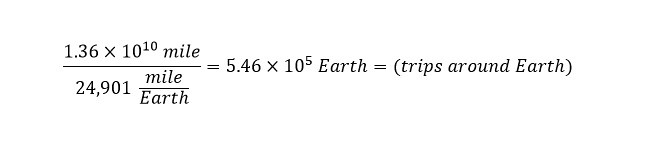
Once we have an answer -- which is 24,901 miles around Earth, a quick inspection is performed to make sure units of measurement are the same.  Yes, both values, 13.6 billion miles and 24,901 miles are both expressed in units of 'mile'.  Therefore, dividing the total number of miles which equates to lining up end to end 291 Goodyear Blimps by the distance around Earth will yield the number of trips that would be made possible as shown below:


Wow!  The answer indicates that with 13.6 billion miles, we could travel around Earth 546,000 times.  Wow!


2) Distance from Earth to the Moon:


The last analysis of distances -- using the circumference around the Earth -- gave us a large number: 546,000 trips around the Earth.  I do not know about you, but trying to imagine that number is too difficult for me.  Therefore, a new metric needs to be created in order to make sense of this enormous number -- 13.6  billion miles -- with which we are left with to untangle.


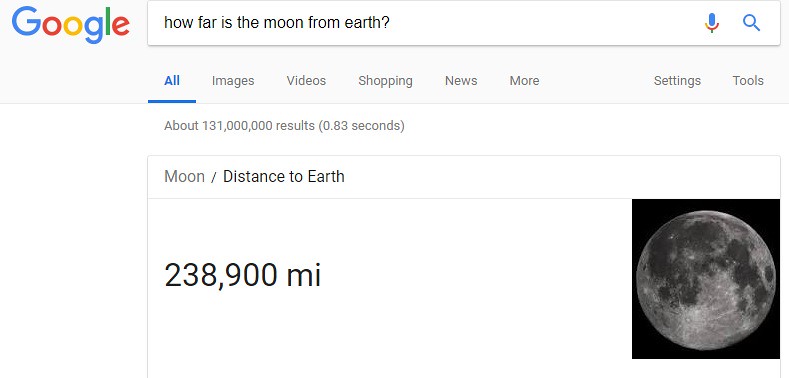
Another possible metric would be to use the distance between Earth and the moon.  If Google is consulted by asking the following question: How far is the moon from earth? -- then the answer below appears:


From the last analysis, the remainder of the calculation is straightforward as shown below:


According to the calculation above using the numbers mentioned, the total number of trips from Earth to the Moon would be approximately 56,900 one way trips.  Wow!  Looking at the answer, the number of trips is still quite large.  Lets consider a larger metric -- the distance to Mars for a final analysis.


3) Distance between Earth and Mars:


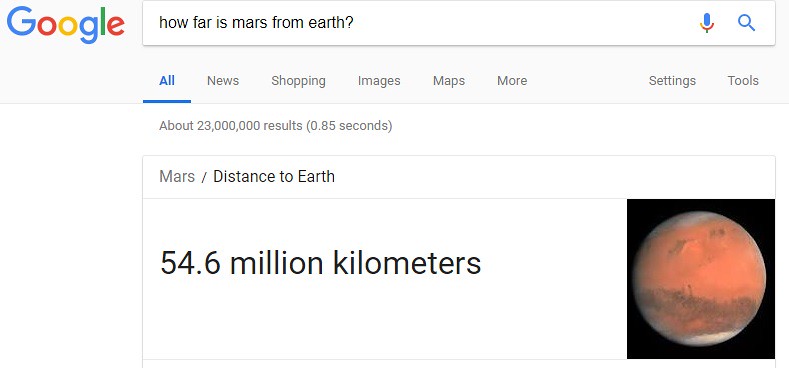
As a final analysis, a yet larger metric is chosen -- which is the distance between Earth and Mars -- to cast the enormous distance of 13.6 billion miles into perspective.  Again, to start the analysis, the distance from Earth to Mars needs to be obtained.  Using the handy search engine Google with the following question: How far is Mars from Earth? -- will yield an answer: 


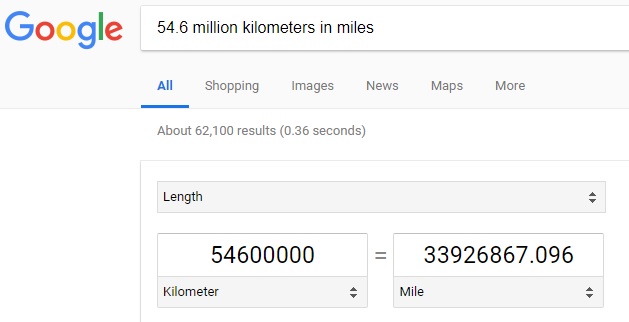
The answer gives us a slight problem.  Following a quick inspection of 'units of measurement', the answer is given in units of 'kilometers' whereas the distance which is used in the above analysis is expressed in units of 'miles'.  Therefore, Google needs to be consulted with the following question: 54.6 million kilometers in miles -- which yields the following conversion shown below:


Notice how usually the inquiry for unit conversion entails getting a conversion factor.  In this case, the distance of concern was in question to save time.  Now, the final analysis can be carried out -- which is to find the number of trips from Earth to Mars that would be made possible using the distance of 13.6 billion miles.  The analysis is shown below:


The calculation indicates that 401 trips would be possible between Earth and Mars.  Wow!


Conclusion...


In the analysis above, the question from a reader was entertained: how far would 291 billion Goodyear Blimps reach end to end?  The answer was astounding.  Much longer than I even imagined.  Although, using dimensional analysis allowed us to cast the value (i.e. total distance) into a manageable perspective.  The metrics chosen were distances within our galaxy.  If larger metrics were needed for an extremely larger number, the a 'light-year' could have been chosen to which compare astronomically large numbers too.  In the future post, there will be such large numbers which require truly long distances.


For the time being, I am thankful to the reader Mike Martino for asking such a great question.  I have had a wonderful time making sense of the distance calculated along with walking readers through the analysis.  Now, powered with the ability to perform similar analysis, choose different metric and arrive at different answers.  Use the numbers above to explore different analyses.  Feel free to comment on different analyses in the comment section below.


Related blog posts:


Dimensional Analysis Of Statistics And Large Numbers - Index Of Blog Posts


What is dimensional analysis?


How many trash carts can be filled with 80 billion pounds of trash?


How many people would be killed if 1,485 pounds of Fentanyl were distributed onto the streets in the U.S.?


What Is Dimensional Analysis?


Was The Recent Oil Spill in China The Largest In History?


LimeBike Dockless Bikeshare Riders Travel A Distance Of 13,000 Miles In Just Over 3 Weeks?


How Many Cigarettes Can You Roll With 18,000 Pounds Of Marijuana?


How Many Turkey's Are Served On Thanksgiving Day? How Many People Served?


How Much Trash Would Be Required To Fill The Great Wall Of China?


How Many Birds Per Minute Can Be Processed On A Single Line At A Poultry Processing Plant?


Hurricane Harvey Drops Enough Rain On Houston To Fill 560 Dallas Cowboy Stadiums


If Technology Fails, Use Basic Math Skills - Count Manually!!


How Much Water Is Contained In All Oceans Around The Globe?