Showing posts with label #edchat. Show all posts

Sunday, December 23, 2018

Happy Holidays!!.....Here are some fun facts to share with family about the holidays


With the holidays rapidly approaching, last minute shopping is all around us.  Hysteria at the malls with frantic shoppers trying to wrap up their gift giving expedition.  On top of that weight are the decorations needed for the season.  By now, neighborhoods around the nation are adorned with Christmas lights while Christmas trees are on full display through front windows of houses all around us.  For this year, a couple of fun facts are in order to spread the Christmas cheer.  The two categories will be: Christmas trees and Christmas lights.


How many Christmas Trees are purchased?


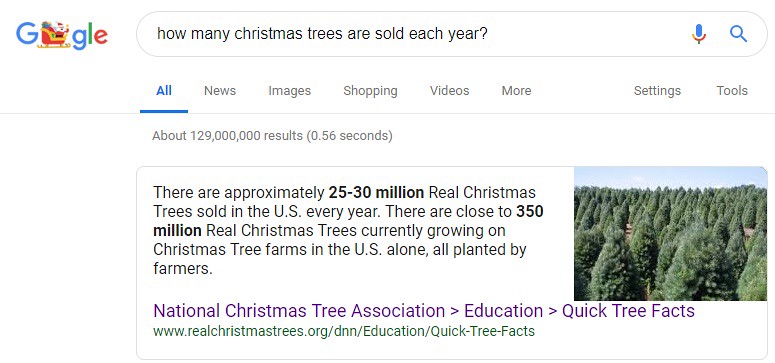
Each Christmas season, trees can be spotted on the top of cars as they are transported from the farm to the house to be decorated.  I always have wondered about the number of trees on average which are sold during Christmas.  Therefore, I decided to search Google with the following question: How many Christmas Trees are sold each year?   The answer is shown below:


Source: Google


According to the National Christmas Tree Association, there are between 25 and 30 million Christmas trees sold each year in the United States.  What was fascinating is the total number of Christmas trees grown in the U.S. each year are 350 million.  The information highlighted in the box above comes from the National Christmas Tree Association's website which has a few more fun facts about Christmas trees shown below:


There are approximately 25-30 million Real Christmas Trees sold in the U.S. every year.
There are close to 350 million Real Christmas Trees currently growing on Christmas Tree farms in the U.S. alone, all planted by farmers.
North American Real Christmas Trees are grown in all 50 states and Canada. Eighty percent (80%) of artificial trees worldwide are manufactured in China, according to the U.S. Commerce Department.
Real Trees are a renewable, recyclable resource. Artificial trees contain non-biodegradable plastics and possible metal toxins such as lead.
There are more than 4,000 local Christmas Tree recycling programs throughout the United States.
For every Real Christmas Tree harvested, 1 to 3 seedlings are planted the following spring.
There are about 350,000 acres in production for growing Christmas Trees in the U.S.; much of it preserving green space.
There are close to 15,000 farms growing Christmas Trees in the U.S., and over 100,000 people are employed full or part-time in the industry.
It can take as many as 15 years to grow a tree of typical height (6 - 7 feet) or as little as 4 years, but the average growing time is 7 years.
The top Christmas Tree producing states are Oregon, North Carolina, Michigan, Pennsylvania, Wisconsin and Washington.


I immediately wondered why there was such a large difference between the amount of Christmas trees planted each year and those that are sold.  Sounds like there are only 1 in 10 trees which actually make the cut to be sold in order to end up in a living room for display with decorations and lights.  The industry requires a significant workforce to support the retail which comes along with the Christmas celebration.  Just take the amount of trees grown to be sold are staggering by itself.


To understand the magnitude of the number of trees which are planted along with the amount that are sold, let's imagine that each tree is stacked on top of one another.  How high would that stack of trees reach? The analysis below will show the answer to that question.  In order to start, an assumption regarding the average height of a Christmas tree needs to be introduced.  For the purpose of this analysis, the assumption will be made that the average height of a Christmas tree is 6 feet tall.


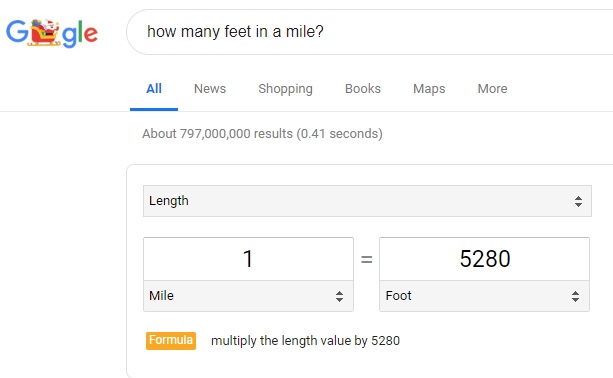
First, the amount of trees which are sold annually in the United States is large.  Therefore, choosing a 'unit' of measurement which will appropriately shed light on the magnitude of the values is essential.  A common unit of measurement for large distances on Earth is the 'mile'.  If Google is consulted with the following question: 'How many feet are in a mile?'  The answer is shown below:


Source: Google


There are 5,280 feet in every mile.  To begin analyzing the values, let's look at the numbers which we are interested in.  Each year, there are between 25 million and 30 million Christmas trees sold in the United States.  That is out of a total of 350 million Christmas trees growing across 15,000 farms.


First, each of the amount of trees sold (and grown) in the United States must be converted to units of miles -- using the assumption that each tree is on average 6 feet tall.  The unit conversion is shown below:
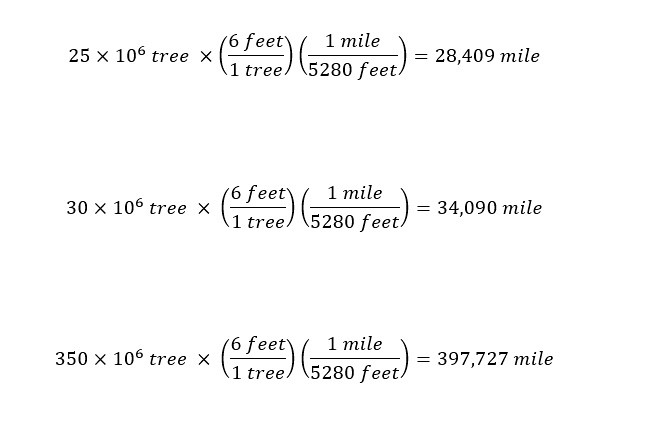


The results above indicate that the range 25-30 million trees sold equal to the distance of 28,409-34,090 miles.  Additionally, the total number of Christmas trees grown annually would equal a total distance of 397,727 miles.  In order to understand the magnitude of these distances, a metric is needed to compare the distances with.  What if we took the total distance of stacked Christmas trees and wrapped the line around a sphere (the Earth)?  How many times could the line of trees circle around the Earth?


We need to determine the total distance around the Earth.  If we consult Google with the following question: What is the circumference of Earth?  The answer is shown below:
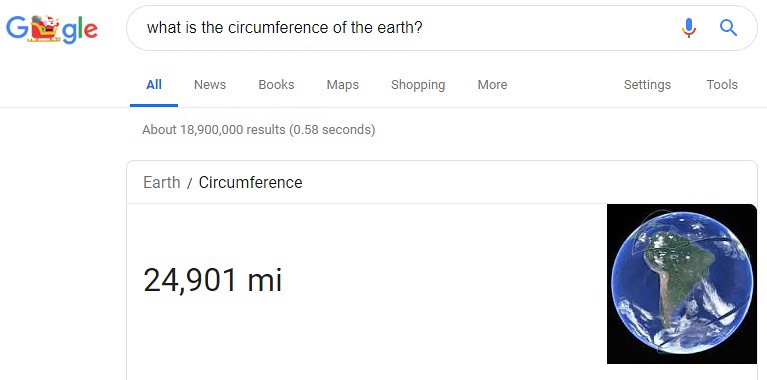


Source: Google


One trip around Earth (at the center) is equal to traveling a total distance of 24,901 miles.  The three distances of Christmas trees can be divided by the circumference of the Earth -- 24,901 miles as shown below:
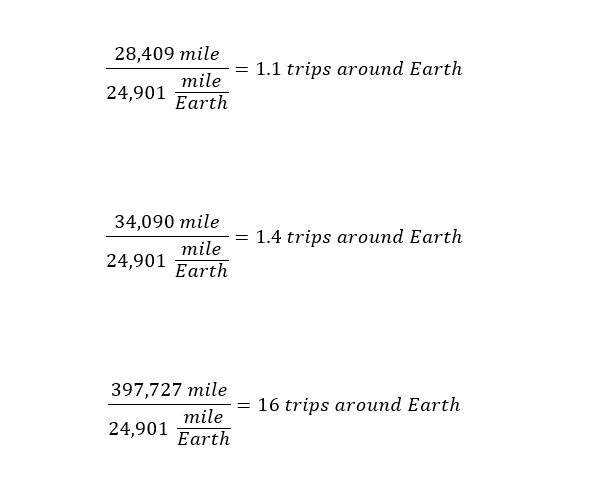


The answers indicate that the amount of Christmas trees sold in the United States each year would stack up to a range of 28-34 thousand miles -- which would equal just over 1.4 trips around the Earth.  Additionally, the total number of Christmas trees grown in the United States would stack up to a distance equal to 16 trips around the Earth.  These numbers really drive home the magnitude of the amount of Christmas trees needed for the Christmas holiday.  Here is a great idea for recycling parts of the Christmas tree -- click here.


How about Christmas light?


In the next section, an analysis will be carried out to highlight the total number of Christmas lights which are purchased each year in the United States.


How about Christmas Light?


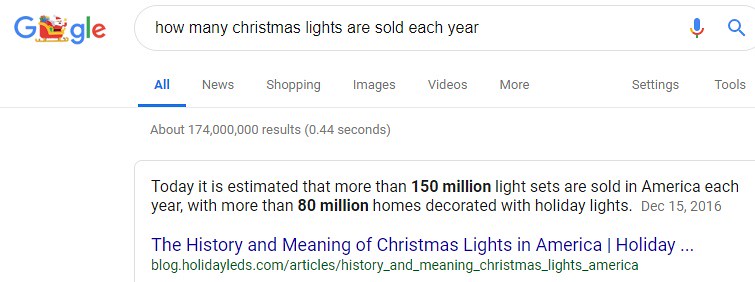
On top of all of the Christmas trees which are sold annually and would wrap around the circumference of Earth are Christmas lights -- at the very least to provide the minimum amount of decoration.  In order to wrap a few strands of Christmas lights around a given tree, either one must store Christmas lights in the garage or choose to purchase new strands.  There is nothing wrong with purchasing new lights in a given year.  Especially when the old lights break or strands of bare exposed wire show -- which could easily cause danger when voltage is applied to them (i.e. plugged into the wall socket).  How many strands are sold in the United States each year?


If a Google search is conducted with the question above, the following answer appears below:


Source: Google


According to our search, there are 150 million strands of Christmas lights sold each year in the United States.  If the same analysis from above is used, the first step will be to convert the strands of lights into a distance.  For this, an online store needs to be consulted to find out the distance sold.  The Christmas lights (clear, no color) sold at Target are shown below:



Source: Target


The length of the Christmas lights in the picture above (100 count) is 24.7 feet.  If the total number of strands of Christmas lights is multiplied by the length (in feet) of a single strand, the total distance would be yielded:



The answer indicates that the total number of strands of Christmas lights would add up to a total distance of 701,704 miles in length.    Last, if the total distance of Christmas lights sold is divided by the circumference of the Earth, the total number of trips around Earth will be yielded as shown below:
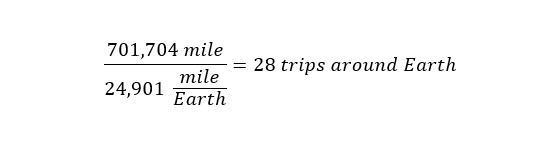


The total amount of Christmas lights sold in the United States each year would equal traveling around the Earth 28 times.  Wow!  That is an enormous amount of Christmas light sold each year.  The enormous number made me question the total amount of Christmas lights which are sitting in boxes in closets, attics, and garages in American houses across the country.  Additionally, a certain percentage of this enormous amount of purchased Christmas lights must be recycled.


If the Wikipedia page for Christmas Lights is consulted regarding the recycling of Christmas lights, the following information can be found:


Christmas lighting does lead to some extensive recycling issues. Every year, more than 20 million pounds of discarded holiday lights are shipped to Shijiao, China (near Guangzhou), which has been referred to as "the world capital for recycling Christmas lights".[28] The region began importing discarded lights around 1990 in part because of its cheap labor and low environmental standards.[28] As late as 2009, many factories would simply burn the lights to melt the plastic and retrieve the copper wire, releasing toxic fumes into the local environment.[28] A safer technique was then developed that involved chopping the lights into a fine sand-like consistency, mixing it with water and vibrating the slurry on a table causing the different elements to separate out, similar to the process of panning for gold.[28] Everything is recycled: copper, brass, plastic and glass.
More and more cities in the U.S., for example, are setting up sensible alternatives and schemes to recycle Christmas lights, with towns organizing drop-off points for handing in old or discarded lights.[29][30]
Installing holiday lighting may also be a safety hazard when incorrectly connecting several strands of lights, repeatedly using the same extension cords, or using an unsafe ladder during the installation process.


The total amount of Christmas lights (in weight) which are shipped to China each year is around 20 million pounds.   I wonder how much material (copper, brass, plastic, and glass) -- percentages of each are recovered.  And used for what?  The process of recycling is interesting and worth reading about for further information.


Conclusion...


The Christmas holiday is a time of celebration.  At the same time, the holiday is an opportunity for families to gather together and catch up on life.  The fun facts calculated and gathered surrounding the Christmas holiday are perfect to add into a trivia game or dinner conversation.  The analysis above showed that the enormous amount of Christmas trees would add up (stack up to) to enough miles to equal 1.4 times traveling around the Earth.  Further, the total number of Christmas trees planted on farms would equal a distance equivalent to traveling around the Earth 16 times.  That is amazing to say the least.  That is a large amount of wood to recycle or burn.


And what about the Christmas lights which are sold each year in the United States?  The total distance of all of the strands of lights sold in the United States each year would be equivalent to traveling around the Earth 28 times.  My goodness that is quite a large amount of Christmas lights sold each year.  Imagine the total amount of Christmas lights which are sitting in boxes in closets, attics, and garages around the United States.  To add to that, 701,704 miles are purchased each year.  Christmas time is a very popular holiday of the year.  Have a great holiday celebration!!


Related Blog Posts:


Parameters: How Much Ice Is Melting In The Antarctic? Enough To Cover Texas?


Parameters: How many sticks of butter are contained in 7.5 million pounds of butter?


South Carolina Governor Henry McMaster asks lawmakers for $1,228,000,000 For Recovery from Hurricane Florence?


Boston Natural Gas Explosion Reveals Old Piping Needs Replacement - Enough To Travel To Colorado?


A Forecaster Predicts That Hurricane Florence Will Drop Enough Rain To Fill 18,400 Mercedes-Benz Superdomes

Hurricane Harvey Drops Enough Rain On Houston To Fill 560 Dallas Cowboy Stadiums


How Much Water Is Contained In All Oceans Around The Globe?


Storm Raises Water Level In Lake Cachuma By 31 feet, How Much Water Is That?


How To Make Sense Of Water Flowing At 100,000 Cubic Feet Per Second


Can 11 Trillion Gallons Of Water Fill 14,000 Dallas Cowboys Stadiums?


How Much Rain Did The East Coast Receive From Hurricane Matthew?


How Much Rain Did Haiti Really Receive?


How Much Rainfall Has Dropped On Louisiana?


How Big Was The "Water Bomb" Of Rainfall In Macedonia?


How Much Rain Did Huauchinango (Mexico) receive?


How Much Rain Did Elliot City (Maryland) Really Receive?


If The Mosul Dam Breaks, The City Of Mosul Would Be Under 65 Feet Of Water?


What is the volume of water in a few inches of rain?


Volume of Waste in the Mine Spill (in Brazil) Equivalent to 78 Deepwater Horizon Oil Spills


Monday, October 8, 2018

NIAID Director Anthony Fauci: How Should We Communicate About Crises?


The news capitalizes off of spreading fear -- which gathers 'eyeballs' and clicks.  A few years ago, Author David Altheide wrote a book titled "Creating Fear" - about the news and the control which is created by the atmosphere of fear surrounding society.  With that being known, how does the public receive a 'fear' or 'crisis'?  What is the correct course of action (for the public) given that the media (news) organizations are living off of perpetuating the notion of 'fear' or 'crisis'?  These are all credible questions.


There are more than a single side to each issue.  In the current issue of perpetuating "fear" or "crisis," those in positions (government, state, and local officials) can actually make a large difference by being more open and transparent into the state of a situation.  An 'disease' or 'outbreak' is a perfect example to use as shown below.  A few years ago, Director Anthony Fauci of the National Institute of Allergy and Infectious Diseases (NIAID) wrote a short piece 'Op-Ed' titled : Zika and Beyond: Communicating about Crises  for the NIH website.  The piece is shown below in full:


During the Ebola outbreak, we admitted two patients infected with the virus to the NIH Clinical Center. People would ask me, “My goodness, are you putting us at great risk?” So I would ask them, “How did you get to work this morning?” They would answer by saying something to the effect of, “Well, I got on the Beltway and drove to the NIH.” This is a high-speed road that encircles Washington, DC, and carries more than 200,000 vehicles per day. I would point out, “Well, your commute posed a greater risk to you than an Ebola patient at the Clinical Center.”
We live in a world where we take risks every day. When you have been taking a risk every day, for the last 20 or 30 years, you may be fully aware of the risk, but you have learned to live with it and it does not bother you.
However, it is very interesting to me how people react when they are confronted with a new risk. When a new risk emerges, especially if it is highly publicized, people often start to consider the new risk to be more significant than others that, in reality, pose a greater threat. This is human nature. We saw it with Ebola, we saw it here in Washington, D.C., with the anthrax attacks, and we are starting to see it now with Zika.
Zika virus is not actually new. It was first recognized in 1947 in a monkey in the Zika forest of Uganda. It was not known to infect humans until 1952, and it stayed under the radar screen for a long time. That was understandable. The virus circulated relatively unnoticed in areas of Africa and Southeast Asia until 2007, when it caused an outbreak on the Yap Islands in Micronesia. In 2013, the virus caused a much larger outbreak in French Polynesia. Despite this spread, few people paid much attention to the virus because the disease it caused was thought to be mild.
Now, of course, the situation has changed. The current outbreak that started in Brazil last year has provided new evidence that Zika virus can also cause a serious birth defect called microcephaly in babies born to infected mothers. Zika virus also has now been associated with Guillain-Barré syndrome. Now, Zika has our attention.
Many people are now hearing or reading that Zika is in their state. By the end of April, the CDC had identified Zika cases in 43 states. Some people are starting to ask whether they should travel to certain states that have reported cases of Zika. In that regard, it is important to note that none of these infections was acquired locally through infected mosquitoes.* So far, all of these cases have been acquired through travel (or sexual contact with someone who has traveled) to countries or territories where Zika is circulating locally.
While we have not yet seen locally acquired cases of Zika in the continental United States, this almost certainly will occur. It is unlikely that these locally acquired cases will become sustained and widespread. However, we must be prepared to deal with them. Certainly, there is no reason to panic. We are going to have to do a lot to educate the public about what the risk is and what the risk is not, and to help people keep the risk in perspective. We should all recall what happened in the United States not so long ago, when an individual came from Liberia and was hospitalized with Ebola in Texas, and then two nurses became infected when caring for him. This sad situation sparked a panic that there was going to be a major outbreak of Ebola in the United States. In reality, there was virtually no chance that would happen.
As concerning as the Zika virus is, we must remember and remind people that it is just the latest disease in a perpetual series of emerging and reemerging infectious disease threats. The timeless threat of new diseases—or old diseases that start to appear in new places or new ways—is now amplified by factors such as urban crowding, international travel, and other human behaviors.
An evolving situation such as the current Zika outbreak, in which there are still unknowns, will create a lot of concern and even panic on the part of some people. We in the public health sector must be crystal clear in articulating exactly what we know and what we still need to know about the threat, and in helping people understand how this new risk compares to risks they willingly assume every day. With that perspective, people will be better able to understand what rational steps they can take to protect themselves.


For more information about Zika Virus, please visit: http://syndication.nih.gov/zika.htm


As I mentioned above, there are more than a single side to every story.  Further, in the introductory paragraph, I asked the question regarding what the public could do to receive a 'fear' or 'crisis' story.  Yes, I am asking what the responsibility is of the public.  That might seem counter intuitive to the normal flow of information.  Although, to a sizable percentage of the U.S. citizens, the question is not out of the ordinary.


We, as Americans need to to change -- when reading or hearing news from either media organizations or government (including state, regional, and local) -- the way that the news permeates our minds and further travels into our lives.  Fact checking on all of our parts could clarify a large amount of controversy and lead to less emotion and more logical conclusions.  Last but not least, reading can serve as a wonderful conduit through which to educate ourselves about issues.  Too few of us read.  Which is concerning.  I understand that not all of American citizens' are 'readers', but reading different forms of news could help clarify misunderstandings.  Additionally, coherent discussions can go a long way to resolve differences.  Mediation is an important field which is fueled by our inability to sit or stand in each others' presence and have coherent discussions.


Regardless of where any one of us stand on an issue, each of us could be served well to put 'crisis' or 'fear' in society into perspective.  In the future, watch to see how these organizations create 'fear' or 'crisis' and come up with your own solutions.  Feel free to share those solutions below.  Have a great day!


Related Blog Posts:


NIH Director Francis Collins Makes A Statement Regarding Sexual Harassment In Science


National Institutes of Health - Anti-Sexual Harassment Web site


National Science Foundation Sexual Harassment of Women Study


Thoughts: What Does National Institute of Health Director Francis Collins get asked in front of Congress?


Parameters: What is the 'mission' of the National Institute for Aging?


NIH Director Updates Congress On Research Progress


Dr. Francis Collins and Bill Gates Discuss Global Health And Genomics


How Much Do New Drugs Cost To Bring To The Pharmacy Counter?


Is Disease Or Treatment Different In Women?


Unraveling The Resistance Of Antibiotics!


How Do Chemists Discover New Drugs? A Brief Introduction!


Saturday, September 29, 2018

Astrophysicist Neil deGrasse Tyson explains why 'Space Force' is nothing new...


In a previous blog post, I introduced the concept of a space force as portrayed in popular news.  Remember at the end of the post, there was a brief video in which Commander Scott Kelly was interviewed in which the introduction of the 'orbital perspective' was unveiled.  What is an 'orbital perspective'?


What Commander Kelly was arriving at was the mutual respect with which space is explored by many different nations.  Specially, when each nation is collectively working in the 'International Space Station' -- looking back through the window -- they collectively see 'Planet Earth' - not each geographical location from where each have travelled from.  All that is visible from space is "One Planet Earth" which implies that all residents (of Planet Earth) should be working together rather than waging war between each other.  Which is why a 'space force' does not necessarily make sense.


Although, ever since each nation pursued travel into space, the commercialization from that initial travel has produced a presence over the past decade which is staggering in comparison to just five decades earlier.  The commercialization of space -- near commercialization -- more appropriately, each nation's presence in space had made the endeavor more about information collection rather than actual warfare.  Hundreds of satellites reside in near orbit and collect/serve as information carriers to various corporations which span across the globe (i.e. the planet).


With the above in consideration regarding the tremendous growth in space, what role do physicists play in space?  Or helping to create a 'space force'?  As you will see shortly, in the video segment from the YouTube channel of MSNBC, Astrophysicist Neil deGrasse Tyson explains why the concept of 'Space Force' is not new and misunderstood:


Nice.  Space warfare is not necessarily warfare as it is more about access to information.  The overall arching statement made by Professor Neil deGrasse Tyson regarding a space force in the video above is the 'fall out' from shooting satellites or other commercial space infrastructure down is going to be enormous and impact us all in some direct or indirect way. 


Which is to say, that if a certain government/enemy force were to shoot down a satellite or space hardware, the 'fall out' would be dangerous to say the least.  The explosion from destroying a satellite or other space hardware would fragment (break apart) into tiny pieces -- each of which -- would be traveling at a speed of 18,000 miles per hour.


To put that speed into perspective would be to cast that speed into traveling around planet Earth.  The circumference of the Earth is 24,901 miles -- the total distance around Earth at the equator.  Traveling at a speed of 18,000 miles per hour, a traveler would go around the entire planet Earth in 1 hour and 38 minutes.   The point is that destroying a piece of equipment in space could very easily result in destruction of other satellites -- such as our own.  We could potentially lose out in the process of shooting another country/nations' satellite down.


There is no need at the present time to create an independent 'space force' in the United States.  Each citizen of the planet should be working together rather than finding divisions.  Each country should aspire to work towards common goals -- especially when concerned with reaching out into space and beyond. 


Related Blog Posts:


Thoughts: Instead of forming a "Space Force" why don't we work together to solve the world's problem?


Scientists should find similarities rather than focus on differences


What is a typical day like for a systems engineer at JPL?


Wednesday, September 26, 2018

Was Enough Coal Ash Spilled Into A Local Lake To Fill Up 2/3 Of An Olympic Sized Swimming Pool?


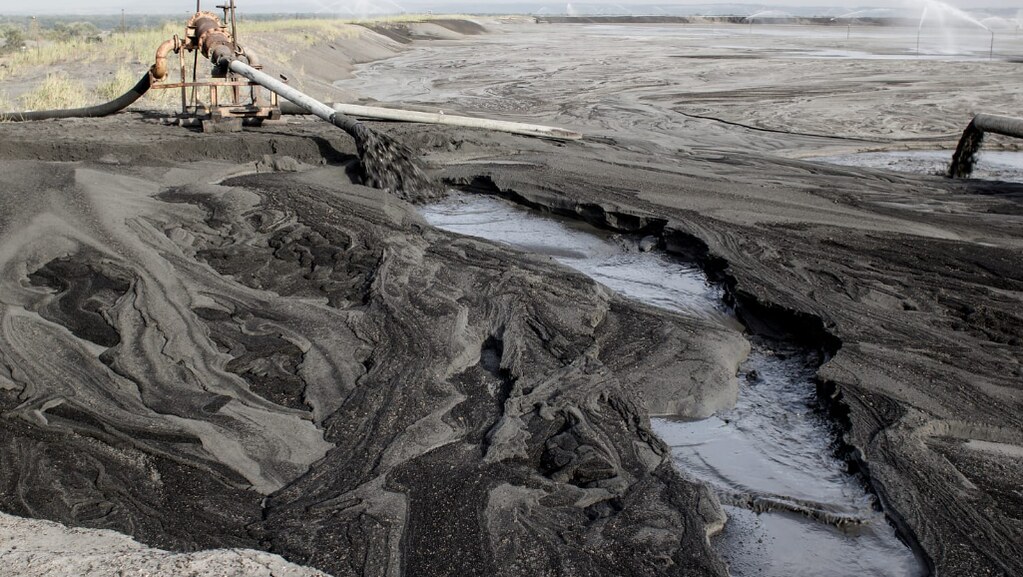
Hurricane Florence has no doubt had a devastating and long lasting impacts on the East Coast which will unveil themselves over time.  Already at the outset, a forecaster predicted that nearly 17 trillion gallons of rain would fall over four states - which has partially come true.  The damage has caused lawmakers to call or write elected politicians in Washington D.C. for around $1.2 billion - just for South Carolina alone.  Unknown to most, is that additionally, other potentially dangerous spills have occurred which have not made the popular news cycle.  As noted in an e-mail from Politico Energy, a coal ash pit broke and spilled a fair amount of toxic solution into a lake as stated below:


Coal ash collapse: Duke Energy said Saturday that heavy rains from Florence had caused the collapse of a slope in the coal ash landfill at a closed plant outside Wilmington. About 2,000 cubic yards of the toxic waste was displaced, the company said in a statement — roughly enough to fill two-thirds of an Olympic-sized swimming pool — although it could not say how much reached a lake that the plant used as a cooling pond or if any coal ash reached the Cape Fear River. Environmental groups that have been fighting in court to force the cleanup of coal ash pits pointed out that the lake is used for recreation and fishing. "After this storm, we hope that Duke Energy will commit itself to removing its ash from all its unlined waterfront pits and, if it refuses, that the state of North Carolina will require it to remove the ash from these unlined pits," Frank Holleman with the Southern Environmental Law Center said in a statement.


In the blog post below, we will verify the statement: "About 2,000 cubic yards of the toxic waste was displaced, the company said in a statement -- roughly enough to fill two-thirds of an Olympic-sized swimming pool..."  Additionally, another potential disaster -- a coal ash spill will be analyzed at the very end of the blog post from South Carolina.


What Is The Volume Of An Olympic-sized Swimming Pool?


In a recent blog post regarding the amount of oil flowing through a pipeline in Canada, the Olympic-sized swimming pool was used as a metric -- i.e. a volume which to compare other large volumes too.  A typical Olympic-sized swimming pool is shown in the picture below:


The volume of an Olympic-sized swimming pool is 660,430 gallons as noted in the previous blog cited above.  With the metric -- i.e. Olympic-sized swimming pool -- defined in terms of volume, we can proceed to verify the statement above -- to prove that the amount of coal ash spilled would fill nearly 2/3 of an Olympic-sized pool.  Let's get on with the analysis...


In order to compare the amount of coal ash which spilled to the volume of an Olympic-sized swimming pool, both values (statistic and metric) need to be defined in uniform (the same) units of measurement.  The author states the volume of coal ash in units of 'cubic yards' whereas the volume of an Olympic-sized swimming pool was cited above in units of 'gallons'.  Therefore, to proceed forward, a unit conversion is necessary: change units from 'cubic yards' to 'gallons'.


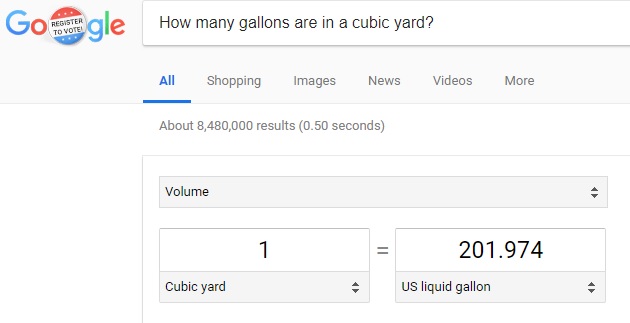
To determine the unit conversion factor from units of 'cubic yards' to 'gallons', first we consult Google with the following question: How many gallons are in a cubic yard?   The answer is shown below:


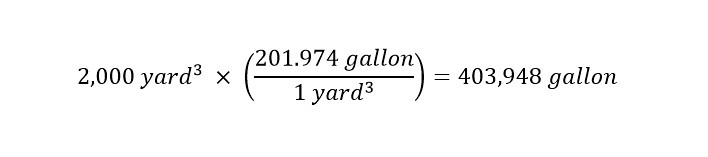
The answer indicates that there are 201.974 gallons in a single cubic yard.  With this unit conversion factor in hand, the conversion from 'cubic yards' to 'gallons' is accomplished below:


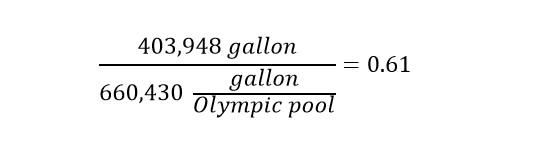
Now that both statistics (coal ash spill and metric) are expressed in the same units of measurement, a simple division of the two values will yield the number of Olympic-sized swimming pools which could be filled with 2,000 cubic yards of coal ash as shown below:


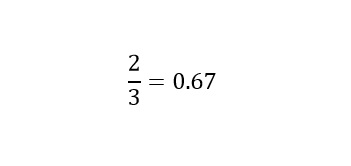
How do we make sense of the answer shown above?  Comparing the amount of coal ash which spilled to the volume of an Olympic-sized swimming pool yields the number 0.61 -- but remember the author states that the amount which spilled is around 2/3 of an Olympic-sized swimming pool.  Therefore, compare 0.61 to 2/3 -- a fraction computed below:


The answer indicates that the two numbers -- calculated 0.61 and 0.67 (2/3) are within 10% of one another -- which is good.  The author was good in his assertion in the excerpt above.  Readers of this blog site might inspect the answer and think critically about the size of the spill relative to other spills discussed in previous blogs.  Why worry about a volume of coal ash equivalent to 2/3 the size of an Olympic-sized swimming pool?


The fact of the matter is that any sizable amount of coal ash which leaks into a natural waterway could harm the public and future damage down the line.  Which is unacceptable.  As you will learn below, the analysis goes further and identifies a much larger volume of coal ash which could potentially cause an unbelievable amount of damage to waterways.


South Carolina - Potential Spill?


Recently, in the news, the statistic was reported from South Carolina which caused me to wonder how the reported number compares to the reported one above.  The article was titled "SC coal ash pit with 200,000 tons of waste could start taking on water Tuesday":


A pit of coal ash holding some 200,000 tons of toxic sludge in Conway could start taking on water Tuesday as the Waccamaw River sloshes over its banks.


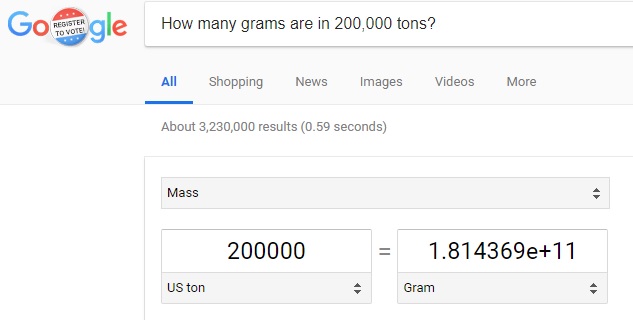
How does the reported number or value of 200,000 tons compare to 2,000 cubic yards?  To start the analysis, a unit conversion factor is needed.  We can consult Google with the following question: How many grams are in 200,000 tons?  The answer is shown below:


In previous blog posts, the methodology follows that above, which is to determine a 'unit conversion factor' then convert initial numbers to the desired units.  For the purposes of brevity, taking a slightly different route, we just asked Google to help us convert from units of 'ton' to 'gram'  directly.


With the mass determined in units of 'grams', the proper way to extract a volume of a given mass of a substance is to use the density of a substance.  Using the density, a volume can be determined as shown below:


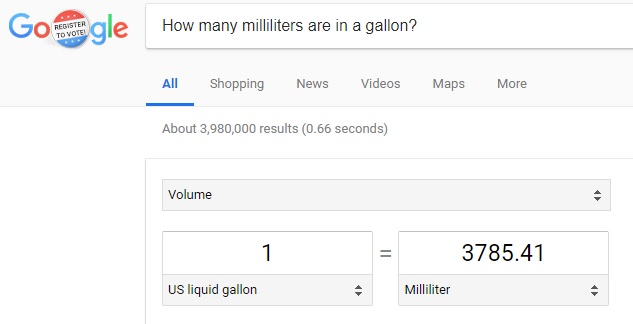
The answer is expressed in units of 'milliliters'.  A couple remaining steps are needed to arrive at a final answer.  First, we need to consult Google with the following question: How many milliliters are in a gallon?  The answer is shown below:


Next, the desired units are 'gallons' which can be determined using the conversion factor above.  The number of gallons in 200,000 tons is where we would like to travel towards in the present analysis.  To get there, the conversion of mass to a volume needs to be accomplished.  This can be done by using the concept of a substances' density -- amount of mass per volume.  Below, the conversion of the mass of coal ash (mass) is converted to a volume (milliliters) is shown:


The approximation above is that the density of water was used in place of the density of 'coal ash' which is closer to 1.6 gram/mL.  Readers might be slightly disappointed, although, the final value will not change dramatically.  The conversion from 'milliliter' to 'gallon' is shown below:


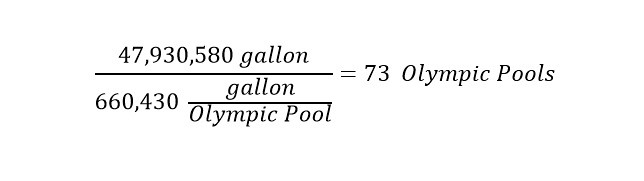
Last but not least, the total amount of Olympic-sized swimming pools which could be filled with 47.9 million gallons of coal ash - potentially which might spill in South Carolina is shown below:


The answer indicates that the potential spill of 200,000 tons would have been equivalent to 73 Olympic-sized pools.  Compared to the amount which spilled in North Carolina, the above value is very large and could cause an unbelievable amount of damage to the environment.  The analysis above has shed light on two very different volumes of coal ash.  At the same time, the analysis gives the reader the ability to analyze the amount of coal ash which could damage the environment and is reported in two different news articles.


Conclusion...


Looking at this value might not seem large compared to the total quantity of rain which fell as a result of Hurricane Florence.  Although, the toxic nature of coal ash could have much greater damage than flooding.  Not to say that flood damage is not bad too to residents.  Contaminating the local water supply for decades could be a much greater risk.  For the present time being, the dams have held up.  That could be temporary given the tremendous amount of rain which has already fallen.


Never the less, the spill in Wilmington is dangerous enough to have potentially damaging effects which might not be realized for quite a while.  The potential amount under threat in other areas should be concerning.  Mining companies should be regulated to a greater extent regarding the large storage pools of coal ash which are commonly stored near mining sites.  The analysis above drives home the point which is that the potential spills along with those already occurring can be quite devastating to the surrounding ecosystems and natural resources on which residents rely.


Related Blog Posts:


South Carolina Governor Henry McMaster asks lawmakers for $1,228,000,000 For Recovery from Hurricane Florence?


Boston Natural Gas Explosion Reveals Old Piping Needs Replacement - Enough To Travel To Colorado?


A Forecaster Predicts That Hurricane Florence Will Drop Enough Rain To Fill 18,400 Mercedes-Benz Superdomes

Hurricane Harvey Drops Enough Rain On Houston To Fill 560 Dallas Cowboy Stadiums


How Much Water Is Contained In All Oceans Around The Globe?


Storm Raises Water Level In Lake Cachuma By 31 feet, How Much Water Is That?


How To Make Sense Of Water Flowing At 100,000 Cubic Feet Per Second


Can 11 Trillion Gallons Of Water Fill 14,000 Dallas Cowboys Stadiums?


How Much Rain Did The East Coast Receive From Hurricane Matthew?


How Much Rain Did Haiti Really Receive?


How Much Rainfall Has Dropped On Louisiana?


How Big Was The "Water Bomb" Of Rainfall In Macedonia?


How Much Rain Did Huauchinango (Mexico) receive?


How Much Rain Did Elliot City (Maryland) Really Receive?


If The Mosul Dam Breaks, The City Of Mosul Would Be Under 65 Feet Of Water?


What is the volume of water in a few inches of rain?


Volume of Waste in the Mine Spill (in Brazil) Equivalent to 78 Deepwater Horizon Oil Spills

Monday, September 17, 2018

Typhoon Mangkhut Drops Enough Rain On Philippines To Fill 25,000 Superdomes per hour?


Source: Time


As Americans were watching Hurricane Florence ravage the East Coast of the United States over the weekend, residents of the Philippine Islands were experiencing an equivalent destruction of their country from Typhoon Mangkhut.  According to the New York Times article titled "See Inside Typhoon Mangkhut in 3-D" at the height of maximum rainfall over the Philippines, the rate of rainfall reached 11.7 inches as shown in the excerpt below:


Rain tends to be heaviest near the center of a storm, in what is known as the eyewall, visible here in red. The highest rainfall rate for Typhoon Mangkhut reached 11.7 inches per hour inside the southern wall on Friday.


With this astounding rate of rainfall in mind, regular readers of this site will naturally ask themselves the following question:


How many Superdomes were filled per hour by Typhoon Mangkhut?


In the paragraphs below, the amount of Superdomes are calculated using dimensional analysis.  The result as indicated (potentially 25,000 Superdomes per hour) is astonishing.  Following the analysis is a video confirming the astounding number which should blow your mind.


How Many Superdomes Per Hour?


Basically, for the current blog post, the same methodology which was used to calculate the number of Superdomes which could be filled with the predicted rainfall due to Hurricane Florence - which I posted last Friday.  The Mercedes-Benz Superdome is located in Louisianna and has an interior volume of 125,000,000 cubic feet.  Shown below is a picture of the Mercedes-Benz Superdome:


Source: The Advocate


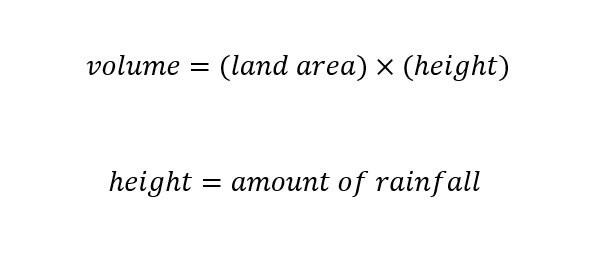
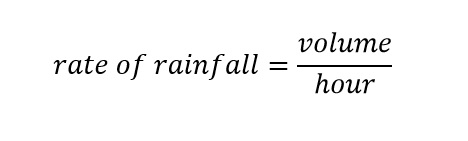
Superdomes can be a 'metric' which are commonly used to cast large (enormous) values of volumes or statistics popularly reported in the news.  The maximum rate of rainfall reported in the New York Times article above is a perfect candidate along with the landmass of the Philippine Islands -- which makes a volume -- to be used in an analysis with the metric above used.  The volume of rainfall can be expressed as an equation as shown below:


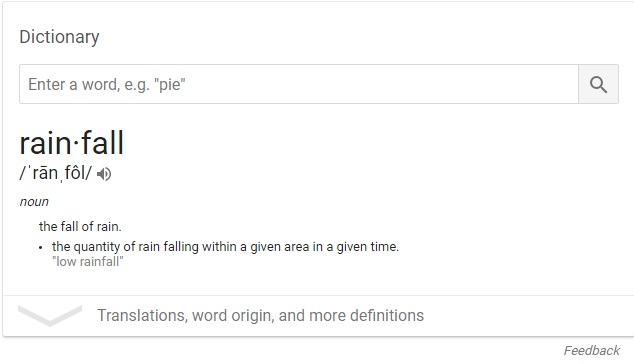
The volume for a geographic area is the land mass area multiplied by the amount of rainfall over the given land mass area.  If we consult Google with the following question: Rainfall?  The definition of the term 'rainfall' is shown below:


The definition of rainfall is 'the quantity of rainfall falling.'  To begin the analysis (with actual numbers) the land mass (total area) of the Philippine Islands needs to be determine.  As usual, Google is consulted with the following question: Philippine Area?   The answer is shown below:


Notice that the area (land mass) is expressed in units of measurement of 'square mile'.  When the maximum rainfall is reported in units of 'inches', a decision to convert one number to the other needs to be made.  For this analysis, 'inches' will be the unit of measurement for analysis -- at least the beginning of the analysis.  In order to convert the land mass area of Philippine Islands from units of 'inch' to 'mile' the following question needs to be asked in a search engine like Google: How many square inches in a square mile?  The answer is shown below:


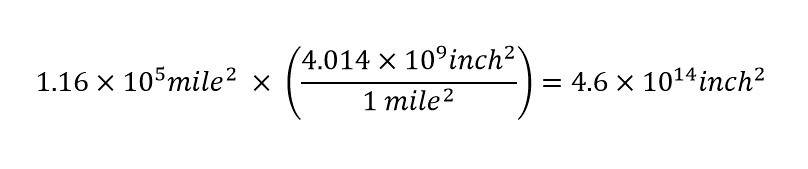
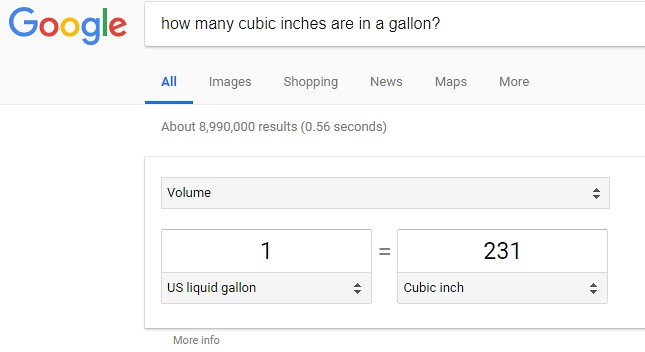
For every single square mile, there are 4.014 billion square inches.  The conversion of units from 'square miles' to 'square inches' is shown below:


The answer above shows that Philippines is around 116 thousand square miles which when converted to square inches turns out to be 460 trillion square inches.  Now that the land mass area is converted to units of square inches, the volume of rain which fell at a maximum on Friday due to Typhoon Mangkhut can be calculated using the expression for volume from above:


Wait?  The above equation is 'rate of rainfall' -- whereas I stated that the volume was being computed above?  Why the difference?  As I stated above, the amount of rain falling over and hour was reported to be 11.7 inches/hour.  Which is a rate.  Therefore, the volume is actually the rate of volume of rainfall over a given time as shown below:


With 11.7 inches/hour of rainfall pouring down due to Typhoon Mangkhut, the total amount (volume) of rain would be 5,400 trillion cubic inches per hour of rain.  Wow!  Based on the calculations in the previous blog post regarding the total amount of rain predicted (by a forecaster) due to Hurricane Florence, lets cast the rate of rainfall into comprehensible units.  To do so, a unit conversion needs to be accomplished from units of 'cubic inches' to 'gallons'.  A conversion factor needs to be determined.


If the following question is typed into Google: How many cubic inches are in a gallon?  The answer is shown below:


With the conversion factor known, the conversion is carried out by using the same methodology as above:


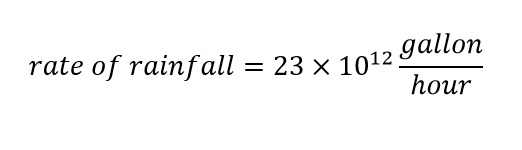
Therefore, the amount of rainfall over the Philippine Islands at maximum rainfall is shown below:


Wow!  23 trillion gallons in a single hour.  In my previous blog post about the predicted amount of rainfall over four states (in a few days) was expected to be 17 trillion.  The difference shows that Typhoon Mangkhut is larger than Hurricane Florence.  This is not to say that Hurricane Florence is not inflicting a large amount of damage in the United States over the weekend.  The East Coast is in terrible shape and we are keeping the residents there in our thoughts.  Be safe.


The metric which has been used to visualize large volumes of rain is the Mercedes-Benz Superdome as shown above.  With a volume of 125,000,000 cubic feet, the Superdome is a perfect metric to which compare the large volume of rain falling over a given region in a storm.  To calculate the number of Superdomes which could be filled with 23 trillion gallons/hour, first a unit conversion needs to be accomplished.  In order to compare the 23 trillion gallons/hour to 125,000,000 cubic feet, a unit conversion from 'gallon/hour' to 'cubic feet/hour' needs to be accomplished.


To determine the number of 'cubic inches' are in a 'cubic feet', we type into Google the following question: How many cubic inches are in a cubic foot?  The answer is shown below:


The conversion of units between 'cubic inch' and 'cubic feet' is shown below:


Next, to determine the number of Superdomes which could be filled with the amount of rain falling over an hour over the Philippine Islands is shown below:


Wow!  The total amount of Superdomes which would be filled at the rate of rainfall equal to 3.1 trillion cubic feet per hour is a whopping 25,000 Superdomes per hour.


The final question is the following:


Does the amount of rainfall -- 3.1 trillion cubic feet per hour over the Philippine Islands make sense?


To answer the question above, lets view the video from YouTube below taken over the weekend during the storm - Typhoon Mangkhut:


Wow!   I am left speechless by the video above.


Conclusion...


Oh my goodness?  The amount of rain is enormous and unparalleled.  Between the total number of storms hitting the globe over the weekend, the amount of rainfall is historic and unparalleled in volume.  The rainfall must be surging into the hundreds of trillions of gallons of water falling on land masses like Philippine Islands and the East Coast of the United States of America.  Destruction is inevitable.  Just think of the amount of time and effort which will be required to restore basic resources like power and water?  The destruction is huge and should not be understated.  Keep the residents experiencing these terrible storms in our thoughts and prayers.


Related Blog Posts:


A Forecaster Predicts That Hurricane Florence Will Drop Enough Rain To Fill 18,400 Mercedes-Benz Superdomes

Hurricane Harvey Drops Enough Rain On Houston To Fill 560 Dallas Cowboy Stadiums


How Much Water Is Contained In All Oceans Around The Globe?


Storm Raises Water Level In Lake Cachuma By 31 feet, How Much Water Is That?


How To Make Sense Of Water Flowing At 100,000 Cubic Feet Per Second


Can 11 Trillion Gallons Of Water Fill 14,000 Dallas Cowboys Stadiums?


How Much Rain Did The East Coast Receive From Hurricane Matthew?


How Much Rain Did Haiti Really Receive?


How Much Rainfall Has Dropped On Louisiana?


How Big Was The "Water Bomb" Of Rainfall In Macedonia?


How Much Rain Did Huauchinango (Mexico) receive?


How Much Rain Did Elliot City (Maryland) Really Receive?


If The Mosul Dam Breaks, The City Of Mosul Would Be Under 65 Feet Of Water?


What is the volume of water in a few inches of rain?


Volume of Waste in the Mine Spill (in Brazil) Equivalent to 78 Deepwater Horizon Oil Spills



Friday, September 14, 2018

A Forecaster Predicts That Hurricane Florence Will Drop Enough Rain To Fill 18,400 Mercedes-Benz Superdomes


Source: Axios


Hurricane Florence has arrived on the East Coast of the United States with a force which seems unparalleled compared to previous storms.  The category has changed with time, though, without dispute, hurricane Florence is present and causing damage which will take years to recover from.  To comprehend the predictions from weather forecasters, dimensional analysis is necessary to cast the enormous predictions into light.  How much rain is going to fall on the East Coast from hurricane Florence?  Here is an excerpt from a weather forecaster interviewed by 'Mashable' in an article titled "Hurricane Florence is forecast to dump a historic amount of rain. Here's how much" which states the huge amount of potential rain to be dropped:


Meteorologist Ryan Maue of WeatherModels tweeted some projections on Thursday morning. 
Maue's models suggest that around 17 trillion gallons of rain will fall across North Carolina, South Carolina, Virginia, and Georgia with some spots receiving as much as 30 inches of rain before Florence is finished. 


According to the excerpt shown above, 17 trillion gallons is predicted to fall on North Carolina, South Carolina, Virginia, and Georgia over the next few days.  This will cause terrible damage to the infrastructure in cities lining the coast and displace many thousands of residents from services (which are much needed) such as electricity, emergency services, and make returning to work nearly impossible.  In order to understand the terrible destruction of the storm, the amount of rain (17 trillion) should be placed into context.  In the paragraphs below, dimensional analysis is used to compare the amount of rain to the number of Mercedes-Benz Superdomes which could be filled with 17 trillion gallons.


How Much Space Occupies The Mercedes-Benz Superdome?


The metric which has been chosen to compare the enormous amount of rain that is expected to fall over the 4 states mentioned above on the East Coast over the next few days is the Mercedes-Benz Superdome.  The Superdome is located in Louisianna and has an interior space (volume) equal to 125,000,000 cubic feet of space.  Yes, I said 125,000,000 cubic feet of space as shown below:


Which fills the Superdome shown below:


Source: The Advocate


That is an large space indeed.  Football games are played in the Superdome and at max capacity will hold a total of 73,000 people.  Although, during a super bowl, the capacity has expanded beyond capacity to hold upwards of 79,000 people.  Needless to say, when an HUGE volume is reported of liquid such as the amount of rain which will fall over the next few days, a perfect metric to compare is that of the Mercedes-Benz Superdome.


According to the excerpt taken from the news, the amount of rain expected to fall is 17 trillion gallons.  First, lets look at the amount of zero's after 17 -- trillion.  If 'Wikipedia' is consulted for the page defining 'trillion', the following definition is shown below:


Trillion (short scale) (1,000,000,000,000; one million million; 1012; SI prefix: tera-), the current meaning in both American and British English.


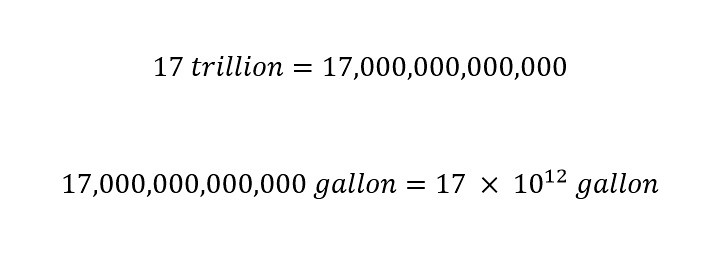
Therefore, if the number 17 trillion is written out in entirety, the number would appear as follows:


The first line above shows 17 trillion in long form.  For the purpose of shortening up a number to move around in calculations used in dimensional analysis, the value 17 trillion could be expressed in 'Scientific Notation' as shown in the second line above.  Which makes writing and expressing the number much easier.  Compared to writing out all of the unnecessary zero's involved.


Notice that the unit of measurement in which the amount of rain projected to fall are expressed in units of 'gallons'.   Remember that the interior space of the Superdome is expressed in units of 'cubic feet'.  Therefore, if the two numbers are going to be used in the same analysis (the purpose of the blog post), then a 'unit' conversion is necessary.  For this blog post, I will arbitrarily use the units of 'cubic feet' as a comparison.  We just as well could have converted over the units of 'cubic feet' to 'gallon's in order to compare the two values of interest (i.e. volume of Superdome and volume of rain).


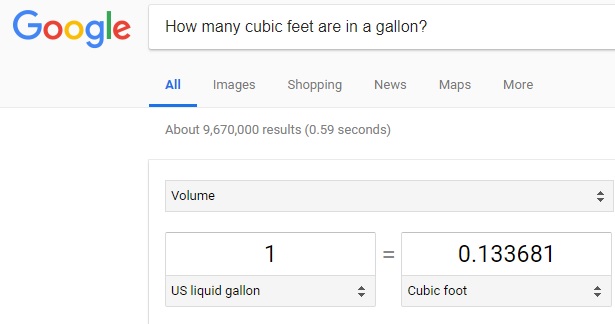
In order to convert the units of measurement from 'gallon' to 'cubic feet', a conversion factor is needed.  To simplify the search for a conversion factor, consult Google with the following question: How many cubic feet are in a gallon?  The answer is shown below:


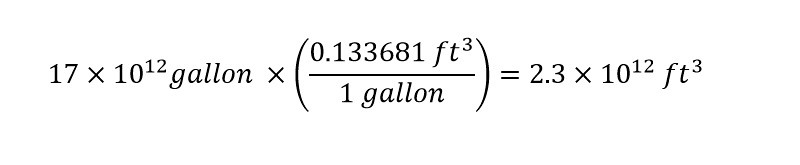
For every gallon, there are 0.133681 cubic feet.  Written as a conversion factor, the unit conversion from gallon to cubic feet is shown below:


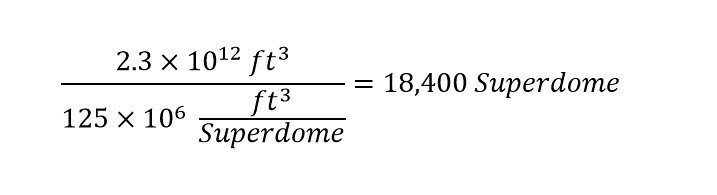
The answer to the conversion shows that 17 trillion gallons is equivalent to 2.3 trillion cubic feet.  Which means that 17 trillion gallons of water is equivalent to 2.3 trillion cubic feet of water.  Same volume, different units of measurement. Now that both values are in the same units of measurement -- 'cubic feet' -- a simple division of two values (total volume of rain divided by total volume of a single Superdome) yields the total number of Mercedes-Benz Superdomes which would be filled with 17 trillion gallons of rain:


The answer indicates that if 17 trillion gallons were poured into 18,400 Superdomes, there would be no water remaining.  Wow.  With this enormous amount of Superdomes as a result, there should be no wonder why residents should be concerned about their health and safety.  That enormous amount of rain will inevitably wreak havoc on the four states listed above.


Conclusion...


In the blog post above, the number of Mercedes-Benz Superdomes were calculated which would be needed to hold a total volume of rain of 17 trillion gallons.  At this moment, you may be wondering how 17 trillion gallons compares to the amount of rain that Hurricane Harvey dropped on Houston (Texas).  Hurricane Harvey dropped 58.3 billion cubic feet of rain.  That is enough to fill 560 Dallas Cowboy Stadiums.  Note that the total amount of rain is distributed across very different amounts of land masses.  Different amounts of rain across different proportions of land.  Still, these hurricanes are dropping enormous amounts of water (in the form of rain) which is wreaking havoc on the surrounding land.


Hopefully, the blog post above along with other dimensional analysis blogs on this site shed light on the severity of storms hitting the world over the past two years.  In the index of blogs below, other storms have been analyzed in a similar fashion.  Regardless of the size of the storm, any loss of life is tragic and unacceptable.  Please keep the residents of hurricane Florence in your thoughts over the next few days (and months).  If you are in the path of hurricane Florence, stay safe please.


Related Blog Posts:


Hurricane Harvey Drops Enough Rain On Houston To Fill 560 Dallas Cowboy Stadiums


How Much Water Is Contained In All Oceans Around The Globe?


Storm Raises Water Level In Lake Cachuma By 31 feet, How Much Water Is That?


How To Make Sense Of Water Flowing At 100,000 Cubic Feet Per Second


Can 11 Trillion Gallons Of Water Fill 14,000 Dallas Cowboys Stadiums?


How Much Rain Did The East Coast Receive From Hurricane Matthew?


How Much Rain Did Haiti Really Receive?


How Much Rainfall Has Dropped On Louisiana?


How Big Was The "Water Bomb" Of Rainfall In Macedonia?


How Much Rain Did Huauchinango (Mexico) receive?


How Much Rain Did Elliot City (Maryland) Really Receive?


If The Mosul Dam Breaks, The City Of Mosul Would Be Under 65 Feet Of Water?


What is the volume of water in a few inches of rain?


Volume of Waste in the Mine Spill (in Brazil) Equivalent to 78 Deepwater Horizon Oil Spills


Thursday, September 6, 2018

Thoughts: Pause before reacting to news regarding 'Proposed Changes' to EPA and other Federal Agencies


Source: EPA (Twitter)


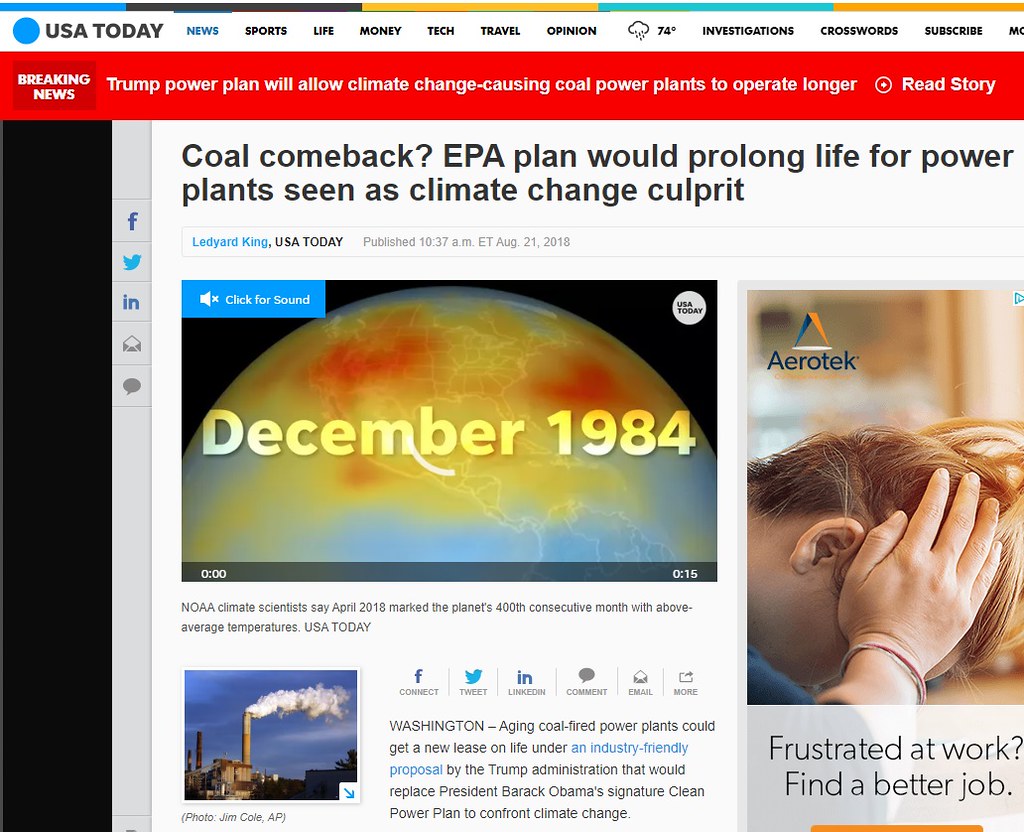
One model of the popular news is based on 'fear' -- propagating/inciting fear -- to get the most 'eyeballs' on a given story.  The thought is to produce news which is extremely controversial in nature and install fear into the story, while receiving the most 'eyeballs' from a given audience.  Don't forget to run ads on the sides of the articles to generate revenue.  Each of us react differently to news.  Take for instance the headline shown below of a recent news article from USA Today shown below:


Source: USA Today


Regardless of the degree of reaction (negative/positive), each of us would be well served to take a pause and consider the degree of threat each story poses to our daily life/safety or to our environment.   In the blog post below, I offer a video in which a former Administrator of the Environmental Protection Agency offers an opinion on the degree of truth behind news bites regarding 'Proposed' changes by either a federal agency (EPA, FDA, USDA, CDC, etc.) or a presidential administration (such as President Trump's administration currently).


Repeal or Not Repeal?


The news is good at producing eye-catching headlines like the one displayed above.  Further, at first sight the headline implies that the 'proposal' to 'repeal' or 'make changes' is absolute and without question.  In previous blog posts on this site, this is not the case at the outset.  More complications come into play when changing or repealing a law which has been enacted.  I came to the understanding of this reality last year while listening to a series of online webinars from the American Association of the Advancement of Science(AAAS).  The Facebook page for the AAAS has a series of webinars which can be viewed on demand.


Dr. Rush Holt, the current CEO of AAAS engaged in a discussion in which he described the reality of repealing or changing a current law enacted by a federal agency or congress -- which was extremely informative.  But why should we be listening to Dr. Rush Holt -- the CEO of AAAS?  The reason is that prior to a career spent in research at Princeton University, Dr. Rush Holt (who is a physicist) served as a U.S Representative for New Jersey's 12th congressional District from 1999 to 2015.  During his tenure in congress, Dr. Holt learned a tremendous amount regarding the processes which turn the wheels moving the country forward on a day to day basis.  Therefore, when Dr. Holt says that laws are in place which can only be replaced by laws which are "better" for the environment -- then I tend to believe him.


Although, what if people (readers) choose not to believe him.  Fair enough.  You may choose to believe the next source I have to provide.  Below is a video of a recent interview between veteran reporter Stephanie Ruhle and former EPA Administrator Christine


Wow.


In the video above, former EPA Administrator Christine Whitman points out the overall complications with the previous EPA Administrator - Scott Pruitt.  Namely, that on a day to day basis, Administrator Pruitt would announce publicly that he was going to 'repeal back an Obama administration regulation'.  Although, as pointed out by former congressman Rush Holt above, that statement is usually followed by legal action -- especially, if the new guidelines put the nation at greater risk of environmental damage.


Remember, to repeal or replace a regulation, the new proposed regulation cannot due more damage to the environment than the previous (or replaced) regulation did.


Additionally, former EPA Administrator Christine Whitman points out that the overall approach to changing (repealing or modifying) an existing regulation has to be done by the following approach: "This is why we think that the existing regulation is bad for the environment and here is the study to back up this assertion" -- along that avenue of reasoning.  Otherwise, the regulation will not be changed at all.


Example-Court Rules against Electric Companies?


Yes, the headline is written correctly.  For all of the news of 'roll-backs' or 'repeals' happening in the Trump Administration, the reality is the opposite.  An example is a lawsuit just ruled against by a panel of judges in Massachusetts.  Here is the news brief from 'Politico Energy' sent yesterday morning via e-mail to subscribers:


COURT SAYS MASSACHUSETTS CARBON CAP APPLIES TO UTILITIES: Massachusetts' top court on Tuesday ruled that electric utilities are indeed subject to the state's major climate change law, including a shrinking cap on carbon emissions imposed last year following an order from Republican Gov. Charlie Baker. The New England Power Generators Association and GenOn argued that the cap cannot apply to the electric sector because it is already regulated under another part of the state law. But the seven-member Massachusetts Supreme Judicial Court ruled that the two parts of the law "complement each other," adding: "Given that the electric sector is one of the largest in-state greenhouse gas emission sources, it would make little to no sense for the Legislature to have excluded it from the critical emission reduction requirements."


The case did not meet the criteria for a reversal or repeal on the ban.  Why would it?  As former EPA Administrator points out correctly, a large percentage of large (huge) corporations are actually falling in line with new environmental regulations (even those set in place by the Obama Administration).   Only the 'outliers' who are in jeopardy from not keeping up with the changing (sustainable) measures are crying out and lobbying the Trump Administration.  Which is attempting to 'roll back' or 'repeal' to protect these dying companies.


In fact, a critical statement made in the video above is that the 'route' or 'method' taken by the Trump Administration is not correct and often fails in courts (i.e. a legal battle) - which is not surprising. I have been saying all along over the past two years that the greatest threat to the Trump Administration is the lack toward attention to detail.  Which specific departments like the State Department and other federal agencies can greatly assist in creating legislation which will actually challenge existing regulations.  Although, the change has to be grounded in 'sound science'.


Speaking of regulations and emissions, in the same e-mail sent yesterday by Politico Energy, a short poll was taken on emission standards and pollution linked to higher adverse health incidences.  Here is the excerpt as reported by the journalist shown below:


HOW ACE IS PLAYING OUT: EPA's own estimates on its proposed Affordable Clean Energy plan to regulate carbon dioxide emissions from power plants is turning off voters, a new POLITICO/Morning Consult poll found. When asked whether EPA "estimates that the proposal could, in some scenarios, increase annual premature deaths from certain particulate emissions by up to 1,400 by 2030" would make voters more or less likely to support the plan, 30 percent of respondents said it would make them "much more likely to oppose" the plan. Fifteen percent said it would make them "somewhat more likely" to oppose the ACE plan, while 9 percent and 13 percent said it would make them "much more likely to support" or "somewhat more likely to support" the plan, respectively.

Asked a similar question about agency estimates that the proposal could reduce 2030 carbon dioxide emissions by as much as 1.5 percent from projected levels without the existing Clean Power Plan, 15 percent of voters said that knowledge would make them either "somewhat more" or "much more" likely to oppose the plan, while 45 percent said the opposite. The poll was conducted Aug. 28-31, with a margin of error of plus or minus 2 percentage points. It surveyed 1,964 registered voters.


Not surprising to say the least.


Conclusion...


The overall approach by the Trump Administration has met considerable opposition in courts.  Which is not surprising given the lack of evidence to support such repeals.  If the science was questionable, then a reasonable argument could be made.  But as I mentioned above and in previous blog posts which can be found here, the efforts have been largely unsuccessful -- especially since large corporations are already moving toward investing in sustainable energy technology Shell announced earlier this year such efforts.  Still, the Trump Administration chooses to argue with congress over science which is settled.


The world is composed of many parts moving at varying speeds.  Different nations move at different speeds with regard toward implementing more sustainable policies at various levels within their respective government.  The United States is one nation moving forward -- not necessarily leading the sustainability future.  Although, over the past few years, investments into a more sustainable world have been made and are continuing to be realized.  We should be investing in a green future.  With that being said, the next time that news is aired which is counter toward forward progress, take pause and think about the probability of the adverse impact actually becoming a reality.  There are certain steps in place in congress to ensure that forward progress is inevitable. That is where we should spend our focus and energy on.


Related Blog Posts:


EPA Estimates Of Methane - GHG - are off by 60%


French President Macron Organizes Climate Conference With Pledges Of Trillions Of Dollars For Climate Risk Management From World Organizations


Conservatives are calling on President Trump to fire EPA Administrator Scott Pruitt over Renewable Fuel Standards


Parameters: Oil vs. Corn based Ethanol - A Tug-Of-War between Trump Administration and Congressional Leaders


Parameters: Shells Oil Corporation Invests In Renewable Energy Infrastructure

Thoughts: Trump Administration Realizes Renewable Energy Is Here To Stay?


Do You Need Clean Air To Breathe? An Introduction To Environmental Justice


Environmental Entrepreneurs Weigh In On Repealing The Clean Power Plan


EPA Blatantly Suppresses Scientific Results Regarding Climate Change?


EPA Director Finally Realizes Reality Of Trying To Roll-Back Obama Era Clean Air Act Regulation


How Can The Paris Climate Agreement Be "More Favorable To The U.S."???


Paris Climate Agreement Is A Start Toward The Renewable Energy Future


Iraq Has Enough Oil To Support The World For 4 Years -- What?


Is 94 Million Barrels Of Oil A Large Amount? That Is The Global Daily Demand!


What Promises Did President Trump Make Science Research During His Campaign?


READ THIS BEFORE VOTING -- Presidential Science (WORLD) Issues!