Showing posts with label sustainability. Show all posts

Friday, April 5, 2019

ARPA-E Should Not Ever Be Shutdown Period.


The Trump Administration has waged war to close the Advanced Research Projects Agency-Energy Program (of division) over the last two and a half years.  Why?  In large part because President Obama created ARPA-E which immediately sets the organization into the crosshairs of the Congressional budget committee each year.  The behavior of the President is strange given that both Republicans and Democrats feel that funding for ARPA-E as an organization is critical to meet the energy needs of the future of the United States.


To understand the motivation further of the Trump Administration, let's take a look at the Wikipedia page description of the Agency:


Legislative history 
The concept of ARPA-E was initially conceived by a report by the National Academies entitled Rising Above the Gathering Storm: Energizing and Employing America for a Brighter Economic Future. The report recognized a U.S. need to stimulate innovation and develop clean, affordable, and reliable energy.[1] ARPA-E was officially created by the America COMPETES Act , authored by Congressman Bart Gordon,[2] within the United States Department of Energy (DOE) in 2007, though without a budget. The initial budget of about $400 million was a part of the economic stimulus bill of February 2009.[3] Then in early January 2011, the America COMPETES Reauthorization Act of 2010 made additional changes to ARPA-E’s structure; this structure is codified in Title 42, Chapter 149, Subchapter XVII, § 16538 of the United States Code.
Among its main provisions, Section 16538 provides that ARPA-E shall achieve its goals through energy technology projects by doing the following:
(1)Identifying and promoting revolutionary advances in fundamental and applied sciences;
(2)Translating scientific discoveries and cutting-edge inventions into technological innovations; and
(3)Accelerating transformational technological advances in areas that industry by itself is not likely to undertake because of technical and financial uncertainty. 
Mission 
Like DARPA does for military technology, ARPA-E is intended to fund high-risk, high-reward research that might not otherwise be pursued because there is a relatively high risk of failure.[4] Like DARPA, it is intended to fund projects involving government labs, private industry, and universities. ARPA-E has four objectives:
(1)To bring a freshness, excitement, and sense of mission to energy research that will attract the U.S.'s best and brightest minds;
(2)To focus on creative, transformation energy research that the industry cannot, or will not support due to its high risk, but that has high reward potential;
(3)To utilize an ARPA-like organization that is flat, nimble, and sparse, capable of sustaining for long periods of time those projects whose promise remains real, while phasing out programs that do not prove to be as promising as anticipated; and
(4)To create a new tool to bridge the gap between basic energy research and development/industrial innovation.[4] 
Launch 
President Barack Obama announced the launch of the Advanced Research Projects Agency–Energy (ARPA-E) on April 27, 2009 as part of an announcement about federal investment in research and development and science education. Soon after its launch, ARPA-E released its first Funding Opportunity Announcement for the new agency, offering $151 million in total with individual awards ranging from $500,000 to $9 million. Applicants submitted eight-page "concept papers" that outlined the technical concept; some were invited to submit full applications.[5]
Arun Majumdar, former deputy director of the Lawrence Berkeley National Laboratory, was appointed the first director of ARPA-E in September 2009, over six months after the organization was first funded.[6] U.S. Secretary of Energy Steven Chu presided over the inaugural "ARPA-E Energy Innovation Summit" on March 1–3, 2010 in Washington, D.C..[7]


After reading the above excerpt, who would not want to provide funds for the research initiatives conducted by ARPA-E.  With that being said, the only real reason which I can find for shutting down the program (aside from Obama's vision) is that the funding is for renewable/clean energy for the future of the United States.  ARPA-E is a spin-off from DARPA (Defense Advanced Research Projects Agency).


DARPA projects are specifically aimed at the military.  Years ago in graduate school, I had a research project which was funded by DARPA.  The research project was centered around the understanding of limits of quantum computation (quantum information processing) using Solid-State Nuclear Magnetic Resonance Spectroscopy (SSNMR).  Members of the public might think that there is no connection between the SSNMR spectroscopy and the military.


Although, the progress made on the project would indirectly improve the measurement known as Magnetic Resonance Imaging (MRI) in the hospital setting.  Funding for DARPA projects is usually aimed to fund projects which are high risk with large pay-offs along with high failure rates.  The range and scope of projects which are supported by DARPA are large.  Which is partly why a specific agency was created -- aimed explicitly at renewable energy research.


Additionally, the need to fund renewable energy projects which pose a large pay-off with a high risk of failure is essential.  As I emphasized earlier, the need to have a broad portfolio of diverse research projects is critical.  Casting as wide of a net as possible ensures a diverse range of technologies which result from the initial plans.  Therefore, keeping the funding source open and increasing the level of funding annually, ensures a healthy nation which keeps up with the pace of developing (and researching) new technologies.


In light of the obvious, universities and private organizations have banded together to show support for the continuation of ARPA-E funding into the future.  Here is the letter of support from many organizations (corporations and universities) for the extension in arpa-e financing (and program):


Dear Chairman Alexander, Ranking Member Feinstein, Chairwoman Kaptur and Ranking Member Simpson,
As diverse organizations interested in the Department of Energy’s Advanced Research Projects Agency – Energy (ARPA-E) program, we thank you for the significant funding for this vital program in Fiscal Years 2018 and 2019. ARPA-E plays a unique and critical role in maintaining America’s global leadership in energy technologies. As you begin drafting the Fiscal Year 2020 Energy and Water Appropriations bills, the undersigned organizations, companies and institutions urge you to enhance our competitiveness and energy security by supporting robust funding for ARPA-E in the Fiscal Year 2020 appropriations bill.  We support funding ARPA-E at least at $400 million in Fiscal Year 2020. This is roughly $35 million higher than in Fiscal Year 2019 and would allow for one additional program solicitation to pioneer advances in a high-impact energy technology area.
ARPA-E is a highly innovative and effective program which enjoys strong bipartisan congressional support. Since its inception, ARPA-E has successfully sponsored a dynamic range of research, including technologies with potentially profound benefits for the nation’s future energy security. Modeled after the highly successful Defense Advanced Research Projects Agency (DARPA), ARPA-E supports “high-risk, high-reward” research which has the potential to drastically alter how we make and use energy in the future. The program utilizes a unique organizational structure and highly successful selection process to identify innovative technologies, pushes them to meet aggressive milestones and helps them to cross the valley of death so the private sector can then commercialize them.
Despite being just ten years old, ARPA-E is already fostering technological breakthroughs in energy storage, transportation fuels, and industrial efficiency. To date, 136 of more than 340 completed projects supported by ARPA-E have attracted over $2.6 billion in private sector follow-on funding, and 71 projects have gone on to form new companies. The enthusiasm for ARPA-E’s vision and quality of work is evidenced by its ability to repeatedly draw more than 2,000 entrepreneurs, state and federal government officials, state and federal agencies and large numbers of investors to its annual Energy Innovation Summit.
The importance of U.S. leadership in energy technologies to our economic and energy security makes ARPA-E a tremendous competitive advantage for our nation. Stable and sustained funding growth is necessary to ensure this successful program continues to enhance America’s ability to pioneer the energy technologies of tomorrow. 


and the signers were from the following organizations:


American Chemical Society
American Council for Capital Formation (ACCF)
American Geophysical Union
American Society of Agronomy
Association of American Universities
Association of Public and Land-grant
Universities
BASF Corporation
Bettergy Corp.
BPC Action
Brayton Energy
Citizens for Responsible Energy Solutions
Clean Energy Business Network
Clean Energy Trust
Cleantech Alliance
ClearPath Action
Copper Development Association
Crop Science Society of America
Dioxide Materials
Duke University
E2 (Environmental Entrepreneurs)
Elemental Excelerator, Inc.
Energy Technology Savings, Inc.
Environmental Defense Fund
Fearless Fund
Flash Steelworks, Inc
Florida State University
General Electric
Georgia Institute of Technology
Gnosys, Inc.
Greentown Labs
Industrial Microbes, Inc.
Information Technology and Innovation
Foundation
Intel Corporation
Introspective Systems
Ionic Materials, Inc.
LEEDCo
Malta Inc
Marine BioEnergy, Inc.
Massachusetts Institute of Technology
Michigan State University
Michigan Technological University
National Audubon Society
National Venture Capital Association
National Wildlife Federation
Natron Energy, Inc.
Natural Resources Defense Council
Newton Energy Group LLC
Nuclear Energy Institute
Onboard Dynamics, Inc.
Otherlab
Pajarito Powder, LLC.
Penn State University
Powerhouse
Princeton University
Prospect Silicon Valley
RedWave Energy, Inc.
SAFCell
SixPoint Materials, Inc.
Soil Science Society of America
Solar Energy Industries Association
Spruce Capital Partners
SSTI
Starfire Energy
Stony Brook University
Swift Coat, Inc.
TechNet
Tenley Consulting
The Nature Conservancy
The State University of New York System
The Texas A&M University System
Third Way
United Technologies Corporation
University of California System
University of California, Berkeley
University of California, Los Angeles
University of California, Merced
University of California, San Diego
University of Colorado Boulder
University of Houston System
University of Illinois at Urbana-Champaign
University of Illinois System
University of Maryland, College Park
University of North Carolina System
University of Oregon
University of Rochester
Urban Future Lab/ ACRE Incubator
US Chamber of Commerce
Vanderbilt University


The above signatures (organizations) represent a massive research consortium.  From industry to academia, there is full support for ARPA-E.  Especially, since investment in energy projects will undoubtedly return dollars to the market in one form or another (either directly or indirectly).  Congressional leaders realize the importance of funding a diverse portfolio of projects both aimed at improving the military side of the nation along with projects aimed at society in general.  More often than not, investment in either pays off in some manner.


Investing money into research might seem pointless at times.  Although, if we look back into history and see the numerous advances which have come out of research spending, funding projects into the future would not ever be questioned.  That is not to say we (as a nation) should throw money at any given research project being proposed.


To close the loop on this conversation, check out this short video about ARPA-E which introduces a few of the concepts which drive research at the organization:


A nation with a diverse and appropriate funding scheme which supports a wide range of projects stands to gain the most.  The United States spends most of GDP on research compared to other nations.  Although, the United States also benefits the most from their investments.  The correlation is obvious.  Spend more and get more.  But spend smart too.


Related Blog Posts:


Congress Intervenes And Asks For No More Oil Drilling Off Of Florida


President Trump Is Out Of Touch With The Transition Toward Renewable Energy


EPA Director Finally Realizes Reality Of Trying To Roll-Back Obama Era Clean Air Act Regulation


Environmental Groups Question Environmental Protection Agency (EPA) Cuts


President Trump's Immigration Rhetoric Damages International Science Student Enrollment


What Promises Did President Trump Make Science Research During His Campaign?


Can The President Prevent The Public From Learning About Scientific Research???


President Trump's Understanding of the Paris Agreement


World Goes Left, While Trump Leads Right - On Climate - Why?


Is This Behavior Presidential - President Trump?


Paris Climate Agreement Is A Start Toward The Renewable Energy Future


READ THIS BEFORE VOTING -- Presidential Science (WORLD) Issues!


Brings Jobs Back By Promoting Renewable Energy!


Sunday, February 24, 2019

Amazon Aims To Reach 50% Of All Shipments To Be Carbon Neutral By 2030. Really?


Source: Pick My Solar


There are two major avenues by which to promote large scale change in societies.  The first is through government action.  While the second is through private sector investment.  At any given moment in time, advances in technology are driven by either one.  One (i.e. government) will drive change followed by the private sector once the confidence in the market has been established.  Or the private sector is driving change which then encourages the government to jump on board through establishing the same bar of confidence in the market.  Does this work for the transition toward renewable energy? Yes.


In the present situation, the government (i.e. Trump Administration) is unwilling to promote renewable energy -- to deal with the growing concern about climate change.  Therefore, the private sector is being charged through consumer demand to transition toward a renewable, more sustainable, society.  This includes the manufacturing/supply chain too.  Amazon announced recently that 50% of all shipments will be made by carbon neutral sources on its blog site:


Amazon has a history of commitment to sustainability, through innovative programs such as Frustration Free Packaging, Ship in Own Container, our network of solar and wind farms, solar on our fulfillment center rooftops, investments in the circular economy with the Closed Loop Fund, and numerous other initiatives happening every day by teams across Amazon. In operations alone, we have over 200 scientists, engineers, and product designers dedicated exclusively to inventing new ways to leverage our scale for the good of customers and the planet.
Amazon has a long-term goal to power our global infrastructure using 100% renewable energy, and we are making solid progress. With improvements in electric vehicles, aviation bio fuels, reusable packaging, and renewable energy, for the first time we can now see a path to net zero carbon delivery of shipments to customers, and we are setting an ambitious goal for ourselves to reach 50% of all Amazon shipments with net zero carbon by 2030. We are calling this project "Shipment Zero” – it won’t be easy to achieve this goal, but it’s worth being focused and stubborn on this vision and we’re committed to seeing it through.


Amazon is in a perfect position to implement this change.  First, Jeff Bezos has built this company up to a fortune (now worth $255 billion).  Second, he started the company out of his garage -- sending off packages in bulk (at the end of every day) to customers.  He has been thinking about sustainability for quite a while.  Also, the public is in a position to demand change on the part of corporations through purchasing power.


Currently, the transition toward renewable (sustainable, clean) energy is being driven by the private sector.  Which is a result of consumer demand.  Consumers are tired of corporations choosing cost-saving measures which potentially damage the environment while boosting their shareholders bottom line.  The time has come where consumers have taken control through social media to demand more environmentally friendly (sustainable) products. 


Here in America, we look toward our European consumers and notice that the same corporations are making changes for the European marketplace based on consumer demand.  Why should we be using unsafe/unhealthy second rate products?  When our European counterparts are forcing companies to make changes?  This revelation is nothing new.  Look at the ingredients which McDonald's uses overseas to replace unhealthy ingredients which are still infused in Americans meals.  More will be written about this later.


The point is that the private sector has the unique opportunity to lead the transition toward a future where renewable energy plays a dominant role in our society (and world).  Government is slowly catching on.  With the recent 3 hearings in Congress over the last month with a bipartisan admission that climate change is not only real but caused by us (humans), the change is on the horizon.  The private sector should be confident in trail-blazing the pathway forward.  Trust me.  Consumers will remember your lead.  Keep up the great work private corporations in not only taking ownership for the pollution, but transitioning toward cleaner - renewable energy. 


Related Blog Posts:


Los Angeles Finally Joins the Transition Away From Fossil Fuel Investment


John Dingell: Longest Serving Senator, Environmentalist and Avid Climate Change Supporter Dies At 92


Parameters: Germany Plans To Cut Coal Dependence By 2038


Parameters: Amazon Go Will Seek To Understand How You Feel About A Grocery Product?


Ralph Nader: An Open Letter to Jeff Bezos, CEO of Amazon


What was the last book you read?


How many trash carts can be filled with 80 billion pounds of trash?


Monday, February 18, 2019

Los Angeles Finally Joins the Transition Away From Fossil Fuel Investment


Source: Carbon Brief


Last October, Governor Jerry Brown signed into law the realization that by 2045 California will be a net zero (carbon neutral) economy/state.  That rocked the news for a while, and news circulated about the transition.  Speculation as to whether that transition was even possible came from the conservative side of the state, whereas the more liberal side of the state claimed that the law was not enough to make the Paris Agreement targets.


Further criticism circulated in the news regarding Governor Brown's treatment of the fossil fuel industry.  Critics charged that he was not being tough enough on them.  These critics included those in favor of shutting down Aliso Canyon Gas Storage Facility located in Porter Ranch, California (the Valley).  The following news from Mayor Garcetti last week in an article from the 'Los Angeles Times' titled "Los Angeles ditches plan to invest billions in fossil fuels, Mayor Eric Garcetti says" outlined the plan to achieve transition away from fossil fuels:


Los Angeles has steadily moved away from coal for electricity, divesting from the Navajo plant in Arizona three years ago and announcing plans to stop buying power from Utah’s Intermountain plant by 2025. But with coal, the most polluting fossil fuel, now nearly removed from the city’s energy mix, it’s time to start planning for a future with zero planet-warming energy sources, Garcetti said Monday — and that means no natural gas.
“It’s the right thing to do for our health. It’s the right thing to do for our Earth. It’s the right thing to do for our economy,” Garcetti said. “And now is the time to start the beginning of the end of natural gas.”
“This is the Green New Deal,” he added, referring to the sweeping climate change policies championed by Rep. Alexandria Ocasio-Cortez (D-N.Y) and endorsed by several contenders for the Democratic presidential nomination. “Not in concept, not in the future, but now.”
The mayor’s decision comes several months after state lawmakers passed a bill requiring California to get 100% of its electricity from climate-friendly sources by 2045, up from a previous target of 50% renewable by 2030.


This comes at the news from Los Angeles Department of Water and Power to the Mayor's office regarding the cost associated with repairing (rebuilding) the seven water cooled (ocean cooled) natural gas power plants along with three other plants at a cost of $3.8 billion.  Whereas the cost to rebuilding the three other plants with solar and energy efficiency would be $2.2 billion.  The time has come to transition toward total (carbon neutral) clean energy.


The Mayor has challenged LA DWP with the task and he is right to do so.  Not just to make incremental adjustments.  A new leader should be bold and insist on LA DWP moving at another speed, preferably WARP speed compared to their normal GOVERNMENT speed -- which is filled with obstacles and potential funding limitations.  I commend Mayor Garcetti for taking a bold action step which is in line with Germany and other nations around the world.  I have written on the obvious fact that the transition toward renewable clean energy is inevitable.  Plus, the capital available for investment was small a few years ago, but has been growing over time.


European nations are taking bold steps to change their dependence on dirty energy.  China has liberated us with the ever dropping price of solar.  Solar is dropping in price as we speak.  In a few years, photovoltaics will be a dominant source of energy generation.  Clean solar photovoltaic energy is on its way.  Current limitations in the renewable energy sector which are screamed by the opposition are 'STORAGE'.  How are we (as a nation) going to efficiently store the clean renewable energy to meet off hours demand?  Batteries?  More research needs to be done, but is not far off.


Both the government and the private sector are racing to meet the demands of the future transition toward renewable energy.  A sustainable environment is what is being asked of our nation's residents.  Now, both the private sector along with the government need to make this happen.  Typically, throughout history, when the pressure is applied to an industry, change happens.  In this case, a range of industries are responding to a global pressure and similar to the improvements which are made during war time, the current global investment is exciting and should yield some amazing results.


The future is exciting.


Related Blog Posts:


Parameters: Germany Plans To Cut Coal Dependence By 2038


Over 600 Environmental Groups write letter to Congress to phase out fossil fuels


Governor Jerry Brown Leads The U.S. With Ambitious Calls For 100% Renewable By 2045 -- Wow!!!


Update: Congress asks Federal Agencies about Dangerous Chemicals -- PFOA and PFOS


Parameters: GM Lays Off Thousands Of Workers -- Why? People Are Not Buying Cars?


EPA Estimates Of Methane - GHG - are off by 60%


135 Climate Scientists Urge Prime Minister Theresa May to Challenge President Trump on his Climate Stance during visit to the UK


Parameters: Oil vs. Corn based Ethanol - A Tug-Of-War between Trump Administration and Congressional Leaders


French President Macron Calls On U.S. Congress To Save The Planet


Parameters: Shells Oil Corporation Invests In Renewable Energy Infrastructure


Parameters: South Korea Uses Renewable Energy For Olympic Games


French President Macron Organizes Climate Conference With Pledges Of Trillions Of Dollars For Climate Risk Management From World Organizations


Do You Need Clean Air To Breathe? An Introduction To Environmental Justice


Environmental Entrepreneurs Weigh In On Repealing The Clean Power Plan


EPA Blatantly Suppresses Scientific Results Regarding Climate Change?


EPA Director Finally Realizes Reality Of Trying To Roll-Back Obama Era Clean Air Act Regulation


Tuesday, February 12, 2019

John Dingell: Longest Serving Senator, Environmentalist and Avid Climate Change Supporter Dies At 92


Imagine that you just joined congress, the year is 1955.  The nation just experienced a landmark court case 'Brown v. Board of Education' -- 'separate but equal'.  Could you predict that over the next 59 years of your service on the nation's capital, you will experience the following events: the creation of the environmental movement, the civil rights movement, the very contested court case 'Roe v. Wade' (abortion rights), destruction of the Berlin Wall, the rise of digital technology, and finally, a bipartisan public acceptance that climate change is not just real but is man-made -- WOW.


Who is John Dingell -- Briefly?


Over the past few days, there have been historical accounts all over the internet describing Senator John Dingell.  One article of interest with a brief but concise historical account of John Dingell recently appeared in 'Politico' titled "You’re Living in the America John Dingell Made" -- which accurately reflects the contributions made to the nation on behalf of the 'Junkyard Dog of Congress' ( a moniker attributed to him by the 'Detroit Free Press').  His love of the nation was unparalleled and reflective in his 59 years of service in congress.   There are two paragraphs out of the article which is worth reading but highlight the enormity of his contributions to the nation:


Modern America is as much a creation of John Dingell’s life work as anyone’s. If you or a parent or grandparent have relied on Medicare or Medicaid; if you’ve seethed about the lack of gun control; if you’ve cheered that segregation of public places is illegal and employment discrimination is banned; if you’re thankful for the continued existence of the U.S. auto industry; if you’ve raged about gas-guzzling cars contributing to climate change; if your health insurance is purchased on the Obamacare exchanges; if you’ve swum in lakes or rivers or oceans free from toxic pollution; if you’ve drunk a glass of or bathed your children in tap water with confidence that it’s free from contamination; then John Dingell played a role in your life.


Then followed later in the article by the second shown below:


 Among the legislation he authored or led the charge in passing: the Clean Water Act of 1972, the Endangered Species Act of 1973, the Water Quality Act of 1965 and the Clean Air Act of 1990. He worked to pass the Civil Rights Act of 1964, which resulted in a bruising primary fight and the burning of a cross on Dingell’s lawn for the second time in his life (his father had been an anti-Klan activist, and even as an old man, John Jr. remembered being 5 or 6 years old and looking out the front window of his family’s home to see a flaming cross). “Of all the bills I’ve played a part in helping pass into law,” he wrote in his 2018 memoir, The Dean, “that remains the one I’m most proud of.”


The reason why I chose the two paragraphs above were to show the inevitable touch of John Dingell in all of our lives (to some degree) along with his remarkable care for the environment.  As stated, he authored or played a pivotal role in passing the following environmental acts: (1) Clean Water Act of 1972, (2) the Endangered Species Act of 1983, (3) the Water Quality Act of 1965, and the Clean Air Act of 1990.


I was struck to see the legislation (issues) for which he has been fighting for are still in contention to this day.  Modest improvements have been made, but there has been a large struggle for change over the past few decades with regard to saving the environment and the planet for that matter.  He has not always sided with environmentalists either.  Although, in sum total, he has fought vigorously for the environment.  Currently, we are at a cross section where change toward reducing our dependence on fossil fuels while increasing our usage of renewable energy sources is front and center stage.


Green New Deal?


Recently, a new resolution titled "Green New Deal" has been circulating in congress over the last week.  First, the "Green New Deal" is arriving in congress at an unprecedented time in history.  Although, the rise of environmental policy has been emerging over decades in congress with Senator John Dingell pushing forward the addition of new regulations to move the needle of progress a tiny bit further.  Currently, we are living in an unprecedented time in history.  I will come back to this fact shortly, but let's return to the initial reaction of the unveiling of the "Green New Deal."


So far -- Bipartisan (mostly Republican) comments on the "Green New Deal" would have the public think that the world is going to down hill toward destruction in a short amount of time due to the ambiguous wording in the resolution.  Although, the authors Senator Alexamdria Ocasio-Cortez and Senator Ed Markey state that there is bipartisan support for such a deal -- large bipartisan support for a climate deal.  Of course, President Trump is using the "Green New Deal" as a platform issue on which to scare people into thinking the following misconceptions:


"I really don't like their policy of taking away your car, of taking away your airplane rights, of 'let's hop a train to California,' of you're not allowed to own cows anymore!" Trump said at a large rally Monday night in El Paso, Texas.
"It would shut down American energy, which I don't think the people in Texas are going to be happy with," Trump said elsewhere in the speech, eliciting cheers from the audience of more than 5,000. "It would shut down a little thing called air travel. How do you take a train to Europe?"
Trump appears to have seized on a line from an informal page of FAQs about the Green New Deal, released last week by Ocasio-Cortez, one of the resolution's co-sponsors, which specifically referred to cows and airplanes.


The blowback and support for the 'Green New Deal' is reported by Politico Energy' as follows:


A GREEN NEW DAY: The Green New Deal resolution sets out aggressive goals to achieve net-zero greenhouse-gas emissions in a decade, as well as a broad set of other transformative economic changes. Michael Grunwald makes the case that even though enacting would be impossible, the resolution still has two useful purposes for Democrats.
"It's primarily a political manifesto, a messaging device designed to commit the Democratic Party to treating the climate crisis like a real crisis, pressuring its presidential candidates to support radical transformation of the fossil-fueled economy," he writes. "At the same time, the Green New Deal is a policy proposal — or at least a sketch of one, a way to launch a substantive debate over how Democrats will attack the crisis if they do regain the White House." Read more.
THE NEXT STEPS are now in the hands of House Democrats, who only this week began to reckon with climate change at the committee level. Most House Democrats were quick to laud the goals of the resolution, but soon split on whether they'd formally back the measure, as Pro's Eric Wolff, Anthony Adragna and Zack Colman report.
Enter the select panel on climate change: Members of the new House Select Committee on the Climate Crisis say they're aiming to use the resolution as a template — even though the panel doesn't have the power to move legislation. Still, they plan to build public support for aggressive policies, as Anthony reports for Pros.
"What I hope this committee does is develop a very ambitious and very comprehensive road map to decarbonize our economy," said Rep. Jared Huffman, a panel member and Green New Deal co-sponsor.


I show the above excerpts not to lead the reader into a debate over the specific wording of the "Green New Deal" or the way out of 'climate crisis' over the next few decades.  What I am here to show that the fact that there is a "Green New Deal" being discussed in congress at the moment is a testament toward the current status of the nation with regard to climate change.  There is a bipartisan support -- finally -- for change toward a renewable future.  Further, there are public statements emerging from Republicans about the need to move toward combating climate change (along with an admission that climate change is caused by man).  WOW.


Last week, there were three different hearings in congress over the need to take action to combat climate change.  This is unprecedented for both parties to admit publicly that climate change is man made and needs to be dealt with immediately.  Of course, no one needs to show the obvious evidence on display around the world: increased frequency of storms, fires, population extinction, landmass destruction for agriculture, etc. -- to name a few.


The fact that there were three landmark hearings last week (and one this week), is a sign that many are stepping up and voicing their support toward a renewable (sustainable) energy future.   The actual plan may change, but the direction toward a more sustainable future is inevitable and has gained a large amount of support across congress - which is greatly encouraging.


The first occurred on Tuesday morning in the House Committee on Energy and Commerce titled "TIME FOR ACTION: ADDRESSING THE ENVIRONMENTAL AND ECONOMIC EFFECTS OF CLIMATE CHANGE."  For those interested in watching the 3 and a half hour hearing, the video is below:


If you do not listen to any appreciable length of the above testimony, be sure to listen to the opening statements from both democrats and republicans -- which are extremely encouraging.  Climate change impacts everyone.  The time has come to take action.


The second hearing was held by the Natural Resources Committee titled "Climate Change: Impacts and the Need to Act" is shown below:


Again, the opening statements were encouraging regarding the need to act immediately along with the bipartisan support.


The third hearing has been rescheduled for this week (Feb 13th).  The House, Science, Space, and Technology Committee is holding a hearing titled "The State of Climate Science and Why it Matters."  Bipartisan effort shows that finally action is being taken.  Not only taken, but taken seriously and publicly announcing the need to take such action seriously -- which is a marked improvement over the last few decades.


Which brings us to the end and final note.  Senator John Dingell lived until the ripe age of 92.  As stated above, his life was full of great adventure and change.  Congressional change which will has helped and will shape our society for decades to come.  Environmentalists such as Senator Dingell have paved the way forward by laying the difficult initial ground.  Just because there is opposition, the following shows that we (as in the U.S.) is late to the game and implementing action:


JOHN DINGELL DIES AT 92: Former Democratic Rep. John D. Dingell Jr., the longest-serving member of Congress whose tenure stretched from Dwight Eisenhower to Barack Obama, died on Thursday at 92. ME offers condolences to his family, and is reminded of the prescience of his take on how the fight over climate change would unfold.
He warned in 2008 that Congress needed to act on climate change because combating it under the Clean Air Act could be a "glorious mess." (Pros will recall ex-EPA chief Scott Pruitt frequently cited that phrase to help justify his deregulatory agenda.) "It seems to me to be insane that we would be talking about leaving this kind of judgment, which everybody tells us has to be addressed with great immediacy, to a long and complex process of regulatory action, litigation upon litigation, and a lack of any kind of speedy resolution to the concerns we have about the issue of global warming," he said at a hearing that year.
His prognostication proved correct. When cap-and-trade failed to pass Congress, the Obama administration turned to existing CAA authorities to target greenhouse gases. Now — 11 years after he said EPA would be "tarred and feathered" if it tried to tackle climate change on its own — Obama's landmark carbon rules for power plants and autos have been blocked in the courts and are being rolled back by the Trump administration. "Structuring a comprehensive climate change program is a responsibility for the Congress," Dingell said in 2008. He died just hours after congressional Democrats unveiled their Green New Deal.


As I have written before on these pages, change is inevitable considering the forward momentum of the international governments.  The investment capital is present and growing to match the need.  The workforce is present to match the need.  Elevating skilled labor to match the renewable energy sector demand will enable previously back breaking jobs to be changed out with new jobs -- jobs which match the changing technology landscape of the future.  As automation plays a greater role in our society, the skilled labor can continue to educate to do more complicated jobs.  Jobs such as monitoring and troubleshooting robotic teams - as Amazon does currently.


Regardless, the need for new jobs is present and will be matched by the growing demand of the renewable energy sector.  The total overhaul of infrasture in our nation (existing buildings, landscapes, etc.) will require large amounts of labor.  Senator John Dingell has laid down to rest in peace.  Ironically, he did so after learning that his job here on Earth had been accomplished with a bipartisan deal -- "Green New Deal" being unveiled.  He will not be forgotten as his work will play a more vital role as the world moves toward a more sustainable and healthy environment for all humans to live.  Thank you Senator John Dingell.


Related Blog Posts:


EPA Administrator Nominee Andrew Wheeler's Opening Statement - Confirmation Hearing!


Over 600 Environmental Groups write letter to Congress to phase out fossil fuels


Senator Carper Blasts Environmental Protection Agency For Considering Relaxing 'Mercury and Air Toxics Standard'?


What does a Government Shutdown look like?


What is the difference between General Anxiety Disorder and Trump Anxiety Disorder?


Congress Gets Involved In Beef Recall


How Effective Are Poultry Corporations At Reducing Salmonella In Their Products?


NIDA Director Nora Volkow: How Health Communicators and Journalists Can Help Replace Stigma with Science


Governor Jerry Brown Leads The U.S. With Ambitious Calls For 100% Renewable By 2045 -- Wow!!!


Thoughts: An example letter of opposition to repealing the 2015 Clean Waters Rule


EPA Estimates Of Methane - GHG - are off by 60%


Chemical Safety Board's Future Uncertain as Hurricane Season Approaches


Update: Congress asks Federal Agencies about Dangerous Chemicals -- PFOA and PFOS


Congress Asks Defense Department and Environmental Protection Agency about Dangerous Chemicals


President Trump Just Allowed Greater Environmental Risk To Children's Health


Thoughts: Senator Bernie Sanders Asks Public To Get Involved In The Public Process At Any Level


Do You Need Clean Air To Breathe? An Introduction To Environmental Justice


French President Macron Organizes Climate Conference With Pledges Of Trillions Of Dollars For Climate Risk Management From World Organizations


Coal Magnate Murray Shames Fossil Fuel Industry For Being "Forward Thinkers" For Energy


Democrats Question EPA Adminstrator Scott Pruitt On Historical Job Cuts At EPA


There Is No Climate Debate -- Scientific Facts Have Settled The Issue?


Wednesday, February 6, 2019

Parameters: Germany Plans To Cut Coal Dependence By 2038


Whenever the transition toward renewable energy is brought up in discussions, people typically tighten up showing a large amount of uncertainty about the topic.  Regardless of their knowledge of the process or the timeline, one certainty exists in today's world:  A large number of countries, local governments, states along with industries are starting to make the transition toward a renewable energy-based system in the future.  Each might possess an individual pace.  But ultimately, each are headed in the correct direction: away from a fossil fuel dependent economy (and world).


Renewable Energy Not Fossil Fuels


The transition toward renewable energy has been under fire to different degrees in different nations.  In the European countries, renewable energy is becoming more favorable with the political will emerging.  Just recently, an article in 'The Ecologist' stated that Lithuania received the European Commission's support to transition toward renewable energy:


International renewable energy industry experts predict that within the next two decades, traditional energy sources such as gas, coal, and oil due will be replaced 100 percent by renewables as a result of their current slow-to-non existent growth rates.
In light of these findings, Lithuanian energy experts believe that by continually meeting EU energy directives, incentivising electricity production, and pursuing corporate responsibility targets where companies aim to be powered 100 percent by renewables, then Lithuania can set an example to policy makers and solar energy suppliers in neighbouring Latvia and Estonia on how to reduce the entire Baltic region’s need for Russian energy and pursue its own energy autonomy.


European investors have been increasingly committing more over time as banks are reassured by technologists and policy makers along with industry analysts that the transition is not only going to happen -- but that the transition will have ample funding with more on the way.  Not to mention that political will is increasing slowly but surely.


Now, Germany recently announced a major change (Big News!!!) to take place by 2038.  The organization 'Climate Action' presented the news as follows:


The Federal Government in Germany has announced plans to phase out coal by 2038.
The Commission on Growth, Employment and Structural Change released a 20-year report which has agreed to cancel out coal by 2038.
With only one vote against, the commission agreed on a total of 40 billion euros in aid for the states affected by the coalition exit. The federal Government will now turn the commission report into a reliable energy concept.
Olaf ScholzIf, Federal Finance Minister, said: “If we do not lose sight of the common goal, we can develop Germany into an exemplary state of energy policy."
In the years 2023, 2026 and 2029, the Commission will undertake a review by an independent panel of experts.
In response to this review, the power plant capacity will be reduced to 17 gigawatts of brown coal and hard coal in 2030, more than halving it. Depending on the report, the withdrawal of coal could take place, according to the recommendation of the commission, by 2035.
Greenpeace have called for this target to be brought forward to 2030 to ensure that carbon emissions are reduced sooner.
It was reported that, in 2018, the production of coal accounted for 38 per cent of Germany’s energy generation. This move away from fossil fuel generation will put Germany back on track to meet the targets set at the Paris Agreement.
This news follows a report that found that the immediate phase-out of fossil fuels is crucial to meet important climate targets.
The report found that if carbon intensive technologies were replaced by carbon-free alternatives, carbon emissions would steadily decline, dropping to near zero in 40 years. This would result in a 64 per cent chance of limiting global warming to 1.5 degrees Celsius.


Great.  Everything stated above is encouraging.  Germany is taking the lead in changing the entire system of nations.  The rest of Europe are on board too as reported in the article before the above statement.  The European Commission must continue to offer assurance (i.e. support).  From the news reports over the last couple of years, the support not only seems to be building, but nations are actually taking action in the European Union.


Although, the size of Germany has always been brought up in discussions here in the United States.  The argument is that a smaller nation is able to make sweeping changes more easily than larger ones can.  Alright.  I can see that.  But that is no excuse for not making changes here -- especially on a state by state basis -- which is comparable to the size of Germany.


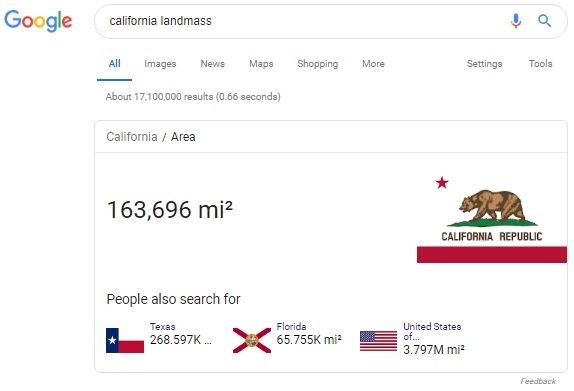
Size -- California vs. Germany??


Right after the article above was published (and I read the article), I was talking with my colleague who holds German citizenship.  She was born in Germany.  In a prior discussion about Germany moving toward the use of natural gas, she warned that the move could be potentially dangerous considering the main source of gas presently -- Gazprom -- from Russia.  This would put Germany at the hands of Russian gas giants (effectively Russia) for a stable and steady gas supply.


Although, since that discussion, the natural gas industry has started to boom (in the sense of shipping).  Technology has improved the ability to ship liquified natural gas all around the world.  Now, back to the discussion at hand.  This massive shift in dependence on fossil fuels in a reasonable amount of time makes other countries uneasy.  Some here in the United States view this transition as 'short sighted' since the infrastructure and change is occuring on such a short time scale.


But is the timescale that short?  What kind of transition plan is reasonable? How long should the U.S. or Germany rely on coal/fossil fuels?


The change that Germany is embarking on reminds me of the recent (as in the past few months) commitment to renewable energy made by then Governor Jerry Brown regarding the state of California.  Governor Brown signed into law last year the commitment to have California on a carbon neutral (net zero) program for energy by 2045.  This was ambitious to say the least.


Remember that California's economy is the fifth largest in the world.  Which may cause someone to immediately draw parallels between Germany's transition and California's transition.  Let's look at the size (landmass) difference between the two for a closer comparison.  First, Germany's landmass is shown below:


Next, California's landmass is shown below:


As you can see, California has a larger landmass than Germany.  With Governor Jerry Brown signing into law the transition to a carbon neutral economy by 2045, the current announcement above for Germany by 2038 is not too far fetched.  Especially given the size of the two landmasses.  Additionally, Germany is probably better suited to the transition toward renewable energy -- which is why the date is set for a complete transition earlier.


Regardless, the news above is exciting to those who are big fans for the transition toward a greater dependence on renewable energy.  As this post is published (Wednesday morning), a subcommittee is gathering in the U.S. Congress --House Committee on Energy & Commerce -- is meeting to discuss action for the United States of America.  I will write a follow up post on the hearing in the near future.  We should watch and note these commitments of transitioning toward renewable energy.  Further, these commitments should serve as a motivation to build momentum toward change.  The future of transitioning toward renewable energy is turning into a reality and is really exciting.


Related Blog Posts:


Governor Jerry Brown Leads The U.S. With Ambitious Calls For 100% Renewable By 2045 -- Wow!!!


Parameters: GM Lays Off Thousands Of Workers -- Why? People Are Not Buying Cars?


EPA Estimates Of Methane - GHG - are off by 60%


135 Climate Scientists Urge Prime Minister Theresa May to Challenge President Trump on his Climate Stance during visit to the UK


Parameters: Oil vs. Corn based Ethanol - A Tug-Of-War between Trump Administration and Congressional Leaders


French President Macron Calls On U.S. Congress To Save The Planet


Parameters: Shells Oil Corporation Invests In Renewable Energy Infrastructure


Parameters: South Korea Uses Renewable Energy For Olympic Games


French President Macron Organizes Climate Conference With Pledges Of Trillions Of Dollars For Climate Risk Management From World Organizations


Do You Need Clean Air To Breathe? An Introduction To Environmental Justice


Environmental Entrepreneurs Weigh In On Repealing The Clean Power Plan


EPA Blatantly Suppresses Scientific Results Regarding Climate Change?


EPA Director Finally Realizes Reality Of Trying To Roll-Back Obama Era Clean Air Act Regulation


Friday, August 10, 2018

Trade War Hurts Farmers -- From The Farmer's Mouth Directly


Source: Big think


Readers might be wondering why I carry on intermittently about the trade war when I am a scientist.  The answer involves an early post which I wrote this year stating the obvious -- that everything is tied to one another by one or two links per se.  I do not expect you to believe me in any manner.  In fact, do the research yourself and see for yourself.  Science is not exclusively about being in a laboratory and performing experiments to push research and discovery ahead (i.e. the boundary of research forward).  Life is full of interconnected parts.  In this post, a farmer remarks (in a super short video) about the damaging effect of the tariffs imposed by President Trump.


Below is a video from 'The New York Times' titled "I Am a Soybean Farmer Hurt by Trump’s Trade War. I Can’t ‘Take It.’"directly from a farmer talking about the policies (tariffs) which President Trump has enacted and the direct adverse impact which has followed to his farm:


Wow! People do not really consider that decisions made by President Trump are having a real adverse impact on a human being's well-being.  Furthermore, when a person views produce at a grocery store, typically, the thought of the entire supply chain is probably absent from their mind.  More importantly, is the final product (meal or meals) which will be prepared with the produce for sale in front of them.


What does that supply chain look like?  Here are some questions which might shed greater light on the cost of eating produce at our grocery stores:

Is there a boat (ship) involved as in the case of shipping cherries to China (as exports from U.S.A.)?  

Are there trucks involved?  

Diesel semi-trucks which are emitting large amounts of greenhouse gases?  

Or are the trucks (semi-trucks) electric and environmentally friendly?  

How far does the produce (commodities) have to travel to arrive at my local supermarket?  

Who unloads these trucks?  

Who unloads ships onto the docks?  


Just think -- all of these components have a real person (a worker) behind them.  Some person goes to work to drive the produce across country after picking up a shipment at the port of Los Angeles.  Another person goes to work to stock the shelves at night with beautiful rich produce for you -- when you arrive at the grocery store.  Yet another person gets rid of produce which is not purchase and has been shipped but is out of date (spoiling).  All of these components which make our produce supply chain have a real person (possibly with a family) behind them.  Furthermore, these people depend on the supply chain.  Trade wars hurt supply chains.


Additionally, the research and discovery which is behind the movement toward sustainable farming to produce food is always a dynamic target.  Which means that there are always parameters which are changing that challenge researchers to produce a better crop.  Who are these people who do research into crops?  Plant biologists might be conducting research into the viability of drought resistant crops.  Or genetic modification might be sought after in the near future in geographical regions where the land is not tolerant of traditional crops.


When all said is done, decisions which are made at the top of the Administration have a variety of adverse impacts to the public at large.  Some are obvious, whereas others might not be apparent at all.  With this in mind, the service industries are not even considered in the 'trade war'.  Each of us as citizens of the United States of America and the world at large contained on Planet Earth should be interested in understanding the issues with policy decisions at hand.  This would allow decisions to be made down the line in the future which will result in a better environment.  One which is better for each of us to live in.  Start listening to everyone (even the farmers).


Related Blog Posts:


"Trade Not Aid" -- The Answer For Trade War!


How Many Cherries Are In 1.5 Million Shipping Boxes?


Parameters: Trade Tariffs Will Affect International Science


Parameters: Tariffs Affect Trade In Both Directions -- In And Out Of The USA


Parameters: Steel And Aluminum Tariffs Are Not Isolated - They Are Tied To Trading Of Other Vital Goods


Parameters: One Parameter Change In The Trade Machine Leads To A 'Re-Adjustment' Of Another


Wednesday, August 1, 2018

"Trade Not Aid" -- The Answer For Trade War!


Source: Malulu


Last week, President Trump announced the financial bail out of $12 billion for farmers who are losing large profits to the trade war.  At first pass, a majority of Americans were expecting such a measure at the very least.  Especially, since the President himself is to blame for the new trade war between countries who used to have agreements prior to the inauguration of the President.  Not everyone is happy with the aid offered to the farmers negatively impacted by tariff set by President Trump.  In fact, the recipients of the trade relief have been chanting along with sending the message "Trade not Aid."


This slogan should come as no surprise to anyone who has received a large payout.  The money is great in the short run - until the money runs out.  That is, if all of the aid is spent on keeping up the farm output with no money coming in, then the money will run out quickly.  Which brings us to the current state of affairs highlighted in an excerpt by Politico Agriculture sent out via e-mail on Monday shown below:


TRUE TARIFF BAILOUT WOULD COST $39 BILLION: The full cost of a government aid package to help U.S. all manufacturers, farmers and fishermen negatively affected by President Donald Trump's new tariffs on steel and aluminum from around the world and a host of products from China could reach $39 billion, the U.S. Chamber of Commerce reports this morning. That works out to be another $27 billion on top of the $12 billion the Trump administration announced last week to help U.S. farmers.
"While America's agricultural industry has been hit extremely hard by escalating tariffs, it's not alone," Neil Bradley, U.S. Chamber executive vice president and chief policy officer, wrote in a blog post. "Thousands of U.S. companies - including manufacturers, input suppliers, fisherman, and businesses from numerous other industries - are finding it more difficult to sell American made products abroad amid the growing trade war."
Other sectors are feeling the pain: The business group estimates that U.S. automobile, motorcycle and parts manufacturers would need up to $7.6 billion in federal aid if the assistance promised for farmers is extended to other sectors. Chemical manufacturers would need $960 million; prepared food manufacturers, $884 million; fishermen and crabbers, $811 million; soap manufacturers, $725 million; beverage manufacturers, $765 million; shipbuilders, $632 million; and furniture makers, $567 million.
Last week, U.S. Trade Representative Robert Lighthizer told lawmakers at a Senate Appropriations subcommittee hearing the administration had no plans "at this time" to extend its farmer aid package to other sectors.
Bradley, in the Chamber's blog post, made clear what the business group would really wants is for Trump to remove the tariffs and back off from the threat of imposing more. "The best way to protect American industries from the damaging consequences of a trade war is to avoid entering into a trade war in the first place," he said.
Steel needs help ... because of the steel tariffs?: Ironically, some of the biggest recipients of an expanded aid package could be two sectors, steel and aluminum, Trump set out to help with his tariffs. A number of countries have retaliated against U.S. steel and aluminum exports, so companies that produce steel and/or manufacture steel products could need $6.4 billion in federal aid and U.S. aluminum companies could need $2.4 billion, the Chamber said.
... AND MORE ON THE TARIFFS: USDA Secretary Sonny Perdue had been in Argentina since Friday, meeting with his fellow ag ministers from the Group of 20 nations. While there, he told Reuters that farmers shouldn't expect to be completely compensated for their losses. "Obviously this is not going to make farmers whole," Perdue said. He also said that about $7 billion to $8 billion of the aid will be in direct cash relief, while other money will go toward export promotion and buying up excess crops.
War of words, and worlds: Officials of the influential Koch network warned that President Donald Trump's tariffs could result in "long-term damage" to the country.
"When in order to win on an issue someone else has to lose, it makes it very difficult to unite people and solve the problems in this country. You see that on trade: In order to get to a good place on trade, convince the American people that trade is bad, " Brian Hooks, one of Charles Koch's top deputies, said this weekend during a briefing for reporters at the network's gathering in Colorado Springs, Colo., POLITICO's Maggie Severns reported.
Those comments prompted former White House chief strategist Steve Bannon to attack the network in turn. In an interview with POLITICO on Sunday, Bannon called the comments unhelpful. "We can have a theoretical discussion later, OK? This is why they don't know what it means to win, OK?"


The excerpt shown above illustrates the loss or potential loss to the deficit of either $12 billion or $39 billion regardless of who is correct.  Either way, the United States of America has officially opened an unlimited credit card account to "Make America Great Again" -- at least that is what is supposed to be happening.  The opposite seems to be unveiling in reality though.


What is surprising about the situation America finds itself in -- in regards to the 'trade war' is that even if the United States could recover or agree on trade agreements with countries based on the previous tariffs, our country would still lose out.  The trade agreements which the United States previously had with other countries had 'special provisions' attached to them.  The possibility of regaining these 'special provisions' is out the door heading into the future.


Which means that even if similar relations were recovered, the 'special provisions' would be gone.  "Free Trade" is based on certain deficits incurred by various countries.  While the United States appears to be 'a loser' on trade deals, as a country the United States has been a 'winner' in a large amount of situations.  I discussed briefly 'global free trade' in a previous post.  The United States is considered the 'major player' on the world stage -- at least as of 2 years ago.


This position has quite possibly changed over the last 2 years.  The current trade war has not helped us on the international stage.  As the excerpt above states: "When in order to win on an issue someone else has to lose, it makes it very difficult to unite people and solve the problems in this country. You see that on trade: In order to get to a good place on trade, convince the American people that trade is bad" -- The American people are now being convinced by politicians that being taken advantage of is a terrible cost of doing business on the world stage.  That is not necessarily the case.


Conclusion...


Bad news consists of recent events such as China telling shipping boats carrying up to 1.5 million shipping boxes of cherries to turn around.  Which is to say, over night, the demand for cherries all over China dropped to zero.  This results to a HUGE SURPLUS of cherries being dumped onto the United States produce market -- which will drive prices down.  In the short term, cost reduction seems great.  Although, in the long term, profits suffer -- farmers suffer -- then in return -- consumers suffer.  Not great.


Other commodities (products) will face similar fates.  Look for increases in prices for consumer goods as a result.  The Trump Administration has been handing out 'exemptions' to certain corporations which make them 'exempt' toward trade tariffs.  How does that help the United States in a trade war?  The answer appears to be that the exemptions amount to setting us further back as a trade negotiator on the world stage.  Which means in certain cases, the United States looks 'uncertain' or 'unstable' in trade negotiations.  Call your elected congressional leaders and demand that trade agreements be elevated to a top position for our nation.  Follow the farmers lead "Trade not Aid".


Related Blog Posts: 


How Many Cherries Are In 1.5 Million Shipping Boxes?


Parameters: Trade Tariffs Will Affect International Science


Parameters: Tariffs Affect Trade In Both Directions -- In And Out Of The USA


Parameters: Steel And Aluminum Tariffs Are Not Isolated - They Are Tied To Trading Of Other Vital Goods


Parameters: One Parameter Change In The Trade Machine Leads To A 'Re-Adjustment' Of Another


Thursday, March 8, 2018

LimeBike Dockless Bikeshare Riders Travel A Distance Of 13,000 Miles In Just Over 3 Weeks?

Source: LimeBike


Dockless BikeShare Programs are emerging in a number of areas across the United States.  Especially, around university campuses for obvious reasons.  Around California State University at Northridge, over 50% of the students live within a radius of 5 miles.  This makes a BikeShare program thrive instead of using cars to travel to and from campus.  Residents may engage in use of BikeShare bicycles too and have done so in the Northridge area.  Below is a dimensional analysis of the total distance traveled (13,000 miles) in just over 3 weeks.  Wow!


Today, I wrote a guest post on for the wonderful website 'BikingInLA' titled "Guest Post: Open letter opposing Englander motion to halt dockless bikeshare and CSUN LimeBike system" which focuses on a recent 'emergency moratorium through a motion' to regulate (basically shut down) the use of LimeBike Dockless Bikeshare bicycles around campus.  The obvious reasons for using alternative modes of transportation can be found in the link to the post along with staggering statistics and testimonials of riders.


For the purpose of the following post, I would like to show the calculations of the stated statistics in the article on 'BikingInLA' written by myself.  To start with the two statistics in question need to be stated below:


1) 13,000 miles -- a person could ride a bicycle 2 round trips from Northridge (California) to New York City (New York).

2) 13,000 miles -- a person could make 17 round trips from Northridge (California) to San Francisco (California).


In order to verify those calculations, a few steps need to be taken.  In the following two sections, each devoted to a single statement above, the steps will be displayed clearly to arrive at the statements above.  Lets start with explaining through dimensional analysis the first statement regarding 2 round trips from Northridge to New York city.


Northridge to New York City?


To start the dimensional analysis of casting the distance of 13,000 miles into perspective, a 'metric' needs to be stated.  In the first statement above, the 'metric' is the distance traveled from Northridge (California) to New York City (New York).


The first step is to find the distance, consult a 'map program' such as 'GoogleMaps' and type in the following destination: New York City.  The map should appear as follows below:


Next, click on the 'directions' button and then a "From" and "To" entry spaces should appear on the upper left hand corner as shown below:


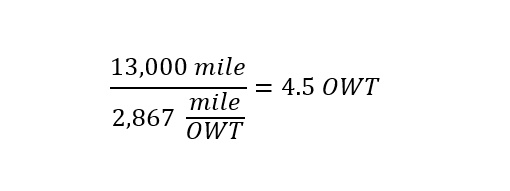
Upon choosing a "car" as a choice of transportation, the following possible set of directions appear like those shown above.  The total distance from Northridge (California) to New York City (New York) is 2,867 miles.


Remember that the distance stated above is a 'One Way Trip'.  Which means that when a final total number of trips is reached through analysis below, the total number of trips will be divided by 2 in order to determine the number of round trips


"OWT" represents 'One Way Trip'.  To calculate the total number of 'One Way Trips' possible by traveling 13,000 miles, a division of the distance traveled by the distance of a 'One Way Trip' as shown below:


The result of the calculation is interpreted as the following: If a person were to travel by bicycle (BikeShare) 13,000 miles, they could complete 4 One Way Trips or 2 Round Trips from Northridge (California) to New York City (New York).  The analysis above matches up with the statistic stated in my guest post on 'BikingInLA' today.


Next, the same analysis is carried out to verify the second statement above using a metric of 'One Way Trips' to San Francisco from Northridge.


Northridge to San Francisco


The analysis above was carried out to verify the distance traveled by LimeBike users in less than a month around the CSUN campus - 13,000 miles using the metric of 'One Way Trips' from Northridge to New York City across the U.S.  In the current analysis below, a smaller metric is used.  The metric is 'One Way Trips' from Northridge (California) to San Francisco (California).


To start the analysis, the website 'www.maps.google.com' is consulted with the following statement: San Francisco, CA and the following result is shown below:


If the current analysis is carried out in the same manner as above, then click on the 'Directions' in the upper left hand corner and two entry spaces will appear.  If the top entry space is filled with 'Northridge, CA' while the second entry space is filled with 'San Francisco, CA' - the following result is shown below:


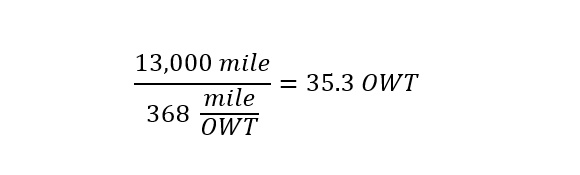
The result is shown above which shows the total distance for a single trip from Northridge (California) to San Francisco (California) is 368 miles.  The is shown below:


Expressed as 'One Way Trips' the following total distance for a single trip is shown below:


With the metric of a single trip known to be 368 miles, to determine the total number of 'One Way Trips' possible is carried out by dividing the total distance in question (13,000 miles) by 368 miles as shown below:


The result above indicates that a total of 35 'One Way Trips' are possible given a person with the ability to travel 13,000 miles by bicycle (BikeShare).  This can be interpreted as a total number of round trips to be 17 from Northridge (California) to San Francisco (California).


Conclusion...


Above, two different analyses were carried out using the same methodologies.  These analyses verified the number of  'Round Trips' possible by the total distance of 13,000 miles.  Additionally, the above dimensional analysis allows us to visualize the magnitude of the number cited in the guest post written on 'BikingInLA' today.  The number of miles -- 13,000 miles represent the number of miles traveled in 40,000 trips by LimeBike users around Northridge in less than a month.  These numbers are extremely encouraging toward moving to alternative modes of transportation.  Incorporating active transportation into our lives will result in a healthier community, less congested (with traffic) and boost local economy.


Related Blogs using dimensional analysis can be found here.