Monday, July 11, 2016

How Much Weight Can 54 Billion Cubic Feet Of Helium Lift?

If you were to release a balloon filled with helium outside, what would happen?  The balloon would rise up until the pressure in the atmosphere caused the balloon to burst releasing the helium inside (which would rise until escaping the atmosphere -- the subject of a previous blog).  The blimps that fly high above us are in part operated by helium (lift provided by the gas).  What is the point right?


Recently, a large helium deposit was found off of Tanzania in Africa that holds an estimated 54 billion cubic feet.  WOW!  Thinking of helium from the perspective of providing "lift" in a balloon, how much weight could the amount contained in the reserve (in Africa) lift?  Read on to find out the answer.


How Much Volume Does 54 Billion Cubic Feet Of Helium Occupy?


As readers of this blog site know, one of the many goals is to demystify science along with the large numbers and concepts that come with the field.  Recently, an article titled "Scientists Make Huge Helium Discovery (On Planet Earth)"  appeared on the website "ChemInfo" that unveiled a new helium deposit that has been found in Africa.  Here is an excerpt detailing the new discovery and the importance from the article:


The scientific community has been abuzz for years that the earth is running out of helium. Though it is one of the most abundant resources in the universe, helium is in limited supply on earth. And once it’s extracted and used, it’s gone forever.

Helium is a rare and vital commodity with many uses including industrial leak detection and deep sea diving equipment. Liquid helium is also used as a coolant for rocket fuel and as a superconductor for magnets in MRI machines. Plus, kids love it at parties.

Because our stockpile of helium has been dwindling at the National Helium Reserve in Texas, with no known new helium gas fields to extract it from, concerns have mounted that the days of floaty party balloons could soon be ending. Recently, scientists made a major discovery that could change that.

For the first time, researchers have pinpointed a giant helium gas field. Usually, helium is discovered accidentally when extracting oil and gas. Up until this point, scientists had never intentionally located a helium field. But the discovery was made after a team from the University of Oxford and Durham University collaborated with a Norwegian helium exploration company, Helium One, and set out to see if it could be done.


If you are wondering whether the world is getting desperate for helium, you are correct.  As the world consumes helium through the avenues listed above, including the semiconducting industry (the largest user), reserves are becoming more precious.


This is why researchers are becoming "proactive" in their search as described above.  Just think about the prospect of not being able to get an MRI at the hospital after sustaining an injury -- due to the lack of a magnetic field which is dependent upon metal windings being immersed in a bath of liquid helium.  Once charged, the metal windings hold the current circulating at zero resistance (superconductivity) until the wires become room temperature again (helium boils off).


How much helium was discovered?


Here is another excerpt regarding the discovery amount shown below:


The researchers estimate that the field could be holding as much as 54 billion cubic feet of helium, which is more than twice the amount being currently held in the U.S. If correct, the field could help supply the world’s helium for generations to come.

Assuming the detection methods are accurate, the team says the next step will be finding the best place to extract the gas. They also hope that the discovery could potentially lead to scientists uncovering more helium fields.


Sticking with the past blog posts on this site, how does a person comprehend such a volume of helium?  First, I should point out that the amount is in question due to the measurement device.  That is an important bit of information.  Why?  The amount detected is only as accurate as the measurement device.  Furthermore, just because the amount is assumed to be that large, the actually amount extracted could be different.


How different?


Probably no more than an order of magnitude.


In order to visualize the enormous amount of helium that has recently been discovered in Africa, lets return to an old post.  As you will recall, there was an enormous amount of gas leaked from a storage facility in Southern California -- the Aliso Canyon Gas Storage Facility -- starting the end of last year.  The leak was massive enough that the total amount of gas leaked turned out to be around 5 billion cubic feet leaked.


The underground storage reservoir was estimated to hold around 184 cubic feet of gas.  A reader sent in a comment to correct me and said that the gas was under extreme pressure, therefore, the total space of the reservoir was less (but how much less) -- not too much less.  The fact remains that the amount of helium discovered in Africa is within a range of volume that has been put into perspective.


Specifically, how many Mercedez Benz Super Domes would have to be filled to hold 54 billion cubic feet of helium gas?


In order to carry out the calculation, the volume of the Super Dome needs to be known -- which is around 125 million cubic feet interior volume.  A picture of the exterior of the Super Dome is shown below:


                                              Source: Photo by David Grunfeld (Nola.com)


With the interior volume of the Super Dome known to be 125 million cubic feet, the amount of Super Domes that could be filled is calculated by dividing the two numbers as shown below:



Wow!  The amount of gas that was discovered underground is enough to fill 432 Mercedez Benz SuperDomes?  My goodness, that is a large amount of gas.  I am constantly amazed at the volumes that are listed in these news stories.  Like most readers, I read the same statistic -- 54 billion cubic feet -- of helium and think the following:  That must be an enormous amount?


By performing dimensional analysis, I am one step closer by comparing the amount to other statistics in the news, such as the Porter Ranch Gas Leak I mentioned above.  Dimensional analysis allows me to place the number in a better place -- a place in my mind of perspective.  Store that number next to Porter Ranch under the mental file -- excessive amounts of gas -- really incomprehensible.


The question that was intended to be answered in the blog post was the following:


How much weight can 54 billion cubic feet of gas lift?


This requires us to think like blimp designers.  Lets do some math below to find out.


How Much Weight Can 54 Billion Cubic Feet Of Gas Lift?


To tackle the question of the blog post, we must think like a blimp designer to a small extent.  In theory, a blimp is filled with helium and can provide a large amount of lift to accomplish a task.  The blimp in question could look like the following -- only much larger:


Source: ABC News


Shown above is the 'Goodyear' Blimp.  According to the website 'HowStuffWorks.com,' the average blimp holds a volume of gas in the range of  67,000 -- 250,000 cubic feet of helium.  Since the volume of gas that is contained in the ground in Africa is enormous -- nearly 5 orders of magnitude larger, our imagination will have to suffice.  Just think of the blimp above just many orders of magnitude larger -- use creativity.


In order to calculate the amount of weight that 54 billion cubic feet of gas can lift, a ratio of volume to weight needs to be determined for a balloon.  I found the answer on 'StuffYouShouldKnow.com' in a post titled "How Many Balloons Would It Take to Lift You Off The Ground, Answered" for the amount of balloons required to lift a person off of the ground.  Lets start by learning from 'frames' taken in the video to determine how many balloons are required to lift a person off of the ground.  From there, the volume can be changed to the volume in question and then determine the weight!


Here are the slides with the relevant information to answer the following question:


How many balloons does it take to lift a person off of the ground?


First, the amount of helium needs to be known for a single balloon along with the weight that can be lifted as shown below:



Next, the volume in a typical balloon needs to be known as shown below:



Next, the logic amounts to the following:


1) If 1 Liter of helium can lift 1 gram, then 14 Liters of helium will lift 14 grams.


2) If a person weighs 50 Kg = 110 pounds, then 3500 balloons should lift them off of the ground?


The last statement is shown with no calculations -- which is bothersome if you are the author of this blog site -- right?  In light of this stretch, I calculated the amount of balloons needed to lift 50 Kg as shown below using the video producers logic:
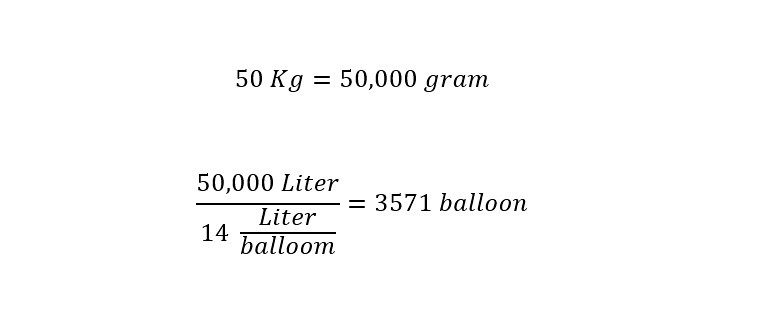


Therefore, 50,000 grams of weight will require 50,000 Liters of helium.  If each balloon holds 14 Liters, then dividing 50,000 Liters by 14 Liters will yield the number of balloons.  In this case, the number calculated revealed just over 3500 balloons would be needed.  The number coincided with the number stated in the video above.


Therefore, I felt comfortable with the ability to reproduce the number reported in the video with the values (parameter values) listed in the video.  This is important for reproducing results.  Reproducing results is increasingly important in science today more than ever with the exponentially growing number of studies being published hourly.


Next, using the values in the video -- I calculated the weight (number of tons).


Wow.  As expected, that is a large amount of weight that can be lifted by 54 billion cubic feet of helium.  How can that number be put into perspective?  In a previous post, the weights of two large objects (Airplane: Spruce Goose and Ship: Queen Mary) were compared and contrasted.


How about using  the weight of the Queen Mary -- which was 96,000-tons?


How many Queen Mary Ships can 54 billion cubic feet of helium lift?


Before the calculation are shown, a picture of the Queen Mary ship might assist you in putting the enormous weight into perspective.   Here is a picture of the Queen Mary below taken from 'Wikipedia':


Source: By RMS_Queen_Mary_Long_Beach_January_2011 -- David Jones 


The calculation is shown below:



According to the calculation, 54 billion cubic feet of helium contained in a 'Goodyear Blimp' could lift the equivalent weight to 18 Queen Mary ships.  WOW.  That is a large amount of helium.  I guess now I understand the enormous enthusiasm behind the discovery off of the tip of Africa.


Just for fun, I thought that I would calculate the number of balloons that could be filled (for celebrations: birthday parties, anniversaries, graduations, etc.).  I show the calculation of the number of balloons that could be filled with 54 billion cubic feet of helium below:
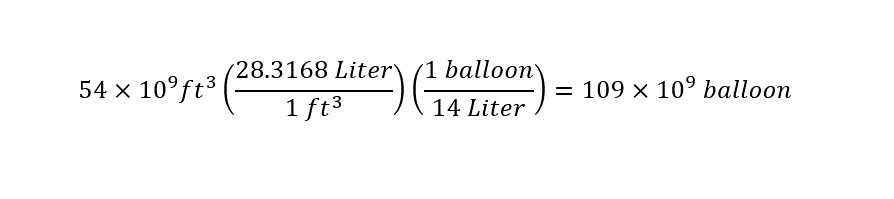


That is an incomprehensible number -- 109 billion balloons.  That would be an enormous number of celebrations.  More than during the span of our lifetime.


Have I made the point yet?


What point?


Conclusion


The discovery of an underground reserve of helium off of Africa has the potential to supply the world with helium for a few decades.  This is reassuring, especially, since just a couple of years ago, the government started discussing the possibility of "rationing" helium to the world.  The current discover is a relief to say the least.  How big is the discovery?  I hope that I have put the enormous number into perspective for you in the paragraphs above.


In a future post, I will explain further why the discovery is important to the field of science.  I now have a few more useful statistics to compare large numbers too -- and so do you.  The next time that someone asks you how to visualize 54 billion cubic feet of a gas (such as helium), you will be able to quickly answer them with the handy statistics:


1) The equivalent of 432 Mercedez Benz SuperDomes!!!


2) If the volume was contained in a blimp, the blimp could lift 18 Queen Mary ships!!!


3) If the volume was in party balloons, 109 billion balloons could be filled for celebrations!!!


Until next time, have a great day!

Tuesday, July 5, 2016

What Is Holding You Back From Achieving Your Potential?

The question is relatively straight forward and has been asked of people for generations.  Unfortunately, each of us do not always have the answer to achieve the success that we would like to or envision.  Why is this the case?  I believe the answer lies in looking within ourselves to work on "inner obstacles" that prevent us from moving toward the next level.  Why do I believe this to be the case?  I give you the example of a Paralympian Lex Gillette below as an example.


Identify The Obstacle!


Recently, I was in awe after watching a commercial of a ParaOlympian for the upcoming Olympics in Rio de Janeiro.  Why?  These athletes are amazing to say the least.  Especially, since each have achieved an obstacle and moved forward to compete in the sport of their interest.


The example that I use is of Lex Gillette.  Here is the short (less and 1.5 minutes long) video of the a day of training titled "Lex Gillette Is Jumping Toward Rio" shown below:


Wow!  I cried the first time that I watched this commercial.  You might be thinking that I have over dramatized the video.  But each of us can learn from Lex's evolution.  Think about the video that is shown below in frames to illustrate my point of potential:


Here is a child who was bound to lose his eyesight as explained by his saddened mother.  Although, determined to support his interests, she pushes him to remain in a public high school and graduate as shown below:


During which, he showed an interest in the "long jump" and chooses to try out.  His mother describes with emotion the feeling of watching him go "off course" during his first jump and land on the "side of the pit" rather than in the sand.


I could only imagine the pain that is felt by a parent watching their child hit the side (of the sand box) and fail to achieve their goal.  Further, a majority of people would give up at this point in pursuing an interest (in the face of adversity).  Instead, Lex listened to great advice from his mother.  A powerful statement that had an immeasurable impact on his success:


"Lexis, it does not matter what anybody tells you...you decide what you can do and no one else."


Wow!  What I do know is that the body is resilient and can adapt to a wide range of difficult situations if the mind chooses to train the body.  How do I know this?


I was born "club footed" and had to wear casts on my legs for the first couple of years of my life.  I can still remember the feeling of trying to walk as the casts were "straightening" out my legs over time.  I remarked on this to my mother a few years ago and her response was: "Mike, you can still remember that.  Amazing since you were so young."


She remembers having to watch me learn how to get up and go on my own -- despite her yearnings to help me.  Similarly, Lex Gillette needed to learn how to work with his blindness to achieve the "long jump" and to go onto compete in the Paralympics -- and win.


How has he done in competing over the years?


Here is a description of the competitions from his 'Wikipedia' page shown below:


He competed in the 2004 Summer Paralympics in Athens, where he won silver in the men's long jump F11 event. At the 2008 Summer Paralympics in Beijing, he won a silver medal in the men's long jump F11 event and finished fifth in the men's triple jump F11. He competed in 100m and 200m T11 events but did not advance to the finals. At the 2012 Summer Paralympics in London, he won a third consecutive silver medal in the men's long jump F11 event. He also finished fourth in the triple jump event.
At the 2013 IPC Athletics World Championships in Lyon, France, he won gold in the men's long jump F11 event and he also won silver in the triple jump event. Gillette is apart of the 2013 IPC Athletics World Championships 4 × 100 m relay team that won a silver medal and set a new American record in the process. Gillette broke his own long jump world record for F11 classified athletes of 6.73m (22 ft. 1in.) with a leap of 6.77m (22 ft. 2in.) on April 23, 2015 at a high performance meet held at the Chula Vista Olympic Training Center.[1][2]


This is a brief summary.  Below on the 'Wikipedia' page is a long list of his amazing accomplishments.  He is a true athlete and inspiration for anyone struggling to achieve their potential.  If you need motivation, do not look any further than him.


Ready To Explore Within Yourself?


This is just one of many stories meant to inspire anyone to find their potential within themselves.  There are a wide range of success stories all around us available to motivate a change toward achieving a goal.  Why don't we look for inspiration and action?


I guess that sitting on the 'pitty potty' ("poor me") is easier than the actual work toward achieving whatever goal the you desire.  The next time that you find yourself wondering why failure is knocking on your door, think of Lex Gillette.  Furthermore, get up and start working to achieve your desired goal.  Until next time, best of luck in your adventure!

Monday, June 27, 2016

Why Do "Units of Measure" Matter?

If I were to tell you the number 1.5 -- what would you say?


Maybe your response might be something like: "1.5 what?"


What if I answered that with the following answers:


1) 1.5 % interest on $1 billion dollars is the balance of your bank account.

2) After traveling 200 miles by bicycle, you have just 1.5 miles to break the world record.

3) 1.5 feet is the distance between the top of your car and the parking garage.

4) 1.5 hours is the length of time that you must wait until riding "space mountain" at Disneyland.


Do you get the point yet?  Giving a number "units of measure" or just units -- which I will refer to from here on out -- gives the number context and meaning.  Alternately, given a specific situation such as the readout on the syringe that the nurse is using to inject medicine into your body, the use of accurate units could mean life or death -- given the incorrect dose.


Why am I stressing the importance of units?


Recently, I ran across a "typo" in a book which caused me to question my reasoning skills.  By the way, this happens quite often, which is why I write these blog posts to verify my reasoning skills.  In the current example, the question was whether the "Spruce Goose" weighed more or less than the Queen Mary.  Read onto find out.


Wrong Inputs Cause Confusion


Given the wrong inputs (data, numbers, language, etc.) can cause a person a large amount of confusion.  For this reason, when a person is communicating to another person, the rigor behind the use of units is critical.  Of course, you would not have to tell the members of the Jet Propulsion Laboratory in Pasadena (California) this truth.  Unfortunately, nearly a couple of decades ago, the team lost the "Mars Climate Orbiter" to a supposed "math error."   What?


Yes, in the article titled "Mars Probe Lost Due to Simple Math Error" the unfortunate mistake which cost millions of dollars to the space industry was reported.  Here is an excerpt describing the mistake:


NASA lost its $125-million Mars Climate Orbiter because spacecraft engineers failed to convert from English to metric measurements when exchanging vital data before the craft was launched, space agency officials said Thursday.

A navigation team at the Jet Propulsion Laboratory used the metric system of millimeters and meters in its calculations, while Lockheed Martin Astronautics in Denver, which designed and built the spacecraft, provided crucial acceleration data in the English system of inches, feet and pounds.

As a result, JPL engineers mistook acceleration readings measured in English units of pound-seconds for a metric measure of force called newton-seconds.

In a sense, the spacecraft was lost in translation.


Wow!  Can you imagine what these top level space scientists were thinking about the magnitude of such a mistake?  Terrible.  A mistake like this is almost unfathomable by a space agency.  Especially, given the amount of detail that goes into the manufacturing and planning process of such a space mission.  Here is an excerpt again highlighting the magnitude of the mistake:


None of JPL's rigorous quality control procedures caught the error in the nine months it took the spacecraft to make its 461-million-mile flight to Mars. Over the course of the journey, the miscalculations were enough to throw the spacecraft so far off track that it flew too deeply into the Martian atmosphere and was destroyed when it entered its initial orbit around Mars last week.

John Pike, space policy director at the Federation of American Scientists, said that it was embarrassing to lose a spacecraft to such a simple math error. "It is very difficult for me to imagine how such a fundamental, basic discrepancy could have remained in the system for so long," he said.

"I can't think of another example of this kind of large loss due to English-versus-metric confusion," Pike said. "It is going to be the cautionary tale until the end of time."


Mentioned in the article was the unfortunate aspect that the space industry has had a series of failures over the years which has tarnished the image to an extent.  Now, the commercial industry has taken over nearly the entire space program, lets hope that this mistake never happens again.


That is an example of a very costly and potentially very deadly mistake due to specifying the wrong units.  The example that I am going to share is small in comparison to the above mistake.  Although, a mistake is a mistake and a small mistake can become a large mistake if not found as highlighted above.


Spruce Goose vs. Queen Mary - Which Is Heavier?


Recently, my wife was reading out of a book titled "Insight Guide California" and stumbled upon the following excerpt shown below:


Upon first hearing this fact, I was confused.  How could a plane weigh more than a ship?  I was in the middle of reading an article in the newspaper when she shared the discovery.  But sure enough, as shown above in the excerpt, according to the book, the Spruce Goose weighs 400,000-tons while the Queen Mary Weighs 89,960-tons.  Here are two pictures shown below -- one of each:


Source: Warather Corporation


After I looked at this picture, I started questioning the validity of the statement in the book above.


Furthermore, if this were true, then the engines on the "Spruce Goose" should be able to lift the entire Queen Mary ship next sitting at the dock next door?  Right?  Obviously, something is wrong here.


If the excerpt above taken from the book were true, then dividing the larger number - 400,000 ton by the smaller number - 81,960 would give the following ratio of weights:


Which would mean that the Spruce Goose (the aircraft) shown above weighs 5 times the amount of the Queen Mary (cruise ship).  First of all, one vessel is meant to fly while the other is meant to glide on water.  Simple reasoning should indicate that the vessel weighing the least should fly -- which is the Spruce Goose.


What are the real weights of the two objects?


Lets ask google as shown below:


And the Queen Mary?


Clearly, the authors of the book made a mistake in citing the correct units.  Now that the correct relative weights are known, I thought that a couple of calculations would be in order to compare the two objects in the picture above to put them into a true perspective.


First, I decided to use the weight 400,000 lbs -- since according the "Wikipedia" the Spruce Goose could hold up to a 150,000 lbs.  First, in order to compare the two weights, both of the objects weights need to be expressed in terms of the same "units."  In this case, "tons" is the preferred unit of comparison as shown below:


The more accurate results are in and WOW are they revealing?  Yes.  In reality, the Spruce Goose (partially loaded with weight) is only 200 tons.  Furthermore, that weight corresponds to being 1/410th in comparison to the weight of the Queen Mary.  Now, the numbers are lining up  with the two objects shown above.


Conclusion . . .


As I have shown, both through an excerpt from a real world tragedy (Mars spacecraft) and fictitious example, from a book, using the correct units of conversion is critical.  In some instances, the results are life-threatening.  Being accurate is always good.  Speaking in the same language is the closest analogy to comparing objects using the same units.  That should drive home the point.


Until next time, have a great day!



Tuesday, June 21, 2016

Iraq Has Enough Oil To Support The World For 4 Years -- What?


If you are a routine reader of this site, then you will recall a blog post that I wrote a couple of weeks ago titled "Is 94 Million Barrels Of Oil A Large Amount Of Oil? That Is The Global Daily Demand".  In that post, I mentioned the staggering amount of oil that is needed to fuel the global daily demand (around 94 million barrels of oil).  This number seemed incomprehensible to me at the time and still is quite difficult to grasp.  I recommend reading the blog post to grasp the following subject matter contained in this post.


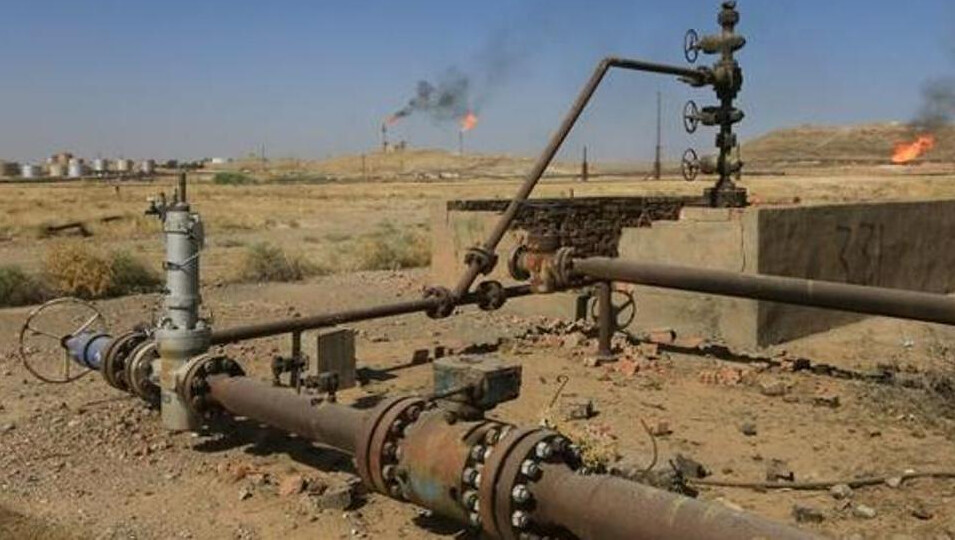
Recently, another number popped up into the news regarding oil.  The conflict over the country Iraq has plagued our nation for the past couple of decades.  Some people speculate our presence is attributed solely to our dependence on oil.  If that is the case, then just how much oil does Iraq have underneath it?  Below is a blog post that explores through dimensional analysis the sizable amount of oil underneath the country of Iraq -- which is no small amount.


How Much Oil Is Iraq Sitting On Top Of?


I have pondered this question for quite a while.  Back in 1996, I had the opportunity to join the US Air Force for four years.  I spent a considerable time in the surrounding countries to Iraq.  The importance of me telling you this is that while I was over there, some speculated our presence was solely a "selfish" one to satisfy our dependence on oil.  I thought if that were the case, then Iraq better have a large amount of oil.   I would have to wait (due to focusing on other interests another two decades to find out).


Fast forward to last weekend.  I was reading an article in the Los Angeles Times titled "In Iraq, a former oil boomtown becomes a relic" in which the destruction caused by the conflict has extended over the oil fields which contribute a sizable amount of oil.  That destruction in some cases would cost billions of dollars to repair aside from the military presence.  There were two paragraphs that in particular caught my eye.  The first was describing the destruction to the city of 200,000 people:


The city, once a bustling home to 200,000 people, is so utterly destroyed that there is little, if any, hope of rebuilding. It is deserted aside from security forces essentially left to defend a memory of hope amid the remains of buildings wrecked by a hailstorm of burning metal chunks caused by the battles.


Here in the US, we have no idea of how to comprehend the description from above other than to compare it to either a passage in a fiction novel or a movie.  The debate over our presence is not the dominant subject of this blog post.  Therefore, I will jump into the other paragraph that caught my attention and which is the subject of this blog post:


Much of Baiji’s output relied on a steady supply of crude from the northern province of Kirkuk — which reportedly has about 10% of the country’s total reserve of 140 billion barrels — an arrangement that worked when Iraq was unified under the rule of strongman Saddam Hussein. It is unlikely, however, to continue; the semiautonomous Kurdish administration in the north is intent on severing ties with the central government and keeping the oil. 


I am no mind reader, but if you look at the paragraph in context to the article on the website -- the majority of readers might have missed a critical statistic.  That is, Iraq sits on top of 140 billion barrels of oil?  OH MY GOODNESS!


Is that number even comprehensible?


Here I thought that the daily global demand of oil -- 94 million barrels of oil was a huge number.  I am continuously amazed at these reported figures for oil demand, consumption, supply, projections made by the popular news.  And here people walk and talk on their cell phones and devices without even considering these staggering amounts.  No wonder there are conflicts in the world.


How do we comprehend 140 billion barrels of oil?


How Many Gallons Are In A 140 Billion Barrels Of Oil?


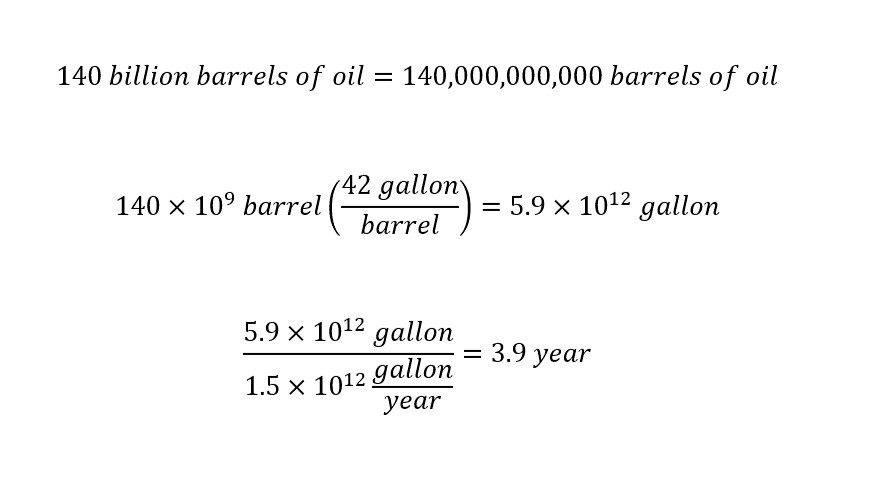
I am not an oil trader, not an oil speculator, or an employer of a producer, etc.  Therefore, I like to view the volume of oil projected/spoken about in columns in units of gallons.  Below I converted the amount of oil in a 140 billion barrels to units of gallons:


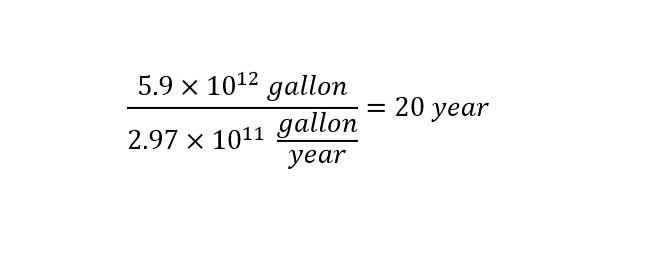
WOW.  WOW.  Yes, the total amount of oil under the country of Iraq in gallons is 5,900-billion gallons.  Now, I wanted to compare this number to the number reported in my previous blog post on the global daily demand.  In order to make the number more meaningful, I decided to convert to the annual consumption of the global demand of oil.  More meaningful, meaning, more mind-bending.  In the last line of the above calculation, I show that Iraq could support the global annual demand for 4 years!!!!


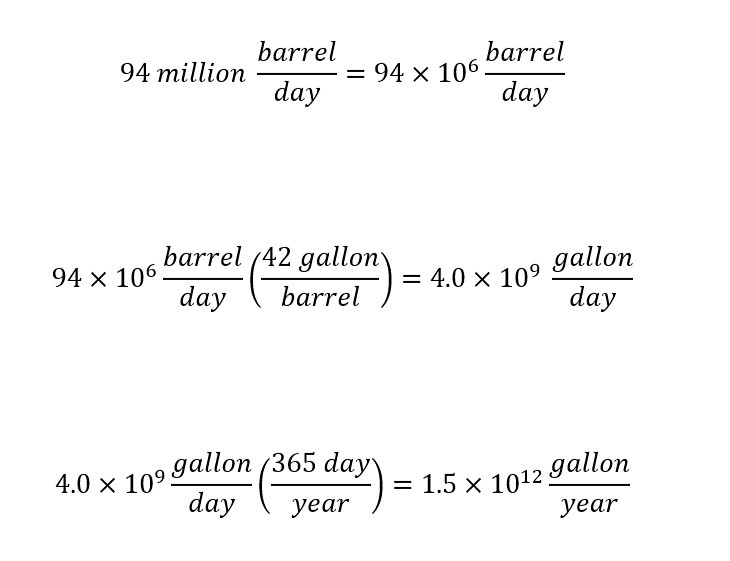
Where did the number with the units "gallons/year" come from?


Here is the conversion of the daily global demand of 94 million barrels/day to "gallons/year" shown below:


Are you satisfied now?  I try to make a large effort to clarify each number.  One of the most bothersome aspect of reading the news is observing a number while not being able to put that number into context.  Dimensional analysis relieves me of this bothersome feeling.


That is rather disappointing.  We are fighting a war in the Middle East or keeping a large presence for just 4 years worth of oil?  Not true exactly.  If the United States annual consumption was only taken into consideration, the number of years that Iraq could support us would be much longer.


Do you believe me?


Fortunately, for the purpose of this blog, you do not have to.  To get the annual consumption for the United States, I asked google as shown below:


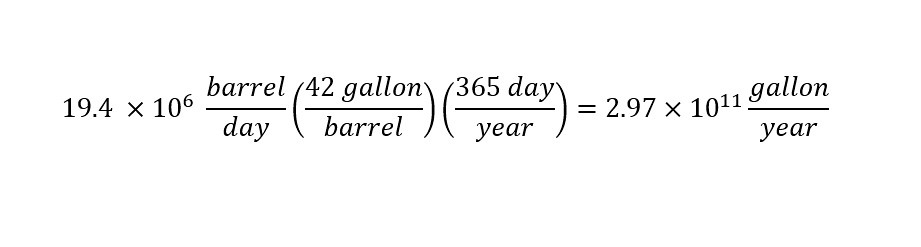
All that was needed to carry out the calculation was the number for the annual oil consumption for the United States -- which is around 19.4 million barrels/day multiplied by 365 days/year -- right?  I show the calculation below:


Now, the total reserves for Iraq -- 5,900 billion gallons can be directly compared to the annual consumption of the US (number above) as follows:


The above calculation sheds light onto the thought process behind the large oil industry in the United States.  Thinking in selfish terms, there is plenty of oil to be had without thinking about the rest of the world.   Although, in the larger picture, the amount of oil is not going to last us forever.


Where is the rest of the oil?


Since the amount listed above is only from a single country in the Middle East, what about the other "oil-rich" countries in the region?


How About Saudi Arabia?


Saudi Arabia contains the largest amount of oil in the world just behind the country of Venezuela.  How do I know this?  Here is an excerpt from the "Wikipedia" page for Saudi Arabia shown below highlighting the supposed fact:


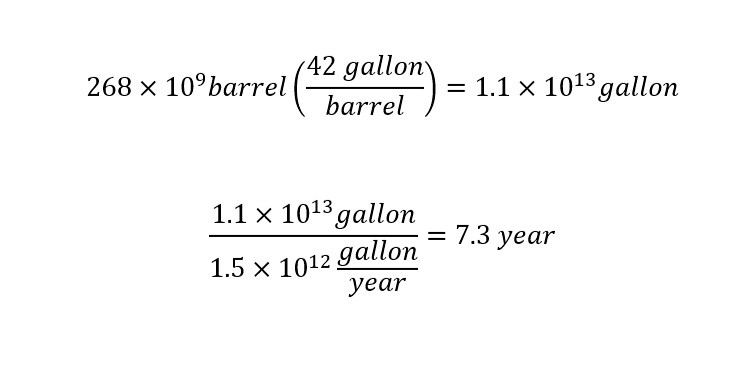
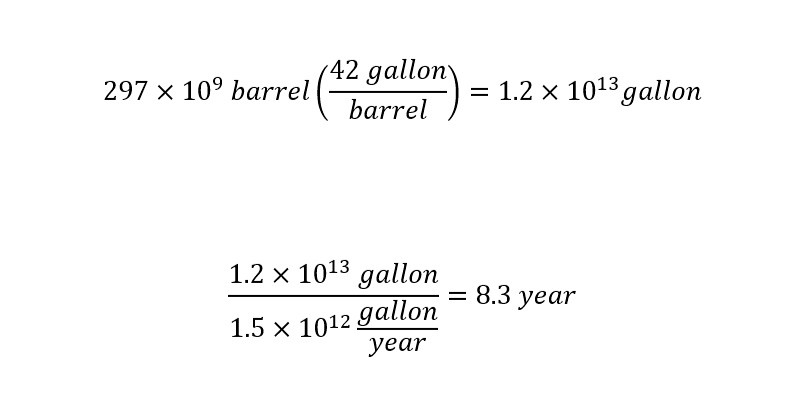
The proven oil reserves in Saudi Arabia are the second largest in the world, estimated to be 268 billion barrels (43×109 m3) (Gbbl hereafter), including 2.5 Gbbl in the Saudi–Kuwaiti neutral zone. They are predominantly found in the Eastern Province.[1] These reserves were the largest in the world until Venezuela announced they had increased their proven reserves to 297 Gbbl in January 2011.[2] The Saudi reserves are about one-fifth of the world's total conventional oil reserves, a large fraction of these reserves comes from a small number of very large oil fields, and past production amounts to 40% of the stated reserves.


What?  That is amazing.  Again, with this volume of oil possible to extract, I am no longer wondering why these countries are under pressure to produce and do business with other countries.  Since, the amount of oil under Iraq has been analyzed using dimensional analysis above, both Saudi Arabia and Venezuela can easily be outlined below to shed some surprising results for the future of oil.


To start with, how long could both countries support the global annual demand (as listed and calculated above)?


The results are shown below -- Saudi Arabia first:


Next, the results for Venezuela:


Again, these two calculations highlight the massive dependence on oil that is spread across the globe.  Wow!  This shows that each of us should start thinking about other sources of energy - to say the least.  The number of years listed above should be a "wake-up" call for the world.


The "wake-up" call should entail sourcing other renewable forms of energy along with reconsidering each trip (needed or unneeded) that uses fossil-fuels traveled throughout the day.  I guess that these numbers highlight the recent demand by shareholders to deal with the potential direction (and shareholder losses) associated with the future of fossil-fuels and investments.


What if we look at both Saudi Arabia and Venezuela selfishly to satisfy the US only?


Here are the results below:


Even if the rest of the world ceases to use oil, there is a "finite" amount of time and oil available for future generations.  This is truly astounding.  Of course, I did not take into account other oil producing countries.  Still, looking at the top 2 provides the best case scenario.  These numbers are not large and need to be taken seriously.


Conclusion . . .


What is next?  Where will the energy come from?


Will the world switch to a different fuel besides "fossil-fuels"?


What happens if the research does not turn out positive results?


These questions are worst case scenarios -- but should still be entertained.  Now is the time to reconsider the global use of these precious "fossil fuels" and other resources which daily are being consumed at a despicable rate.  I am not trying to sound like a crazy environmentalist.  The numbers listed above are approximations -- but should be alarming.  Notice how the top two oil producing nations reflect the support in only double digit proportions.  None indicated triple digit support (i.e., 100 years worth of oil).


Further, the development of renewable energy will take time to research and bring to market.  Now is the time to start supporting such research.  Alternatively, now is the time to consider your use of oil.


How much oil do you use on a daily basis?  How about an annual basis?


These questions might seem humorous from your vantage point, but let me propose another question:


What would you do if oil was not available?


How would you run your life?


Obviously, life would go on.  But, entertaining these drastic questions which eventually will be turned into measures (conservation, divestment, etc.) is a useful skill to start practicing.  Especially, while resources are still abundant.  The next time that you jump into the car or SUV to drive a couple of blocks to the store for a single item ask yourself:  Do I really need to drive?


This practice might seem trivial (you as a single person or car), but multiply yourself by a few hundred million and compare that gas consumption to the figures listed above, and then the numbers are not so extreme from one another.  Lets conserve and divest more money into a renewable future.  As scientists and researchers, we need time to test out hypothesis and get things wrong before we get them right and the technology proceeds to the market (i.e., your door).  Help us out!


Related Blog Posts:


What Is Dimensional Analysis?


Dimensional Analysis Of Statistics And Large Numbers - Index Of Blog Posts


1,600 Cattle Consume Equivalent Amount Of Water As A Bel Air Resident Per Day?


Wednesday, June 15, 2016

1,600 Cattle Consume Equivalent Amount Of Water As A Bel Air Resident Per Day?

All of us view the world from a different perspective.  Literally, each of us look at the world from a different set of eyeballs -- which by definition means -- we see a different picture.  Further, each of us view the world through our respective interests, occupation, life experiences.  Why do I mention this obvious observation?


Recently, I was in Nebraska on vacation or to visit family more specifically -- which was much different than California.  The inevitable discussion emerged between my brother-in-law, his boss (a cattle rancher) and myself centered around the drought in California.  Any time that people from other states in the U.S. (either visiting or welcoming a visitor - me) find out that I am originally from California, a discussion emerges surrounding the drought crisis in California.   Often times, I learn a new fact or piece of information that I previously did not know.  In this instance, I learned that a farmer's dimensional analysis of a water crisis is projected in terms of cattle (not surprisingly).  Below are the details of this wonderful and informative interaction.


Cattle Consume Water?


Of course cattle drink water!  That did not surprise me in the least.  What did surprise me was the discussion surrounding the drought in California.  Over lunch (as mentioned above) a discussion emerged that had do to with the continuous drought conditions in California.  My brother-in-law's boss was grilling me about California.


Not surprising since I stuck out in the restaurant like a "sore-thumb".  Why you might ask?  Here is a picture of my brother-in-law and his boss below:


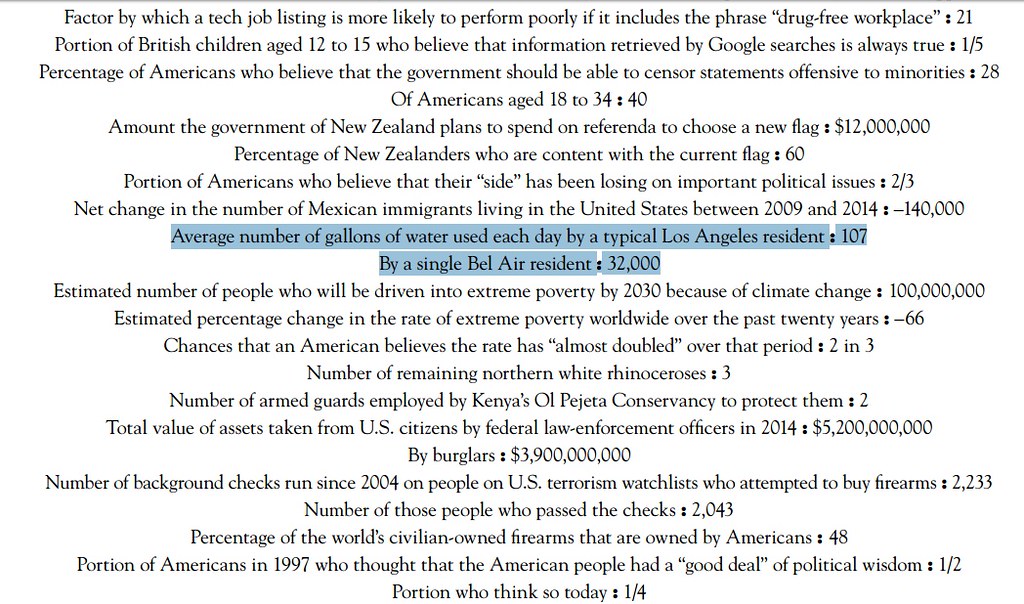
As we were discussing the drought in California, I decided to throw out on the table one of my newly discovered statistics about water usage in California.  Which of the many do I speak of?  I decided to discuss the difference in water consumption in water use -- which I wrote a blog post about a few months back.  Here is the main statistic that blew my mind from Harper's shown below:


Over lunch I went ahead and gave a quick statement to invoke a response of surprise between the two residents of Los Angeles.  I stated the the typical LA resident uses 107 gallons of water per day.  He was not surprised at the amount.  Next, I stated that the average 'Bel Air' resident uses 32,000 gallons of water per day.  WOW.


What was his response?


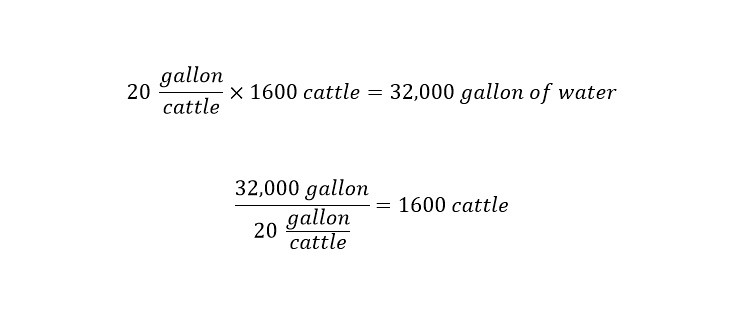
He rapidly returned with the statement: "On a hot day, one of my cows will drink max 20 gallons of water.  I guess that equals 1600 cattle then now doesn't it."


I had to stop and run the math in my head for a moment.  I was amazed at his perspective.  In retrospect, as a cattle rancher, this makes perfect sense.  He is concerned from the standpoint of how much water is required to keep his cattle optimized.  I will show the calculation below:


There are two avenues by which to verify the cattle rancher (Scott's) quick calculation.  First, take both of his numbers and multiply them together.  Second, divide the total number of gallons by the number of gallons per cattle to get the total number of cattle.  Either way, the calculations are straightforward.  You might find yourself asking the following question:


So what?  Big deal -- Everyone knows that Bel Air residents are outrageous water consumers?


True.  From that conversation, I took home a few pieces of information -- which I will share:


1) Each of us look at life from a different perspective.


2) Each of us have our own reference point.


3) Each of us are unique.


4) Each Bel Air reside consumes as much water as 1600 cows on a daily basis!!!!


Conclusion ...


Look, I have wrote blog posts in the past about the outrageous use of water consumers here in California.  Also, I have wrote about the amount of rain in a few inches of rain fall.  I have to admit that this is the first time that I have used cows as a tool for dimensional analysis.  The results are staggering.


In closing, each of us have a different perspective on how to view life.  Further, for a farmer in Nebraska, the mention of water usage causes him to 'default' to his cows -- which makes perfect sense.  Think about the number of cattle that could be drinking next time you turn on the faucet.  How many cows are you starving?  Until next time, have a great day!


Tuesday, June 7, 2016

Is 94 Million Barrels Of Oil A Large Amount? That Is The Global Daily Demand!

Climate change is an ongoing debate that attracts news often due to the changing weather on the planet.  We (the world) share the atmosphere.  Therefore, all participants should be concerned when we see dramatic examples.  What are these dramatic examples?  China has an atmosphere that is opaque as shown in the picture below:


The take home point is that the issue of climate change is starting to permeate through various circles (board rooms) of various large corporations.  One such corporation is Exxon Mobil Corportation.  Recently, there have been questions generated at the top of the corporate structure about the direction of the future.  Where do we stand?  The global oil demand is 94 million barrels (by one estimate) every single day.  WOW!  How do we visualize that large of volume?  Below are a couple of ways that might be helpful.


Investors Push Board Of Exxon For Answers!


In a recent artile from the New York Times titled "Exxon Investors Seek Assurance As Climate Shifts, Along With Attitudes," the authors discuss the new emerging trend of investors starting to inquire into mitigating risks associated with climate change.  Here is the new revelation of investors which is indicative of a changing energy landscape:


At the company’s planned annual meeting on Wednesday in Dallas, shareholders will vote on a resolution to prod Exxon Mobil to disclose the risks of climate change to its business.

Such resolutions have been floated before, and they typically do not pass. But there is a growing chorus of investors, many of them large institutional shareholders, who say they are worried that Exxon Mobil, the largest publicly traded energy company in the world, is not adequately preparing for tighter times if countries start acting on the pledges they made last December as part of the Paris climate change accord.

Exxon Mobil, for example, projects that global demand for oil will keep growing — by just over 13 percent from today, to 109 million barrels of oil a day by 2040.

But the International Energy Agency’s projections include one situation where demand could drop by 22 percent, to 74 million barrels a day by 2040, if measures are put in place to keep global warming at levels that, while still dangerous, could avoid the most devastating consequences.

The shareholder resolution calls for Exxon Mobil to publish an annual assessment of impacts of various climate change policies, including ones that would lead to the steep drops foreseen in the most severe energy agency’s forecast. Another resolution calls for the company to give shareholders a bigger say over governance.


The excerpt above highlights the major issues that society faces in today's fast-paced changing world.  I think that the authors did a great job of summing the issue up.  The impact of the Paris Climate Talks is gaining momentum by the fact that the subject is making news.  I was amazed to see that the results of the climate talks last December is actually causing a downstream change which is exerting pressure back up the chain.


To have other corporations start to divest stock in companies that are geared toward future renewable energy technology is a main stay in the current popular media.  Further, to have a story about consumers starting to question the practices of these large corporations occupies the same space as a change in technology.  But to have the investors of a large corporation like Exxon Mobil start to ask questions of the Board is a whole new parameter change in the equation toward moving to renewable energy technology.


The investors are serious players in a company -- for if the investor (who holds a large amount of shares) gets scared, then he/she can dump their stock and cause problems for the corporations.  Here is a question in the form of an excerpt that sums up the issue from the article shown below:


But big owners of the stock worry that the optimism of Exxon Mobil’s outlook for oil demand is dangerously misguided.

“Investors can’t afford to have Exxon become the next Kodak,” said Scott M. Stringer, the comptroller of New York City, whose pension fund owns roughly $1 billion worth of Exxon Mobil stock.

“It is impossible for them to do business for the next 100 years as they have the last 100 years,” added Mr. Stringer, who supports the risk-disclosure resolution


This is a wake-up call for these large corporations.  But, what really caught my eye were the numbers representing the increase or decrease in daily global demand in oil.  Upon first pass (reading), I was trying to figure out what the exact daily global demand is -- really a ball park figure?  I am sure that the process of trying to get the numbers to estimate the total number of barrels in oil on a daily basis is complicated.  I decided to type into google a question -- shown below:


As you can see, the first boxed statement indicates that the daily global demand is around 94 million barrels a day.  Oh my goodness.  WOW.  If you look down the list, there are two other sources that I inlcuded in the picture.  I read both to make sure that the first figure was on par with the range that was mentioned in the New York Times article above.


Another statement that caught my attention was on the website "Watchdog.org" listed as the 3rd entry above.  Here is an interesting and eye-catching statement guiding the reader to put the huge global daily demand of oil into perspective.  The author uses dimensional analysis with no equations but with dimensions that have been used on this blog site before -- the Olympic Size Swimming Pool.  Here is the excerpt:


“It’s mind-boggling,” Peter Tertzakian, the chief economist and managing director of Canada’s ARC Financial Corporation told participants at the Platts North American Crude Oil Summit last Thursday.

To put that number in perspective, Tertzakian offered this nugget: “That’s the equivalent of draining an Olympic-size swimming pool every 15 seconds.”

“You can say, pardon the pun, the world goes ’round on oil,” Tertzakian told Watchdog.org.


Previously on this blog site, I have used the Olympic Size Swimming Pool to put a large volume of water into perspective.  You will recall here on the introductory post!   In that post, the calculation involved determining the amount of Olympic Sized Pools that would be filled with 20 million gallons of oil -- which was spilled in the Exxon Valdez Oil Spill in 1987.  Kind of ironic with the subject matter in the current post -- right?  The calculation revealed the spill would fill 30 Olympic Swimming Pools.  I thought that volume was large.  Keep on reading.


How Many Olympic Size Pools Could Be Filled?


In the article, the author included a picture of an Olympic Size Swimming Pool to drive home the result of dimensional analysis.  Here is a picture of an Olympic Swimming Pool from "Wikipedia":


Source: Wikipedia


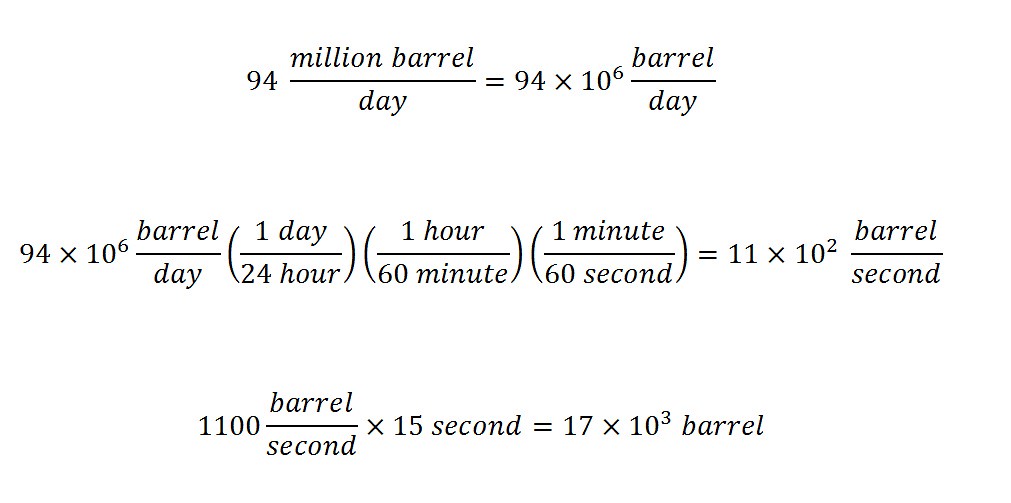
Without further ado, the volume has been stated in the excerpt above of 94 million barrels of oil per day -- represents the daily demand for the world.  Further, in the article from "Watchdog.org" the statement says that the volume corresponds to an Olympic Size Swimming Pool being filled every 15 seconds.  Is that correct?  How does a person check this fact out through dimensional analysis?


First, the amount of water that occupies the typical Olympic Size Swimming Pool needs to be known.  Taken from "Wikipedia" the amount if 660,000 gallons.  Additionally, the conversion of barrels to gallons needs to be known too.  First, I calculate the amount of barrels in 15 seconds as shown below:


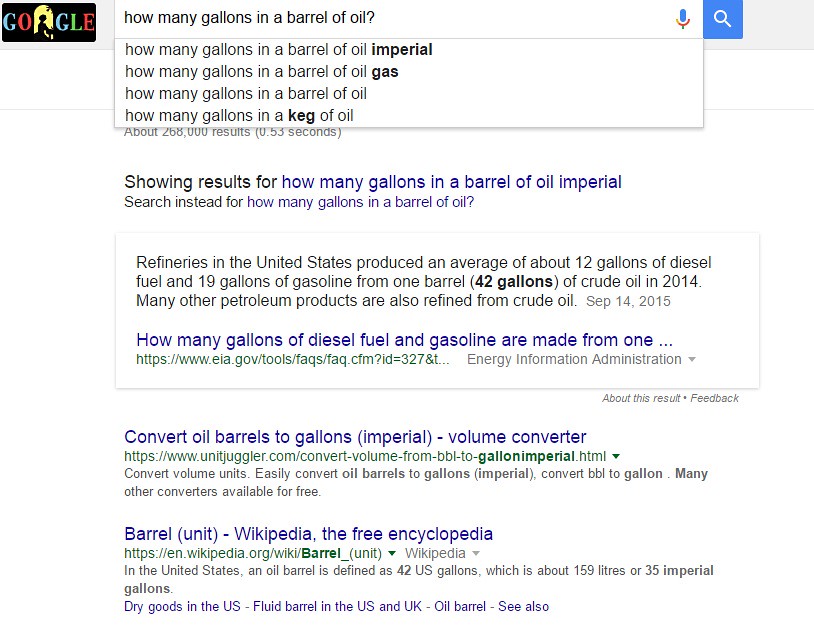
The amount of barrels delivered in 15 seconds is 17,000-barrels.  How many gallons are in a barrel of oil?  The news typically reports volumes of oil in barrels rather than gallons or liters.  Shown below is the image of typing the question of conversion units from google:


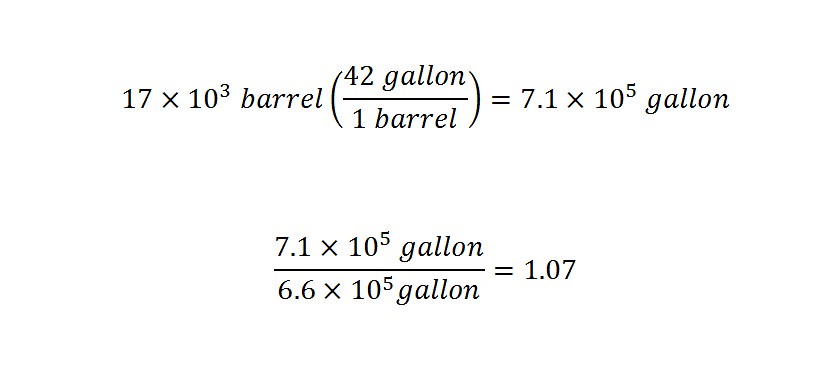
The image above is helpful or should be to the reader.  Not all conversion factors have to be taken from a reference book or a text book.  To lower the barrier toward carrying out the calculation, just ask google.  With the conversion, the amount of gallons in 15 seconds can be determined as shown below:


There are 710,000-gallons in 17,000-barrels of oil.  Additionally, I took the liberty to complete the calculation of comparing the amount of barrels to the volume of an Olympic Sized Swimming Pool.  Basically, the statistic cited in the "Watchdog.org" article was correct.  Nice, I like when the media do their calculations correctly.


Is there any other dimension or volume that could be chosen to further put the volume in perspective?


How about the world's largest swimming pool?


Located in Chile, the world's largest swimming pool is 66,000,000-gallons.  WOW.  Here is a photo taken from the "Wikipedia" site:


Source: Wikipedia


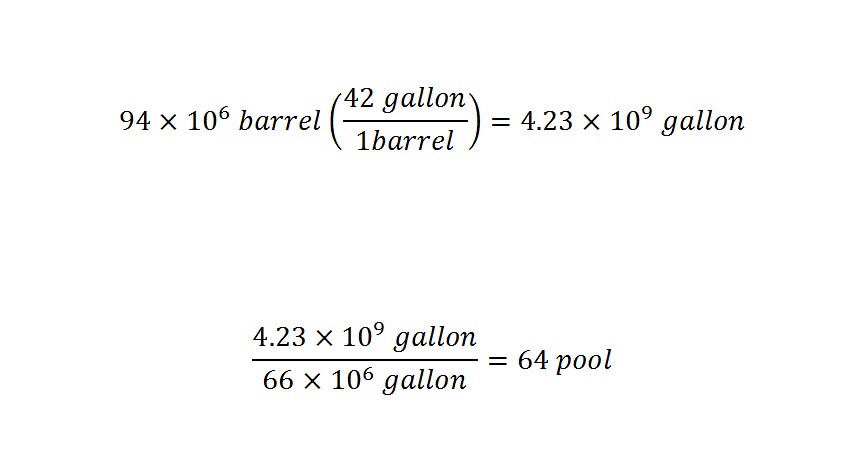
I wondered how many of these would be filled up by the total daily volume for the global demand -- 94 million barrels.  Here is the calculation below:


64 pools -- how is that possible to put into perspective?  My mind was bent.  I like large numbers and see them a lot in science, but this number is incomprehensible.  As usual, I like to look for a variety of volumes to compare the numbers.


How about the Mercedez Benz Super Dome?


How Many Super Domes?


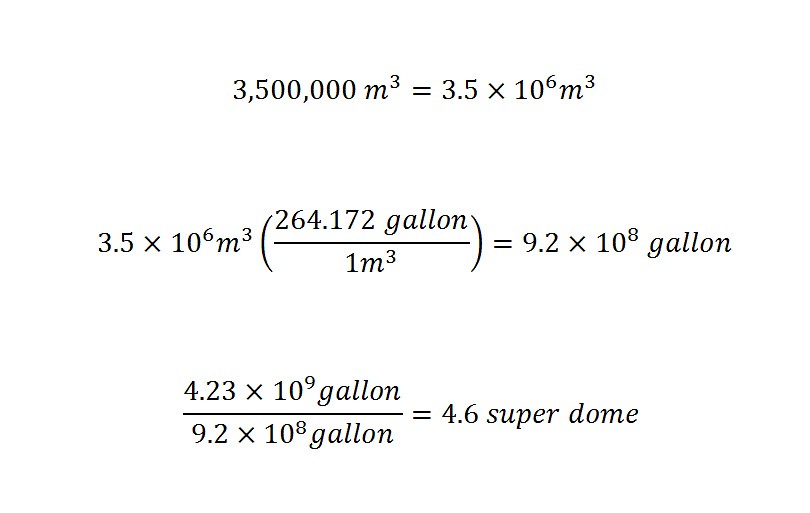
In order to figure this out, I needed the volume of the interior space of the Mercedez Benz Super Dome in Louisiana.  The volume is 3,500,000 cubic meters -- interior space.


Source: Wikipedia


How does a person calculate the volume and compare the result to 94 million barrels?


To start with, the proper conversions need to be carried out;  Specifically,


The next time that you (the reader) are inside the Super Dome think about the fact that 4.5 of these could hold the daily global demand of oil.  Absolutely amazing to say the least.


Have I given you a good perspective of the global daily demand of oil -- 94 million barrels of oil?


Conclusion ...


The next time that you find yourself at the gas pump think about the complexity associated with computing the daily demand of oil globally.  Undertaking this task would require compiling a bunch of statistics from a variety of organizations.  More importantly, I would ask the reader to consider the opposition on behalf of those civilian's who would like to transition immediately toward renewable energy.  Can the world accomplish this task quickly?  What if all of the major corporations decided to make a transition -- how long would that take?  Probably longer than you could imagine.


Yes, I am speculating on this.  Although, upon viewing the perspective given above through dimensional analysis, what is an appropriate time line?  How do we accomplish this?  These are open ended questions which need to be entertained.  You might be wondering at this point:


What can I do to reduce my consumption of oil and contrabution to the global daily demand?


Imagine if each of us cut our usage by just a little.  That would add up to a large number.  Lets all do our part and move toward using/demanding renewable energy technology.


Related Blog Posts:


Dimensional Analysis Of Statistics And Large Numbers - Index Of Blog Posts


Science Topics, Thoughts, and Parameters Regarding Science, Politics, And The Environment!


Wednesday, June 1, 2016

Why Do People Fly Drones Into "Restricted Air Space"?

Here is a picture of a sign that is located outside the Pentagon in Washington D.C. shown below:


Source: Shannon Giles


When I first saw the picture before reading the article, I thought the following:  "Why would anyone fly a drone over the Pentagon?"


Flying Drones In Restricted Air Space -- Government Land!


Drones are being used in a variety of environments today which are expanding at an unprecedented pace.  The typical stories that make the news with respect to the use of drones (recreationally) are centered around the use of drones in "restricted air space."  Specifically, amateur drone operators flying drones in "restricted air space" near airports, flying drones on "restricted property," and finally in "private property."  The private property example is of a drone flying outside of Senator Diane Feinstein's house.  As you can imagine, a debate ensued quickly after that regarding regulations on drone operations for amateurs.


These are blatant violations that are being held in debate lately.  Up until a few months ago, there had been no precedent (guidelines) for amateur drone operators.  That has changed with the release of rules (initial) by the Federal Aviation Administration (FAA).


There are situations which involve drones that are not shed in a negative light.  According to a recent article, drones are serving a great role in the study of ecology for biologists.  The title of the article is "NSF Grant To Help Grow Drone Technology For Biologists and Ecologists"  Here is an excerpt:


“We will help these wildlife trackers do their jobs and improve information gathering. Instead of using hand or pole-mounted antennas, we will put an them on a UAV that can go up hundreds of feet and leverage the three-dimensional flight capabilities to more easily locate the radio tag signals,” Shafer said.

NAU’s drone technology capabilities for tracking wildlife will turn the UAV into a virtual pole that can fly hundreds of feet in the air and replace or augment handheld poles currently used to pick up radio tag signals.

Michael Shafer and Paul FlikkemaMichael Shafer and Paul Flikkema are working on an unmanned aerial radio tracking system for monitoring small wildlife species. The technology will be shared with scientists around the world.  Wildlife biologists have an easier time studying larger animals because they use GPS-enabled tags. Those sensors are usually too heavy for bats, birds and other small animals, which need small, specialized radio-transmitting tags.

“We are developing a new UAV that is not available anywhere commercially,” said Flikkema. “We think the technology is a great synthesis of a mobile platform with sophisticated electronics and software that together can help find and track small animals.”


The above description seems like an exception to the current regulations on amateur drone flying.  Actually, as regulations go into effect over time, the science community will grow to use a "regulation or permit" system to use drones to study restricted areas.  By restricted areas, I do not mean areas like the airspace above the pentagon.


Bird Strikes Can Incur Serious Damage To Aircraft


Up until the introduction of recreational drones, the only real threat to the air space was primarily due to collisions with birds.  Very simply stated, a bird strike is when a flying aircraft collides with a bird flying in their native environment and cause potential damage.  At this point, you might be wondering the following question:


How many bird strikes occur each year?  -- frequently enough to cost a lot of money!


How much money do these collisions cost? -- around $1.2 billion in damages and delays!


To answer these questions, I would first like to show a few pictures of collisions with planes.  Shown below are a few pictures of the range of damage that a bird can inflict on an aircraft.  Remember, the bird most likely lost their life.  Here are the photos:


1) Nose Damage:


Source: http://www.birdstrike.it/en/index.php?Archive_2012


2) More Nose Damage:


Source: http://www.airliners.net/aviation-forums/general_aviation/print.main?id=5782851


3) Wing Tip:


Source: http://gizmodo.com/bird-strikes-are-scary-for-even-the-strongest-planes-1744561482


4) Helicopter:


Source: https://en.wikipedia.org/wiki/Bird_strike


Have I made the following point:  Bird colliding with any flying object (mechanical) can be deadly for both colliding parties (birds and humans)?  These pictures are graphic and should be viewed with the perspective of answering the following question:  Why do I need to fly a drone into "restricted air space"?  You might be thinking that the above pictures are of bird strikes -- which are much different than a human being flying a drone.  Really?


I beg to differ on the subject matter of the last sentence.  I think that birds have evolved to avoid colliding with jets of all sizes throughout the year.  What about drones?


Have Drones Collided With Civilian Aircraft?


The popular news channels have carried stories about amateur drone operators flying drones into "restricted air space."  Left out of those stories were the collision stories with drones.  Part of this may be due to lobbyist on part of the drone community -- who knows?


Anyways, lets look at a collision of a drone with a civilian aircraft.  Shown below is a short video of a collision of a drone with a public aircraft:


That is amazing footage taken by a passenger on a commercial airline flight.  Should you be afraid to fly?  No.  But spread the word the next time that you hear your friends bragging about flying drone.


Clearly, the situation above was in "restricted air space."  Lets back up a minute and ask the following question which I alluded to above.  How good are humans at operating drones?


Here is a video compilation of a few drone crashes -- shown below:


Couple these videos to the notion that drone operators should be able to fly in ever location.  Why do we as humans think that we can fly a drone at high altitudes?  The ceiling is set at 500 feet.  How tall is five hundred feet?  Shown below is a picture of the bell tower at UC Riverside -- which is ... feet tall:


Source: https://en.wikipedia.org/wiki/University_of_California,_Riverside_campus


The tower is 161 feet tall.  That means that the current ceiling for an amateur drone operator is 500 feet.  Roughly a little over three towers stacked on top of one another.  OMG.  Imagine trying to maneuver and respond from a distance of 500 feet?


Can you imagine what the view from 500 feet above the Earth's surface looks like?  Here is a free-climber that pulled a stunt and is standing from a crane that is 500 feet above the ground.  Take a look at the picture below while thinking of the FAA setting the ceiling for an amateur drone operator of 500 feet:


Source: DailyMail.com


Do you think that your response (operating a drone flying at this height) might be reduced by a lack of vision?


Obviously, there are concerns with letting an amateur operate a drone at heights of this magnitude.  New drones have cameras mounted on them.  Still, the disconnect caused by the distance is concerning and can result in major damages and costs to the airline industry.   Furthermore, ask yourself the question:


Why should a person be able to operate a drone within a ceiling of 500 feet?


Current regulations limit the flight to be within the visual sight of the operator.  Meaning, you cannot fly a drone out of your line of sight.


Conclusion ...


Why do drone operators need to fly drones into "restricted air space"?  This probably feeds into the broader debate over privacy.  People do not want their privacy encroached upon on one hand.  Whereas on the other hand, as drone operators, they do not want restricted freedom to fly their drones within (restricted space).  Drone operation leisurely are growing at an exponential rate and will become further problematic (i.e., collisions, damage to property, etc.) in the future.


Now is the time to recognize and come up with a system that accommodates all parties involved -- regulators to operators.  Given enough time passing, the difficulty in forming regulations will become more problematic and be reactive in nature.  Why not be proactive in regulating and save damage to others?  Until next time, have a great day.