Showing posts with label STEMed. Show all posts

Tuesday, August 28, 2018

Scientists should find similarities rather than focus on differences


Source: Kinsky-STEM


STEM education has become a hot topic over the last decade.  STEM stands for Science, Technology, Engineering, and Mathematics.  Just by inspecting each word in the acronym, the realization of the broadness of the interdisciplinary field becomes apparent.  Within this broad field, scientists tend to focus on differences rather than on similarities.  Which needs to change if STEM initiatives are going to be propelled forward in the future to center stage.


I am a chemist not a biologist!


In the pursuit of elevating STEM initiatives throughout the K-12 education along with the university setting, major differences in technique are starting to arise - which is of concern for the future.  For university professors, my colleagues are reporting that differences in starting to appear across a discipline like chemistry.  Typically, the area of Chem Ed covers all of chemistry.  Recently, our department hired a 'Chem Ed' faculty member for a tenure track position.  She has been with the department for an entire year so far getting her research group up and going.


Recently, she returned from a conference for 'Chem Ed' specialists.  She is a biochemist by education with an emphasis in 'Chem Ed' -- meaning the bulk of her PhD research was concerned with 'Chem Ed'.  For those not aware of what the field (or sub discipline) of 'Chem Ed' is, the emphasis is on researching different methods to improve the curriculum of chemistry in general which results in better retention rates (graduation), higher student engagement in classes, and overall student success throughout the undergraduate journey.  Basically, to improve education methods in the sciences -- 'best practices' in teaching.  This is an exploding field at the moment.


The conference she recently attended was called 'Biennial Conference Chemical Education.  Each year the conference is held in different locations.  If you are interested in reading the history of the conference series, click here to find out more about its origins.  Upon her return, I was speaking with her about the wide variety of presentations which were offered.  Later that same day, I was at an outreach event at a local park, when I ran across a biology professor from our same university who is deeply interested in STEM initiatives.  Without thinking more deeply about my question, I asked him the following question:  "Did you attend BCCE?"

He responded "What conference?"

I followed with "Li from our department went to BCCE  at Notre Dame?"

With that he asked "Isn't that for chemists?...Why would I go, I am a biologist?"


At that point, I was thinking to myself that he is correct and why would I ask such a question to someone in a completely different discipline?


Although, with time, I started to consider the question "Do best practices in Bio Ed translate over to Chem Ed and vice versa? Just out of curiosity.  Why are professors at the same institution attending conferences in completely different disciplines about improving best teaching practices?  Especially, when all of us are working together to elevate STEM initiatives?  This stumped me, so I asked the question on Twitter (social media).


I did a few interesting responses, but the response that most resonated with my curiosity was the following: "Professors do not talk with one another Mike."  This was from a biologist who has years of experience and is at our university.  With time, I reasoned that initiatives like "Faculty Development" on campus bring together professors from a wide variety of disciplines to tackle these matters.  Further, that during these sessions, each discipline could share 'best teaching practices'.  Case closed right?  Wrong...


Chemists do not talk to each other?


I let a couple of weeks pass and then one day, my wife (Kayla) who is a professor of chemistry and is involved in Faculty Development was debriefing me about her day.  I was semi interested to here about the pre-semester chatter in our department with classes starting.  I decided to engage and listen.  She said that during the particular afternoon, she visited the offices of new professors (in our department) just to find out what 'best practices' they were engaged in if any or trying new teaching techniques in the coming semester.  Which has since started (yesterday).  The results were astounding to say the least.


After talking with four professors, she realized that there had been a large amount of data collected over the last 2 years (already considering they were new) collectively.  Further, that a few of the techniques were 'redundant' in practice and could have been avoided.  Of course, for the redundancy to have been avoided, this would required professors sharing 'best practices' with one another.  This left me astounded after hearing the reality.   How can professors who work in the same building not share 'best practices' in teaching?  This left me disappointed and confused (still to this day).


Such a waste of energy.  This needs to change if there is going to be forward momentum.  To cap all of this off, my colleague (Li) who just returned from the conference - BCCE - said that the field of Chem Ed is headed for further splitting into sub-disciplines? What?  Which means that the will be a corresponding 'Ed' component to the following sub-disciplines in chemistry: Chemistry, Organic Chemistry, Inorganic Chemistry, Physical Chemistry, Analytical Chemistry, Biochemistry.


Why is this occurring?  This seems to be moving progress in the opposite direction rather than forward!


Why are people searching for differences rather than similarities?  After all, the goal is to improve on educational practices while elevating the fields - which span a wide variety of interests - in the eye of the public.  According to the 'Wikipedia' page for STEM, there are more variations of STEM shown below:


- STM (Scientific, Technical, and Mathematics;[5] or Science, Technology, and Medicine; or Scientific, Technical, and Medical)
- eSTEM (environmental STEM) [6][7]
- iSTEM (invigorating Science, Technology, Engineering, and Mathematics); identifies new ways to teach STEM-related fields.
- STEMLE (Science, Technology, Engineering, Mathematics, Law and Economics); identifies subjects focused on fields such as applied social sciences and anthropology, regulation, cybernetics, machine learning, social systems, computational economics and computational social sciences.
- STEMS^2 (Science, Technology, Engineering, Mathematics, Social Sciences and Sense of Place); integrates STEM with social sciences and sense of place.
- METALS (STEAM + Logic), introduced by Su Su at Teachers College, Columbia University.[citation needed]
- STREM (Science, Technology, Robotics, Engineering, and Mathematics); adds robotics as a field.
- STREM (Science, Technology, Robotics, Engineering, and Multimedia); adds robotics as a field and replaces mathematics with media.
- STREAM (Science, Technology, Robotics, Engineering, Arts, and Mathematics); adds robotics and arts as fields.
- STEAM (Science, Technology, Engineering, Arts, and Mathematics)[8]
- STEAM (Science, Technology, Engineering and Applied Mathematics); more focus on applied mathematics[9]
- GEMS (Girls in Engineering, Math, and Science); used for programs to encourage women to enter these fields.[10][11]
- STEMM (Science, Technology, Engineering, Mathematics, and Medicine)
- AMSEE (Applied Math, Science, Engineering, and Entrepreneurship)
- THAMES (Technology, Hands-On, Art, Mathematics, Engineering, Science)


What?  Again, look at what has transpired over time to find differences rather than similarities.  Why are professionals looking for differences rather than similarities?  To me, this makes little sense.  This is not to say that 'Best Practices' in biology translate over directly to chemistry.  Although, I would argue that each discipline could stand to learn from listening to the successes and failures of each discipline.  Further, this reduces the possibility of redundant efforts and saves time overall.


Conclusion....


What is the point of a university?  Besides education and research, why does a university exist?  One answer is that a university brings together a large number of very intelligent professors in the same geographical zone.  Further, to bring together bright minds together to provide a 'well-rounded' educational experience with the possibility of research experience too.  Aside from this mission, is the university a place to exchange ideas?  Yes, I believe so. 


In light of these questions and possibly answers, why then are professionals searching for differences rather than similarities.  University officials should be trying to bring together professors to share their best and worst teaching experiences. Included in this sharing should be best and worst practices of research too.  Additionally, research which focuses on elevating the percentage of different culture, ethnicity's, and genders who pursue STEM field for a profession.  Research such as this highlight the need to bring different people together into STEM disciplines rather than find differences.   Coordinating a collective amount of diverse opinions and results from various academic teaching pursuits provides a rich and meaningful way to push a diverse field in need forward.  Lets work on similarities and avoid finding differences.


Read about STEM initiatives winding their way through Congress - legislation!


Related Blog Posts:


Why Chemistry Matters from the mouths of Nobel Laureates!


President Trump finally fills the Office of Science and Technology Policy position - Yeah!


Teachers, Parents -- Students need to learn how to write and mail a physical letter


Does your brain move throughout the day?


"All Of Us" - The Best Medical Knowledge Update Effort - Please Join!


What Is Going On Inside That Cell?


How Do Scientists Think?


Science Topics, Thoughts, and Parameters Regarding Science, Politics, And The Environment!










Wednesday, August 22, 2018

What is a typical day like for a systems engineer at JPL?


Source: Phys.Org


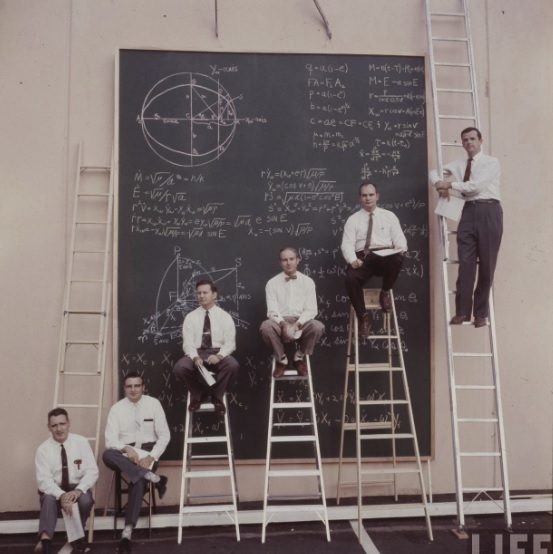
Hollywood gives us a picture (one example) of a typical day in the life of a systems engineer at the Jet Propulsion Laboratory.  What does that picture look like?  An example might be shown below:


Now compare that with the written description from an interview of a true systems engineer at the Jet Propulsion Laboratory in Pasadena as highlighted on the 'Science & Entertainment Exchange' website shown below:


What is a typical day like for a systems engineer at JPL?

The one thing I love about my job as a systems engineer is that there really is no such thing as a typical day. It changes dramatically over the lifecycle of a project, which goes like this. In the early phases of a project, the scientist community and NASA decide what it is that needs further study. Take Jupiter, for example. How was Jupiter really formed? Related to that question are things like: Does Jupiter have a core? How big is the core? What is the water vapor content of the atmosphere?
Next, a call for proposals is sent out and engineers work with scientists to figure out how to go about finding the answers. Can we use a telescope on Earth? Or do we need to send a spacecraft all the way to Jupiter? Can it just fly by the planet or does it need to go into orbit? Then, we come up with a specific design for the spacecraft and instruments. For the instruments: they are often selected through a parallel proposal process. For the spacecraft side: if a spacecraft is going all the way to Jupiter, we work through big design questions like: Does it need nuclear power? Or can we use solar power? If we use solar power, how big would the arrays need to be? Over time, we mature the design to a very high level of detail, then build parts, and assemble them. There are many points throughout the design process for testing things, performing analyses, etc., to ensure everything is going to come together smoothly and perform the way we expect. Eventually, we launch the spacecraft. Once we are in this operations phase, we are getting the data back from the instruments, but also managing the health of the spacecraft.
So far, I have worked on projects starting from the middle of the design phase through the final assembly, testing, launch, and operations phases. My job focuses a lot on troubleshooting and resolving design disconnects. For example, early in the design phase a telecom engineer might want 100 watts of power to make sure the signal back to Earth is very strong and easy to lock onto, but the power system may be providing only 500 watts for the entire spacecraft. The systems engineer’s job is to work with engineers from both of those areas (and the rest of the spacecraft too) to explore the trade space and figure out the best approach.


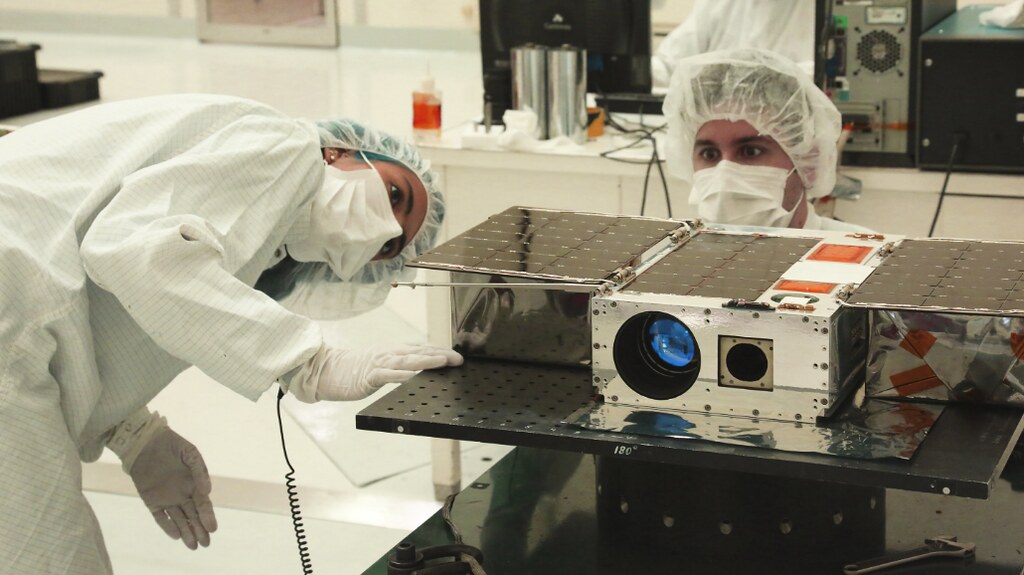
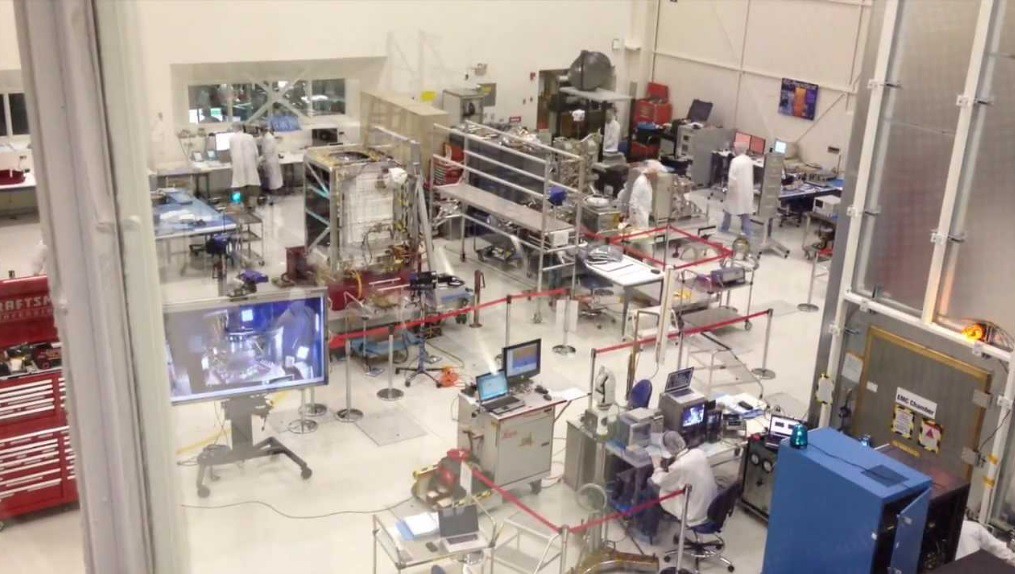
The description above implies the images below:


Source:JPL


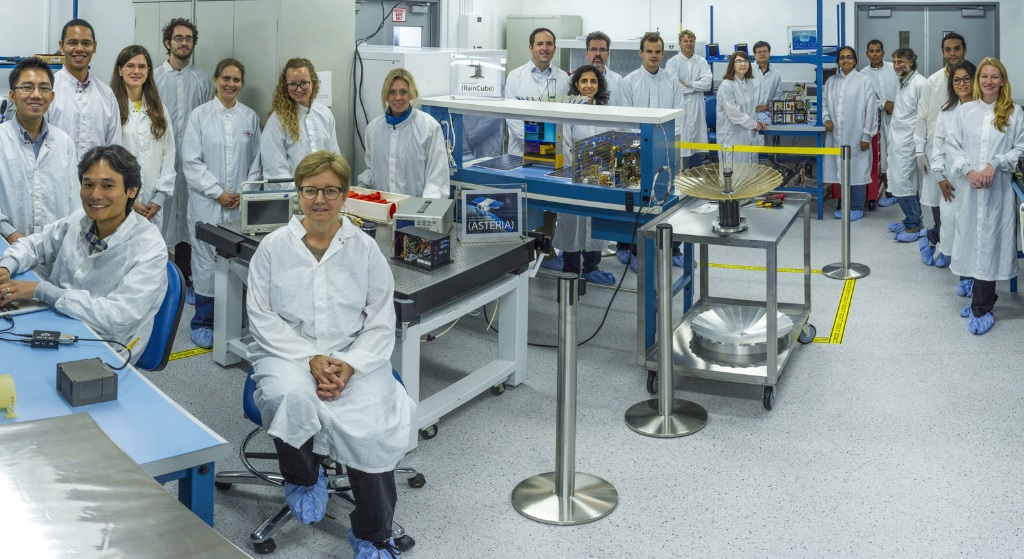
Laboratories like the one above and below house teams of scientists who work collaboratively to think about all of the considerations for a given mission.  A team which appears like the picture below:


Source: JPL/NASA


The laboratory above (spacecraft factory) is a result of years of work by NASA engineers.  Over the course of decades, space scientists have worked to optimize (perfect) the process of design, construction, testing, and launching/mission.  According to the description above by the systems engineer, a day can take on many different forms.  Which highlights a very important observation which frequently arises when non-scientists visit laboratories.  The scientific process has many components which range from constantly sourcing out funding for various research projects to solving unexpected problems encountered during research and development.


Conclusion...


The traditional (old image) of a scientist or systems engineer is one that is not only outdated but has changed over the last few decades.  What image do I speak of?  The image of men chalking up the boards with equations has been replaced largely by computational methods.  A scientist working alone in his/her laboratory day after day has been replaced by a more collaborative working environment -- diverse with different genders, race, and ethnic backgrounds.  Which spurs different angles of creativity and ideas in solving a project at hand.  Since funding is getting more hard to find, more consideration into each part of the process from planning to finalizing construction of a spacecraft is considered in more detail. The result is a more diverse and inclusive interdisciplinary research and design group of scientists who are more concerned about living in a better world and beyond. 


Related Blog Posts:


Why Chemistry Matters from the mouths of Nobel Laureates!


Scientists compare Misinformation In Mainstream News to a Viral Infection


What Is Going On Inside That Cell?


How Do Scientists Think?


Tuesday, January 24, 2017

STEM Outreach Is Useful For All Participants!

Last Thursday, I had the opportunity to participate in a science fair at a local elementary school as a judge.  I participated last year and had a wonderful time.  Additionally, I wrote about the fact that the projects presented at the science fair should be age (and grade) appropriate.  Here is the blog post regarding the continuing need in science fairs.  With the digital age of technology emerging at a rapid pace, the ability to present a science project is easier than ever and make the presentation look professional.  Still, when you are a judge at a science fair judging 3rd grade posters, the level of detail should not exceed the grade or skill level.  At the same time, having the family involved in a 3rd grader's science project brings everyone into the project -- which elevates STEM overall -- and that is a good outcome for participant.  Before I dive into the blog post, the following question should be entertained:


What is STEM?


STEM is an acronym which stands for: Science, Technology, Engineering, and Math (STEM).  The combination of the physical and life sciences along with emerging technological fields and the mathematics which solidifies the group as a whole.  The reach of STEM is broad based and cannot be overstated! Currently, there is a need to elevate the amount of students heading into colleges to pursue a career in one of the fields encompassed by STEM initiatives.  Additionally, to protect our environment and the health of our nation (and world), a basic understanding of issues which the basic student or enthusiast can impact with an education or knowledge of the broad areas of STEM is important.  In the paragraphs below, I want to touch on the what I learned from the experience and how useful such outreach is for each participant.


What Is A Science Fair Judge?


A science fair judge is a special person.  No, I am not just saying that because I participated recently as a science fair judge.  The first time that I watched my wife -- Kayla -- who is also a scientist participate as a science judge, I honestly thought the following: "that is so nice of her...but I think that this is a waste of my time -- personally."   Oh, how arrogant I was and ignorant.


In order to participate in certain science fair events, you usually have to take time off of work.  The judging usually occurs during the day time while school is in session.  That in of itself requires a person to think of others and take time out to further a cause that they believe in.  Last year, I was a science fair judge at the same elementary school as this year.  Unfortunately, due to privacy concerns on behalf of the parents and students -- photos were not allowed.  But that won't stop me from conveying the benefits of participating in such an event.


There was a mixture of participants this year which made the event a great time.  The total judging time took around 4 hours.  All together there were 7 judges: a librarian, a chemical engineer (petroleum engineer), a mechanical engineer, 2 biochemists, a computer scientist, 2 chemists, and a science teacher (retired).  Having a diverse crowd made the judging process that much more fun and interesting.  Each of us bring our own opinion and professional background to the judging arena.


Whenever scientists get into the same room, the feeling is probably similar to a group of medical doctors.  Without the humongous ego though.  Scientists are skeptical along with traditionally being results/data driven.  This carries over to the critique of 3rd grader science projects as you can imagine.  Each of us have our own idea as to the level of greatness a given project has attained.


I was surprised to learn so much from other judges at the contest.   Surprised because sometimes such events are usually judged by scientists who are judging posters at the speed of light to get done and go home.  Taking your time and giving each project a level of respect is important.  Treating the posters like you would a 'grant application' or a paper submission to a funding source is important.


Teasing out the level of participation of the student and the family members is difficult to do in some situations.  A science fair project should fit the skill level of the participants.  Although, this year, I was talking to the science teacher (retired) and she had an interesting impact on me on multiple levels.  Why?


First, when the rules were being set before the judging session started, we were told to look at the folders out in front of the posters.  One of the qualifications was the bibliography.  Specifically, each students should cite at least ONE BOOK each.  School administrators were tired of seeing "online" references to websites such as "YouTube" on a given project.  Although, the generation participating in the science fair contest is growing up in a digital age.  Which means this requirement is rather outdated.


These students are growing up in a digital age.  Finding resources now requires engaging in an online search.  Rather than restrict the students to a local library which might or might not have the proper resources, the online world is sufficient for the emerging student of today -- being raised in the digital world.  This year differed greatly in comparison to last year in that we were able to interview the 3rd graders at their poster.  When asked: "where did you come up with this wonderful idea?" The common answer was: "From watching videos on YouTube".  A few years ago, I watched a "YouTube" video on how to change a Honda Civic car window motor and was thankful to have my window working a short while after the tutorial.  Therefore, how can we fault these children for searching online.


During my discussion with the retired teacher, she completely agreed that referencing a source from online is the new trend.  That is not to say books are no valuable.  An online search can reveal a rare book which might be out of print or completely hard to get your hands on a physical copy of.  The process of searching online for a reference and learning is a take home message that both of us agreed upon that outweighed the source of the information (online vs. library).  I enjoy spending time at the library on the campus (university) where I work.  But I can find a large amount of information on my laptop in my office too.  Each has their strong points.


Understanding the rules by which to judge the science posters is a process in of itself -- since we have 9 minds from different backgrounds coming together.  Nonetheless, the process is completely informative.  Ideas which you might not have thought of arise from others which are mind boggling to you.  At least, that has been my experience both years so far.  I will talk more about learned ideas in the next section.  The point is that simply participating with other judges presents the opportunity to talk and form rules and point out strong points (and weak points) about a given project -- which teach each of us about our respective professional work and opinions.


Not to diverge too much.  The chemical engineer was a retired petroleum engineer who lives in Porter Ranch in the San Fernando Valley.  The same Porter Ranch which was all over the news due to the exorbitant methane gas leak out of the Aliso Canyon Gas facility last year.  I was asking him about his position from being a resident which was completely fascinating.  He did not smell the gas too much.  Although his wife complained about the smell constantly.  He did mention that the industry was very much aware of the regulations and was rather 'complacent' instead of being 'proactive' in making changes which would have increased the safety of the site.


I mentioned that I wrote a blog post last year regarding the massive size of the well.  Further, a follow up blog discussed the misleading amount that was stored under ground.  He said that what surprised him most about the leak was that each gas well was supposed to have a "shutoff control valve" at the surface and at the bottom of the well in the event of a massive leak.  Had the leaking well had the "shutoff control valve" at the base (bottom of the pipe exiting the well), the leak could have been stopped instantly.  What a disaster?  What a complacent mistake in judgement?  But the 'bottom line' (profits) of the corporation is more important than safety.


This was one of a number of good conversations that might not normally be possible had we not decided to come and participate in this shared interest.  Elevating science in elementary school is extremely important.


3rd Grade Science Projects?


When I first showed up to judge, I was told that we would be judging 3rd grade science fair projects.  At first, I thought, when I was in 3rd grade, I was not interested in science and I loved just playing around on the playground.  Science was not my priority.  I was pleasantly surprised to see that the students of today differ greatly from myself and have a joy of science -- even at this young age.  Additionally, each has a seriousness about their projects which matched their enthusiasm.


Last year, the winner of the science fair was a young man who studied the composition of soil.  He took a large amount of time to write up his results and draw out his poster.  I wrote a blog regarding the event.  In that blog post, I discussed that science fair projects need to fit the age of the child engaging in the project.  Age-appropriate projects are important for the student to learn how to proceed with the project from the start to finish.  That means coming up with the idea to the execution of the project.  Obviously, the parent will have to help to a large extent with the execution of the project.  But the idea should still come from the student.


Although, I will touch on in a moment an argument raised by a retired elementary science teacher which caused me to pause and think twice about the strict requirement of age-appropriate projects.


What does a science project that is not age appropriate look like?


This year, an example of a science fair project from the fair that I participated at was a study of the 'drag' or 'turbulent' air coming off of a race car (indy 500 car).  Great idea.  But I am not sure that a student in the 3rd grade would have come up with that on her/his own.  Maybe by watching a race or two, a question would arise as to the reason for the giant fin on the rear of the car by the child.  I am skeptical that the student decided to study 'turbulent' behavior with a fan and a wing.  Furthermore, the graphics were great in the illustrations and I would be challenged to duplicate them myself.  This is an example of a project that is not age appropriate.


Another example would be of a project which makes use of an 'oscilloscope' to measure frequency and bandwidth of an incoming electrical signal.  A 3rd grade science project?  Really?  And in the students notebook, the analysis of the incoming signal was expressed by using calculus and functions typically used in signal analysis.  I was very skeptical of this project along with the previous project.


In both cases, the parents professional life might have heavily influenced the choice of a project to pursue.  Great ideas for a college student or a graduating senior in high school.  But out of the league for a 3rd grader.


How do you tease out the amount of participation of the 3rd grade student in his/her project?


Last year, the students were unaccessible to answer questions regarding their projects.  This raised the level of skepticism among the more advanced science projects (not age-appropriate).  The director of the program decided this year to have the students come in and be interviewed by the judges.  This provided the student with the opportunity to share their part of the project with the judges.


Having the students participate and explain their work gave them a sense of accomplishment.  I am not sure that I would have been able to do what these students did at the same age many years ago.  As I mentioned, I was more interested in playing.  The interviewing sessions turned out to be of great importance for the judges.  Additionally, giving the students a 'voice' is the first step toward producing a great science communicator for the future.


What is an example of an age-appropriate science project?


A good example of an age-appropriate science project this year was the study of bacteria (or germs).  I interviewed a student who chose to look at the effect of washing your hands versus the amount of germs present.  What?  The student chose to vary the amount of time spent on washing his hands versus the amount of residual germs that were present.


The student did a total of 3 experiments, one each day.  He would wash his hands for three different time intervals: 10 seconds, 20 seconds, and 60 seconds.  After each washing, he would swab (take a sample) from his hand and put the swab into a petri dish (a small cylindrical plastic dish).  Instead of growing the bacteria at a faster speed by using an incubator, he used the natural sunlight as a heat source.  An incubator is a container that provides a controlled environment to grow cells (source: Wikipedia):


In biology, an incubator is a device used to grow and maintain microbiological cultures or cell cultures. The incubator maintains optimal temperature, humidity and other conditions such as the carbon dioxide (CO2) and oxygen content of the atmosphere inside. Incubators are essential for a lot of experimental work in cell biology, microbiology and molecular biology and are used to culture both bacterial as well as eukaryotic cells.


After the bacteria had grown using the natural sunlight, he came up with a counting method to count the colonies that had grown in each dish.  With the numbers of colonies recorded, he plotted them on an excel sheet.  Over the course of the three days, the data was inconsistent.  Two days were exactly the same. Whereas the third day, there was a sudden spike (increase) in germs.


I was able to ask the question regarding the inconsistency of the data over the three day period.  He offered that the day in question could have been a day where more students were sick.  Now, this is a good answer from a 3rd grader.  The project was simple.


Further, the project was innovative since the 'microbiome' is a hot topic in the news along with 'antibiotic resistance.'  The student chose soap that was not 'antibacterial' soap -- to ensure the growth of germs.  Had he used 'antibacterial' soap, the measure of the colonies would have been virtually impossible -- since 'antibacterial' soap completely (or nearly) eliminates germs.   I thought that the student was well versed and chose an attainable science project which required little supplies but answered a very important questions.


I asked the student about the relevancy of his project to the environment of a hospital.  He mentioned that his project supported the reason why doctors have to 'scrub in' before surgery for a long period of time.  Doctors spend a very long time washing their hands before they enter the operating room to ensure that they have eliminated any source of bacterial contamination from their hands and arms.


What are the benefits of any science project 'age-appropriate' or 'not age-appropriate'?


I mentioned above that I learned a lesson from a retired elementary science teacher regarding participation in science projects.  Previously, I was strict regarding the level of difficulty regarding the science project.  If the project is too difficult, then the student does not participate and loses interest.  Basically, the parent is competing in the science fair project not the child.


Although, the teacher I mentioned, taught me that regardless of the science project, if the entire family is participating in a science fair project then more people benefit from engaging in STEM activities.  I had never thought of the process in that light before.  Getting the family involved in the project, means getting more people interested in STEM projects.


The student will have more opportunities to compete in science fair projects as he/she progresses through their education.  But the parents and family might not help out as the student gets older.  Therefore, engaging the entire family is engaging a wider audience to the benefits of participating in science fair projects.  Everyone learns about science.


Conclusion...


I have shown that there are numerous benefits to being a science fair judge.  Everyone who participates in the process eventually comes out more educated from the experience.  Having the students participate with interviews greatly enhances their ability to communicate science.  Additionally, experiencing the enthusiasm of the student inspires the judges (at least me) to continue to engage in outreach.  The experience overall was very positive and I plan to continue to help out at as many as I am able to throughout the year.


The diversity of projects inspires scientist like myself who get caught up in projects that are advanced compared to the elementary level.  Science is about curiosity.  Science is about asking questions and seeking answers.  Science is a continuous journey of asking and seeking answers.  Science is about challenging yourself and your understanding of the world around you.  I encourage each of you to participate in a science fair -- either as a judge or a family member with a project.  I am inspired by these young children to do a better job at communicating science.  If they can do it at their age, then I can improve more at my age.


Until next time, Have a great day!!!!


Monday, December 19, 2016

How Much Water Is 55 Billion Gallons Of Rainfall?

As the water season began (at least that is what is reported by the news) in early October of this year, news accounts will be arising discussing various rainfalls.  Certain accounts will detail the much needed rainfall while others might even scare readers of the excess rain and the damage that might follow.  Regardless, the way the news agencies reports rainfall is often misleading and uneventful.  Below, I discuss one example from the "Los Angeles Times."


How Is Rainfall Reported?


Over the course of the last year, I have started to write about the reporting of rainfall.  I am constantly amazed at the subtlety with which large volumes of rain are reported after a given storm.  This problem of mine started back near the end of 2015 -- after reading a report of a storm.


Before I get into the initial motivation to investigate news reports about volumes of rain fall, I would like to say that I am still baffled why the news reports "inches" of rainfall while total volumes in units of "cubic feet."  I would prefer the units of total rainfall reported in units of "gallons" -- personally.  The reason is that I can visualize using a few metrics (large volumes -- pools, stadiums, etc.) to compare the reported values to.  Although, one could argue that my request is just unique to me and I could just as easily perform dimensional analysis to get the units that I feel comfortable with.  Fair enough!


During the end of the month of December of 2015, large volumes were reported and I wrote an initial blog post about this rainfall in following month.  Accuracy was not the first and foremost during this storm -- which concerned me.  The reason why is in the numbers.  Let's take a look briefly at the reported numbers which in some cases were skewed or miscalculated.


In that blog post, the news reported a number based on the weather service of 65 billion gallons of water from a single storm -- which is an enormous amount of rain.  One of my family members told me this factoid and stated that 65 billion gallons of water equated to increasing the water level of Lake Tahoe by 6 inches.  Meaning, that enormous amount of rain if collected and poured into Lake Tahoe would result in an increase of 6 inches of height to the lake.


After hearing that number, I sat back and thought -- Wow -- that means that Lake Tahoe is larger than I thought.  This factoid bothered me for a few days.  As a result, I decided to carry out a few calculations which are shown in the blog post.  I will get to the point.  The result of the calculation gave a volume that was very different than the volume reported by the news.


What was I to make of this disparity in volumes?


Did I make a mistake in my calculation?


Did my approximation not make sense?


Check out the blog to understand my full thought process in calculating using a simple approximation -- that of a cylinder.  The result of the calculations revealed that the total volume of rainfall in that particular storm was 6.5 billion gallons NOT 65 billion gallons.  A factor of 10 different in the reported statistic.


Should we be concerned by the lack of accuracy in reporting?  


Yes.


Two major results came from that practice:


1) The volume I calculated was correct.


2) The weather station corrected their reported volume after checking their calculation.


3) I learned a better method by which to perform dimensional analysis of rainfall using reported volumes.


Out of this exercise came the correction of the weather station.  Again, all of this is in the blog post.  Additionally, I learned that method by which the weather stations use (one of the methods) to calculate the volume of rainfall in a given storm.


After carrying out the exercise and writing the blog, I decided that from that point on forward, I would watch news accounts of rainfall volume in the future.  Further, I would look out for reported statistics and try to put them into perspective for the reader using dimensional analysis.  The result has been the blog posts that make up this site.


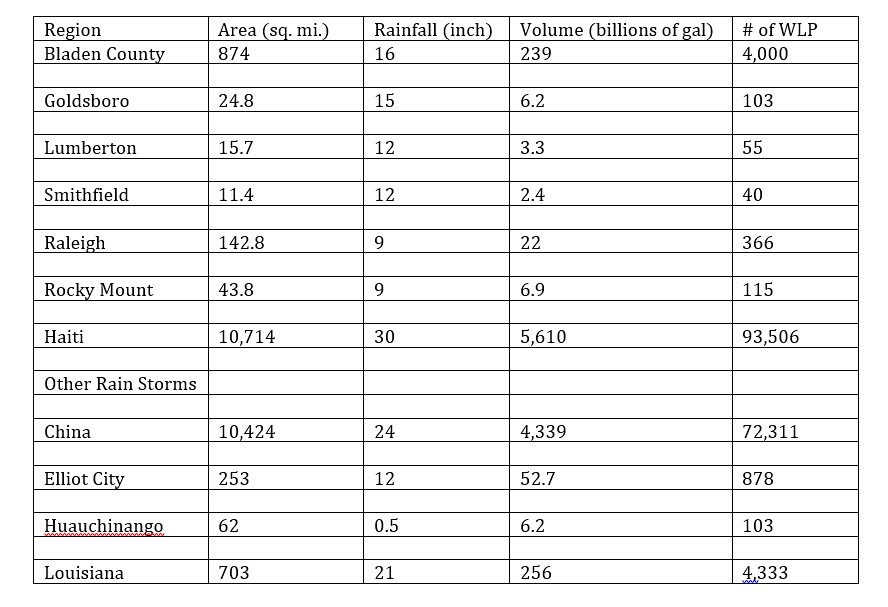
The results of previous blog posts this year so far regarding the total volume of rainfall have been collected into a table shown below:


Note: Click on any of the cities to access original blog post (with calculations) on this site -- (1) Bladen County, (2) Goldsboro, (3) Lumberton, (4) Smithfield, (5) Raleigh, (6) Rocky Mount, (7) Haiti, (8) China, (9) Elliot City, (10) Huauchinango, (11) Louisiana -- and I forgot (12) Macedonia


The first seven storms listed in the notes above are a result of Hurricane Matthew which ripped through the Eastern part of the USA originating from Haiti.  The last five storms listed are storms that have occurred due to unusual rainfall this year.   Recently, the Associated Press covered this in a story about the National Oceanic and Atmospheric Administration released report on rainfall this year around the world with implications toward Climate Change.


Regardless, the enormity of the storms are worth writing about.  With that in mind, let's move onto the reported value of rainfall over the season thus far in Folsom (California) of 55 billion gallons so far.


How Much Is 55 Billion Gallons Of Rainfall?


In a recent story in the 'Los Angeles Times' titled "A tale of two droughts in California: Wetter in the north, still bone dry in the south" the disparity of rainfall between Northern and Southern California was discussed with varying numbers reported which would make a person mind spin.  One excerpt that stuck in my mind was the following regarding rainfall received in Folsom:


The recent rains were enough to force federal officials to begin releasing water from Folsom Lake to protect against flooding for the first time since March, said Louis Moore, a spokesman for the Bureau of Reclamation, which manages the reservoir. Since the beginning of December, Folsom has risen more than 20 feet — an increase of about 55 billion gallons.


Now, if you are a reader of this blog, then the number 55 billion gallons should stick out of the excerpt above along with the number 20 feet.  Further, with the previous blog posts on this site, you will understand my need to understand the magnitude of large numbers like this.  Numbers that are truly incomprehensible.  I believe that the value of 55 billion gallons of rainfall qualify for the analysis typically found on the site.


To start such an analysis to put the enormous number into perspective, a metric is needed.  A metric serves as a 'ruler' of measurement.  Metric's specifically take away all ambiguity when defined.  What?  I know that is confusing.  Basically, we need a measurement to compare the volume too.


Let's choose 3 volumes and see how the statistic of 55 billion gallons compare.  The 2 volumes will be: 1) World's largest pool  2) Lake Tahoe.


1) World's largest swimming pool:


To start an analysis of the volumes is to ensure that the 'units' of measurement are the same.  That is, for the example at hand, the volume of the World's Largest Swimming Pool needs to be expressed in units of 'gallons' to be directly compared to the volume reported above of 55 billion gallons.


The World's Largest Swimming Pool is shown below:


Source: Twisted Sifter


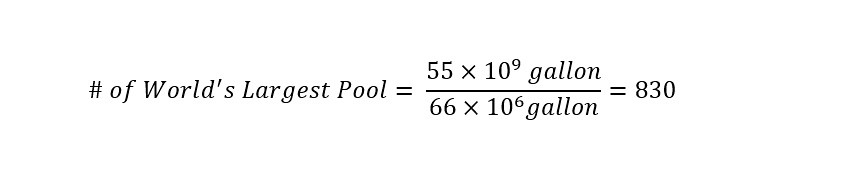
The volume of the enormous swimming pool is a whopping 66 million gallons.  That is huge.  If we express the volume of rainfall reported in the article in scientific notation, the number would look like the following shown below:


Remember, if the volume were written out in long form, the value would appear as follows: 55,000,000,000 gallons!  Expressing the number in scientific notation allows us to express the number in a compact form.  The volume of the World's Largest Pool can be expressed similarly in a compact scientific notation.


Since the units are of the volume are expressed in 'gallons' -- the number of swimming pools that could be filled with 55 billion gallons of rainfall can be directly determined by dividing the two volumes as shown below:


Wow!  The result can be interpreted as the following:


55 billion gallons of rainfall would fill 830 - World's Largest Swimming Pools!!!!!!!!!


How does one visualize that number of swimming pools?


Note: Since my last blog post using swimming pool in San Alfonso del Mar -- another pool built by the same company has built the new "world's largest swimming pool" -- Crystal Lagoon located in Sharm-el-Sheikh, Egypt.


Can you visualize a total volume of 830 of the above pools?


I cannot.  Maybe another metric is needed to better grasp the enormous volume of rainfall.


Sometimes our choice of a metric does not necessarily cast the volume in a graspable light.  For instance, trying to visualize the total volume of 830 World's Largest Pool combined is too difficult.  Maybe another analysis is useful with a larger metric to cast the volume is needed.


 In order to get a better grasp of the volume, a larger volume is needed to serve as a 'metric' to compare enormous volumes too.  55 billion gallons is not a typical volume.  Therefore, a larger volume is needed.  On a previous blog post on this site, Lake Tahoe has been used as a metric for extremely large volumes -- which this qualifies as that category.


Below is a picture of Lake Tahoe from Space:


Source: Snow Brains


Upon inspection of the photo above, Lake Tahoe is a huge lake.  The total square area of the Lake is 191 square miles.  In order to use this value as a reference to cast 55 billion gallons of rainfall into perspective, a little math will have to be performed.  But, we will take the process slow.  If at any point, you (the reader) need clarification, please leave a comment in the blog post below.


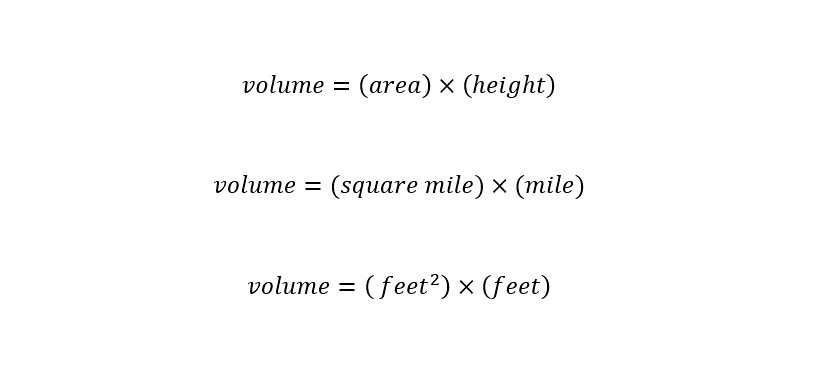
To start with, an equation for the volume of Lake Tahoe is needed.  Above, the surface area of Lake Tahoe is given as 191 square miles.  An expression (or equation) for the volume of an irregular shape like a lake is the following:


According to the expression above, the volume can rainfall can be determined by knowing the amount of rainfall that a storm delivered across a surface.  Meaning, if a circle is the two-dimensional surface, then by understanding how much water fell on the circular surface, the determination of the volume of a cylinder is possible.  By the way, the units of volume are 'cubic feet' or 'cubic mile' - etc.  Cubic feet is most likely easier to visualize -- since most of us have an idea of the dimension of a foot is in comparison to inches of rain.


Since in the present case, a volume is known, then in order to understand the magnitude of 55 billion gallons the question becomes the following:


How many feet would Lake Tahoe rise if 55 billion gallons were dumped into the Lake?


In order to start the calculation, a unit conversion is required to move on.  The second line of the volume expression states volume in terms of 'units of miles'.  This is not useful when discussing rainfall -- which is usually reported in units of 'inches'. If the calculation is carried out with units of 'miles,' then the results of the calculation would be expressed in 'miles' -- which would be difficult to interpret.


Rather than get an answer that is difficult to interpret, a conversion can be performed to units of feet from miles.  There are 27,880,000,000-square feet in a square mile.  With this conversion factor available, the units conversion is easy and shown below from square miles to square feet:


Next, take the answer (in square feet) and plug the value into the original volume above:


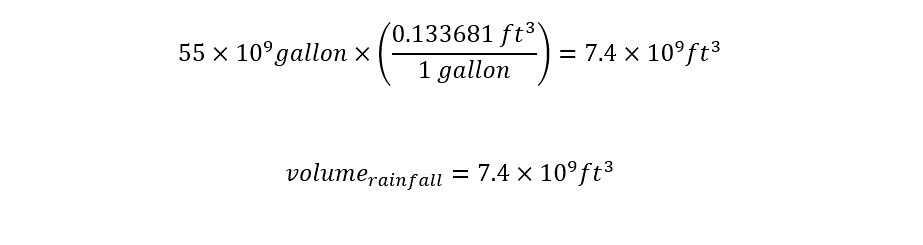
Shown above is an expression for volume with a value for the area (191 square miles) inserted.  There are still two unknowns left -- volume of rainfall and height.  In order to plug a volume into the above expression, a 'unit' conversion is necessary from 'gallons' to 'cubic feet'.  There is 0.133681 cubic feet in 1 gallon.  With the conversion factor in hand, the conversion is simple as shown below:


Next, if the volume of rainfall is plugged into volume equation above, we are left with one equation with one unknown (height) as shown below:


If we rearrange the above expression to solve for height from the total volume, we get the following:


Wow.  The following result states that if 55 billion gallons of water was dumped into Lake Tahoe, the water level would rise 1.4 feet in total.  That is just under 18 inches (1.5 feet).


Can you visualize the change in height?


Of course - why?  Because, I am 5 feet 7 inches tall.  I could stand next to the Lake (shown below) and visualize roughly the water level rising to my knees.  I can easily imagine Lake Tahoe filling up by 1.5 feet.  What I did not realize is that Lake Tahoe is enormous.


Further, take that measurement and look out onto the Lake and the visualization of 55 billion gallons comes into focus.  The choice of Lake Tahoe as a metric fits the dimensional analysis much better.  Half the battle in performing dimensional analysis problems is choosing the correct 'units' and 'metric' by which to compare the stated (reported) value in the popular news to.


Again, here is another picture of Lake Tahoe shown below (not from space):


Source: Lara Farhadi


Conclusion . . .


In the paragraphs above, a couple of metrics (world's largest pool and Lake Tahoe) to cast the enormous volume of 55 billion gallons of rainfall into perspective.  Both volumes represent two extremes of the entire spectrum.  Using the process of dimensional analysis, we were able to compare the volumes to the reported volume of 55 billion gallons.  Prior to this analysis, any attempt toward understanding the true magnitude of the statistic.


Too often, reading the news results in a lack of understanding of the true magnitude of large numbers.  Whether these numbers represent volumes, heights, miles traveled, electricity generated, there is a need to try to understanding them.  The avenue by which to do so is through 'dimensional analysis'.  The process is rewarding when you arrive at a result.  Regardless of the result.  Often times, more thought and analysis is needed to make further sense of the statistics.


Until next time, Have a great day!


Tuesday, December 13, 2016

International Students Make American Science Stronger

I was reading last weeks editorial from the journal of 'Science' -- a prestigious science journal very widely respected by the entire world science community.  The editorial titled "Life For Refugees Scholars" detailed the emerging problem of refugee scientists leaving battle zones such as Syria.  What caught my attention was the closing paragraph shown below:


Displaced scholars, whether refugees or in exile, need the support of institutions large and small, in countries large and small, to break through the barriers that prevent them from academic engagement and employment—fears that they will take jobs away, require more help than they give, or not make the transition to teaching students in the host country. In succumbing to this backlash, we forget that the world's great universities became great because they welcomed refugees, exiles, and thinkers in distress. With support from the international academic community, threatened scholars and scientists can be saved. Let us all ensure that academic training is not wasted, knowledge for present and future generations is preserved, and that the next Albert Einstein or Felix Bloch is not lost in the painful currents of forced emigration.


In the paragraphs below, I would like to briefly discuss the benefits of having international students here in America to elevate science in the United States.


Graduate School in the United States


Upon entering graduate school in the United States two observations became very apparent to me:


1) The graduate class is small compared to an incoming freshman class at the undergraduate level.


2) Foreign students make up a sizable portion of the class


The first remark is based on the observation that one encounters when entering a graduate school class in the physical sciences.  This could be the case, since compared to say a graduate law or graduate medicine class, the research class is rather small.  Although, when you consider the available position (research laboratory positions available), then the class size makes sense.


Given that the class size is small, the second observation was rather surprising to me at first.  When I entered graduate school at University of California at Riverside, the total class size was around 15 students.  At least 50% of the class was made up of international students.  I did not understand the reason at first.  As I will explain, the reason became apparent in my second quarter of class near the end of my first year in graduate school.


Classes and Exams!


Part of every class was an exam component.  Educational institutions still use the written exam as a critical measure of learning success.  Although, after leaving graduate school, UCR was in the process of changing around the steps (tests -- written and oral) which made up a 'graduate degree' from the department -- which was surprising.


During the first year of a Ph.D. program, the major component of the graduate educational process is to take all required classes for the degree.  The remainder of the time spent in graduate school will be devoted to research and giving updates on your research project.  Upon hearing this, students are usually quite amazed and happy.  The thought of only taking around 6 classes for your Ph.D. -- is exciting.


With that being said, the classes are different from undergraduate courses.  The material is slightly different in the treatment of problems.  Fundamentally, in chemistry, one would start to explore more difficult aspects of the same problems encountered in the undergraduate education process.


How is that possible?


Take for example, the assumption of an "ideal gas" which is grounded in two basic assumptions:


1) The atoms are treated as point particles


2) The point particles do not interact with each other


These two assumptions simplify the types of chemistry problems that can be entertained.  Based on the two assumptions, atoms or molecules will be treated as independent entities and not interact with each other.  When the break down of the assumptions occur, the incorporation of math becomes more prominent in the problem solution.  More math -- oh no!


Math is not a problem generally speaking.  But not all chemists are going to enter a field of research that requires a heavy math background.  This is a point of debate for a later post.


At the point you might be wondering why I am talking about this?


What happened to international students?


Well, during classes, a student from the United States cannot help but notice that the international students are able to solve problems rather easily.  A common assumption is that they are trained in math better than students in the United States.  This might or might not be true -- again, a point for debate for a later post.  What is true about their presence is that "political rules" have been put into place to accept the student into the United States graduate education programs.


One is that the student must have already completed the equivalent of a "Master's Degree" from their country or origin.


The above requirement turns out to benefit a United States student to a large extent in the long run.  Even though, in the short run, this is counter-intuitive to the feeling a person gets when competing with an international student.  Let me explain below.


International Students Inspire U.S. Students


As I mentioned above, each international student entering the United States for graduate education has the equivalent of a "Master's Degree" from their country of origin.  Note: what this means overall is that the courses that every American graduate student takes in graduate school have already been completed by each international graduate student.  The comparison would be for be for a student to take the same course twice -- have two times to complete a course.  Of course, during the second time around your grade should increase.


I learned this fact from taking a class in "thermodynamics" in graduate school.  In the class, which was considered large, there were 6 students total.  Normally, a graduate course might have 4 students or maybe 5.  Six or above is considered very large.


Therefore, the classes in graduate school are intimate and like a "meeting" rather than a traditional lecture.  Nonetheless, the classes are still classes in which a professor lectures and students learn through listening and then completing assignments.  My thermodynamics course was no different.  What amazed me at the time were the scoring of the international students on a given exam.


The students would score very high on the exam -- perfect or "nearly perfect" -- meaning like 98/100.  If there was extra credit offered, the students would score on the order of 110/100.  Imagine, what the American students (myself) were feeling comparing ourselves to these students.  Plus, the grades were on a "curve" which meant, we would be graded against these students -- Oh My!


On the first couple of exams, we felt disappointed scoring 85/100, 90/100, 95/100.  While the international students were scoring: 98/100, 100/100, 105/100.  When the last midterm exam came in our class, the professor stated the following to the class:


Tomorrow's test will be extremely difficult.  I want to see if the international students can still score in the high 90's.  Therefore, I will be writing the test for them.  For the American students, take the exam and try your best.


What?


What is the meaning of the statements emerging from his mouth?


Has he lost his mind?


The tests are already difficult.  Needless to say, we showed up the next day and took the exam.  I scored in the 70's.  I was not the best student to say the least.  Furthermore, I am not a great test taker.  As the professor explained to me later in my graduate career -- he said:


Mike, if the point of the class was to turn in great homework assignments, you would score perfectly. Your homework scores are great -- given the time to think and solve the work.  But unfortunately, life is not always about homework.  Sometimes, tests are needed too.


I will never forget him telling me this.  We were right outside the chemistry building.  He went onto to explain that the feeling of 'feeling not good enough' should either be put aside or dealt with.  Further, he suggested that if I felt overwhelmed, I could always drop out of graduate school and get a job earning pretty good money.  But, he also stated a theme that I have heard time and time again during my education by other professors -- which inspires me to move forward regardless of the 'local feeling' that I might be harboring.


My observation has been that you like being in school and thinking critically about chemistry.  And that if you were to drop out of school, you might find yourself bored without being challenged.  Further, in the current situation, you might want to understand why the University of California system accepts international students at all. 
International students are required to have an equivalent of a "Master's Degree" from their country of origin.  And the process of accepting graduate students is to choose the highest quality of student.  The reason why?  Because, we want to challenge you (American students) to achieve greater than what you would do had they not been in the class. 
If the international students were not in the current class, then the best student would be considered the best and the remainder of you would write them off (he is just really good at math).  But with international students present and kicking ass on the exams, you guys are really pushing yourselves to out do them on the exams and homework assignments.  This produces a better American graduate student in our experience.


After hearing the above statement, I felt changed.  First, I started to understand that bringing in international students to the university should not be viewed as a 'threat' but a challenge.  In the sense, to improve the science that American students do.  Second, immersing yourself in the study of science problems in research has changed over the years.  Let me explain.


In the past, the image of a scientist was one of a single researcher in a laboratory performing research quietly and thinking methodically.  That image has changed over the past few decades to be one of a 'research group'.  For those people who are not interested in science, the image that is preserved is the former image.  Therefore, when a funding issue arises, the thought of giving money to a 'single researcher' is questioned.


The fact of the matter is that science is performed by a 'research group' made up of a diverse amount of scientists.  The size of the group can vary from 4 people (3 graduate students + 1 professor) to 60 people (35 graduate students + 20 post doctoral fellows + 4 professional research staff + 1 professor).  Yes, large research groups exist like this.  Look no further than Professor George Whitesides of Harvard Chemistry Department.  His research group is enormous.  Of course, the amount of small companies and ideas that come out of his laboratory on an annual basis is huge too.


The point is that science is made up of many critical components.  One is the diversity that drives the group (both international + American students).  Secondly, the funding of that research group is critical.  Third, the production of working scientists needs to happen to fill professional jobs in industry or academia.  Chemical industry, Pharmaceutical industry, Aerospace industry, among others to mention a few desirable job employers.


Most of the large industries mentioned in the last paragraph are 'global' industries which mean that there are multiple facilities around the world.  This fits in well with the diversity that is seen in the American university setting.  Having international students elevate American science as well as science all around the world.


Having a global mindset with regard to funding science is critical if we (as global residents of the Planet Earth) would like to save the planet.  Just because science research comes from the United States or Europe, makes either no less important.  Hence the need to preserve the ability to have visiting scholars and students mix ideas in with each other to produce 'global science' instead of researching in a small scale private setting with large borders.  Diversity is not preserved in such environments.


Conclusion...


The reason why I wrote this blog post is due to the current administration that is about to take office.  First, I think having the politicians who fund research understand the importance of having international scholars and students is extremely important.  Second, the example that leads currently is the break up of Britain -- known as Brexit.


In an article from the website "Laboratory Equipment" titled "Brexit Uncertainties Threaten Brain Drain for UK Science" the threat of the 'brain drain' from the shifting resources in science funding are discussed along with immigration status.  Here is an excerpt detailing real fears of losing critical scientist due to shifts in the political landscape:


"I'm worried that after my current contract finishes, one of the prerequisites could be a permanent residence card," she said. "I'd like to apply for EU grant money, but how much longer will it be available for?"

Britain's top universities have long been among the world's most sought-after destinations for study and research, drawing the brightest minds from all corners of the globe. But since Britons voted in June to leave the 28-nation EU, many in the science community say the U.K. risks losing the money, the international influence — and crucially, the talent — to sustain that enviable position.

More than one-tenth of research funding at British universities has come from the EU in recent years. Some fields — such as nanotechnology and cancer research — are more dependent on EU funding than others, according to a report by technology firm Digital Science. From 2007 to 2013, Britain received 8.8 billion euros ($9.4 billion) in direct EU investment in research.


As you can see, immigration issues are not the only source of fear in the changing science landscape as a result of a political decision.   Regardless, when politicians start discussing changing the porosity (openness or closeness) of the national borders, science will be inevitably affected in a negative way.  Here is another excerpt to describe such a change:


Scientists and researchers argue that being part of the EU has given British science a huge boost because it allows Britain to recruit the best talent across Europe and take part in important research collaborations and student exchanges without being constrained by national boundaries. The bloc's freedom of movement means its 500 million people can live and work visa-free in any member state.

No one knows yet what form Britain's exit from the EU — commonly known as Brexit — is going to take, but immigration was a key issue for "Leave" voters. Many believe some limit should be put on the number of EU citizens moving to Britain.

Prime Minister Theresa May has vowed to reassert control over British borders. She has offered no firm guarantees for the rights of Europeans already living in Britain, an uncertainty that weighs heavily over the 32,000 Europeans who make up 16 percent of the academic workforce in British universities. Many universities say the rhetoric over immigration control is also jeopardizing recruitment of researchers and students from further afield.


Typically, when we think of immigration issues, we restrict our definition to the "undocumented" (which I do not like to use) people who have crossed our borders for a variety of reasons (asylum, economic, livability, lack of resources, etc.).  What we do not consider is that any immigration reform will have an impact on science -- an adverse impact.


Which is why as Americans, we need to think and vote critically on immigration reform.  When we see changes start to take shape that are negatively impacting science, we need to take action and contact our local representatives (senators and congressional reps).  Otherwise, we are risking losing the status as the leader in science in the world.


In closing, the jobs of the future will revolve around our ability to lead in the scientific field.  Ranging from computational to environmental, jobs that are created will undoubtedly involve a higher education in science.  Therefore, it is critical to keep the momentum of incorporating international scholars and students into our science system to elevate our standing.  Lets make our scientists the best in the world.


Until next time, Have a great day!


Wednesday, October 12, 2016

Unraveling The Resistance Of Antibiotics!

Stories seem to emerge daily regarding the threat to the human race regarding the rise in resistance of antibiotics toward common diseases.  One side of the spectrum, the pro-antibiotic sector are dispersing antibiotics like candy to farm animals and patients without caution.  Whereas on the other side of the spectrum, there is a growing community of researchers, advocates, and concerned citizens -- yelling at the top of their voices to stop administering antibiotics needlessly.  With both sides of the spectrum known, the following question emerges naturally:


Where is scientific research at on the issue?


Are advancements in discovery being made to deal with the potential threat?


The short answer is that the discovery process takes time and is complicated.  Which is no answer at all.  Whereas the long term solution involves research being done.  As I explained in a previous post on drug discovery, research advances are arduous and take time.  Recently, though, progress has been reported in the scientific community and worth giving a "shout out" about.  Below is the short post regarding the advance.


Antibiotic Resistance?


Yes, whenever I hear about antibiotic resistance, I stop and pause for a moment of scare.  Then I think about the progress that is being made (hopefully).  I cannot have myself worry too much about the issue since I do not perform research directly toward a solution.  Although, I can support students who are biochemistry undergraduates and graduate students while educating them on the need and importance of such research.  Couple that with a proper training on the scientific instrument needed to perform the research and my job ends there.


Sounds scary right?


Well, not all is held in limbo with regard to antibiotic resistance.


First, what is antibiotic resistance?  In order to understand the issue, what is the problem?


Here is an excerpt taken from the 'Wikipedia' page for "Antibiotic Resistance" is shown below:


Antimicrobial resistance (AMR) is the ability of a microbe to resist the effects of medication previously used to treat them.[2][3][4] This broader term also covers antibiotic resistance, which applies to bacteria and antibiotics.[3] Resistance arises through one of three ways: natural resistance in certain types of bacteria; genetic mutation; or by one species acquiring resistance from another.[5] Resistance can appear spontaneously because of random mutations; or more commonly following gradual buildup over time, and because of misuse of antibiotics or antimicrobials.[6] Resistant microbes are increasingly difficult to treat, requiring alternative medications or higher doses—which may be more costly or more toxic. Microbes resistant to multiple antimicrobials are called multidrug resistant (MDR); or sometimes superbugs.[7] Antimicrobial resistance is on the rise with millions of deaths every year.[8] A few infections are now completely untreatable because of resistance. All classes of microbes develop resistance (fungi, antifungal resistance; viruses, antiviral resistance; protozoa, antiprotozoal resistance; bacteria, antibiotic resistance).
Antibiotics should only be used when needed as prescribed by health professionals.[9] The prescriber should closely adhere to the five rights of drug administration: the right patient, the right drug, the right dose, the right route, and the right time.[10] Narrow-spectrum antibiotics are preferred over broad-spectrum antibiotics when possible, as effectively and accurately targeting specific organisms is less likely to cause resistance.[11] Cultures should be taken before treatment when indicated and treatment potentially changed based on the susceptibility report.[12][13] For people who take these medications at home, education about proper use is essential. Health care providers can minimize spread of resistant infections by use of proper sanitation: including handwashing and disinfecting between patients; and should encourage the same of the patient, visitors, and family members.[12]
Rising drug resistance can be attributed to three causes use of antibiotics: in the human population; in the animal population; and spread of resistant strains between human or non-human sources.[6] Antibiotics increase selective pressure in bacterial populations, causing vulnerable bacteria to die—this increases the percentage of resistant bacteria which continue growing. With resistance to antibiotics becoming more common there is greater need for alternative treatments. Calls for new antibiotic therapies have been issued, but new drug-development is becoming rarer.[14] There are multiple national and international monitoring programs for drug-resistant threats. Examples of drug-resistant bacteria included in this program are: methicillin-resistant Staphylococcus aureus (MRSA), vancomycin-resistant S. aureus (VRSA), extended spectrum beta-lactamase (ESBL), vancomycin-resistant Enterococcus (VRE), multidrug-resistant A. baumannii (MRAB).[15]
A World Health Organization (WHO) report released April 2014 stated, "this serious threat is no longer a prediction for the future, it is happening right now in every region of the world and has the potential to affect anyone, of any age, in any country. Antibiotic resistance—when bacteria change so antibiotics no longer work in people who need them to treat infections—is now a major threat to public health."[16] Increasing public calls for global collective action to address the threat include proposals for international treaties on antimicrobial resistance.[17] Worldwide antibiotic resistance is not fully mapped, but poorer countries with weak healthcare systems are more affected.[9] According to the Centers for Disease Control and Prevention: "Each year in the United States, at least 2 million people become infected with bacteria that are resistant to antibiotics and at least 23,000 people die each year as a direct result of these infections." [18]


Is that a comprehensive definition?


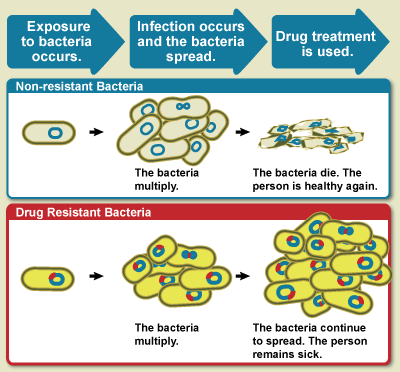
Instead, why not start with a simple pictorial representation of what antimicrobial resistance is.  In a previous post on the need for greater science communication, Dr. Tyler Dewitt gave a great explanation of the modes of how virus's and bacteria invade a host organism like the human body.  I suggest taking a look at the post.  Once the invader (virus or bacteria) enters the system, the invader takes hold (control) of your system.  The control allows the invader to make several copies of itself to proliferate and grow to become a problem (onset of disease).


What can be done about such a state?


One methodology that has become increasingly common if the invader is a microbe or bacteria is to administer antibiotics which wipe out the infection.  Shown below is a picture taken from the 'Wikipedia' page again for clarity to illustrate the point of action of antibiotics:


Source:By NIAID – NIH


The image above is very simple to understand the action of an antibiotic.


Advances In Antibiotic Resistance


Recently, there has been advances in research surrounding antibiotic resistance that may speed up the ability to deal with the looming threat.  In an article from the website 'Sciencedaily.com' titled "Mystery of bacteria's antibiotic resistance unravelled" new developments have been made in unraveling the mode of disabling the effect of antibiotics by researchers.  Here is an excerpt discussing the advancement:


One of the mechanisms leading to rifampicin's resistance is the action of the enzyme Rifampicin monooxygenase.

Pablo Sobrado, a professor of biochemistry in the College of Agriculture and Life Sciences, and his team used a special technique called X-ray crystallography to describe the structure of this enzyme. They also reported the biochemical studies that allow them to determine the mechanisms by which the enzyme deactivates this important antibiotic.

The results were published in the Journal of Biological Chemistry and PLOS One, respectively.

"In collaboration with Professor Jack Tanner at the University of Missouri and his postdoc, Dr. Li-Kai Liu, we have solved the structure of the enzyme bound to the antibiotic," said Sobrado, who is affiliated with the Fralin Life Science Institute and the Virginia Tech Center for Drug Discovery. "The work by Heba, a visiting graduate student from Egypt, has provided detailed information about the mechanism of action and about the family of enzymes that this enzyme belongs to. This is all-important for drug design."


 Before I make a few comments on the success of the discovery in the pipeline to a marketable drug or treatment, I would like to add another excerpt from the same article highlighting the importance of the antibiotic rifampicin is to an array of diseases:


Rifampicin, also known as Rifampin, has been used to treat bacterial infections for more than 40 years. It works by preventing the bacteria from making RNA, a step necessary for growth.

The enzyme, Rifampicin monooxygenase, is a flavoenzyme -- a family of enzymes that catalyze chemical reactions that are essential for microbial survival. These latest findings represent the first detailed biochemical characterization of a flavoenzyme involved in antibiotic resistance, according to the authors.

Tuberculosis, leprosy, and Legionnaire's disease are infections caused by different species of bacteria. While treatable, the diseases pose a threat to children, the elderly, people in developing countries without access to adequate health care, and people with compromised immune systems.


As you can see, the ability of the antibiotic rifampicin to knock out an array of important diseases cannot be overstated.  Therefore, any advancement in understanding modes of action or in this case 'inaction' are critical to drug designers for the future.  At this point, you might be wondering what the structure of rifampicin looks like?  Shown below is the chemical structure of rifampicin take from 'Wikipedia':


Rifampicin

Source of image: By Vaccinationist - Rifampicin on PubChem


With the discovery of the mechanism by which Rifampicin Monooxygenase deactivates rifampicin's ability to act as an antibiotic, should we all throw our hands up and celebrate?


The discovery of the deactivation mechanism of rifampicin is a major step for drug makers in producing new lines of antibiotics in the future.  As I mentioned in a previous blog on drug discovery, the flow of patentable drug includes discoveries made at the university level.  This discovery certainly qualifies as one -- certainly.  Although, more studies will have to be followed up in order to realize the discovery into a better antibiotic in the future.


I should mention one major point of contention about the discovery of the mechanism.  The spectroscopic technique that was used was x-ray crystallography.   X-ray crystallography as a technique just celebrated it't 100th year since the discovery of the technique.  Here is an excerpt from the 'Wikipedia' page describing the technique of 'x-ray crystallography':


X-ray crystallography is a tool used for identifying the atomic and molecular structure of a crystal, in which the crystalline atoms cause a beam of incident X-rays to diffract into many specific directions. By measuring the angles and intensities of these diffracted beams, a crystallographer can produce a three-dimensional picture of the density of electrons within the crystal. From this electron density, the mean positions of the atoms in the crystal can be determined, as well as their chemical bonds, their disorder and various other information.
Since many materials can form crystals—such as salts, metals, minerals, semiconductors, as well as various inorganic, organic and biological molecules—X-ray crystallography has been fundamental in the development of many scientific fields. In its first decades of use, this method determined the size of atoms, the lengths and types of chemical bonds, and the atomic-scale differences among various materials, especially minerals and alloys. The method also revealed the structure and function of many biological molecules, including vitamins, drugs, proteins and nucleic acids such as DNA. X-ray crystallography is still the chief method for characterizing the atomic structure of new materials and in discerning materials that appear similar by other experiments. X-ray crystal structures can also account for unusual electronic or elastic properties of a material, shed light on chemical interactions and processes, or serve as the basis for designing pharmaceuticals against diseases.


The spectroscopic technique is very powerful and is commonly used in a wide range of areas of research for structural determination.  One drawback is the constraint of having to grow a crystal -- a rather large crystal to subject the x-rays to in order to obtain a diffraction pattern.


Why does this matter?


One commonly held belief among spectroscopists is that x-ray crystallography is extremely useful in a range of areas as a first step or a confirmation step.  The constraint of having to grow a crystal is also a large point of contention regarding the usefulness of the information obtained by the diffraction pattern.  Why?


The reason is centered around the fact that processes in the body (i.e., at physiological conditions) are performed in a 'liquid-state' rather than a 'crystalline-state' (i.e., solid state).  Scientists argue about the true degree of accuracy of a structure obtained by x-ray crystallography rather than say a structure obtained by nuclear magnetic resonance (NMR) in the liquid state.  The structure obtained by NMR is believed to be more representative of the actual conditions (liquid state, pH, temperature, etc.).


Nevertheless, the discovery above is extremely important.  The realization of a site of deactivation for rifampicin monooxygenase can now be further explored and compared to other antibiotics.  Scientists in industry and academia (university settings) will use incorporate this mechanism into their current understanding and models to produce a better antibiotic.


Further, understanding 'antimicrobial resistance' is a hot topic.  Just today, the 'Los Angeles Times' published an editorial discussing two bills that are hitting legislature for consideration.  Lets hope the combined efforts of all of these actions, leads to fewer cases of deaths in hospitals along with safer and better antibiotics.


Conclusion...


Should we be celebrating?


The advancement discussed above is cause to celebrate momentarily. Although, as I mentioned in the previous post regarding the drug discovery process, the path is long and arduous. Advancements such as these improve the ability of researchers to add another piece to the puzzle. Given more information, further advances can be pushed even further. Of course, that goes without being said (i.e., thank you captain obvious). Research is a long process and needs a lot of funding and time to test and retest procedures to make sure that scientists get the process right -- to eliminate the problem the first time around. Adjustments often have to be made due to inefficiencies of a given treatment or terrible side effects. Although, with a better understanding of the mode of action and inaction, drug manufacturers create more accurate drugs and research is one step further in understanding how nature operates to take control over our immune systems or subject us to terrible diseases.


Last but not least, the overall importance of writing a post like this is to convey the excitement and importance of such research. To demystify the meaning of "antibiotic resistance" or "antimicrobial resistance." Raising awareness of the magnitude of the issue will hopefully rally support on part of the public (your support) to elevate the need for funding and research into such issues. Do your part. Advocate for science and educate yourself on the successes and challenges (failures, obstacles). Give us some feedback.


Until next time, have a wonderful day!