Source: Southern Living
With the holidays rapidly approaching, last minute shopping is all around us. Hysteria at the malls with frantic shoppers trying to wrap up their gift giving expedition. On top of that weight are the decorations needed for the season. By now, neighborhoods around the nation are adorned with Christmas lights while Christmas trees are on full display through front windows of houses all around us. For this year, a couple of fun facts are in order to spread the Christmas cheer. The two categories will be: Christmas trees and Christmas lights.
How many Christmas Trees are purchased?
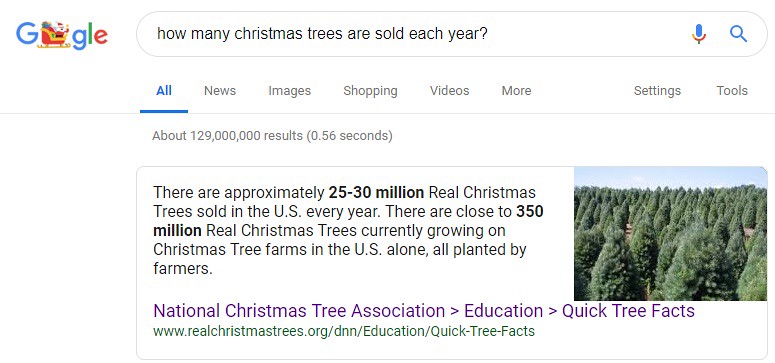
Each Christmas season, trees can be spotted on the top of cars as they are transported from the farm to the house to be decorated. I always have wondered about the number of trees on average which are sold during Christmas. Therefore, I decided to search Google with the following question: How many Christmas Trees are sold each year? The answer is shown below:
Source: Google
According to the National Christmas Tree Association, there are between 25 and 30 million Christmas trees sold each year in the United States. What was fascinating is the total number of Christmas trees grown in the U.S. each year are 350 million. The information highlighted in the box above comes from the National Christmas Tree Association's website which has a few more fun facts about Christmas trees shown below:
There are approximately 25-30 million Real Christmas Trees sold in the U.S. every year.There are close to 350 million Real Christmas Trees currently growing on Christmas Tree farms in the U.S. alone, all planted by farmers.North American Real Christmas Trees are grown in all 50 states and Canada. Eighty percent (80%) of artificial trees worldwide are manufactured in China, according to the U.S. Commerce Department.Real Trees are a renewable, recyclable resource. Artificial trees contain non-biodegradable plastics and possible metal toxins such as lead.There are more than 4,000 local Christmas Tree recycling programs throughout the United States.For every Real Christmas Tree harvested, 1 to 3 seedlings are planted the following spring.There are about 350,000 acres in production for growing Christmas Trees in the U.S.; much of it preserving green space.There are close to 15,000 farms growing Christmas Trees in the U.S., and over 100,000 people are employed full or part-time in the industry.It can take as many as 15 years to grow a tree of typical height (6 - 7 feet) or as little as 4 years, but the average growing time is 7 years.The top Christmas Tree producing states are Oregon, North Carolina, Michigan, Pennsylvania, Wisconsin and Washington.
I immediately wondered why there was such a large difference between the amount of Christmas trees planted each year and those that are sold. Sounds like there are only 1 in 10 trees which actually make the cut to be sold in order to end up in a living room for display with decorations and lights. The industry requires a significant workforce to support the retail which comes along with the Christmas celebration. Just take the amount of trees grown to be sold are staggering by itself.
To understand the magnitude of the number of trees which are planted along with the amount that are sold, let's imagine that each tree is stacked on top of one another. How high would that stack of trees reach? The analysis below will show the answer to that question. In order to start, an assumption regarding the average height of a Christmas tree needs to be introduced. For the purpose of this analysis, the assumption will be made that the average height of a Christmas tree is 6 feet tall.
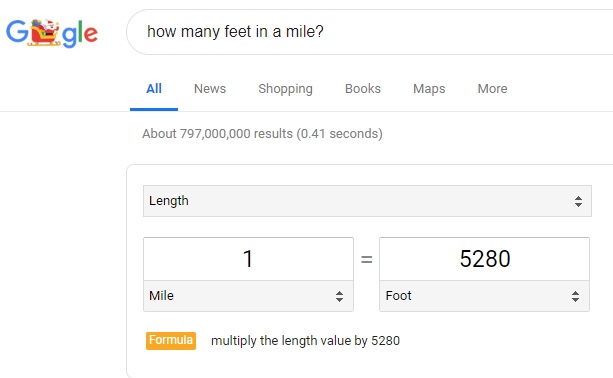
First, the amount of trees which are sold annually in the United States is large. Therefore, choosing a 'unit' of measurement which will appropriately shed light on the magnitude of the values is essential. A common unit of measurement for large distances on Earth is the 'mile'. If Google is consulted with the following question: 'How many feet are in a mile?' The answer is shown below:
Source: Google
There are 5,280 feet in every mile. To begin analyzing the values, let's look at the numbers which we are interested in. Each year, there are between 25 million and 30 million Christmas trees sold in the United States. That is out of a total of 350 million Christmas trees growing across 15,000 farms.
First, each of the amount of trees sold (and grown) in the United States must be converted to units of miles -- using the assumption that each tree is on average 6 feet tall. The unit conversion is shown below:
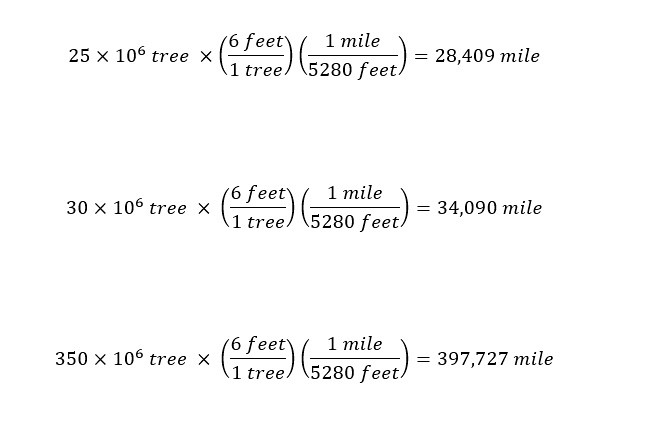
The results above indicate that the range 25-30 million trees sold equal to the distance of 28,409-34,090 miles. Additionally, the total number of Christmas trees grown annually would equal a total distance of 397,727 miles. In order to understand the magnitude of these distances, a metric is needed to compare the distances with. What if we took the total distance of stacked Christmas trees and wrapped the line around a sphere (the Earth)? How many times could the line of trees circle around the Earth?
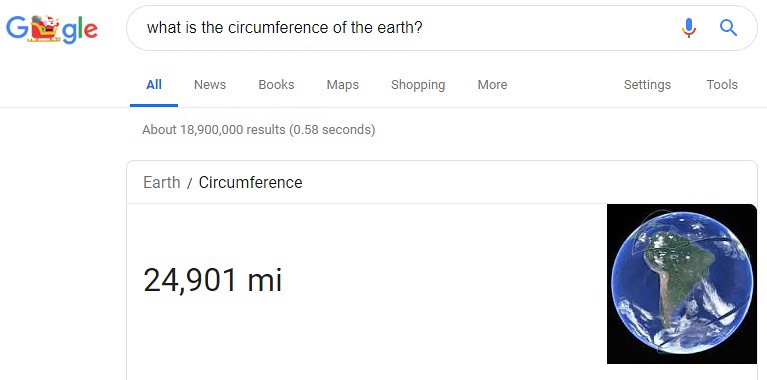
We need to determine the total distance around the Earth. If we consult Google with the following question: What is the circumference of Earth? The answer is shown below:
Source: Google
One trip around Earth (at the center) is equal to traveling a total distance of 24,901 miles. The three distances of Christmas trees can be divided by the circumference of the Earth -- 24,901 miles as shown below:
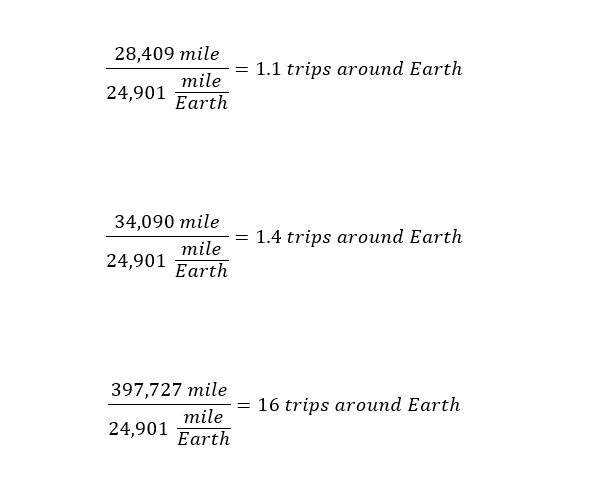
The answers indicate that the amount of Christmas trees sold in the United States each year would stack up to a range of 28-34 thousand miles -- which would equal just over 1.4 trips around the Earth. Additionally, the total number of Christmas trees grown in the United States would stack up to a distance equal to 16 trips around the Earth. These numbers really drive home the magnitude of the amount of Christmas trees needed for the Christmas holiday. Here is a great idea for recycling parts of the Christmas tree -- click here.
How about Christmas light?
In the next section, an analysis will be carried out to highlight the total number of Christmas lights which are purchased each year in the United States.
How about Christmas Light?
On top of all of the Christmas trees which are sold annually and would wrap around the circumference of Earth are Christmas lights -- at the very least to provide the minimum amount of decoration. In order to wrap a few strands of Christmas lights around a given tree, either one must store Christmas lights in the garage or choose to purchase new strands. There is nothing wrong with purchasing new lights in a given year. Especially when the old lights break or strands of bare exposed wire show -- which could easily cause danger when voltage is applied to them (i.e. plugged into the wall socket). How many strands are sold in the United States each year?
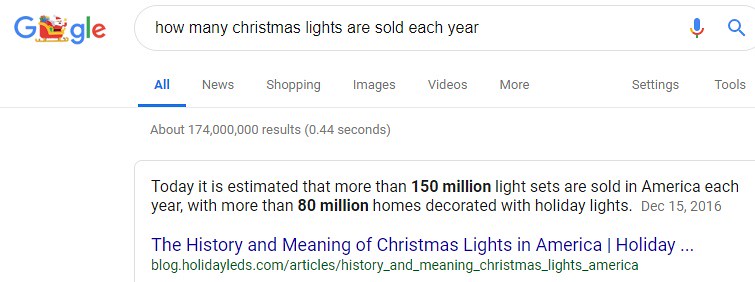
If a Google search is conducted with the question above, the following answer appears below:
Source: Google
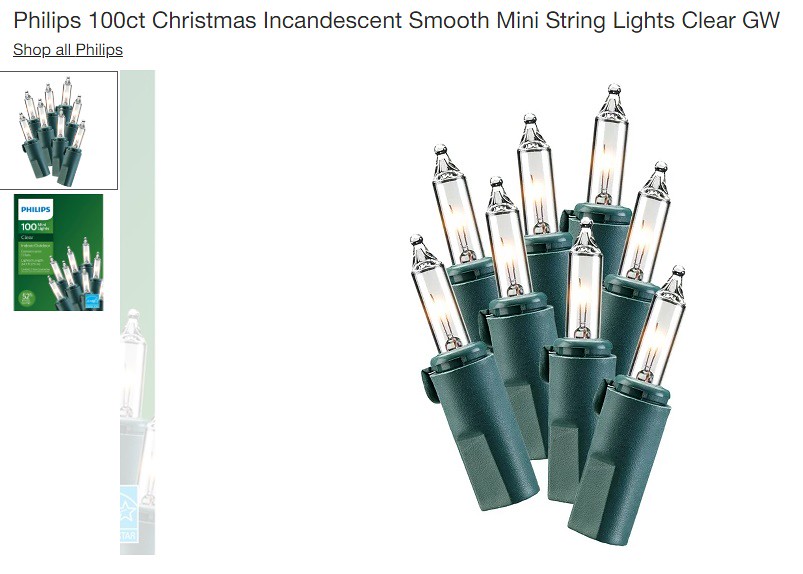
According to our search, there are 150 million strands of Christmas lights sold each year in the United States. If the same analysis from above is used, the first step will be to convert the strands of lights into a distance. For this, an online store needs to be consulted to find out the distance sold. The Christmas lights (clear, no color) sold at Target are shown below:
Source: Target
The length of the Christmas lights in the picture above (100 count) is 24.7 feet. If the total number of strands of Christmas lights is multiplied by the length (in feet) of a single strand, the total distance would be yielded:

The answer indicates that the total number of strands of Christmas lights would add up to a total distance of 701,704 miles in length. Last, if the total distance of Christmas lights sold is divided by the circumference of the Earth, the total number of trips around Earth will be yielded as shown below:
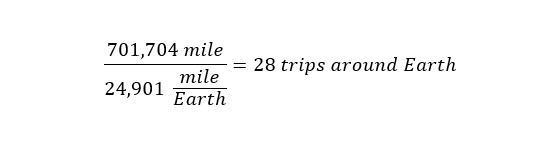
The total amount of Christmas lights sold in the United States each year would equal traveling around the Earth 28 times. Wow! That is an enormous amount of Christmas light sold each year. The enormous number made me question the total amount of Christmas lights which are sitting in boxes in closets, attics, and garages in American houses across the country. Additionally, a certain percentage of this enormous amount of purchased Christmas lights must be recycled.
If the Wikipedia page for Christmas Lights is consulted regarding the recycling of Christmas lights, the following information can be found:
Christmas lighting does lead to some extensive recycling issues. Every year, more than 20 million pounds of discarded holiday lights are shipped to Shijiao, China (near Guangzhou), which has been referred to as "the world capital for recycling Christmas lights".[28] The region began importing discarded lights around 1990 in part because of its cheap labor and low environmental standards.[28] As late as 2009, many factories would simply burn the lights to melt the plastic and retrieve the copper wire, releasing toxic fumes into the local environment.[28] A safer technique was then developed that involved chopping the lights into a fine sand-like consistency, mixing it with water and vibrating the slurry on a table causing the different elements to separate out, similar to the process of panning for gold.[28] Everything is recycled: copper, brass, plastic and glass.More and more cities in the U.S., for example, are setting up sensible alternatives and schemes to recycle Christmas lights, with towns organizing drop-off points for handing in old or discarded lights.[29][30]Installing holiday lighting may also be a safety hazard when incorrectly connecting several strands of lights, repeatedly using the same extension cords, or using an unsafe ladder during the installation process.
The total amount of Christmas lights (in weight) which are shipped to China each year is around 20 million pounds. I wonder how much material (copper, brass, plastic, and glass) -- percentages of each are recovered. And used for what? The process of recycling is interesting and worth reading about for further information.
Conclusion...
The Christmas holiday is a time of celebration. At the same time, the holiday is an opportunity for families to gather together and catch up on life. The fun facts calculated and gathered surrounding the Christmas holiday are perfect to add into a trivia game or dinner conversation. The analysis above showed that the enormous amount of Christmas trees would add up (stack up to) to enough miles to equal 1.4 times traveling around the Earth. Further, the total number of Christmas trees planted on farms would equal a distance equivalent to traveling around the Earth 16 times. That is amazing to say the least. That is a large amount of wood to recycle or burn.
And what about the Christmas lights which are sold each year in the United States? The total distance of all of the strands of lights sold in the United States each year would be equivalent to traveling around the Earth 28 times. My goodness that is quite a large amount of Christmas lights sold each year. Imagine the total amount of Christmas lights which are sitting in boxes in closets, attics, and garages around the United States. To add to that, 701,704 miles are purchased each year. Christmas time is a very popular holiday of the year. Have a great holiday celebration!!
Related Blog Posts:
Parameters: How Much Ice Is Melting In The Antarctic? Enough To Cover Texas?
Parameters: How many sticks of butter are contained in 7.5 million pounds of butter?
South Carolina Governor Henry McMaster asks lawmakers for $1,228,000,000 For Recovery from Hurricane Florence?
Boston Natural Gas Explosion Reveals Old Piping Needs Replacement - Enough To Travel To Colorado?
A Forecaster Predicts That Hurricane Florence Will Drop Enough Rain To Fill 18,400 Mercedes-Benz Superdomes
Hurricane Harvey Drops Enough Rain On Houston To Fill 560 Dallas Cowboy Stadiums
How Much Water Is Contained In All Oceans Around The Globe?
Storm Raises Water Level In Lake Cachuma By 31 feet, How Much Water Is That?
How To Make Sense Of Water Flowing At 100,000 Cubic Feet Per Second
Can 11 Trillion Gallons Of Water Fill 14,000 Dallas Cowboys Stadiums?
How Much Rain Did The East Coast Receive From Hurricane Matthew?
How Much Rain Did Haiti Really Receive?
How Big Was The "Water Bomb" Of Rainfall In Macedonia?
How Much Rain Did Elliot City (Maryland) Really Receive?
If The Mosul Dam Breaks, The City Of Mosul Would Be Under 65 Feet Of Water?
What is the volume of water in a few inches of rain?
Volume of Waste in the Mine Spill (in Brazil) Equivalent to 78 Deepwater Horizon Oil Spills

.svg/450px-LED%2C_5mm%2C_green_(en).svg.png)