Showing posts with label mathematics. Show all posts

Wednesday, June 20, 2018

How many trash carts can be filled with 80 billion pounds of trash?


Each of us generates trash throughout each day.  The usual routine is to make sure that the trash that each of us generate ends up in 'the trash can' in each room.  From there, we know that the trash that is deposited will then get shipped to either a dump or a boat to another country.  Did you know that?  What if other countries cannot except anymore trash?  Why do I ask this question?  Read onto find out.


Recently, in an article in The New York Times titled "‘The Dump Killed My Son’: Mountains of Garbage Engulf India’s Capital" the author reported two stunning statistics regarding gigantic trash piles which were looming close to neighborhoods and carrying the possibility of transmitting disease.   Here is an excerpt which caught my eye regarding total amount of waste:


In the metropolitan area of Delhi, which includes the capital New Delhi, trash heaps are towering monuments to India’s growing waste crisis. About 80 billion pounds of trash have accumulated at four official dumping sites, on the fringes of a capital already besieged by polluted air and toxic water, according to the supervisors of the dumps.


Some of these dumps are simply open aired rooms which span up to 17 stories in height.  Yes, that is equivalent to around 170 feet in height.  WOW.  The weight in trash was another mind blowing statistic which was too much to comprehend.  Therefore, I decided to carry out a little dimensional analysis in order to better understand this mind blowing number -- 80 billion pounds of trash.  I asked the following question:


How many trash carts could be filled with 80 billion pounds of trash?


How many pounds of trash in a trash cart?


In order to start the analysis, the metric which will be used to cast this enormous number needs to be known.  The trash cart of interest is shown below:
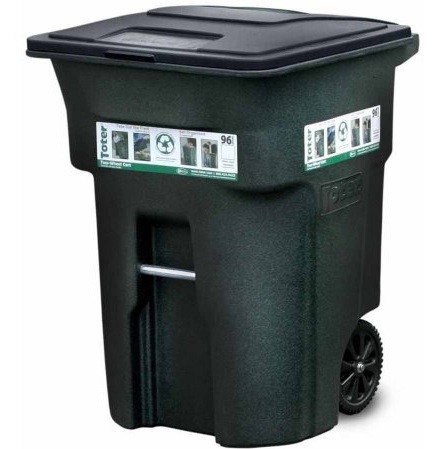


This trash cart is commonly used in the United States by various waste management corporations.  The average amount of trash in pounds which each can hold might be tricky to figure out -- since not all trash weighs the same or takes up the same volume -- not all trash has the same density!


To get an answer, Google can be consulted by inserting the following question: "how many pounds of trash does a 96 gallon trash cart hold?"  The answer is shown below:
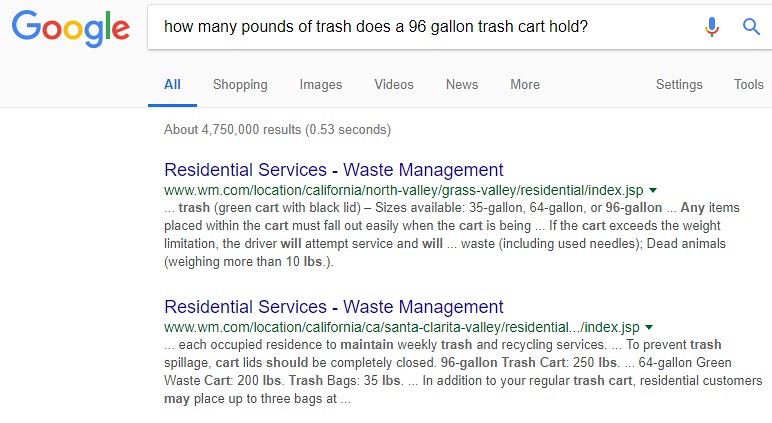


According to text in image, a 96 gallon trash can is able to hold up to 250 lbs of trash.  As I just mentioned, the exact amount of trash (weight) is difficult to calculate for a given volume.  Trash might weigh different amounts depending on the composition of the trash.  At this point, you might be a little disappointed.  No worries.


A common theme in this blog site is to "approximate" an answer.  Which is what is being done by us when we consult Google.  With an answer obtained, the analysis may be carried out to obtain a final answer.  With this in mind, lets move on to calculate the total amount of trash cans which may be filled with 80 billion pounds of trash.


How Many Trash Bins Hold 80 Billion Pounds Of Trash?


In the last section, the amount of trash was determined (in weight) which each trash bin (or can) could hold.  Given now the enormous statistic of 80 billion pounds -- the amount of trash in four different sites within the city Delhi, how many trash bins would be required to hold all of that trash?


The calculation can be done in a single step once the values (or numbers) and units of measurement have been inspected to ensure uniformity.  By uniformity of units, we mean that if a number such as the total amount of trash is reported in 'units of pounds', then our conversion factor must also be expressed in 'units of pounds' -- which is the case.


In the paragraphs above, the conversion factor for the 'density' of trash was determined by asking the search engine Google.  The density of trash was determined to be (approximated to be) around 250 pounds/96 gallons.  Density traditionally is expressed in units of 'grams/milliliters or kilograms/cubic meter.  For the sake of the current analysis, we can choose the units - we wish - as long as the answer is expressed in units typical for density.


Since a single 96 gallon trash can (or bin) holds around 250 pounds of trash, the density can be expressed as follows:
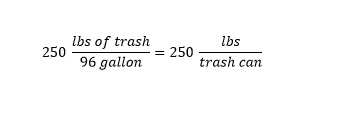


We drop the 96 gallons and substitute 'per trash can' -- meaning 1 trash can = 96 gallons.  Yes, volume is expressed as a single trash can -- strange.  This is acceptable as long as we state our assumption explicitly for the reader.  Therefore, the total amount of trash cans needed to hold 80 billion pounds of trash is calculated by dividing the total amount of trash by the density of trash as shown below:
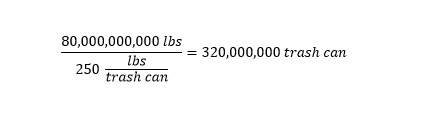


The answer indicates that a total of 320,000,000 trash cans or 320 million trash cans.  Wow!  Not a small amount.  Naturally, when I read a startling statistic like this, I wonder why such an enormous amount of trash has been allowed to accumulate over time?  What about the propagation of disease?  Is there a possibility of disease propagation with such a staggering amount?


In another section of the same article, the description of a single pile was 17 stories high?  That is over 170 feet tall (an approximate value) as mentioned above.  Wow.  Now that the following analysis has been performed, you (the reader) have been liberated to carry out similar analyses using the same method.  In addition, analyses such as the one above shed a greater amount of light on the magnitude of the problem at hand -- the accumulation of trash.


Related Blog Posts:


How many people would be killed if 1,485 pounds of Fentanyl were distributed onto the streets in the U.S.?


What Is Dimensional Analysis?


Was The Recent Oil Spill in China The Largest In History?


LimeBike Dockless Bikeshare Riders Travel A Distance Of 13,000 Miles In Just Over 3 Weeks?


How Many Cigarettes Can You Roll With 18,000 Pounds Of Marijuana?


How Many Turkey's Are Served On Thanksgiving Day? How Many People Served?


How Much Trash Would Be Required To Fill The Great Wall Of China?


How Many Birds Per Minute Can Be Processed On A Single Line At A Poultry Processing Plant?


Hurricane Harvey Drops Enough Rain On Houston To Fill 560 Dallas Cowboy Stadiums


If Technology Fails, Use Basic Math Skills - Count Manually!!


How Much Water Is Contained In All Oceans Around The Globe?


Friday, April 13, 2018

What Is Dimensional Analysis?


What is dimensional analysis?  Have you ever used dimensional analysis in your everyday life?  Here is the introductory description which is located on the Wikipedia page for "Dimensional Analysis":


In engineering and science, dimensional analysis is the analysis of the relationships between different physical quantities by identifying their base quantities (such as length, mass, time, and electric charge) and units of measure (such as miles vs. kilometers, or pounds vs. kilograms vs. grams) and tracking these dimensions as calculations or comparisons are performed. Converting from one dimensional unit to another is often somewhat complex. Dimensional analysis, or more specifically the factor-label method, also known as the unit-factor method, is a widely used technique for such conversions using the rules of algebra.[1][2][3]
The concept of physical dimension was introduced by Joseph Fourier in 1822.[4] Physical quantities that are of the same kind (also called commensurable) have the same dimension (length, time, mass) and can be directly compared to each other, even if they are originally expressed in differing units of measure (such as inches and meters, or pounds and newtons). If physical quantities have different dimensions (such as length vs. mass), they cannot be expressed in terms of similar units and cannot be compared in quantity (also called incommensurable). For example, asking whether a kilogram is greater than, equal to, or less than an hour is meaningless.
Any physically meaningful equation (and likewise any inequality and inequation) will have the same dimensions on its left and right sides, a property known as dimensional homogeneity. Checking for dimensional homogeneity is a common application of dimensional analysis, serving as a plausibility check on derived equations and computations. It also serves as a guide and constraint in deriving equations that may describe a physical system in the absence of a more rigorous derivation.


Wow!  Does that sound complicated?  Basically, what the description says above is that if you are comparing the mass of two oranges, both the units of measurement (weight) in this case have to be in the same 'units' - grams, pounds, kilograms, etc.  If you weight orange number #1 and report a weight of 70 grams, then try to compare a second orange's weight reported as 0.400 kg (kilograms) - then the comparison cannot be completed.


At least until you convert the weight of orange #1 to units of kilograms or weight #2 to units of grams.  If both weights were expressed in the same units -- say grams, then orange #1 weighing = 70 grams -- would be much smaller than orange #1 weighing = 400 grams.  The same logic applies to base quantities (dimensions) -- like length, mass, volume, height, speed, etc.


How about trying another route to clarify the description in the excerpt above.  If you have ever tried to follow a recipe while cooking, then chances are you have engaged in 'dimensional analysis' without knowing that you were doing so.  Don't believe me? Follow the quick cooking example below.


Example: Cooking


Here is a quick example of using 'dimensional analysis' in your kitchen.  Take the recipe shown below as an example:


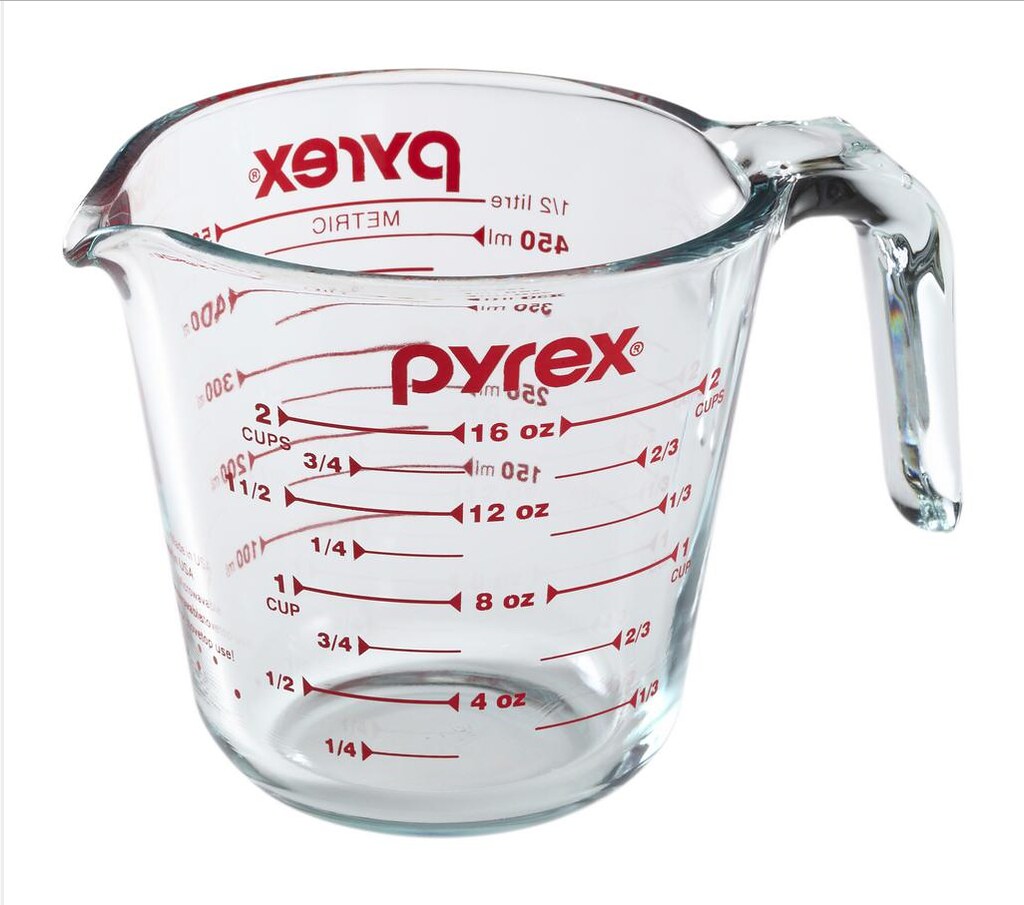
The recipe above calls for 100 mL of milk.  That is 100 milliliters of milk.   What if the kitchen in which you are preparing the shake does not contain a 'measuring cup' shown below which is extremely useful in converting between different units of measurement:


Source: HomeDepot


Upon closer inspection of the image of a 'measuring cup' above, one can easily see a series of markings at different heights with different labels.  These labels indicate different volumes of measurement in different units.  According to the image of the recipe shown earlier, the amount of milk called for in creating the shake was 100 mL -- Which could easily be converted using the instrument above -- i.e. measuring cup.


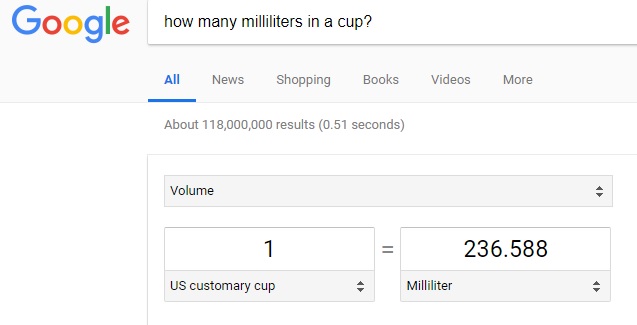
Although, what would you do if you did not have a measuring cup within the kitchen in which preparation of the shake was taking place?  How would a person find the conversion factor to convert between units of 'milliliters' and units of 'cups'?  One easy method with the advent of the internet has been to resort to to a 'search engine' like 'Google' or 'Bing'.


Proceed to bring up a web browser and bring up Google.com and type in the search space: "How Many Milliliters In A Cup?" and the web page with the conversion (interactive) columns should appear as shown below:


Note: The conversion shown above is 'interactive' - which means that the labels are 'drop down' menus which can serve to change either 'units of measurement' or 'dimensions' (i.e. length, area, volume, time, speed, etc.).  Feel free to play with the web page to convert between units of various dimensions.


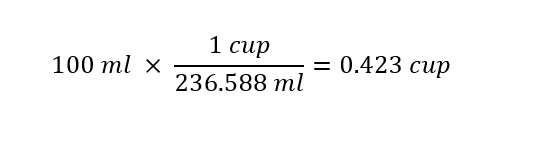
Next, with the conversion factor known which will assist us in converting between units of 'cups' and units of 'milliliters', the remaining step in the conversion is to carryout a mathematical operation as shown below:


The result indicates that in order to follow the recipe (approximately -- not precisely), roughly 1/2 cup of milk will correspond to 100 milliliters of milk.  Note that the conversion is approximate -- since 1/2 = 0.5 not 1/2 = 0.423 !!!


Is the method of carrying out a dimensional analysis problem is clear?  If the answer is yes, then you are ready to read past blog posts which mainly use 'dimensional analysis' to cast statistics reported in the news into perspective -- click here to access the index of past blog posts.  If you are not comfortable with carrying out 'dimensional analysis' problems, see the tutorial below.


Dimensional Analysis Tutorial


A Tutorial on Dimensional Analysis is shown below:


After watching the video above along with reading the content of the blog post so far, you may be wondering where to get conversion values if not from the internet.  Science textbooks have conversion tables.  After a quick search of conversion tables, the 'Accidental Scientist' appeared with a host of information.  Here is a screenshot of an example of a table of conversions below.  Note: if you click on the source, you will be directed to the site:


As you can see, there is no need to memorize conversions -- at least all of the conversions.  That is what reference materials are for when needed.


Conclusion...


In the paragraphs above, the useful (and fun) method of carrying out calculations using 'dimensional analysis' was shown.  Armed with the power to carry out comparisons with conversion factors allows you to verify a large portion of statistics which are reported in the popular news on a day-to-day basis.  Is this useful?  Depends on how much energy that you choose to exert in understanding the process of using it to live a better life.


Understanding the power of comparison with conversion factors will add extra dimensions of happiness to your life.  How do I know?  When a person can visualize or comprehend the magnitude of a reported statistic by putting the value into perspective using dimensional analysis, the problem or subject matter of the news article becomes that much more useful to the reader.  Again, thank you for visiting the website and check out the dimensional analysis blog posts by clicking here.


Related Blog Index:


Dimensional Analysis Of Statistics And Large Numbers - Index Of Blog Posts