Wednesday, July 4, 2018

Bacteria communicating in communities -- quorum sensing


If you have ever had to clean the drain in your sink or the film of dirt off of the shower wall, chances are that a bacteria colony did reside there at one time. You know what I am talking about...That build up of film on your shower door/wall which progressively gets more opaque and changes color if left untouched by a sponge with cleaner.  Bacteria colonies arise all over the place.  How do bacteria colonies grow?  How do individual bacteria in colonies communicate with each other?  Scientists have made progress into unveiling the details below.


In the video shown below -- which is 10 seconds in length, the growth of bacteria is shown along with the immediate conversations between them in a community setting:


Scientists have often wondered how bacteria communicate when in a colony setting.  This step represents an advance in the detection of communication.  A step in the right direction to say the least.  Exciting as the results may be, the researchers now have their hands full in pushing the project further.


Related Blog Posts:


What Is Going On Inside That Cell?


Chemistry Reactions Are Amazing - See For Yourself


Thoughts: How Did People Talk In 1929?


Parameters: 3D Printed Human Hearts?


Parameters: Can Computers Think?


How Do LED Christmas Lights Work?


Chemistry Videos Unveil Problems With Battery Technology


A Virtual Tour Of A Plant Cell? Really?


A Virtual Tour Of A Human Cell?


Chemists Learn To Build Up Nanoparticles -- One Atom At A Time!


World Health Organization Suggests More Funding For Antibiotic Resistance Research


Should Pollution Concern Us?


New Chemistry Shows Promise In Preventing Fires In Lithium Ion Batteries!!!


Monday, July 2, 2018

EPA Estimates Of Methane - GHG - are off by 60%


Source: PBS


Greenhouse Gases (GHG) are a contentious subject in the debate on climate change.  Whenever calculations or models are created regarding the atmosphere and effects due to pollutants, different results appear depending on the parameters taken into account in the model itself.  Recently, a report discussed in an article from the journal 'Nature' titled "Methane leaks from US gas fields dwarf government estimates" states the issue as follows:


Methane leaks from the US oil and gas industry are 60% greater than official estimates, according to an analysis of previously reported data and new airborne measurements.

Because methane is a potent greenhouse gas, scientists say that the unaccounted-for emissions could have significant impacts on the climate and the country’s economy. The lost gas alone is worth an estimated US$2 billion a year, scientists say.

The analysis1, published on 21 June in Science, is one of the most comprehensive looks yet at methane output from US oil and gas production, and reinforces previous studies that suggested emissions outpaced government estimates. That research prompted the US government to develop regulations that would restrict methane emissions from oil and gas production — rules that US President Donald Trump is now attempting to roll back.

The latest study shows that the US oil and gas supply chain emits about 13 million metric tons of methane, the main component of natural gas, every year. That's much higher than the US Environmental Protection Agency's (EPA's) estimate of about 8 million metric tons.

This discrepancy probably stems from the fact that the EPA’s emissions surveys miss potential sources of methane leaks, such as faulty equipment at oil and gas facilities, says study leader Ramón Alvarez, an atmospheric chemist at the Environmental Defense Fund, a non-profit group in Austin, Texas.


The author of the article goes onto state the obvious dangers of methane as a greenhouse gas compared to other offenders such as CO2 - carbon dioxide.  Methane has roughly 80 times more warming power on the planet compared to carbon dioxide.  How did two different studies conclude such a large difference in methane emissions?  According to the article above, the scientist took into account information from oil and gas industry (local municipal data) which was absent in the EPA report.  This naturally leads a person to wonder why the information was left out.  The answer is uncovered below.


How was 60% of a methane estimate left out of a report?


The news journal 'Politico' sent out the following e-mail with news of the report's major difference as shown below:


DEMOCRATS: BRING BACK THE ICR: Democrats are rallying around a return of an EPA information collection request in the aftermath of reports last week that oil and gas methane emissions are much greater than previously thought. A group of Democrats sent a letter to Pruitt on Wednesday calling on him to reinstate a formal ICR — which would require companies to report detailed technical information about methane emissions from their operations — after he withdrew the Final Methane ICR in March 2017. "With new science showing that emissions are likely considerably higher than previously thought, there is no excuse for delaying or rescinding methane emission controls, or for failing to collect data from methane emitters," the Democrats wrote.


As a result of the disparity in results from the Environmental Protection Agency's study, democratic congressional leaders sent EPA Administrator Scott Pruitt the follow letter of inquiry into the matter shown below:


Dear Administrator Pruitt: 
On March 2, 2017, the Environmental Protection Agency (EPA announced that it was withdrawing Information Collection Request (ICR) 2548.01, which would have required oil and gas companies to provide information on methane emissions from their operations.  On March 8, 2017, two of us sent a letter asking that you reinstate the ICR given the urgent need to collect accurate data on methane emissions in order to set and enforce appropriate and cost-effective standards to reduce such emissions.  In the extremely short response we received from the Acting Assistant Administrator for Air and Radiation on May 23, 2017, we were informed that the rationale for withdrawing the ICR was to, "allow the Administrator time to assess the need for the requested information." 
Since the date of our original letter, a number of events have occurred that highlight the urgent need to reissue the ICR and collect accurate methane emission data.  First, the U.S. Senate rejected the Congressional Review Act effort to repeal the Bureau of Land Management's (BLM) methane waste rule, the only such effort to fail in a vote, which demonstrated strong bipartisan support for reducing methane emissions.  Second, both BLM and the EPA have moved to undo, weaken, or avoid promulgating methane regulations, policies that should be informed with the best available science, not vague notions of industry "burdens" and incomplete knowledge of the public benefit of cutting emissions.  Third, the most recent release of EPA's Inventory of U.S. Greenhouse Gas Emissions and Sinks showed that methane emissions from oil and gas production operations increased 34% from 1990 to 2016, and the growth of methane emissions from natural gas production operations outpaced the growth of natural gas productions, 58% to 52%. 
Even more concerning, a new report in the journal Science from 24 authors representing 12 universities, two government labs, and more, reported that methane emissions from the U.S. oil and gas supply chain were roughly 60 percent higher than EPA inventory estimates, and that emissions from production operations were more than double the EPA estimates.  According to a story in The New York Times about the study, the 13 million metric tons of methane lost by the oil and gas industry each year is worth approximately $2 billion and would be enough to fuel roughly 10 million homes. 
Methane emissions exacerbate the worst impacts of climate change, result in significant air pollution through the concurrent release of ozone-forming volatile organic compounds, waste a valuable resource, and, when occurring on public lands, deprive American taxpayers and states of a valuable source of royalty payments.  With new science showing that emissions are likely considerably higher than previously thought, there is no excuse for delaying or rescinding methane emission controls, or for failing to collect data from methane emitters.  We believe that EPA needs to reissue the ICR as soon as possible, or provide a comprehensive explanation why it will not.  Therefore, we ask that by July 31, 2018, you provide us with the results of your assessment of the need to require methane emission data, as mentioned in the May 23, 2017, response, including a full explanation of how those results were arrived at.  If that assessment is not done, please confirm when you expect to complete it.//Thank you for your prompt attention to this letter. 


Had EPA Administrator Scott Pruitt requested the information on potential leaks and measurements around the facilities of the oil and gas industry, there would be no issue at hand -- presumably.  Now, in the 'reactive state' or 'reactive mindset' Americans find themselves in, again, scientific data shows large differences in greenhouse gases which negatively impact our environment.  The news regarding the large difference is extremely disappointing to say the least.


Conclusion...


I have stated the obvious point of disappointment from day 1 of the Trump administration.  Why does President Trump believe that there is no reason to have a 'Science Adviser' in the White House?  According to answers he gave in a campaign questionnaire on science issues, he suggested that science would be able to weigh in on each matter of relevance toward making policy.  Here is a campaign questionnaire given to President Trump on science issues in 2015.


Furthermore, instead of 'draining the swamp,' President Trump has appeared to over fill the swamp further with even more corrupt minded politicians and administrators.  See recent post with video here.  The time has come to admit that the current administration does not have our best interest (the public's best interest) or safety in mind when making policy.  Sadly enough, suppressing science (which I will touch on in an upcoming post) along with leaving science out of policy making seems to be high on the priority list of policy making.  Which runs counter intuitive to consumer/public safety.


The EPA is a watchdog, not a barrier to protect corrupt business practices to fill the pockets of wealthy business stakeholders.  We deserve to have en EPA which looks out for public safety by regulating the oil and gas industry to limit the pollutants which arrive in our neighborhoods and in the skies above us.


Related Blog Posts:


French President Macron Organizes Climate Conference With Pledges Of Trillions Of Dollars For Climate Risk Management From World Organizations


Conservatives are calling on President Trump to fire EPA Administrator Scott Pruitt over Renewable Fuel Standards


Parameters: Oil vs. Corn based Ethanol - A Tug-Of-War between Trump Administration and Congressional Leaders


Parameters: Shells Oil Corporation Invests In Renewable Energy Infrastructure


Thoughts: Trump Administration Realizes Renewable Energy Is Here To Stay?


Do You Need Clean Air To Breathe? An Introduction To Environmental Justice


Environmental Entrepreneurs Weigh In On Repealing The Clean Power Plan


EPA Blatantly Suppresses Scientific Results Regarding Climate Change?


EPA Director Finally Realizes Reality Of Trying To Roll-Back Obama Era Clean Air Act Regulation


How Can The Paris Climate Agreement Be "More Favorable To The U.S."???


Paris Climate Agreement Is A Start Toward The Renewable Energy Future


Iraq Has Enough Oil To Support The World For 4 Years -- What?


Is 94 Million Barrels Of Oil A Large Amount? That Is The Global Daily Demand!


What Promises Did President Trump Make Science Research During His Campaign?


READ THIS BEFORE VOTING -- Presidential Science (WORLD) Issues!


Friday, June 29, 2018

Does your brain move throughout the day?


Source: YouTube


Over the last few years, the news has been preoccupied by a number of important stories.  One of which is the phenomenon known at CTE - ccc - also known as 'Brain Slosh'.  Researchers have uncovered that the brain actually moves in a regular pattern which is aligned with the heart beat.


In a recent blog post by the Director of the National Institutes of Health, Dr. Francis Collins highlights the research (imaging) behind the video shown below:


Wow.  Up until now, the discussion surrounding the movement of the brain has been centered around the controversial condition in NFL football players (and other football player of all ages too) known as "Chronic Traumatic Encephalopathy" -- due to repeated 'hits' to the head during the game. In the near future, I will write more about this subject and the research which is funded by the National Football League.  With this taken center stage, developments in imaging have been emerging as a result.  This is an example of such a benefit of conducting research into other questions surrounding the brain.  After watching the video above, the natural question is the following:


How is the imaging done for the video above?


The research behind this imaging is described as follows in the blog post:


In the video, a traditional series of brain scans captured using standard MRI (left) make the brain appear mostly motionless. But a second series of scans captured using the new technique (right) shows the brain pulsating with each and every heartbeat.
As described in the journal Magnetic Resonance in Medicine, the team started by measuring the pulse of a healthy person. They synchronized the pulse with MRI images of the person’s brain, stitching the scans together to create a sequential video. Their new MRI approach then relies on a special algorithm developed by another group to magnify the subtle changes.
The new report demonstrates application of the technique to MRI scans of a healthy person and someone with structural abnormalities of the skull and the brain’s cerebellum known as Chiari malformations. Remarkably, those amplified MRI images revealed obvious differences in brain motion. The researchers also showed in another investigation which parts of the brain move the most.
The researchers hope this new approach will help physicians capture potentially important changes in the brains of people with conditions such as hydrocephalus (“water on the brain”), which influence brain pressure and motion. One thing is already clear: we’ve never seen the brain quite like this before.


Amazing.  The work described above will undoubtedly improve the entire field of medical imaging as a whole.  Each unique question asked by researchers holds the potential to add to the field of imaging in a number of unexpected ways.  Which is why scientist have difficulty with under funded science as a whole.  Not to say that certain projects could not be tailored down to save money.


Any time a research pursuit is followed, a flow of information will result.  Whether that information is useful or not is unknown in some cases.  Research into imaging techniques will have a direct and observable effect on patient care.  Unlike other types of research, shedding more light on the happenings in the region of the skull (i.e. the brain) is greatly needed and under funded.  Which means that the opportunity for improvement along with the potential to unveil vast amounts of information is huge and worthy of pursuing.  The future is exciting to say the least.


More Blogs Can Be Found Here:


Science Topics, Thoughts, and Parameters Regarding Science, Politics, And The Environment!


Dimensional Analysis Of Statistics And Large Numbers - Index Of Blog Posts


Tuesday, June 26, 2018

Parameters: Tariffs Affect Trade In Both Directions -- In And Out Of The USA


Source: War Is Boring


Trade is a complicated matter. With that being said, trade occurs between countries and countries benefit from the global trade system.  In a previous blog post on this site, I have stressed the importance of thinking in a 'global fashion' when discussing trade.  The possibility of isolating certain imports/exports such as steel and aluminum is not possible without negatively impacting other traded products.  In the blog post below, a few of the various 'connected' products which are being negative impacted (higher priced commodities) are highlighted below.


Warnings Before The Storm


Recently, there has been a considerable amount of news coverage concerning the trade tariffs which are being implemented by the Trump administration.  The tariffs are supposedly under the umbrella of 'protecting national security.'  Really?  What is really at stake is the relationships that have been formed over decades of bilateral/multilateral agreements.  Here are the latest few e-mails from 'Politico' news journal regarding the unfolding tariffs set to take place over the last few weeks.


According to 'Politico Energy' (last week Monday) China is planning on implementing tariffs on us too as shown below:


CHINA THREATENS ENERGY TARIFFS: The Beijing government released a target list Friday of 25 percent tariffs it says it is ready to impose if the U.S. carries out a second round of duties on Chinese goods. On the list, Pro's Ben Lefebvre reports, is a host of energy products, including shipments of U.S. oil, coal and petrochemicals. China is the third-largest customer for U.S. oil behind Mexico and Canada.
If the tariffs are enacted, U.S. oil exporters Exxon, Chevron and others would have to search for new customers, said Andy Lipow, president of consulting service Lipow Oil Associates. "China would have to buy additional quantities of oil from someone else, and the U.S. would have to look for new customers, presumably someone who lost sales from the Chinese," Lipow said. "But the imposition of tariffs can lead to a wider trade war, which ultimately slows economic growth around the world and reduces demand for fuel." More here from Ben, and more from Pro's Victoria Guida on the proposed tariffs here.


Following on Tuesday (last week), an email from 'Politico Energy' highlights OPEC and trade tariffs as shown below:


ON OPEC: Harold Hamm, founder and CEO of Continental Resources, canceled his scheduled appearance at this week's OPEC meeting in Vienna, a company spokeswoman told Reuters, saying the event didn't fit Hamm's schedule. But Reuters reports: "Hamm is the third of five U.S. shale executives to withdraw from a scheduled speaking slot at the OPEC meeting in Vienna." His withdrawal follows an intensifying trade dispute between China and the U.S., with China imposing $50 billion in tariffs on U.S. crude oil and other goods, Reuters reports. Continental has been a key supplier of crude oil to China — whose market may tilt toward OPEC suppliers in the absence of U.S. oil.
Separately, analysts at Goldman Sachs say they still expect oil prices to increase above $80 a barrel over the coming months, despite the trade tensions and concern over higher OPEC production, CNBC reports. The analysts said the possibility of OPEC producers announcing an increase to crude production levels could actually have a bullish impact on prices.
Ahead of the meeting: New analysis from French think tank Institut Français des Relations Internationales highlights 10 "OPEC+" oil producers and the extent to which they've been economically hit by lower prices. With the exception of Venezuela, leading producers managed to "navigate through the storm of lower oil prices" during the 16-month down market, but now may want to cash in and raise production, the analysis found. Read it here.


The two excerpts above now indicate that there is a greater threat to other relationships besides the trade partners in question - bilateral agreements.  This further exemplifies that more 'goods' or 'products' are tied to one another.  Then on Wednesday (last week), in an e-mail from 'Politico Agriculture', readers were given some insight into an exchange between Commerce Secretary Wilbur Ross and congressional leaders as shown below:


ROSS GETS EARFUL ON TRUMP TARIFFS: Finance Committee senators blasted Commerce Secretary Wilbur Ross on Wednesday for the damage done to the U.S. agricultural sector by foreign retaliation to the administration's steel and aluminum tariffs. American farmers "are bearing the brunt of retaliation for these actions," Chairman Orrin Hatch said during the hearing. "I just don't see how the damage posed on all of these sectors could possibly advance our national security."
Warnings about economic harm: Sen. Ron Wyden (D-Ore.) cited complaints from Oregon potato growers and Pacific Northwest cherry growers "who have got nearly 1.5 million boxes of cherries ready to ship to China. They're worried those cherries are going to end up stuck on the dock or rotting in a warehouse due to China's retaliation,"
Not buying national security line: Sen. Chuck Grassley (R-Iowa) noted that market volatility can also make it more expensive for companies to invest in commodities to balance out the risk of other holdings. "I wish we would stop invoking national security because that's not what this is about," Sen. Pat Toomey (R-Pa.) said. "This is about economic nationalism."
The goal is more free trade: Ross said the administration has "no control over what another country does in retaliation," but argued the president's most recent threat to impose tariffs on another $200 billion in Chinese products was designed to discourage further escalation. The administration's aim, he said, is to have more free trade — not less. "The president's objective is not to end up with high tariffs, and his objective is not to end up in a trade war," Ross said. "His objective is to get to a lowering of barriers, both tariffs and non-tariff ones, and to protect intellectual property. ... The purpose of this is to get to an endgame that is much closer to free trade than what we've been before."
What about farmers? But Sen. Michael Bennet (D-Colo.) blasted Ross for not articulating a vision of how agricultural producers would be protected. "I don't think you're going to have any backstop for our farmers and ranchers, and to blindly pursue these policies without considering what happens to them I think is a huge mistake," he said.
Grassley wants nothing to do with handouts: Sen. Chuck Grassley had told reporters during his weekly ag briefing Monday that Trump pointed to Agriculture Secretary Sonny Perdue before telling a group of governors and congressional lawmakers that the federal government would subsidize any losses faced by farmers due to tariffs. "That's not what my farmers in Iowa want — help from the federal treasury," Grassley responded. He reiterated his displeasure about the idea to Ross at the hearing.


How can Commerce Secretary Wilbur Ross actually state with a straight face that the tariffs are designed to move the nation closer to 'free trade' than before?  This does not make sense at all.  Why?  What the administration does not take into account is that the overall benefits of global free trade on all parties (nations) in the world?  In an earlier post, I pointed this obvious aspect out.


The current administration believes that the possibility exists to make money on free trade with tariffs.  Over the last few weeks, threats have been made by other countries to level the playing field and enforce trade tariffs on exports/imports coming from the United States.  The result will be the following as has been reported in the news so far as shown below:


1) According to the New York Times, nails used for construction will increase at least 20% in price, a 20% duty has been imposed by the European Union on imported Whiskey from the U.S., a 25% tariff by China will be imposed on Lobsters, along with unknown losses for both the Peanut Butter industry, and Cranberry industry.


2) According to economic analyst Steve Ratner on Morning Joe, the price of soft wood lumber has increased 27%, which translates to the added cost of construction to a new home of around $6,388.


3) According to USA Today, both the soybean market and aerospace exports to China will take a hit - which impacts farmers and aerospace industry.  And Harley-Davidson Motorcycle corporation will move a portion of manufacturing overseas to avoid tariffs by other countries such as the European Union -- due to the tariffs imposed by the Trump administration.


None of the above bullet points highlight the obvious terrible fact that along with increases in prices of traded goods, a corresponding loss of American Jobs will occur.   The negative impact of the above tariffs is not enormous, but represents a loss to the revenue of our country.  According to the U.S. Department of Commerce, moves such as removing our nation from trade deals (i.e. NAFTA) could result in job losses of around 2.6 million American jobs.  Wow.


In the reporting cited above, the potential trade war with China over around $50 billion is not huge, but is not necessarily preferred and will not result in any positive outcome for the United States.  Additionally, a list of 180 types of products to which tariffs will be imposed upon can be found in the following article by NPR titled "EU Tariffs Take Effect, Retaliating For Trump's Tariffs On Steel And Aluminum".


And finally, yesterday Monday, in an email from 'Politico Agriculture,' pork prices are due to increase in price by 20% on July 5 of this year:

TARIFFS PILE ON PORK INDUSTRY: Few industries have been hit harder by President Donald Trump's tariffs than pork, where producers have gone from predicting growth at the beginning of the year to worrying about losing market share in two of their three biggest markets, Mexico and China. Pork producers already took a blow in 2017 when Trump pulled the U.S. out of the Trans-Pacific Partnership, putting producers in an awkward position with Japan — the biggest importer of U.S. pork by value, according to the National Pork Board.
Pork has been targeted by tariffs at every step of the way, first showing up on a retaliatory list released by China after the Trump administration imposed $3 billion worth of duties on steel and aluminum in March. China is the third largest importer of U.S. pork, buying a little more than $1 billion worth of product in 2017. But producers are much more concerned about losing market share with our neighbor to the south. Mexico's 10-percent tariff on pork will jump to 20 percent on July 5, and the largest importer of American pork by volume is already in discussions with the European Union about ramping up cross-Atlantic imports.
The USDA's livestock, dairy and poultry outlook report released June 18 predicts hog prices are expected to average 19 percent lower in the third quarter and 17 percent lower in the fourth quarter, compared to prices from last year, in part due to price adjustments to Mexican tariffs.


Overall, in the excerpts above, the clear notion of a threat to our 'national security' is obviously not a true threat.  Therefore, the trade tariffs imposed on other countries to overcome any threat to our national security is just a ploy (a trick) to build support among the citizens of the United States of America.  Do not fall for the trick.  Below, I want to discuss briefly, the indirect effect on business with China which has been reported but is not discussed widely in the news.


Storm Larger Than Predicted


The reporting over the last few weeks regarding trade would lead a person to believe that other countries will now need to 'pay their fair share' on traded imports/exports.  That sounds wonderful in principle.  With China having around $200 billion dollars in imported goods to the United States, the U.S. stands to get a good share of money from tariffs.  While the United States has only about $50 billion in exports in return, the Chinese government appears to have less negotiating power.  At first sight...


In reality, there is an entire other sector which is not classified as 'traded goods' as reported by NPR.  Those goods or that category is 'services' -- i.e. the service industry along with the tourism industry.  Businesses would love to expand their presence in China.  The Chinese government could strike back and put restrictions on corporations which would have an unknown negative impact to the United States.  The radio station NPR aired an episode titled "What It Takes For An American To Do Business In China" in which the unknown threat was discussed as follows:


READE: Well, I hope the United States expected the response that they got because any China watcher would tell you that China will not want to come to a negotiating table from a position of weakness. China would definitely respond with an immediate and clear message.
KELLY: The Chinese cannot respond in kind, though, because the U.S. doesn't send $150 billion worth of goods to China, right?
READE: Correct, but the trade relationship is bigger than just the production and export of goods. There's a whole services side to the trade, and it's a number of things that you don't necessarily think about. So it includes tourism, which is in the billions of dollars. It also includes education.


The cumulative negative impact to the U.S. with regard to businesses trying to break into the Chinese market is unknown.  Therefore, the current trade discussion is heating up and turning into a potentially problematic situation for both countries.  Hopefully, in the months to come, congressional leaders step up along with large corporations and write/call President Trump and have him reverse the discouraging trade tariffs.


Conclusion...


Ultimately, the United States will suffer from the current move toward the trade imbalance being implemented by the Trump Administration.  There is no sign of that occurring at the moment.  The overall message coming out of the trade war is that trade is not a huge system of 'isolated components'.  Each component is tied to each other.  The analogy in medicine is that operating on one system in the human body does not impact any other anatomical/physiological system.  Truth is that each component is connected in some fashion to another.  Why would law makers, administrators think differently.


Last but not least, the real troublesome result of the ongoing breakdown of trade agreements is that deep relationships are broken or thrown into question between countries.  Which is exactly what we (as a nation) do not want.  Trust between nations is important.  Imagine if you shopped at the farmers market every week.  Furthermore, imagine if you could trust that each week a certain vendor selling a selective fruit/vegetable would definitely be there.  The vendor depends on your business and you (as the consumer depend) on the vendor showing up with the produce that you desire to purchase.  The relationship is built on trust -- really purchasing trust.


If no relationship exists, then the vendor has no reason to keep the prices the same or show up.  As a result, you are impacted (cannot buy the produce that you would like) and the farmer/vendor cannot sell product.  And the farmer's market association which hosts the market each week loses on the vendor's cut of the profits.  Relationships breakdown and everyone loses.  Lets not let that happen with other nations around the world.


Saturday, June 23, 2018

Ralph Nader: An Open Letter to Jeff Bezos, CEO of Amazon


Taxes, taxes, and more taxes.  The capitalist complain about 'taxes'.  Taxes are what hinder growth complain CEO along with regulatory procedures (i.e. regulations, safety and economic regulations, etc.).  Chief Executive Officers offer explanation of lower taxes to spur an economy: lowering taxes along with easing regulations allows CEOs to hire more workers and increase wages while spending more money to kick-start the economy.


The only problem with the argument is the result that occurs time and time again with lowering taxes and easing regulations: CEOs line their own pockets with bonus's along with reporting increase profits to their shareholders (i.e. business is booming).  No one gets hired! Furthermore, we find that the public is in greater danger of a disaster (i.e. chemical spill, health hazard, outbreak, etc.) due to easing regulations.  Recently, Ralph Nader has chimed in on the subject of taxes in the form of an 'open letter' to Jeff Bezos of the giant corporation -- Amazon.  The letter is shown below:

  
June 21, 2018

Jeff Bezos, CEO
Amazon.com, Inc.
410 Terry Ave N
Seattle, WA 98109
Dear Mr. Bezos:
You’ve come a long way from being a restless electrical engineering and computer science dual major at our alma mater, Princeton University. By heeding your own advice, your own hunches and visions, you’ve become the world’s richest person – at $141 billion and counting.  You must feel you are on top of the world.
You are crushing your competition—those little stores on Main Street, USA, and other large companies that are still in business.
Your early clever minimizing of sales taxes gave you a big unfair advantage over brick and mortar stores that have had to pay 6, 7, 8 percent in sales taxes. Your tax-lawyers  and accountants are using the anarchic global tax avoidance jurisdictions to drive your company’s tax burden to zero on a $5.6 billion profit in 2017, plus receiving about $789 million from Trump’s tax giveaway law, according to The American Conservative magazine (see Daniel Kishi’s article, “Crony Capitalism Writ Large,” in the May/June 2018 edition).
Amazon has been a leading corporate welfare King and is about to reap more of this extorted harvest once you decide where to locate your second headquarters. By the way, if you are considering the Washington, D.C. area, where you are building an extended mansion worthy of an emperor, consider the fact that there is a higher concentration of public interest lawyers per square mile there than any other metropolitan area. These lawyers stand opposed to further housing price spirals, gentrification, congestion, and huge crony capitalistic subsidy demands.
Your expansion into retail stores and warehouses will further highlight the low wages and sometimes hazardous working conditions and assembly line pressures of your corporate model.  Other companies are exploiting their workers—as in Walmart (which by the way pays far more income taxes than you do on a percentage basis even under its tax avoidance schemes)— but few companies are as blatant in their planning to replace with robotics the warehouse workers and truck drivers delivering goods.
Your small Board of Directors is clueless about both their responsibility for Amazon shareholders and their overall social responsibility.  Your board will rubberstamp all of your proposals as they tally how rich you’ve made them with stock options, at the expense of your workers. I wrote you (see enclosed letter) as a shareholder to start paying a dividend—your horde of cash belongs to the shareholders, doesn’t it? You have not had the courtesy to reply to this letter.
Amazon and Starbucks have just succeeded in a grotesque power play reversing the Seattle City Council’s vote to impose a mere $48 million a year tax on large, local corporations to combat the crisis of homelessness and unaffordable housing in your hometown. Given your successful tax avoidance mania, you should be ashamed of yourself. Because of your company’s insatiable greed, you have decided to ignore the plight of the homeless.
You should spend some personal time with Seattle’s homeless. Then you can announce what you have seen is inconsistent with our society‘s values and capabilities. You should then announce that you will personally pay that annual $48 million to the city. This charitable gesture will ground, ever so slightly, your cash investments in extraterrestrial space travel. Jeff, reduce your focus on the future, installing all robotic plants and your outer space ventures. You would do well to increase your focus on what is happening presently on Earth.  Here, hard-pressed people have to live and raise their children with increasingly bleak prospects.
So you are on top of the world, hyper-rich, arrogant, with your raucous laugh and your sudden temper, believing that neither antitrust laws, nor labor laws, nor tax laws, nor consumer, nor environmental, nor securities laws will ever catch up with the excesses of your business model.
Don’t bet on it. Relentless greed with overly concentrated power (about the only thing you seem not to be willing or able to control is Alexa whose ambitions may come back to haunt you) sooner or later, faces a statute of limitations.

Sincerely,
Ralph Nader


 I do not pretend to understand or know the solution which will solve the issues which plague our society today.  I try to read widely and provide the reader with views which are not very popular.  By unpopular, the iconic activist Ralph Nader has dedicated his life to protecting/speaking out against wrong actions taken by either government or large corporations.


The views of activist like Ralph Nader and Noam Chomsky are worth entertaining.  The evidence they cite has been accumulated over decades of their activism.  As an amateur activist myself, I am learning from a wide variety of sources.  Education is an ongoing process.  Activism is an ongoing process too.  We can learn a tremendous amount from the earlier activists.  Letters like the one above, call out CEO's on their wrongful behavior.


Furthermore, the letters are rich with references to build a platform of activism from.  I encourage each person to learn something from each of these letters I post -- even if just a faint consideration of the problem at hand occurs momentarily.  That is learning too.  Further, that sets the seed in a person's mind toward finding a solution in the future.  The solution is a collection of each of our solutions - i.e. democracy.


Related Blog Posts:


Ralph Nader: MAGA is really MADA?


Ralph Nader: Has Corruption Become Institutionalized?


Ralph Nader Says 10 Million People Could Change Healthcare Policy - That Few?


Ralph Nader Suggests To Consumers Reading 'Consumer Reports' Before Impulse Buying


Thoughts: Ralph Nader On A Cashless Economy


Ralph Nader Asks "Will the Federal Civil Service Defend Us?"


Activist Ralph Nader Gives Politicians Advice Post Hurricane Harvey


Activist Ralph Nader Calls To Each Pillar Of Society - A Call To Action.


Can One Community Organization Change Regional Transportation Habits?


Wednesday, June 20, 2018

How many trash carts can be filled with 80 billion pounds of trash?


Each of us generates trash throughout each day.  The usual routine is to make sure that the trash that each of us generate ends up in 'the trash can' in each room.  From there, we know that the trash that is deposited will then get shipped to either a dump or a boat to another country.  Did you know that?  What if other countries cannot except anymore trash?  Why do I ask this question?  Read onto find out.


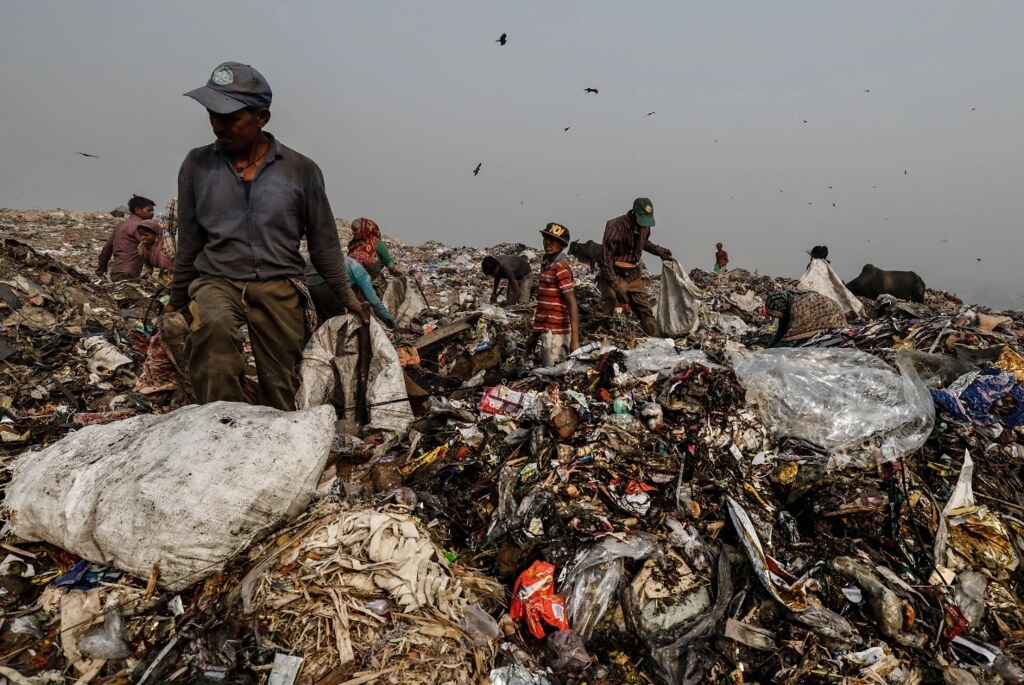
Recently, in an article in The New York Times titled "‘The Dump Killed My Son’: Mountains of Garbage Engulf India’s Capital" the author reported two stunning statistics regarding gigantic trash piles which were looming close to neighborhoods and carrying the possibility of transmitting disease.   Here is an excerpt which caught my eye regarding total amount of waste:


In the metropolitan area of Delhi, which includes the capital New Delhi, trash heaps are towering monuments to India’s growing waste crisis. About 80 billion pounds of trash have accumulated at four official dumping sites, on the fringes of a capital already besieged by polluted air and toxic water, according to the supervisors of the dumps.


Some of these dumps are simply open aired rooms which span up to 17 stories in height.  Yes, that is equivalent to around 170 feet in height.  WOW.  The weight in trash was another mind blowing statistic which was too much to comprehend.  Therefore, I decided to carry out a little dimensional analysis in order to better understand this mind blowing number -- 80 billion pounds of trash.  I asked the following question:


How many trash carts could be filled with 80 billion pounds of trash?


How many pounds of trash in a trash cart?


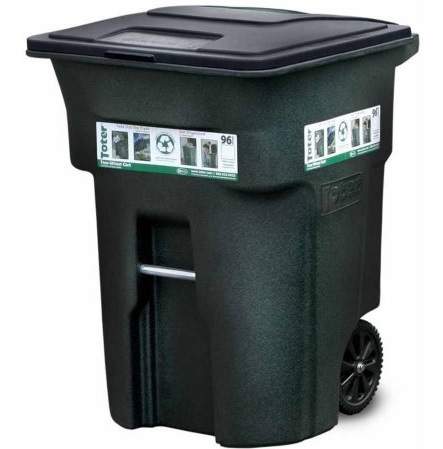
In order to start the analysis, the metric which will be used to cast this enormous number needs to be known.  The trash cart of interest is shown below:


This trash cart is commonly used in the United States by various waste management corporations.  The average amount of trash in pounds which each can hold might be tricky to figure out -- since not all trash weighs the same or takes up the same volume -- not all trash has the same density!


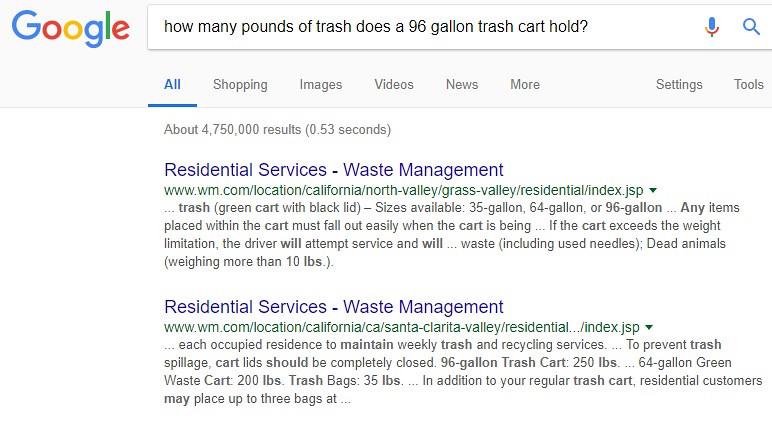
To get an answer, Google can be consulted by inserting the following question: "how many pounds of trash does a 96 gallon trash cart hold?"  The answer is shown below:


According to text in image, a 96 gallon trash can is able to hold up to 250 lbs of trash.  As I just mentioned, the exact amount of trash (weight) is difficult to calculate for a given volume.  Trash might weigh different amounts depending on the composition of the trash.  At this point, you might be a little disappointed.  No worries.


A common theme in this blog site is to "approximate" an answer.  Which is what is being done by us when we consult Google.  With an answer obtained, the analysis may be carried out to obtain a final answer.  With this in mind, lets move on to calculate the total amount of trash cans which may be filled with 80 billion pounds of trash.


How Many Trash Bins Hold 80 Billion Pounds Of Trash?


In the last section, the amount of trash was determined (in weight) which each trash bin (or can) could hold.  Given now the enormous statistic of 80 billion pounds -- the amount of trash in four different sites within the city Delhi, how many trash bins would be required to hold all of that trash?


The calculation can be done in a single step once the values (or numbers) and units of measurement have been inspected to ensure uniformity.  By uniformity of units, we mean that if a number such as the total amount of trash is reported in 'units of pounds', then our conversion factor must also be expressed in 'units of pounds' -- which is the case.


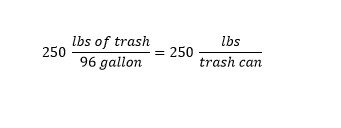
In the paragraphs above, the conversion factor for the 'density' of trash was determined by asking the search engine Google.  The density of trash was determined to be (approximated to be) around 250 pounds/96 gallons.  Density traditionally is expressed in units of 'grams/milliliters or kilograms/cubic meter.  For the sake of the current analysis, we can choose the units - we wish - as long as the answer is expressed in units typical for density.


Since a single 96 gallon trash can (or bin) holds around 250 pounds of trash, the density can be expressed as follows:


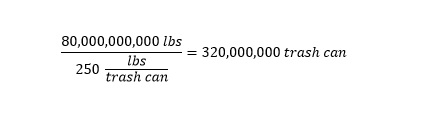
We drop the 96 gallons and substitute 'per trash can' -- meaning 1 trash can = 96 gallons.  Yes, volume is expressed as a single trash can -- strange.  This is acceptable as long as we state our assumption explicitly for the reader.  Therefore, the total amount of trash cans needed to hold 80 billion pounds of trash is calculated by dividing the total amount of trash by the density of trash as shown below:


The answer indicates that a total of 320,000,000 trash cans or 320 million trash cans.  Wow!  Not a small amount.  Naturally, when I read a startling statistic like this, I wonder why such an enormous amount of trash has been allowed to accumulate over time?  What about the propagation of disease?  Is there a possibility of disease propagation with such a staggering amount?


In another section of the same article, the description of a single pile was 17 stories high?  That is over 170 feet tall (an approximate value) as mentioned above.  Wow.  Now that the following analysis has been performed, you (the reader) have been liberated to carry out similar analyses using the same method.  In addition, analyses such as the one above shed a greater amount of light on the magnitude of the problem at hand -- the accumulation of trash.


Related Blog Posts:


How many people would be killed if 1,485 pounds of Fentanyl were distributed onto the streets in the U.S.?


What Is Dimensional Analysis?


Was The Recent Oil Spill in China The Largest In History?


LimeBike Dockless Bikeshare Riders Travel A Distance Of 13,000 Miles In Just Over 3 Weeks?


How Many Cigarettes Can You Roll With 18,000 Pounds Of Marijuana?


How Many Turkey's Are Served On Thanksgiving Day? How Many People Served?


How Much Trash Would Be Required To Fill The Great Wall Of China?


How Many Birds Per Minute Can Be Processed On A Single Line At A Poultry Processing Plant?


Hurricane Harvey Drops Enough Rain On Houston To Fill 560 Dallas Cowboy Stadiums


If Technology Fails, Use Basic Math Skills - Count Manually!!


How Much Water Is Contained In All Oceans Around The Globe?


Sunday, June 17, 2018

What was the last book you read?


Source: MedicalXpress


Can you remember the name of the last book that you read recently?  Alright, how about the last book in 'hard copy' or 'soft copy' -- yes, a physical book?  Are those two answers different?  As the world seems to increasing move toward the digital world, so has our preferences to access data.  Which brings me to the point of this short blog post -- has the 'art of reading' been lost among us?


In my opinion, the answer is no.  Yes, more people are moving toward accessing books in digital form.  Although, I am open to being challenged on this assertion.  Recently, I ran across a TED talk from February of this year titled "The Dying Art of Reading Books" by Ms. Arrushi Agarwal with an introduction in the comments section shown below - which captivated my attention:


Research suggests that children who read for enjoyment every day perform better,  develop a broader vocabulary, increased general knowledge and an enhanced understanding of cultures. Reading for pleasure is a better indicator of whether a child does well at school rather than their social or economic background. In this age when multi media is encroaching our households and educational institutions and the number of avid readers is progressively getting endangered  Ms.Arushi Agarwal reminds us of the benefits and the joy of reading.
Ms.Arushi Agarwal is a student of Grade Eleven. She has a brilliant academic record and a well stocked personal library. Arrushi is a self professed bibliophile. Research suggests that children who read for enjoyment every day not only perform better, but also develop a broader vocabulary, increased general knowledge and a better understanding of other cultures. In fact, reading for pleasure is more likely to determine whether a child does well at school than their social or economic background. In this age when multi media is encroaching our households and educational institutions and the number of avid readers is progressively getting endangered we have with us a young lady who will be reminding us of the importance and the art of reading. This talk was given at a TEDx event using the TED conference format but independently organized by a local community. Learn more at https://www.ted.com/tedx


Wow.  The pleasure of reading is a subjective experience.  Reading allows a person to explore places in the world which are unreachable.  As pointed out in the video below, each person creates their own version of the places, events, and occurrences as described by an author in a given book.  Which means that there are billions of creative (subjectively created by each person) which are entertained as a result of books which are published.  This is astonishing to consider.


Reading allows a person to familiarize or leave their comfort zone and explore another world.  The benefits of reading are numerous as pointed out in the excerpt above.  The joy of opening a book cannot be properly described in the written word.  A whole new world/dialogue is created when a person opens up a book.  Books speak to us in an unusual way.  Creativity and imagination is required to read a book.  These factors contribute to the benefits of reading. 


What is the last book that you read?  Feel free to leave the title and a short description in the comments below.  For those interested in watching the short presentation -- 6 1/2 minutes in length, the video is shown below:


When was the last time that you found yourself lost in a book?  Each of us should read a book of significant length and outside our natural comfort zone.  This experience 'kick starts' our imagination as pointed out by Ms. Arrushi Agarwal -- who has made quite a journey through reading in a short span.  I hope that you will be inspired by the post and the content of the post to pick up a book and dive into a whole new world for a while.  The effort is worth the journey.  Happy Father's Day!!


Related Blog Posts:


Science Topics, Thoughts, and Parameters Regarding Science, Politics, And The Environment!