Showing posts with label Life Education. Show all posts

Sunday, June 17, 2018

What was the last book you read?


Source: MedicalXpress


Can you remember the name of the last book that you read recently?  Alright, how about the last book in 'hard copy' or 'soft copy' -- yes, a physical book?  Are those two answers different?  As the world seems to increasing move toward the digital world, so has our preferences to access data.  Which brings me to the point of this short blog post -- has the 'art of reading' been lost among us?


In my opinion, the answer is no.  Yes, more people are moving toward accessing books in digital form.  Although, I am open to being challenged on this assertion.  Recently, I ran across a TED talk from February of this year titled "The Dying Art of Reading Books" by Ms. Arrushi Agarwal with an introduction in the comments section shown below - which captivated my attention:


Research suggests that children who read for enjoyment every day perform better,  develop a broader vocabulary, increased general knowledge and an enhanced understanding of cultures. Reading for pleasure is a better indicator of whether a child does well at school rather than their social or economic background. In this age when multi media is encroaching our households and educational institutions and the number of avid readers is progressively getting endangered  Ms.Arushi Agarwal reminds us of the benefits and the joy of reading.
Ms.Arushi Agarwal is a student of Grade Eleven. She has a brilliant academic record and a well stocked personal library. Arrushi is a self professed bibliophile. Research suggests that children who read for enjoyment every day not only perform better, but also develop a broader vocabulary, increased general knowledge and a better understanding of other cultures. In fact, reading for pleasure is more likely to determine whether a child does well at school than their social or economic background. In this age when multi media is encroaching our households and educational institutions and the number of avid readers is progressively getting endangered we have with us a young lady who will be reminding us of the importance and the art of reading. This talk was given at a TEDx event using the TED conference format but independently organized by a local community. Learn more at https://www.ted.com/tedx


Wow.  The pleasure of reading is a subjective experience.  Reading allows a person to explore places in the world which are unreachable.  As pointed out in the video below, each person creates their own version of the places, events, and occurrences as described by an author in a given book.  Which means that there are billions of creative (subjectively created by each person) which are entertained as a result of books which are published.  This is astonishing to consider.


Reading allows a person to familiarize or leave their comfort zone and explore another world.  The benefits of reading are numerous as pointed out in the excerpt above.  The joy of opening a book cannot be properly described in the written word.  A whole new world/dialogue is created when a person opens up a book.  Books speak to us in an unusual way.  Creativity and imagination is required to read a book.  These factors contribute to the benefits of reading. 


What is the last book that you read?  Feel free to leave the title and a short description in the comments below.  For those interested in watching the short presentation -- 6 1/2 minutes in length, the video is shown below:


When was the last time that you found yourself lost in a book?  Each of us should read a book of significant length and outside our natural comfort zone.  This experience 'kick starts' our imagination as pointed out by Ms. Arrushi Agarwal -- who has made quite a journey through reading in a short span.  I hope that you will be inspired by the post and the content of the post to pick up a book and dive into a whole new world for a while.  The effort is worth the journey.  Happy Father's Day!!


Related Blog Posts:


Science Topics, Thoughts, and Parameters Regarding Science, Politics, And The Environment!


Monday, September 19, 2016

Why Is There Another Oil Spill?

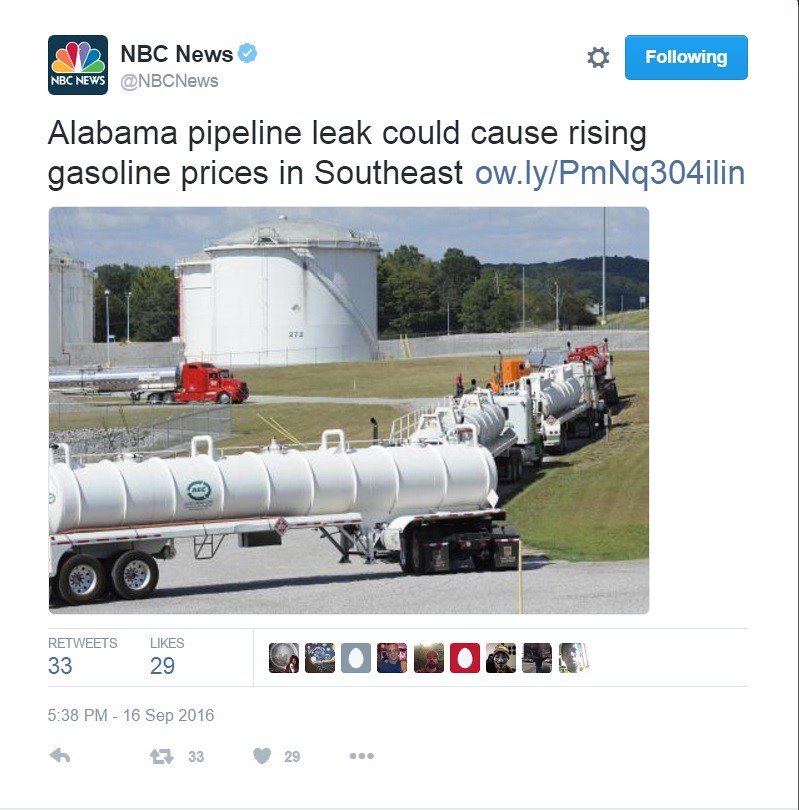
This is the question that I ask myself after viewing the following picture on twitter below:


Usually, the next question is the following:


How many gallons spilled this time?


Sounds like I am beating the same old drum.  I am.  A correction first in my initial question.  According to the news, gasoline spilled, not raw oil from the ground.  Other news sources quote oil.  Regardless, large volumes of any chemical that spills in any geographical area is not great for the environment.  Why? First, the following question:


Why can't these large oil companies get their act together and put infrastructure in place to stop such large volumes from polluting the environment?


In order to agree or disagree with me, we should explore the amount of oil that actually spilled in the cited case in Alabama.  First, I want to highlight that based on previous blog posts on my site under the theme "Large Volume Spill" -- the reported amount can be put immediately into perspective.  That is to say, if you have been reading the past blog posts, then upon reading the reported number of barrels of oil spilled, the volume should make sense.


To an extent, that realization is rather disappointing since that means this is not an isolated case.  Before we draw out more emotions, lets look at the numbers reported and subject the values to dimensional analysis.  Below is the result.  Enjoy!


How Many Gallons In A Barrel?


In order to understand the magnitude of the spill in Alabama, there are two values that need to be known.  First, the volume of oil that actually spilled -- usually reported in units of 'barrels'.  Next, the conversion factor from 'barrels' to 'gallons'.


According to the news site "NBC News," the amount of oil that was spilled was in the range of 6,000 to 8,000 barrels.  Here is an excerpt about the spill taken from the article:


It's unclear when the line started leaking, but Colonial said in a statement that the leak was detected on Sept. 9, and about 6,000 to 8,000 barrels of gasoline had been lost.

The company said there are no threats to public safety because the leak has been contained, but warned that parts of Georgia, Alabama, Tennessee, North Carolina and South Carolina gas markets would first be affected by the "disruption in supply."

Patrick DeHaan, a senior petroleum analyst with Gasbuddy.com, said prices at the pumps in those states could swell by 5 to 20 cents a gallon. "And it could be even worse," he said.


Where did the gasoline go?  According to the reports, the gasoline has 'pooled' into a 'retention pool' nearby preventing the gasoline from leaking into either the ground water or the nearby river.


Why is this so sketchy?


Why do we run a pipeline next to an important river?


Time and again, we see these designs in the interest of improving the bottom line of the petroleum companies on top of keeping Americans depend on cars.  Over the last two years, there have been enough examples of the failure of retention pools.  Think of the Gold King Mine waste spill in Colorado.  How about the Brazil mine wastewater spill?  And just a couple of days ago, there was a spill in Florida -- which I will write about in the next week or so.  In times such as these, one has to wonder why the companies want to risk damage to the environment too?


Lets put that discussion on pause for a minute in order to understand the magnitude of the spill here.


How many gallons does this volume equate to?


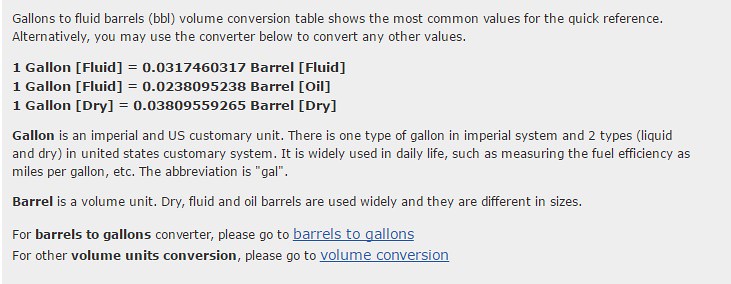
The conversion factor from a 'barrel' of oil to a 'gallon' of oil is the following provided by the website "asknumbers.com":


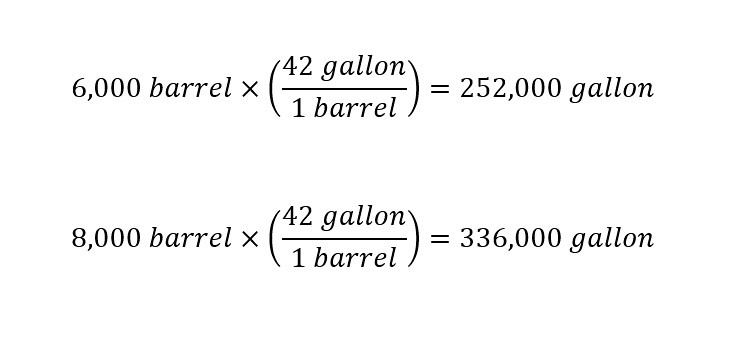
There are 42 gallons in one barrel.  If you perform the following calculation take 1 and divide the number (decimal number above) as follows: 1/ 0.0238 to get 42 gallons.  With these two values, the range can be calculated as shown below:


Wow!  Earlier, I suggested that based on the previous posts on this blog, the numbers should be easily put into perspective.


What did I mean by the statement?


How Does The Spill Compare To Refugio?


A couple of years ago, the California coast was once again rocked by an oil spill.  Again, in Santa Barbara.  The name of the spill was Refugio after the beach on which the oil washed up.  I wrote a blog post about the spill that has tainted the beaches below the northern beach.  We still see the effects to the environment -- which are not pretty and devastating.  Unfortunately, we accept them as part of our dependence on oil.


How does the current gasoline spill compare to the oil spill at Refugio Beach?


The Refugio oil spill was small (142,000 gallons) compared with the enormous 'Deepwater Horizon' Oil spill caused by the BP Oil drilling off shore (210,000,000 gallons).  Of course, the 'off shore' drilling was further out.  The spill near the beach in California was three orders of magnitude less than 'Deepwater Horizon'.  Still, a man-made disaster should not have happened in the first place.


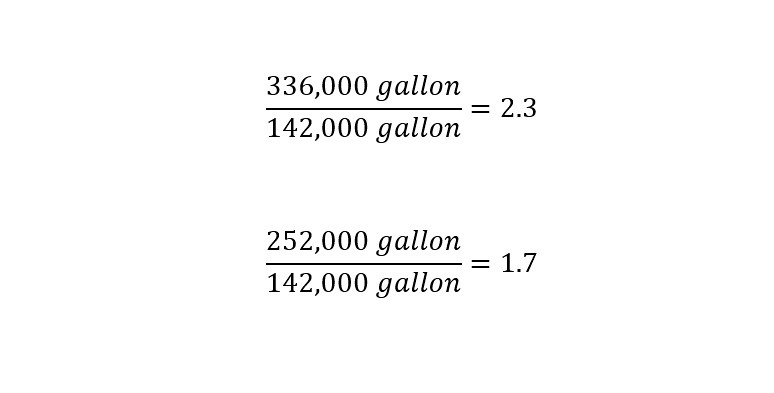
If the value of the current gas spill in Alabama is divided by the volume of the spill in Refugio Beach, the answer is the proportion of one spill to the other as shown below:


Which is to say, the results above based on the ranges calculated for the gasoline spill in Alabama suggest that the spill was 1.7-2.3 times the oil spill in Refugio Beach.  The spill overall was small compared to the previous spill entertained on this blog site.  Although, any damage to the marine environment or the public drinking water system is too much damage.


What else can be said about the volume of gasoline spilled in Alabama?


Again, if you are a consistent reader of the site, then you can look at the volume and say the following:


The amount that was spilled was relatively small in comparison to recent large volume disasters.  If we take an Olympic Swimming pool to use as a metric, not even half of the pool would be filled.  Really?  Yes, the volume of an Olympic Swimming pool is around 660,000 gallons.


You might be wondering where I got the idea to include the Olympic Size swimming pool.  In the "introductory post" for this site, I include an Olympic Size swimming pool as a metric in a dimensional analysis calculation.


Should we be worried about the spill?


Conclusion ...


Based on the last few statements, one might not be concerned about the spill due to the 'relatively small volume' of the spill.  Then I would ask the following:


If that volume were small, then why is the price of gas starting to rise as a result?


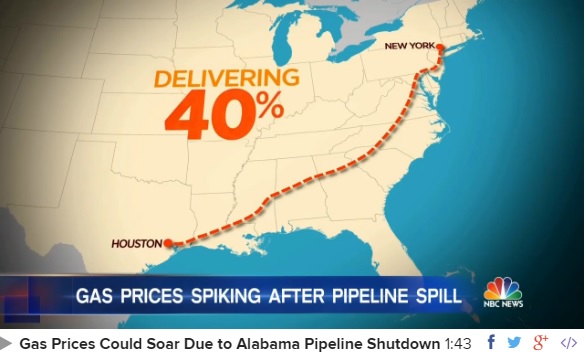
The answer is due to two culprits.  First, the amount that spilled is contained and not a huge amount -- therefore, we have lost some gas.  The second culprit is the significant parameter in the loss of gasoline.  The infrastructure is a large part of the supply chain and will need to be repaired.  Here is a diagram of the pipeline that busted and leaked gasoline taken from the video in the article mentioned above:


According to the map above, the pipeline delivers 40% of the gas to the region.  


Why do companies build pipelines like this?  


In the event of a break or leak, the entire system is shut down.  I have yet to understand the reasoning behind such construction.  


Maybe a reader can provide us with some information?  


Anyone out there work for a petroleum company want to educate the audience?


Regardless, in the Midwest, there is a current dispute with a native nation about the pipeline crossing property.  Additionally, the proposed pipeline will cross right on top of an aquifer in Nebraska.  Is this a good idea based on the current events unfolding in the nation -- with regard to large volume chemical spills?  Why don't politicians connect the dots between the two disasters?  I hate to speculate, therefore, I will end the post here.


After reading the above post, the spill should be easier to understand.  Furthermore, in the future, a spill will be easier to cast into perspective given the methodology explained in the brief post with the dimensional analysis.  Until next time, have a great day!


Monday, May 16, 2016

Ambassador Of Chemistry Has Followed Me All Of My Life -- Even In the Military

When your friends and family members realize that your majoring in Chemistry in college, you instantly become the "ambassador of chemistry."  Maybe the motivation behind that is to help motivate the person to really become the best chemist that is possible.  The realization that I had a mind that was tuned in to chemistry/physics came to me in high school at lunch time.


In the following paragraphs, I will explain how chemistry followed me into the military.  Specifically, I will highlight two separate environments -- high school and the military to illustrate my point -- your passion/interests are constantly intersecting your life.  Do you believe me? If not, read more below.  If so, read more below.


When Did Chemistry Appeal To Me?


Growing up, my father would always talk to me about chemistry.  Part of that is due to that he loved chemistry.  He is a true academic in the sense that he could get lost in studying science.  If he were to be taken hostage and locked up in a library, given the proper amount of food and clothing, he would live the remainder of his life happy as ever.  I remember when I was in Junior High, he put a bumper sticker on his car that read "Honk If You Got an A In P-Chem."  Who would have thought that two decades later I would become a "physical chemist."


My first exposure in academia to chemistry was kind of "off the beaten path."  I used to "ditch" classes quite a bit.  I missed a lot of high school one particular semester.  As a result, I was given a punishment.  First, I would attend Saturday detention from 8 am - 12 pm.  I remember my father proudly dropping me off to attend.  He was happy that I received a proper punishment for missing school.  Additionally, I had to skip lunch and report to the chemistry/physics teacher's classroom -- Mr. Barth -- now Dr. Barth.


What seemed like a punishment then, turned into a major part of my doctoral work a decade later.  I was given the task of building (with a friend) a track of alternating bar magnets.  The track was to be two magnets wide (around 4 inches) and around 6 feet long.  In total, there were around 250 magnets that we had to glue (opposite polarity) alternating (north to south).  At this point, you might ask the following question:


What was the purpose of the experiment?


In short, the object was to build a "magnetic levitation train" to measure the coefficient of friction.   Before I answer the question in detail, a visual diagram of the experimental setup would be very useful in interpreting the purpose of the experiment.  The experimental setup when completed appeared like the following photograph of the "kit" that sells today online:


Source: www.rainbowresource.com


In the diagram above, there appears to be a block of wood that is floating.  On either side of the track, there are plastic rails to hold the block of wood or magnetic car onto the track.  Back in the late 80s, our car was simply made out of cardboard with magnets glued onto the bottom.  There is a fair amount (a huge) of tedious work involved in building the track.  That process too prepared me for research in the physical science area.


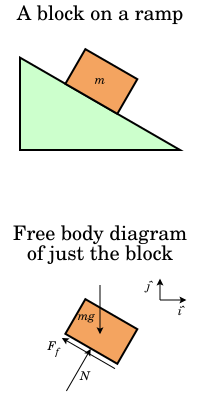
The purpose of the track was to elevate one side of the track to form a "triangle."  The diagram would appear to be similar in nature to a block of wood sliding down a slanted surface.  Additionally, if the relevant forces are outlined, the diagram taken from the "Wikipedia" page emerges:


Source: By Krishnavedala


By studying the above diagram, the forces are outlined.  In the past, "force" has been introduced in another blog post as the product of the mass of an object with the gravitational acceleration constant pushing the object toward Earth.  Therefore, the only new concept is the force of friction.  Friction is created all around us.  Stop reading this blog and rub your hands together.  Do they start to heat up?  That is due to the friction between the two surfaces of your hands.  Got it! Good.


With a magnetic levitating track, where is the friction?  The only source of friction (neglecting wind resistance) is due to the car (cardboard) rubbing up against the plastic rails on the track.  By changing the angle of the track relative the the ground and measuring the time of travel, the coefficient of friction is easily determined.  That was our challenge.


I say "our" because there was another gentlemen in the room assigned to the project.  He did not miss school like me.  In fact, he was a straight "A" student.  He had a name -- Gil Vitug.  We became and remain very good friends.  At the time, he was more attracted to the physics side of life.  Years later, we both graduated with our doctorate degrees (Ph.D.) from University of California at Riverside.  He was working in Astrophysics (working at the Stanford Linear Accelerator) while I was working on developing instrumentation for Nuclear Magnetic Resonance experiments.


From that experience, both of us learned the ability to extract a large amount of information from a low-cost setup.  Finding a way with limited funding to measure a quantity is extremely useful.  Especially, as science funding is becoming more difficult to receive.  That was a valuable experience and served as a springboard to which we became "science ambassadors."  Out of our school class, we were the two to work in academia.


After high school, I entered college and majored in chemistry with the intention of becoming a surgeon.  I wanted to end up in experimental medicine.  I even defined my own field -- experimental medicine.  Today, that desire would have translated to obtaining a "Md/Ph.D" degree and working in a government laboratory.  I had no clue at the time.  In fact, my father sat me down and had a talk with me during my junior year of college.  He suggested that I look into graduate school in chemistry rather than medicine based on my responses to his questions regarding experimental medicine.  I was at the time and remain extremely grateful for that discussion.


Why did I diverge onto that tangent?


Out of those experiences, came a love for chemistry.  The experiences were not traditional to me.  Late night discussions with my father over topics such as dropping a penny into a bottle of beer spurred my interests in thinking about chemistry.  I was not a good student in school.  I did show up every day to class.  And, I was able to entertain concepts in science reasonably well.  The concepts would be in my head.


What remained to be a delinquency was the patience to sit down and study along with explaining the concepts contained within my head.  The process of beginning to tackle that delinquency took up the better part of the next decade.  Although, with the help of certain individuals (like my father and Dr. Bath along with Gil -- now Dr. Vitug) and a military sergeant, the path was easier.  Each person challenges me to become a better person.  Furthermore, optimizing the shortcomings in my life has been a continuous challenge -- still to this day.  Let me explain briefly how.


Chemistry In The Military?


How can a soldier study chemistry in the military?  As I mentioned in a previous blog post, chemistry is all around us.  Everything involves chemistry!  What determines whether a soldier studies or utilizes chemistry is their job classification or rank.  If an enlisted soldier decides to become an officer, he/she returns to college and majors in science.  That could involve returning to a job in the military that involves directly performing research.


Although, the more probable situation would be to assigned a job where the requirements have no direct connection to chemistry.  Additionally, as an enlisted soldier, the job is most likely going to entail no direct connection to research in sciences.  That is reserved more for a position like an officer or a civilian employee.


I was assigned to work as an electrician on the fighter aircraft F-16.  That entailed working on the jet on the "flight line" along with working on the parts in a "back shop" setting.  What is the difference between the two: "flight line" and "back shop"?  Working on the "flight line" involves removing electrical components (generators, rheostats, controllers, batteries, chargers, etc.) and environmental components (bleed air valves, air condition controllers, water separation units, etc.) along with repairing the associated wiring and ducting to those components.


This is different from working in the "back shop" or the component repair shop.  The component repair shop is a The two types of work are very different but have the same mission.  The overall mission is to keep aircraft in the air.  With that being said, work that arrives in the "back shop" or component repair shop can be from any aircraft -- not just the F-16.  Since our base (Shaw AFB, South Carolina) was a predominantly F-16 air base, most of the components that we encountered to repair were from F-16 aircraft.


What does all this have to do with chemistry and being a chemistry ambassador?


When I first arrived at the base, my supervisor -- Master Sergeant Daniel Jonas asked me a series of questions.  These included if I had any college or university experience.  I answered yes -- I had 4 years in chemistry before dropping out.  He scolded me for dropping out and encouraged me to finish my degree in the military (and become an officer).  He also sent me to the "Middle East" 18 months out of the 24 months -- due to my popularity (hard work ethics).  Even though I did not get to go back to school while serving my country, I had the ability to demonstrate my knowledge of the field of chemistry by an assignment -- which was an interesting and unusual occurrence in the military.  Especially for an enlisted soldier in his/her first tour of duty.


Master Sergeant Daniel Jonas was a curious man.  In fact, he had an unquenchable thirst for information -- spanning all disciplines from economics through physical sciences.  He was a very interesting person to say the least.  I have often wondered how I happen to run across people in my life like him -- I am extremely fortunate.  My wife says, I attract these people -- who see my potential.  Maybe she is correct.


Anyways, Msgt. Jonas realized an issue with a battery and called on my chemistry skills to fix the problem.  Specifically, he was concerned about two aspects of recharging (or reconditioning) the F-16 battery.  First, the unusually large amount of waste generated in the process of charging the battery.  Second, the methodology of charging the battery which degraded the lifetime of the battery -- which was nominally around 3-5 years.  Let me explain the situation using science language.


Hazardous Waste Generation


The F-16 battery is a single unit (one case) that houses 24 cells that are linked together in "series."  A picture of the battery is shown below:


Source: Public Domain


With the diagram of each "cell" shown below:


Source: By Ransu, Public Domain


In order to understand the problems that Msgt. Jonas recognized, the chemical reactions of the discharging and charging cycle of the battery need to be known.  Shown below are the chemical reactions of the two cycles of the Nickel Cadmium battery taken from the patent webpage for the "battery charger":


Upon inspection of the chemical reactions, the hydroxide ions play a critical role in the discharge/charge cycle over the course of the life of the battery.  The electrolyte solution must contain a chemical that upon dissociation produces a hydroxide ion.  For the battery above, the chemical is a solution of potassium hydroxide in water.  This is important in recognizing the problem that needed to be fixed to extend out the life of the battery.


I was tasked to understand the charging/discharging cycle of the battery.  Furthermore, I was tasked with explaining the problem to the other members of the back shop working on the batteries.  Before I go into that, the charging cycle needs to be understood.  Looking at the "Wikipedia" page for the "Nickel-Cadmium Battery" the process proceeds like in the following manner:


Vented cell (wet cell, flooded cell) NiCd batteries are used when large capacities and high discharge rates are required. Traditional NiCd batteries are of the sealed type, which means that charge gas is normally recombined and they release no gas unless severely overcharged or a fault develops. Unlike typical NiCd cells, which are sealed, vented cells have a vent or low pressure release valve that releases any generated oxygen and hydrogen gases when overcharged or discharged rapidly. Since the battery is not a pressure vessel, it is safer, weighs less, and has a simpler and more economical structure. This also means the battery is not normally damaged by excessive rates of overcharge, discharge or even negative charge.
They are used in aviation, rail and mass transit, backup power for telecoms, engine starting for backup turbines etc. Using vented cell NiCd batteries results in reduction in size, weight and maintenance requirements over other types of batteries. Vented cell NiCd batteries have long lives (up to 20 years or more, depending on type) and operate at extreme temperatures (from −40 to 70 °C).
A steel battery box contains the cells connected in series to gain the desired voltage (1.2 V per cell nominal). Cells are usually made of a light and durable polyamide (nylon), with multiple nickel-cadmium plates welded together for each electrode inside. A separator or liner made of silicone rubber acts as an insulator and a gas barrier between the electrodes. Cells are flooded with an electrolyte of 30% aqueous solution of potassium hydroxide (KOH). The specific gravity of the electrolyte does not indicate if the battery is discharged or fully charged but changes mainly with evaporation of water. The top of the cell contains a space for excess electrolyte and a pressure release vent. Large nickel plated copper studs and thick interconnecting links assure minimum effective series resistance for the battery.
The venting of gases means that the battery is either being discharged at a high rate or recharged at a higher than nominal rate. This also means the electrolyte lost during venting must be periodically replaced through routine maintenance. Depending on the charge–discharge cycles and type of battery this can mean a maintenance period of anything from a few months to a year.
Vented cell voltage rises rapidly at the end of charge allowing for very simple charger circuitry to be used. Typically a battery is constant current charged at 1 CA rate until all the cells have reached at least 1.55 V. Another charge cycle follows at 0.1 CA rate, again until all cells have reached 1.55 V. The charge is finished with an equalizing or top-up charge, typically for not less than 4 hours at 0.1 CA rate. The purpose of the over-charge is to expel as much (if not all) of the gases collected on the electrodes, hydrogen on the negative and oxygen on the positive, and some of these gases recombine to form water which in turn will raise the electrolyte level to its highest level after which it is safe to adjust the electrolyte levels. During the over-charge or top-up charge, the cell voltages will go beyond 1.6 V and then slowly start to drop. No cell should rise above 1.71 V (dry cell) or drop below 1.55 V (gas barrier broken).


The take home point was that there was maintenance involved in the discharging/charging process over the course of the life of the battery.  My supervisor wondered why the life of the battery was no where near the length that was written by the factory.  This is where my job started -- since I had a chemistry background and interest in science.


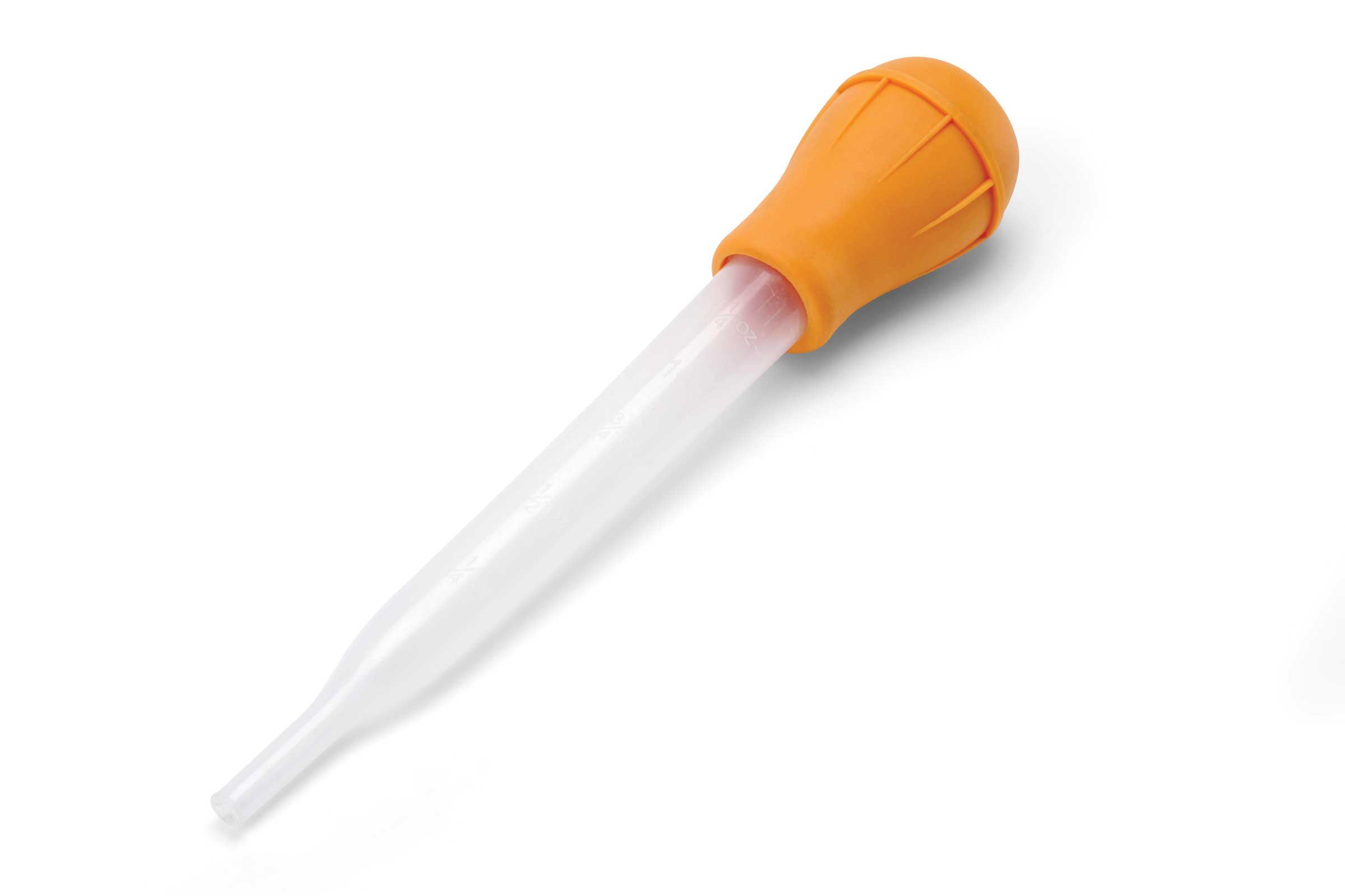
To accommodate the expansion of the volume of liquid during the charging cycle, each instrument had a "turkey baster" sitting next to it for the easy removal of excess water.  During the dynamic charging cycle, the cells would expand due to the hydrogen gas being liberated.  The caps would be loosened and set beside the battery.  Essentially, the battery sat on the table top hooked up the charger and "open" (vent caps removed) to the environment.  Unknown to us at the time, that is where the problems lay the entire time -- the open cells to the atmosphere.  Why?


Source: www.rd.com


There were a couple of issues with the charging/disharging cycles that I started to mention above which may be confusing.  After the charging cycle, the "electrolyte" level might need to be adjusted (meaning removal or addition of water with the "turkey baster" device shown above) as discussed in the excerpt above.


The problem with this is the removal of the following: 1) electrolyte mixture -- KOH and H20 (Potassium hydroxide and water), and 2) the electrode (which decomposed).  Collecting these two chemicals is and disposing them safely (not down the drain) is required.  This means that the solution of waste has to be kept in a "hazardous waste" container -- which is picked up each week by a disposal company.  Each weak, the shop would generate on the order of 55 gallons of "hazardous waste" -- mostly water, but a little bit of potassium hydroxide, electrode (cadmium, nickel, etc.).   As you might imagine, this was a huge motivation to determine how to extend the life of the battery.


During the addition of water or the extraction of the electrolyte after charging, the problem was that the internal concentrations of all components had changed.  If the "turkey baster" was used to pull out water/KOH and electrode material, the over the course of the lifecycle of the battery -- each time that the battery was sent to be conditioned in the "back shop" -- the battery would be degraded ever so slightly.  Adding this up over time, renders the battery unusable.


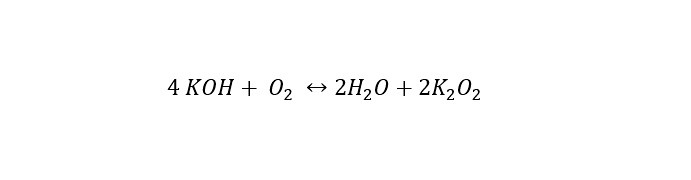
Couple this to the competing chemical reaction occurring with the air -- which is shown below:


This reaction was not known to occur at the time of our investigation.  If Msgt. Jonas had not been so persistent in understanding all chemical reactions within the F-16 battery, the situation (short lifetime of the battery) would have continued on for decades.  What did I learn out of this?  Does any of this make sense to you (the reader)?  I know that I have been rambling on for a while.


Conclusion....


The point I would like to make with this post is that a persons true passion becomes apparent eventually in one's life -- whether they pursue work within that passion or not.  For Master Sergeant Jonas, that passion is an unquenchable thirst for knowledge.  He is a power house of knowledge and commands those around him "in directly" to be thirsty as well.  Amazing.  I have always loved chemistry in one form or another.  Dr. Dan Barth has taught chemistry and physics for decades.  My father shares a passion for the physical sciences (as well as others too).  Put all of us in a room together or have us interact with each other, and these shared interests will become apparent soon.  Additionally, each one will show their specific talent or interests over time.


Regardless if a person pursues their interests or not, those interests will become apparent over time.  For me, hanging out in the chemistry and physics classroom benefitted me greatly -- since this experience was aligned with my interests.  I imagine that the school counselor who assigned me to the room instead of detention saw my interests shine through at some point in our interactions.


Similarly, when I arrived in the US Air Force at Shaw AFB -- I must have exuded the interests in sciences.  This later caused me to be chosen to interpret and explain the work of Master Sergeant Jonas and the extension of the F-16 battery.  What does this have to do with you?


If you are at a point in your life where you have no idea of where to go in moving forward, just keep moving forward.  Eventually, your interests will come to the surface.  But, you must be willing to listen to yourself and observe your interests.  I will you luck in your adventure pursuing your interests.  Have a great day.



Tuesday, April 19, 2016

Try Cooking Spaghetti Like A Chemist!

Whenever I go to parties or social occasions, I get asked about my profession.  People will often comment to me when they learn that I am a chemist that "they do not think that way....analytically, or in atoms, molecules, etc."(or "I was terrible at math").  Other times, the person will carry on with the large differences in thought patterns.  The mere fact that people feel compelled to convey this information is fascinating.  Have scientists made themselves look that different to the non-scientist?  Are we doing that bad of a job?


This is not to say that science is easy to grasp with concepts (like atoms, molecules, photons, cells, etc.) that are not immediately visible.  Remember that each scientist has to work at understanding concepts.  Nothing is for free!  Why do I bring this up?  As you will see in the paragraphs below, there exist many scales by which to understand the world around us.  Everyone at least should have the pleasure of understanding that the scales exist.  At least, that is the position that I choose to take.


Boiling Water - Simple Right?


The process of boiling water is pretty simple at first sight right?  Just add water to the sauce pan and set on the stove top -- apply heat.  Simple.  Oh, and wait until you hear the familiar sound of the water boiling or see the bubbles emanating (rising up) from the water toward the surface of the water in the sauce pan.


To most people, this is a process that is routine in order to start cooking a variety of meals.  Some people carry this task out without even thinking about what is actually happening inside the sauce pan.  But what if we wanted to think of the process in terms of a chemist analyzing the heating process of boiling inside the sauce pan.  First, a proper definition of boiling is needed.


Since we started off with a description of boiling water in a sauce pan (a picture that is commonly seen in the kitchen), the next level of detail (scientific description) might be shown from "Wikipedia."  Below is the opening paragraph for the entry of "Boiling" taken from "Wikipedia" and serves an intermediate description of the process of boiling water:


Boiling is the rapid vaporization of a liquid, which occurs when a liquid is heated to its boiling point, the temperature at which the vapor pressure of the liquid is equal to the pressure exerted on the liquid by the surrounding atmosphere. There are two main types of boiling; nucleate boiling where small bubbles of vapor form at discrete points, and critical heat flux boiling where the boiling surface is heated above a certain critical temperature and a film of vapor forms on the surface. Transition boiling is an intermediate, unstable form of boiling with elements of both types. The boiling point of water is 100 °C or 212 °F, but is lower with the decreased atmospheric pressure found at higher altitudes.


Why did I state that the above excerpt would serve as an intermediate description of the boiling process?


The reason is quite simple.  Because there exists no mention of the water molecules that make up the liquid that is being heated to the boiling point.  Additionally, at the boiling point as stated above, the pressure (vapor pressure) on the liquid by the atmosphere is equal to the pressure in the liquid.  Therefore, molecules are free to escape into the vapor form.  Of course, at this point, the number of molecules escaping depends on the concentration of the vapor.  There exists an equilibrium between the liquid and the vapor above the liquid.  Here is an excerpt to clarify the relationship between a liquid and the vapor pressure above the liquid taken from "Wikipedia" -- "Vapor Pressure":


Vapor pressure or equilibrium vapor pressure is defined as the pressure exerted by a vapor in thermodynamic equilibrium with its condensed phases (solid or liquid) at a given temperature in a closed system. The equilibrium vapor pressure is an indication of a liquid's evaporation rate. It relates to the tendency of particles to escape from the liquid (or a solid). A substance with a high vapor pressure at normal temperatures is often referred to as volatile. The pressure exhibited by vapor present above a liquid surface is known as vapor pressure. As the temperature of a liquid increases, the kinetic energy of its molecules also increases. As the kinetic energy of the molecules increases, the number of molecules transitioning into a vapor also increases, thereby increasing the vapor pressure.


And the corresponding diagram which I found extremely useful also taken from the "Wikipedia" page is shown below:


Source: By HellTchi


As you can easily see, that there exists an "equilibrium" of molecules (indicated by red dots) in the diagram above.  What does this mean?  Equal number of molecules are going into solution (into the liquid) as there are leaving the solution (liquid) -- hence the "equilibrium state."


Upon reaching the boiling temperature of a liquid in a sauce pan, the "equilibrium" can be shifted in a certain direction.  Meaning, more molecules can escape if the system is open.  In the above diagram which was taken from the website "Wikipedia" there is a box around the diagram -- which indicates that the above diagram is a "closed system" in equilibrium.


If the top of the container were opened to the atmosphere, then water molecules would escape.  If you have ever boiled water for a long duration of time without refilling the water, then eventually, the water in the sauce pan would disappear.  The heat is driving the equilibrium in addition to the fact that the vapor (gas above the water) is diffusing into other areas of the kitchen and house.  The water liquid in the sauce pan is trying to form an equilibrium with the entire atmosphere (the space of the house).  Wow!  Think about it.


How does a chemist think about boiling water then?


Now that the process of boiling water has been properly defined, lets look at an example of a chemist looking to "model" the process going on inside of the sauce pan.  I borrowed an excerpt from an article out of the website "R&DMag.com" titled "Researchers Study Three-Way Battles In The Quantum World."  Here is the excerpt below:


  When water in a pot is slowly heated to the boil, an exciting duel of energies takes place inside the liquid. On the one hand, there is the interaction energy that wants to keep the water molecules together because of their mutual attraction. On the other hand, however, the motional energy, which increases due to heating, tries to separate the molecules. Below the boiling point the interaction energy prevails, but as soon as the motional energy wins the water boils and turns into water vapor. This process is also known as a phase transition. In this scenario the interaction only involves water molecules that are in immediate proximity to one another.


Do you think about that while staring into a pot of water that is arriving at the boiling temperature?  The above excerpt was to prime the reader about the ongoing fascinating research by the Quantum Electronics group at ETH Zurich.  Specifically, using a laser beam the group managed to trap in a "lattice" a few rubidium atoms.  By controlling the frequency of the lasers, there was control (or a monitor) of the rubidium atoms that might enter and exit the "lattice."


Why was this important?  As mentioned in the pot of water example, the "long-range" interactions were previously thought not to contribute to the process of boiling.  Now, with refinements in both "modeling" and experimentation, the group was able to study the long range interactions.  The work is a good step in the right direction to studying unique properties of liquids in complex environments.


The significance is stated by the authors as follows:


  "Using this trick we now have three competing energy scales in our system: besides the motional and interaction energies there is, in addition, the energy associated with the long-range interaction", explains Landig. "By varying the motional energy and the long-range interaction energy, we are able to study a number of novel quantum phase transitions."


Having a better understanding of phase transitions will be critical in our ability to study certain scales.  What is meant by this?  Typically, we live on the "Classical https://en.wikipedia.org/wiki/Classical_physicsScale" -- the scale where we study objects like


Most people do not.


Adding Pasta To Boiling Water!


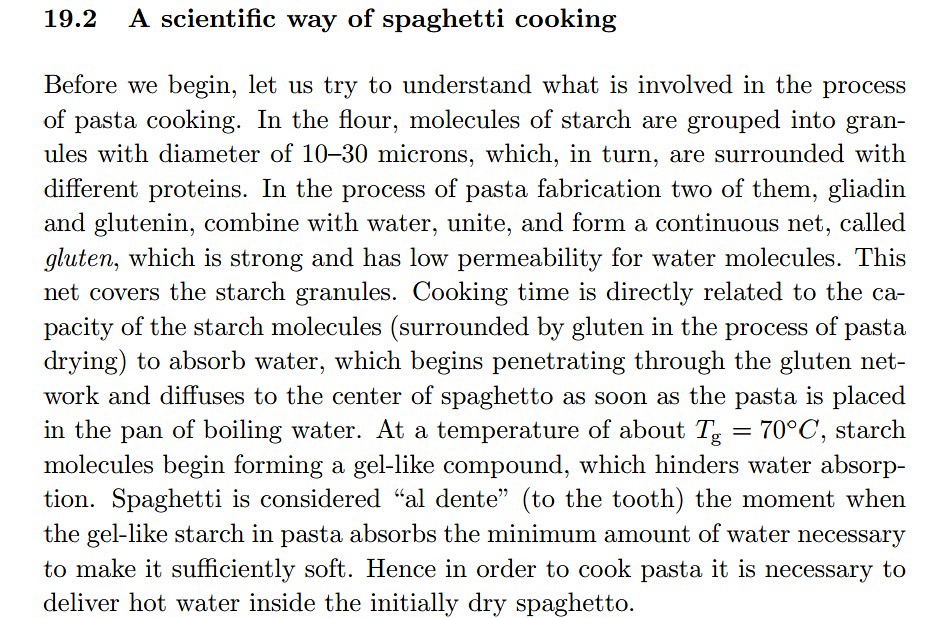
Now that you have had an introduction molecules and atoms -- so far as these concepts apply to the example above -- which was the boiling pot of water, lets make a complicated system into an even more complicated system.  I have yet to read the book titled "The Wonders Of Physics" by the author Dr. so and so.  I found a few excerpts which swayed me into purchasing the book.


Yes, I have a large amount of mental debt.  That is what I refer to as having too many books in the queue to read.  On my shelf at home along with books on another shelf at my office, there are two stacks of books -- that I am reading.  Yes, I can read multiple books at once.  No, I am not special.  My grandmother passed the ability to do so genetically -- I found out in my early 30's -- when I encountered her multiple stacks.  Anyways, here is an excerpt that has relevance to the discussion of cooking pasta that was taken from his book:


The authors take the science a step further than I had previously done with the above description taken from the article in laboratory magazine.  Well written and succinct to the level of detail with which can drive thought among a chemist about the various factors involved in the chemistry of cooking.  Of course, to a chemist, the process of cooking is traditionally reduced to a "reaction" which produces a "product."  The recipe dictates the conditions under which the "reaction" will take place to produce the desired "product" -- your meal.


Chances are the next time you eat a meal, you will have a thought regarding the chemistry behind the "reaction" needed to produce the meal.  If you choose to learn more about the topic, maybe in the future, you can switch professions and become a chemist working on the problem of pasta's for a company like "Kraft" that sells pasta products.  Chemists are needed to fill these positions.


Prior to reading this blog post, you might have just thought that non-chemists were the people responsible for coming up with the wonderful recipe that produces the meal that you desire.  The initial cooking recipe might have been started by a non-scientist.  But if a company produces the product and tries to optimize the product, chances are the there is a "food scientist" behind the process (Research & Design).  Food science is a huge field worth exploring.


Going back to the excerpt above, I am amazed at the level of detail at which "food scientists" work at.  Understanding the composition of pasta and the relevant parts that the components play during the cooking process (heating pasta in boiling water) is fascinating.  I cannot wait to read the book.  Maybe I will have to move that particular book to the top of the pile of "books to read."


Furthermore, I will have to investigate how the authors came up with the detailed explanation of the formation of "gluten" when heating the pasta.  Why is this important?  Currently, there is a large push in food industry to provide "gluten free" products.  I have been curious about this emerging trend.  Seems like the chance of not seeing a sign out in front of food vendors in Los Angeles labeled "Gluten Free" is near impossible.  I always wonder -- what does that mean?


According to the above excerpt, "glutenin" and "gliadin" along with water form a network (or net) that is termed "gluten."  Gluten is responsible for the rise and elasticity of the bread as indicated on the "Wikipedia" page for "gluten":


Gluten (from Latin gluten, "glue") is a mixture of proteins found in wheat and related grains, includingbarley, rye,[1] oat,[2] and all their species and hybrids (such as spelt,[3] kamut, and triticale[3][4]). Gluten giveselasticity to dough, helping it rise and keep its shape and often gives the final product a chewy texture.


The properties of proteins are responsible for incorporating these ingredients into food products such as breads, pastas, cereals, etc.  Chemistry is amazing.  If we want to further understand which ingredient is playing a certain role, scientists have uncovered that too with the following excerpts for "glutenin" and "gliadin" from their respective "Wikipedia" pages:


"Glutenin":


Glutenin (a type of glutelin) is the major protein within wheat flour, making up 47% of the total protein content. The glutenins are protein aggregates of high-molecular-mass (HMW) and low-molecular-mass (LMW) subunits with molar masses from about 200,000 to a few million, which are stabilized by intermolecular disulfide bonds, hydrophobic interactions and other forces. Glutenin is responsible for the strength and elasticity of dough.[1]


And, next is "Gliadin":


Gliadin is a class of proteins present in wheat and several other cereals within the grass genus Triticum. Gliadins, which are a component of gluten, are essential for giving bread the ability to rise properly during baking. Gliadins and glutenins are the two main components of the gluten fraction of the wheat seed. This gluten is found in products such as wheat flour. Gluten is split about evenly between the gliadins and glutenins, although there are variations found in different sources.


Imagine the research that went into investigating that out of the many different proteins in wheat along with other cereals, the research narrowed down to two proteins: glutenin and gliadin.  I wonder what the spectroscopic signatures of these two proteins are?  How was the research carried out to narrow down to these two proteins?  How were the proteins characterized?  That is another topic for another blog.


Where do we go from here with this blog post?


How About A Conclusion?


Lets recap on the underlying message so far in the blog post.  First, simple processes like cooking can be extremely complicated depending on the scale of viewing.  With respect to the problem of cooking pasta the following has been shown.  If you are considering the macroscopic scale, then you might be concerned with consistency or smoothness, or softness of the pasta along with the temperature at which you are cooking the pasta.  Furthermore, if you are cooking the pasta at different altitudes or environments, the recipe might change.  What about if you are looking at the process from the eyes of a chemist or food scientist?


If you are viewing the problem (cooking pasta in boiling water) as a chemist, there are different scales at which to think about the problem.  On the microscale or even nanoscale, you have these molecular systems in a complex environment.  Establishing a vapor equilibrium with the environment above the liquid.  If that environment is closed (e.g. having a saucepan with a lid on it), then refilling the water might not be necessary.  The liquid will establish an "equilibrium" with the "headspace" of vapor above the liquid.  There might be visible water droplets on the lid of the saucepan -- which after growing to a certain size will be overcome by the force of gravity and drop back into the boiling water.  At that point more water molecules will escape into the "headspace" between the liquid and the lid to establish an "equilibrium" state at that temperature and pressure.


What about an open sauce pan of boiling water?


Upon boiling, the system which is made up of gas and liquid will still try to establish an "equilibrium" with itself.  The problem is that the system is open.  Which means that the liquid in the pan will establish an "equilibrium" with the entire house -- as the water vapor diffuses throughout the rooms of the house.  Diffusion occurs due to having a high concentration of water vapor in a small area and a lower concentration throughout the house.  There is something to think about -- that will occupy your mind for a while.


Thinking like a scientist is not a decision -- once you have been exposed to the concepts.  You might be able to get away with ignoring the concepts when viewing the environment around you for a short time.  Why would you want to do that?  Do the concepts above give you a headache?  No worries if they do.  Understanding the concepts behind science take time.  That is why education is a life long learning process.  As highlighted above, every day, new ideas and concepts about the world are emerging and in every greater detail.  Again, this is why learning science should be fun and entertaining and also a life long pursuit.  I hope that you never look at a boiling pot of water the same way ever again.  Until next time, enjoy the day!