Showing posts with label Health. Show all posts

Monday, March 4, 2019

Have You Ever Heard A Song About Personalized Medicine? Here Is A Scientist Singing A Song.


Source: Uniavisen


Just coming off of the holidays over two months ago, the image above is still fresh in our minds.  Of course, the next major holiday is probably not winter but sunshine -- Summer.  The thoughts of beaches and sun blazing down on the water while surfing, swimming, or just straight chillin' on the beach.  My point is that when I mention a scientist singing a song, the above picture is a common place to project that image.  But what about in a rock band?  Or a music band in general?  Not common right?  Wrong.


You would be surprised at the amount of scientists who also are associated with a musical instrument or an art project/hobby.  Scientists are notorious for engaging in artistry of some sorts -- whether that be from playing in a band or painting a picture to designing the next generation of skin care make up.  Art plays a prominent (although scientists may not like to admit this fact) role in science.


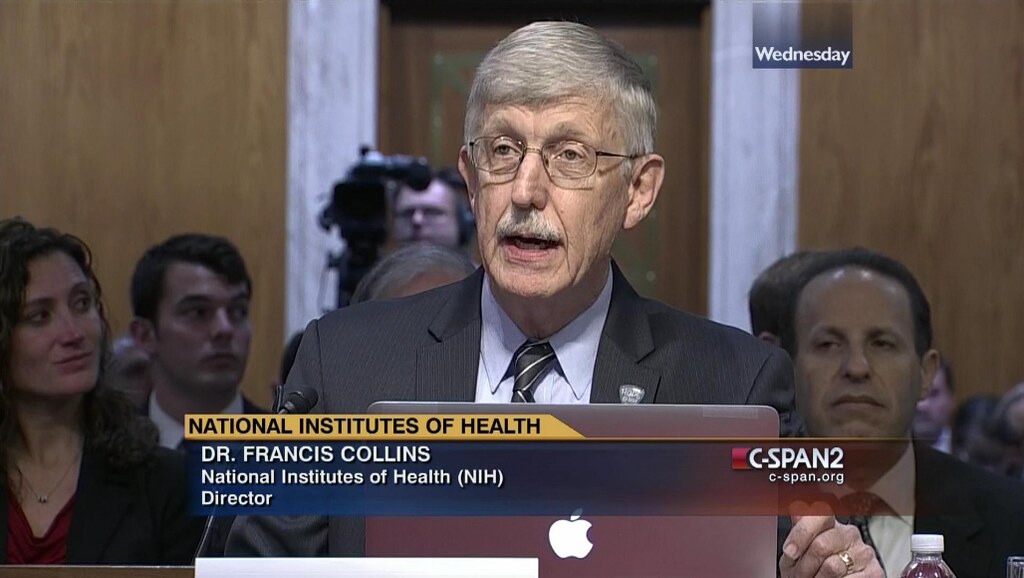
With all of this being said, the Director of the National Institutes of Health recently was interviewed in an article titled "For Scientists About to Rock (We Salute You)" to discuss his next love to science -- which is making music:


Science and music are closely connected. Says Dr. Francis Collins, director of the National Institutes of Health (NIH): “Whether you’re working with another person or a whole team of people who have different skills, different dreams and different aspirations and you put them together, you create something magical. Science does that and so does music.”
Collins, a physician-geneticist, is noted for his landmark discoveries of disease genes and his leadership of the international Human Genome Project, which culminated in April 2003 with the completion of a finished sequence of the human DNA instruction book. He served as director of the National Human Genome Research Institute at the NIH from 1993 to 2008. He was appointed the 16th NIH director by President Barack Obama and was confirmed by the Senate in 2009.
When Collins came to the NIH, he was concerned that his passion for music would take a backseat to science. He soon learned about The Directors, a band consisting of former NIH senior staff. The name changed to the Affordable Rock ‘n’ Roll Act (ARRA) and everyone at the NIH is welcome to join.
The name’s not political. It stems from being affordable, “since we don’t get paid for performing,” Collins said.


To read the remainder of the article - click here.  Dr. Francis Collins is a multifaceted kind of man.  He is engaged in all sorts of activities ranging from playing in music bands to practicing christianity.  Yes, Dr. Collins is a christian. This comes as a great surprise to most scientists who meet or interact with Dr. Collins.  Typically, the thought is at odds with conventional science, but Dr. Collins states not so obvious.


The spectrum of scientists is wide and all encompassing.  In fact, there are more religious people than the non-scientist might expect in science.  Although, most do not speak out in favor of religion for fear of professional disqualification.  Yes, that would be highly illegal, but the reality is that is the truth.  Great scientists such as Dr. Collins manage to live in both realms without any difficulty or controversy.  Anyone can view Dr. Collins 'CV' -- Curriculum Vitae here.


Back to his true passion of singing.  Below is a song written by Dr. Francis Collins about 'Personalized Medicine':


For those who do not have the bandwidth to listen to the song, I show the transcript below for you to read:

00:05 I put these here just in case well Susan
00:13 can be blamed for this because she
00:17 suggested that you all were of the sort
00:19 that might actually adjust to a little
00:22 bit of foolish singing at the end and
00:24 that's the only kind of singing I do so
00:27 so uh this is a song about the future
00:31 personalized medicine remember I said
00:37 that thousand dollar genome is coming
00:39 pretty soon and that means each of you
00:42 each of you will have the chance maybe
00:44 in the next five or six years to have
00:46 your entire genome read out all six
00:49 billion of those letters of your DNA
00:51 code and then you'll have to figure out
00:54 what it means and that's a bit of a
00:57 challenge a few people have already gone
00:59 through this experience and they've been
01:01 a little flummoxed
01:02 trying to make sense of the data well we
01:05 will all be so this is a song that you
01:08 could imagine yourself having just
01:10 received your genome basically you're
01:14 sitting in front of your computer you're
01:16 sort of scrolling through the pages and
01:19 what do you see a lot of AC GMT in
01:23 various orders and trying to figure out
01:25 exactly what does this mean so this is
01:29 your song and I need a little help on
01:31 one part of this song because it goes up
01:35 to a high C sharp that's a little
01:38 outside my normal range you will you
01:41 will feel it coming and and you will
01:45 help me I sure hope anyway you'll know
01:48 what you have to do
01:50 so here's the song of looking at your
01:52 genome as I walk along the pages in all
02:00 six billion places upon my computer
02:05 screen am I built for strong endurance
02:13 or loss of life insurance am i a mere
02:19 machine
02:23 I'm a walking through the genes don't
02:27 know what all this means
02:30 again the meeting be behind that gmt and
02:36 i want to help me out
02:42 why why why why why you've got an a I've
02:48 got a see there what does that say
02:54 amazing DNA at EDD
03:11 so I'm glad to know I've got some of
03:15 what Crick and Watson found and brought
03:20 them say use your own imagination
03:28 despite variation we're really much the
03:33 same
03:34 I will walk in through the genes don't
03:40 know what all this means
03:42 Oh what can the meaning be behind that
03:47 G&T; I wonder why why why why why why
03:58 you've got a G I've got a see there what
04:03 does that say
04:06 amazing DNA a dee dee dee dee da dee dee
04:12 DNA a DDD DNA
04:37 you


Wow!  As I just stated, the spectrum of scientists is wide and all encompassing.  All types of people in life do science.  In addition, all types of people make up scientists.  If you take a look at Dr. Collins long and successful career, you will notice the extent (a large amount) he has pushed the edge of research.  Currently, he is the director of the National Institutes of Health.


The song above is about a current enormous project called "All of Us" by the National Institutes of Health.  A few months ago, I wrote a blog post about the unveiling of the enormous program which aims to push the medical field toward precision medicine.  Precision medicine stands to hone in on individual treatments by teasing out individual differences in treatment/diagnosis, disease pathology.  Why do people have different forms of cancer?  What is attributed to these differences in medical diagnosis?  What is the difference between two patients with a seemingly similar form of cancer?  Is the cancer the same or different?  How do the treatment of both patients differ?


Medicine is moving along a trajectory which is exciting and will reveal new medicine in the future.  We need as many different types of people engaging in science, technology, engineering, and mathematics (STEM) fields to help further science.  On the patient side, the "All of Us" trial needs as many volunteers as possible to expand the diversity in disease treatment and diagnosis.  This will require different people (ethnic, gender, cultural, etc.) participating as volunteers along with a highly diverse group of scientists processing the trial and gathering the data.  This is a time of celebrating the differences among us, not just as scientists but as human beings.  


Related Blog Posts:


Tuesday, February 12, 2019

John Dingell: Longest Serving Senator, Environmentalist and Avid Climate Change Supporter Dies At 92


Imagine that you just joined congress, the year is 1955.  The nation just experienced a landmark court case 'Brown v. Board of Education' -- 'separate but equal'.  Could you predict that over the next 59 years of your service on the nation's capital, you will experience the following events: the creation of the environmental movement, the civil rights movement, the very contested court case 'Roe v. Wade' (abortion rights), destruction of the Berlin Wall, the rise of digital technology, and finally, a bipartisan public acceptance that climate change is not just real but is man-made -- WOW.


Who is John Dingell -- Briefly?


Over the past few days, there have been historical accounts all over the internet describing Senator John Dingell.  One article of interest with a brief but concise historical account of John Dingell recently appeared in 'Politico' titled "You’re Living in the America John Dingell Made" -- which accurately reflects the contributions made to the nation on behalf of the 'Junkyard Dog of Congress' ( a moniker attributed to him by the 'Detroit Free Press').  His love of the nation was unparalleled and reflective in his 59 years of service in congress.   There are two paragraphs out of the article which is worth reading but highlight the enormity of his contributions to the nation:


Modern America is as much a creation of John Dingell’s life work as anyone’s. If you or a parent or grandparent have relied on Medicare or Medicaid; if you’ve seethed about the lack of gun control; if you’ve cheered that segregation of public places is illegal and employment discrimination is banned; if you’re thankful for the continued existence of the U.S. auto industry; if you’ve raged about gas-guzzling cars contributing to climate change; if your health insurance is purchased on the Obamacare exchanges; if you’ve swum in lakes or rivers or oceans free from toxic pollution; if you’ve drunk a glass of or bathed your children in tap water with confidence that it’s free from contamination; then John Dingell played a role in your life.


Then followed later in the article by the second shown below:


 Among the legislation he authored or led the charge in passing: the Clean Water Act of 1972, the Endangered Species Act of 1973, the Water Quality Act of 1965 and the Clean Air Act of 1990. He worked to pass the Civil Rights Act of 1964, which resulted in a bruising primary fight and the burning of a cross on Dingell’s lawn for the second time in his life (his father had been an anti-Klan activist, and even as an old man, John Jr. remembered being 5 or 6 years old and looking out the front window of his family’s home to see a flaming cross). “Of all the bills I’ve played a part in helping pass into law,” he wrote in his 2018 memoir, The Dean, “that remains the one I’m most proud of.”


The reason why I chose the two paragraphs above were to show the inevitable touch of John Dingell in all of our lives (to some degree) along with his remarkable care for the environment.  As stated, he authored or played a pivotal role in passing the following environmental acts: (1) Clean Water Act of 1972, (2) the Endangered Species Act of 1983, (3) the Water Quality Act of 1965, and the Clean Air Act of 1990.


I was struck to see the legislation (issues) for which he has been fighting for are still in contention to this day.  Modest improvements have been made, but there has been a large struggle for change over the past few decades with regard to saving the environment and the planet for that matter.  He has not always sided with environmentalists either.  Although, in sum total, he has fought vigorously for the environment.  Currently, we are at a cross section where change toward reducing our dependence on fossil fuels while increasing our usage of renewable energy sources is front and center stage.


Green New Deal?


Recently, a new resolution titled "Green New Deal" has been circulating in congress over the last week.  First, the "Green New Deal" is arriving in congress at an unprecedented time in history.  Although, the rise of environmental policy has been emerging over decades in congress with Senator John Dingell pushing forward the addition of new regulations to move the needle of progress a tiny bit further.  Currently, we are living in an unprecedented time in history.  I will come back to this fact shortly, but let's return to the initial reaction of the unveiling of the "Green New Deal."


So far -- Bipartisan (mostly Republican) comments on the "Green New Deal" would have the public think that the world is going to down hill toward destruction in a short amount of time due to the ambiguous wording in the resolution.  Although, the authors Senator Alexamdria Ocasio-Cortez and Senator Ed Markey state that there is bipartisan support for such a deal -- large bipartisan support for a climate deal.  Of course, President Trump is using the "Green New Deal" as a platform issue on which to scare people into thinking the following misconceptions:


"I really don't like their policy of taking away your car, of taking away your airplane rights, of 'let's hop a train to California,' of you're not allowed to own cows anymore!" Trump said at a large rally Monday night in El Paso, Texas.
"It would shut down American energy, which I don't think the people in Texas are going to be happy with," Trump said elsewhere in the speech, eliciting cheers from the audience of more than 5,000. "It would shut down a little thing called air travel. How do you take a train to Europe?"
Trump appears to have seized on a line from an informal page of FAQs about the Green New Deal, released last week by Ocasio-Cortez, one of the resolution's co-sponsors, which specifically referred to cows and airplanes.


The blowback and support for the 'Green New Deal' is reported by Politico Energy' as follows:


A GREEN NEW DAY: The Green New Deal resolution sets out aggressive goals to achieve net-zero greenhouse-gas emissions in a decade, as well as a broad set of other transformative economic changes. Michael Grunwald makes the case that even though enacting would be impossible, the resolution still has two useful purposes for Democrats.
"It's primarily a political manifesto, a messaging device designed to commit the Democratic Party to treating the climate crisis like a real crisis, pressuring its presidential candidates to support radical transformation of the fossil-fueled economy," he writes. "At the same time, the Green New Deal is a policy proposal — or at least a sketch of one, a way to launch a substantive debate over how Democrats will attack the crisis if they do regain the White House." Read more.
THE NEXT STEPS are now in the hands of House Democrats, who only this week began to reckon with climate change at the committee level. Most House Democrats were quick to laud the goals of the resolution, but soon split on whether they'd formally back the measure, as Pro's Eric Wolff, Anthony Adragna and Zack Colman report.
Enter the select panel on climate change: Members of the new House Select Committee on the Climate Crisis say they're aiming to use the resolution as a template — even though the panel doesn't have the power to move legislation. Still, they plan to build public support for aggressive policies, as Anthony reports for Pros.
"What I hope this committee does is develop a very ambitious and very comprehensive road map to decarbonize our economy," said Rep. Jared Huffman, a panel member and Green New Deal co-sponsor.


I show the above excerpts not to lead the reader into a debate over the specific wording of the "Green New Deal" or the way out of 'climate crisis' over the next few decades.  What I am here to show that the fact that there is a "Green New Deal" being discussed in congress at the moment is a testament toward the current status of the nation with regard to climate change.  There is a bipartisan support -- finally -- for change toward a renewable future.  Further, there are public statements emerging from Republicans about the need to move toward combating climate change (along with an admission that climate change is caused by man).  WOW.


Last week, there were three different hearings in congress over the need to take action to combat climate change.  This is unprecedented for both parties to admit publicly that climate change is man made and needs to be dealt with immediately.  Of course, no one needs to show the obvious evidence on display around the world: increased frequency of storms, fires, population extinction, landmass destruction for agriculture, etc. -- to name a few.


The fact that there were three landmark hearings last week (and one this week), is a sign that many are stepping up and voicing their support toward a renewable (sustainable) energy future.   The actual plan may change, but the direction toward a more sustainable future is inevitable and has gained a large amount of support across congress - which is greatly encouraging.


The first occurred on Tuesday morning in the House Committee on Energy and Commerce titled "TIME FOR ACTION: ADDRESSING THE ENVIRONMENTAL AND ECONOMIC EFFECTS OF CLIMATE CHANGE."  For those interested in watching the 3 and a half hour hearing, the video is below:


If you do not listen to any appreciable length of the above testimony, be sure to listen to the opening statements from both democrats and republicans -- which are extremely encouraging.  Climate change impacts everyone.  The time has come to take action.


The second hearing was held by the Natural Resources Committee titled "Climate Change: Impacts and the Need to Act" is shown below:


Again, the opening statements were encouraging regarding the need to act immediately along with the bipartisan support.


The third hearing has been rescheduled for this week (Feb 13th).  The House, Science, Space, and Technology Committee is holding a hearing titled "The State of Climate Science and Why it Matters."  Bipartisan effort shows that finally action is being taken.  Not only taken, but taken seriously and publicly announcing the need to take such action seriously -- which is a marked improvement over the last few decades.


Which brings us to the end and final note.  Senator John Dingell lived until the ripe age of 92.  As stated above, his life was full of great adventure and change.  Congressional change which will has helped and will shape our society for decades to come.  Environmentalists such as Senator Dingell have paved the way forward by laying the difficult initial ground.  Just because there is opposition, the following shows that we (as in the U.S.) is late to the game and implementing action:


JOHN DINGELL DIES AT 92: Former Democratic Rep. John D. Dingell Jr., the longest-serving member of Congress whose tenure stretched from Dwight Eisenhower to Barack Obama, died on Thursday at 92. ME offers condolences to his family, and is reminded of the prescience of his take on how the fight over climate change would unfold.
He warned in 2008 that Congress needed to act on climate change because combating it under the Clean Air Act could be a "glorious mess." (Pros will recall ex-EPA chief Scott Pruitt frequently cited that phrase to help justify his deregulatory agenda.) "It seems to me to be insane that we would be talking about leaving this kind of judgment, which everybody tells us has to be addressed with great immediacy, to a long and complex process of regulatory action, litigation upon litigation, and a lack of any kind of speedy resolution to the concerns we have about the issue of global warming," he said at a hearing that year.
His prognostication proved correct. When cap-and-trade failed to pass Congress, the Obama administration turned to existing CAA authorities to target greenhouse gases. Now — 11 years after he said EPA would be "tarred and feathered" if it tried to tackle climate change on its own — Obama's landmark carbon rules for power plants and autos have been blocked in the courts and are being rolled back by the Trump administration. "Structuring a comprehensive climate change program is a responsibility for the Congress," Dingell said in 2008. He died just hours after congressional Democrats unveiled their Green New Deal.


As I have written before on these pages, change is inevitable considering the forward momentum of the international governments.  The investment capital is present and growing to match the need.  The workforce is present to match the need.  Elevating skilled labor to match the renewable energy sector demand will enable previously back breaking jobs to be changed out with new jobs -- jobs which match the changing technology landscape of the future.  As automation plays a greater role in our society, the skilled labor can continue to educate to do more complicated jobs.  Jobs such as monitoring and troubleshooting robotic teams - as Amazon does currently.


Regardless, the need for new jobs is present and will be matched by the growing demand of the renewable energy sector.  The total overhaul of infrasture in our nation (existing buildings, landscapes, etc.) will require large amounts of labor.  Senator John Dingell has laid down to rest in peace.  Ironically, he did so after learning that his job here on Earth had been accomplished with a bipartisan deal -- "Green New Deal" being unveiled.  He will not be forgotten as his work will play a more vital role as the world moves toward a more sustainable and healthy environment for all humans to live.  Thank you Senator John Dingell.


Related Blog Posts:


EPA Administrator Nominee Andrew Wheeler's Opening Statement - Confirmation Hearing!


Over 600 Environmental Groups write letter to Congress to phase out fossil fuels


Senator Carper Blasts Environmental Protection Agency For Considering Relaxing 'Mercury and Air Toxics Standard'?


What does a Government Shutdown look like?


What is the difference between General Anxiety Disorder and Trump Anxiety Disorder?


Congress Gets Involved In Beef Recall


How Effective Are Poultry Corporations At Reducing Salmonella In Their Products?


NIDA Director Nora Volkow: How Health Communicators and Journalists Can Help Replace Stigma with Science


Governor Jerry Brown Leads The U.S. With Ambitious Calls For 100% Renewable By 2045 -- Wow!!!


Thoughts: An example letter of opposition to repealing the 2015 Clean Waters Rule


EPA Estimates Of Methane - GHG - are off by 60%


Chemical Safety Board's Future Uncertain as Hurricane Season Approaches


Update: Congress asks Federal Agencies about Dangerous Chemicals -- PFOA and PFOS


Congress Asks Defense Department and Environmental Protection Agency about Dangerous Chemicals


President Trump Just Allowed Greater Environmental Risk To Children's Health


Thoughts: Senator Bernie Sanders Asks Public To Get Involved In The Public Process At Any Level


Do You Need Clean Air To Breathe? An Introduction To Environmental Justice


French President Macron Organizes Climate Conference With Pledges Of Trillions Of Dollars For Climate Risk Management From World Organizations


Coal Magnate Murray Shames Fossil Fuel Industry For Being "Forward Thinkers" For Energy


Democrats Question EPA Adminstrator Scott Pruitt On Historical Job Cuts At EPA


There Is No Climate Debate -- Scientific Facts Have Settled The Issue?


Sunday, November 11, 2018

What is the next big step in Mental Health Research?


Today is Veterans Day and I would like to reach out to all of my brothers and sisters who have donned a U.S. Military uniform and SERVED OUR COUNTRY to say a Big THANK YOU FOR YOUR SERVICE.  Your service does not go unnoticed in the Kaiser family household and is greatly appreciated.  The opportunity to wear a U.S. Military uniform and serve our country is not afforded to each resident of the United States.  I have had the opportunity and respect every other person who has had the chance to as well.  Unfortunately, each of us have varied experiences during our time in the service.  There are those who serve and leave the service to lead a somewhat normal life with memories which are unshakable.  While there are others who leave the service is an unfortunate state of mind -- which is tragic and needs to be dealt with -- especially given the sacrifice to our country offered by soldiers. No one gets out for free without memories of their service.


Last week on Wednesday night in Thousand Oaks (California), a 28 year old veteran entered a bar named "...." and released terror by shooting up the place to leave 11 killed and untold number of people with mental scars with which they will live for years to come.  How did this happen?  Why did this happen?  Especially, as early reports suggest that Ian David Long was visited by law enforcement earlier (in April) in 2018 which included a deployment of mental health services to clear him (as no current threat).


Now 13 people are dead and the rest of us are wondering what is going on in the world?  The shooter was a student at California State University at Northridge (up to 2016) -- which directly impacts myself and others who are employed here.  Released the next day was a press release from the National Institute of Mental Health titled "NIMH Explores the “Next Big Thing” in Mental Health Services Research" with the following updates on Mental Health Research from a conference held earlier in the year (in August).  With the tragedy that just unfolded, what is the "next big thing" which will address/mitigate these terrible occurrences from recurring.  According the the NIMH, a whole range of issues confront the Mental Health Research system which mainly stem around patient treatment:


NIMH Explores the “Next Big Thing” in Mental Health Services Research
November 8, 2018 • Institute Update
What’s the “next big thing” that could help people with mental illnesses get the treatment and services they need? This important question was the theme of the National Institute of Mental Health (NIMH)’s 24th biennial Mental Health Services Research (MHSR 2018) conference held August 1-2, in Rockville, MD.
“This conference brings together mental health researchers and other experts, trainees, consumers, advocates, and mental health care providers to learn about current research findings and discuss new research that might close the gap between what science shows is most effective and what services people actually receive in real-world settings,” explained Michael Freed, Ph.D., EMT-B., a conference co-chair. “We are thrilled that this year the conference had more presentation proposals, more sessions, and more attendees than ever before. There is clearly a lot of interest in this research.”
Health services research is a multidisciplinary scientific field that examines how to improve people’s access to health care providers and services; how to improve the quality, continuity, and equity of the care they receive; how to most efficiently pay for needed health care; and ultimately, how to improve the symptoms and functioning of people with health conditions. The research considers individual and provider preferences and behavior, innovations in technology, and community, organizational, and systems-level factors to understand how to implement effective practices in care-delivery settings.
In his opening address, Dr. Freed acknowledged the participants’ passion and ongoing contributions to mental health services research and challenged them to use the meeting to generate new research ideas. In a pre-recorded welcoming address, NIMH Director Joshua Gordon, M.D., Ph.D., noted that, “Research doesn’t stop with the discovery of a new treatment, because even the best treatment won’t work if people can’t or won’t use it. We also need research to figure out how best to deliver effective therapies and services to those who need it now.”
The wide range of conference topics reflected the realities of mental health delivery today. Judge Steve Leifman, J.D., Administrative Judge for the Eleventh Circuit Court of Florida, delivered a compelling keynote address, noting that people with mental illnesses are more likely to be in jail—where mental health treatment is typically not available—than in a mental health facility. The key to addressing this problem is to make mental health care more easily available to those who have difficulty obtaining it, and he described his long-time efforts to do just that. Judge Leifman’s advocacy work in Miami-Dade County created an opportunity for the criminal justice system there to divert low-level offenders with mental illnesses to treatment and social services rather than to incarceration. The goal is to reduce psychiatric symptoms in order to break the cycle of repeat arrests and to provide services that lead to community reintegration and stability. This approach has significantly decreased the number of arrests and repeat incarcerations of people with mental illnesses, as well as the overall jail population in the county.
Jürgen Unützer, M.D., M.P.A., M.A., professor and chair of the Department of Psychiatry and Behavioral Health at the University of Washington, delivered the inaugural Wayne Katon Memorial Lecture.Dr. Katon was an accomplished mental health services researcher, teacher, and mentor whose research established the collaborative care approach as an effective intervention in psychiatry).
In his address, Dr. Unützer described the robust body of research supporting the effectiveness of collaborative care, in which primary care physicians actively collaborate with mental health care managers and psychiatric treatment specialists to provide comprehensive patient care. With provider training, he explained, treatment for less severe mental health concerns can be delivered in the primary care setting while patients needing more intensive treatment can be referred to contacts working in mental health specialty settings. He discussed how this approach could address provider shortages and reduce the long wait-times often faced by people seeking mental health care. Dr. Unützer also reviewed the possible—but addressable—challenges to wide-spread adoption of collaborative care and underscored the approach’s potential for broadly improving mental health treatment outcomes.
Two plenary sessions of the conference were directly focused on this year’s theme—what are our visions of “The Next Big Thing” in mental health services and research. Talks in these sessions focused on a wide range of topics including how electronic health records and health information exchanges can be used advantageously in both research and care delivery; research and practice considerations in the use of telehealth platforms; the promise of practice-based research networks; and, the use of learning health networks for improving services for those with severe mental illnesses.
As in prior years, the conference also provided career development opportunities for a competitively selected group of Early Stage Investigators (ESIs). Thirty ESIs presented posters at the main conference and attended a post-conference New Investigators Workshop. During the workshop, experts from NIMH and academia gave presentations on developing a career in mental health services research and on navigating the process of NIMH grant submissions. ESIs also met with these experts to receive feedback to refine their ideas for future grant applications.
“Thanks to the presenters and attendees, the meeting exceeded our expectations in exploring ideas for new research directions,” stated Denise Juliano-Bult, M.S.W., a meeting co-chair. “The quality of the presentations and panels was outstanding, and it was not only the biggest conference to date but included some of the most visionary sessions we’ve heard. Ultimately, we hope that MHSR 2018 will enable the synthesis of ideas from a broad range of perspectives that can inform the development of future NIMH services research priorities.”
The meeting agenda with links to the video recordings of the presentations are available on the NIMH website.


With the above press release being stated, hopefully the result will be mental health services which are offered to more people and effective.  There are too many people who are suffering from mental illness in the United States -- who go untreated.  Additionally, there is such a large change needed across the entire nation that a solution seems out of sight.  Although, if each local government tries to make changes which are accessible, then large scale changes across the nation will be noticeable. 


Conclusion...


Mental illnesses impact each of us either directly or indirectly.  If you know of someone in need of mental health services, please don't hesitate to contact the right services to help them.  Each of have a responsibility to say something if a danger is present.  Furthermore, each of us can contribute to society to urge elected leaders to take action and find a solution -- i.e. direct money toward services along with other accessible solutions -- policy making, community discussions, outreach to other government officials.  All of these combined actions will hopefully result in a more efficient and effective system which provides treatment to all of those in need.


Related Blog Posts:


Science Topics, Thoughts, and Parameters Regarding Science, Politics, And The Environment!


Wednesday, July 4, 2018

Bacteria communicating in communities -- quorum sensing


If you have ever had to clean the drain in your sink or the film of dirt off of the shower wall, chances are that a bacteria colony did reside there at one time. You know what I am talking about...That build up of film on your shower door/wall which progressively gets more opaque and changes color if left untouched by a sponge with cleaner.  Bacteria colonies arise all over the place.  How do bacteria colonies grow?  How do individual bacteria in colonies communicate with each other?  Scientists have made progress into unveiling the details below.


In the video shown below -- which is 10 seconds in length, the growth of bacteria is shown along with the immediate conversations between them in a community setting:


Scientists have often wondered how bacteria communicate when in a colony setting.  This step represents an advance in the detection of communication.  A step in the right direction to say the least.  Exciting as the results may be, the researchers now have their hands full in pushing the project further.


Related Blog Posts:


What Is Going On Inside That Cell?


Chemistry Reactions Are Amazing - See For Yourself


Thoughts: How Did People Talk In 1929?


Parameters: 3D Printed Human Hearts?


Parameters: Can Computers Think?


How Do LED Christmas Lights Work?


Chemistry Videos Unveil Problems With Battery Technology


A Virtual Tour Of A Plant Cell? Really?


A Virtual Tour Of A Human Cell?


Chemists Learn To Build Up Nanoparticles -- One Atom At A Time!


World Health Organization Suggests More Funding For Antibiotic Resistance Research


Should Pollution Concern Us?


New Chemistry Shows Promise In Preventing Fires In Lithium Ion Batteries!!!


Tuesday, June 5, 2018

Scientists compare Misinformation In Mainstream News to a Viral Infection

Source: Wikipedia


We are inundated with a variety of news from a large amount of sources everyday.  How do we make use of such information?  How do we verify the deluge of information?  In keeping with the tradition of educating the public on how scientists view various events portrayed in the media along with life in general (i.e. how do scientists think), a new piece of useful information has surfaced for readers to mull over.  Scientists compare the misinformation in the news cycle to a viral infection.


In a past issue (December of 2017) of 'Science' magazine the following "letters" were sent into the Journal.  The "letters" section is composed of chosen comments sent in by readers regarding earlier commentary/reporting from the science community which was published in an earlier issue.  In the particular issue mentioned in the comments section -- there were a couple articles about the circulation of 'misinformation' in the mainstream news.  The scientists drew parallels to the inoculation against an infection in biology:


The unprecedented spread of misinformation threatens citizens' ability to form evidence-based opinions on issues of societal importance, including public health, climate change, and national security. In his Editorial “Nip misinformation in the bud” (27 October, p. 427), R. Weiss argues that fact checking after misinformation has spread is often ineffective. Decades of research in cognitive science (1) have buttressed this concern by establishing the robust “continued influence effect”: Post-publication retractions and corrections often fail to eliminate the influence of misinformation. In some cases, they reinforce falsehoods simply by repeating them. The more exposure people have to a falsehood, the more truth-value they ascribe to it (2). The networked nature of online media enables misinformation to spread rapidly, much like a viral contagion (3). Accordingly, Weiss calls for a solution in which scientific facts reach the public before misinformation has a chance to spread and take hold.
A growing body of research suggests that this may be possible, but it must be done preemptively. This process of “inoculation” adheres to a biological analogy: Just as injections containing a weakened strain of a virus trigger antibodies in the immune system to help confer resistance against future infection, the same can be achieved with information. Recent studies find that misinformation can be used against itself: By preemptively warning people against misleading tactics and by exposing people to a weakened version of the misinformation, cognitive resistance can be conferred against a range of falsehoods in diverse domains such as climate change (4, 5), public health (6), and emerging technologies (7). In the battle against misinformation, it is better to prevent than cure. The benefit of inoculation is that it can spread, too, online and through word-of-mouth (8). News outlets and the public can help inoculate each other to achieve societal immunity against misinformation.


The concept of preemptively warning people will work in theory.  In fact, depending on the culture from which the person is from, preemptive action might work more effectively.  Different countries have different models of regulatory procedures - for instance - which make such actions work in much different ways.


Here in the United States, the regulatory system appears to be at the moment more of a 'reactionary' system rather than a 'proactive' system.  Which means that preemptive measures do not necessarily work very effectively.  That is, of course, not to say that in our country every resident believes this to be true.  There will be a sizable percentage on which preemptive knowledge might work quite well on informing.  Although, over the range of the entire population, this kind of warning appears not to work as well as in other countries.  Why?  I have no idea at the moment.


As an example, take the recent attempt by the White House (and government agencies) to cover up a health report on the potential dangers of the class of chemicals known as perfuorinated chemicals.  Recently, I wrote a blog post on the cover up.  Then I followed the initial blog post up with an update to the initial introduction of terrible news.  On top of the breaking news, during a supposed conference held to discuss solutions, the Environmental Protection Agency (EPA) staff attempted to throw journalists out of the conference.  The agency's actions were an obvious attempt at covering up important news.


The terrible aspect of the news is that there are inherent dangers associated with the class of chemicals -- which are well known.  This is a blatant example of a reactionary system.   Why not put in place measures to replace this class of compounds with another class of chemicals which are less harsh on humans along with the environment?  Another related 'reactionary' measure instituted in the United States is the Chemical Safety Board.  The Chemical Safety Board is charged with investigating the aftermaths of tragedies (chemical hazardous spills, fires, accidents, etc.).  Why not have a 'proactive' system in place?  Currently, the fate of the Chemical Safety Board is in jeopardy -- read about that here.


The regulatory system in other countries -- say Britain for example -- is built on the 'preemptive' system.  Instead of 'reacting' to a given tragedy, the British will put in place laws and regulation -- voted on by parliament - which are 'proactive' in nature rather than 'reactive'.  Therefore, a 'preemptive' strike would work quite well over in that part of the world.  Why there is such a large difference in different parts of the world is beyond my understanding at this time.  If you (the reader) has any inputs (ideas) on this difference, please feel free to contribute in the comments section below.


Conclusion...


The United States is made up of a regulatory system which is 'reactive' in nature rather than 'proactive'.  I would love to see the system change in the near future.  How to change the system exactly I do not have the solid idea?  Although, any change in the United States definitely has to build from the ground up through voting/speaking out to our respective political representatives who make/create law/regulations on our behalf.   Additionally, a better informed society is willing to take a risk and become 'proactive'.  That is not to say that we are a nation of 'dummies'.  I believe that each of us could educate ourselves on a range of matters which in turn would create a better country - that might resemble a proactive rather than a reactive system.


Of course, in order to do so takes time and effort on each of our parts.  What have you done to make the world a better place?  What steps are you taking to help inoculate the public against 'fake news'?  Rather than spend your time upset, take action to reduce the spread of fake news.  Here on this site, I try to bring to light news about issues in hope of communicating the importance of understanding the issue.  At least to provide a platform from which the reader (you) can further investigate the matter in greater depth.  The path is yours to pursue to educate yourself and others.  Inoculate yourself by educating yourself.


Related Blog Posts:


Chemical Safety Board's Future Uncertain as Hurricane Season Approaches


How Dangerous Are Cigarettes?


Thoughts: What Does National Institute of Health Director Francis Collins get asked in front of Congress?

Update: EPA Throws Journalists Out Of PFAS Conference - Why?


Update: Congress asks Federal Agencies about Dangerous Chemicals -- PFOA and PFOS


Congress Asks Defense Department and Environmental Protection Agency about Dangerous Chemicals


Saturday, June 2, 2018

Chemical Safety Board's Future Uncertain as Hurricane Season Approaches


Storms are inevitable in the world.  How various countries and nations prepare for them is a unique trait.  Here in the United States the main agency is Federal Emergency Management Agency (FEMA).  The United States is a 'reactionary' nation rather than a 'proactive' nation.  Instead of preparing for a disaster, the disaster occurs and then an evaluation happens after which a political sparring match occurs and finally funding arrives.  Yes, I am being negative.


On top of all of that negativity is that there are dangers posed by corporations which have chemicals that need to be regulated and inspected before a storm occurs.  That agency is is the Environmental Protection Agency which has been lacking to say the least.  Therefore, the 'reactionary' method will employ the Chemical Safety Board.   Recently, the head of which has resigned leaving the direction uncertain -- which is not good -- while entering storm season.


Chemical Safety Board


In order to understand the importance of the Chemical Safety Board, here is a short introduction from Wikipedia:


The U.S. Chemical Safety and Hazard Investigation Board, generally referred to[1] as the Chemical Safety Board or CSB, is an independent U.S. federal agency charged with investigating industrial chemical accidents. Headquartered in Washington, D.C., the agency's board members are appointed by the president and confirmed by the United States Senate. The CSB conducts root cause investigations of chemical accidents at fixed industrial facilities.[2] 
The U.S. Chemical Safety Board is authorized by the Clean Air Act Amendments of 1990 and became operational in January 1998. The Senate legislative history states: "The principal role of the new chemical safety board is to investigate accidents to determine the conditions and circumstances which led up to the event and to identify the cause or causes so that similar events might be prevented." Congress gave the CSB a unique statutory mission and provided in law that no other agency or executive branch official may direct the activities of the Board. Following the successful model of the National Transportation Safety Board and the Department of Transportation, Congress directed that the CSB's investigative function be completely independent of the rulemaking, inspection, and enforcement authorities of the Environmental Protection Agency and Occupational Safety and Health Administration. Congress recognized that Board investigations would identify chemical hazards that were not addressed by those agencies.[3]


As I mentioned above, the Chemical Safety Board is a 'reactionary' step in the process of solving problems.  The Environmental Protection Agency is charged with implementing regulations for keeping safe track (including storage) of chemicals used in industry.  Although, over the last year and a half, EPA director Scott Pruitt has carried out 'historical' cuts as discussed in a previous post on this site.  The dismissals at the EPA has put the safety of the citizens of this nation at greater risk due to the inability to regulate industries and their safe keeping of chemicals along with dangerous practices in the pursuit of saving money for shareholders.  This should be concerning.


Now, according to recent reporting by Politico Energy, heading into hurricane season (or storm season), the nation is in greater danger as shown below:


CSB FAULTS HURRICANE PREP AT CHEMICAL PLANTS: The U.S. Chemical Safety Board said Thursday that chemical plants need to better prepare for hurricanes and potential floods after releasing findings from its investigation into an explosion at the Arkema chemical plant during Hurricane Harvey last summer. "Our investigation found that there is a significant lack of guidance in planning for flooding or other severe weather events," CSB Chairperson Vanessa Allen Sutherland said. "... As we prepare for this year's hurricane season, it is critical that industry better understand the safety hazards posed by extreme weather events."
— Speaking of hurricane season: This year's hurricane season is not expected to be quite as bad as last year, Pro's Ben Lefebvre reports. NOAA forecast a 75 percent chance that this year's hurricane season will be at-or-above normal levels for major storms. The likelihood is that 10-16 named storms will form, with up to four of those liable to become major hurricanes. Read more.


That reporting was over a week ago.  Last Tuesday, reporting from "The Scientist" followed up with more bad news regarding the last safety net -- Chemical Safety Board:


Vanessa Allen Sutherland will resign next month as chair of the US Chemical Safety & Hazard Investigation Board. With the vacancy, the board will drop to having only three members—two short of the standard five, C&EN reported earlier this week (May 22).
“The remaining board members will be required to vote on an interim executive, unless and until the White House nominates and the Senate confirms a new Chairperson,” the board, usually referred to as the Chemical Safety Board (CSB), says in a statement. However, that nomination is in doubt, C&EN notes, as the Trump administration has twice tried to shut down the CSB altogether.


This is not great news for the fate of the Chemical Safety Board.  Especially, heading into hurricane season.  The Chemical Safety Board is an agency which each of us should watch closely since the fate of the organization directly impacts our well-being.  Below, a video and excerpt will serve as evidence of the importance of the last chance (reactionary) organization for ensuring safety among industries.


Hurricane Season Approaches


Hurricane season is upon us according to some accounts.  The question naturally arise as to whether we (as a nation) have improved our disaster preparedness from last Hurricane Season -- when Hurricane Harvey, Hurricane Irma, and Hurricane Maria ripped through some states.  According to Politico Energy, Hurricane season is not going to go well for FEMA as shown below:


THE STORY OF THE HURRICANES: With just days until the June 1st start to hurricane season, a POLITICO investigation into FEMA found numerous low-income families were denied funding from the agency because they lived within a flood zone and failed to carry flood insurance — a legal requirement that many of them were unaware of.

POLITICO’s Danny Vinik reports this morning from Texas’ Kashmere Gardens — a historically African-American neighborhood in Houston that is still trying to recover from Hurricane Harvey — and the hodgepodge of programs that help middle-class neighborhoods bounce back, but leave many poor and minority areas behind. He found that many families struggle with language issues and are inexperienced in dealing with the federal bureaucracy, leaving them to navigate a system that even FEMA officials agree is overly complicated.

And while more federal money is on the way to Texas, it may take a year or more after Harvey struck to reach communities like Kashmere Gardens, which are desperately trying to rebuild, Danny writes. Yet, the problems in Houston aren’t surprising to FEMA experts and others familiar with the complicated quilt of programs designed to help those in need of disaster assistance. “This is a recurring and systemic problem that we find with the delivery of federal recovery dollars,” said Fred Tombar, the senior adviser for disaster recovery at the Department of Housing and Urban Development from 2009 to 2013. Read more here.

AND IN PUERTO RICO: The mayor of one of the island's largest cities worried about the upcoming storm season and how another hit to its fragile power grid could throw the U.S. territory back into the dark. “I’m afraid we are not prepared to receive another [hurricane],” Ponce Mayor Maria Meléndez told Pro’s David Beavers during a visit to Washington last week. “The electricity system will fall down again if we don’t manage it more rapidly.” Read that story here.


Hurricane Harvey ripped through the Houston area to produce massive problems for the area.  People have the impression that the area has recovered completely - which is anything but the truth.  Although, even during a good economic time in Houston, problems were widespread within the real estate industry.  News accounts after the devastation caused by Hurricane Harvey detailed house buyers experience and the added costs of 'flood insurance.'  Here is the page (index) for the coverage of Hurricane Harvey by NPR.


On top of the damage done to the housing sector was damage done to the corporations.  In particular, a chemical corporation by the name of Arkama in Houston suffered catastrophic losses due to chemicals which were destroyed while being stored in unstable conditions.  This resulted in a giant explosion and the release of toxic chemicals into the air for the residents of the surrounding community to suffer health problems from breathing the air in their houses and communities.  The chemical Safety Board was charged to carry out an investigation.  Here is a 13 minute video produced to explain the findings of the investigation of Arkama in Houston (Texas):


Wow.  The video above drives home the importance of the Chemical Safety Board.  Investigating a disaster after the occurrence is super important for the prevention of future disasters.  If the government is short on resources, then who is going to investigate the problem?  Furthermore, who is going to make recommendations on future practices which can be funded by Congress and passed on to regulatory agencies for future prevention of such disasters?


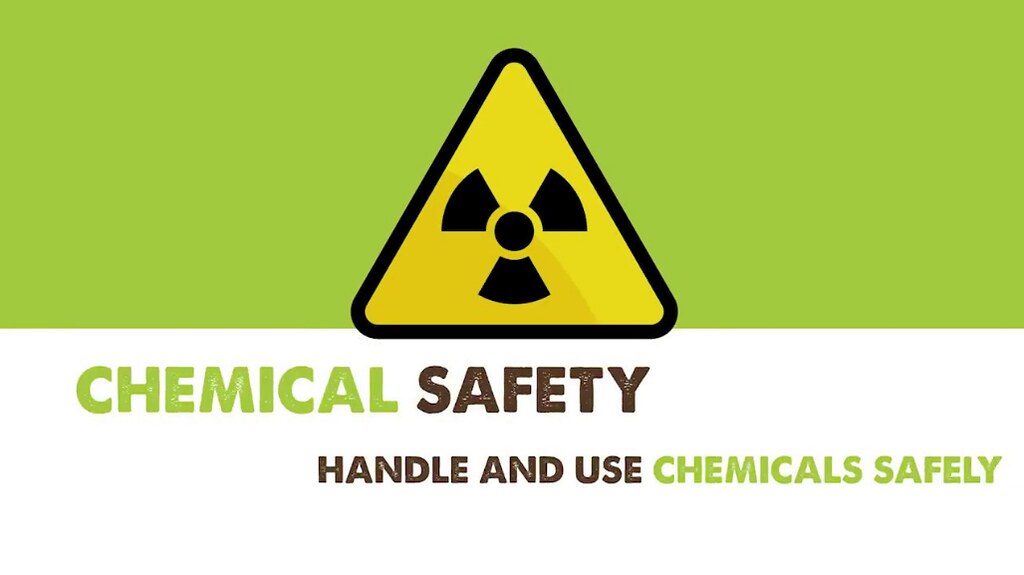
The importance of chemical safety regulation cannot be overstated.  Chemical safety is saddled on each of us.  Which sounds rather discouraging.  Although, the safety of the public is at risk.  Therefore, if you encounter a dangerous situation in any industry which handles chemicals, say something.  Here is a minute long video which demonstrates the simplicity of chemical safety:


Chemical safety impacts all of us at some fundamental level.


Conclusion...


The uncertainty surrounding the Chemical Safety Board should be unsettling to each of us.  Any attempt to dismantle this extremely important organization is a threat to each of us.  Therefore, the status of the organization is important to track.  If the government attempts to shut this down, as the public, we should ensure that there is an equivalent resource in place to investigate disasters and generate future reports on prevention of future disasters.


Related Blog Posts:


Ralph Nader: Has Corruption Become Institutionalized?


Hurricane Harvey Drops Enough Rain On Houston To Fill 560 Dallas Cowboy Stadiums


Puerto Rico Crops Devastated By Hurricane Maria


Democrats Question EPA Adminstrator Scott Pruitt On Historical Job Cuts At EPA


Environmental Groups Question Environmental Protection Agency (EPA) Cuts


What Does An Official Letter From The White House Requesting Funds For Hurricane Harvey Look Like?


Wasteful Water Use Tied To 'Education and Poverty' - Really?


Dimensional Analysis Of Statistics And Large Numbers - Index Of Blog Posts


Science Topics, Thoughts, and Parameters Regarding Science, Politics, And The Environment!


Wednesday, May 30, 2018

How Dangerous Are Cigarettes?


Source: Mirror.co.uk


By now there are probably few people who are not aware of the dangerous aspects (health dangers) of smoking cigarettes.  The adverse health impact of smoking cigarettes is very visible in our society today.  People are dying of lung cancer due to smoking.  Additionally, the tobacco industry lost a landmark case in the late '90's' for covering up the fact that nicotine is addictive and the industry was aware of that fact.  Currently, the movement is now shifting toward 'vaping'.  I wrote a blog post about the potential hazards of vaping which can be found here.  For this blog post, I thought that I would talk a little about cigarettes and the dangers behind them.


Cigarette Production Is Dangerous


Recently, I stumbled upon a video created by the U.S. Food and Drug Regulatory Agency regarding the dangers of cigarettes (3 minutes in length):


Let's take a step back and review the crucial steps outlined in the video above:


1) Plant

2) Harvesting/Processing

3) Combustion


Below, each of the above steps are slightly elaborated on for the purpose of clarity for the reader:


1) Plant Stage:


As indicated in the video, plants have natural 'pesticides' defense mechanisms to keep bugs and invaders away.  Just so happens that the pesticide commonly found in tobacco plant is the addictive component in cigarettes -- Nicotine.  In the late 90's, a huge lawsuit ensued around the tobacco companies disregard for evidence that was in their hands regarding the 'addictive nature' of nicotine.  One of the largest legal battles gave the largest monetary settlement which cost the tobacco companies hundreds of millions of dollars.


On top of the addictive nature of the chemical  nicotine, plants also have a wide range of chemicals stored in their arsenal to carry out day to day operations.  In addition to the arsenal of compounds needed for daily operation, plants also uptake chemicals found in the soil.  Which means that toxic metals like arsenic or lead (not to mention cadmium) could potentially be incorporated into the cigarette's composition solely based on growth location.  Additionally


For instance, what if a tobacco field was next to a chemical plant?  Any chemicals which made their way into the air and further into the soil could potentially end up in the cigarette that you hold in your hand.  These are just the chemicals which make their way into your cigarette by being in the soil in which the tobacco plant is grown in.  Rarely do people consider chemicals leaching (entering) into a plant if diffusing from a far off chemical or industrial plant.  Location matters.


2) Harvesting/Processing Stage:


The next stage after the planting the tobacco plant and allowing them to grow is the 'harvesting/processing' stage.  The plant is taken from the ground and exposed to the 'curing process' during which 'tobacco specific nitrosoamines' are formed.  Termed 'TSNA's' by the Food and Drug Administration (FDA), these compounds are known carcinogens which cause cancer in both the lungs and esophagus.  The tobacco plant is dried out during the curing process and treated with specific chemicals to prepare the plant for processing into a cigarette.


During the 'processing stage' of the production of cigarettes, at different stages chemicals are added to the tobacco plant to mask undesirable features in a cigarette such as harshness or odors along with undesirable tastes.  These chemicals or sugars can eventually become acid aldehydes which are known carcinogens.  Other chemicals may be added during the processing stage to enhance other qualities of the cigarette which contribute to the desirability of the final product which resides in the consumer's hand.  The point is that during the harvesting/processing stage, the tobacco is exposed to a large number of chemicals which was previously unknown to any reader of this article.  One large assumption is that all harmful chemicals are produced in the combustion process -- which is far from true.


3) Combustion Stage:


In the combustion stage, the cigarette has been formed into the familiar product sold in packages shown in the introductory photo above.  The process of burning the cigarette is defined as a 'combustion' process explained beautifully by the Government of Canada below:


Combustion is referred to as a chemical reaction.
Here is an example of a chemical reaction: a nail getting rusty (the metal oxidizes in the presence of oxygen).
Matter is changed by combustion.
Combustion modifies the order and organization of atoms in chemicals.
Order and organization
Just in the same way building blocks can be put together, taken apart and re-assembled to form a new construction, atoms can be put together, taken apart and re-assembled to form new chemicals.
In combustion, oxygen from the air and intense heat cause the atoms of the chemicals naturally present in the tobacco plant to reorganize into new chemicals.
The example shown here demonstrates this modification using building blocks as an analogy.
When a cigarette burns, the chemicals in the tobacco are changed into new chemicals!
Many of these new chemicals are toxic.


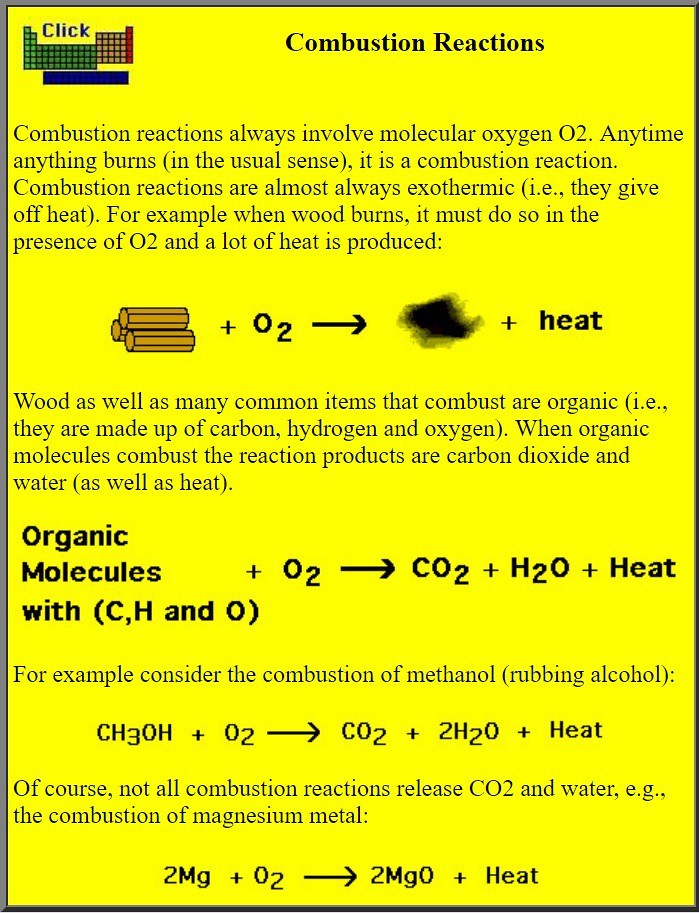
To understand the chemistry behind a combustion reaction, here is an image taken from the University of Indiana -- with a quick but concise lesson on combustion reactions shown below:


As shown in the image above, the combustion reaction is portrayed in the first reaction line with a pile of wood reacting with "Oxygen (O2)" producing black smoke and heat.  These are not conventional symbols (or chemical language), the reaction is represented in the basic sense -- visually.  Here is the combustion reaction of paper shown below:


Source: byjus.com


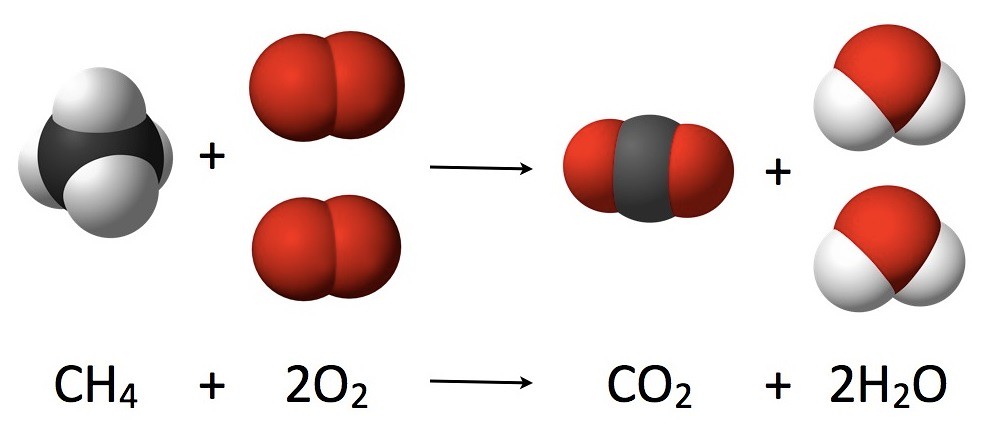
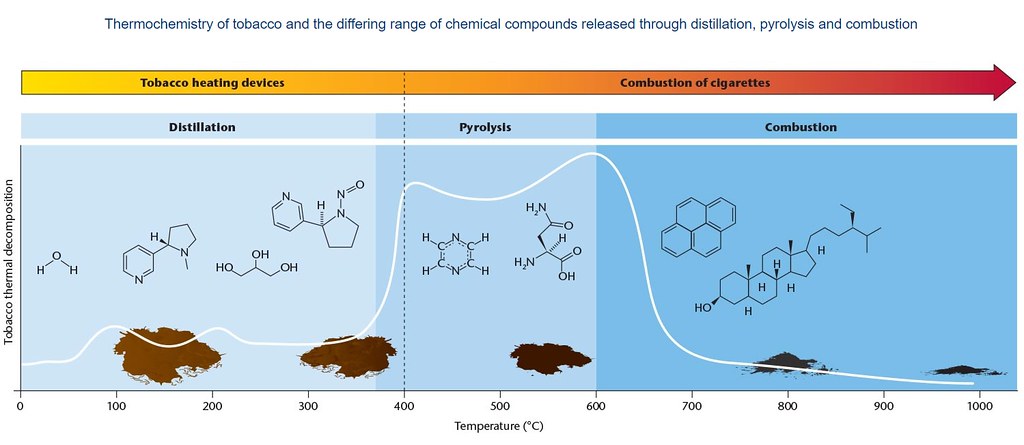
In the reaction above, methane reacts with 2 moles of oxygen to produce carbon dioxide along with 2 moles of water.  For more about moles, visit previous blog posts.   Or consult the wikipedia page for Avogadro's Number by clicking here.  The point is that during the combustion reaction, atoms rearrange themselves.  In the product phase, there is extra energy given off as 'heat'.  Below is a spectrum of different thermal (heat driven) processes: distillation, pyrolysis, and combustion.  On the x-axis is temperature.


Source: Bat-Science


By clicking on the 'Source link' below the image, the enlarged (larger) image will appear.  The point of the picture above is to show that if different amounts of heat is applied to the same tobacco (chemical), then different products will be given off.  This is a very important concept to grasp when thinking in terms of energy and chemistry reactions.


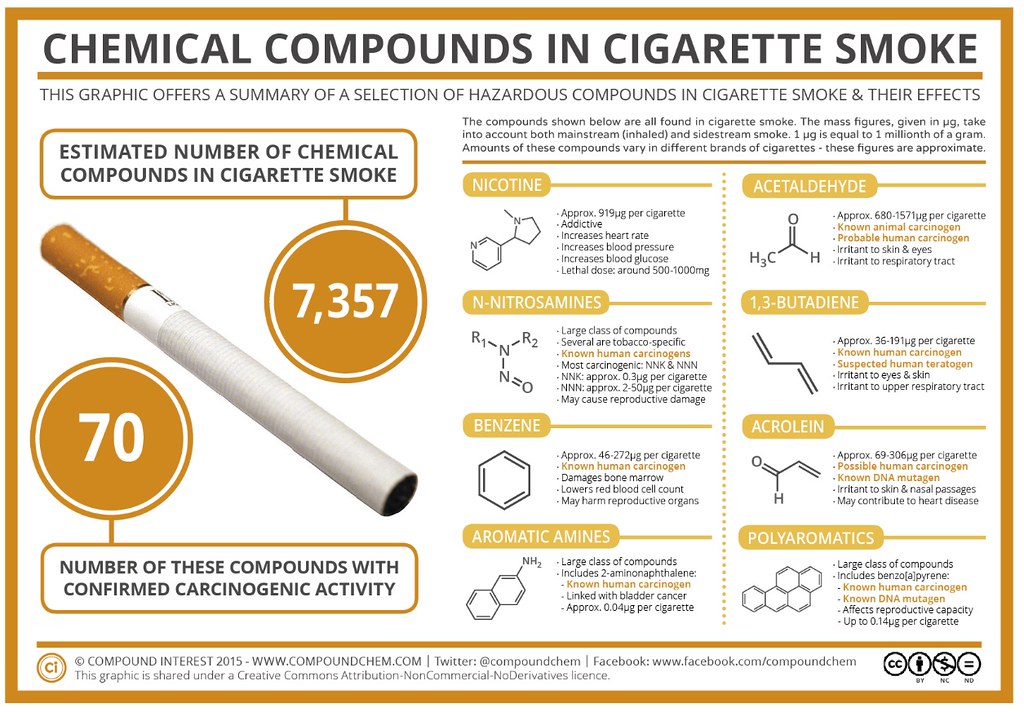
Depending on the source (different measures), the combustion of cigarette smoke produces a range of chemical products.  But wait, above, in the simple combustion reaction the products were: Carbon dioxide, Water, and Smoke along with Heat?  Yes, that smoke contains harmful (toxic) chemicals.  Here is an infographic produced by 'Compound Chemistry' detailing a multitude of compounds contained in cigarette smoke:


Again, by clicking on "Compound Chemistry" in the 'Source' - below the picture, a larger (the original) image will appear in a webpage.  The number of compounds (chemicals) found in cigarette smoke are limited by the ability to measure the exact composition of chemicals.  Additionally, combustion produces partial decomposition products too.  As technology improves, the ability to measure a more precise composition of chemicals will emerge over time.


Conclusion...


Chemistry is pervasive throughout the world.  Molecules are made up of atoms of space.  The atoms are connected with bonds which are made up of shared electrons.  These forces (bonds) can be broken with sufficient energy (i.e. heat) such as in the combustion reaction.  Upon which other molecules are formed.  Why do I stress this obvious aspect of chemistry?


The reason is that during the process of growing tobacco to the process of combustion involves the making and breaking of chemical bonds which results in various chemicals.  The take home message in the post above is that more chemicals exist which are harmful in cigarettes than are advertised or reported by the tobacco industry.  In the future, I will talk more about vaping and the parameters which contribute to the dangerous chemicals which are produced in the process of enjoying vaporizing 'juice'.


Related Blog Posts:


Chemistry Reactions Are Amazing - See For Yourself


Chemists Learn To Build Up Nanoparticles -- One Atom At A Time!


How Much Water Is Contained In All Oceans Around The Globe?


Dimensional Analysis Of Statistics And Large Numbers - Index Of Blog Posts


What Is Dimensional Analysis?


Sunday, May 27, 2018

Thoughts: What Does National Institute of Health Director Francis Collins get asked in front of Congress?

Source: C-SPAN


Regardless of each opinion held by every person existing in the great nation of the United States, each of us could learn a great deal by watching a hearing held by Congress on any given topic.  The topics are very diverse and surprising when a person decides to look into the variety.  I would even go onto say, there is a tremendous amount of content to mull over when making choices for constituents across every district of the United States.  Our elected politicians have an enormous amount of material to consider for a given topic.  Of course, that is the purpose of hiring aides (in Washington D.C.).


With that being said, what do the people who are asked to testify in front of congress say?  What type of questions are asked of them by congressional leaders?  At the end of the blog post, I will include other posts with links to other congressional testimonies.  Since I am focused mainly on science and the environment, I thought that highlighting the recent testimony of Dr. Francis Collins, the Director of the National Institutes of Health would be appropriate for the present post.  Below are the introductory remarks with a couple of short videos.


NIH Director's Opening Remarks


At the beginning of a congressional testimony, the major players get a chance to give an opening statement or submit opening remarks to be entered for the record.  Below are Dr. Francis Collins opening remarks:


Good morning, Chairman Blunt, Ranking Member Murray, and distinguished Members of the Subcommittee.  I am Francis S. Collins, M.D., Ph.D., and I have served as the Director of the National Institutes of Health (NIH) since 2009.  It is an honor to appear before you today.
Before I discuss NIH’s diverse investments in biomedical research and some of the exciting scientific opportunities on the horizon, I want to thank this Subcommittee for your sustained commitment to NIH to ensure that our nation remains the global leader in biomedical research and advances in human health.
I want to personally express gratitude to this Subcommittee and its leadership for its support in crafting and passing the FY 2018 Consolidated Appropriations Bill.  The FY 2018 Omnibus provides an incredible increase of $3 billion for NIH, including funding for opioid- and pain-related research, Alzheimer’s disease, antimicrobial resistance, and development of a universal influenza vaccine.  NIH has immediately set to work to invest those additional resources into groundbreaking research.
As the nation’s premier biomedical research agency, NIH’s mission is to seek fundamental knowledge about the nature and behavior of living systems and to apply that knowledge to enhance human health, lengthen life, and reduce illness and disability.  As some of you have witnessed first-hand on your visits to NIH, our leadership and employees carry out our mission with passion and commitment.  This extends equally to the hundreds of thousands of individuals whose research and training we support, located in every State of this great country, and where 81 percent of our budget is distributed.
The FY 2019 Budget provides $34.8 billion for NIH to fund the highest priority scientific discoveries while also maintaining fiscal stewardship of Federal resources.  This Budget will consolidate research functions across the Department, optimize available grant dollars to fund research, invest in NIH’s buildings and facilities, and support NIH priority areas including combatting the opioid epidemic, advancing Precision Medicine, and investing in translational research.
The FY 2019 Budget consolidates HHS research programs into three new institutes within the NIH.  The Budget provides $380 million for the activities of the Agency for Healthcare Research and Quality (AHRQ), consolidated into the National Institute for Research on Safety and Quality.  The National Institute for Occupational Safety and Health (NIOSH), including the Energy Employees Occupational Illness Program (EEOCIPA), currently administered by the Centers for Disease Control and Prevention, and the National Institute on Disability, Independent Living, and Rehabilitation Research (NIDILRR), currently administered by the Administration for Community Living, are also proposed for consolidation into the NIH.
America’s continuing leadership in conducting biomedical research requires infrastructure and facilities that are safe, compliant with all laws and regulations, and conducive to cutting edge research and research support.  NIH owns 281 facilities, including a research hospital, laboratories, and offices.  NIH’s Backlog of Maintenance and Repair exceeds $1.8 billion.  NIH is currently working with the National Academies of Sciences, Engineering and Medicine to identify NIH facilities and infrastructure most in need of repair.  We look forward to providing that report to the Committee as soon as it is final.
The FY 2019 Budget makes much needed investments in NIH’s facilities.  The Budget proposes $200 million to support multiple biomedical research infrastructure priorities.  The FY 2019 Budget will allow NIH to continue to repair and upgrade deteriorated infrastructure.  In a recent analysis requested by this Committee, the condition of NIH laboratories ranks near the lowest in the federal government due to the high likelihood of floods, power outages, and mechanical failures.  Items on the backlog list include: install steam and chilled water distribution systems; conduct structural repairs to older buildings; upgrade plumbing systems; repair elevators; upgrade heating, ventilating, and air conditioning systems; replace deteriorated electrical systems, and more.  In addition, due to the age and use of NIH facilities, NIH must invest funds in removing contaminants and hazardous waste before construction or capital repairs can begin in most of its buildings.  The Budget will allow NIH to track what contaminants are being cleared from each of our buildings, which will ultimately help NIH do a better job of anticipating the cost and time required to begin new projects in existing buildings.
Truly exciting, world class science is taking place.  I would like to provide just a few examples of the depth and breadth of the amazing research the FY 2019 Budget supports across the Institutes and Centers of NIH.
Over the past 15 years, communities across our Nation have been devastated by increasing prescription and illicit opioid misuse, addiction, and overdose.  This Committee made a historic investment of $500 million in our work in FY 2018, and the FY 2019 Budget builds on that with an investment of $850 million to support a range of activities to advance research on pain and addiction.  NIH has and will continue to support cutting-edge research on pain, opioid misuse, addiction, and overdose.  Drug addiction is a complex neurological condition, driven by many biological, environmental, social, and developmental factors.  Continued research will be key to understanding the crisis and informing future efforts.  Pain is an equally complex condition affecting millions of Americans.  NIH will: explore new formulations for overdose reversal medications capable of combatting powerful synthetic opioids; search for new options for treating addiction and maintaining sobriety; continue to research how best to treat babies born in withdrawal through our ACT NOW trial; develop biomarkers to objectively measure pain; build a clinical trial network for pain research; and attempt to find non-addictive and non-pharmacological approaches to chronic pain.  Thanks to your support, all hands are on deck at NIH for this public health crisis.
Another exciting area of continued investment in FY 2019, building on this Committee’s long-standing support, is Precision Medicine.  On May 6th, NIH officially launched the national roll-out of the All of Us Research Program.  This program will partner with one million or more people across the United States to provide the most diverse biomedical data resource of its kind and gain unprecedented insights into the biological, environmental and behavioral influences of disease.  The FY 2019 Budget, including resources from the 21st Century Cures Act, supports the ramp up of the program. After pilot testing system and forming partnerships with community organizations across the country, national enrollment is about to begin.  All of Us will not focus on only one specific disease.  Rather, it will be a national data resource to inform many research studies on a wide variety of health conditions. The data provided by one million participants will provide opportunities for researchers—including academics and citizen scientists—who want to understand how and why different people experience certain diseases and conditions while others do not, and why many people respond differently to treatments and prevention methods that will help accelerate medical breakthroughs.
NIH is the largest funder of basic biomedical research in the United States, providing a critical research foundation for both the public and private sector.  Building on that solid foundation of basic research, NIH also supports translational research that turns observations in the laboratory, clinic, and community into interventions that improve the health of individuals and the public, whether those interventions be diagnostics, therapeutics, medical procedures, or behavioral changes.  For example, Congress created the Cures Acceleration Network (CAN) at the National Center for Advancing Translational Sciences (NCATS) to advance the development of high-need cures and to reduce significant barriers between research discovery and clinical trials.  For example, CAN currently supports NCATS’ Tissue Chip for Drug Screening program, which was designed to revolutionize the process for predicting drug safety.  Researchers developing miniaturized platforms that could support miniature models of living organs — such as the lung, liver, and heart — that could be integrated into connected organ systems.  New Tissue Chip initiatives were funded in FY 2017 and this support will continue into FY 2019.  CAN uses flexible research awards using the special authorization called other transaction authority to attract non-traditional government partners, and to expand, modify, and, if needed, discontinue activities to meet program needs.  The FY 2019 Budget will allow NCATS, through CAN, to continue to invest in high-risk, high reward initiatives designed to address significant scientific and technical challenges that hinder translational research. 
One of my personal priorities is developing the next generation of talented biomedical researchers.  Last year, I shared with the Committee NIH’s plans to build on our support for early-stage investigators through a new initiative known as the Next Generation Researchers Initiative.  The FY 2019 Budget includes a dedicated fund of $100 million in the Office of the Director to incentivize additional Institute and Center support for these researchers.  NIH remains committed to the development, support, and retention of our next generation of investigators. 
We have never witnessed a time of greater promise for advances in medicine than right now.  Your support has been critical, and will continue to be.  Thank you again for inviting NIH to testify today. We look forward to answering your questions.


There is a lot to cover since there is a tremendous amount of research done.  Imagine trying to report on all of the new discoveries which have been accomplished over the year which are funded by the government.  Especially given the wide diversity of funding initiatives.  The information gained during the process of research and discovery are wide ranging and some times uncertain in understanding.  New drug targets could be discovered while the technology to bring to market the medicine might not be available yet. 


Additionally, new companies could be emerging looking to invest and take a new drug to market.  The future is exciting yet unknown and Dr. Francis Collins has to stand up before congress to report and justify the funding -- while always looking to increase the annual budget.  The task must seem monumental given the scope and wide range of projects not to mention the needs of the NIH.


Short Videos of Questions


Now that you have seen the opening statement, a couple of videos might be appropriate.  The first video is of the opening remarks from the committee chair - Senator Roy Blunt.  He gives a good overview of the current state of funding and initiatives that have been considered over the past few years in around 6 minutes of speech:


Wow!  That is pretty impressive.  Dr. Collins mentions that the 'ROI' -- 'Return On Investment' from spending money for research at the National Institutes of Health is $8.38 for every $1 spent (over a five year period).  Remember, the money invested goes to research medical disease at the basic science stage along with grants which help pharmaceutical companies bring a drug to market to treat a disease (when success is shown).


For those concerned citizens who worry about spending needless money on projects which 'seem' to produce nothing, I would argue that every project pursued yields fruits of knowledge.  Whether that yield be as small as the realization of the need for newer technology or the realization that the existing projects will really have to be broken up into many smaller components with each a separate funding cut.  Meaning that there is no money which is wasted in research.  I understand that there are scientists who will disagree with me.  That is not to say that money could be better spent from grants coming out of the National Institutes of health.  What always strikes me as amazing is the wide range of projects (under various sub-agencies throughout the NIH) that are undertaken by scientists throughout our nation.


Senator Roy Blunt mentions the newly launched initiative of the National Institutes of Health guided toward precision medicine called "All of Us."  I just wrote a short blog post with a video embedded in the post to give a reader an introduction into the ground breaking initiative toward understanding unique traits among individuals rather than large populations.


The next video shows Senator Jerry Moran questioning


Dr. Richard Hodes, Director of the National Institute on Aging, spoke briefly about identifying various biomarkers of disease.  Recently, I wrote a short blog post with a video on the mission of the National Institute on Aging (NIA) -- which is worth checking out if you are unfamiliar with the NIA and research conducted within the facility and outside (funded by the agency).


For those who are interested in listening/viewing the entire hearing, here is the link to the Senate Appropriations web page with the embedded video of testimony.


Conclusion...


Congress has a difficult job in front of them when dealing with spending issues on behalf of the entire United States of America.  Each geographical region has different spending needs which require different amounts of funding from the government on an annual basis.  What is not different or unique is that each geographical region is filled with human beings.  Each of us eventually will need hospital services within our lifetime.  Each of us will eventually need a medication which was funded by the National Institutes of Health.  And eventually, each of us will realize that money spent on medical research is important.


Just ask a person with a rare disease for which there is no treatment available.  What would you say to that person from a spending perspective?  Although, just because money is thrown at a project (research problem) does not guarantee positive results.  Unfortunately, the answer may be beyond the reach of our current research capabilities or understanding.  If we do not continue to promote research and discovery across a wide range of fields, then we will never know our limits of understanding.  Research is not an area from which we (as a nation) should be trying to save money.  If anything, an annual increase should be without question.  This statement is backed by a great return on investment as stated above by Dr. Francis Collins.


Related Blog Posts:


Parameters: What is the 'mission' of the National Institute for Aging?


"All Of Us" - The Best Medical Knowledge Update Effort - Please Join!


NIH Director Updates Congress On Research Progress


Dr. Francis Collins and Bill Gates Discuss Global Health And Genomics


How Much Do New Drugs Cost To Bring To The Pharmacy Counter?


Is Disease Or Treatment Different In Women?


Unraveling The Resistance Of Antibiotics!


How Do Chemists Discover New Drugs? A Brief Introduction!