Showing posts with label bacteria. Show all posts

Friday, December 7, 2018

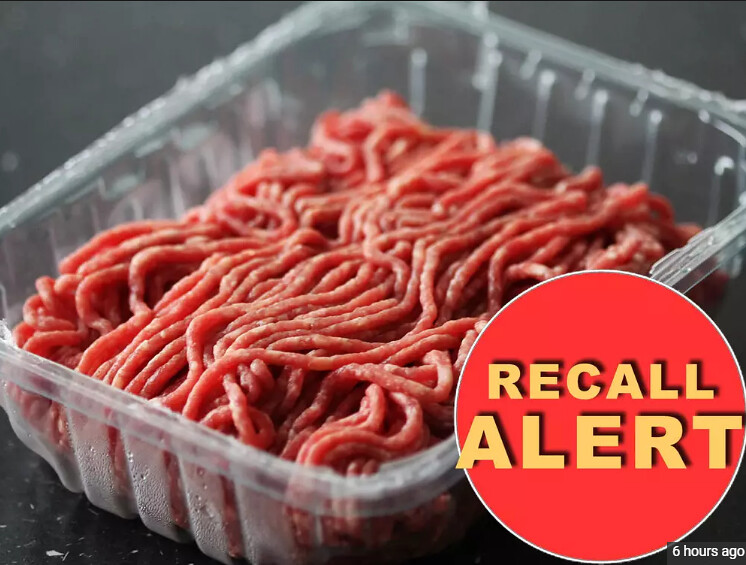
Congress Gets Involved In Beef Recall


Source: Cooking Light


Amid the beef recall hitting the United States, one cannot help but think about the post I wrote recently regarding the unkown fact that bacteria is not checked in meat/poultry products after the products leave the warehouse by the Food Safety Inspection Service.  As I alluded to, corporations left on their own to conduct inspections is a path toward outbreaks.  Not all corporations are offenders.  Although, the beef recall is indicative the lack of inspections on part of a corporation --


Congress has now been inserted into the recall based on the number of people affected by the tainted (salmonella tainted) beef.  Congresswomen Rosa DeLauro sent a letter of inquiry to Agricultural Secretary Sonny Purdue shown below:
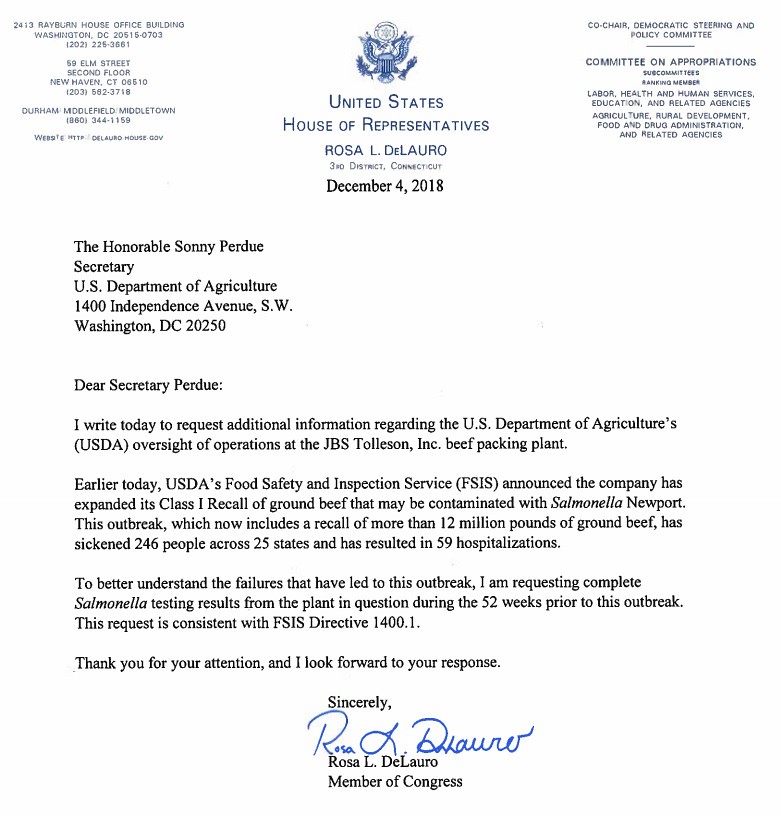


Source: Congress


The following message is written on the letter shown above:


Dear Secretary Purdue:

I write today to request additional information regarding the U.S. Department of Agriculture's (USDA) oversight of operation at the JBS Tolleson, Inc. beef packing plant. 
Earlier today, USDA's Food Safety and Inspection Service (FSIS) announced the company has expanded its Class 1 Recall of ground beef that may be contaminated with Salmonella Newport.  This outbreak, which now includes a recall of more than 12 million pounds of ground beef, has sickened 246 people across 25 states and has resulted in 59 hospitalizations. 
To better understand the failures that have led to this outbreak, I am requesting complete Salmonella testing results from the plant in question during the 52 weeks prior to this outbreak.  This request is consistent with FSIS Directive 1400.1.  
Thank you for your attention, and I look forward to your response. 
Sincerely, 
Rosa L. DeLauro
Member of Congress


I am glad to see that congress has now been involved in the matter.  Especially since the inquiry comes against the backdrop of a recently released report by the Food Safety Inspection Service on the efficacy of poultry inspections in a variety of poultry plants around the United States.  The report shows that a sizable portion of the poultry plants have earned less than stellar (alarming) grades on their ability to inspect for Salmonella (along with other bacteria) in the outgoing products.


Conclusion...


The issue is a moving target -- an ongoing situation -- which is changing and will be updated on this site when news pops up.  Food safety from a contamination standpoint is just as alarming as food safety from ingredient safety is to me.  Each of us deserve to understand the regulations and checks (and balances) which exist in government (federal down through local) to provide a safety and healthy product to the consumer.


Stay vigilant and educate yourself on the safety of the world around yourself.  Education is the best weapon to combat any problem which plagues society.  Unfortunately, not enough education is accomplished on this matter at professional institutions.  Therefore, the responsibility lies within each of us to do the work.  Stay tuned.


Related Blog Posts:


One Unknown Fact Which Should Cause Consumers To Be Careful About Handling Meat Before Cooking!


How Effective Are Poultry Corporations At Reducing Salmonella In Their Products?


Ralph Nader: Post Election -- Next Step -- Open Up The Existing Secretive Congress


New trend in the Thanksgiving Holiday for 2018? Smaller Turkeys?


A Forecaster Predicts That Hurricane Florence Will Drop Enough Rain To Fill 18,400 Mercedes-Benz Superdomes

Hurricane Harvey Drops Enough Rain On Houston To Fill 560 Dallas Cowboy Stadiums


How Much Water Is Contained In All Oceans Around The Globe?


Storm Raises Water Level In Lake Cachuma By 31 feet, How Much Water Is That?


How To Make Sense Of Water Flowing At 100,000 Cubic Feet Per Second


Can 11 Trillion Gallons Of Water Fill 14,000 Dallas Cowboys Stadiums?


How Much Rain Did The East Coast Receive From Hurricane Matthew?


How Much Rain Did Haiti Really Receive?


How Much Rainfall Has Dropped On Louisiana?


How Big Was The "Water Bomb" Of Rainfall In Macedonia?


How Much Rain Did Huauchinango (Mexico) receive?


How Much Rain Did Elliot City (Maryland) Really Receive?


If The Mosul Dam Breaks, The City Of Mosul Would Be Under 65 Feet Of Water?


What is the volume of water in a few inches of rain?


Volume of Waste in the Mine Spill (in Brazil) Equivalent to 78 Deepwater Horizon Oil Spills


Wednesday, November 28, 2018

How Effective Are Poultry Corporations At Reducing Salmonella In Their Products?


Amid the growing concern of the Romaine Lettuce contaminated with E.Coli over the Thanksgiving weekend, there has been a heightened discussion surrounding bacteria -- Salmonella in general.  For up to date information on the Romaine Lettuce contamination, please visit the Center for Disease Control and Prevention (CDC) web page for the outbreak.  This discussion is not new.  In fact, behind the scenes, the Food Safety Inspection Service conducted inspections (audits) and found surprising results (not good) through the last year from October 2017 thru til October 2018.  Below are the results and grades for the corporations at controlling Salmonella contamination in their products.


Corporations are self-regulated?


As I wrote in a previous blog post, the Food Safety Inspection Service does not inspect each outgoing package of poultry/meat which is sold in the United States.  Instead, corporations are subject to stringent documentation processes along with frequent visits to sites by regulators to audit safety of work flow and poultry/meat processing.  Which leaves the responsibility to the consumer to ultimately handle the poultry/meat safely (removing bacteria) before serving the final dish to family and friends.


After Thanksgiving weekend, writers at Politico Agriculture followed up on the news of the Romaine lettuce contamination along with potential problems with certain poultry/meat products which are popular around the holidays:


GOOD NEWS/BAD NEWS ON FOOD SAFETY: After getting everyone's attention pre-Thanksgiving, the FDA thinks it has traced the E. coli outbreak in romaine lettuce to growing regions in northern and central California, Pro Ag's Helena Bottemiller Evich and Sarah Zimmerman report. To help better assess future problems, leafy green distributors have now voluntarily agreed to identify where and when their lettuce was grown and harvested (effective immediately).
Now for the bad news: The day after Thanksgiving, when few were paying attention, USDA's Food Safety and Inspection Service released data showing that dozens of poultry plants have failed Salmonella performance standards.
FSIS reviewed dozens of slaughterhouses from October 2017 through October 2018, after reports of major salmonella outbreaks in chicken and turkey that sickened hundreds around the country. (Each plant is given a category rating from 1 to 3, with "category 3" signifying the company failed performance standards.)
— Four Jennie-O plants were found to have high levels of salmonella. That includes the plant in Barron, Wis., that issued a voluntary recall of around 150,000 pounds of ground turkey after FSIS determined the company was one of many brands likely connected to an outbreak that sickened at least 164 people over the past year.
— Jennie-O said it has created a "salmonella task force," according to a company statement shared with MA, to "better understand salmonella, and more importantly, what actions we can take to prevent it." 
— Nearly three-fourths of slaughterhouses of Perdue Farms, one of the country's top poultry producers, failed to meet performance standards for chicken parts. A Perdue spokesperson said the rankings "don't necessarily reflect current plant salmonella levels."
Thomas Gremillion, director of the Consumer Federation of America's Food Policy Institute, told MA the number of failed performance standards was due in part to "weak incentives under federal rules for poultry companies to attend to the bacteria."
— Most major poultry companies have at least one "category 3" processing plant, with more than 15.4 percent of samples testing positive for salmonella, Gremillion noted.


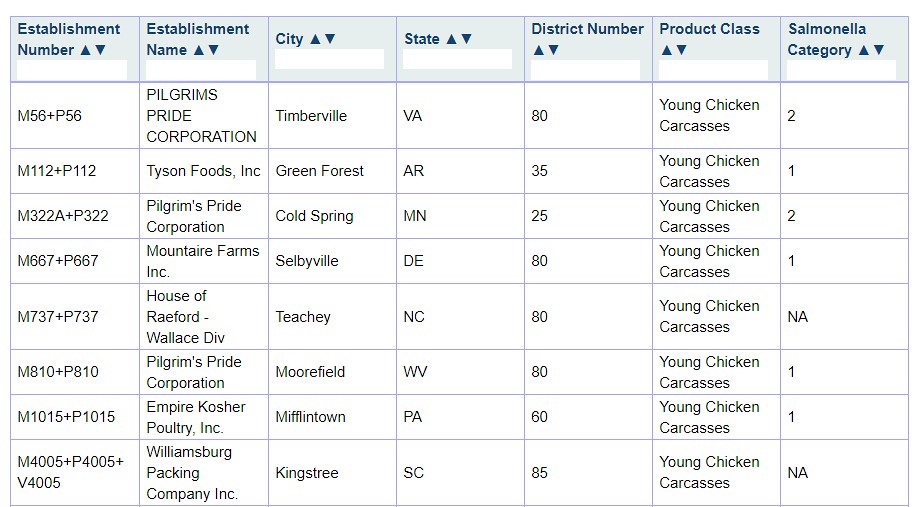
Wow.  Bad grades were found among poultry plants - which is concerning from a health and safety standpoint.  After reading the above news, the 'rating system' is probably sitting heavily on your mind (as it was for me last night).  The United States Department of Agriculture posted results of the survey with a glossary of terms shown below:


Source: USDA - FSIS


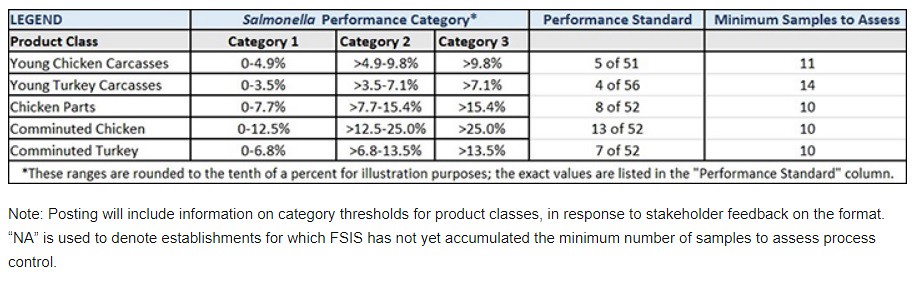
Note that the USDA posted the glossary at the end of the web page which piqued my curiosity.  Why not show the rating categories in the beginning?  Before the data rather than after.  Regardless, the results are concerning to say the least.  In order to interpret the results effectively as a reader/consumer, the following 'rules' which dictate the 'category' are shown below:


Source: USDA-FSIS


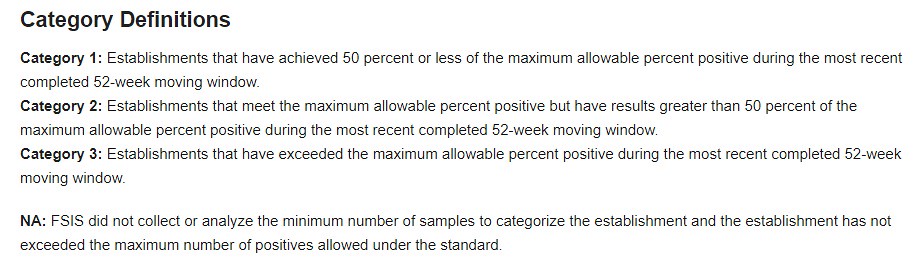
After posting the image of the categories for the inspectors to place grades into, I realized that the text is too small.  Below are the categories restated:


Category Definitions
Category 1: Establishments that have achieved 50 percent or less of the maximum allowable percent positive during the most recent completed 52-week moving window.
Category 2: Establishments that meet the maximum allowable percent positive but have results greater than 50 percent of the maximum allowable percent positive during the most recent completed 52-week moving window.
Category 3: Establishments that have exceeded the maximum allowable percent positive during the most recent completed 52-week moving window.

NA: FSIS did not collect or analyze the minimum number of samples to categorize the establishment and the establishment has not exceeded the maximum number of positives allowed under the standard.


The inspectors additionally broke down the inspections into specific parts of the chicken and different chickens as shown below:


Source: USDA-FSIS


Again, the image is rather small (the text in the image), therefore to view the results, click on the hyperlinked text "USDA-FSIS" and scroll down to the bottom of the web page (which is long).  The glossary and breakdown of results are worth viewing.  The overall message of the results is that the inspection uncovered the fact that major outbreaks of salmonella have occurred frequently and are of great concern.  I do not pretend to have the solution.  Although, I would offer that less regulation is not the answer.  More inspections and regulations are needed.


Conclusion...


According to a report from the news website 'Today' titled "FDA update on romaine lettuce: Safe to eat as long as lettuce is not from central CA" Romaine lettuce is good except from Central (California).  Still, I would suggest exercising great caution while handling lettuce before preparing it for a meal.  Recent research out of University of California at Riverside has unveiled the fact that "pre-rinsed" lettuce is not without bacteria.  Simply because of the shape of the pore inside the lettuce leaf, the thought is that bleach does not effectively reach into the pocket (pore) and appropriately kill the bacteria at 'regulated concentrations' of bleach used by corporations.  Professor Sharon Walker leads the research as shown in the video below:


As Professor Walker points out that there is very little scientific evidence behind the regulation which is involved in cleaning lettuce.  The work here will have impact in other areas of food research.  The poultry industry will undoubtedly be included in the new research.  According to the results shown above, there is plenty of room for improvement in developing new ways to remove/control the spread of bacteria (i.e. Salmonella) in the food industry.


Until those new innovative ways are translated into policy and regulations, please take appropriate steps to avoid the unwanted spread of bacteria among consumer products both inside and outside of your household. 


Related Blog Posts:


One Unknown Fact Which Should Cause Consumers To Be Careful About Handling Meat Before Cooking!


Natural Disasters Have Long Term Effects Which Are Quickly Forgotten?


What is the next big step in Mental Health Research?


A Forecaster Predicts That Hurricane Florence Will Drop Enough Rain To Fill 18,400 Mercedes-Benz Superdomes


Hurricane Harvey Drops Enough Rain On Houston To Fill 560 Dallas Cowboy Stadiums


How Much Water Is Contained In All Oceans Around The Globe?


Storm Raises Water Level In Lake Cachuma By 31 feet, How Much Water Is That?


How To Make Sense Of Water Flowing At 100,000 Cubic Feet Per Second


Can 11 Trillion Gallons Of Water Fill 14,000 Dallas Cowboys Stadiums?


How Much Rain Did The East Coast Receive From Hurricane Matthew?


How Much Rain Did Haiti Really Receive?


How Much Rainfall Has Dropped On Louisiana?


How Big Was The "Water Bomb" Of Rainfall In Macedonia?


How Much Rain Did Huauchinango (Mexico) receive?


How Much Rain Did Elliot City (Maryland) Really Receive?


If The Mosul Dam Breaks, The City Of Mosul Would Be Under 65 Feet Of Water?


What is the volume of water in a few inches of rain?


Volume of Waste in the Mine Spill (in Brazil) Equivalent to 78 Deepwater Horizon Oil Spills
Wednesday, July 4, 2018

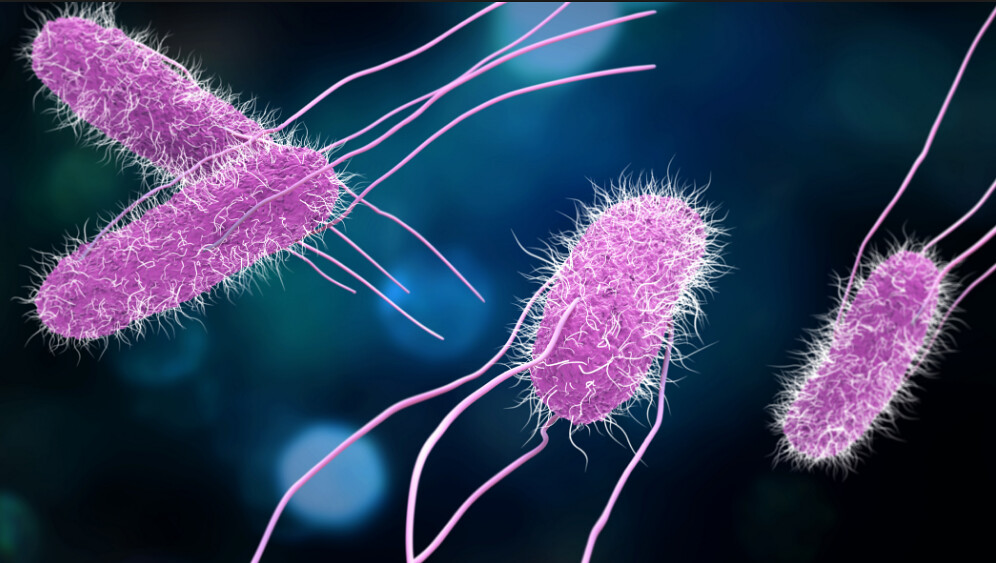
Bacteria communicating in communities -- quorum sensing


If you have ever had to clean the drain in your sink or the film of dirt off of the shower wall, chances are that a bacteria colony did reside there at one time. You know what I am talking about...That build up of film on your shower door/wall which progressively gets more opaque and changes color if left untouched by a sponge with cleaner.  Bacteria colonies arise all over the place.  How do bacteria colonies grow?  How do individual bacteria in colonies communicate with each other?  Scientists have made progress into unveiling the details below.


In the video shown below -- which is 10 seconds in length, the growth of bacteria is shown along with the immediate conversations between them in a community setting:


Scientists have often wondered how bacteria communicate when in a colony setting.  This step represents an advance in the detection of communication.  A step in the right direction to say the least.  Exciting as the results may be, the researchers now have their hands full in pushing the project further.


Related Blog Posts:


What Is Going On Inside That Cell?


Chemistry Reactions Are Amazing - See For Yourself


Thoughts: How Did People Talk In 1929?


Parameters: 3D Printed Human Hearts?


Parameters: Can Computers Think?


How Do LED Christmas Lights Work?


Chemistry Videos Unveil Problems With Battery Technology


A Virtual Tour Of A Plant Cell? Really?


A Virtual Tour Of A Human Cell?


Chemists Learn To Build Up Nanoparticles -- One Atom At A Time!


World Health Organization Suggests More Funding For Antibiotic Resistance Research


Should Pollution Concern Us?


New Chemistry Shows Promise In Preventing Fires In Lithium Ion Batteries!!!