Showing posts with label Physics. Show all posts

Tuesday, March 26, 2019

Can A Plant Pathogen Be Transported By Wind During A Rain Storm?


Source: WuzupNigeria


The spread of seeds, particles and pathogens over considerable distances is of great concern.  Especially given the current trend of converting crops from tradition crops to GMO (genetically modified crops).  Proprietary seeds are held tightly among farmers who pay to plant special seeds.  The ability to protect the spreading of seeds under storm conditions is nearly impossible.  That is during normal conditions -- i.e. normal weather: sunny, average temperature, humidity level for a given geographical area -- seeds are controlled by the human distribution of seeds.  What happens to this phenomena (spreading of spores, seeds, particles, dust, pathogens, etc.) during a rain storm?


Rain falls to the ground and forms puddles over time.  Water which gathers on the ground contains dirt, particles, pathogens, seeds, etc.  When a rain drops out of the sky and hits the ground during a wind storm, what happens to those pathogens (and other particles) in the water?  What about the surface of a leaf?  Do these pathogens (and particles) travel over distances during a rain/wind storm?  What is the mechanism by which pathogens (and particles) travel over large distances?


How do particles (and pathogens) get into the air?


Past research has shown that rust (build up on metal or other surfaces) can spread in a wind storm a considerable distance -- on the order of kilometers (1 mile = 1.60934 kilometers).  Research published last November in the Journal 'Proceedings of the National Academy of Sciences' revealed the mechanisms by which pathogens (and other particles) travel over large distances.  The study revealed the exact mechanisms broken down into parameters such as overcoming cohesive force between spores clustered together on a surface, the ejection mechanism (how to get off the ground into the air), and the traveling of the pathogen over large distances.   Next, add into the mix a rain storm with wind.


To break this down further.  Imagine a pathogen (or seed, particle, etc.) sitting on the ground.  The wind is rushing by above the surface on which the pathogen sits.  How does the pathogen acquire enough energy (kinetic energy) to be ejected into the air rushing by above?  That is where the researchers use high-speed cameras (as shown in the videos below) to tease out the exact mechanisms.  High-speed cameras show that a falling rain drop contains enough energy to eject a pathogen (and other particles) into the laminar air flow which can potentially travel over large distances.


Upon impact with the ground, the energy of the rain drop is distributed unevenly into a series of droplets which splash up and outward.  The kinetic energy of the outward water distributed creates enough of a vortex (as shown in the video below) to eject a pathogen from the ground up into the rushing air above the surface.  From there, the pathogen has sufficient energy to travel large distances given that the wind maintain a constant energy to push the pathogen along.


Also contained in the research paper are the simulations which were used along with the calculations (and equations) on which the phenomena was modeled.  The data was in agreement with the evidence obtained in the high-speed camera videos.  Here are two videos to show how the spores (plant pathogens) are elevated into the air once the drop hits the surface:


The second video shows the formation of a vortex by the rain drop which is one of a few critical parameters for pathogens ejecting off of a surface and joining a laminar flow to travel large distances:


The videos show above that there is sufficient energy in a rainwater drop to eject a pathogen (or other particles) up into the air.  Ejecting the pathogen is sufficient enough to catch a larger airflow of laminar air which could potentially carry the pathogen over large distances -- i.e. kilometers, miles, etc.   The research represents a good model by which pathogens can travel over large distances.  Previous research did not provide exact detail of vortex formation which would be sufficient to lift a pathogen into larger vortexes.


The research represents a quantification of dynamics of pathogen (disease) spreading among the plant community.  Rain drops are one pathway by which pathogens could acquire enough energy to be ejected into the air to travel large distances.  More studies will help optimize the conditions under which pathogens travel and possibly shed light into new avenues of mechanisms of ejection.  The ejection mechanisms uncovered in the research above add to the existing contribution from insects residing on leaf surfaces, leaf vibration, along with other kinetic energy contributions. Overall, the research represents yet another parameter revealed in disease propagation in the agricultural community.


Related Blog Posts:


How Do Scientists Track Bees Inside BeeHives? Use QR Codes?


Want To Improve Science Communication: Add Artists!


Should you consider science while before voting next Tuesday?


The Executive Director Of The American Meteorological Society Educates President Trump On Climate Change


White Blood Cells in action destroying Cancer Cells!


Why Chemistry Matters from the mouths of Nobel Laureates!


Bacteria communicating in communities -- quorum sensing


What Is Going On Inside That Cell?


How Dangerous Are Cigarettes?


What Is Dimensional Analysis?


Chemistry Videos Unveil Problems With Battery Technology


A Virtual Tour Of A Plant Cell? Really?


A Virtual Tour Of A Human Cell?


Richard Branson's Son Produces Short Films To Illustrate The Devastation By Hurricane Irma





Thursday, February 28, 2019

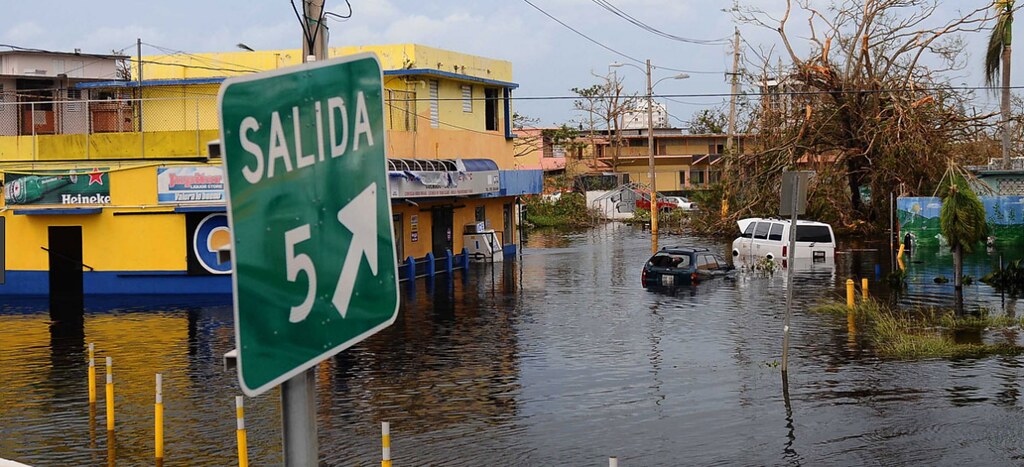
Hurricane Maria Destroys Puerto Rico's Science Programs Then Presents Unusual Research Opportunities?


The devastation caused by Hurricane Maria is still being revealed nearly a year and a half after the storm ripped through the island.  Of course, anyone who has lived through a disaster like this will tell you that the island will probably never recover.  Not to mention that the loss of life can never be replaced.  With that being said, any community (or island) must find the courage to recover and re-establish life as it were if possible.  


Under normal conditions, agencies such as FEMA (Federal Emergency Management Agency) would provide sufficient funds to help the island start the journey toward recovery.  Unfortunately, we do not live in normal conditions at the current moment under the current administration.  Funding agencies are being stressed beyond reach for existing funds and when this occurs, areas like scientific research usually suffer the most. 


How Did Maria Impact Science?


At the very least, the lightest impact (which actually may not be true due to PTSD), the lab members may undergo treatment to make sure that there are no residual medical issues after a storm has hit the island.  Of course, if you have no laboratory staff: graduate students, undergraduate students, postdoc's, professional researchers -- then you have no lab.  Meaning, all the best equipment can occupy the lab, but without scientists to run and monitor the instruments, then there is no lab.


The second critical component of any scientific laboratory are the scientific instruments and infrastructure in which these along with the supplies (beakers, tubing, cell cultures, glove boxes, etc.) needed to conduct good/sound science.  This is sometimes the perceived most critical component of any scientific laboratory.  Although, I would argue that the scientists which occupy any laboratory are the most critical components to any scientific instruments.  I have yet to see any scientific instrument just start collecting data by itself without any scientist's intervention/initiation.


A recent article in 'The Scientist' titled "Science in Puerto Rico Still Recovering After Hurricane Maria" details some of the disastrous consequences to a scientific laboratory after a storm of a magnitude such as Hurricane Maria.  The human damage alone can be irreplaceable not to mention the buildings and local municipal utility grid.  And when the destruction to the infrastructure is considered, parameters such as mold and water damage can set a laboratory recovery back several months to years:


Giray’s lab is among 14 or so in the Julio Garcia Diaz biology building, which was among those severely damaged, particularly as it was already undergoing roof repairs when the storm hit. Water seeped in through the roof and windows, damaging costly research equipment, furniture, and lab materials. Toxic mold thrived in the moist, hot climate, creating hazardous conditions that made the building uninhabitable. Power outages cut off researchers’ freezers and fridges, destroying precious genetic and tissue samples for good. The damages are estimated to range from $250,000 up to $2.5 million dollars per lab in that building, says Giray, a behavioral biologist whose main focus is honeybees.


Even more important are samples which are collected outside of the laboratory or purchased for several thousand dollars which are sensitive to temperature/humidity/vibrational fluctuations:


Some of the casualties from the hurricane are less easy to restore: “Collections take much longer time and may never be replaced,” says Giray’s colleague Riccardo Papa, who lost almost all of his DNA samples documenting the diversity of butterflies across South America when his lab’s –80 °C freezer lost electricity. Papa, an evolutionary biologist, didn’t have a lab again until a week ago, and until recently has been meeting with his students and postdocs at coffee shops or places around campus to discuss research. He has been able to do some experiments and genetic analyses in another building. Repairs are still underway for the damaged insectary, in which his team raises butterflies.


Research must go on.  With or without the infrastructure.  Here in California, after the Northridge Earthquake in 1994, FEMA set up temporary 'mobile homes' to serve as both classrooms and temporary offices along with laboratories in certain circumstances.  To hear that 'group meetings' were still being held at coffee shops is a testament to the pace of recovery.  In a majority of cases after a disaster, classroom recovery comes first, then eventually research laboratories.  Although, it is worth remembering that each research laboratory group is made up of students and research professors who take years (applying for individual grants/writing publications) to acquire the appropriate funding to purchase research scientific instrumentation.  Therefore, to put a price on the total loss in the event of a disaster like Hurricane Maria proves extremely difficult.


The total cost to a researcher is really unknowable for years to come.  Some researchers never recover and decide to shut down their laboratories after such a storm.  Which leaves current graduate students without an end in sight to their degrees (M.A. and PhD).  Additionally, staff (professional researchers) might quickly find themselves out of work and have to leave regions like Puerto Rico and find work elsewhere.  Which means transplanting their families and children's education to a different geographical location.  The cost can be severe not just to the researcher themselves.


More can be written in future articles on this theme of disasters and research laboratories.  Either together or separately.  The total cost to a geographical location from a disaster such as Hurricane Maria can only be estimated at the beginning (a very rough approximation).  The price tag evolves over time with the disbursement of emergency funds by organizations such as FEMA along with other federal organizations or the Congress.  The terrible destruction to a scientific institution is terrible to say the least.  Restoring science should be a high priority among others on the island of Puerto Rico.


Sunday, February 10, 2019

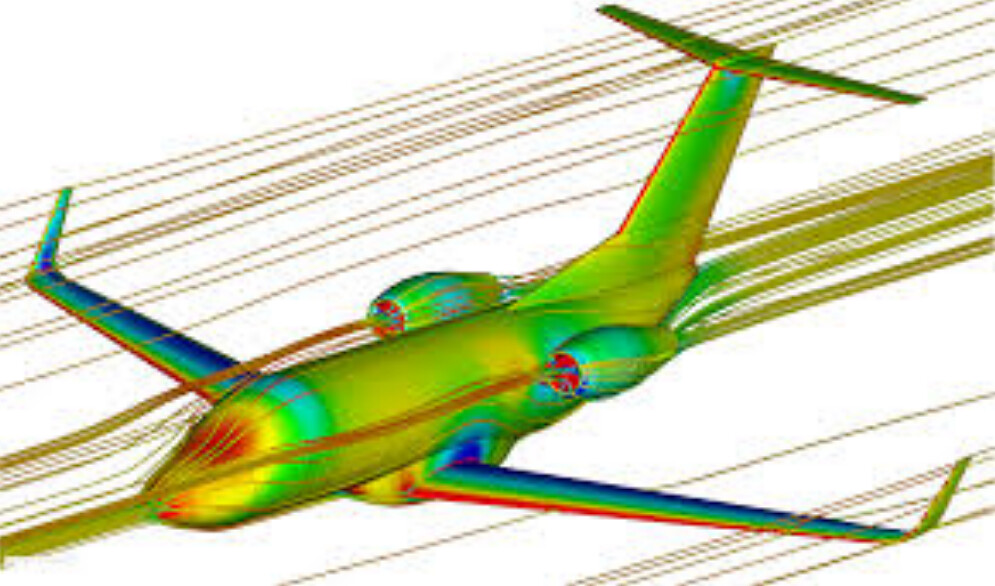
3 very interesting research projects for Fluid Dynamics Research


Source: Termoflow


Have you ever been on the road inside a small car only to be passed by a large semi-tracker truck?  Further, as you are passed, the driver experiences a lateral (right or left) push from the trucks passing?  This push is the wind flow which is being pushed to the side by the diesel truck's inefficient air flow.  One major consequence of this inefficient air flow is the production of wind resistance (or a drag force) -- which drives down the miles per gallon (fuel efficiency) a given vehicle can get.


All vehicles suffer to some extent from the inefficient air flow surrounding a vehicle.  Some more than others.  Although, a large (and I mean large) amount of interest has been devoted in the form of research to minimize (and improve) air flow across a given object (to generalize it).  For those who are unaware of the study of 'Fluid Dynamics', the following can serve as an introduction:


In physics and engineering, fluid dynamics is a subdiscipline of fluid mechanics that describes the flow of fluids—liquids and gases. It has several subdisciplines, including aerodynamics (the study of air and other gases in motion) and hydrodynamics (the study of liquids in motion). Fluid dynamics has a wide range of applications, including calculating forces and moments on aircraft, determining the mass flow rate of petroleum through pipelines, predicting weather patterns, understanding nebulae in interstellar space and modelling fission weapon detonation,
Fluid dynamics offers a systematic structure—which underlies these practical disciplines—that embraces empirical and semi-empirical laws derived from flow measurement and used to solve practical problems. The solution to a fluid dynamics problem typically involves the calculation of various properties of the fluid, such as flow velocity, pressure, density, and temperature, as functions of space and time.
Before the twentieth century, hydrodynamics was synonymous with fluid dynamics. This is still reflected in names of some fluid dynamics topics, like magnetohydrodynamics and hydrodynamic stability, both of which can also be applied to gases.[1]


With the working introduction given above, the study of 'fluid dynamics' is now more comprehensible.  Still, the variety of projects which the study of fluid dynamics covers is incomprehensible.  Nearly any given situation which involves moving parts different mediums can be understood and broken down into a research project categorized under fluid dynamics.  Why?  Chances are that there is a 'fluid' or  lubricant involved in the workings.


Further, as highlighted below, most objects which move through the world can be understood at the level of a project under the category of fluid dynamics.  The video below highlights 3 research projects that are share the field of fluid dynamics research:


Amazing to say the least.  I love really interesting research project.  Of course, I love to learn just about anything.  The first project which is being tackled by Marguerite Matherne a graduate student studying in Dr. David Hu's lab at Georgia Tech.  Her project involves looking deeper into the process of transporting pollen back to the beehive by bees.  Pollen is composed of proteins which would not normally just adhere to one another.  Therefore, the bee needs to suspend the pollen into nectar to form a suspension.


What properties of this suspension allow the bee to transport the 'maximum' amount of pollen back to the beehive?  The viscosity of the suspension needs to be just right in order to complete the journey (and not fall apart).  Although, the drag force of the shaped pollen cannot exceed the force exerted by the bee in flying back to the beehive.  Otherwise the trip would be impossible.  As shown in the video, the research covers these parameters along with others relevant to the process.  Nevertheless, the project is unique and important to the survival of the bee population -- not to mention helping humans with fruit crops by spreading pollen among crops.


The second research project which was developed by and carried out by Dr. Giorgio-Serchi at the University of Edinburgh -- is devoted to understanding the forces (fluid dynamics) generated by sea creatures resulting in movement across a given area.  How do the framework of the structure interact with the fluid to produce forward movement?  If we could see at the molecular scale, the picture might be much greater in difficulty, therefore, making models (using computer simulations) is suitable for a research project at the moment.


Last but not least, researcher Daria Frank is working with Dr. Paul Linden at Cambridge University to better understand oil plumes.  Specifically, as in the case of the Deepwater Horizon Oil spill, the oil disperses in a plume with an initial angular momentum (angular momentum due to the Earth's spinning around an axis).  The project is to characterize the parameters of the rising oil plume and compare those parameters to a storm passing over the Earth's surface.


Comparing an oil spill -- a swirling plume (in the presence of water -- fluid) versus a storm -- a spinning top (fluid is air).  What are the differences?  What are the similarities?  The information gathered will better place the oil/gas industry in a better position to combat challenges -- especially in the face of a disaster.


4 Accessible Examples


Shown below are 4 different examples of research projects which would be encompassed under the category of fluid dynamics research.  The examples are very accessible to each of us, since each represent real life examples frequently encountered in society.  As you progress through the examples, think of questions that you would ask regarding the dynamics surrounding the object's environment.


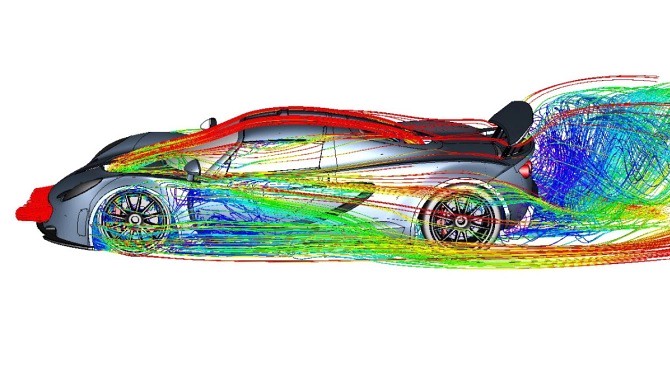
Example 1: Fluid flow around a race car:


Source: Rodrigonemmen


What are the most relevant methods for dealing with fluid dynamics surrounding the air flow of a car?  How do magnetohydrodynamics figure into the solution?  How do different materials play into the dynamics of air flow across a car?  What about the development of heat spots across a vehicle?  What type of instabilities contribute to turbulent air flow across a car?  What type of equations are necessary to model the air flow?  Partial differential equations?  In order to understand the system better, the solutions involve introducing a method which is a combination of methods. 


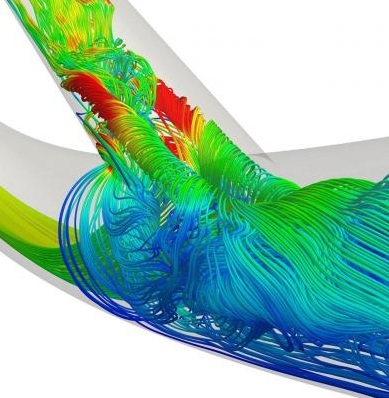
Example 2: Fluid flow through an human artery


Source: Di Cardilogy


How does the flow of blood through the vessels of arteries and blood vessels affect the dynamics inside of the heart during a cardiac cycle?  How does the build up of plaque on the side of an artery wall contribute to turbulent flow within the artery?  How does the plaque weaken the artery wall leading to atherosclerosis?  What are the overall dynamics of the arterial system?  How does one build up site of plaque contribute to overall flow within the entire system?  These are a just a few of the questions being entertained by such researchers in the field of fluid dynamics in medicine/engineering.


Example 3: Fluid flow around a bicycle


Source: Insightreplay


What are relevant parameters for cyclists?  Weight of the bicycle?  Weight of the cyclist?  If you shave your leg and arm hair, does that really cut time off of a ride?  What about body shape?  What about the shape of the frame?  Is there an optimal shape of each component which will result in reducing air flow across the system?  These are just a few questions that the cycling industry has had to deal with over the years.  Fluid dynamics could certainly contribute to answering a few of them.


Example 4: Fluid flow around a golf ball


Source: Symscape


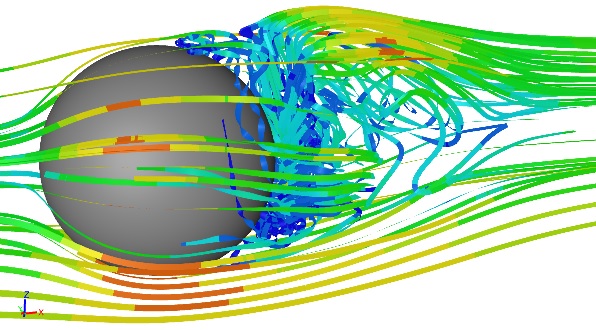
Most of us at one point or another have seen a game (or part of) of golf on the television or screen of a smart device.  What are the relevant parameters which play greatly into reducing the turbulence of air build up behind the ball?  In a previous blog post, I show how the 'dimples' on the surface of golf balls play a tremendous role in reducing the drag force on the golf ball.  Golf ball companies are very interested in reducing drag force overall to any degree.  Golfers dream of having complete flight stability during a game to better place their ball in a desired location.


Overall, these 4 examples serve us well in introducing the field of fluid dynamics.  Now, as each of us carry on in our busy days, feel free to pause a moment and look around yourself at your environment.   Find an example where the field of fluid dynamics could make a change -- a positive one.  There are many examples, each of us must be willing to think critically about the underlying parameters which dictate the performance and/or operation of a given phenomena.  Enjoy!


Related Blog Posts:


Does a Golf Ball have more than one shape (round)?


Parameters: "How widespread within NASA is the conviction that human activity is responsible for climate change?"


Want To Improve Science Communication: Add Artists!


White Blood Cells in action destroying Cancer Cells!


Astrophysicist Neil deGrasse Tyson explains why 'Space Force' is nothing new...


Scientists should find similarities rather than focus on differences


Why Chemistry Matters from the mouths of Nobel Laureates!


How Far Are We From Star Trek "Replicator" Technology?


"All Of Us" - The Best Medical Knowledge Update Effort - Please Join!


What Is Going On Inside That Cell?


Chemistry Reactions Are Amazing - See For Yourself


Parameters: Can Computers Think?


Parameters: 3D Printed Human Hearts?


A Virtual Tour Of A Plant Cell? Really?


A Virtual Tour Of A Human Cell?


Saturday, September 29, 2018

Astrophysicist Neil deGrasse Tyson explains why 'Space Force' is nothing new...


In a previous blog post, I introduced the concept of a space force as portrayed in popular news.  Remember at the end of the post, there was a brief video in which Commander Scott Kelly was interviewed in which the introduction of the 'orbital perspective' was unveiled.  What is an 'orbital perspective'?


What Commander Kelly was arriving at was the mutual respect with which space is explored by many different nations.  Specially, when each nation is collectively working in the 'International Space Station' -- looking back through the window -- they collectively see 'Planet Earth' - not each geographical location from where each have travelled from.  All that is visible from space is "One Planet Earth" which implies that all residents (of Planet Earth) should be working together rather than waging war between each other.  Which is why a 'space force' does not necessarily make sense.


Although, ever since each nation pursued travel into space, the commercialization from that initial travel has produced a presence over the past decade which is staggering in comparison to just five decades earlier.  The commercialization of space -- near commercialization -- more appropriately, each nation's presence in space had made the endeavor more about information collection rather than actual warfare.  Hundreds of satellites reside in near orbit and collect/serve as information carriers to various corporations which span across the globe (i.e. the planet).


With the above in consideration regarding the tremendous growth in space, what role do physicists play in space?  Or helping to create a 'space force'?  As you will see shortly, in the video segment from the YouTube channel of MSNBC, Astrophysicist Neil deGrasse Tyson explains why the concept of 'Space Force' is not new and misunderstood:


Nice.  Space warfare is not necessarily warfare as it is more about access to information.  The overall arching statement made by Professor Neil deGrasse Tyson regarding a space force in the video above is the 'fall out' from shooting satellites or other commercial space infrastructure down is going to be enormous and impact us all in some direct or indirect way. 


Which is to say, that if a certain government/enemy force were to shoot down a satellite or space hardware, the 'fall out' would be dangerous to say the least.  The explosion from destroying a satellite or other space hardware would fragment (break apart) into tiny pieces -- each of which -- would be traveling at a speed of 18,000 miles per hour.


To put that speed into perspective would be to cast that speed into traveling around planet Earth.  The circumference of the Earth is 24,901 miles -- the total distance around Earth at the equator.  Traveling at a speed of 18,000 miles per hour, a traveler would go around the entire planet Earth in 1 hour and 38 minutes.   The point is that destroying a piece of equipment in space could very easily result in destruction of other satellites -- such as our own.  We could potentially lose out in the process of shooting another country/nations' satellite down.


There is no need at the present time to create an independent 'space force' in the United States.  Each citizen of the planet should be working together rather than finding divisions.  Each country should aspire to work towards common goals -- especially when concerned with reaching out into space and beyond. 


Related Blog Posts:


Thoughts: Instead of forming a "Space Force" why don't we work together to solve the world's problem?


Scientists should find similarities rather than focus on differences


What is a typical day like for a systems engineer at JPL?


Thursday, September 20, 2018

Boston Natural Gas Explosion Reveals Old Piping Needs Replacement - Enough To Travel To Colorado?


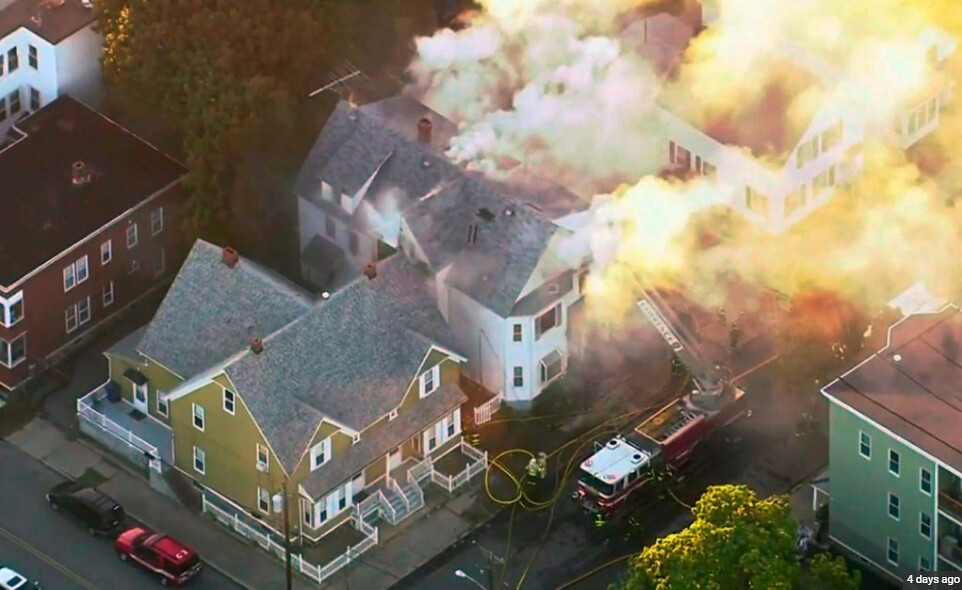
Terrible tragedies occur daily in certain regions.  In other regions, the frequency may be less so.  For the case of an explosion due to a natural gas leak, the frequency is small at the moment.  That frequency could be changing over the course of a decade due to badly aging pipeline (infrastructure) in Boston.  Recently, there was an explosion which destroyed 39 homes in a fire which started as a leak from a natural gas source. In the blog post below, the terrible event is cast into light for the reader to understand the extent of possible future damage that lies beneath the ground.


Aging Pipeline?


According to a news article in 'USA Today' titled "Natural gas explosions: Boston-area gas pipes among oldest and leakiest in US" a natural gas explosion was caused by aging pipes which are abundant in various cities across the United States:


The Merrimack Valley, the area north of Boston that was shaken by dozens of natural gas explosions Thursday, is served by some of the nation's oldest and most leak-prone pipes.
Investigators have yet to determine what caused the gas explosions that burned at least 39 homes in the towns of Lawrence, Andover and North Andover. But the gas utility that serves the area has more miles of old, cast-iron gas mains than all but 15 utilities in the nation, according to a USA TODAY analysis of federal safety data.


 Unfortunately, according to the Pipeline and Hazardous Materials Safety Administration, the replace of the corroded/damaged iron pipes is not required by law.  This is after years of the Pipeline and Hazardous Materials Safety Administration has spent years trying to convince utility companies to replace (i.e. invest) iron piping across the United States.


Currently, Boston has enough pipe which needs to be replaced to cover the ground needed to travel between Boston and Colorado.  Wow! According to the article cited above:


In the Boston area, Boston Gas in the metro area and Columbia Gas in the Merrimack Valley combine to use more than 2,200 miles of old iron mains. That's more iron gas pipe than is still in use in 45 other states combined. 


Of course, in the same article the limiting step (main obstacle) for the utility companies is cost.  The cost to replace the aging pipe with plastic roughly is around $1 million dollars per mile.  Wow! I can see how the utility companies would be resistant toward change at such a cost.  In order to get a more clearer understanding of the cost of $1 million dollars per mile, lets perform a brief dimensional analysis on that figure -- 2,200 miles worth of aging piping.


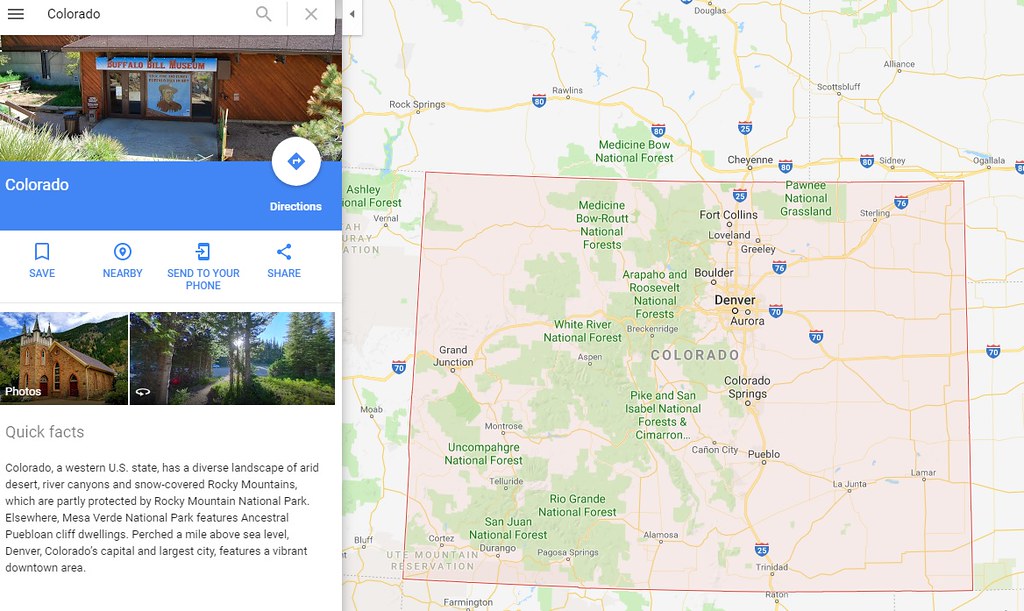
If GoogleMaps is consulted by typing into the search bar "Colorado" then hitting enter, the answer is shown below:


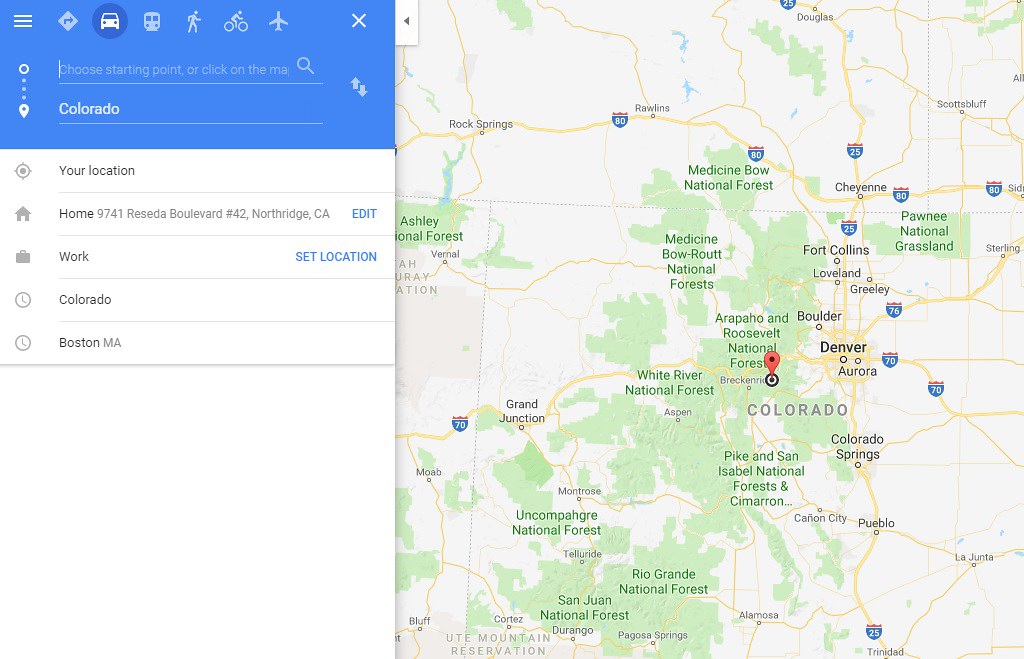
Which shows a map of Colorado.  Now, if we zoom in onto the search function within GoogleMaps on the upper left hand corner of the screen, the picture appears as follows - shown below:


The picture is difficult to resolve the box in the upper left hand corner.  Although, the point is that there is a space to enter the 'starting point' (starting destination) and the ending destination is already filled with 'Colorado'.  Upon entering the entry 'Boston MA' and pressing enter, the map is shown below with different routes between the two points:


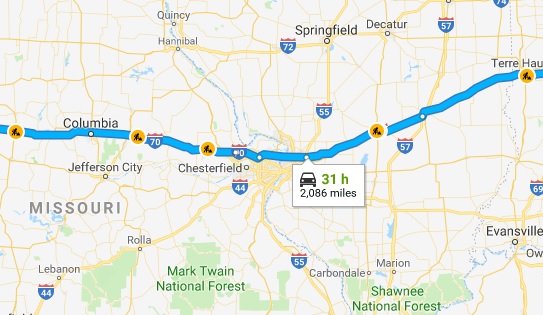
If the route is 'zoomed in on' the image below is shown with the route information - i.e. time, distance - as shown below:


The total distance between Boston (MA) and Colorado is 2,086 miles.  Traveling by car would take an estimated 31 hours.


What does one make of this analysis?


Especially in relation to the article above regarding old iron gas pipes which need to be replaced?


The cost of replacing a mile of old iron pipe cited above was around $1 million - does that make sense?  Possibly with all of the digging and reapplication of asphalt to cover the new pipe (not to mention the cost of plastic piping).  The construction costs can certainly add up over the course of any analysis.  What is important here is the following:


Replacing 2,200 miles of piping is equivalent to replacing a pipe extending from Boston (MA) to Colorado.  


Wow!  Looking at the distance in this respect casts the project into a much different light.


What Contributes to Pipe Degradation?


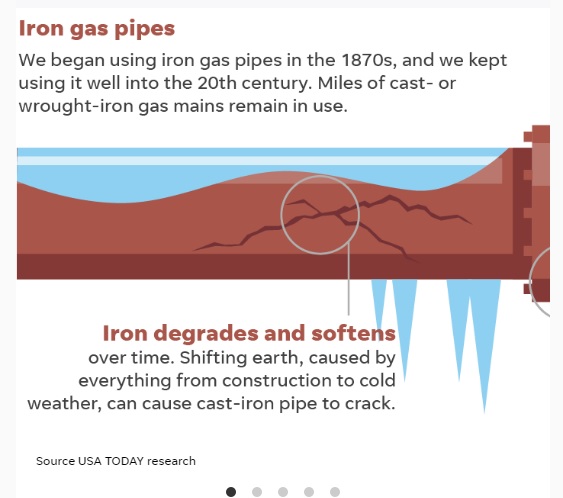
Last but not least, a brief exploration (and I mean brief) into the various causes (parameters) which contribute to the degradation of iron pipes (or steel in other cities) might be useful the reader.  Especially, since a few images were provided in the article cited above with text.  I have taken the images and pasted them below to give a brief tour of parameters which contribute to the degradation of pipes (underground) over time.


Source: USA Today


In the image above, the points are made regarding the aging of iron pipes simply due to shifting earth -- whether caused by weather or local construction is of concern to the residents around the city.  Additionally, city officials should consider the projects and weather patterns when thinking about aging pipes and a timeline to replace such pipes.


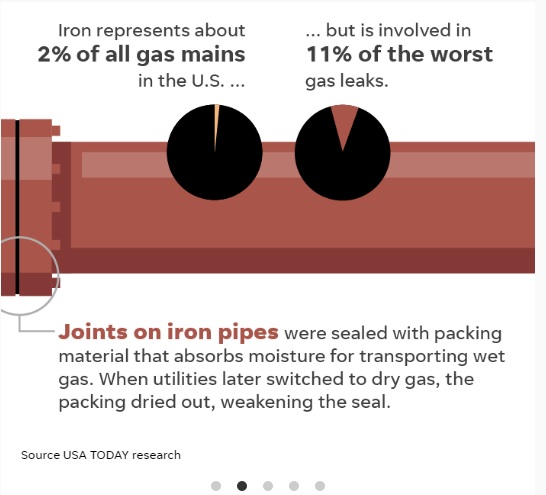
Speaking of weather, the 'joints' in between two sections of pipes used to be made out of a material which absorbed moisture since the natural gas running through the aging pipe contained moisture.  Recently, the moisture has been removed.  With the removal has left the interior 'joint' material to dry out and potentially form a leak as shown below:


Source: USA Today


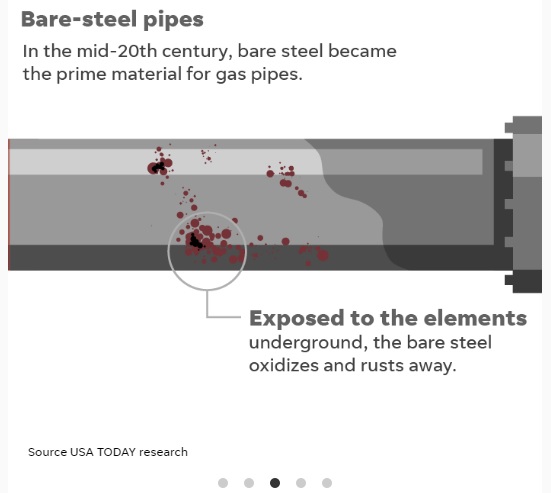
New or replaced piping should not contain such material. Over time, steel piping came into fashion to be used over iron piping.  The issue surrounding steel is that inevitably, the metal surface (exterior) will be subjected to the local elements in the underground.  Such elements will promote oxidation reactions which will cause rust or corrosion and weaken pipes or form leaks as shown below:


Source: USA Today


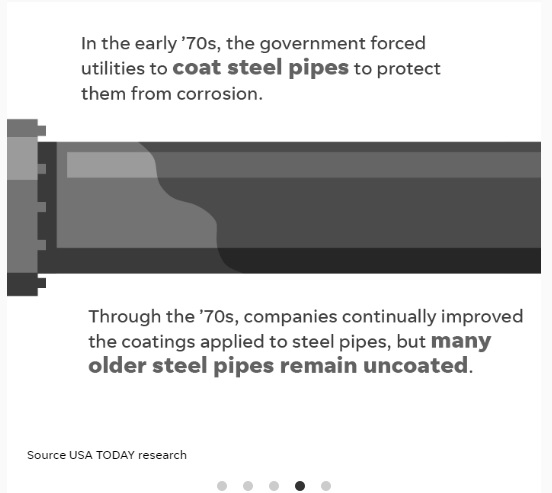
In order to mitigate (reduce) such corrosion or rust reactions from occurring, a 'coating' was applied to the steel pipes before installation.  Of course, sitting under ground which might be shifting or exposed to varying weather patterns, the 'coating' is inevitably going to react and disappear over time.  Further, the older steel was not coated. Which could have other problems listed above:


Source: USA Today


Conclusion...


The terrible tragedy of last weeks explosion due to a leak in the pipes running underneath a city carrying natural gas is devastating to say the least.  In fact, the only observation that is worst than the tragedy is the fact that there exists still 2,200 miles worth of remaining 'aging piping' which could give way at any time and cause another explosion.  In the blog post above, I cast the large number of remaining miles of iron piping still underneath the residents of Boston in terms of a single 'one way' trip from Boston to Colorado.


One has to really stop and pause to comprehend the danger which lies beneath them -- when staring at the map in the blog post above.  Just think of the time and energy costs of replacing the pipe.  The replacement will not happen over night to be sure.  But if nothing happens, then what remains is the potential danger of another tragedy.  Hopefully, the mayor of Boston steps up and implements guidelines to replace the piping in a swift timeline.  The safety of the residents (of the US) is of paramount importance to us all.


Related Blog Posts:


A Forecaster Predicts That Hurricane Florence Will Drop Enough Rain To Fill 18,400 Mercedes-Benz Superdomes

Hurricane Harvey Drops Enough Rain On Houston To Fill 560 Dallas Cowboy Stadiums


How Much Water Is Contained In All Oceans Around The Globe?


Storm Raises Water Level In Lake Cachuma By 31 feet, How Much Water Is That?


How To Make Sense Of Water Flowing At 100,000 Cubic Feet Per Second


Can 11 Trillion Gallons Of Water Fill 14,000 Dallas Cowboys Stadiums?


How Much Rain Did The East Coast Receive From Hurricane Matthew?


How Much Rain Did Haiti Really Receive?


How Much Rainfall Has Dropped On Louisiana?


How Big Was The "Water Bomb" Of Rainfall In Macedonia?


How Much Rain Did Huauchinango (Mexico) receive?


How Much Rain Did Elliot City (Maryland) Really Receive?


If The Mosul Dam Breaks, The City Of Mosul Would Be Under 65 Feet Of Water?


What is the volume of water in a few inches of rain?


Volume of Waste in the Mine Spill (in Brazil) Equivalent to 78 Deepwater Horizon Oil Spills


Saturday, August 4, 2018

Thoughts: Instead of forming a "Space Force" why don't we work together to solve the world's problem?


Source: Brane Space


If you have not heard yet, the current administration in Washington D.C. is planning to form a 6th military branch called the "Space Force."  If you click on the hyperlinked "Space Force" you will be directed to the current (as of the writing of the post) search for this new endeavor.  Many in the defense industry are scratching their heads wondering where the endeavor is headed.  More importantly, why is President Trump calling for the formation?


With the entertainment of that idea in mind, there are also a community of special high ranking military service personnel who are wondering why not just deal with the current problems of the world.  Who are they?  In the video below from 'MSNBC' titled "What We Know About The Existing U.S. Space Force | Velshi & Ruhle | MSNBC" a brief discussion arises between the reporters and Commander Scott Kelly regarding the formation of a "Space Force" and the "Orbital Perspective."  The video is less than 8 minutes in length and worth viewing:


According to reporting by MSNBC reporter Ali Velshi in the video above, there are multiple components to transitioning toward such an endeavor/change.  First, funding would have to be approved by Congress (good luck on that) to create a 'Space Force'.  Not to mention, the paperwork and usual mandates and laws which accompany such a creation.  The process would be a huge ordeal.  Currently, each branch has a 'space subdivision' with the United States Air Force leading out in front with 'Space Command'. 


Skeptics mainly point to the cost, which would ultimately restructure the current distribution of money which funds the main 5 branches of the military.  The video above is divided into two parts.  The first was just discussed -- funding and creating such an extraordinary 'Force' when the military adequately handles the present demand.  The second part of the video above covers an interview with former NASA astronaut Scott Kelly.  Commander Scott Kelly rightfully points out that currently, each astronaut up in space working together are former enemies (military personnel) who are now forging a relationship to work together to advance the mission of space exploration (i.e. different nations put astronauts in the International Space Station). 


As Commander Scott Kelly points out in the video above, the observation by astronauts alike when viewing the Earth from orbit is the following: "Each of us should work together to solve the ONE PLANET on which we both live."  From his description, the 'orbital perspective' causes a viewer to question the meaning of "countries," "states," "nations" or "boundaries" in general.


Historically, each country (nation) has embedded the need to defend space under various branches of the military.  In the United States, the United States Air Force has a branch responsible for space.  Throughout history, only one country (nation) has had anything like a 'Space Force' -- which is Russia.  Currently, each nation who contributes human capital (i.e. astronauts) to the International Space Station do not feel that their welfare is threatened.  At least not enough to start a "space war" forming each a bunch of separate 'Space Forces' in space.  How would that even work?


Until the occupation of space becomes an issue between nations, each nation should focus on their respective contribution to the problems plaguing planet Earth.  There are more than enough problems to focus on without the need of creating another set of military issues (i.e. creating Space Forces).  The wars which are being battled here on Earth are plenty to keep us busy as an aggregate of different nations trying to inhabit the same planet.  Here is another opinion/article from a popular astronomer/astrophysicist on the matter.


Related Blog Posts:


How Much Water Is Contained In All Oceans Around The Globe?


How Much Would The Sun Weigh If Filled With Water?


Why Is Elon Musk Powering A Freight Ship With A Rocket Engine?


Why Do People Fly Drones Into "Restricted Air Space"?


Are The Elements Hydrogen And Helium "Of This World"?


Thursday, June 14, 2018

Conservatives are calling on President Trump to fire EPA Administrator Scott Pruitt over Renewable Fuel Standards


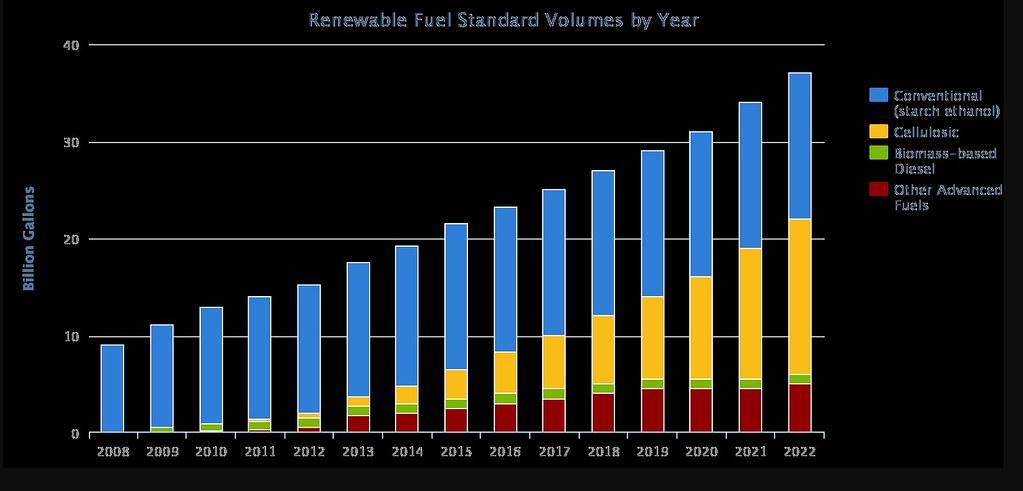
What is the motivation to move from a 'fossil fuel' based economy toward a renewable energy economy?  According to an excerpt which arrived in my e-mail box yesterday morning from 'Politico Energy,' farmers are not happy with EPA Administrator Scott Pruitt's handling of the Renewable Fuel Standard as shown below:


ON THE ROAD AGAIN: Following his talks Tuesday with Kansas farmers, EPA Administrator Scott Pruitt is expected to travel today to a sorghum farm in Reliance, S.D., where corn growers will take to their tractors to protest his moves on biofuels. In particular, the farmers are angry about his proposed changes to the Renewable Fuel Standard, and they're accusing him of siding with oil refiners.
Already, Pruitt faced some heat when he met with farmers and ethanol producers in Kansas on Tuesday. "To be honest, Administrator Pruitt, we're mad as hell," Kansas Corn Commissioner Dennis McNinch told Pruitt, according to a KCC press release. "We are under attack once again from the oil industry as they try to unravel the RFS using their latest scare tactic claiming that RINs are about to put them out of business. Big oil is enjoying wide profit margins today. People like Sen. [Ted] Cruz believe that the oil industry needs to be thrown a bone. How many bones do they need?"
From Pruitt's corner, the administrator called the visit "a candid and productive dialogue" on the RFS in a statement. Statements from farmers indicate Pruitt also said EPA has the authority to reallocate blending requirements from exempted small refiners to large refiners, which farmers say would stabilize biofuel credit prices. Bill Pracht, CEO of the East Kansas Agri-Energy, the ethanol producer Pruitt visited, said in a separate statement he told Pruitt that biofuel credit prices had been so volatile over the last year that the company had idled a brand new biofuel plant.
The administrator tweeted out images from his trip Tuesday. "I strongly believe the most effective way to make decisions is to hear directly from stakeholders," he wrote. "The Trump Administration is committed to standing up for the American farmer."
And he tipped some WOTUS news: During his visit to Dedonder Farms in Kansas, the administrator told farmers that he would send the agency's new Waters of the U.S. rule to OMB later this week, according to a tweet from local media at the event.
Still, ahead of his trip today, the American Future Fund, an Iowa-based 501(c)(4) focusing on conservative and free market ideas, announced a new TV ad campaign targeting Pruitt. "Scott Pruitt is a swamp monster," the ad says. "Mr. President, you know what to do," before playing a clip of President Donald Trump declaring, "You're fired." The ad is initially set to air in Nebraska and South Dakota. Watch it here.
ON THE HILL: GOP Sen. John Cornyn says finding common ground on an overhaul of the RFS is "like trying to come up with peace in the Middle East." Cornyn has not yet put pen to paper on a bill, though he's still holding discussions and he hopes to at least introduce a bill this year. "It's not easy," he said. "There's a reason this has been hanging around for a long time. We're just trying to grind it out day by day."
Not into octane: Cornyn is not enthusiastic about swapping out the RFS for a national octane standard, a policy that seems to have taken center stage in talks led by Rep. John Shimkus. The octane standard has some backing from both oil and ethanol interests, but support will depend on the details of the plan. "No decision is made on our side," he said. "I'm not sure we need another government mandate when we're trying to get rid of one, so that's a concern."


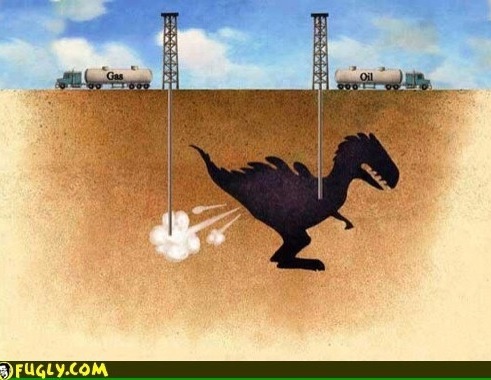
The excerpt above raises the obvious questions: Where does oil come from?  The ground.  Why is oil in the ground to begin with?  Why is oil called 'fossil fuels'?  If Google is consulted, then the following answer is shown below:


Which translates to the following picture shown below from the website 'Quora':


Source: Quora


A picture is worth a thousand words!  There are only a limited number of 'fossils' which were buried many thousands of years ago.  If there have been no recent extinction events which have caused a replenishing event, then why would a society think that 'fossil fuels' will be around forever?  The world operates on around 94 billion barrels a day.  Oil rich regions like Iraq where oil seems to be endless are speculated to only be able to support the world for 4 years.  That is, of course, if the world was drawing oil only from Iraq.  Given the distribution of oil from around the world, the estimate is probably much longer.


Despite the obvious decline in investment in 'fossil fuel' based energy -- as discussed in this blog post previously, the Trump Administration continues to seek waivers for the refineries to please the oil industry.  Why?  I am amazed.  Even after being criticized heavily by Congress - as noted in the previous blog post on the Renewable Fuel Standard.


Although, presently, the Administration is caught in their own conundrum -- which was brought on by earlier language sent out to please both parties.  In earlier discussions, both the White House and the EPA Administrator seemed sincerely interested in 'bailing out' both industries -- which seemed impossible at the time -- and is now coming to light to be impossible.  Lesson learned: Watch out what you promise to whom you promise!


As a result, farmers in the Mid West have now started to turn against the White House and the EPA Administrator.  The turning tide might not be very strong at the moment.  Although, the blatant display of displeasure is certainly a sign of the changing times.  The conservative nonprofit group 'American Future Fund' has produced the following video (commercial - 30 seconds in length) calling for EPA Administrator to be fired:


Wow.  Maybe the time has arrived for the White House to make changes which are more in line with the changing world.  Which is to say, adhere to the targets for the Renewable Fuel Standard set by Congress.  Stay within the goals set by the Paris Agreement.  And drop support for the aging (and dying) coal and nuclear power plant industries.  The world is changing.  Why is the U.S. not in line to change with other countries?  Lets start demanding change too.


Related Blog Post:


Parameters: Oil vs. Corn based Ethanol - A Tug-Of-War between Trump Administration and Congressional Leaders


Parameters: Shells Oil Corporation Invests In Renewable Energy Infrastructure


Thoughts: Trump Administration Realizes Renewable Energy Is Here To Stay?


Do You Need Clean Air To Breathe? An Introduction To Environmental Justice


Environmental Entrepreneurs Weigh In On Repealing The Clean Power Plan


EPA Blatantly Suppresses Scientific Results Regarding Climate Change?


EPA Director Finally Realizes Reality Of Trying To Roll-Back Obama Era Clean Air Act Regulation


How Can The Paris Climate Agreement Be "More Favorable To The U.S."???


Paris Climate Agreement Is A Start Toward The Renewable Energy Future


Iraq Has Enough Oil To Support The World For 4 Years -- What?


Is 94 Million Barrels Of Oil A Large Amount? That Is The Global Daily Demand!


Tuesday, June 5, 2018

Scientists compare Misinformation In Mainstream News to a Viral Infection

Source: Wikipedia


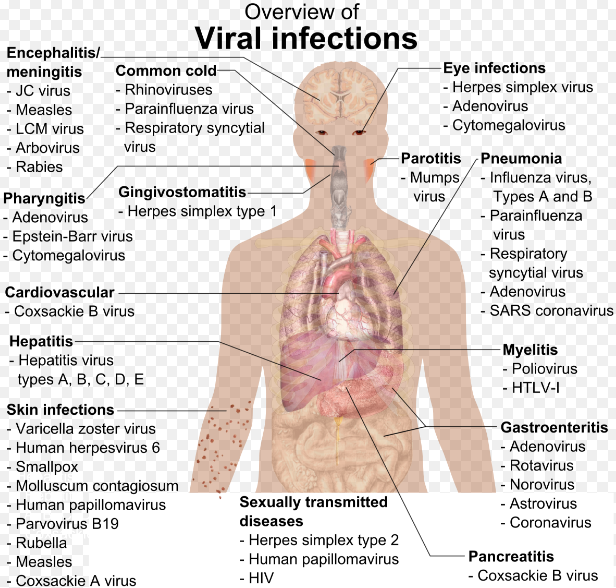
We are inundated with a variety of news from a large amount of sources everyday.  How do we make use of such information?  How do we verify the deluge of information?  In keeping with the tradition of educating the public on how scientists view various events portrayed in the media along with life in general (i.e. how do scientists think), a new piece of useful information has surfaced for readers to mull over.  Scientists compare the misinformation in the news cycle to a viral infection.


In a past issue (December of 2017) of 'Science' magazine the following "letters" were sent into the Journal.  The "letters" section is composed of chosen comments sent in by readers regarding earlier commentary/reporting from the science community which was published in an earlier issue.  In the particular issue mentioned in the comments section -- there were a couple articles about the circulation of 'misinformation' in the mainstream news.  The scientists drew parallels to the inoculation against an infection in biology:


The unprecedented spread of misinformation threatens citizens' ability to form evidence-based opinions on issues of societal importance, including public health, climate change, and national security. In his Editorial “Nip misinformation in the bud” (27 October, p. 427), R. Weiss argues that fact checking after misinformation has spread is often ineffective. Decades of research in cognitive science (1) have buttressed this concern by establishing the robust “continued influence effect”: Post-publication retractions and corrections often fail to eliminate the influence of misinformation. In some cases, they reinforce falsehoods simply by repeating them. The more exposure people have to a falsehood, the more truth-value they ascribe to it (2). The networked nature of online media enables misinformation to spread rapidly, much like a viral contagion (3). Accordingly, Weiss calls for a solution in which scientific facts reach the public before misinformation has a chance to spread and take hold.
A growing body of research suggests that this may be possible, but it must be done preemptively. This process of “inoculation” adheres to a biological analogy: Just as injections containing a weakened strain of a virus trigger antibodies in the immune system to help confer resistance against future infection, the same can be achieved with information. Recent studies find that misinformation can be used against itself: By preemptively warning people against misleading tactics and by exposing people to a weakened version of the misinformation, cognitive resistance can be conferred against a range of falsehoods in diverse domains such as climate change (4, 5), public health (6), and emerging technologies (7). In the battle against misinformation, it is better to prevent than cure. The benefit of inoculation is that it can spread, too, online and through word-of-mouth (8). News outlets and the public can help inoculate each other to achieve societal immunity against misinformation.


The concept of preemptively warning people will work in theory.  In fact, depending on the culture from which the person is from, preemptive action might work more effectively.  Different countries have different models of regulatory procedures - for instance - which make such actions work in much different ways.


Here in the United States, the regulatory system appears to be at the moment more of a 'reactionary' system rather than a 'proactive' system.  Which means that preemptive measures do not necessarily work very effectively.  That is, of course, not to say that in our country every resident believes this to be true.  There will be a sizable percentage on which preemptive knowledge might work quite well on informing.  Although, over the range of the entire population, this kind of warning appears not to work as well as in other countries.  Why?  I have no idea at the moment.


As an example, take the recent attempt by the White House (and government agencies) to cover up a health report on the potential dangers of the class of chemicals known as perfuorinated chemicals.  Recently, I wrote a blog post on the cover up.  Then I followed the initial blog post up with an update to the initial introduction of terrible news.  On top of the breaking news, during a supposed conference held to discuss solutions, the Environmental Protection Agency (EPA) staff attempted to throw journalists out of the conference.  The agency's actions were an obvious attempt at covering up important news.


The terrible aspect of the news is that there are inherent dangers associated with the class of chemicals -- which are well known.  This is a blatant example of a reactionary system.   Why not put in place measures to replace this class of compounds with another class of chemicals which are less harsh on humans along with the environment?  Another related 'reactionary' measure instituted in the United States is the Chemical Safety Board.  The Chemical Safety Board is charged with investigating the aftermaths of tragedies (chemical hazardous spills, fires, accidents, etc.).  Why not have a 'proactive' system in place?  Currently, the fate of the Chemical Safety Board is in jeopardy -- read about that here.


The regulatory system in other countries -- say Britain for example -- is built on the 'preemptive' system.  Instead of 'reacting' to a given tragedy, the British will put in place laws and regulation -- voted on by parliament - which are 'proactive' in nature rather than 'reactive'.  Therefore, a 'preemptive' strike would work quite well over in that part of the world.  Why there is such a large difference in different parts of the world is beyond my understanding at this time.  If you (the reader) has any inputs (ideas) on this difference, please feel free to contribute in the comments section below.


Conclusion...


The United States is made up of a regulatory system which is 'reactive' in nature rather than 'proactive'.  I would love to see the system change in the near future.  How to change the system exactly I do not have the solid idea?  Although, any change in the United States definitely has to build from the ground up through voting/speaking out to our respective political representatives who make/create law/regulations on our behalf.   Additionally, a better informed society is willing to take a risk and become 'proactive'.  That is not to say that we are a nation of 'dummies'.  I believe that each of us could educate ourselves on a range of matters which in turn would create a better country - that might resemble a proactive rather than a reactive system.


Of course, in order to do so takes time and effort on each of our parts.  What have you done to make the world a better place?  What steps are you taking to help inoculate the public against 'fake news'?  Rather than spend your time upset, take action to reduce the spread of fake news.  Here on this site, I try to bring to light news about issues in hope of communicating the importance of understanding the issue.  At least to provide a platform from which the reader (you) can further investigate the matter in greater depth.  The path is yours to pursue to educate yourself and others.  Inoculate yourself by educating yourself.


Related Blog Posts:


Chemical Safety Board's Future Uncertain as Hurricane Season Approaches


How Dangerous Are Cigarettes?


Thoughts: What Does National Institute of Health Director Francis Collins get asked in front of Congress?


Update: EPA Throws Journalists Out Of PFAS Conference - Why?


Update: Congress asks Federal Agencies about Dangerous Chemicals -- PFOA and PFOS


Congress Asks Defense Department and Environmental Protection Agency about Dangerous Chemicals


Wednesday, May 30, 2018

How Dangerous Are Cigarettes?


Source: Mirror.co.uk


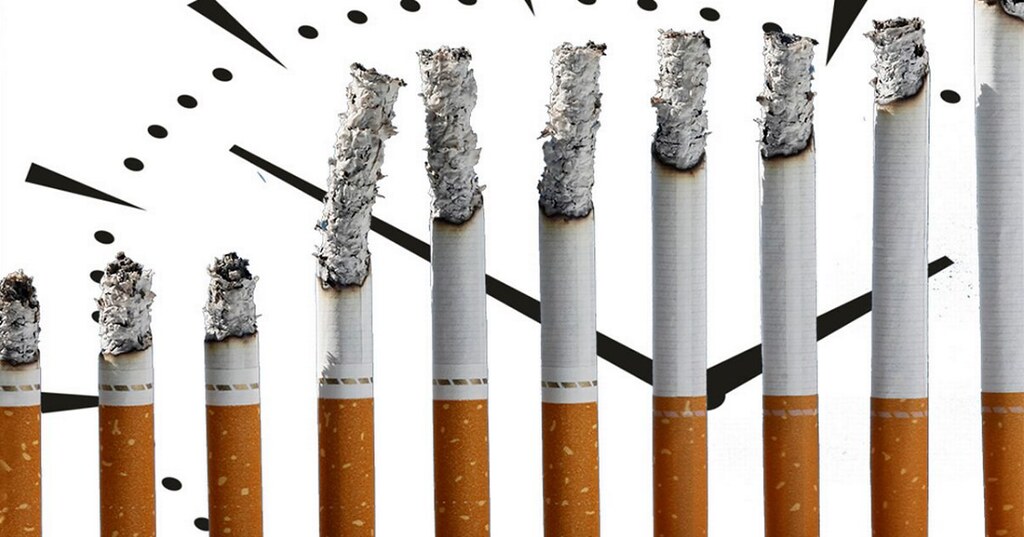
By now there are probably few people who are not aware of the dangerous aspects (health dangers) of smoking cigarettes.  The adverse health impact of smoking cigarettes is very visible in our society today.  People are dying of lung cancer due to smoking.  Additionally, the tobacco industry lost a landmark case in the late '90's' for covering up the fact that nicotine is addictive and the industry was aware of that fact.  Currently, the movement is now shifting toward 'vaping'.  I wrote a blog post about the potential hazards of vaping which can be found here.  For this blog post, I thought that I would talk a little about cigarettes and the dangers behind them.


Cigarette Production Is Dangerous


Recently, I stumbled upon a video created by the U.S. Food and Drug Regulatory Agency regarding the dangers of cigarettes (3 minutes in length):


Let's take a step back and review the crucial steps outlined in the video above:


1) Plant

2) Harvesting/Processing

3) Combustion


Below, each of the above steps are slightly elaborated on for the purpose of clarity for the reader:


1) Plant Stage:


As indicated in the video, plants have natural 'pesticides' defense mechanisms to keep bugs and invaders away.  Just so happens that the pesticide commonly found in tobacco plant is the addictive component in cigarettes -- Nicotine.  In the late 90's, a huge lawsuit ensued around the tobacco companies disregard for evidence that was in their hands regarding the 'addictive nature' of nicotine.  One of the largest legal battles gave the largest monetary settlement which cost the tobacco companies hundreds of millions of dollars.


On top of the addictive nature of the chemical  nicotine, plants also have a wide range of chemicals stored in their arsenal to carry out day to day operations.  In addition to the arsenal of compounds needed for daily operation, plants also uptake chemicals found in the soil.  Which means that toxic metals like arsenic or lead (not to mention cadmium) could potentially be incorporated into the cigarette's composition solely based on growth location.  Additionally


For instance, what if a tobacco field was next to a chemical plant?  Any chemicals which made their way into the air and further into the soil could potentially end up in the cigarette that you hold in your hand.  These are just the chemicals which make their way into your cigarette by being in the soil in which the tobacco plant is grown in.  Rarely do people consider chemicals leaching (entering) into a plant if diffusing from a far off chemical or industrial plant.  Location matters.


2) Harvesting/Processing Stage:


The next stage after the planting the tobacco plant and allowing them to grow is the 'harvesting/processing' stage.  The plant is taken from the ground and exposed to the 'curing process' during which 'tobacco specific nitrosoamines' are formed.  Termed 'TSNA's' by the Food and Drug Administration (FDA), these compounds are known carcinogens which cause cancer in both the lungs and esophagus.  The tobacco plant is dried out during the curing process and treated with specific chemicals to prepare the plant for processing into a cigarette.


During the 'processing stage' of the production of cigarettes, at different stages chemicals are added to the tobacco plant to mask undesirable features in a cigarette such as harshness or odors along with undesirable tastes.  These chemicals or sugars can eventually become acid aldehydes which are known carcinogens.  Other chemicals may be added during the processing stage to enhance other qualities of the cigarette which contribute to the desirability of the final product which resides in the consumer's hand.  The point is that during the harvesting/processing stage, the tobacco is exposed to a large number of chemicals which was previously unknown to any reader of this article.  One large assumption is that all harmful chemicals are produced in the combustion process -- which is far from true.


3) Combustion Stage:


In the combustion stage, the cigarette has been formed into the familiar product sold in packages shown in the introductory photo above.  The process of burning the cigarette is defined as a 'combustion' process explained beautifully by the Government of Canada below:


Combustion is referred to as a chemical reaction.
Here is an example of a chemical reaction: a nail getting rusty (the metal oxidizes in the presence of oxygen).
Matter is changed by combustion.
Combustion modifies the order and organization of atoms in chemicals.
Order and organization
Just in the same way building blocks can be put together, taken apart and re-assembled to form a new construction, atoms can be put together, taken apart and re-assembled to form new chemicals.
In combustion, oxygen from the air and intense heat cause the atoms of the chemicals naturally present in the tobacco plant to reorganize into new chemicals.
The example shown here demonstrates this modification using building blocks as an analogy.
When a cigarette burns, the chemicals in the tobacco are changed into new chemicals!
Many of these new chemicals are toxic.


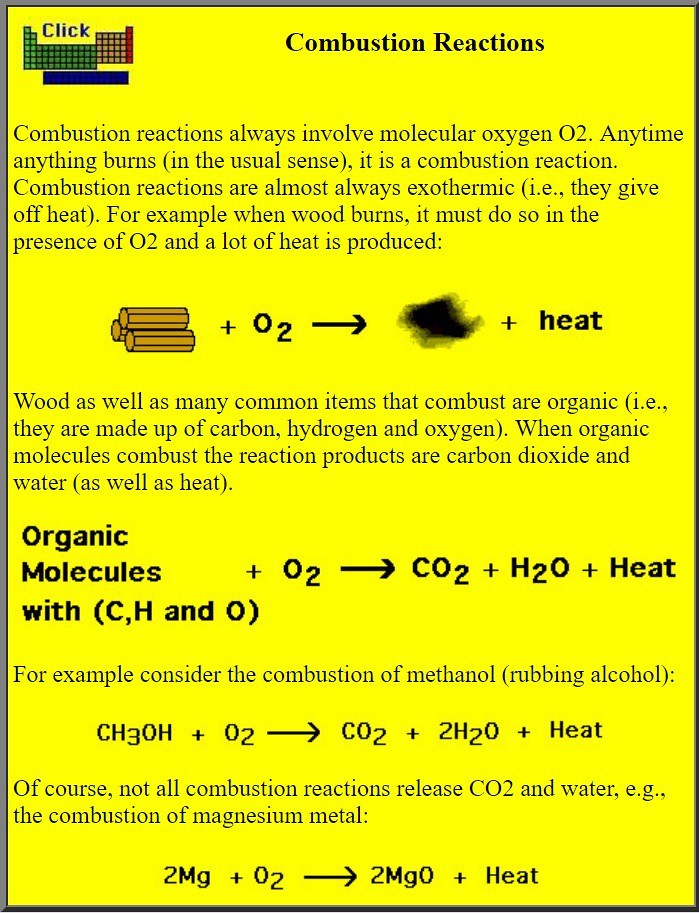
To understand the chemistry behind a combustion reaction, here is an image taken from the University of Indiana -- with a quick but concise lesson on combustion reactions shown below:


As shown in the image above, the combustion reaction is portrayed in the first reaction line with a pile of wood reacting with "Oxygen (O2)" producing black smoke and heat.  These are not conventional symbols (or chemical language), the reaction is represented in the basic sense -- visually.  Here is the combustion reaction of paper shown below:


Source: byjus.com


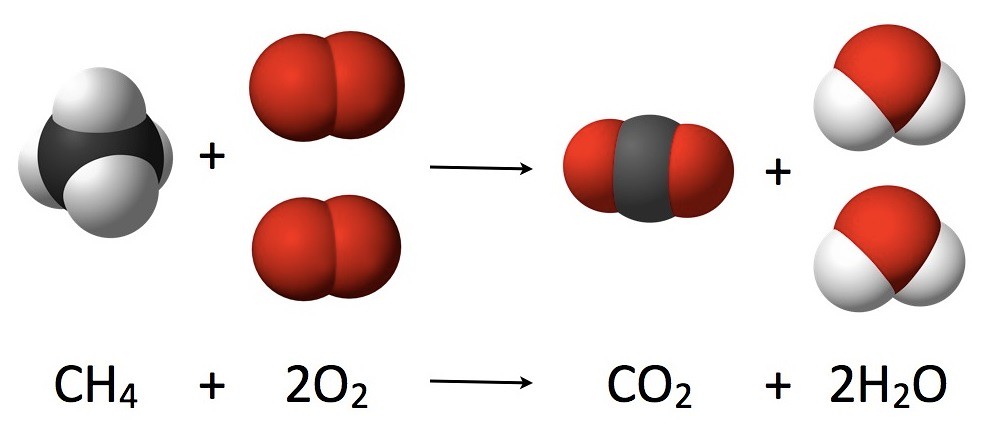
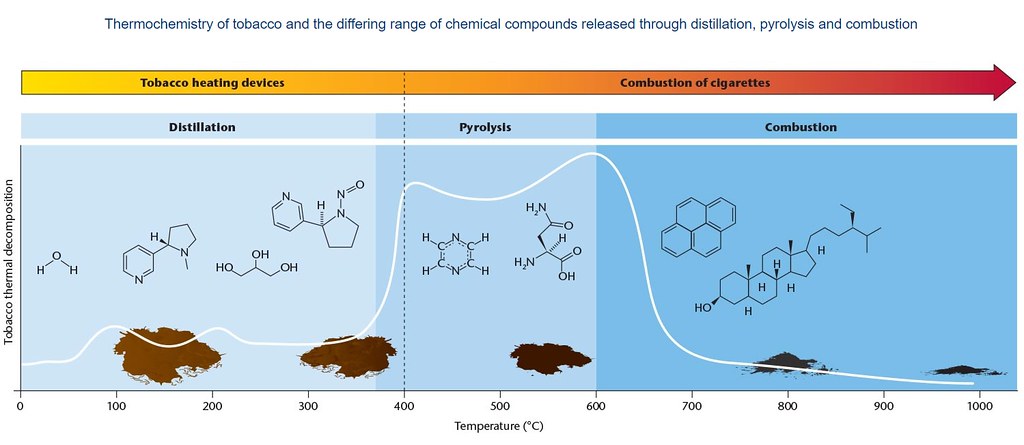
In the reaction above, methane reacts with 2 moles of oxygen to produce carbon dioxide along with 2 moles of water.  For more about moles, visit previous blog posts.   Or consult the wikipedia page for Avogadro's Number by clicking here.  The point is that during the combustion reaction, atoms rearrange themselves.  In the product phase, there is extra energy given off as 'heat'.  Below is a spectrum of different thermal (heat driven) processes: distillation, pyrolysis, and combustion.  On the x-axis is temperature.


Source: Bat-Science


By clicking on the 'Source link' below the image, the enlarged (larger) image will appear.  The point of the picture above is to show that if different amounts of heat is applied to the same tobacco (chemical), then different products will be given off.  This is a very important concept to grasp when thinking in terms of energy and chemistry reactions.


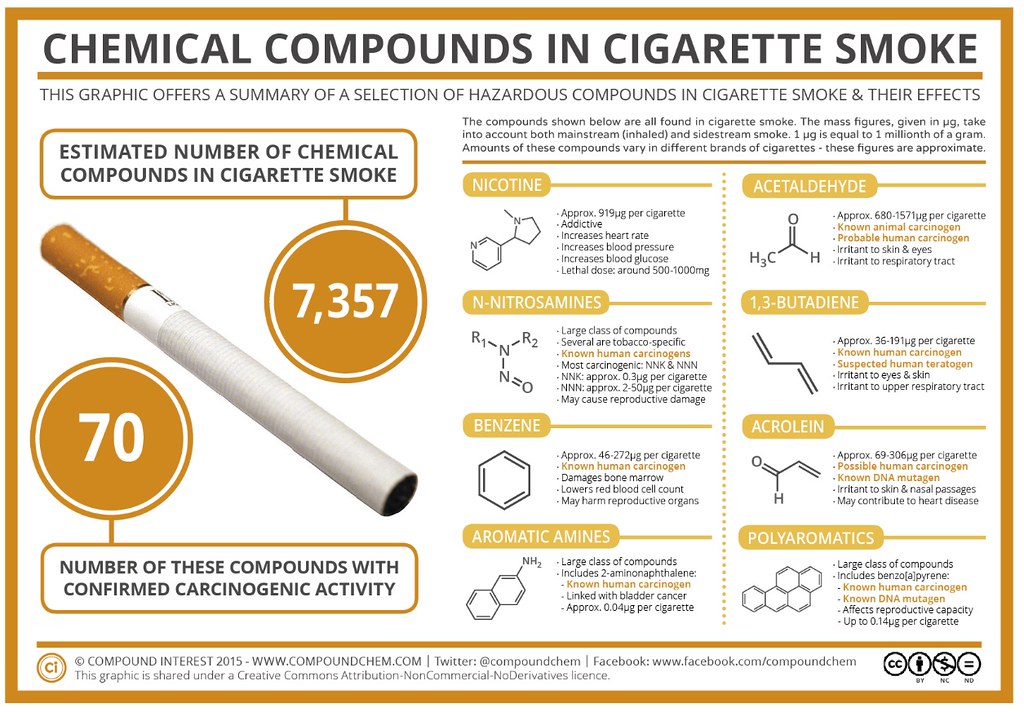
Depending on the source (different measures), the combustion of cigarette smoke produces a range of chemical products.  But wait, above, in the simple combustion reaction the products were: Carbon dioxide, Water, and Smoke along with Heat?  Yes, that smoke contains harmful (toxic) chemicals.  Here is an infographic produced by 'Compound Chemistry' detailing a multitude of compounds contained in cigarette smoke:


Again, by clicking on "Compound Chemistry" in the 'Source' - below the picture, a larger (the original) image will appear in a webpage.  The number of compounds (chemicals) found in cigarette smoke are limited by the ability to measure the exact composition of chemicals.  Additionally, combustion produces partial decomposition products too.  As technology improves, the ability to measure a more precise composition of chemicals will emerge over time.


Conclusion...


Chemistry is pervasive throughout the world.  Molecules are made up of atoms of space.  The atoms are connected with bonds which are made up of shared electrons.  These forces (bonds) can be broken with sufficient energy (i.e. heat) such as in the combustion reaction.  Upon which other molecules are formed.  Why do I stress this obvious aspect of chemistry?


The reason is that during the process of growing tobacco to the process of combustion involves the making and breaking of chemical bonds which results in various chemicals.  The take home message in the post above is that more chemicals exist which are harmful in cigarettes than are advertised or reported by the tobacco industry.  In the future, I will talk more about vaping and the parameters which contribute to the dangerous chemicals which are produced in the process of enjoying vaporizing 'juice'.


Related Blog Posts:


Chemistry Reactions Are Amazing - See For Yourself


Chemists Learn To Build Up Nanoparticles -- One Atom At A Time!


How Much Water Is Contained In All Oceans Around The Globe?


Dimensional Analysis Of Statistics And Large Numbers - Index Of Blog Posts


What Is Dimensional Analysis?