Showing posts with label engineering. Show all posts

Saturday, March 2, 2019

Canada Comes Up With Energy Savings List For K-12 School Buildings


Do you know how much energy is lost through the average building?  What do I mean by lost energy through a building?  Think about the home improvement shows which have grown in popularity in recent years.  One major restriction on these types of shows which is commonly unknown -- there is a limit on how many windows which can be installed in a house renovation project.  The reason is due to the amount of energy which can be lost through the window during the cold season.  Not to mention the ability to 'cool' the house during the summer season -- depending on the geographical region.


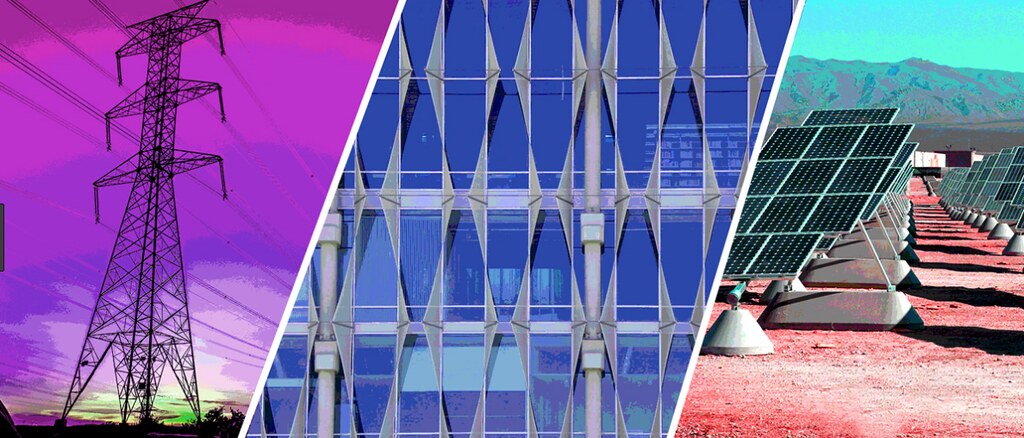
A tremendous amount of energy is lost through the windows, walls, and attics -- along with every other crease, crack, joint inside buildings.  A building is quite 'porous' - meaning the energy is easily - very easily lost through the structure.  Which results in an increased energy consumption.  Therefore, in any transition toward clean (sustainable) energy, a major part must be concerned with the improvement of building materials and construction to reduce energy usage/consumption.


In addition to the lost energy through poor energy construction, there are other factors which are impacted by the construction of a building.  Ambiance is typically noted as a dominant factors such as ventilation, lighting, air flow, along with overall feeling inside the room/building.  Recently, Canada came up with benchmarks for K-12 schools to aim for to reduce energy consumption.  Here is the announcement shown below:


Energy benchmarking for K-12 schools
Improve learning outcomes with energy benchmarking
Studies have shown that physical environment contributes to learning and productivity. Schools that are well lit, well ventilated, and in good repair create a healthy, comfortable learning and teaching environment, which leads to better performance and achievement.
In 2005, the U.S. Environmental Protection Agency found that a typical school district spends more on energy than on any other expense except salaries. Energy costs are higher than the total for computers and texbooks combined. Furthermore, one third of the energy is often wasted due to poorly functioning equipment, poor insulation and outdated technology. Energy benchmarking can help shrink the waste and reduce the costs, especially if students are actively engaged in monitoring and finding ways to reduce energy use. Benefits that can arise from regular energy benchmarking include the following:
-- Schools can use savings from improved energy performance to help pay for building improvements and other upgrades that enhance the learning environment.
-- Energy improvements can help free up resources so they can be redirected towards educational materials.
-- A more energy efficient structure will simultaneously help pay for those investments through cost savings over time.
-- Improving the energy efficiency of the school can serve as a key learning tool for students in terms of science, math, the environment, and social and fiscal responsibility.
-- By being more energy efficient, schools across Canada can help reduce greenhouse gas emissions. 
Collect the data you need to benchmark your school
The ENERGY STAR® Score for K-12 Schools in Canada applies to a building or campus of buildings used as a school for Kindergarten through Grade 12. It does not apply to CEGEP, college or university classroom facilities and laboratories, or vocational, technical, trade schools or daycare facilities. These schools will still benefit from energy benchmarking and can obtain an energy use intensity (EUI) value to identify energy-saving priorities.

To obtain a 1-100 ENERGY STAR score, in addition to your school’s basic tombstone information, you need the following building data:
-- Gross floor area for each building
-- Gross floor area of gymnasium
-- Student seating capacity
-- Number of employees
-- Percent of each building that is cooled
-- Percent of each building that is heated
-- High school (yes/no)
-- Energy Use

Specific energy billing information for each building for all purchased energy. You will need to begin with at least 12 consecutive months for each energy source and update regularly with monthly usage data.
Note that the above information is not required to start benchmarking. You can start using the tool to track your energy performance no matter how much data you have. However, in order to obtain the 1-100 score or an energy use intensity value, you need the details above.

Apply for certification
If your school earns a score of 75 or higher and meets certain other criteria, it could be eligible for ENERGY STAR certification. Learn more about certification and how you can apply.


The plan outlined above might be brief but is a great starting point.  As countries around the world move toward renewable/clean energy, all factors should be considered to improve the overall transition.  Thinking deeply about each energy contribution (and loss) will only result in a greater outcomes (in terms of energy efficiency).  Opponents may argue that more or less needs to be done.  Regardless, a conversation needs to be started on the transition toward a better more efficient building construction.


Getting toward a cleaner energy economy will take both time and energy.  Although, if the conversation does not start now on various paths toward achieving greater energy efficiency, no progress will be made in years to come.  The European Union has been at the forefront of financing (giving confidence) to various countries who start to make the transition.  Here in the United States, the conversation has begun.  That is good progress given the size and scope of the transition for our nation.


Related Blog Posts:


Amazon Aims To Reach 50% Of All Shipments To Be Carbon Neutral By 2030. Really?


How many Olympic size swimming pools per day would be filled with 890,000 barrels of oil?


A Good Start: Republicans Accept Climate Change As Real


Thoughts: Pause before reacting to news regarding 'Proposed Changes' to EPA and other Federal Agencies


French President Macron Organizes Climate Conference With Pledges Of Trillions Of Dollars For Climate Risk Management From World Organizations


A Good Start: Republicans Accept Climate Change As Real


What Is Going To Be Discussed At The G-20 Summit in Hamburg, Germany?


Trump Goes Right On Paris Agreement, Part Of U.S. And World Head Left


How Can The Paris Climate Agreement Be "More Favorable To The U.S."???


Judge Suggests Revisiting Environmental Concerns Of The Dakota Access Pipeline


President Trump's Understanding of the Paris Agreement


Trump Goes Right On Paris Agreement, Part Of U.S. And World Head Left


World Goes Left, While Trump Leads Right - On Climate - Why?


Paris Climate Agreement Is A Start Toward The Renewable Energy Future

Sunday, February 10, 2019

3 very interesting research projects for Fluid Dynamics Research


Source: Termoflow


Have you ever been on the road inside a small car only to be passed by a large semi-tracker truck?  Further, as you are passed, the driver experiences a lateral (right or left) push from the trucks passing?  This push is the wind flow which is being pushed to the side by the diesel truck's inefficient air flow.  One major consequence of this inefficient air flow is the production of wind resistance (or a drag force) -- which drives down the miles per gallon (fuel efficiency) a given vehicle can get.


All vehicles suffer to some extent from the inefficient air flow surrounding a vehicle.  Some more than others.  Although, a large (and I mean large) amount of interest has been devoted in the form of research to minimize (and improve) air flow across a given object (to generalize it).  For those who are unaware of the study of 'Fluid Dynamics', the following can serve as an introduction:


In physics and engineering, fluid dynamics is a subdiscipline of fluid mechanics that describes the flow of fluids—liquids and gases. It has several subdisciplines, including aerodynamics (the study of air and other gases in motion) and hydrodynamics (the study of liquids in motion). Fluid dynamics has a wide range of applications, including calculating forces and moments on aircraft, determining the mass flow rate of petroleum through pipelines, predicting weather patterns, understanding nebulae in interstellar space and modelling fission weapon detonation,
Fluid dynamics offers a systematic structure—which underlies these practical disciplines—that embraces empirical and semi-empirical laws derived from flow measurement and used to solve practical problems. The solution to a fluid dynamics problem typically involves the calculation of various properties of the fluid, such as flow velocity, pressure, density, and temperature, as functions of space and time.
Before the twentieth century, hydrodynamics was synonymous with fluid dynamics. This is still reflected in names of some fluid dynamics topics, like magnetohydrodynamics and hydrodynamic stability, both of which can also be applied to gases.[1]


With the working introduction given above, the study of 'fluid dynamics' is now more comprehensible.  Still, the variety of projects which the study of fluid dynamics covers is incomprehensible.  Nearly any given situation which involves moving parts different mediums can be understood and broken down into a research project categorized under fluid dynamics.  Why?  Chances are that there is a 'fluid' or  lubricant involved in the workings.


Further, as highlighted below, most objects which move through the world can be understood at the level of a project under the category of fluid dynamics.  The video below highlights 3 research projects that are share the field of fluid dynamics research:


Amazing to say the least.  I love really interesting research project.  Of course, I love to learn just about anything.  The first project which is being tackled by Marguerite Matherne a graduate student studying in Dr. David Hu's lab at Georgia Tech.  Her project involves looking deeper into the process of transporting pollen back to the beehive by bees.  Pollen is composed of proteins which would not normally just adhere to one another.  Therefore, the bee needs to suspend the pollen into nectar to form a suspension.


What properties of this suspension allow the bee to transport the 'maximum' amount of pollen back to the beehive?  The viscosity of the suspension needs to be just right in order to complete the journey (and not fall apart).  Although, the drag force of the shaped pollen cannot exceed the force exerted by the bee in flying back to the beehive.  Otherwise the trip would be impossible.  As shown in the video, the research covers these parameters along with others relevant to the process.  Nevertheless, the project is unique and important to the survival of the bee population -- not to mention helping humans with fruit crops by spreading pollen among crops.


The second research project which was developed by and carried out by Dr. Giorgio-Serchi at the University of Edinburgh -- is devoted to understanding the forces (fluid dynamics) generated by sea creatures resulting in movement across a given area.  How do the framework of the structure interact with the fluid to produce forward movement?  If we could see at the molecular scale, the picture might be much greater in difficulty, therefore, making models (using computer simulations) is suitable for a research project at the moment.


Last but not least, researcher Daria Frank is working with Dr. Paul Linden at Cambridge University to better understand oil plumes.  Specifically, as in the case of the Deepwater Horizon Oil spill, the oil disperses in a plume with an initial angular momentum (angular momentum due to the Earth's spinning around an axis).  The project is to characterize the parameters of the rising oil plume and compare those parameters to a storm passing over the Earth's surface.


Comparing an oil spill -- a swirling plume (in the presence of water -- fluid) versus a storm -- a spinning top (fluid is air).  What are the differences?  What are the similarities?  The information gathered will better place the oil/gas industry in a better position to combat challenges -- especially in the face of a disaster.


4 Accessible Examples


Shown below are 4 different examples of research projects which would be encompassed under the category of fluid dynamics research.  The examples are very accessible to each of us, since each represent real life examples frequently encountered in society.  As you progress through the examples, think of questions that you would ask regarding the dynamics surrounding the object's environment.


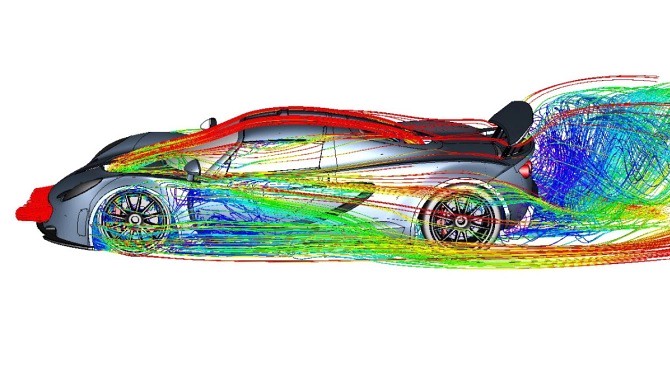
Example 1: Fluid flow around a race car:


Source: Rodrigonemmen


What are the most relevant methods for dealing with fluid dynamics surrounding the air flow of a car?  How do magnetohydrodynamics figure into the solution?  How do different materials play into the dynamics of air flow across a car?  What about the development of heat spots across a vehicle?  What type of instabilities contribute to turbulent air flow across a car?  What type of equations are necessary to model the air flow?  Partial differential equations?  In order to understand the system better, the solutions involve introducing a method which is a combination of methods. 


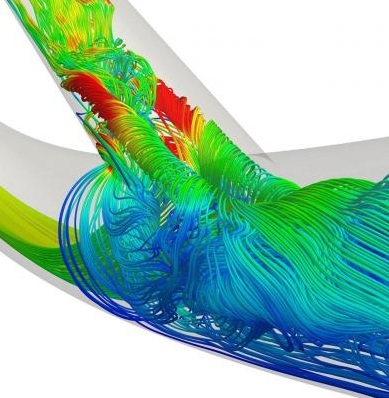
Example 2: Fluid flow through an human artery


Source: Di Cardilogy


How does the flow of blood through the vessels of arteries and blood vessels affect the dynamics inside of the heart during a cardiac cycle?  How does the build up of plaque on the side of an artery wall contribute to turbulent flow within the artery?  How does the plaque weaken the artery wall leading to atherosclerosis?  What are the overall dynamics of the arterial system?  How does one build up site of plaque contribute to overall flow within the entire system?  These are a just a few of the questions being entertained by such researchers in the field of fluid dynamics in medicine/engineering.


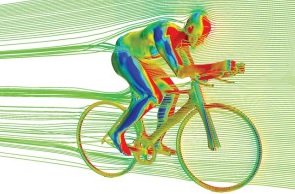
Example 3: Fluid flow around a bicycle


Source: Insightreplay


What are relevant parameters for cyclists?  Weight of the bicycle?  Weight of the cyclist?  If you shave your leg and arm hair, does that really cut time off of a ride?  What about body shape?  What about the shape of the frame?  Is there an optimal shape of each component which will result in reducing air flow across the system?  These are just a few questions that the cycling industry has had to deal with over the years.  Fluid dynamics could certainly contribute to answering a few of them.


Example 4: Fluid flow around a golf ball


Source: Symscape


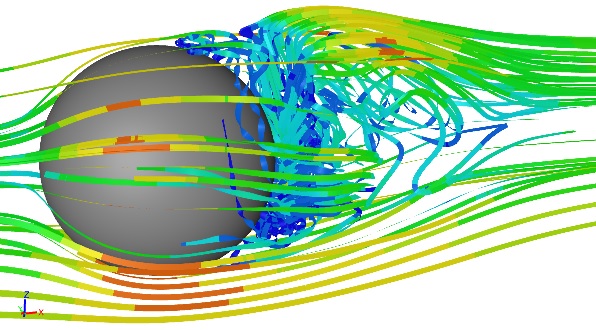
Most of us at one point or another have seen a game (or part of) of golf on the television or screen of a smart device.  What are the relevant parameters which play greatly into reducing the turbulence of air build up behind the ball?  In a previous blog post, I show how the 'dimples' on the surface of golf balls play a tremendous role in reducing the drag force on the golf ball.  Golf ball companies are very interested in reducing drag force overall to any degree.  Golfers dream of having complete flight stability during a game to better place their ball in a desired location.


Overall, these 4 examples serve us well in introducing the field of fluid dynamics.  Now, as each of us carry on in our busy days, feel free to pause a moment and look around yourself at your environment.   Find an example where the field of fluid dynamics could make a change -- a positive one.  There are many examples, each of us must be willing to think critically about the underlying parameters which dictate the performance and/or operation of a given phenomena.  Enjoy!


Related Blog Posts:


Does a Golf Ball have more than one shape (round)?


Parameters: "How widespread within NASA is the conviction that human activity is responsible for climate change?"


Want To Improve Science Communication: Add Artists!


White Blood Cells in action destroying Cancer Cells!


Astrophysicist Neil deGrasse Tyson explains why 'Space Force' is nothing new...


Scientists should find similarities rather than focus on differences


Why Chemistry Matters from the mouths of Nobel Laureates!


How Far Are We From Star Trek "Replicator" Technology?


"All Of Us" - The Best Medical Knowledge Update Effort - Please Join!


What Is Going On Inside That Cell?


Chemistry Reactions Are Amazing - See For Yourself


Parameters: Can Computers Think?


Parameters: 3D Printed Human Hearts?


A Virtual Tour Of A Plant Cell? Really?


A Virtual Tour Of A Human Cell?


Saturday, August 4, 2018

Thoughts: Instead of forming a "Space Force" why don't we work together to solve the world's problem?


Source: Brane Space


If you have not heard yet, the current administration in Washington D.C. is planning to form a 6th military branch called the "Space Force."  If you click on the hyperlinked "Space Force" you will be directed to the current (as of the writing of the post) search for this new endeavor.  Many in the defense industry are scratching their heads wondering where the endeavor is headed.  More importantly, why is President Trump calling for the formation?


With the entertainment of that idea in mind, there are also a community of special high ranking military service personnel who are wondering why not just deal with the current problems of the world.  Who are they?  In the video below from 'MSNBC' titled "What We Know About The Existing U.S. Space Force | Velshi & Ruhle | MSNBC" a brief discussion arises between the reporters and Commander Scott Kelly regarding the formation of a "Space Force" and the "Orbital Perspective."  The video is less than 8 minutes in length and worth viewing:


According to reporting by MSNBC reporter Ali Velshi in the video above, there are multiple components to transitioning toward such an endeavor/change.  First, funding would have to be approved by Congress (good luck on that) to create a 'Space Force'.  Not to mention, the paperwork and usual mandates and laws which accompany such a creation.  The process would be a huge ordeal.  Currently, each branch has a 'space subdivision' with the United States Air Force leading out in front with 'Space Command'. 


Skeptics mainly point to the cost, which would ultimately restructure the current distribution of money which funds the main 5 branches of the military.  The video above is divided into two parts.  The first was just discussed -- funding and creating such an extraordinary 'Force' when the military adequately handles the present demand.  The second part of the video above covers an interview with former NASA astronaut Scott Kelly.  Commander Scott Kelly rightfully points out that currently, each astronaut up in space working together are former enemies (military personnel) who are now forging a relationship to work together to advance the mission of space exploration (i.e. different nations put astronauts in the International Space Station). 


As Commander Scott Kelly points out in the video above, the observation by astronauts alike when viewing the Earth from orbit is the following: "Each of us should work together to solve the ONE PLANET on which we both live."  From his description, the 'orbital perspective' causes a viewer to question the meaning of "countries," "states," "nations" or "boundaries" in general.


Historically, each country (nation) has embedded the need to defend space under various branches of the military.  In the United States, the United States Air Force has a branch responsible for space.  Throughout history, only one country (nation) has had anything like a 'Space Force' -- which is Russia.  Currently, each nation who contributes human capital (i.e. astronauts) to the International Space Station do not feel that their welfare is threatened.  At least not enough to start a "space war" forming each a bunch of separate 'Space Forces' in space.  How would that even work?


Until the occupation of space becomes an issue between nations, each nation should focus on their respective contribution to the problems plaguing planet Earth.  There are more than enough problems to focus on without the need of creating another set of military issues (i.e. creating Space Forces).  The wars which are being battled here on Earth are plenty to keep us busy as an aggregate of different nations trying to inhabit the same planet.  Here is another opinion/article from a popular astronomer/astrophysicist on the matter.


Related Blog Posts:


How Much Water Is Contained In All Oceans Around The Globe?


How Much Would The Sun Weigh If Filled With Water?


Why Is Elon Musk Powering A Freight Ship With A Rocket Engine?


Why Do People Fly Drones Into "Restricted Air Space"?


Are The Elements Hydrogen And Helium "Of This World"?