Showing posts with label man-made disaster. Show all posts

Thursday, September 20, 2018

Boston Natural Gas Explosion Reveals Old Piping Needs Replacement - Enough To Travel To Colorado?


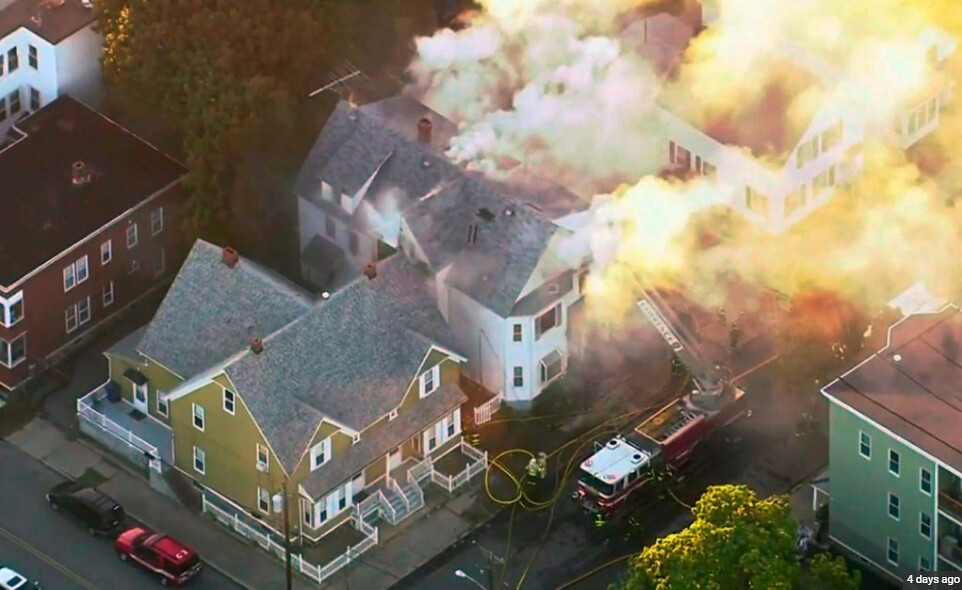
Terrible tragedies occur daily in certain regions.  In other regions, the frequency may be less so.  For the case of an explosion due to a natural gas leak, the frequency is small at the moment.  That frequency could be changing over the course of a decade due to badly aging pipeline (infrastructure) in Boston.  Recently, there was an explosion which destroyed 39 homes in a fire which started as a leak from a natural gas source. In the blog post below, the terrible event is cast into light for the reader to understand the extent of possible future damage that lies beneath the ground.


Aging Pipeline?


According to a news article in 'USA Today' titled "Natural gas explosions: Boston-area gas pipes among oldest and leakiest in US" a natural gas explosion was caused by aging pipes which are abundant in various cities across the United States:


The Merrimack Valley, the area north of Boston that was shaken by dozens of natural gas explosions Thursday, is served by some of the nation's oldest and most leak-prone pipes.
Investigators have yet to determine what caused the gas explosions that burned at least 39 homes in the towns of Lawrence, Andover and North Andover. But the gas utility that serves the area has more miles of old, cast-iron gas mains than all but 15 utilities in the nation, according to a USA TODAY analysis of federal safety data.


 Unfortunately, according to the Pipeline and Hazardous Materials Safety Administration, the replace of the corroded/damaged iron pipes is not required by law.  This is after years of the Pipeline and Hazardous Materials Safety Administration has spent years trying to convince utility companies to replace (i.e. invest) iron piping across the United States.


Currently, Boston has enough pipe which needs to be replaced to cover the ground needed to travel between Boston and Colorado.  Wow! According to the article cited above:


In the Boston area, Boston Gas in the metro area and Columbia Gas in the Merrimack Valley combine to use more than 2,200 miles of old iron mains. That's more iron gas pipe than is still in use in 45 other states combined. 


Of course, in the same article the limiting step (main obstacle) for the utility companies is cost.  The cost to replace the aging pipe with plastic roughly is around $1 million dollars per mile.  Wow! I can see how the utility companies would be resistant toward change at such a cost.  In order to get a more clearer understanding of the cost of $1 million dollars per mile, lets perform a brief dimensional analysis on that figure -- 2,200 miles worth of aging piping.


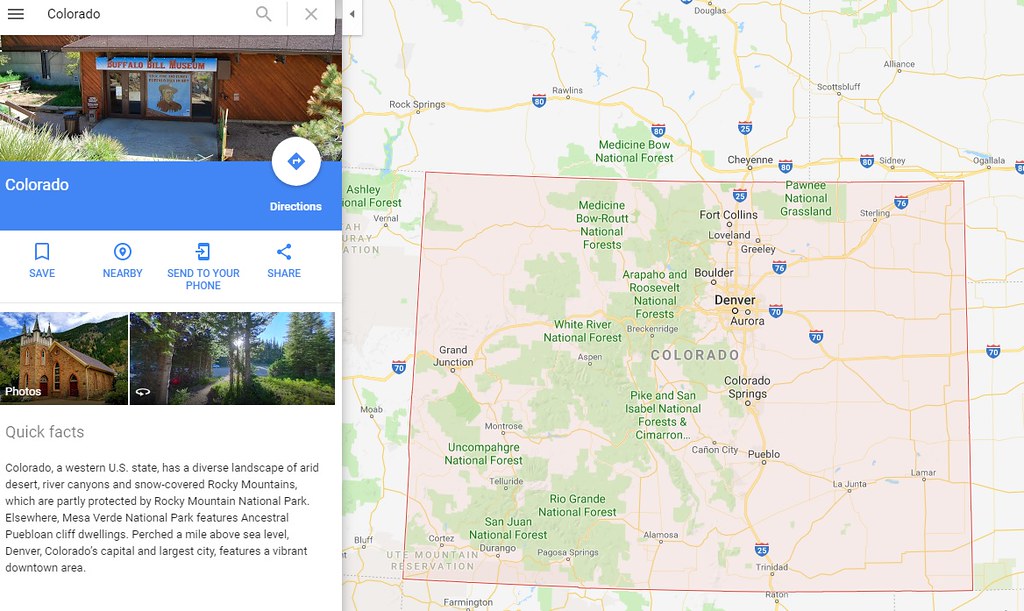
If GoogleMaps is consulted by typing into the search bar "Colorado" then hitting enter, the answer is shown below:


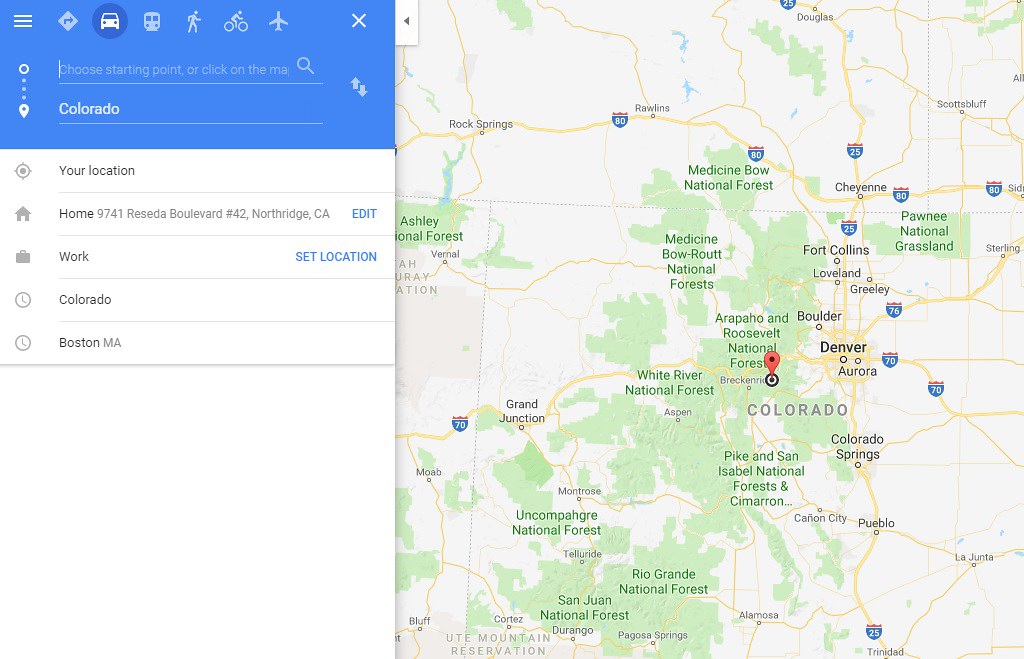
Which shows a map of Colorado.  Now, if we zoom in onto the search function within GoogleMaps on the upper left hand corner of the screen, the picture appears as follows - shown below:


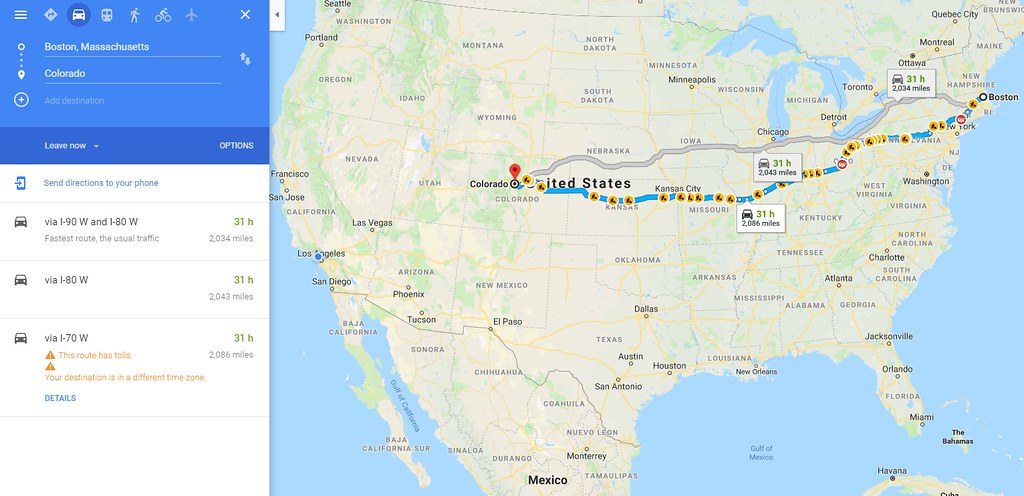
The picture is difficult to resolve the box in the upper left hand corner.  Although, the point is that there is a space to enter the 'starting point' (starting destination) and the ending destination is already filled with 'Colorado'.  Upon entering the entry 'Boston MA' and pressing enter, the map is shown below with different routes between the two points:


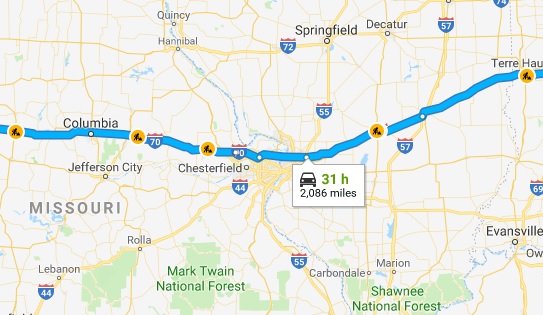
If the route is 'zoomed in on' the image below is shown with the route information - i.e. time, distance - as shown below:


The total distance between Boston (MA) and Colorado is 2,086 miles.  Traveling by car would take an estimated 31 hours.


What does one make of this analysis?


Especially in relation to the article above regarding old iron gas pipes which need to be replaced?


The cost of replacing a mile of old iron pipe cited above was around $1 million - does that make sense?  Possibly with all of the digging and reapplication of asphalt to cover the new pipe (not to mention the cost of plastic piping).  The construction costs can certainly add up over the course of any analysis.  What is important here is the following:


Replacing 2,200 miles of piping is equivalent to replacing a pipe extending from Boston (MA) to Colorado.  


Wow!  Looking at the distance in this respect casts the project into a much different light.


What Contributes to Pipe Degradation?


Last but not least, a brief exploration (and I mean brief) into the various causes (parameters) which contribute to the degradation of iron pipes (or steel in other cities) might be useful the reader.  Especially, since a few images were provided in the article cited above with text.  I have taken the images and pasted them below to give a brief tour of parameters which contribute to the degradation of pipes (underground) over time.


Source: USA Today


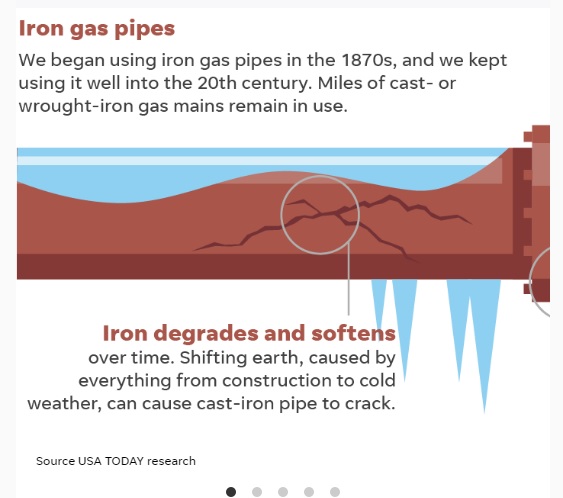
In the image above, the points are made regarding the aging of iron pipes simply due to shifting earth -- whether caused by weather or local construction is of concern to the residents around the city.  Additionally, city officials should consider the projects and weather patterns when thinking about aging pipes and a timeline to replace such pipes.


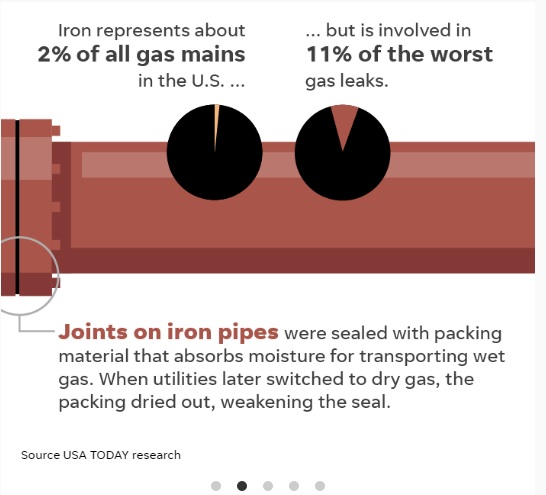
Speaking of weather, the 'joints' in between two sections of pipes used to be made out of a material which absorbed moisture since the natural gas running through the aging pipe contained moisture.  Recently, the moisture has been removed.  With the removal has left the interior 'joint' material to dry out and potentially form a leak as shown below:


Source: USA Today


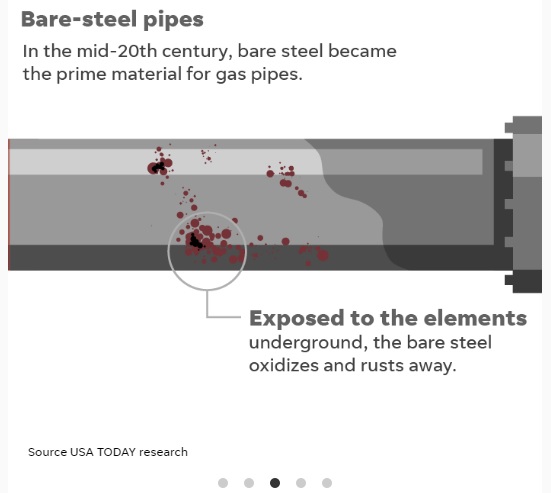
New or replaced piping should not contain such material. Over time, steel piping came into fashion to be used over iron piping.  The issue surrounding steel is that inevitably, the metal surface (exterior) will be subjected to the local elements in the underground.  Such elements will promote oxidation reactions which will cause rust or corrosion and weaken pipes or form leaks as shown below:


Source: USA Today


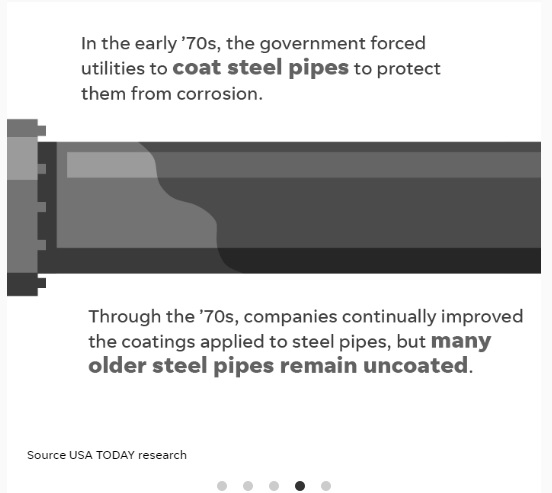
In order to mitigate (reduce) such corrosion or rust reactions from occurring, a 'coating' was applied to the steel pipes before installation.  Of course, sitting under ground which might be shifting or exposed to varying weather patterns, the 'coating' is inevitably going to react and disappear over time.  Further, the older steel was not coated. Which could have other problems listed above:


Source: USA Today


Conclusion...


The terrible tragedy of last weeks explosion due to a leak in the pipes running underneath a city carrying natural gas is devastating to say the least.  In fact, the only observation that is worst than the tragedy is the fact that there exists still 2,200 miles worth of remaining 'aging piping' which could give way at any time and cause another explosion.  In the blog post above, I cast the large number of remaining miles of iron piping still underneath the residents of Boston in terms of a single 'one way' trip from Boston to Colorado.


One has to really stop and pause to comprehend the danger which lies beneath them -- when staring at the map in the blog post above.  Just think of the time and energy costs of replacing the pipe.  The replacement will not happen over night to be sure.  But if nothing happens, then what remains is the potential danger of another tragedy.  Hopefully, the mayor of Boston steps up and implements guidelines to replace the piping in a swift timeline.  The safety of the residents (of the US) is of paramount importance to us all.


Related Blog Posts:


A Forecaster Predicts That Hurricane Florence Will Drop Enough Rain To Fill 18,400 Mercedes-Benz Superdomes

Hurricane Harvey Drops Enough Rain On Houston To Fill 560 Dallas Cowboy Stadiums


How Much Water Is Contained In All Oceans Around The Globe?


Storm Raises Water Level In Lake Cachuma By 31 feet, How Much Water Is That?


How To Make Sense Of Water Flowing At 100,000 Cubic Feet Per Second


Can 11 Trillion Gallons Of Water Fill 14,000 Dallas Cowboys Stadiums?


How Much Rain Did The East Coast Receive From Hurricane Matthew?


How Much Rain Did Haiti Really Receive?


How Much Rainfall Has Dropped On Louisiana?


How Big Was The "Water Bomb" Of Rainfall In Macedonia?


How Much Rain Did Huauchinango (Mexico) receive?


How Much Rain Did Elliot City (Maryland) Really Receive?


If The Mosul Dam Breaks, The City Of Mosul Would Be Under 65 Feet Of Water?


What is the volume of water in a few inches of rain?


Volume of Waste in the Mine Spill (in Brazil) Equivalent to 78 Deepwater Horizon Oil Spills


Saturday, November 5, 2016

Does Oil Demand Restrict The Amount Of Safety Regulation On Big Oil Companies?

If the last few decades are used as a litmus test, the following questions can be raised regarding large oil operations inside the United States:


Does our demand out strip our ability to provide safe oil/gas to various parts of the U.S.?


Have regulators lost control of the ability to regulate large oil companies?


How many more oil/gas spills must occur before meaningful change can occur?


The above questions are real and meaningful to each of us.  Below is evidence that these statements might be true or stand to be questioned.


Man-Made Disasters


There is no question that the world demand for oil is out of control.  By out of control, I mean that our dependence on oil is so large that the flow of oil around the world is imperative and not an option.  With the rise of research and development into renewable fuels/energy, the options could change depending on the magnitude of the output of such emerging technologies.


How big is our dependence on oil?


What is the daily dependence of oil on the world scale?


How about a developed nation like the U.S.?


I wrote a blog about the magnitude of the world daily usage of oil a few months ago.  The estimated number of barrels required to fuel the world is around 94 million barrels of oil per day.  In the blog post, I point out by using dimensional analysis that 94 million barrels of oil is equivalent to 4.23 billion gallons of oil per day.  A metric that is commonly used on this blog site is the Mercedez Benz Super Dome shown below:


Source: Nwill21


Which has interior space of 125,000,000 cubic feet of interior space which looks like the picture below taken from 'Wikipedia':


Source: David Reber


Just imagine, nearly 5 Super Domes (4.6) could be filled with the daily Global demand of oil.  WOW.  That puts the global daily demand of oil into perspective.  If you are interested in viewing the calculations, click here to access the post.


What about the U.S.?


The daily oil demand for the US is estimated to be around 19.4 million barrels per day.  With a conversion factor of 42 gallons of oil per barrel, the calculation of the conversion is possible as shown below:


The daily U.S. demand of oil is 814 million gallons a day. Wow.  Further, the oil demand is dispersed throughout the entire U.S. for consumption.  This begs the question:


How does the oil get distributed throughout the U.S. to meet the daily demand?


The three major avenues of distribution are shown below:


Truck:


Rail Car:


And finally, the most popular form of transport is the 'pipeline' shown below:


Source: Greenbiz


There is no doubt that each form of transportation involves an inherent risk associated.  Over the last couple of years, the oil pipelines have become a hot topic of dispute.  Just recently, a protest has been brewing in North Dakota over the proposed pipeline.  The energy company 'Energy Transfer' wants to run a pipeline through North Dakota underneath a water supply for the Standing Rock Sioux Tribe.


In a blog I wrote last week, I discussed the battle that has erupted over the pipeline.  An article I quoted from 'The New York Times' cited the two following statements regarding pipelines and the safety surrounding them:


Amount of pipeline in the U.S.:


The United States has a web of 2.5 million miles of pipelines that carry products like oil and natural gas, pumping them to processing and treatment plants, power plants, homes and businesses. Most of the lines are buried, but some run above ground.


Safety of pipelines:
Energy companies and their federal overseer, the Pipeline and Hazardous Materials Safety Administration, promote the safety record of pipelines. Pipeline companies say it is far safer to move oil and natural gas in an underground pipe than in rail cars or trucks, which can crash and create huge fires.

But pipeline spills and ruptures occur regularly. Sometimes the leaks are small, and sometimes they are catastrophic gushers. In 2013, a Tesoro Logistics pipeline in North Dakota broke open and spilled 865,000 gallons of oil onto a farm. In 2010, an Enbridge Energy pipeline dumped more than 843,000 gallons of oil into the Kalamazoo River in Michigan, resulting in a cleanup that lasted years and cost more than a billion dollars, according to Inside Climate News.

In a 2012 examination of pipeline safety, ProPublica reported that more than half of the country’s pipelines were at least 50 years old. Critics cited aging pipelines and scant federal oversight as factors that put public health and the environment at risk.


In the same post, I pointed out that the amount of oil is far less in a given accident by fuel truck compared to a break in the oil pipeline.  A typical fuel truck carries (less than 4,000 gallons) along with a rail car (train car capacity is around 33,000 gallons per car).  The article out of 'The Times' used in the post cited a daily volume of around 470,000 barrels would be moved throughout the pipeline.  That equals around 19.7 million gallons per day being pumped through the pipeline per day.  See post for calculations!


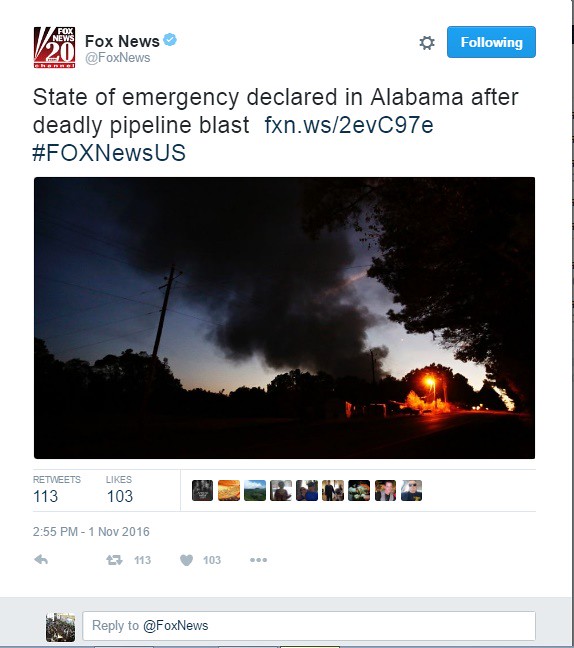
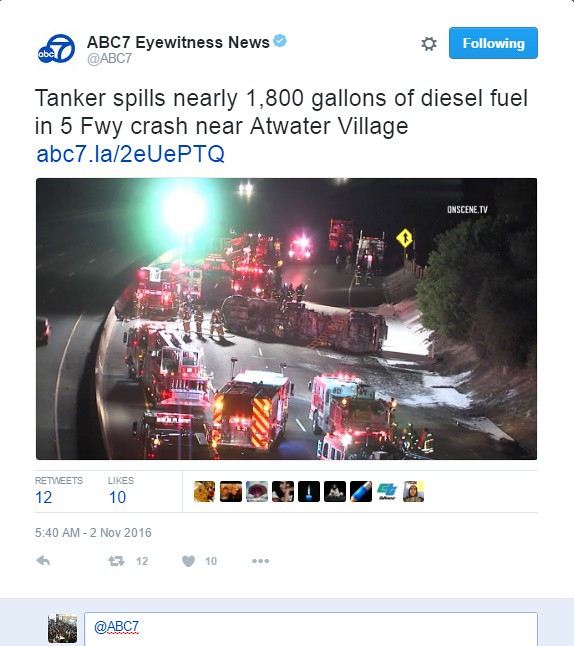
Now, compare the relative volumes being transported by each method.  Here are two images of 'Tweets' that appeared within 24 hours of me publishing the previous post shown below regarding disasters brought on by transporting oil/gas:


Tweet 1:


Tweet 2:


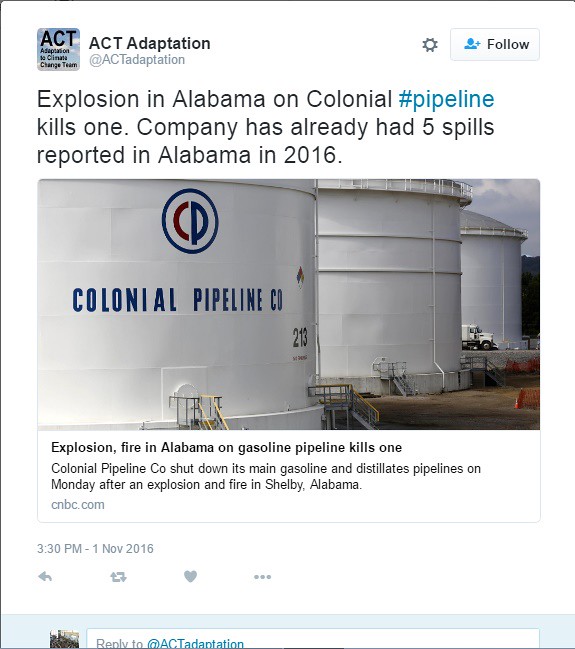
In the first tweet, a pipeline exploded and caused great damage to the surrounding area.  Whereas in the second tweet, a local fuel truck tanker overturned and caused a spill of 1,800 gallons.  Further, a couple of years ago, the company whose pipeline broke due to an explosion has had multiple (5 violations) so far in 2016 as shown by the tweet below:


The energy company 'Colonial' just had a pipeline burst a couple of months ago which spewed around 6,000 - 8,000 barrels of fuel spilled into the forest.  I wrote a blog post about the spill.  According to the company, the spill was small (supposedly) in comparison to others in recent history.  You don't say?


In comparison to the volumes listed in the excerpts above from 'The Times' article which I used in a previous post, Colonial would like you to think the spills are small.  As I calculated in the blog post, the range of 6,000 - 8,000 barrels corresponds to 250,000-330,000 gallons of fuel does not compare well (Really?) with the respective volumes 865,000 and 843,000 gallons of oil.


With all of the oil being dumped and not necessarily reported, one cannot help but wonder where are all of the regulators at?


Are they being paid off by the energy companies to remain silent of overlook disasters?


Have we as a nation reach a point with 2.4 million miles of oi pipelines throughout the U.S. at which regulation becomes impossible?


Do we have enough regulators to handle the job needed to maintain safe oil pipelines?


These questions remain unanswered.  In the United States this coming Tuesday, a national election is going to take place.  If the answer lies anywhere, the answer that involves change will be held with a future President of the United States.  In the next section, each candidates views on regulation, climate change, and business relations will be presented.


Regulation Is Needed!


As I just mentioned, a national election is going to take place this Tuesday.  If an answer to the above questions is possible, the next President should be able to shed light on the matter based on the platform on which they are running for office.  I wrote a blog a couple of days ago which just listed 20 questions that Presidential candidates should answer.  These questions are important in providing any guidance as to the next four years of funding and support for reform and regulation will look like.  See the previous post for all of the 20 questions - only those pertaining to the subject of the post will be displayed below.


The questions and answers below were directly taken (cut and pasted) from the nonprofit's "Science Debate" website under "20 Questions" for candidates about science issues.  Over 56 organizations signed on to make these questions which represent 12 million scientist around the country.


Without further ado, here are the questions and answers:


Climate Change:


Question 3:


The Earth’s climate is changing and political discussion has become divided over both the science and the best response. What are your views on climate change, and how would your administration act on those views?


Answers:


Hillary Clinton:


When it comes to climate change, the science is crystal clear. Climate change is an urgent threat and a defining challenge of our time and its impacts are already being felt at home and around the world. That’s why as President, I will work both domestically and internationally to ensure that we build on recent progress and continue to slash greenhouse gas pollution over the coming years as the science clearly tells us we must. 
I will set three goals that we will achieve within ten years of taking office and which will make America the clean energy superpower of the 21st century: 
1) Generate half of our electricity from clean sources, with half a billion solar panels installed by the end of my first term. 
2) Cut energy waste in American homes, schools, hospitals and offices by a third and make American manufacturing the cleanest and most efficient in the world. 
3) Reduce American oil consumption by a third through cleaner fuels and more efficient cars, boilers, ships, and trucks. 
To get there, my administration will implement and build on the range of pollution and efficiency standards and clean energy tax incentives that have made the United States a global leader in the battle against climate change. These standards are also essential for protecting the health of our children, saving American households and businesses billions of dollars in energy costs, and creating thousands of good paying jobs. 

These standards set the floor, not the ceiling. As President, I will launch a $60 billion Clean Energy Challenge to partner with those states, cities, and rural communities across the country that are ready to take the lead on clean energy and energy efficiency, giving them the flexibility, tools and resources they need to succeed. 


Donald Trump:


There is still much that needs to be investigated in the field of “climate change.”  Perhaps the best use of our limited financial resources should be in dealing with making sure that every person in the world has clean water.  Perhaps we should focus on eliminating lingering diseases around the world like malaria.  Perhaps we should focus on efforts to increase food production to keep pace with an ever-growing world population.  Perhaps we should be focused on developing energy sources and power production that alleviates the need for dependence on fossil fuels.  We must decide on how best to proceed so that we can make lives better, safer and more prosperous.


Energy:


Question 7:


Strategic management of the US energy portfolio can have powerful economic, environmental, and foreign policy impacts. How do you see the energy landscape evolving over the next 4 to 8 years, and, as President, what will your energy strategy be?


Answers:


Hillary Clinton:


The next decade is not only critical to meeting the climate challenge, but offers a tremendous opportunity to ensure America becomes a 21st century clean energy superpower. I reject the notion that we as a country are forced to choose between our economy, our environment, and our security. The truth is that with a smart energy policy we can advance all three simultaneously. I will set the following bold, national goals – and get to work on Day 1, implementing my plan to achieve them within ten years of taking office: 
1) Generate half of our electricity from clean sources, with half a billion solar panels installed by the end of my first term. 
2) Cut energy waste in American homes, schools, hospitals and offices by a third and make American manufacturing the cleanest and most efficient in the world. 
3) Reduce American oil consumption by a third through cleaner fuels and more efficient cars, boilers, ships, and trucks. 
My plan will deliver on the pledge President Obama made at the Paris climate conference—without relying on climate deniers in Congress to pass new legislation. This includes: 
1) Defending, implementing, and extending smart pollution and efficiency standards, including the Clean Power Plan and standards for cars, trucks, and appliances that are already helping clean our air, save families money, and fight climate change. 
2) Launching a $60 billion Clean Energy Challenge to partner with states, cities, and rural communities to cut carbon pollution and expand clean energy, including for low-income families.  
3) Investing in clean energy infrastructure, innovation, manufacturing and workforce development to make the U.S. economy more competitive and create good-paying jobs and careers. 
4) Ensuring the fossil fuel production taking place today is safe and responsible and that areas too sensitive for energy production are taken off the table. 
5) Reforming leasing and expand clean energy production on public lands and waters tenfold within a decade. 
6) Cutting the billions of wasteful tax subsidies oil and gas companies have enjoyed for too long and invest in clean energy. 
7) Cutting methane emissions across the economy and put in place strong standards for reducing leaks from both new and existing sources. 
8) Revitalizing coal communities by supporting locally driven priorities and make them an engine of U.S. economic growth in the 21st century, as they have been for generations. 


Donald Trump:


It should be the goal of the American people and their government to achieve energy independence as soon as possible.  Energy independence means exploring and developing every possible energy source including wind, solar, nuclear and bio-fuels.  A thriving market system will allow consumers to determine the best sources of energy for future consumption.  Further, with the United States, Canada and Mexico as the key energy producers in the world, we will live in a safer, more productive and more prosperous world.


Water:


Question 10:


The long-term security of fresh water supplies is threatened by a dizzying array of aging infrastructure, aquifer depletion, pollution, and climate variability. Some American communities have lost access to water, affecting their viability and destroying home values.  If you are elected, what steps will you take to ensure access to clean water for all Americans?


Answers:


Hillary Clinton:


Chronic underinvestment in our nation’s drinking and wastewater systems has sickened and endangered Americans from Flint, Michigan, to Ohio and West Virginia. Outdated and inadequate wastewater systems discharge more than 900 billion gallons of untreated sewage a year, posing health risks to humans and wildlife life, disrupting ecosystems, and disproportionately impacting communities of color. In addition, many struggling communities around the United States have limited or no access to clean, safe water.

We will invest in infrastructure and work with states, municipalities, and the private sector to bring our water systems into the 21st century and provide all Americans access to clean, safe drinking water.

Climate change is also triggering changes in weather patterns, including the increased prevalence of long, hard droughts that pose a dire risk to the health and prosperity of American communities, particularly in the West. The federal government must become a better partner in supporting state and locally-led efforts to improve water security. To that end, we will create a coordinated, multi-agency Western Water Partnership to help fund water efficiency, consideration, and infrastructure modernization projects across the region, including significant new investments in water reuse and reclamation. 

We will also work to bring cutting edge efficiency, treatment and reuse solutions to our nation’s water challenges by establishing a new Water Innovation Lab. The Lab will bring urban water managers, farmers and tribes together with engineers, entrepreneurs, conservationists and other stakeholders to develop practical and usable technologies and strategies that can be deployed by local water utilities, agricultural and industrial water users, and environmental restoration projects across the country.


Donald Trump:


This may be the most important issue we face as a nation for the next generation.  Therefore, we must make the investment in our fresh water infrastructure to ensure access to affordable fresh water solutions for everyone.  We must explore all options to include making desalinization more affordable and working to build the distribution infrastructure to bring this scarce resource to where it is needed for our citizens and those who produce the food of the world.  This must be a top priority for my administration.


Nuclear Power:


Question 11:


Nuclear power can meet electricity demand without producing greenhouse gases, but it raises national security and environmental concerns. What is your plan for the use, expansion, or phasing out of nuclear power, and what steps will you take to monitor, manage and secure nuclear materials over their life cycle?


Answers:


Hillary Clinton:


Meeting the climate challenge is too important to limit the tools available in this fight. Nuclear power – which accounts for more than 60 percent of our zero carbon power generation today – is one of those tools. I will work to ensure that the climate benefits of our existing nuclear power plants that are safe to operate are appropriately valued and increase investment in the research, development and deployment of advanced nuclear power. At the same time, we must continue to invest in the security of our nuclear materials at home, and improve coordination between federal, state, and local authorities. We must also seek to reduce the amount of nuclear material worldwide – working with other countries so minimize the use of weapons-grade material for civil nuclear programs.


Donald Trump:


Nuclear power is a valuable source of energy and should be part of an all-the-above program for providing power for America long into the future.  We can make nuclear power safer, and its outputs are extraordinary given the investment we should make.  Nuclear power must be an integral part of energy independence for America.


Global Challenges:


Question 13:


We now live in a global economy with a large and growing human population. These factors create economic, public health, and environmental challenges that do not respect national borders. How would your administration balance national interests with global cooperation when tackling threats made clear by science, such as pandemic diseases and climate change, that cross national borders?


Answers:


Hillary Clinton:


Many of the greatest - and hardest - challenges facing our country extend beyond our borders and can only be ultimately addressed through global solutions. Climate change is a case in point. And that is why as Secretary of State I elevated the role of climate policy in our diplomacy, appointing our country’s first Special Envoy for Climate Change, making climate policy a key part of our broader relationship with China and other key countries, and helping to create and launch the global Climate and Clean Air Coalition to reduce potent non-carbon climate pollution.

As the world’s biggest and most powerful economy—and as the second-biggest emitter of greenhouse gases and the biggest historical emitter—the United States has a responsibility to lead the global response to the climate challenge. By making strong progress to reduce greenhouse gas emissions at home, President Obama was able to persuade and pressure other major emitters, including China and India, to step up. This dual process, where domestic policy changes helped spur international action, led tot the historic 195-nation Paris climate agreement, the first in our history where every country agreed to be part of the solution to climate change. 

The Paris agreement is critical, but it is not sufficient on its own. To keep global warming below the two degrees Celsius threshold and avoid the worst consequences of climate change, we need to cut emissions by at least 80 percent below 2005 levels by mid-century. To get there, we will need to continually work to improve upon the goals set in Paris, both in the United States and around the world. That’s why we must work to support more clean energy investment in emerging economies, help developing nations build resilience to the climate impacts that can’t be avoided, and continue to drive clean energy innovation here at home. And we will continue to work on a bilateral and multilateral basis with our partners, with key countries like China, and with the UNFCCC to protect our nation, our planet, and our children’s future. 

When dealing with the outbreak of diseases, we must be sure to act with caution, and rely on science to inform our decisions around trade, travel, and treatment. We are privileged to live in a country that individuals around the world aspire to visit and even immigrate to. It is within our national interest to think beyond our borders, and through our leadership, do everything we can to foster peace, health, and security around the world. In the United States, we need to break the cycle in which our own public health system is beholden to emergency appropriations for specific epidemics. We can do this by creating a dedicated Rapid Response Fund to help shore up our defenses, accelerate development of vaccines and new treatments, and respond more effectively to crises. We will also create a comprehensive global health strategy that moves beyond the disease-by-disease emergency model and seeks to build a robust, resilient global health system capable of quickly responding to and ending pandemics. 


Donald Trump:


Our best input to helping with global issues is to make sure that the United States is on the proper trajectory economically.  For the past decade we have seen Gross Domestic Product growth that has not provided adequate resources to fix our infrastructure, recapitalize our military, invest in our education system or secure energy independence.   We cannot take our place as world leader if we are not healthy enough to take care of ourselves.  This means we must make sure that we achieve our goals in tax reform, trade reform, immigration reform and energy independence.  A prosperous America is a much better partner in tackling global problems that affect this nation achieving its national objectives. 


Regulation:


Question 14:


Science is essential to many of the laws and policies that keep Americans safe and secure. How would science inform your administration's decisions to add, modify, or remove federal regulations, and how would you encourage a thriving business sector while protecting Americans vulnerable to public health and environmental threats?


Answers:


Hillary Clinton:


It is essential that environmental, health, and energy regulations, among other areas, use the best available science to guide decision-making, and I am committed to making sure that continues. For instance, we will have science guide us as we make important investments around health care. We will continue to invest in research to further our understanding of disease, including ramping up our investment in Alzheimer’s and related dementias to $2 billion per year, continuing Vice President Biden’s Cancer Moonshot, and scaling up our broader investment in the National Institutes of Health’s budget to combat all of the diseases of our day. 

My opponent in this race has consistently discounted scientific findings, from his comments about vaccines to his claim that climate change is a hoax. These dangerous positions not only put Americans at risk, but can have long term impacts on our country’s growth and productivity. Science will ensure our country continues to progress, and will help our government use its resources to provide the best possible life for all Americans.  


Donald Trump:


This is about balance.  We must balance a thriving economy with conserving our resources and protecting our citizens from threats.  Science will inform our decisions on what regulations to keep, rescind or add. A vibrant, robust free market system will regulate the private sector.


The above responses give us a starting point on which to form our opinion when we head to the voting polls next Tuesday.  At this point, you might ask the following question:


Mike, there are more than two Presidential Candidates?


What about Gary Johnson or Dr. Jill Stein?


For brevity, I chose to only include the two major candidates responses.  In order to view the remaining two candidates answers to the above questions, please visit my previous blog post with the questions and answers.


Conclusion


Regardless of who wins next Tuesday at the national election for the next seat as President of the United States, the issues at hand will still remain the same.  Although, armed with the answers to the questions above along with the remaining questions, each of us can get a sense of where the support lies in protecting us and the environment.  Our transition toward renewable energy is not just a "must happen" but a "when will it happen" statement.  With a more educated voting population, the process can move forward more easily.  Each of us should consider the above questions and answers seriously and plan for the future.


Until next time, Have a wonderful day!


Thursday, September 1, 2016

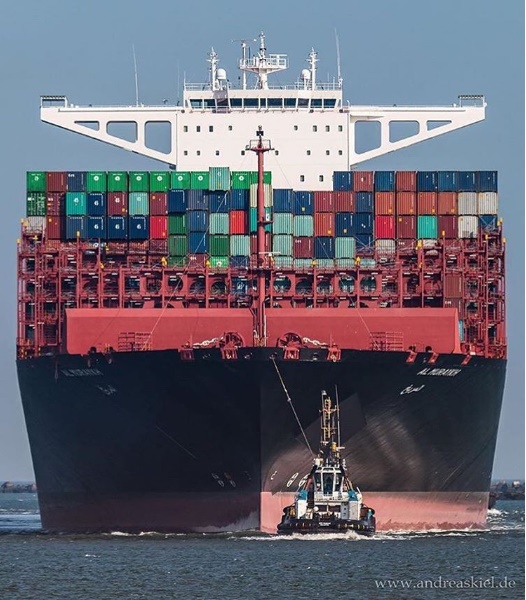
How Much Weight Can The Average Freight Ship Carry?

The news cycle is fast in this world.  Disasters stay in the news a few days -- if the damage is truly extensive.  The recovery from disasters can be long and arduous.  Even though the story might disappear from the news feed, the work to recover might be months or years depending on the extent of the damage.  An immediate example that might come to mind is the recovery from the flooding that occurred recently in Louisiana.  I wrote a blog post regarding the 256 billion gallons of rain that the region received.  On the other end of the spectrum might be the oil rig that recently floated ashore in Scotland -- which I write about here.  Lets explore an intermediate example in the blog post below.


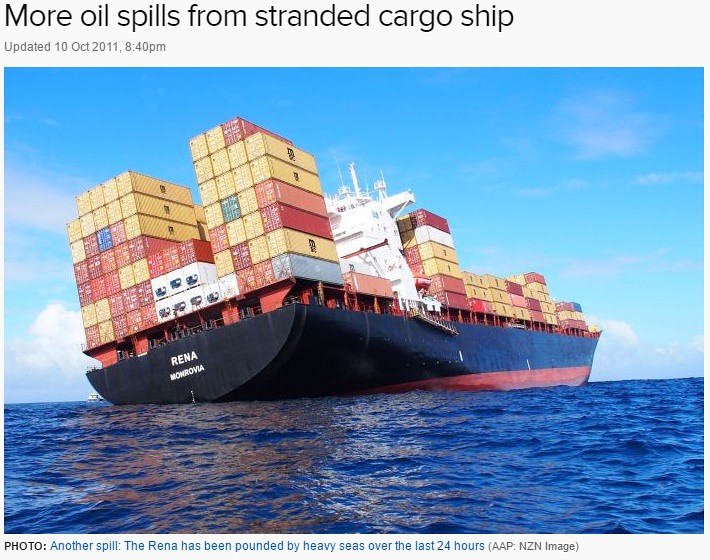
Take for example the following picture shown below:


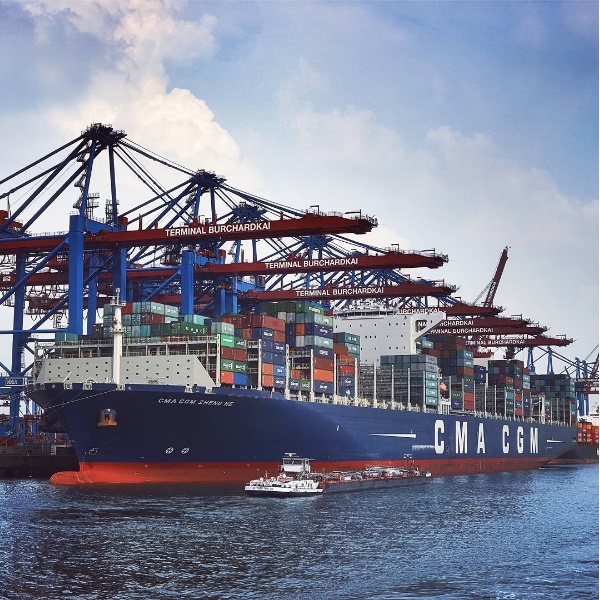
The image above obviously conveys a major problem that needs to be dealt with.  The picture above is taken from an accident in 2011 -- where the freight ship "Rena" got stuck.  Normally, we would expect to see the following picture of a freight ship shown below:


Or parked in a port ready to be either unloaded or loaded like the ship below:


Returning to the first picture, when a disaster occurs like the one shown above, how does an organization (International, Federal, State, etc.) deal with the problem?  What do you do to remedy the situation?  Obviously, there is a tremendous amount of weight stored on the cargo ship.


Why do I ask such questions?


Cargo On A Freight Ship


The reason that I am interested in asking such questions is due to the "noise" created by the "news" coupled with a devastating disaster -- whether the disaster be natural or man-made.  The "noise" is the news cycle which has reduced the average person's attention span by having us jump from disaster to disaster.  In the example above, the freight ship is stuck in the ocean on a reef.


If an average viewer was to follow just the news cycle, then they might be under the impression that the freight ship was fixed immediately and went back to business as usual.  Through entertaining the amount of weight that an average freight ship might carry at a given time at sea, the perception might be changed.  Or at least updated with further information on which to base an opinion on.


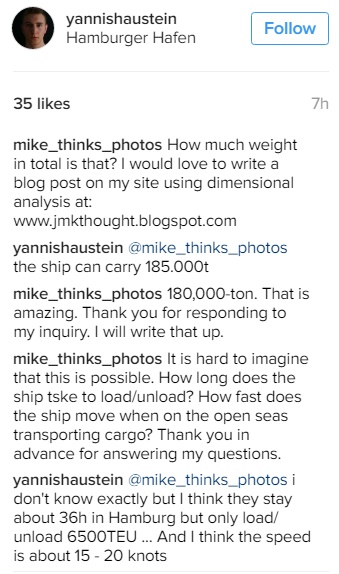
I have been wondering the answer to this question for a long time.  Every time that I see a picture of a freight ship either at Port or out to sea -- I am stunned by the magnificent feat this must be to carry such an enormous amount of weight in a given trip.  A few weeks ago, I was surfing my Instagram account (@mike_thinks_photos) when I happened to run across a picture of a freight ship and was held in amazement once again.  I decided to ask a few question as shown below:


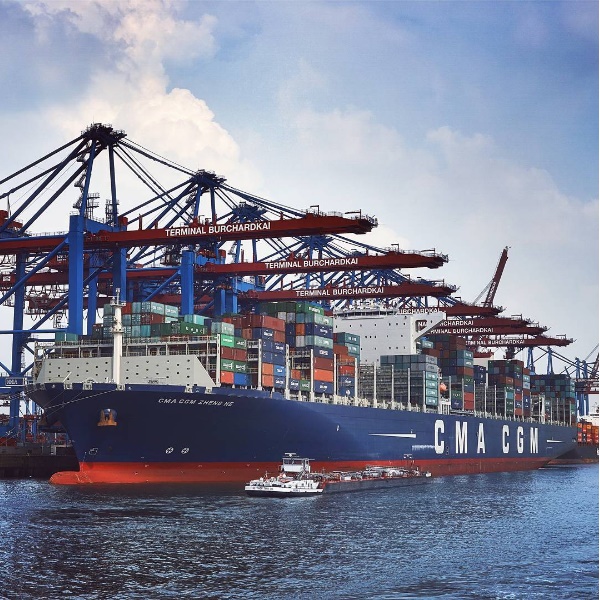
The conversation was attached to the photo shown below:


I cannot wrap my head around a ship (like the one above) carrying a payload of 180,000-tons.  WOW!  That is too much for me to comprehend.  The reason why is based on a previous post that I wrote about the relative weights of the Queen Mary Ship and the Spruce Goose airship created by Howard Hughes.  In that post, the conclusion was drawn that the erroneous excerpt from a tour guide mistook the weight of the Spruce Goose to be 400,000 tons (which was completely off base).  Why?


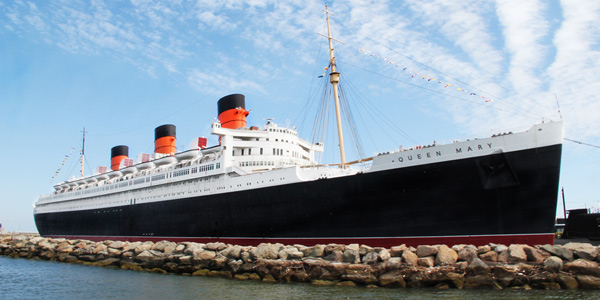
If that were the case, then the Queen Mary Ship which is pictured below and weighs 96,000 tons would be roughly 1/4 of the weight of the Spruce Goose -- which clearly is not the case:


Source: Wikipedia


Here is another view of the Queen Mary Ship along with the dome which houses the Spruce Goose airship shown below:


Further, if this were the case, then the Spruce Goose would go down in history as the most "fuel inefficient" plane in history and would probably have never been able to lift off the ground.   The conclusion of that blog post was that the "units" of measurement -- weights of each object were clearly mistaken by the author and that certainly can make a difference in the readers mind (not to mention the California Tourist eager to see those attractions).


An additional point to note in the example above of comparing the two objects (Queen Mary Ship and Spruce Goose airship) is the weight of each.  If the Queen Mary does indeed weigh 96,000 tons -- then this can qualify as a 'metric' to use in the current post in regards to casting the weight carried on a freight ship into perspective.


A calculation can be carried out by dividing the two stated values of weight by each other.  That is, divide the weight that is possible to carry on a freight ship (180,000 tons) by the weight of the Queen Mary Ship to get the following result shown below:


Which is to say, that the amount of freight (in weight) that an average freight ship can carry is equivalent to nearly the weight of two Queen Mary Ships -- WOW!


No wonder why disasters like the one above where the freight ship runs aground on a reef are so problematic.  Think about the timeline of getting the ship back to moving cargo as usual.  What steps have to be taken to stabilize a ship that is off-axis as shown in the picture (the first picture)?


Here are a few considerations:


1) How does a crew remove cargo from a tiled ship?


2) How does a crew pull the ship back into the water (if possible)?


3) How does a crew inspect ship for damage?


If we just entertain the three considerations above, how does a shipping company proceed with such a disaster?  If anyone reading this blog post works for a shipping company, please feel free to comment below and give us some insight into the matter.  Seems like an impossible task to me.  I would have the following questions of concern:


1) What happens if the ship moves while removing the cargo?


2) What happens if the cargo falls off the ship while attempting to extract the freight?


3) What happens to the workers aboard the ship while the cargo is being removed?


4) Where is the extracted cargo moved to -- another ship?


Wow! 180,000 tons is equal to nearly two Queen Mary Ships.


Conclusion...


The next time that you see a freight ship like the one shown below:


Stop and entertain the following thought: The amount of weight on that ship could equal nearly two of the ships shown in the picture below:


Furthermore, take a little time to ponder the amount of effort which would be required of salvaging crews to fix a freight ship that had floated ashore or onto a reef (like Rena above).  Additionally, think about the importance of trade routes throughout the world (Suez Canal, etc.).


Why are those shipping routes so coveted?


When the issue is cast into the metric of the amount of weight possible to carry, the problem is quite simple.  The next time that the popular news is filled with "noise" regarding dock workers striking at the Ports which house these ships, stop and think of the volume of cargo that is being held up from moving about the world.  Think of the packages and goods that are being stalled on ships that are waiting at sea to be unloaded.


The above weight mentioned did not include the thousands of tons of oil which was stored on the ship to power the movement of the cargo on route.  Until next time, have a great day!!


Monday, May 23, 2016

A California Dream Spoiled By Big Oil

My wife tells the story often to strangers of her evolutional history of becoming a resident of California.  The story usually starts off with a brief introduction to her bedroom as a teenage girl with a poster of the California coastline -- the beach on it.  Dreaming, she says of the following: basking in the sun, meeting her husband, and living near the beach.  In a sense, she has obtained each.  I am a native Southern California guy.  We live inland around 40 minutes drive (without traffic) from the beach.  Periodically, we find ourselves at the beach -- like we did yesterday.  What is the issue you might ask?  Let me explain below.


The California Dream?


As I mentioned, I am a native of Southern California.  I grew up in Corona (California) which is inland from the beach aroun 60 miles.  Corona during that time was a small city.  My parents both grew up in Santa Monica by the beach.  As a result of the tremendous growth, they decided to move inland away from all of the commotion.  Of course, their family still stayed in the area, so the opportunity to visit was always present.


Corona was not the beach.  Although, Corona (during that time) had special attributes of its own.  Originally, Corona was a citrus station filled with orange trees, the urban sprawl was large.  As a result, as children we would ride our bicycles all around town distances 5 or more miles in a single direction.  In hindsight, this training turned out to be useful in motivating our  nonprofit organization -- bikecar101.


Over the years, my siblings and I spent a considerable time at our grandparents house near the beach.  We would go to the beach very often and run around burning off all the excess energy which had been built up throughout the day with other activities.  Surfing was included in the beach trips.  For us, living in California meant both the beach dream and the small town feel which is much different than living in downtown Los Angeles.  Although, today, the city of Corona has grown considerably and has but only a few orange trees left.  The rest is growth (housing and commercial buildings).


Why am I carrying on like this?  What is the point to all of this rambling?


The reason why I discuss my background is to set the stage for the following observation which I am told quite frequently.  My wife, who is from Omaha (Nebraska) will often tell me that I do not appreciate California.  At first this was strange.  I had been to quite a few other countries while serving in the US Air Force -- but that is another story for another time.  Over time, I came to ignore her when she said this to other people.  California is a wonderful place, but just like every other place in this great nation, there are wonderful attributes and not so wonderful attributes associated with the State.


More specifically, within Southern California are the same distinctions.  I am constantly amazed by this observation.  People are interesting and amusing (myself included).  Alright, now that we have that out of the way, lets get down to business.  The "California Dream" was ruined yesterday for me -- sounds strange right?  Is that even possible?  I believe that the possibility exists, let me explain.


Last weekend, a mutual friend of ours wanted to surf at Venice Beach on Saturday.  I have not surfed for a couple of years and had no board, therefore, I was not super motivated to go with him.  I did want to visit and he wanted to surf with a passion.  Turns out he just bought a board rack for his bicycle and wanted to ride down with us and hang out and surf a little.  No problem.


We got to the beach and had a great lunch.  After, he rented a wet suit and we settled on the beach near the water to watch him hit the waves.  To my amazement, the following observations were made by us on the beach that day:


Observation #1: Stain on wet suit


The first observation was a strange smeared stain that was black that ran across the wet suit that Bryce rented.  He really wanted to surf.  So much so that he was willing to wear a wet suit that had a stain which appeared like the suit had been used as "toilet paper" in the rest room.  I am not joking.  Very strange I thought to say the least.


He set out and paddled around for a while until he was tired and returned only to want to immediately get out of that wet suit.  The suit smelled dirty and as a result made him disgusted.  I thought -- after surfing for years -- that is what you get when you rent a wet suit.  At least the water washed the suit off as he was using the suit.   So I thought ...


Observation #2: Mysterious black sticky compound on my feet


When we were leaving the beach, I decided to wash my feet before putting on my shoes to bicycle back home.  I noticed that there was a black sticky compound on my feet that had sand stuck adhered to the patch.  I thought at first that upon walking across the grass near the beach, I might have walked through a patch of "dog poop."   Nope.


When we arrived at the showers, I tried to wash the stuff off of my foot.  To no avail, whatever was adhered to my foot was there to stay.  Kayla even tried to wash is off and smelled the substance to identify the smell as "bong resin."  Bong resin is the tar that accumulates at the bottom of the pipe used to smoke marijuana and stinks while having the property of being "super sticky."  I thought that the possibility of that substance stuck to my foot being "bong resin" was strong since the smell of marijuana is all encompassing Venice Beach.  I decided to stick my sock on and ride home to deal with the sticky substance stuck to my foot after in the shower.


Observation #3: Sticky substance was not "bong resin"


To my astonishment in the shower, the substance was definitely not "bong resin."  How do I know?  There was no smell or trace odor of marijuana upon closer inspection.  What was this substance?  Turns out later while talking with some friends over dinner that night who surf down at Venice, the substance was "tar."  Basically, the tar had been more common place since the oil spill by the company -- Plains All American Pipeline -- up the coast last year in Santa Barbara.  What?  That was "oil tar."


Oil Spills Aftermaths Linger For Years


I remember reading the in depth coverage of the oil spill in Santa Barbara caused by the Plain Oil Company which resulted in around 140,000 gallons of oil dumped onto the coast.  My first thought was to compare that amount to the gigantic oil spill in the Gulf of Mexico by the BP Oil company years ago.  Here is a direct calculation of the ratio of the spills:


Yes, the number is super small in comparison.  For this reason, I did not think to much of this spill.  In the initial blog post of this website (introductory blog post), I calculated the number of Olympic sized swimming pools that would be filled with the equivalent volume of the Exxon Valdez Oil Spill in 1989.  This turned out to be 30 Olympic sized swimming pools -- Wow.  What about the oil spill in Santa Barbara of 140,000 gallons of oil.  Shown below is the calculation:


Compared to other oil spills, the Refugio oil spill in Santa Barbara did not seem that large.  I would have thought that over the course of a few months, the oil would have dispersed enough to be "non-existent" -- or removed from the local beaches.


Of course, any spill can be catastrophic -- regardless of volume.  According to the news accounts, the damage to the environment was not known at the time and would take a while to tally.  There was a large difference between the oil spills that I should mention before proceeding.  The Refugio Oil spill that occurred in Santa Barbara (California) was very close to the coastal beach.  Whereas the gigantic oil spill off the Gulf Coast of Mexico was a distance offshore.  This point of distinction needs to be made before proceeding further.  Regardless, according to the news accounts, the damage was serious.


According to a news story released nearly 10 days after the spill that appeared on the website "The Guardian" titled "Globs Of Tar Was Ashore, Closing Los Angeles Beaches," the beach was not inhabitable by visitors.  Here is an excerpt from the article:


Popular beaches along nearly seven miles (11 kilometres) of Los Angeles-area coastline were off-limits to surfing and swimming on Thursday as scientists looked for the source of globs of tar that washed ashore.

The sand and surf on south Santa Monica bay appeared virtually free of oil after an overnight clean-up, but officials weren’t sure if more tar would show up. They planned to assess during low tide at midday.

Public health officials told people to avoid contact with the water, wet sand or any material that washed up in the area. They warned that contact with petroleum products can cause skin irritation and result in long-term health problems.


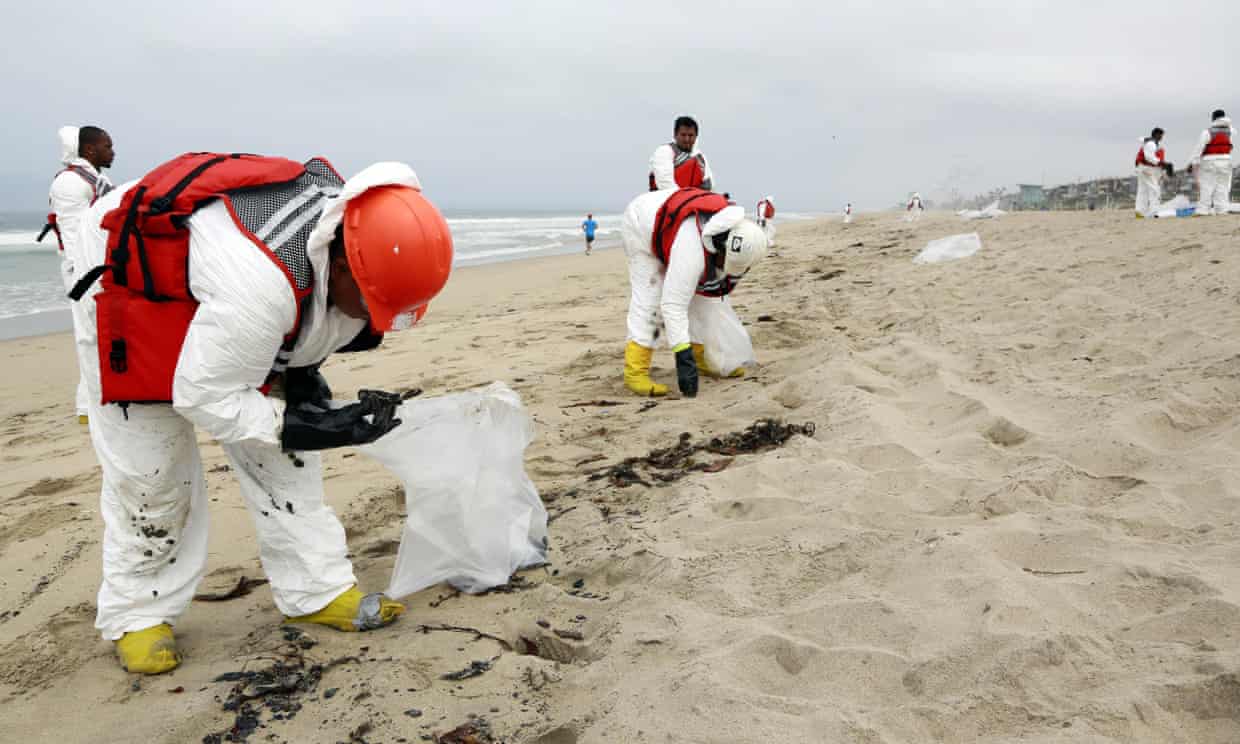
In the initial accounts, officials did not really have an idea of the magnitude of the spill or the potential aftermath of the spill.  The only concrete piece of knowledge that could be disseminated was that "tar balls" would show up?  Alright.  Furthermore, they closed the beach while cleanup crews walked the beach as shown in a photograph taken from the article and shown below:


Source: The Guardian


Can you imagine the concerted effort that was involved in order to get the oil removed from the beach?


A month later, the news was no less reassuring that the cleanup effort was successful thus far.  In another article appearing on the website "The Guardian" titled "Cleanup Of California Oil Spill Goes Low Tech To Limit Environmental Impact," the estimate of the total cleanup was to be around $64 million dollars -- wow!  That did not include the potential damage of the spill on the environment.  Here is an excerpt from that account regarding the cleanup effort at the time:


In the latest spill, workers shoveled tar balls and contaminated sand into plastic bags that were then carried away for disposal. They also had to be careful not to disturb populations of western snowy plovers that were in the middle of their breeding season.
 “We’re more concerned about the impact of the cleanup doing more injury than the oil did originally,” said Kim McCleneghan of the state department of fish and wildlife, who responded to both spills. 
About 91% of 97 miles of coastline – mostly sandy beaches – surveyed by teams of experts from various federal and state agencies has been given the all-clear.


Since the accounts surrounding the oil spill (within a few months), the subject has gone dark.  Meaning, that the news agencies are not spending coverage on the aftermath -- a year later.  That was (so I thought over the weekend after peeling oil off of my feet) until yesterday.


Plains All American Oil Gets Fined


An article that appeared in the "New York Times" titled "Company Says It's Been Indicted For The California Oil Spill" with a picture that reminded us of the extent of the spill shown below:


Source: New York Times


We are reminded of the extent of the damage of the oil spill by the excerpt shown below which was taken from the article:


On May 19 last year, the corroded, two-foot-diameter underground pipeline broke open near Refugio State Beach, west of Santa Barbara. Much of the oil flowed into the ocean, in an area that is home to an array of shorebirds and marine mammals, and is near the migratory path of gray whales. It formed a dark plume in the water that stretched for miles and coated several beaches, harming tourism, and officials have said that tar balls from the spill washed ashore as far as 100 miles to the southeast. 
The company initially estimated the spill at 21,000 gallons, but later revised that to more than 140,000 gallons. In documents supplied to lawmakers, Plains acknowledged that it had not alerted federal regulators until more than three hours after discovering the spill.


Here is an excerpt from the article discussing the possible distribution of charges being brought by the Attorney General of California -- Kamala Harris:


The California attorney general, Kamala D. Harris, and the Santa Barbara County district attorney, Joyce E. Dudley, said a Santa Barbara County grand jury had handed up an indictment charging the company, Plains All American, with four felonies and 42 misdemeanors, and charging an employee, James Buchanan, an environmental and regulatory compliance specialist at Plains, with three misdemeanors.

The company also faces multiple civil cases in the oil spill, but criminal charges in such a case are more unusual. Ms. Harris, who is running for the United States Senate, said the indictment reflected what the company knew or should have known of the dangers posed by its actions.

“The negative impacts of this conduct were immediate and tragic,” Ms. Harris said. “Anyone who violates the law and endangers our environment is going to be held responsible.”


I am happy to see that justice is being served toward the giant oil company "Plains All American Oil" by the Attorney General.  Accidents like this should not ever go away with time.  Especially, since the environmental destruction takes time to assess and set in.  After reading these articles and revisiting the oil spill, I wondering why I happened to get oil on my feet last weekend?


Oil Seeps Naturally From The Ocean Floor?


After I had the experience (which was foreign to me) of obtaining "tar" on my foot at the beach, I started to ask around.  I found a correlation with the information obtained about the presence of "tar" on the beach and the amount of years a person had been a resident of California.  Which is to say, people who had lived here less than 10 years tended to blame the "tar" on "natural oil seeps."  This fascinated me since I had lived here and frequented the beaches up and down the coast and not once (until this time) experienced "tar" on the beach.


Yes, I knew that there had been oil rigs up and down the coastal land (slightly inland) that had come and gone.  Still, I was surprised to hear from people how they just blew off the presence of "tar" as a derivative of the following statement: "Oh, the tar?  That is caused by natural oil seeps..."  What?  I guess that the following line of reasoning might be due to the amount of oil rigs that are in the area coupled with natural places like the La Brea Tar pits.  I highlighted the astounding amount of oil rigs in LA county in a previous blog post -- 5000 -- WOW.  With this number in mind, I guess that awareness should not make my discovery a surprise.


What about "natural oil seeps?"


I started to look into these "natural oil seeps."  What I found was an institute dedicated to studying the marine ecological environment called the "Woods Hole Oceanographic Institute."  The vision of the institute is stated below:


The ocean is a defining feature of our planet and crucial to life on Earth, yet it remains one of the planet’s last unexplored frontiers. For this reason, WHOI scientists and engineers are committed to understanding all facets of the ocean as well as its complex connections with Earth’s atmosphere, land, ice, seafloor, and life—including humanity. This is essential not only to advance knowledge about our planet, but also to ensure society’s long-term welfare and to help guide human stewardship of the environment. WHOI researchers are also dedicated to training future generations of ocean science leaders, to providing unbiased information that informs public policy and decision-making, and to expanding public awareness about the importance of the global ocean and its resources.


The WHOI in abbreviated form was instrumental in the analysis of the BP Gulf Deepwater Horizon Oil spill 6 years ago.  That spill was the largest oil spill in history.  The institute played a major role in analyzing the plankton and other marine organisms trapped in water columns near the blowout of oil along with the overall oil dispersion over time within the ocean.  The main take home message of me bringing this up is to say that the WHOI has experience with "natural oil seeps" -- studying the origination and contribution to the environment.  Check out their "Research Projects" page.


After I delved into their website a little more, I found statements like the one below discussing the origination of oil in the ocean which surprised me:


Oil can come from a variety of sources, each of which influences the amount, type, and duration of a spill. The 2003 report published by the National Research Council titled Oil in the Sea III organized these sources into four categories: natural seeps, petroleum extraction, petroleum transportation, and petroleum consumption. Of these, seeps are by far the single largest source, accounting for nearly half of all the petroleum compounds released to the ocean worldwide each year. Seeps are also the only natural source of oil input to the environment. The other sources, in order of magnitude, are extraction, transportation, and consumption and stem from human activity.

An important difference between seeps and human-generated inputs is that seeps are widely distributed around the world and occur at a fairly slow and relatively constant rate.  So constant, in fact, that some animals and microbes have evolved to thrive in the presence of the chemicals that flow from the seafloor near seeps. Studies of these unique organisms and ecosystems are an important part of the picture that scientists are assembling of how oil affects marine biology.

Oil that enters the ocean as a result of extraction, transportation, or consumption often receives more attention than seeps for the simple fact that it is more visible. These events are of interest to scientists because they generally constitute large inputs from a single source and can occur anywhere in the world, often in places that have little, if any, natural ability to cope with the contamination. The impacts of oiling on individual plants and animals or on entire ecosystems range from the visible and immediate (e.g., smothering) to long-term and largely hidden (e.g., genetic disruption) and can have implications on the physical structure or health of a region for decades. Human systems, such as water supplies, fisheries, and tourism industries, are also vulnerable to oil spills, and this adds even more complexity when trying to understand the full effects of a particular event.


I was surprised to find out that nearly half of the oil in the ocean comes from natural inputs.  I am still skeptical of the situation.  Upon further research into their website, the sources of oil become more apparent and justified from a scientific standpoint.  I want to show an excerpt that will bring to light a more logical connection to my experience at Venice Beach a couple of weekends ago.  Here is the excerpt from the "natural oil seeps" webpage on the WHOI website:


In locations where seeps are found, oil flows slowly up through networks of cracks, forming springs of hydrocarbons similar to the La Brae tar pits on land. Lighter compounds rise buoyantly to the water’s surface and evaporate or become entrained in ocean currents; others fall to the seafloor and collect over hundreds or thousands of years. 

Seeps are often found in places where oil and gas extraction activities are also located. As a result, many surface slicks and tar balls caused by seeps are often attributed to releases from oil and gas platforms. The question arises, then: If oil occurs naturally in the ocean and if seeps are the biggest single source, why is there concern about the occasional accidental spill? The answer lies in the nature and rates of oil inputs by these different sources.

Seeps are generally very old and flow at a very low rate. The material that flows out is still very often toxic, but organisms some that live nearby are adapted to conditions in and around seeps. A few very unique species of animals are even able to use the hydrocarbons and other chemicals released at seeps as a source of metabolic energy. In addition, rather than being made up entirely crude oil, the material flowing from seeps is often heavily biodegraded by microbial action deep beneath the seafloor.

In contrast, the production, transportation, and consumption of oil by humans generally results in relatively short, high-volume inputs of oil and refined hydrocarbon products in places that have never experienced significant exposure to these chemicals and so do not have many natural defenses to them. As a result, seeps are often looked upon as a living laboratory for scientists to study how natural processes affect the fate of released oil or how individual species or communities of plants and animals are capable of dealing with the burden of otherwise toxic chemicals. From this may one day come a better understanding of how to help places affected by oil spills recover and regain much of their pre-spill health and function.


These last four paragraphs justify my experience at the beach a couple of weeks ago.  Within the excerpt above, the contribution from the extraction and transport processes play a large role in the "tar" encountered on the beaches.  Additionally, this coincides with the statements I have heard since my experience from older "locals" of the Los Angeles area.  Some will not even go into the water anymore to surf because of the oil "tar" -- which has increased over the years.  This brings me to my last question:


Why has no one mentioned the increase in "tar" on the beaches or reported on the increase?


Have we all lost our minds? And as a result are just accepting of this unusual occurrence?


Something is unusual here.  I am very surprised that not one of these communities along the coast (Malibu, Santa Barbara, Manhattan, Santa Monica, etc.) have not been outraged at the increased occurrence of "tar" on the beaches.  Simply amazing.


Conclusion...


I remain skeptical of the contribution of the "natural oil seeps" due to the science of the flow rate and leakage along with the evolution of natural organisms to capitalize on their location and use the various hydrocarbons for nutrients.  This seems to me to be natural. Yet, these organisms would not leave behind giant "tar balls" to be washed up onto shore.  And if so, why would generations not be complaining about the presence of such organic matter on the shore.


The beaches in California are nearly worshipped along with the weather.  Over the generations, I am surprised to not hear anything of these natural occurrences.  Therefore, I tend to favor the other opinion that I hold -- the big oil companies are to blame for the increase in "tar" on our beaches.  With the presence of the "fall out" from last year's 140,000 gallons, I am more inclined to attribute the increase in "tar" to events such as those (as terrible as they may be).


Last Thursday, KPCC (a radio station) had a story titled "Pipeline Operator Could Face Additional Penalties For Santa Barbara Oil Spill" which talked about the disaster briefly and the "final investigative report" released by authorities regarding the Plains All American Pipeline's failure in last year's oil spill.  Here was the introduction to the story below which justifies my skepticism regarding a greater contribution from "Big Oil" rather than "natural oil seeps":


An oil pipeline company responsible for a massive spill on the California coast a year ago didn't do enough to prevent corrosion and its operators didn't detect and react to the spill quickly enough, federal regulators said Thursday.

Plains All American Pipeline also didn't have adequate systems in place to signal there was a major leak in the pipeline running near the Santa Barbara County coast, the Pipeline and Hazardous Materials Safety Administration said in its final investigation report.

"The operators failed on multiple levels to prevent, detect and respond to this incident," agency Administrator Marie Therese Dominguez said. "A number of preventable errors led to this incident and the company's failures in judgment, including inadequate assessment of this line, and faulty planning made matters worse. What happened is completely unacceptable and we will hold the company accountable."


I think that enough has been said on the matter.  What is next is the litigation followed by action.  What does "action" look like?  Well, each of us need to follow horrible stories like this and take "action" by writing (e-mail or written letter, or call) our local representatives and explain that these events do not justify the drilling that is going on currently.  All oil drilling should be shut down in the region until an agreement between large oil companies and agencies along with the public can be reached.


How much more of the environment do we need to damage before the message is heard?  As of this moment, the public and legislatures appear to be wearing "ear muffs" to buffer out the noise (outcry) of this damaging action by the oil companies.   Until next time, your assignment is to read more about the oil seeps and the part that "Big Oil" is playing into them.  Have a great day.