Tuesday, December 13, 2016

International Students Make American Science Stronger

I was reading last weeks editorial from the journal of 'Science' -- a prestigious science journal very widely respected by the entire world science community.  The editorial titled "Life For Refugees Scholars" detailed the emerging problem of refugee scientists leaving battle zones such as Syria.  What caught my attention was the closing paragraph shown below:


Displaced scholars, whether refugees or in exile, need the support of institutions large and small, in countries large and small, to break through the barriers that prevent them from academic engagement and employment—fears that they will take jobs away, require more help than they give, or not make the transition to teaching students in the host country. In succumbing to this backlash, we forget that the world's great universities became great because they welcomed refugees, exiles, and thinkers in distress. With support from the international academic community, threatened scholars and scientists can be saved. Let us all ensure that academic training is not wasted, knowledge for present and future generations is preserved, and that the next Albert Einstein or Felix Bloch is not lost in the painful currents of forced emigration.


In the paragraphs below, I would like to briefly discuss the benefits of having international students here in America to elevate science in the United States.


Graduate School in the United States


Upon entering graduate school in the United States two observations became very apparent to me:


1) The graduate class is small compared to an incoming freshman class at the undergraduate level.


2) Foreign students make up a sizable portion of the class


The first remark is based on the observation that one encounters when entering a graduate school class in the physical sciences.  This could be the case, since compared to say a graduate law or graduate medicine class, the research class is rather small.  Although, when you consider the available position (research laboratory positions available), then the class size makes sense.


Given that the class size is small, the second observation was rather surprising to me at first.  When I entered graduate school at University of California at Riverside, the total class size was around 15 students.  At least 50% of the class was made up of international students.  I did not understand the reason at first.  As I will explain, the reason became apparent in my second quarter of class near the end of my first year in graduate school.


Classes and Exams!


Part of every class was an exam component.  Educational institutions still use the written exam as a critical measure of learning success.  Although, after leaving graduate school, UCR was in the process of changing around the steps (tests -- written and oral) which made up a 'graduate degree' from the department -- which was surprising.


During the first year of a Ph.D. program, the major component of the graduate educational process is to take all required classes for the degree.  The remainder of the time spent in graduate school will be devoted to research and giving updates on your research project.  Upon hearing this, students are usually quite amazed and happy.  The thought of only taking around 6 classes for your Ph.D. -- is exciting.


With that being said, the classes are different from undergraduate courses.  The material is slightly different in the treatment of problems.  Fundamentally, in chemistry, one would start to explore more difficult aspects of the same problems encountered in the undergraduate education process.


How is that possible?


Take for example, the assumption of an "ideal gas" which is grounded in two basic assumptions:


1) The atoms are treated as point particles


2) The point particles do not interact with each other


These two assumptions simplify the types of chemistry problems that can be entertained.  Based on the two assumptions, atoms or molecules will be treated as independent entities and not interact with each other.  When the break down of the assumptions occur, the incorporation of math becomes more prominent in the problem solution.  More math -- oh no!


Math is not a problem generally speaking.  But not all chemists are going to enter a field of research that requires a heavy math background.  This is a point of debate for a later post.


At the point you might be wondering why I am talking about this?


What happened to international students?


Well, during classes, a student from the United States cannot help but notice that the international students are able to solve problems rather easily.  A common assumption is that they are trained in math better than students in the United States.  This might or might not be true -- again, a point for debate for a later post.  What is true about their presence is that "political rules" have been put into place to accept the student into the United States graduate education programs.


One is that the student must have already completed the equivalent of a "Master's Degree" from their country or origin.


The above requirement turns out to benefit a United States student to a large extent in the long run.  Even though, in the short run, this is counter-intuitive to the feeling a person gets when competing with an international student.  Let me explain below.


International Students Inspire U.S. Students


As I mentioned above, each international student entering the United States for graduate education has the equivalent of a "Master's Degree" from their country of origin.  Note: what this means overall is that the courses that every American graduate student takes in graduate school have already been completed by each international graduate student.  The comparison would be for be for a student to take the same course twice -- have two times to complete a course.  Of course, during the second time around your grade should increase.


I learned this fact from taking a class in "thermodynamics" in graduate school.  In the class, which was considered large, there were 6 students total.  Normally, a graduate course might have 4 students or maybe 5.  Six or above is considered very large.


Therefore, the classes in graduate school are intimate and like a "meeting" rather than a traditional lecture.  Nonetheless, the classes are still classes in which a professor lectures and students learn through listening and then completing assignments.  My thermodynamics course was no different.  What amazed me at the time were the scoring of the international students on a given exam.


The students would score very high on the exam -- perfect or "nearly perfect" -- meaning like 98/100.  If there was extra credit offered, the students would score on the order of 110/100.  Imagine, what the American students (myself) were feeling comparing ourselves to these students.  Plus, the grades were on a "curve" which meant, we would be graded against these students -- Oh My!


On the first couple of exams, we felt disappointed scoring 85/100, 90/100, 95/100.  While the international students were scoring: 98/100, 100/100, 105/100.  When the last midterm exam came in our class, the professor stated the following to the class:


Tomorrow's test will be extremely difficult.  I want to see if the international students can still score in the high 90's.  Therefore, I will be writing the test for them.  For the American students, take the exam and try your best.


What?


What is the meaning of the statements emerging from his mouth?


Has he lost his mind?


The tests are already difficult.  Needless to say, we showed up the next day and took the exam.  I scored in the 70's.  I was not the best student to say the least.  Furthermore, I am not a great test taker.  As the professor explained to me later in my graduate career -- he said:


Mike, if the point of the class was to turn in great homework assignments, you would score perfectly. Your homework scores are great -- given the time to think and solve the work.  But unfortunately, life is not always about homework.  Sometimes, tests are needed too.


I will never forget him telling me this.  We were right outside the chemistry building.  He went onto to explain that the feeling of 'feeling not good enough' should either be put aside or dealt with.  Further, he suggested that if I felt overwhelmed, I could always drop out of graduate school and get a job earning pretty good money.  But, he also stated a theme that I have heard time and time again during my education by other professors -- which inspires me to move forward regardless of the 'local feeling' that I might be harboring.


My observation has been that you like being in school and thinking critically about chemistry.  And that if you were to drop out of school, you might find yourself bored without being challenged.  Further, in the current situation, you might want to understand why the University of California system accepts international students at all. 
International students are required to have an equivalent of a "Master's Degree" from their country of origin.  And the process of accepting graduate students is to choose the highest quality of student.  The reason why?  Because, we want to challenge you (American students) to achieve greater than what you would do had they not been in the class. 
If the international students were not in the current class, then the best student would be considered the best and the remainder of you would write them off (he is just really good at math).  But with international students present and kicking ass on the exams, you guys are really pushing yourselves to out do them on the exams and homework assignments.  This produces a better American graduate student in our experience.


After hearing the above statement, I felt changed.  First, I started to understand that bringing in international students to the university should not be viewed as a 'threat' but a challenge.  In the sense, to improve the science that American students do.  Second, immersing yourself in the study of science problems in research has changed over the years.  Let me explain.


In the past, the image of a scientist was one of a single researcher in a laboratory performing research quietly and thinking methodically.  That image has changed over the past few decades to be one of a 'research group'.  For those people who are not interested in science, the image that is preserved is the former image.  Therefore, when a funding issue arises, the thought of giving money to a 'single researcher' is questioned.


The fact of the matter is that science is performed by a 'research group' made up of a diverse amount of scientists.  The size of the group can vary from 4 people (3 graduate students + 1 professor) to 60 people (35 graduate students + 20 post doctoral fellows + 4 professional research staff + 1 professor).  Yes, large research groups exist like this.  Look no further than Professor George Whitesides of Harvard Chemistry Department.  His research group is enormous.  Of course, the amount of small companies and ideas that come out of his laboratory on an annual basis is huge too.


The point is that science is made up of many critical components.  One is the diversity that drives the group (both international + American students).  Secondly, the funding of that research group is critical.  Third, the production of working scientists needs to happen to fill professional jobs in industry or academia.  Chemical industry, Pharmaceutical industry, Aerospace industry, among others to mention a few desirable job employers.


Most of the large industries mentioned in the last paragraph are 'global' industries which mean that there are multiple facilities around the world.  This fits in well with the diversity that is seen in the American university setting.  Having international students elevate American science as well as science all around the world.


Having a global mindset with regard to funding science is critical if we (as global residents of the Planet Earth) would like to save the planet.  Just because science research comes from the United States or Europe, makes either no less important.  Hence the need to preserve the ability to have visiting scholars and students mix ideas in with each other to produce 'global science' instead of researching in a small scale private setting with large borders.  Diversity is not preserved in such environments.


Conclusion...


The reason why I wrote this blog post is due to the current administration that is about to take office.  First, I think having the politicians who fund research understand the importance of having international scholars and students is extremely important.  Second, the example that leads currently is the break up of Britain -- known as Brexit.


In an article from the website "Laboratory Equipment" titled "Brexit Uncertainties Threaten Brain Drain for UK Science" the threat of the 'brain drain' from the shifting resources in science funding are discussed along with immigration status.  Here is an excerpt detailing real fears of losing critical scientist due to shifts in the political landscape:


"I'm worried that after my current contract finishes, one of the prerequisites could be a permanent residence card," she said. "I'd like to apply for EU grant money, but how much longer will it be available for?"

Britain's top universities have long been among the world's most sought-after destinations for study and research, drawing the brightest minds from all corners of the globe. But since Britons voted in June to leave the 28-nation EU, many in the science community say the U.K. risks losing the money, the international influence — and crucially, the talent — to sustain that enviable position.

More than one-tenth of research funding at British universities has come from the EU in recent years. Some fields — such as nanotechnology and cancer research — are more dependent on EU funding than others, according to a report by technology firm Digital Science. From 2007 to 2013, Britain received 8.8 billion euros ($9.4 billion) in direct EU investment in research.


As you can see, immigration issues are not the only source of fear in the changing science landscape as a result of a political decision.   Regardless, when politicians start discussing changing the porosity (openness or closeness) of the national borders, science will be inevitably affected in a negative way.  Here is another excerpt to describe such a change:


Scientists and researchers argue that being part of the EU has given British science a huge boost because it allows Britain to recruit the best talent across Europe and take part in important research collaborations and student exchanges without being constrained by national boundaries. The bloc's freedom of movement means its 500 million people can live and work visa-free in any member state.

No one knows yet what form Britain's exit from the EU — commonly known as Brexit — is going to take, but immigration was a key issue for "Leave" voters. Many believe some limit should be put on the number of EU citizens moving to Britain.

Prime Minister Theresa May has vowed to reassert control over British borders. She has offered no firm guarantees for the rights of Europeans already living in Britain, an uncertainty that weighs heavily over the 32,000 Europeans who make up 16 percent of the academic workforce in British universities. Many universities say the rhetoric over immigration control is also jeopardizing recruitment of researchers and students from further afield.


Typically, when we think of immigration issues, we restrict our definition to the "undocumented" (which I do not like to use) people who have crossed our borders for a variety of reasons (asylum, economic, livability, lack of resources, etc.).  What we do not consider is that any immigration reform will have an impact on science -- an adverse impact.


Which is why as Americans, we need to think and vote critically on immigration reform.  When we see changes start to take shape that are negatively impacting science, we need to take action and contact our local representatives (senators and congressional reps).  Otherwise, we are risking losing the status as the leader in science in the world.


In closing, the jobs of the future will revolve around our ability to lead in the scientific field.  Ranging from computational to environmental, jobs that are created will undoubtedly involve a higher education in science.  Therefore, it is critical to keep the momentum of incorporating international scholars and students into our science system to elevate our standing.  Lets make our scientists the best in the world.


Until next time, Have a great day!


Wednesday, December 7, 2016

How Much Do New Drugs Cost To Bring To The Pharmacy Counter?

One of the many issues that need to be addressed by politicians is the rising cost of prescription drugs.  Recent examples include the astronomical increase the drug 'Daraprim' by the crooked ex-CEO Martin Skreli of 5600%.  As If the public did not react appropriately, the next example was of the 'EpiPen' of 400% increase which led to a congressional hearing with the CEO Heather Bresch testifying as to the needed increase.  These two examples are outliers, but which still beg the two questions below:


Why do these drugs cost so much to make?  


How long does the average drug take to get to market?


These two questions will be answered with an example or two below.


Drug Design Length And Cost?


In a post that I wrote a few weeks back, I included a video of the process by which a drug goes through to get funded and produced to arrive at your pharmacy.  The process followed the listed steps below:


1) Basic research is conducted by university research laboratories around the nation and funded by the National Institutes of Health.


2) The results from research (are pre-clinical) submitted to the 'Food and Drug Administration' (FDA) for approval to proceed with a 3 phase clinical trial in humans.


3) Pharmaceutical companies proceed to conduct 3 phase clinical trial.


4) If 3 phase clinical trials are successful, then all data (pre-clinical, 3 phase clinical, etc.) is sent back to the Food and Drug Administration for approval to produce and market.


5) The FDA will continue to monitor the drug's progress throughout the lifetime in the marketplace to ensure safety.


In order to grasp the steps in full, a more detailed explanation of the above steps is in order.  At least a clarification of each step will greatly reduce the confusion.   The steps above are a combination of the pharmaceutical industry, academia (universities), and the government -- working on different parts but combined in the big picture.


Steps 1 & 2:


To start with, research is conducted at universities across the United States that is tax-payer funded through government science funding agencies like the National Institutes of Health (NIH) and the National Science Foundation (NSF).  These are the two largest funding sources through which scientific funding is provided.   Other sources include private funding through foundations like the 'Gates foundation,' along with others.


Research that is conducted with this money is typically aimed at preventing or treating disease -- that is the overarching picture or message.  The process seems simple, yet can take up to 20 years and cost nearly $1 billion dollars.  That is quite an investment.  The process begins with fundamental research about diseases at universities.


This process helps uncover the mechanism by which a disease or treatment works.  Examples might include research looking into the mechanism of the spread of the Zika virus.  Research aims to identify the gene or proteins responsible for the pathway through which the disease proceeds.  These are biological targets which can them be investigated to find out how scientists can produce drugs that bind to the targets.  By binding to the target of interest, the elimination of a disease might occur, or the repair of a mutated gene could occur.


The process of finding drugs (or molecules) that bind or 'hit' the biological target might take years.  Hundreds of tests through 'assays' or binding tests which test hundreds of different drugs that show promise of hitting the target.  Extensive testing is conducted and the outcome is a class of candidate drugs that will hit (or bind) the biological target involved in the disease pathway.


An interesting side note is that if there are drugs that hit multiple targets (not specific) then, that drug might have the potential to possess a large amount of 'side effects' -- which are undesirable.  Therefore, testing to ensure that each candidate only hits the desired target in the disease pathway is critical at this stage.  Especially, before the drug is tested on humans.  This part of the drug development process is referred to as "pre-clinical testing."


With the Pre-clinical data gathered at the university level, the data is submitted to the Food and Drug Administration for review.  If the FDA approves of the data enough to advance the candidates toward a "3 phase clinical trial," then a pharmaceutical company will usually take over the testing process from here.


Steps 3 & 4:


The 3 phase clinical trial testing on humans is very expensive and usually out of the limits of university budgets.  Therefore, at this point, a pharmaceutical company will proceed to test the candidates in human trials.  The process starts with phase 1 trial.


Phase 1:


During the phase 1 clinical testing trials, between 20-80 healthy adults are tested with the drug to evaluate the safety of the drug.  Additionally, the drug is tested for a safe dosage and any side effects during this phase.


Phase 2:


Phase 2 testing involves giving the drug to around 100-300 people to test the drug further.  During this phase, a certain portion of the group being tested will have the disease being sought after to treat.  This is to get a better idea as to the efficacy of the drug and knowledge about how the drug is working in either a healthy patient or a patient with the desired disease to be treated.


Phase 3:


The final phase is phase 3 -- which aims to verify the drugs effectiveness.  Approximately 1000-3000 patients with the disease sought to be treated are tested.  During this trial, the pharmaceutical companies will also compare testing other known treatments (drugs, comparing different brands, etc.) and no drugs (placebo -- sugar pill).  Using a larger sample (patient size) allows the testing to be statistically accurate in the regulatory agencies eyes.


Step 5:


If the drug is successful during all three phase testing trials in humans, the pharmaceutical company will submit the entire data (pre-clinical and clinical testing - phase 3) to the FDA for approval to manufacture and market the drug to treat the desired disease.  The FDA approval indicates that the company can indeed go through and manufacture the drug to treat the disease.  Although, throughout the drug's lifetime, the FDA will be keeping tabs on the drugs efficacy and can ask for paperwork at any time or additional testing.


Obviously, the steps outlined above requires the coordination of a large amount of people and data.  Think about just one perspective -- i.e., the research aspect of the process.  This by itself would be overwhelming.  Then add on another perspective of the process -- i.e., the legal challenges.  Not to mention other aspects like marketing and branding the drug.  All together, there is no wonder why the cost is so high.  But pharmaceutical companies still reap a large profit from a blockbuster drug -- so don't feel too bad for them.


Recently, the rules have changed for the drug manufacturers and additional testing is required.  A perfect example is the testing for 'alcohol dose dumping' - which I recently became aware of.  In the next section, I will introduce you to this phenomenon -- which as you will see will require more testing and money associated with the production of the drug.


More Requirements?


As I just mentioned, recently (as in 2005) the FDA has changed the testing requirements to add more testing.  Testing the drug in its native environment (inside the patient during a 3 phase trial) is not sufficient enough.  Now, the addition of 'dose-dumping' testing is required of companies.  I was unaware of the phenomenon until I stumbled upon a document on the FDA website titled "Mitigating the Risks of Alcohol Induced Dose Dumping from Oral Sustained or Controlled Release Dosage Forms: Proposed Regulatory Procedures."


Here is a brief background on 'dose-dumping' from the FDA report:


Unintended, rapid drug release in a short period of time of the entire amount or a significant fraction of the drug contained in a modified release dosage form is often referred to as “dose dumping”. Depending on the therapeutic indication and the therapeutic index of a drug, dose-dumping can pose a significant risk to patients, either due to safety issues or diminished efficacy or both. Generally dose-dumping is observed due to a compromise of the release-rate-controlling mechanism. The likelihood of dose-dumping for certain modified release products when administered with food has been recognized for about twenty years and a regulatory process established to address it (1-2).
Some modified-release oral dosage forms contain drugs and excipients that exhibit higher solubility in ethanolic solutions compared to water. Such products can be expected to exhibit a more rapid drug dissolution and release rate in the presence of ethanol.  Therefore, in theory, concomitant consumption of alcoholic beverages along with these products might be expected to have the potential to induce dose dumping. This potential mechanism leading to dose-dumping from an oral modified-release dosage form has not previously attracted attention in the pharmaceutical science literature or in regulatory assessment process. There are many reasons this may not have previously been considered, amongst these reasons is that there may have existed a general assumption that a clinically insignificant difference in drug release rate would be expected with concomitant ethanol consumption in vivo. A study conducted over twenty years ago (3) and the absence of a clear post-marketing signal pointing to alcohol inducing dose dumping may have reinforced the latter assumption. 


Drugs are designed by the manufacturer to have certain desirable time release characteristics.  To have a drug release all of the active ingredients at once may be not just undesirable but have extremely adverse reactions to a patient.  Therefore, considering the impact of taking medications on an empty stomach or full stomach are normal.  Additionally, with more precision medicine comes optimization in the form of adding other factors (like alcohol and other medications) which might result in degraded performance of the drug.  Of course, requiring extra considerations requires more testing which in turn requires more cost.  Although, one important factor to keep in mind when considering the cost of a prescription drug along with sympathizing with the manufacture is the stage of the process of change.


Where are the changes going to affect the 'bottom line'?


If the changes by the FDA require methodology change at the stage of 'basic research' then the cost is on the 'tax payer' and not the pharmaceutical industry.  Whereas, in the case above, the drug has already been manufactured and the change (including the solubilization by alcohol) is after the formulation stage and relies on the pharmaceutical company's 'bottom line.'  This cost cuts into the profit of the drug by adding more cost into the design of the drug to avoid 'dose-dumping'.


Based on the example above, the cost can be incurred by pharmaceutical companies or the government (i.e., tax-payer).  Our new President-elect Trump has stated in a recent interview with 'Time magazine' titled "Donald Trump on Russia, Advice from Barack Obama and How He Will Lead" that he is "... going to bring down drug prices. I don’t like what’s happened with drug prices."  That sounds encouraging.


The question is where is the cost going to be cut from -- government side or pharmaceutical side.  Either side will have a respective impact on Research & Design in the future for science and drug development.  Furthermore, as you can see, any change has an effect on cost.  Let's look at a positive change for better drug design below.   The change directly impacts the above problem of 'dose-dumping.'


An article recently on the website 'Research & Development' titled "New Discovery Could Help Oral Medicines Work Better" highlights new developments which are costly to incorporate into new drugs.  Although, in the article, research chemists funded by Dow -- have designed certain molecules (differing chain lengths) that help certain medications (or drugs) dissolve better in the stomach.


Again, the problem is with the dissolution of a medication inside the stomach (precision is desirable) as stated below from the article:


One of the biggest challenges for pharmaceutical companies when developing oral medications is to ensure that the body will fully absorb the drug molecules. Many therapeutic structures do not easily dissolve on the molecular level, which means they are less effective. In that case, the dose must be increased for patients, which may increase side effects.

"A way to explain the differences in solubility of medicines is to think of how sugar easily dissolves in water and is rapidly absorbed by your digestive system, whereas sand doesn't dissolve in water and if swallowed, would pass right through the digestive system," said Theresa Reineke, a chemistry professor in the University of Minnesota's College of Science and Engineering and lead researcher on the study.

Drug companies add substances, called excipients, to help the medicines dissolve in the stomach and intestinal fluid, but there have been few improvements in recent years to this decades-old technology. The process outlined in the study is a major breakthrough that revolutionizes the process of making drug structures more soluble in the body so that they are better absorbed.

Funded by Dow, researchers examined two medications—phenytoin, an anti-seizure drug, and nilutamide, a drug used to treat advanced-stage prostate cancer. The team used automated equipment at Dow to synthesize long-chain molecules. Their efficiency as excipients with these drugs were then tested with facilities at the University of Minnesota, including the Characterization Facility located in the University's College of Science and Engineering. One particular excipient discovered by this research allowed these insoluble drugs to fully dissolve in simulated intestinal fluid in a test tube. When they tested phenytoin with the new excipient in rat models, it promoted drug absorption three times better than the previous formulation.


The overall benefit of the discovery is that the molecules that were made could impact a range of medications, not just a couple.  Meaning, that the development could impact the field of 'oral dosing' -- medications taken by mouth -- which would be huge.  The problems and solutions above illustrate the extent to which the government and academia along with the pharmaceutical industry have to go to get a 'working pill' to your mouth or solution to inject intravenously.  After reading the above processes, you should step back and consider again why a drug costs so much money to develop.


Conclusion...


I have outlined above the steps that add up to 20 years and roughly $1 billion worth of research/marketing/legal work that goes into the drug design process.  Too many people have problems with the availability of prescription drugs due to cost.  Drug companies should be able to recoup the cost of research and design behind the drug that is sold at market.  Although, when drugs are given away or sold to foreign countries at a hugely reduced cost, concerned citizens start to speak up here in the U.S. regarding the inherent unfairness behind such disparities.


Furthermore, when a pharmaceutical company increases (by hundred of percent) the price of a drug for an outrageous claim in change of design, citizens should speak up to their elected officials (politicians) who have the ability to conduct a congressional hearing.   There are recent examples that justify this advice.


An example is the pharmaceutical company Mylan and the congressional trial where the CEO Heather Bresch had to testify in order to justify a 400% increase in cost for the EpiPen treatment.  After testifying, representatives thought that they were justified.  Although, in a recent article in 'Drug Development & Discovery' titled "Mylan CEO Discusses EpiPen Price Hikes at Forbes Event" Mylan CEO Heather Bresch tries to explain the increase in her company's product 'EpiPen':


Herper asked what specific value was added to these products after Mylan acquired them in 2007, which prompted Bresch to present two versions of the EpiPen on stage to illustrate how the pen has evolved over time.  She explained the pen in its initial form confused patients making it difficult to operate leading to accidental sticks whereas the latest iteration was safer and more ergonomic.

Plus, the CEO elaborated that Mylan spent over $1 billion implementing lobbying efforts to increase access to EpiPens and awareness regarding severe allergic reactions noting the company has been able to reach 80 percent more patients since acquiring the EpiPen in 2007, according to Business Insider.


The above reason sounds suspicious to say the least.  I don't buy the excuse.  For the reason listed above in the steps of drug discovery process, changing the 'ergonomic features' of a product most likely does not involve a large cost.  Especially from the standpoint of the regulatory process.  The underlying product (active drug and formulation) is not changed.  Therefore, I remain skeptical of Heather Bresch's reason for increasing the cost.


Furthermore, in closing, she stated the most accurate (and honest) aspect of the pharmaceutical industry in the following statement:


There’s a lack of understanding of where that full list… [price]…goes and how it is divided in the system,” Bresch told the audience. “The pharmaceutical system was not built on the idea of consumer engagement.”


True.  I could not agree more -- more transparency is needed regarding the way the pharmaceutical industry operates.  Which is why the public remains skeptical of the practices and pricing of the drugs that hit the market to treat diseases in the United States.  Stay tuned for more on this subject.


Until next time, Have a great day!



Sunday, December 4, 2016

How Much Would The Sun Weigh If Filled With Water?

Recently, I was listening to a radio show called "StarTalk" with the physicist Prof. Neil deGrass Tyson.  The episode was a panel of astrophysicists talking about the study of 'black holes' in our universe -- which was completely fascinating I might add.  During the discussion, there was a large amount of dimensional analysis going on in order to drive home the relevance and complexity associated with studying 'black holes' from Earth.  One statistic popped up out of nowhere:


If the Sun was filled with water, it would weigh nearly as much as it does now!


At the time, I was riding the train back home from vacation and did not have my laptop handy to look up a few values to explore the stated statistic further.  Since then, the statement has been lingering in the back of my head.  Today, I decided to perform a couple of calculations to either verify or debunk that statement.  Below are the result of those calculations.


How Much Does The Sun Weigh?


In order to tackle such a calculation, a few values need to be known.  First, the weight of the Sun needs to be obtained.  If the weight of the Sun is not known, then a comparison based on an analysis is useless.  Second, the Sun will be approximated as a perfect sphere for calculation purposes.  Third, since the sphere is going to be used as the shape of the Sun, then a formula for the volume needs to be obtained.  Finally, the density of water needs to be known to use as a correlation factor of volume to weight.  Right about now you are probably thinking the following:


How do all of these values and formula come together to confirm the statement above?


I will show you in the paragraphs below.  In order fully grasp the nature of the analysis that is about to unfold, lets cast the Sun into a better perspective.  The weight of the Sun can be obtained from the resourceful "wikipedia" page along with other useful facts such as the description shown below:


The Sun is the star at the center of the Solar System. It is a nearly perfect sphere of hot plasma,[13][14] with internal convective motion that generates a magnetic field via a dynamo process.[15] It is by far the most important source of energy for life on Earth. Its diameter is about 109 times that of Earth, and its mass is about 330,000 times that of Earth, accounting for about 99.86% of the total mass of the Solar System.[16] About three quarters of the Sun's mass consists of hydrogen (~73%); the rest is mostly helium (~25%), with much smaller quantities of heavier elements, including oxygen, carbon, neon, and iron.[17]


Wow!  The description above sets the tone for the following analysis. First, the numbers involved are going to be VERY large (many zeroes before the decimal place).   The Sun is enormous and dwarfs the Earth easily in its description.  The weight of the Sun is listed on the 'wikipedia' page as the following:


The mass of the Sun above is expressed in 'Scientific Notation' to abbreviate the enormous number.  Typically, scientist use this 'abbreviated notation' to express huge numbers more easily.  At the same time, scientific notation can also be used to express very small numbers (i.e., a billionth of a meter, a nanometer = 1/1,000,000,000 meter).  If the mass of the Sun expressed in scientific notation was written out in long form, the mass would appear as shown below:


Alright.  After viewing the mass of the Sun in long form, the ease of using 'Scientific Notation' is completely understandable.


To start the calculation, the volume of a sphere needs to be known.  Below is the volume of a sphere in equation form:


In order to calculate the weight of the Sun filled with water the following steps need to be taken:


1) Obtain the radius (denoted as 'r') of the Sun


2) Calculate the volume of the Sun


3) Calculate the mass of the Sun from the volume (with the density of water)


4) Compare the calculated mass of the Sun to the stated mass (above) from 'wikipedia'


The steps are quite simple.  Keep in mind though, that in order to compare or calculate values, wthe values need to be in correct 'units' (i.e., 'kilogram,' 'gram,' 'milliLiter,' 'Liter,' or 'cubic meters').  Otherwise, completing calculations and comparing calculated volumes is impossible -- like 'comparing apples with oranges.'


With this in mind, lets start calculating the mass of the Sun filled with water following the steps above.  First, the radius of the Sun needs to be known.  From the 'wikipedia' page, the radius of the Sun is stated to be either 695,700 kilometers or 109 times the radius of the Earth.  Expressed  in long form for the calculation, the radius of the Sun is shown below:


The radius of the Sun can be directly plugged into the equation for the volume of a sphere above to yield the following:


The volume of the Sun is shown above.  In order to calculate the mass from the volume, we need the density of water.  Density is the amount of mass contained in a given volume.  For water, the value of the density is 1.00 gram/milliLiter.  Since there are 1000 milliLiters in a single Liter, then the density for water can be expressed as 1000 gram/Liter.


The expression for density of a given molecular compound can be expressed as the 'mass' per 'volume' as shown below:


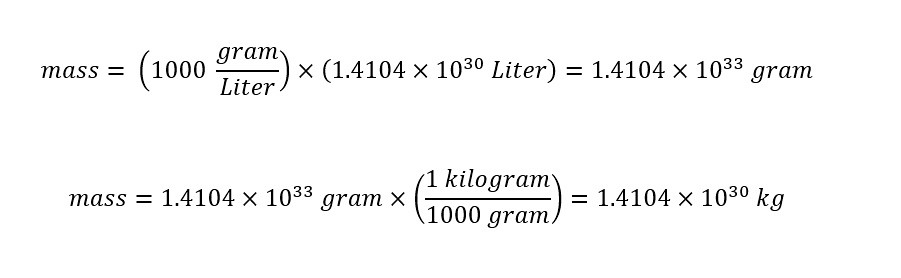
The first line shows the equation for the density of a given molecular compound.  In the second line, the equation is re-arranged to yield the 'mass' from the two parameters 'density' and 'volume'.  Plugging in the values from the calculation and reference (density) value, the 'mass' of the Sun can be calculated as shown below:


The calculated mass of the Sun is shown above.  Of course, the value of the mass is enormous as expected -- which is good.  Returning to the statement above -- which motivated the article:


If the Sun was filled with water, it would weigh nearly as much as it does now!


The following question can be asked regarding the calculated mass and the reference mass listed from 'wikipedia':


How do the two masses (theoretical and calculated) compare to each other?


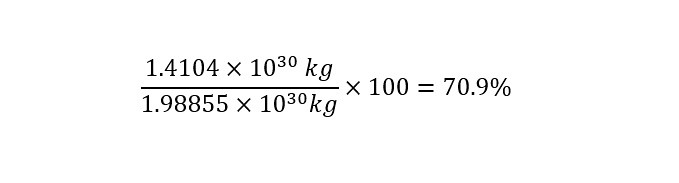
The easiest way to compare two value (in the same units -- i.e. 'kilogram') is to express them as a ratio of each other as shown below:


The result shows that the two values have the same "order of magnitude" -- that is 10 raised to the power of 30.  But the two values are NOT nearly the same -- Why Not?   Read onto find out.


Plasma Is Denser Than Water


In carrying out the calculation above, there are a number of assumptions listed below:


1) The Sun is shaped as a sphere


2) Density of water at 25 degrees Celsius was used in the calculation


What was not figured in was that the density of an mass can change with temperature.  The Sun has a reaction going on in the core of the sphere.  There are four states of matter: Gas, Liquid, Solid, and Plasma.  In the calculation above, the state of matter used for water was a liquid -- 1.00 gram/milliLiter at 25 degrees Celsius.


According to the 'wikipedia' page for 'plasma,' the density can change significantly with temperature as shown in the image taken below:


What does this mean in the overall calculation?


Why should I (you -- the reader) care?


Understanding the accuracy of an approximation is crucial to the words that are used to describe the comparison of two values.  In the situation of comparing two masses -- the result of the calculation and the theoretical mass from 'wikipedia' -- you can easily see that the two are not comparable.  In order to understand the reason why that is the case or might be -- look toward the density of the molecule in question -- in this case water.


The density inside plasma can vary up to 7 orders of magnitude different from that in room temperature.  Meaning, you can pack more mass into a given space.


Conclusion...


The above calculation is a great opportunity to illustrate the methodology of carrying out a 'dimensional analysis' problem.  Based on the result of the calculation, the statement above regarding the mass of the Sun filled with water nearly being equal to that of the current weight is not necessarily true.  Although, the two values did have the same 'order of magnitude' -- 10 raised to the power of 30.


Nevertheless, the exercise was fun and displayed the power of 'dimensional analysis.'  Now, you have the ability to carry out the same calculations on your own.  The next time that you are listening to the radio or reading the paper and find an interesting fact, you can verify the two values on your own.


Until next time, Have a great day!



Wednesday, November 30, 2016

Using Scavenger Hunts To Solve Real World Problems?

In a recent article in the news site "Research & Discover Magazine" titled "DARPA Completes 2nd Field Test of Experimental Nuclear Detection" a scavenger hunt was used to test a network of sensors.


This is wonderful for the enhancement of defense for the country's biggest challenges. With over a 1000 sensors deployed, the challenge is to fuse all of the data together to make sense of the efficiency and challenges that lie ahead in the real-time detection of a threat.  The amount of data coming in from such an exercise (simulation) must be overwhelming.  Further, to process and correlate the data is time consuming.


In a recent post I wrote about the NFL collecting 'big data', a single football game generates a large data set.  The number of sensors (one each players shoulder pad + sensors on the field) should generate a data set of considerable length.  The authors did not specify the size of either data set in each study -- which begs the following questions:


How does the data set generated by a single football game compare the data set generated by the scavenger hunt above?


I wonder if the two organizations are using similar algorithms to mine the data sets generated out of each circumstance (scavenger hunt vs. football game)?


The two different studies obviously generate different amounts of data.  Furthermore, the types of sensors used in each study are probably quite different.  Regardless, each of these studies prove that the future holds a considerable investment into generating large data sets.  Additionally, new graduates of the physical and life sciences would be well-served to have the experience in handling large data sets.


The future is exciting for those working in data science.  As in other fields, as time goes by and problems are tackled, new problems emerge.  If the problems are not tackled, then no new problems will emerge.  In the case of generating and handling big data, correlations might be possible but a lack of computational power might be limiting.


More often the case, a researcher is stuck with a large data set and lacks the questions regarding the possible mining strategies.  In order to come up with possible correlations, scientist must understand the data that is being collected in each study (scavenger hunt vs. football game).   Although, with the help of mining data from social media companies, progress could be spread up exponentially.  This necessitates the need to have more interdisciplinary research.  Otherwise we have a bunch of studies occurring in parallel which might benefit if the researchers would talk to each other about the problems and strategies without giving away proprietary information.


This means that we will be at a point of stagnation -- which is not good.   Fortunately, most scientists find a way to move forward and tackle problems in order to keep pushing the field of research forward.  At the current moment, both DARPA and private organizations like the NFL do not appear to be running out of funding, which is exciting for those of us watching the developments from the 'sidelines.'


Friday, November 25, 2016

Free Speech Is The Least Of President-Elect Trump's Problems Ahead

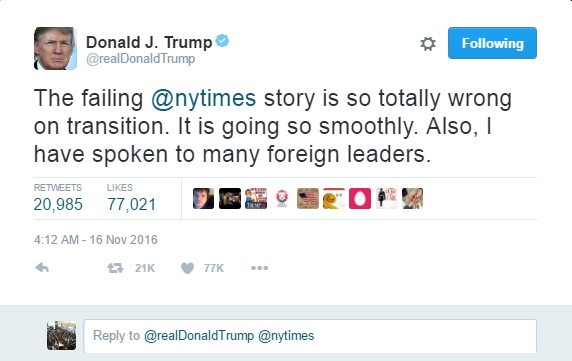
When I was on Twitter recently I saw the tweet below from President-elect's Twitter page:


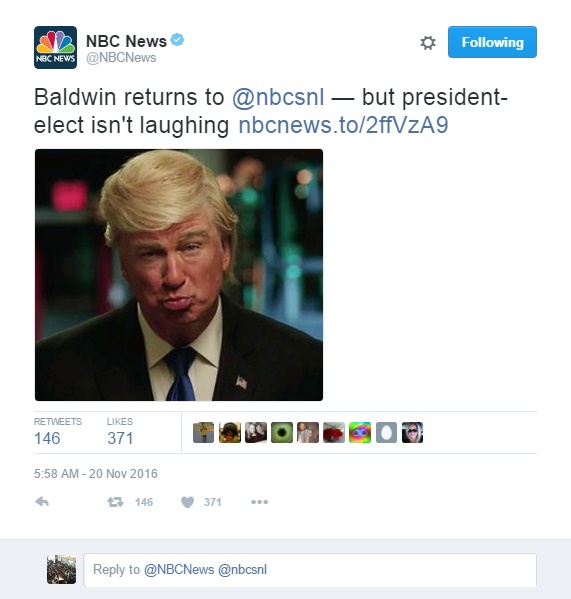
Followed shortly by the two Tweets below:


and Saturday Night Live back in full swing with a President-elect Trump impression:


These Tweets seem to suggest a disturbing pattern of the incoming President-elect.  The reason is that the implication is that the leader of the free world is more concerned about personal image rather than upholding very important issues like those of science and policy.  Below are a few remarks about worries and concerns.


Image Alert...Threat Detected!!


As I showed above, the images of the Tweet suggest that we are approaching a disturbing future.  I am usually quite optimistic and still am.  Which is why I chose to write this short blog post to remind the public and President-elect Trump  personal image is 'trumped' by important scientific issues.


One main issue is freedom of speech.  Regardless of whether we are discussing the issue in relation to science or personal belief.  America was founded on the idea of values such as 'free speech' and 'equality.'  We have come quite a ways.  During that evolution, the United States has emerged as the leader of the free world -- i.e. the most developed world.  That is not being pompous in any manner.  We are leading the ways in many ways.  We have obligations based on the infrastructure that we have built up over the generations.


At the same time, we have obligations to keep the momentum going.  At this point, you are probably wondering why I bring all of this up?  Especially, since the news has been broadcasting everything I just wrote about on HIGH VOLUME the last few weeks.  Well, let me explain.


The President of the United States has the 'highest visibility' of any world leader.  World leader folks -- yes World Leader - wow!  With that responsibility comes the 'limelight' -- lots of press.  If we have a President-elect worried about a newspaper reporting ('The New York Times') about the troubles emerging during a transition, then so be it.  That is the reality.  That is their job.  Their job is not to cater to the President-elect to make his image look great.


Recently, the newspaper 'The New York Times' ran the article titled "Firings and Discord Put Trump Transition Team in a State of Disarray" about the halt of the transition team for President-elect Trump.  The article discussed the upset of the progress with all of the 'wish-wash' behavior centered around the indecision of the Trump team.  But the most important information contained in the article is near the end:


In another delay, Mr. Pence did not sign legally required paperwork to allow his team to begin collaborating with Mr. Obama’s aides until Tuesday evening, a transition spokesman said. Mr. Christie on Election Day signed a memorandum of understanding to put the process into motion as soon as the outcome was determined, but once he was ousted from the job, Mr. Pence had to sign a new agreement.

The paperwork serves as a nondisclosure agreement for both sides, ensuring that members of the president-elect’s team do not divulge information about the inner workings of the government.

Teams throughout the federal government that have prepared briefing materials and reports for the incoming president’s team are on standby, waiting to begin passing the information to counterparts on Mr. Trump’s staff.

As of Tuesday afternoon, officials at key agencies including the Justice and Defense Departments said they had received no contact from the president-elect’s team.


In business, the process of hiring and firing is frequent and fine.  When you are dealing with the speed of the government, the firing of an individual (team chief) can bring the process to a halt.  After reading this, excerpt, I was thinking about the first few weeks of previous President's-elect.


Did the same problems happen?


Did previous teams have these issues?


Surely, the process of hiring over 4,000 positions cannot be easy and swift?


This does not excuse the President-elect's behavior of focusing on his image so early instead of critical needs -- like transitioning quickly to get ready to run the nation.


On a slightly different note, the choice of working out of 'Trump Tower' in Manhattan has caused a stir too.  In a different article from 'The Times' titled "With Trump Using Tower as Base, Fifth Avenue Grinds to a Halt" customers of the store 'Gucci' inside his building were frustrated with him already:


“I had to be questioned by three different police officers just to get into this store,” said Ms. Hendrickson, 47, who was visiting from South Orange, N.J., the Sylvie at last in her hand. As she mused on Mr. Trump’s being garrisoned in his penthouse apartment, she wondered why he was not preparing in Washington. “This isn’t a Monday-Friday job,” she said. “This is a very serious job, and you need to spend time in the White House.”


From the first read, the stories are making President-elect Trump out to appear not prepared to make large decisions.  But that is not the case at all.  Holding the highest office in the world requires a person to grow 'thick skin'.  This job will bring strong opposition with tough decisions.  At this point, President-elect Trump appears to be having great difficulty.  Just wait until after the inauguration!


With the Tweets above regarding his image and the ability of 'The New York Times' reporting about critical issues that affect our nation, the time has come for him to concentrate on real issues.  Parading his possible candidates around does not build confidence in the nation in regard to solving critical problems that plague the nation and the world at large.


Science Alert -- Trump Possibly Switching Positions!


On a different note but related to image, over the last couple of weeks, President-elect Trump has eased back on his radical opposition positions toward the direction of the nation over the next few years.  During his campaign, he stated in different ways that he was not a large believer in 'climate change'.   Moreover, that he would divert funding from one direction (climate change regulation) toward another (helping the nation - however that is defined?).  Remember my blog posts a couple of weeks ago -- here and here -- on issues from scientists and the research world -- worth reading.  Recent statements have started to change those views  for the better of science -- I believe.


In an interview a couple of days ago with 'The New York Times,' he changed directions as indicated in the following excerpts below:


Climate Change - Pulling out of the Paris Agreements:


On climate change, Mr. Trump refused to repeat his promise to abandon the international climate accord reached last year in Paris, saying, “I’m looking at it very closely.” Despite the recent appointment to his transition team of a fierce critic of the Paris accords, Mr. Trump said that “I have an open mind to it” and that clean air and “crystal clear water” were vitally important.


This is encouraging since his previous position was against the Paris agreement.  Sounds like he is coming around to understand that the wide range of issues that he believes to be able to tackle in a 4 year period are unattainable.  He is coming back to Earth -- slowly:


He displayed a jumble of impulses, many of them conflicting. He was magnanimous toward Mrs. Clinton, but boastful about his victory. He was open-minded about some of his positions, uncompromising about others.

The interview demonstrated the volatility in Mr. Trump’s positions.

He said he had no interest in pressing for Mrs. Clinton’s prosecution over her use of a private email server or for financial acts committed by the Clinton Foundation. “I don’t want to hurt the Clintons, I really don’t,” he said.


The statement is encouraging for progress ahead.  I like to see that he is open-minded, but wary of oscillating on issues.  The saving grace might be embedded in the fact that he is concerned about his image.  The image conscience might save the nation.  As I wrote on Veteran's Day, I believe that the President-elect has the opportunity to help the nation by helping veterans.  Furthermore, by helping veterans, tough issues like homelessness and mental health issues will be solved.  I still hold that hope of his success in dealing with these two critical issues.


I chose to write this blog for the purpose of bringing to light the obvious:


President-elect Trump should be concerned with issues that plague the nation and the world at large rather than be concerned about his image.  Sure, having a good rapport with the nation is good.  Although, getting the job done is more important.


Choosing to shame the nation on issues of free speech is not a useful use of his transition plan.
 President-elect should not be speaking his opinion on such matters like the actors who exercised their 'free speech' last Saturday night.  Here is the Tweet from his Twitter feed:


Do you want a President who is concerned about his image on Saturday Night Live?


The United States was built on values as I mentioned earlier.  Values like "freedom of speech" or "equality."  Here is what the cast of the New York City Play 'Hamilton' had to say to a visiting audience member -- Vice President-elect Mike Pence last Saturday Night:


“You know, we have a guest in the audience this evening,” he said to audience laughter. “And Vice President-elect Pence, I see you walking out, but I hope you will hear us just a few more moments. There’s nothing to boo here, ladies and gentlemen. There’s nothing to boo here. We’re all here sharing a story of love. We have a message for you, sir. We hope that you will hear us out.”
As he pulled a small piece of paper from his pocket, Dixon encouraged people to record and share what he was about to say “because this message needs to be spread far and wide.”

There was 'boo-ing' in between the introduction and the message which is below:


“Vice President-elect Pence, we welcome you, and we truly thank you for joining us here at ‘Hamilton: An American Musical.’ We really do,” Dixon said to further applause. “We, sir, we are the diverse America who are alarmed and anxious that your new administration will not protect us, our planet, our children, our parents, or defend us and uphold our inalienable rights, sir. But we truly hope this show has inspired you to uphold our American values and work on behalf of all of us. All of us. Again, we truly thank you truly for seeing this show, this wonderful American story told by a diverse group of men and women of different colors, creeds and orientations.”


Can you fault the actors taking the opportunity to express their concern to the incoming Vice President of the United States? 


Conclusion...


Regardless of which side of the political spectrum you reside, science should be a high priority.  As a nation, we should hold our political officials accountable to make our priorities first rather than second.  Each of us has a responsibility to speak out and share our views and concerns.  The office of the President of the United States is currently under a transition.  Hopefully, the outcome of the transition is a nation with a sense of change and purpose to save the world and planet Earth.


So far, there is concern with the turmoil surrounding the President-elect Trump and his image.  Lets put the issues that confront us as a nation first and image second.  Tough actions (climate change that is not favorable) take tough decisions.  We rely on our politicians to stand up and stand firm for our values.  Even in the face of opposition -- which might result in a few (thousands or million) unfavorable Tweets or Social Media posts.


We should focus on the issues that will help society.  Research and development is crucial to growth as a nation.  Lets focus our attention on growth rather than image.


Until next time, Have a great day!



Tuesday, November 22, 2016

The NFL Is Collecting Big Data?

Currently, there is a data revolution occurring in the world.  Recent articles in professional journals often highlight the need for science based data degrees.  The hope is to have data scientists migrate often away from the field of science into more lucrative jobs crunching numbers to determine how to increase the number of "likes" and the sort.  Add to that craziness, and you get big organizations like the National Football league joining the party of 'big data' collection.  The question is the following:


What is the NFL going to do with the 'big data' collected?


In order to find out a few of the possibilities, one must continue to read below.  The possibilities are endless, although, the initial reasons are restrictive.


What Is Big Data In Football?


When I read the title of the article on the website "Scientific Computing" titled "The NFL Joins The Data Revolution in Sports", the first question that came to mind is:


What data are they collecting that is not already being collected?


I was confused by the title of the article, since, one would think that a huge organization like the NFL would already have an enormous amount of data.  Think about the gambling industry across the world and their profits on sports.  One would imagine that big data has played a significant role already in generating an enormous amount of profits from big data.  Evidently not.  Hard to believe.


According to the article mentioned, the NFL is just entering the field of "Big Data":


In some potentially game-changing news for the way we understand professional football, the National Football League began the 2016 preseason by placing tracking sensors in its footballs for the first time. The chips are also in balls used in Thursday night games.

Over the past decade, we’ve seen an explosion in data analytics in sports, particularly on the professional level. Technological advances in cameras and sensors have allowed teams, media and fans to gain insight into a bunch of previously gray areas of sport performance, such as the National Basketball Association’s use of SportVU to track every bit of player and ball movement on the floor.

The concept of integrating numbers and analysis into scouting, training and coaching isn’t new. But access to powerful hardware and software has greatly increased the quality and quantity of available data. A nearly insatiable appetite for data on sports has created a sports analytics market that is set to grow from the millions to the multiple billions of dollars over the next few years.


 The amount of data generated during each game would be enormous.  By keeping the sensor limited to the football and possibly the sidelines, the data generated would be reduced too.  Although, with a reduction of data flowing in from the game, the accuracy of the plays suffer too.  The author mentions that the next step would be to incorporate sensors into the players 'shoulder pads' - which would increase the data stream coming in.


Overall, the practice would be transformative to the entire industry.  I wonder how that would change the challenges that referees face during the game.  Currently, during a challenge, the play is reviewed on a closed circuit screen available to the referee and officials only.  With the rise of sensors, now the game can be analyzed by each team in real time.  Although, the technology is not distributed in real time yet.


Any avenue of improvement that the coaching staff can incorporate into the teams training regimen would be greatly sought after.  Currently, teams are exploring both game simulators and drone coverage of their practices to improve overall flow.  The incorporation of data from the NFL offers two great aspects of improvement:


Ideally, data from ball trackers or shoulder pad trackers could serve two purposes for the NFL. First, it can help teams understand player movement and the flow of play more completely, providing coaches a greater understanding on how players are physically performing during plays, and allowing for input from coaches to players on how to fix their technique to increase efficiency or limit exposure to injury, possibly leading to more efficient training and practice.

Second, the data can be used by the league’s media partners, and perhaps its fans, to further explain the game to audiences, particularly on television. By tracking player movement digitally, clearer representations of what makes individual football plays succeed (or fail) can be provided. These data also allow media to break down individual physical accomplishments, such as extraordinary bursts of speed by wide receivers.

The NFL’s plan to release tracking data within 24 hours of a game’s end points to a future in the league where hard data on player and ball movement are integrated into the daily strategic calculations of each coaching staff. This will likely create a rush to innovation within NFL coaching, as each staff grapples with what will likely be a huge amount of data every week, trying to come up with best practices and analytical methods for evaluating and using that data constructively.


Of course, generating a tremendous amount of data means that the NFL along with individual teams that participate need to have the technological infrastructure (computing power, data scientists, etc.) to make meaningful use of the data coming into the organization.  This requires both technology and scientists to handle that technology in a fruitful manner.


That means scientists will be taken away from professional fields in which they were trained to contribute.  Is this good?


NFL Data Science Improves Science Indirectly


There are a tremendous amount of scientists who are interested in sports.  At least, that is my impression after going through the university system in a science driven field -- through an advanced degree program.  The prospect of losing a scientist to the NFL organization at first sight might seem unethical.  Scientists should stick within their field (discipline) right?


Not necessarily.  There might be many benefits by losing data scientist to the NFL.  First, the scientist working for the NFL will inevitably have a appropriate infrastructure to handle the large amounts of data coming in.  In science, funding is scarce and often sought out among many research groups.


I have always maintained that in order to improve the funding for science, we need the entertainment industry and the sports industry to get involved (financially and technologically) to boost the ability of science.  Why?  Not all great ideas come from working on science problems in science.


What do I mean by this last statement?


A famous story about the world famous physicist Albert Einstein revolves around generating his best ideas while shaving.  Successful people will often tell stories of ideas which have been generated about their business while performing outside work or tasks.  The shower or shaving are just two.


Additionally, while performing a job outside a given field, a scientist may gain insight into the problems within their field.  This methodology is sometimes referred to as "thinking outside the box."  By tackling problems associated with dealing with large data sets like players in a game, other problems might be tackled using different algorithms.  Can you think of any?  I can.


One such problem is tracking people in real time in a city and finding potential threats (WM -- chemical and biological weapons, etc.).  Sifting through the data to find meaningful answers might improve the governments ability to sift through data to find a threat.  Although, the funding opportunities to develop an algorithm or simulation might be too costly on part of the city.  Therefore, having organizations such as the sports organizations tackling the data regarding player movement within a given region (on field inside a stadium) will inevitably improve our ability to detect a threat.


As most of us know, the entertainment industry is rich in funding and not at a loss for funding such interesting projects.  Alternatively, new algorithms will be made (which are proprietary for the NFL) to tackle the issue of analyzing real-time data.  But the inherent thinking or structure of mining the data is what is critical.  After that is known, then an algorithm could be changed to achieve that specific problem.  This prospect offers a great future to science and society in the future.


Conclusion...


The correlations which will arise as a result of data mining real-time player information have yet to be realized.  By the descriptions in the cited article above, we are just at the tip of the iceberg in terms of finding relationships within such data sets.  Additionally, no one knows the benefit or adverse effect the data mining will have on both the gaming (gambling industry) and the NFL organization.


Hopefully, out of such data mining algorithms, safer players (with less injuries, etc.) will result.  Science will inevitably benefit out of the data mining processes that are developed.  I have no doubt about that.  Scientists are interested in sports and already use the industry to approach problems in science.  Even if progress is made on the initial thought process of how to find correlations in the data, I believe that meaningful results will arise from the exercise.  Initial findings suggest that this is the case.  Although, as I mentioned, we are just at the 'tip of the iceberg' in the process.  Stay tuned!


Until next time, Have a great day!



Friday, November 18, 2016

Is Disease Or Treatment Different In Women?

As modern medicine moves toward the field popularized by the term "personalized medicine," along the way, the first stop will be gender specific medicine.  At least, that seems likely as the field of medicine continues to evolve and research unveils gender specific treatments and disease types.


Gender Specific Diseases?


Each of us have encountered different statistics in the healthcare field for diseases based on gender.  One such example is the occurrence of cardiovascular disease in adults over the age of 40 years.  For women, the occurrence is 1 in every 2 whereas for men it is 2 in every 3.  The obvious question arises:


Why do these differences arise?


Recently, I was listening to a TED talk titled "His and Hers ... Healthcare" by Dr. Paula Johnson.  The video runs less than 15 minutes in length and is worth watching.


In her talk, she starts off with citing statistics in occurrence of mental illness between men and women.  Which ultimately leads her to the visionary statement of the differences lie at the molecular level leading to "sex differences in each cell".  This is visionary way of thinking.  Before I tell you more about the TED talk by Dr. Paula Johnson and the differences in treatment for men and women in medicine, lets look at Dr. Paula Johnson's TED talk profile.  Here is an excerpt from the page:


Dr. Johnson is the Executive Director of the Connors Center for Women's Health and Gender Biology, Chief of the Division of Women's Health at Brigham and Women's Hospital in Boston, Massachusetts and a Professor of Medicine at Harvard Medical School. As an entrepreneurial leader in medicine, she has built organizations which stand at the leading edge of hospital-based interdisciplinary healthcare delivery, discovery and disease prevention. Dr. Johnson started and grew the Connors Center for Women's Health and Gender Biology. This nationally-recognized center, includes an interdisciplinary health care practice model that solidifies the important connection between healthcare delivered to each patient and the health of entire communities.


Read more by clicking the hyperlinked sentence introducing the excerpt above which came from the personal profile composed by the TED talk organization.  I just wanted to give the reader some background on the evolution of Dr. Paula Johnson.  Dr. Johnson introduces through a brief account of the emergence of the National Institutes of Health's (NIH) 'Revitalization Act of 1993' -- which was critical to the inclusion of minorities and women into clinical trials.  Here is a summary amended in 2001 from the NIH website:


SUMMARY: This notice updates the NIH policy on the inclusion of women and minorities as subjects in clinical research. It supercedes the 1994 Federal Register notice (https://grants.nih.gov/grants/guide/notice-files/not94-100.html) and the August 2000 notice in the NIH Guide to Grants and Contracts (https://grants.nih.gov/grants/guide/notice-files/NOT-OD-00-048.html). It incorporates the definition of clinical research as reported in the 1997 Report of the NIH Director’s Panel on Clinical research. Also, this notice provides additional guidance on reporting analyses of sex/gender and racial/ethnic differences in intervention effects for NIH-defined Phase III clinical trials. The guidelines ensure that all NIH-funded clinical research will be carried out in a manner sufficient to elicit information about individuals of both sexes/genders and diverse racial and ethnic groups and, particularly in NIH-defined Phase III clinical trials, to examine differential effects on such groups. Since a primary aim of research is to provide scientific evidence leading to a change in health policy or standard of care, it is imperative to determine whether the intervention or therapy being studied affects women or men or members of minority groups and their subpopulations differently.

In June 2001, NIH adopted the definition of clinical research as: (1) Patient-oriented research. Research conducted with human subjects (or on material of human origin such as tissues, specimens and cognitive phenomena) for which an investigator (or colleague) directly interacts with human subjects. Excluded from this definition are in vitro studies that utilize human tissues that cannot be linked to a living individual. Patient-oriented research includes: (a) mechanisms of human disease, (b) therapeutic interventions, (c) clinical trials, and (d) development of new technologies; (2) Epidemiologic and behavioral studies; and (3) Outcomes research and health services research http://www.nih.gov/news/crp/97report/execsum.htm.


Imagine that before the inclusion of minorities and women, all of medical trial data was based on men?


Is that really possible?


Upon the first read, this might be impossible to believe.


Even drug testing?


Yes, this is possible.  I know from direct experience.  Back in 1995, I was taking a polymer chemistry course from an old chemist named Professor Roy Kreiger.  Professor Kreiger had been in industry as a bench chemist before he returned to academia to teach.  During our lecture he told of a weekend which was spent as a bench chemist having an extreme case of feeling nauseous.  Here is the story.


He was working as a bench chemist at a pharmaceutical company.  Over the weekend (during time off), the company offered its employees an opportunity to earn "extra money".  Sometimes he would participate and during other weekends he would not.  The participation would entail taking the experimental medicine over the weekend and returning to work on Monday to fill out a detailed questionnaire regarding the experience.  He did this up until he had a bad reaction.


After vomiting all weekend, he returned to work to report that the voluntary medication caused him to be nauseous all weekend.  When he asked what the experimental medication was that he had been ingesting all weekend, the response was that he was administered a new type of "birth control."


After that experience, he no longer participated in earning "extra money".  Upon seeing the TED talk by Dr. Paula Johnson, I was reminded that there was a time when drugs were only tested on  men.  That time was when Professor Kreiger worked in the pharmaceutical industry.


Returning to the video above, Dr. Paula Johnson provides two distinct examples of physiological differences between men and women in disease.  Below the picture is a description of the differences of the two images by Dr. Paula Johnson taken from her TED talk above.


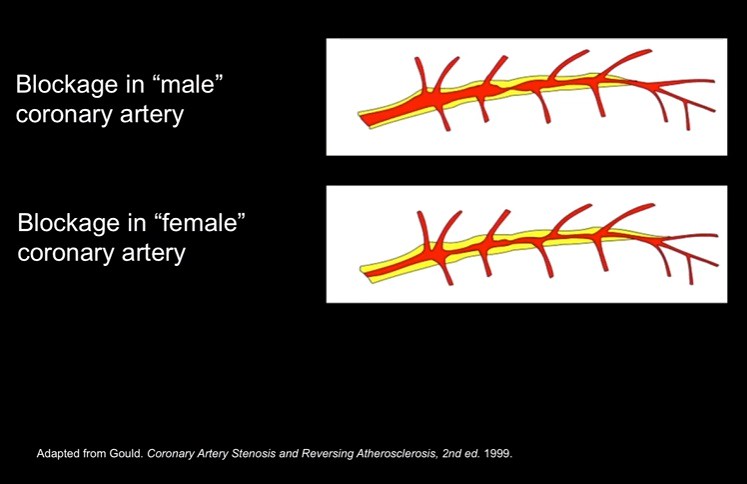
The first example is the difference in plaque build up in the artery as shown below:


Here is the description of the difference by Dr. Paula Johnson of the slide above:


Let's start with heart disease. It's the number one killer of women in the United States today. This is the face of heart disease. Linda is a middle-aged woman, who had a stent placed in one of the arteries going to her heart. When she had recurring symptoms she went back to her doctor. Her doctor did the gold standard test: a cardiac catheterization. It showed no blockages. Linda's symptoms continued. She had to stop working. And that's when she found us. When Linda came to us, we did another cardiac catheterization and this time, we found clues. But we needed another test to make the diagnosis. So we did a test called an intracoronary ultrasound, where you use soundwaves to look at the artery from the inside out.
And what we found was that Linda's disease didn't look like the typical male disease. The typical male disease looks like this. There's a discrete blockage or stenosis. Linda's disease, like the disease of so many women, looks like this. The plaque is laid down more evenly, more diffusely along the artery, and it's harder to see. So for Linda, and for so many women, the gold standard test wasn't gold.


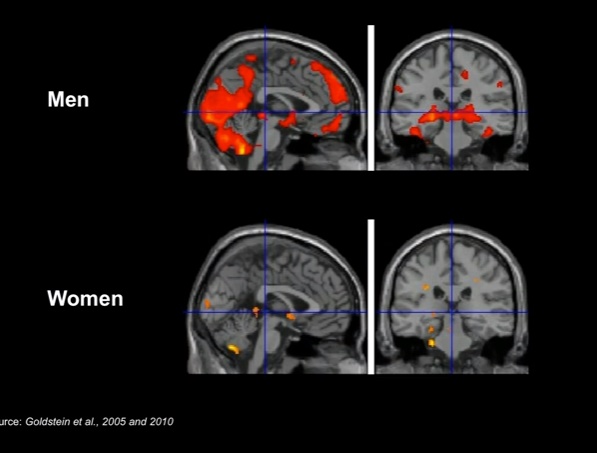
and the second example is a functional MRI (Magnetic Resonance Imaging) image of depression in both men and women.  The brain areas highlighted in distinct regions as shown below:


Here is the description of the slide by Dr. Paula Johnson in her TED talk above:


So let's go back to depression. Depression is the number one cause of disability in women in the world today. Our investigators have found that there are differences in the brains of women and men in the areas that are connected with mood. And when you put men and women in a functional MRI scanner -- that's the kind of scanner that shows how the brain is functioning when it's activated -- so you put them in the scanner and you expose them to stress. You can actually see the difference. And it's findings like this that we believe hold some of the clues for why we see these very significant sex differences in depression.
But even though we know that these differences occur, 66 percent of the brain research that begins in animals is done in either male animals or animals in whom the sex is not identified.
So, I think we have to ask again the question: Why leave women's health to chance? And this is a question that haunts those of us in science and medicine who believe that we are on the verge of being able to dramatically improve the health of women. We know that every cell has a sex. We know that these differences are often overlooked. And therefore we know that women are not getting the full benefit of modern science and medicine today. We have the tools but we lack the collective will and momentum.


There are other factors that could contribute to differences in the above images.  Although, overall, there are major difference as shown above.  These two examples are among many that highlight the need to have different clinical trials and treatment for different sexes.  Dr. Paula Johnson makes a compelling case to change the system based on the examples that she uses in her TED talk.  She also points out that the system has yet to change completely -- which is surprising to me.  If differences were apparent, why would we as a society not want to treat everyone equal -- find a treatment for each of us.  This is a bridge toward providing "personalized medicine".


In the paragraphs below, I show an example of private funding, published research, and new research arising which are addressing the differences in sexes with regard to research and development.


In order to change the system, the challenge will take time.  Although, as you will see, progress is being made which suggests motivating evidence of a change.  If you are interested in reading on and looking at the various abstracts of journal articles and books, please feel free to do so.  Additionally, a few foundations and their work are shown below which cast light on the much needed research due to differences in gender.


Today, research with the inclusion of sex and minorities is nowhere where it needs to be -- in terms of taking into account the sex differences of disease.  Why?  Is the cost to expensive?  Do some researchers feel like they are duplicating a trial?  Who knows.


Supplemental Material below:


Organizations Concerned About Gender Medicine


Dr. Paula Johnson highlights in her talk that despite the obvious data from various studies (some of which) introduced in her talk, 60 % of studies are still using either men or rats as test subjects.  Why?  Obvious, the inclusion of women and minorities is still at its infancy.  More discussion and relevancy needs to be brought to the forefront of the decision making process.


How do we accomplish this as a society?


The process could begin with funding projects from private funding.  Part of the money which comes from private funding sources may originate from a foundation.  Below are a couple of foundations which are built to elevate the importance of gender or sex in carrying out research clinical trials.


1) Foundation for Gender-Specific Medicine:


OUR MISSION

To use the study of gender to foster the development of new sciences and improve health care for all patients
The Foundation for Gender Specific-Medicine supports the investigation of the ways in which biological sex and gender affect normal human function and the experience of disease. One of the discipline’s pioneers, Marianne J. Legato, FACP, MD established the Foundation as a continuation of her work with The Partnership for Gender-Specific Medicine at Columbia University.

OUR GOALS

1. Support original scientific research in gender-specific medicine:
Each year, the Foundation provides fellowships to untenured, young faculty members with the goal of fostering their interest in gender-specific medicine at the beginning of their investigative careers.  Currently, we award two-year research grants at the Columbia University College of Physicians and Surgeons and one-year grants at the Johns Hopkins School of Medicine.  However, we are always looking for new scholars.
2. Create an evidence-based set of protocols to guide physicians:
The Foundation is working to assemble a critical mass of evidence-based criteria for optimal gender-specific treatment within each specialty of medicine.  We have finished recommendations for gender-specific care of diabetics and are currently working on cardiovascular disease.

Gender-specific care centers around the globe will receive our completed guidelines.  We will then observe and summarize the impact of these guidelines based on the morbidity and mortality of patients treated according to our recommended protocols.  Columbia University’s Office of Clinical Trials will collaborate with us in organizing and supervising our clinical studies on the impact of sex and gender on the efficacy of new drugs and medical devices.
3. Educate of the lay public and the scientific/medical community:
The Public
The Foundation understands that science does not operate outside of the rest of society, and we consider education a central part of our mission. The interests of the lay public drive medical research and practice. Rather than simply serving as an informational vehicle, the Foundation creates an open dialogue between patients and the medical community. In addition to the many books that Dr. Legato has written for the lay public, the Foundation promotes gender-specific medicine through lectures, symposia, and social media.

The Foundation for Gender-Specific Medicine is heavily invested in elevating awareness of the differences arising from sex or gender in diseases and treatments.  Columbia University is not a 'unknown' university and stands at the forefront of research in medicine.  Also listed on the page "about us" is the range of organizations that the foundation is affiliated with.  Many are home to Nobel Prize winners.  More and more people are interested in finding out the answer of how much contribution gender or sex plays into the role of disease or treatment.


2) FONDAZIONEISTUD:


Below is an abstract for a review of Gender Medicine titled: "Gender Medicine: A new approach for healthcare"


Abstract:


Gender Medicine is a fascinating newly emergent approach of medicine aimed at recognizing and analyzing the differences arising from gender in several aspects: anatomical, physiological, biological, functional, social and in the field of the response to pharmacological treatment. The term gender is to be intended as the definition issued by the World Health Organization (WHO), according to which gender refers to the socially constructed roles, behaviors, activities, and attributes that a given society considers appropriate for men and women. Therefore, Gender Medicine deals with a wider area than simply taking into account sex differences, which are merely the biological characteristics that define men and women.
Several studies have demonstrated that the physiology and the psychology of men and women are different and this diversity has a profound impact on the development, diagnosis and treatment of a disease and also on how the patient deals with that pathology. Gender Medicine applies these concepts in order to ensure everyone the best available treatment, with several benefits: it reduces the level of error in medical practice, promotes therapeutic appropriateness for both genders and improves personalized therapies, finally lowering the costs of the National Health Services (NHS), in a long term perspective.
The aim of this project is to drive awareness of this emergent topic. We firstly defined Gender Medicine, by analyzing the contents and by a historical overview, from its first steps to concrete applications, both in Italy and in the international context, thanks to interviews with national and international experts. We then moved to the analysis of clinical features: when, how and why the outcomes of drug therapies are different according to gender? We also described the perceptions of the involved stakeholders (physicians, patients, institutions, etc.) and we finally asked people for their opinion on the topic, through an online questionnaire.


Foundations and projects which emerge from them are crucial to the emergence and mainstream inclusion of women and minorities into clinical and research trials.  Although, until different studies start to show up in the scientific journals as "published articles" -- the idea will remain at a distance.  Even when the evidence is present.  Below are a few published reviews or papers highlighting the need for inclusion of sex differences in to research that have emerged in the last few years:


1) Handbook of Experimental Pharmacology:


"Sex and gender differences in clinical medicine"


Abstract:


Sex and gender differences in frequent diseases are more widespread than one may assume. In addition, they have significant yet frequently underestimated consequences on the daily practice of medicine, on outcomes and effects of therapies. Gender medicine is a novel medical discipline that takes into account the effects of sex and gender on the health of women and men. The major goal is to improve health and health care for both, for women as well as for men. We give in this chapter an overview on sex and gender differences in a number of clinical areas, in cardiovascular diseases, pulmonary diseases, gastroenterology and hepatology, in nephrology, autoimmune diseases, endocrinology, hematology, neurology. We discuss the preferential use of male animals in drug development, the underrepresentation of women in early and cardiovascular clinical trials, sex and gender differences in pharmacology, in pharmacokinetics and pharmacodynamics, in management and drug use. Most guidelines do not include even well-known sex and gender differences. European guidelines for the management of cardiovascular diseases in pregnancy have only recently been published. Personalized medicine cannot replace gender-based medicine. Large databases reveal that gender remains an independent risk factor after ethnicity, age, comorbidities, and scored risk factors have been taken into account. Some genetic variants carry a different risk in women and men. The sociocultural dimension of gender integrating lifestyle, environment, stress, and other variables cannot be replaced by a sum of biological parameters. Because of this prominent role of gender, clinical care algorithms must include gender-based assessment.


The wide range of diseases where sex differences is prominent are so large that one would think that the field of 'Gender Medicine' would explode.  Catchy titles like the following were used to get the attention of professionals in order to get traction.


2)  Clinical Chemistry Laboratory Medicine:


Research Article: "Gender medicine: a task for the third millennium"


Abstract:


Gender-specific medicine is the study of how diseases differ between men and women in terms of prevention, clinical signs, therapeutic approach, prognosis, psychological and social impact. It is a neglected dimension of medicine. In this review we like to point out some major issues in five enormous fields of medicine: cardiovascular diseases (CVDs), pharmacology, oncology, liver diseases and osteoporosis. CVDs have been studied in the last decades mainly in men, but they are the first cause of mortality and disability in women. Risk factors for CVD have different impacts in men and women; clinical manifestations of CVD and the influence of drugs on CVD have lot of gender differences. Sex-related differences in pharmacokinetics and pharmacodynamics are also emerging. These differences have obvious relevance to the efficacy and side effect profiles of various medications in the two sexes. This evidence should be considered for drug development as well as before starting any therapy. Gender disparity in cancer incidence, aggressiveness and prognosis has been observed for a variety of cancers and, even if partially known, is underestimated in clinical practice for the treatment of the major types of cancer. It is necessary to systematize and encode all the known data for each type of tumor on gender differences, to identify where this variable has to be considered for the purposes of the prognosis, the choice of treatment and possible toxicity. Clinical data suggest that men and women exhibit differences regarding the epidemiology and the progression of certain liver diseases, i.e., autoimmune conditions, genetic hemochromatosis, non-alcoholic steatohepatitis and chronic hepatitis C. Numerous hypotheses have been formulated to justify this sex imbalance including sex hormones, reproductive and genetic factors. Nevertheless, none of these hypothesis has thus far gathered enough convincing evidence and in most cases the evidence is conflicting. Osteoporosis is an important public health problem both in women and men. On the whole, far more epidemiologic, diagnostic and therapeutic studies have been carried out in women than in men. In clinical practice, if this disease remains underestimated in women, patients' and physicians' awareness is even lower for male osteoporosis, for which diagnostic and therapeutic strategies are at present less defined. In conclusion this review emphasizes the urgency of basic science and clinical research to increase our understanding of the gender differences of diseases.


3) World Journal of Gastroenterology:


Research Article: "Gender specific medicine in liver diseases: a point of view"


Abstract:


Gender medicine focuses on the patho-physiological, clinical, prevention and treatment differences in diseases that are equally represented in men and women. The purpose of gender medicine is to ensure that each individual man and woman receives the best treatment possible based on scientific evidence. The concept of "gender" includes not only the sexual characteristics of individuals but also physiological and psychological attributes of men and women, including risk factors, protective/aggravating effects of sexual hormones and variances linked to genetics and corporal structures that explain biological and physiological differences between men and women. It is very important to consider all the biological, physiological, functional, psychological, social and cultural characteristics to provide patients with individualized disease management. Herein, we critically analyze the literature regarding gender differences for diseases and acquired conditions of the most representative hepatic pathologies: primary biliary cirrhosis, autoimmune hepatitis, primary sclerosing cholangitis, non alcoholic fatty liver disease and alcoholic liver disease, and viral chronic hepatitis B and C. The last section addresses hemochromatosis, which is a prevalent iron overload disorder in the Caucasian population. This review aims to describe data from the literature concerning viral chronic hepatitis during pregnancy, management during pregnancy and delivery, and new effective drugs for the prevention of maternal infection transmission without significant adverse effects or complications.


4) Journal Atherosclerosis:


Research Article: "Sex differences in cardiovascular risk factors and disease prevention"


Abstract:


Cardiovascular disease (CVD) has been seen as a men's disease for decades, however it is more common in women than in men. It is generally assumed in medicine that the effects of the major risk factors (RF) on CVD outcomes are the same in women as in men. Recent evidence has emerged that recognizes new, potentially independent, CVD RF exclusive to women. In particular, common disorders of pregnancy, such as gestational hypertension and diabetes, as well as frequently occurring endocrine disorders in women of reproductive age (e.g. polycystic ovary syndrome (PCOS) and early menopause) are associated with accelerated development of CVD and impaired CVD-free survival. With the recent availability of prospective studies comprising men and women, the equivalency of major RF prevalence and effects on CVD between men and women can be examined. Furthermore, female-specific RFs might be identified enabling early detection of apparently healthy women with a high lifetime risk of CVD. Therefore, we examined the available literature regarding the prevalence and effects of the traditional major RFs for CVD in men and women. This included large prospective cohort studies, cross-sectional studies and registries, as randomised trials are lacking. Furthermore, a literature search was performed to examine the impact of female-specific RFs on the traditional RFs and the occurrence of CVD. We found that the effects of elevated blood pressure, overweight and obesity, and elevated cholesterol on CVD outcomes are largely similar between women and men, however prolonged smoking is significantly more hazardous for women than for men. With respect to female-specific RF only associations (and no absolute risk data) could be found between preeclampsia, gestational diabetes and menopause onset with the occurrence of CVD. This review shows that CVD is the main cause of death in men and women, however the prevalence is higher in women. Determination of the CV risk profile should take into account that there are differences in impact of major CV RF leading to a worse outcome in women. Lifestyle interventions and awareness in women needs more consideration. Furthermore, there is accumulating evidence that female-specific RF are of influence on the impact of major RF and on the onset of CVD. Attention for female specific RF may enable early detection and intervention in apparently healthy women. Studies are needed on how to implement the added RF's in current risk assessment and management strategies to maximize benefit and cost-effectiveness specific in women.


The research has been covered for at least the last 9 years, but remains invisible to the public.  Specific journals cover the field (as is the case in other specialized areas of science).  Although, with the importance arising between sex differences, one would think that the research would be broadcasted to a wider audience.


Journal that is discontinued after running for 9 years is "Gender Medicine" with the last issue highlighting the transition toward the use of genomics in medicine shown below:


1) Publication: Gender Medicine


Research Article: "Mainstreaming Sex and Gender Analysis in Public Health Genomics"


Abstract:


The integration of genome-based knowledge into public health or public health genomics (PHG) aims to contribute to disease prevention, health promotion, and risk reduction associated with genetic disease susceptibility. Men and women differ, for instance, in susceptibilities for heart disease, obesity, or depression due to biologic (sex) and sociocultural (gender) factors and their interaction. Genome-based knowledge is rapidly increasing, but sex and gender issues are often not explored.


2) Handbook of Clinical Gender Medicine :


Book Description:


A new vision to understanding medicine
Gender medicine is an important new field in health and disease. It is derived from top-quality research and encompasses the biological and social determinants that underlie the susceptibility to disease and its consequences. In the future, consideration of the role of gender will undoubtedly become an integral feature of all research and clinical care. 

Defining the role of gender in medicine requires a broad perspective on biology and diverse skills in biomedical and social sciences. When these scientific disciplines come together, a revolution in medical care is in the making. Covering twelve different areas of medicine, the practical and useful Handbook of Clinical Gender Medicine provides up-to-date information on the role of gender in the clinical presentation, diagnosis, and management of a wide range of common diseases.

The contributing authors of this handbook are all experts who, in well-referenced chapters, cogently and concisely explain how incorporation of gender issues into research can affect the medical understanding and treatment of heart disease, osteoporosis, arthritis, pain, violence, and malaria among other conditions. This intriguing and unique medical textbook provides readers with a valuable new perspective to understand biology and incorporate gender issues into the different branches of medicine.


And last but not least, an emerging field (little late after 20 years) is the International Society of Gender Medicine whose mission is stated below:


Aims of the IGM
The specific purpose of the society is to establish and develop gender medicine in an international context by promoting gender –specific research in basic sciences, clinical medicine and public health. This is based on the insight, that the two sexes may have different experiences of the same disease: they may present with different symptoms, respond differently to therapy and tolerate/cope with the disease differently.  The pathophysiology of disease may also vary as a function of genetics, epidemiology and biological sex/gender.
Therefore, the society will aim to:
1) Advance the understanding of sex/gender differences by bringing together scientists and clinicians of diverse backgrounds;
2) Strive to implement gender in the medical curriculum, prepare and allocate gender-specific learning materials, curricula and gender trainings for instructors
3) Promote gender-specific public health issues such as  information for persons, institutions and organizations in the area of gender medicine
4) Facilitate interdisciplinary research on sex/gender differences in basic and clinical frameworks
5) Encourage the application of new knowledge of sex/gender differences to improve health and health care
6) Cooperate with other professional and international societies of gender medicine and similar scientific organizations
7) Encourage and support the creation of professional organizations dedicated to the promotion of sex/gender medicine GM
8) Encourage and support international cooperation, collaboration and education among professionals working in the field sex/gender medicine.
9) Organize international meetings and congresses on relevant topics
10) Assist in the publication of position papers and guidelines in credible scientific journals and textbooks


There is a strong need for a society like the International Society of Gender Medicine to exist.  Healthcare professionals should gather together to explore the emerging field.  As mentioned earlier, the field of Gender Medicine is relatively new.  The most probable cause for the infancy of the field is the lack of 'gender specific care' or stigma associated with a 'non-binary' gender classification.


As highlighted in the abstracts of the emerging articles, research and development is making apparent the need to include minorities and women into trials and clinical research design.  The path toward "personalized medicine" involves dealing with the wide spectrum of gender types that compose our society today.  Using the pre-historic 'binary system' (male or female) classification is no longer valid.  More important is to understand the gender differences that actually arise in our society today and have been around for quite sometime -- just not recognized.


Until next time, Have a great day!