Showing posts with label Drug Targets. Show all posts

Wednesday, March 1, 2017

World Health Organization Suggests More Funding For Antibiotic Resistance Research

Healthcare is under fire at the moment.  President Trump has repeatedly stated his disapproval with the current health care system.  During his campaign, he continuously slammed the current healthcare initiative - the Affordable Care Act -- better known as - ObamaCare.  Part of the reason why health care is so terrible in our country is that we have a health care system that is "reactive" rather than "proactive."  I will explain briefly what I mean by that in the paragraphs below.  In order to achieve the insurmountable obstacle of "antibiotic resistance," the health care system needs to shift money toward research and development -- toward a "proactive" health care system.


WHO?


Who are the WHO?  What is the WHO?  According to the "Wikipedia" page for the "World Health Organization" - the organization:


The World Health Organization (WHO) is a specialized agency of the United Nations that is concerned with international public health. It was established on 7 April 1948, headquartered in Geneva, Switzerland. The WHO is a member of the United Nations Development Group. Its predecessor, the Health Organization, was an agency of the League of Nations.
The constitution of the World Health Organization had been signed by 61 countries on 22 July 1946, with the first meeting of the World Health Assembly finishing on 24 July 1948. It incorporated the Office international d'hygiène publique and the League of Nations Health Organization. Since its creation, it has played a leading role in the eradication of smallpox. Its current priorities include communicable diseases, in particular HIV/AIDS, Ebola, malaria and tuberculosis; the mitigation of the effects of non-communicable diseases; sexual and reproductive health, development, and aging; nutrition, food security and healthy eating; occupational health; substance abuse; and driving the development of reporting, publications, and networking.
The WHO is responsible for the World Health Report, a leading international publication on health, the worldwide World Health Survey, and World Health Day (7 April of every year). The head of WHO is Margaret Chan.
The 2014/2015 proposed budget of the WHO is about US$4 billion.[1] About US$930 million are to be provided by member states with a further US$3 billion to be from voluntary contributions.[1]


A coalition of countries with the objective to eradicate specific diseases like smallpox while mitigating the communicable diseases like HIV, Ebola, Malaria, and Tuberculosis.  As one can imagine, the responsibility alone by the organization is not enough to handle the diseases mentioned above.  Although with participation from global economies -- which are made up of global companies which produce vaccines and medical equipment to help win the battle of emerging diseases, these issue can be handled.


Antibiotics and vaccines play a major role in fighting diseases around the world.  Although, any one country (or nation) can produce a great new treatment to combat a global disease, but without global communication, the disease will continue to propagate.  The World Health Organization (WHO) is responsible for being the 'global conduit' through which information and treatments flow around the world to ensure a healthier and safer place.  Continued cooperation is necessary among countries.  Which is why guidance (reports) is necessary on critical issues such as antibiotic resistance -- discussed below.


Antibiotic Resistance


The World Health Organization released a report regarding the emergence of 'antibiotic resistance' strains which pose a potential threat in the future if not dealt with now.  Naturally, after hearing the statement one might have the following question:


How does a country or a consortium of countries deal with such a feat?


Three days ago, the World Health Organization provided a list of categorized threats which was made up by a panel of stakeholders.  The objective of the list is shown below:


To prioritize pathogen research is of the upmost importance.  Especially, when viruses like Ebola are hitting areas of the world which remain inaccessible.  And when these areas are accessible, nowhere else is the point of a globalized health care initiative more exemplified.  Part of the reason why the Ebola virus got as far as the US was because of a 'semi-global' (almost uniform) effort to combat it.  Of course, the downfalls associated with the spread and vaccination against a virus such as Ebola were disjointed and driven by a profit -- i.e., small companies and political pressures.


Therefore, reading the introduction of a program with the purpose of having a uniform initiative to fight against 'antibiotic resistance' is reassuring to say the least.  Currently, an administration is in place here in the United States which would like to see 'less regulation' -- i.e., less government.  This path is dangerous from the standpoint of finding cures (new antibiotics, new treatments) for emerging diseases along with evolving bacterial strains.  The efforts of the World Health Organization in gathering a global force to compile a list of priorities is refreshing.  Of course, the list is a list.  To make the research happen to address the threats listed -- needs scientific funding at all levels.


In case you are reading this and wondering whether the panel which made the suggestions up are biased or fueled by outside forces, here below is the methodology of the panel which came up with the list:


After reading the above paragraph, I had to resort to "Wikipedia" to shine a little more light on the meaning of the term "Multi-Criteria Decision Analysis" which stated:


Multiple-criteria decision-making (MCDM) or multiple-criteria decision analysis (MCDA) is a sub-discipline of operations research that explicitly evaluates multiple conflicting criteria in decision making (both in daily life or in professional settings). Conflicting criteria are typical in evaluating options: cost or price is usually one of the main criteria, and some measure of quality is typically another criterion, easily in conflict with the cost. In purchasing a car, cost, comfort, safety, and fuel economy may be some of the main criteria we consider – it is unusual that the cheapest car is the most comfortable and the safest one. In portfolio management, we are interested in getting high returns but at the same time reducing our risks, but the stocks that have the potential of bringing high returns typically also carry high risks of losing money. In a service industry, customer satisfaction and the cost of providing service are fundamental conflicting criteria.
In our daily lives, we usually weigh multiple criteria implicitly and we may be comfortable with the consequences of such decisions that are made based on only intuition.[citation needed] On the other hand, when stakes are high, it is important to properly structure the problem and explicitly evaluate multiple criteria.[citation needed] In making the decision of whether to build a nuclear power plant or not, and where to build it, there are not only very complex issues involving multiple criteria, but there are also multiple parties who are deeply affected from the consequences.
Structuring complex problems well and considering multiple criteria explicitly leads to more informed and better decisions. There have been important advances in this field since the start of the modern multiple-criteria decision-making discipline in the early 1960s. A variety of approaches and methods, many implemented by specialized decision-making software,[1][2] have been developed for their application in an array of disciplines, ranging from politics and business to the environment and energy.[3]


Often considering real world problems involves evaluating conflicting viewpoints.  In order to reach a decision, weighing in all of the view points is critical.  Now that we have the assurance that the panel of experts took a wide range of issues into account in developing a list of potential threats, lets take a look at the list.  Shown below are three categories with each of the threats listed:


Critical:


High:


Medium:


In addition to the bacterial pathogens listed above, the panel assembled also offered a few "recommendations" regarding future direction for the Research & Development of antibiotics to head as shown below:


In addition to the "recommendations" by the panel to guide scientists and policy makers moving forward, the panel also offered a few "remarks" about the report and the information contained within it shown below:


Aside from the list of antibiotics which are compromised or threatened, I think the above remarks shed light on the importance of the report overall.  As noted, the heterogeneity (mixed) implementation throughout regions (voluntary countries) remains a significant problem toward combating antibiotic resistance.  The education to the world at large needs to be uniform.  Otherwise, enlisting stakeholders to participate will be very difficult to do.


Who are these stakeholders?


The public, physicians, hospital administrators, large corporations, and farmers to name a few.  Anyone who indiscriminately uses antibiotics without concern that the need is present.  Each of us need to evaluate the need to use antibiotics.  Just prescribing anyone with an infection a course of treatment is dangerous to those down the line who really need a course of antibiotics.


Nature is resilient in evolving.  Which means that bacteria and viruses are evolving constantly in time.  This is a natural course for them to follow -- to survive.  If the science community cannot keep up in discovering new antibiotics, the war will be lost to the so-called 'super bugs.'


Not to worry, as mentioned in the report the occurrence of infections was not measurable in the institutions which participated.  Which means now is the time to invest more heavily in research to investigate and discover a new target for an antibiotic -- a more efficient and effective drug.


Recently, in an article in the journal "The Scientist" titled "WHO Lists Antibiotic Development Priorities" the need to further research was made clear by the WHO's Assistant Director of Health Systems Paule Kieny:


“This list is truly an example of society . . . requesting the R&D response to an urgent public health need,” Kieny said. “With this list we are also asking governments to commit funds to R&D to address antibiotic resistance now in order to reduce the amount of resources that they will need to spend later when resistance to antibiotics develops into an even bigger crisis.”

It’s not enough to ask governments to help fund and drugmakers to produce new antibiotics, said Kieny: “stewardship”—the responsible administration of these compounds—is also important. Beyond calling for novel antimicrobials, she said, “we need also to look at how best . . . to avoid overuse and misuse.”


The above comments made by Paule Kieny should be common sense.  Instead of burning through our resources to treat 'reactively' we should be thinking in terms of combating illnesses 'proactively'.  Stepping away from the report at hand (on pathogens), the above arguments could be extended toward modern medicine at large.  In a recent post, I discussed how the US was selling oil for extra science funds for the federal agency -- the National Institutes of Health.  Instead of needing extra funding, why not shift the funding away from Medicaid and Medicare toward research.  No, I am not talking about taking any coverage away from people.


What I am proposing is to invest more of the 'pie' (larger percentage) of the total funding for the Health and Human Services to save downstream cost.  Instead of saving money and frantically calling on our science community to solve unknown problems due to evolution, why not give more money upfront to solve the problems which exist at the moment.  Treat now through science and save money downstream.  See the pie chart of government spending in the blog post mentioned here.


Spending money on research into combatting bacteria is one example.  Below, I highlight two recent advances toward combatting 'antibiotic resistance.'


New Antibiotics?


In a blog post written last year (less than a few months ago), I discussed new research which shed light on antibiotic resistance research.  There is a brief introduction to the topic in that post.  With each new finding, new developments can proceed.  Of course, if the development just ended with the discovery of a new target -- antibiotic drug discovery would be much easier.  Remember, my introductory blog to drug discovery which lists the steps taken to get a drug approved and to the market.  Furthermore, in a follow-post, the exact steps were laid out to drive home the point that drug discovery takes years to come to fruition.  Therefore, the need is now to elevate science funding.   Right about now, you might be thinking the following question:


Great Mike, I am all for science, so why are you trying to convince me?


The reason why is centered around our elected officials who guide funding to resource agencies.  In the beginning of the year after President Trump was inaugurated, a "freeze" was conducted on federal agencies who help get the funds flowing from the stage of research to the stage of production to approval.  I wrote about the 'freeze' in a blog about the President's power to forbid the public about science.  Science which is tax-payer funded.  Which means -- you decide by your vote who gets funding!!!


Just yesterday, in an article in the journal "Lab Manager" titled "Novel Amyloid Structure Could Lead to New Types of Antibiotics" new research results were uncovered which could lead to combating strains such as Staphylococcus aureus:


The highly pathogenic Staphylococcus aureus bacteria is one of the five most common causes of hospital-acquired infections. In the US alone, approximately 500,000 patients at hospitals contract a staph infection. It is the bacteria responsible for MRSA, for which there is no vaccine.
Assistant professor Meytal LandauAssistant professor Meytal LandauPHOTO COURTESY OF THE TECHNION-ISRAEL INSTITUTE OF TECHNOLOGYBut all that could change, thanks to groundbreaking findings published Feb. 24 in Science by a Technion-Israel Institute of Technology team led by assistant professor Meytal Landau of the Faculty of Biology. The researchers discovered, for the first time, unique amyloid fibrils through which the pathogenic and highly drug resistant Staphylococcus aureus bacterium attacks the human cells and immune system. The research could advance the discovery of antibiotics with a novel mechanism of action that will attack key bacterial toxins.


The research discussed above is an approach which differs greatly from traditional antibiotic research.  Traditionally, the research is centered around finding a way to dismantle to kill the bacteria by targeting an active site on the bacteria.  The research above differs in that bacteria use a pathway which involves 'amyloid fibers' as ammunition.  Current efforts by the team include ways to dismantle the 'ammunition' instead of going after the target themselves.  Very interesting:


She estimates that the new discovery will lead to the development of antibiotics with a new action mechanism. Such drugs will inhibit the amyloid formation thereby neutralizing one of the important ‘weapons’ in the arsenal of this pathogenic bacterium. In her opinion, since this antibiotic is not aimed at killing the bacterium but only reducing its toxicity to humans, it will not lead to a rapid development of bacterial resistance towards it.

“Resistance to antibiotics develops in bacteria due to evolutionary pressure—natural selection leads to the growth of bacteria which antibiotics are unable to kill,” she said. “If we reduce the pressure on the bacterium and don’t kill it but rather prevent its pathogenic aspects, the resistance will probably not rush to develop.”


Novel approaches like the one highlighted above have the potential to offer a solution which is easier to fund and approve.  Medicines are already being developed to attack amyloid fibers.  Amyloid fibers have been studied quite extensively over the past few decades -- which might help speed the process of developing new antibiotics more quickly.  Which gives us (science and society) an advantage for the moment until the next 'super bug' appears.


Conclusion...


Whenever I think of the topic of antibiotic resistance, I think of my father who is a surgeon.   He was very resistant toward administering courses of antibiotics to us as children and adults.  His overarching thought was that the human body does a larger service to itself by building up natural immunity toward invaders.  Of course, some times, our defenses our down to the point of becoming defenseless at which point -- prescribing a treatment is valid.


I was fortunate to have parents in the medical field.  Hours (and days) on end were spent on lecturing to us children about medicine.  Out of these long lectures grew out an appreciation for science.  For me, a lifetime of love with science.  I have been writing a fair amount about the topic of increasing spending on scientific research since science impacts every aspect of our daily lives.  We just don't realize this truth.


Furthermore, we do not realize the importance of writing to our elected officials to tell them our opinions.  Opinions differ, but we all can agree that participating in democracy is healthy.  I wrote a blog about writing your elected official recently.  The officials do actually write back and share their views on matters of importance.  I would encourage you to follow the actions of scientists and journalists and write or express your opinion in some form to support science and a free press.  Through the process of research and discovery, new treatments will emerge.  Through the free press, new treatments can be discussed and highlighted for the general public to utilize and appreciate.


Until next time, have a great day!


Wednesday, December 7, 2016

How Much Do New Drugs Cost To Bring To The Pharmacy Counter?

One of the many issues that need to be addressed by politicians is the rising cost of prescription drugs.  Recent examples include the astronomical increase the drug 'Daraprim' by the crooked ex-CEO Martin Skreli of 5600%.  As If the public did not react appropriately, the next example was of the 'EpiPen' of 400% increase which led to a congressional hearing with the CEO Heather Bresch testifying as to the needed increase.  These two examples are outliers, but which still beg the two questions below:


Why do these drugs cost so much to make?  


How long does the average drug take to get to market?


These two questions will be answered with an example or two below.


Drug Design Length And Cost?


In a post that I wrote a few weeks back, I included a video of the process by which a drug goes through to get funded and produced to arrive at your pharmacy.  The process followed the listed steps below:


1) Basic research is conducted by university research laboratories around the nation and funded by the National Institutes of Health.


2) The results from research (are pre-clinical) submitted to the 'Food and Drug Administration' (FDA) for approval to proceed with a 3 phase clinical trial in humans.


3) Pharmaceutical companies proceed to conduct 3 phase clinical trial.


4) If 3 phase clinical trials are successful, then all data (pre-clinical, 3 phase clinical, etc.) is sent back to the Food and Drug Administration for approval to produce and market.


5) The FDA will continue to monitor the drug's progress throughout the lifetime in the marketplace to ensure safety.


In order to grasp the steps in full, a more detailed explanation of the above steps is in order.  At least a clarification of each step will greatly reduce the confusion.   The steps above are a combination of the pharmaceutical industry, academia (universities), and the government -- working on different parts but combined in the big picture.


Steps 1 & 2:


To start with, research is conducted at universities across the United States that is tax-payer funded through government science funding agencies like the National Institutes of Health (NIH) and the National Science Foundation (NSF).  These are the two largest funding sources through which scientific funding is provided.   Other sources include private funding through foundations like the 'Gates foundation,' along with others.


Research that is conducted with this money is typically aimed at preventing or treating disease -- that is the overarching picture or message.  The process seems simple, yet can take up to 20 years and cost nearly $1 billion dollars.  That is quite an investment.  The process begins with fundamental research about diseases at universities.


This process helps uncover the mechanism by which a disease or treatment works.  Examples might include research looking into the mechanism of the spread of the Zika virus.  Research aims to identify the gene or proteins responsible for the pathway through which the disease proceeds.  These are biological targets which can them be investigated to find out how scientists can produce drugs that bind to the targets.  By binding to the target of interest, the elimination of a disease might occur, or the repair of a mutated gene could occur.


The process of finding drugs (or molecules) that bind or 'hit' the biological target might take years.  Hundreds of tests through 'assays' or binding tests which test hundreds of different drugs that show promise of hitting the target.  Extensive testing is conducted and the outcome is a class of candidate drugs that will hit (or bind) the biological target involved in the disease pathway.


An interesting side note is that if there are drugs that hit multiple targets (not specific) then, that drug might have the potential to possess a large amount of 'side effects' -- which are undesirable.  Therefore, testing to ensure that each candidate only hits the desired target in the disease pathway is critical at this stage.  Especially, before the drug is tested on humans.  This part of the drug development process is referred to as "pre-clinical testing."


With the Pre-clinical data gathered at the university level, the data is submitted to the Food and Drug Administration for review.  If the FDA approves of the data enough to advance the candidates toward a "3 phase clinical trial," then a pharmaceutical company will usually take over the testing process from here.


Steps 3 & 4:


The 3 phase clinical trial testing on humans is very expensive and usually out of the limits of university budgets.  Therefore, at this point, a pharmaceutical company will proceed to test the candidates in human trials.  The process starts with phase 1 trial.


Phase 1:


During the phase 1 clinical testing trials, between 20-80 healthy adults are tested with the drug to evaluate the safety of the drug.  Additionally, the drug is tested for a safe dosage and any side effects during this phase.


Phase 2:


Phase 2 testing involves giving the drug to around 100-300 people to test the drug further.  During this phase, a certain portion of the group being tested will have the disease being sought after to treat.  This is to get a better idea as to the efficacy of the drug and knowledge about how the drug is working in either a healthy patient or a patient with the desired disease to be treated.


Phase 3:


The final phase is phase 3 -- which aims to verify the drugs effectiveness.  Approximately 1000-3000 patients with the disease sought to be treated are tested.  During this trial, the pharmaceutical companies will also compare testing other known treatments (drugs, comparing different brands, etc.) and no drugs (placebo -- sugar pill).  Using a larger sample (patient size) allows the testing to be statistically accurate in the regulatory agencies eyes.


Step 5:


If the drug is successful during all three phase testing trials in humans, the pharmaceutical company will submit the entire data (pre-clinical and clinical testing - phase 3) to the FDA for approval to manufacture and market the drug to treat the desired disease.  The FDA approval indicates that the company can indeed go through and manufacture the drug to treat the disease.  Although, throughout the drug's lifetime, the FDA will be keeping tabs on the drugs efficacy and can ask for paperwork at any time or additional testing.


Obviously, the steps outlined above requires the coordination of a large amount of people and data.  Think about just one perspective -- i.e., the research aspect of the process.  This by itself would be overwhelming.  Then add on another perspective of the process -- i.e., the legal challenges.  Not to mention other aspects like marketing and branding the drug.  All together, there is no wonder why the cost is so high.  But pharmaceutical companies still reap a large profit from a blockbuster drug -- so don't feel too bad for them.


Recently, the rules have changed for the drug manufacturers and additional testing is required.  A perfect example is the testing for 'alcohol dose dumping' - which I recently became aware of.  In the next section, I will introduce you to this phenomenon -- which as you will see will require more testing and money associated with the production of the drug.


More Requirements?


As I just mentioned, recently (as in 2005) the FDA has changed the testing requirements to add more testing.  Testing the drug in its native environment (inside the patient during a 3 phase trial) is not sufficient enough.  Now, the addition of 'dose-dumping' testing is required of companies.  I was unaware of the phenomenon until I stumbled upon a document on the FDA website titled "Mitigating the Risks of Alcohol Induced Dose Dumping from Oral Sustained or Controlled Release Dosage Forms: Proposed Regulatory Procedures."


Here is a brief background on 'dose-dumping' from the FDA report:


Unintended, rapid drug release in a short period of time of the entire amount or a significant fraction of the drug contained in a modified release dosage form is often referred to as “dose dumping”. Depending on the therapeutic indication and the therapeutic index of a drug, dose-dumping can pose a significant risk to patients, either due to safety issues or diminished efficacy or both. Generally dose-dumping is observed due to a compromise of the release-rate-controlling mechanism. The likelihood of dose-dumping for certain modified release products when administered with food has been recognized for about twenty years and a regulatory process established to address it (1-2).
Some modified-release oral dosage forms contain drugs and excipients that exhibit higher solubility in ethanolic solutions compared to water. Such products can be expected to exhibit a more rapid drug dissolution and release rate in the presence of ethanol.  Therefore, in theory, concomitant consumption of alcoholic beverages along with these products might be expected to have the potential to induce dose dumping. This potential mechanism leading to dose-dumping from an oral modified-release dosage form has not previously attracted attention in the pharmaceutical science literature or in regulatory assessment process. There are many reasons this may not have previously been considered, amongst these reasons is that there may have existed a general assumption that a clinically insignificant difference in drug release rate would be expected with concomitant ethanol consumption in vivo. A study conducted over twenty years ago (3) and the absence of a clear post-marketing signal pointing to alcohol inducing dose dumping may have reinforced the latter assumption. 


Drugs are designed by the manufacturer to have certain desirable time release characteristics.  To have a drug release all of the active ingredients at once may be not just undesirable but have extremely adverse reactions to a patient.  Therefore, considering the impact of taking medications on an empty stomach or full stomach are normal.  Additionally, with more precision medicine comes optimization in the form of adding other factors (like alcohol and other medications) which might result in degraded performance of the drug.  Of course, requiring extra considerations requires more testing which in turn requires more cost.  Although, one important factor to keep in mind when considering the cost of a prescription drug along with sympathizing with the manufacture is the stage of the process of change.


Where are the changes going to affect the 'bottom line'?


If the changes by the FDA require methodology change at the stage of 'basic research' then the cost is on the 'tax payer' and not the pharmaceutical industry.  Whereas, in the case above, the drug has already been manufactured and the change (including the solubilization by alcohol) is after the formulation stage and relies on the pharmaceutical company's 'bottom line.'  This cost cuts into the profit of the drug by adding more cost into the design of the drug to avoid 'dose-dumping'.


Based on the example above, the cost can be incurred by pharmaceutical companies or the government (i.e., tax-payer).  Our new President-elect Trump has stated in a recent interview with 'Time magazine' titled "Donald Trump on Russia, Advice from Barack Obama and How He Will Lead" that he is "... going to bring down drug prices. I don’t like what’s happened with drug prices."  That sounds encouraging.


The question is where is the cost going to be cut from -- government side or pharmaceutical side.  Either side will have a respective impact on Research & Design in the future for science and drug development.  Furthermore, as you can see, any change has an effect on cost.  Let's look at a positive change for better drug design below.   The change directly impacts the above problem of 'dose-dumping.'


An article recently on the website 'Research & Development' titled "New Discovery Could Help Oral Medicines Work Better" highlights new developments which are costly to incorporate into new drugs.  Although, in the article, research chemists funded by Dow -- have designed certain molecules (differing chain lengths) that help certain medications (or drugs) dissolve better in the stomach.


Again, the problem is with the dissolution of a medication inside the stomach (precision is desirable) as stated below from the article:


One of the biggest challenges for pharmaceutical companies when developing oral medications is to ensure that the body will fully absorb the drug molecules. Many therapeutic structures do not easily dissolve on the molecular level, which means they are less effective. In that case, the dose must be increased for patients, which may increase side effects.

"A way to explain the differences in solubility of medicines is to think of how sugar easily dissolves in water and is rapidly absorbed by your digestive system, whereas sand doesn't dissolve in water and if swallowed, would pass right through the digestive system," said Theresa Reineke, a chemistry professor in the University of Minnesota's College of Science and Engineering and lead researcher on the study.

Drug companies add substances, called excipients, to help the medicines dissolve in the stomach and intestinal fluid, but there have been few improvements in recent years to this decades-old technology. The process outlined in the study is a major breakthrough that revolutionizes the process of making drug structures more soluble in the body so that they are better absorbed.

Funded by Dow, researchers examined two medications—phenytoin, an anti-seizure drug, and nilutamide, a drug used to treat advanced-stage prostate cancer. The team used automated equipment at Dow to synthesize long-chain molecules. Their efficiency as excipients with these drugs were then tested with facilities at the University of Minnesota, including the Characterization Facility located in the University's College of Science and Engineering. One particular excipient discovered by this research allowed these insoluble drugs to fully dissolve in simulated intestinal fluid in a test tube. When they tested phenytoin with the new excipient in rat models, it promoted drug absorption three times better than the previous formulation.


The overall benefit of the discovery is that the molecules that were made could impact a range of medications, not just a couple.  Meaning, that the development could impact the field of 'oral dosing' -- medications taken by mouth -- which would be huge.  The problems and solutions above illustrate the extent to which the government and academia along with the pharmaceutical industry have to go to get a 'working pill' to your mouth or solution to inject intravenously.  After reading the above processes, you should step back and consider again why a drug costs so much money to develop.


Conclusion...


I have outlined above the steps that add up to 20 years and roughly $1 billion worth of research/marketing/legal work that goes into the drug design process.  Too many people have problems with the availability of prescription drugs due to cost.  Drug companies should be able to recoup the cost of research and design behind the drug that is sold at market.  Although, when drugs are given away or sold to foreign countries at a hugely reduced cost, concerned citizens start to speak up here in the U.S. regarding the inherent unfairness behind such disparities.


Furthermore, when a pharmaceutical company increases (by hundred of percent) the price of a drug for an outrageous claim in change of design, citizens should speak up to their elected officials (politicians) who have the ability to conduct a congressional hearing.   There are recent examples that justify this advice.


An example is the pharmaceutical company Mylan and the congressional trial where the CEO Heather Bresch had to testify in order to justify a 400% increase in cost for the EpiPen treatment.  After testifying, representatives thought that they were justified.  Although, in a recent article in 'Drug Development & Discovery' titled "Mylan CEO Discusses EpiPen Price Hikes at Forbes Event" Mylan CEO Heather Bresch tries to explain the increase in her company's product 'EpiPen':


Herper asked what specific value was added to these products after Mylan acquired them in 2007, which prompted Bresch to present two versions of the EpiPen on stage to illustrate how the pen has evolved over time.  She explained the pen in its initial form confused patients making it difficult to operate leading to accidental sticks whereas the latest iteration was safer and more ergonomic.

Plus, the CEO elaborated that Mylan spent over $1 billion implementing lobbying efforts to increase access to EpiPens and awareness regarding severe allergic reactions noting the company has been able to reach 80 percent more patients since acquiring the EpiPen in 2007, according to Business Insider.


The above reason sounds suspicious to say the least.  I don't buy the excuse.  For the reason listed above in the steps of drug discovery process, changing the 'ergonomic features' of a product most likely does not involve a large cost.  Especially from the standpoint of the regulatory process.  The underlying product (active drug and formulation) is not changed.  Therefore, I remain skeptical of Heather Bresch's reason for increasing the cost.


Furthermore, in closing, she stated the most accurate (and honest) aspect of the pharmaceutical industry in the following statement:


There’s a lack of understanding of where that full list… [price]…goes and how it is divided in the system,” Bresch told the audience. “The pharmaceutical system was not built on the idea of consumer engagement.”


True.  I could not agree more -- more transparency is needed regarding the way the pharmaceutical industry operates.  Which is why the public remains skeptical of the practices and pricing of the drugs that hit the market to treat diseases in the United States.  Stay tuned for more on this subject.


Until next time, Have a great day!


Wednesday, September 28, 2016

How Do Chemists Discover New Drugs? A Brief Introduction!

How do chemists discover new drugs?  Obviously, in the laboratory!  Is that all one can say about the process?  Certainly not.  There is a process by which discovery happens.  The process may vary depending on which laboratory a chemist works in.  Although, the process does not vary so greatly as to eliminate a general procedure or process a drug takes from laboratory to the marketplace.  In the blog below, I introduce the general process by which drug discovery proceeds.  I want to highlight the word "introduction" since depending on your level of understanding, the process can be described in different ways.


Drug Discovery - General Route


I recently stumbled upon a video made by the 'National Institutes of Allergy and Infectious Diseases' (NIAID) titled "How A Drug Becomes A Drug" which I will show below in a moment.  Before I emphasize the importance of viewing the short video (less than 4 minutes), I want to introduce the agency NIAID -- which is a sub-agency of the 'National Institutes of Health'.  Here is an excerpt describing the organization taken from the "Wikipedia" page for the "NIAID" below:


The National Institute of Allergy and Infectious Diseases (NIAID) is one of the 27 institutes and centers that make up the National Institutes of Health (NIH), an agency of the United States Department of Health and Human Services (HHS). NIAID's mission is to conduct basic and applied research to better understand, treat, and prevent infectious, immunologic, and allergic diseases.[1]
NIAID has "intramural" (in-house) laboratories in Maryland and Montana, and funds research conducted by scientists at institutions in the United States and throughout the world. NIAID also works closely with partners in academia, industry, government, and non-governmental organizations in multifaceted and multidisciplinary efforts to address emerging health challenges such as the pandemic H1N1/09 virus.


The three main mission areas can be summarized from the "Wikipedia" page as follows:


Human Immunodeficiency Virus/Acquired Immunodeficiency Syndrome (HIV/AIDS)
The goals in this area are finding a cure for HIV-infected individuals; developing preventive strategies, including vaccines and treatment as prevention; developing therapeutic strategies for preventing and treating co-infections such as TB and hepatitis C in HIV-infected individuals; and addressing the long-term consequences of HIV treatment.
Biodefense and Emerging Infectious Diseases (BioD)
The goals of this mission area are to better understand how these deliberately emerging (i.e., intentionally caused) and naturally emerging infectious agents cause disease and how the immune system responds to them.
Infectious and Immunologic Diseases (IID)
The goal of this mission area is to understand how aberrant responses of the immune system play a critical role in the development of immune-related disorders such as asthma, allergies, autoimmune diseases, and transplant rejection. This research helps improve the understanding of how the immune system functions when it is healthy or unhealthy and provides the basis for development of new diagnostic tools and interventions for immune-related diseases.


The above mission covers every disease known and unknown.  The National Institutes of Health is a huge organization made up of sub-agencies like the NIAID to divide up the mission.  As such, the NIAID oversees the funding of drug research to a large extent in order to understand how infectious disease compromise the immune system -- the body at large.  Additionally, the NIAID is interested in how drug discovery overcomes infectious diseases that have invaded our body.  This includes the research behind the disease at the academic level.


I mentioned above a short video to highlight the general process of drug discovery from the academic level up all the way through to the consumer level -- i.e. the pharmacy.  Here is the video below -- which is worth watching:


In the video above, the research is said to start at the basic science level at the university.  This is true to an extent.  Basic research into disease function and origin typically starts at the university level.  Although, I would add that a fair amount of research is done at the industry level too by large drug companies.  That research is typically targeted at a specific disease in which the pathway of progression or origin is known.  I will explain more about the last sentence shortly.


The drug companies take the research done at the academic (university) level and carry the "small molecule" or "drug target" out to an actual therapeutic that is sold on the shelf of the pharmacy.


Why is this important to know?


Periodically, in the popular news, stories emerge about the over pricing of medication by companies like Turing pharmaceuticals (outrageous pricing) which cause wonder as to why such high prices exist for a given medication.  These instances (of over pricing) are minimal compared to the price point needed to make a profit and move onto research more efficient drugs.  The point is that research at the companies take time and money along with infrastructure.


The overall benefit of such research could be realized through an "open-access" network of drug targets and therapeutics (proprietary information at the moment) to which other researchers could access at their leisure.  Arguments for such a system is that the funding has been provided by a government agency.  Whereas arguments against such a system is loss of proprietary information.  Tough call.  Sorry for the divergence.


The goal of research is to find effective therapeutics (drugs) that treat a large part of the population.  Side effects come about as a result of non-target delivery.  The drug misses the target of intent or hits additional targets and causes extra problems.  This is where the concept of "personalized medicine" comes in and will be discussed in future blog posts.  For now, lets focus on designing drugs for a certain disease.


Drug Design 101


In order to design a drug to treat a certain disease or ailment, the pathology of the disease needs to be known.  The origin of the disease needs to be known.  How did the disease originate in the body?


Is the disease the result of a mutation in the genetic make-up of the person?


Is there a mutation in the DNA of the patient which causes a downstream mutation in the production of proteins?


Is the protein distorted in shape, contour which affects function?  


Is the disease caused by an external agent (i.e. virus or bacteria)?


These problems can plague researchers success greatly for years.  Luckily, over time, drug companies have built up libraries of "molecules" that serve as "messengers" or "therapeutics" that can hit a specific target that is involved in the process of the disease.  Here is an excerpt from the "Wikipedia" page for "drug design" which I think will help you understand the process at the research level in either the university or industry setting:


Drug design, often referred to as rational drug design or simply rational design, is the inventive process of finding new medications based on the knowledge of a biological target.[1] The drug is most commonly an organic small molecule that activates or inhibits the function of a biomolecule such as a protein, which in turn results in a therapeutic benefit to the patient. In the most basic sense, drug design involves the design of molecules that are complementary in shape and charge to the biomolecular target with which they interact and therefore will bind to it. Drug design frequently but not necessarily relies on computer modeling techniques.[2] This type of modeling is sometimes referred to as computer-aided drug design. Finally, drug design that relies on the knowledge of the three-dimensional structure of the biomolecular target is known as structure-based drug design.[2] In addition to small molecules, biopharmaceuticals and especially therapeutic antibodies are an increasingly important class of drugs and computational methods for improving the affinity, selectivity, and stability of these protein-based therapeutics have also been developed.[3]
The phrase "drug design" is to some extent a misnomer. A more accurate term is ligand design (i.e., design of a molecule that will bind tightly to its target).[4] Although design techniques for prediction of binding affinity are reasonably successful, there are many other properties, such as bioavailability, metabolic half-life, side effects, etc., that first must be optimized before a ligand can become a safe and efficacious drug. These other characteristics are often difficult to predict with rational design techniques. Nevertheless, due to high attrition rates, especially during clinical phases of drug development, more attention is being focused early in the drug design process on selecting candidate drugs whose physicochemical properties are predicted to result in fewer complications during development and hence more likely to lead to an approved, marketed drug.[5] Furthermore, in vitro experiments complemented with computation methods are increasingly used in early drug discovery to select compounds with more favorable ADME (absorption, distribution, metabolism, and excretion) and toxicological profiles.[6]


The drug designer is looking for a "biological target" that is involved in either the origin or progression of the disease.  As mentioned above, there are two popular processes: computer-aided drug based design and structure-based drug design.  Both involve information on the biological target of interest.


What might a biological target look like?


A biological target can vary in definition depending on the nature of the disease.  For instance, if the disease involves the distortion or mutation of a protein, then the surface of the protein would be considered the biological target.  Specifically, the site of interest for a drug to interact with is referred to as the "active site."  Here is an image take from the "Wikipedia" page for "Active Site" to help assist the reader in what that might look like:


Source: Thomas Shafee - Own work, CC 


As you can see, the protein appears to be like a "blob" in the image above.  The reason for that to emphasize the "binding site" or "catalytic site" not the overall structure which is of little concern to the drug designer.  Remember that proteins are made up of amino acids which in turn form large "macromolecules" some of which are referred to as Proteins.  I wrote an earlier blog about oligosaacharides are made up of simple sugars.


Starting from the picture above, now, the video below might make sense to watch before we proceed with our discussion of drug design.  The video is titled "A Basic Introduction to Drugs, Drug Targets, and Molecular Interactions" and is just over 4 minutes long -- and definitely worth watching.


The video above is more technical than some readers might want to view in order to understand the process.  Therefore, we should back off a little on the "technical side" and focus on the "development" side of drug development -- from a simplistic standpoint.


Are you ready to understand drug design from a simple standpoint?


Alright, here we go!


In order to do so, I decided to borrow a few slides from a recent webinar offered online by the American Chemistry Society.  The webinar was titled "Crystallography As A Drug Design And Delivery Tool" and was given by Dr. Vincent Stoll of AbbVie -- where he serves as the Director of Structural Biology.


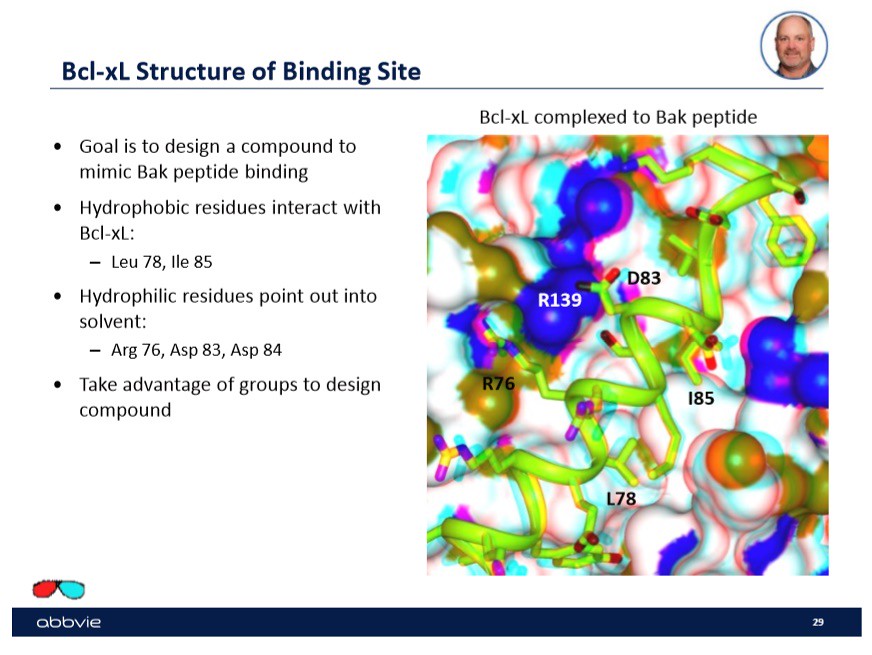
One of the examples that Dr. Stoll used to talk about drug design was binding to the transmembrane molecule B-Cell-Lymphoma-Extra-Large or bcl-xl in the mitochondria.  In his talk, he focused on a few binding sites shown in the slide below with a picture:


Specifically, in this case the company wanted to design a drug candidate that would "mimic" the peptide Bak binding.  Shown to the right on the slide are the sites or "active sites" that the peptide Bak bind to on the transmembrane molecule bcl-xl.  In order to find a drug that will mimic the binding of the peptide, the drug will have to have the ability to bind to multiple sites on the transmembrane molecule.


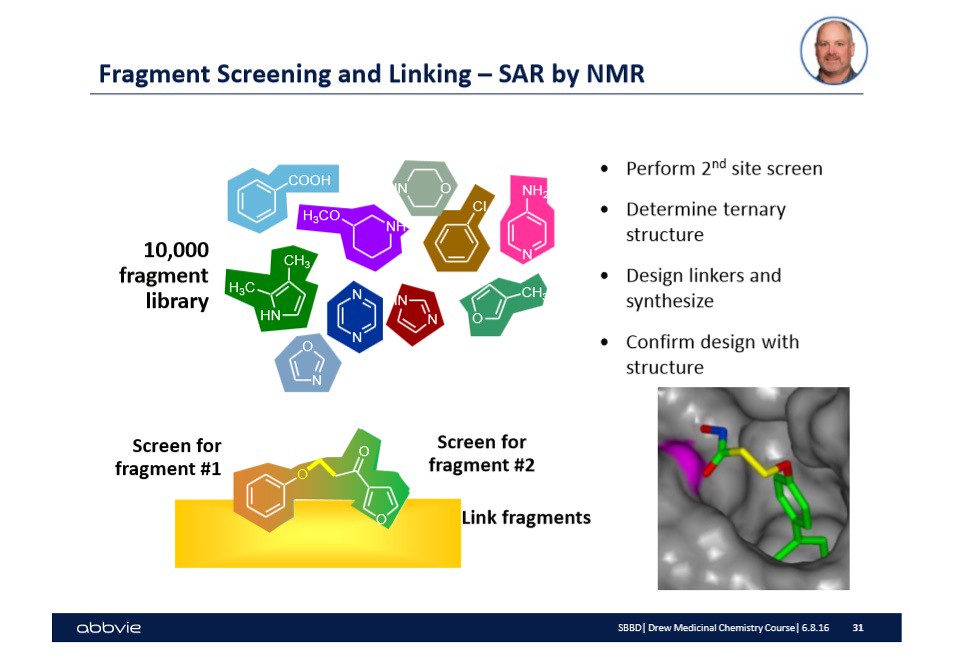
Fortunately, over time, large drug companies have built up a data base or library of 'molecules' that will bind to similar or exact sites.  In the slide below, I show a yellow surface with two molecules hovering above the surface -- slightly bound -- taken from Dr. Stoll's talk:


There is a lot of information on the slide shown above.  Let me walk you through the relevant information for drug design 101.  First, I mentioned that each drug company kept a library or database with a bunch of 'fragments' that are intended to hit specific targets on biological surfaces.  These biological surfaces can be viewed as the picture shown to the right in the slide.  They might be a protein surface, or another biological surface of interest to drug manufacturers.


In the case above, the two molecules shown on the yellow surface -- one is a brown color while the other is a green color.  The different color is to illustrate that the molecules are fragments designed to hit a specific type of target or active site on a biological surface.  In this case, the biological surface is the transmembrane molecule bcl-xl.


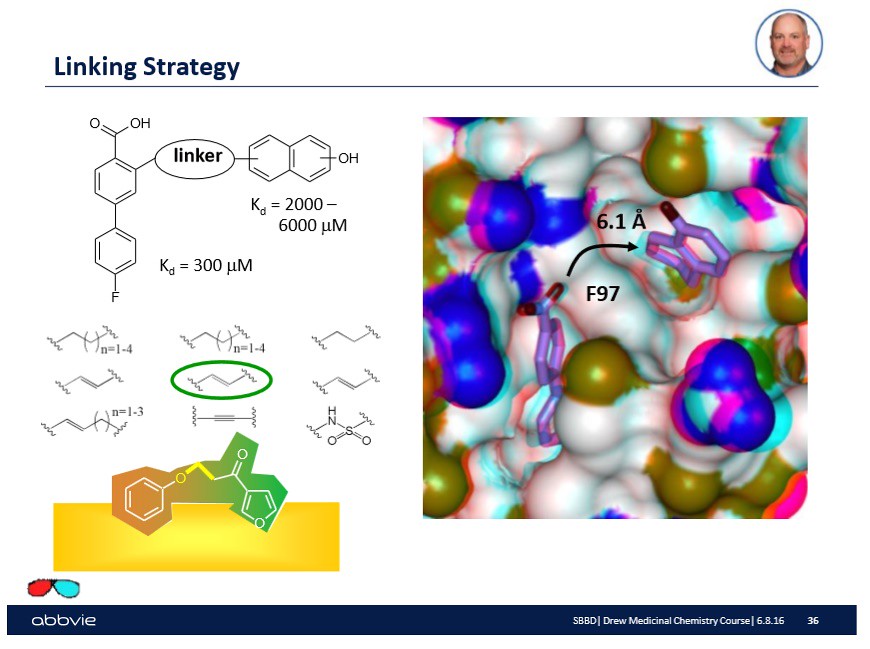
Once the fragments have been identified that will occupy and hit the desired targets or active sites, then the challenge is to link the fragments together by chemistry.  This step in of itself is often challenging and does not guarantee that the newly formed molecule (of two fragments with a linker molecule) will work.  Therefore, in the picture above, there are possible linker molecules that exist within the pharmaceutical database that have been shown to work in other cases.


After linking the two fragments together, the next step is to verify by spectroscopy that the total or linked molecule worked.


How is this accomplished?


In the lab, the substrate or biological surface will have a drop of the linked molecule injected onto the surface.  Then the surface which should have the drug bound to the active sites will be investigated using a spectroscopic technique like Nuclear Magnetic Resonance Spectroscopy.  Upon confirmation, a number will be reported as shown on the slide that indicates the binding affinity of the molecule onto the surface:


In the slide above, there are a couple of numbers reported that make sense to drug designers but probably not the reader -- you.  Do not worry.  Over time (through other blog posts) you will come to understand their meaning.  What is important to understand at this point is that after linking molecular fragments together, an experiment occurs to understand if the drug or linked molecule is as effective as the fragments are alone.


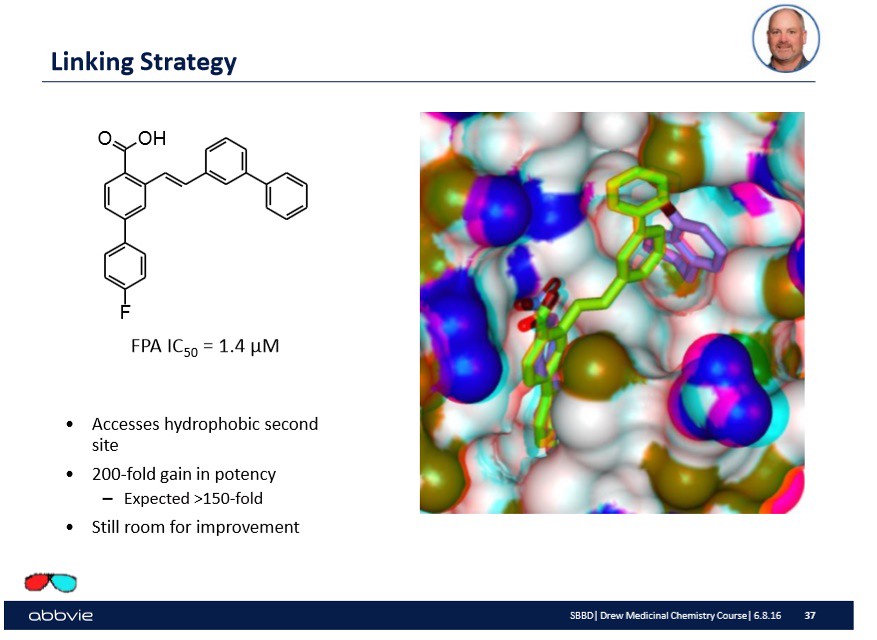
Furthermore, the pharmaceutical company might understand the chemistry of the active site to a large extent and further modify the linked molecules to make a more "potent" drug or linked molecule.  On the slide below, I show from Dr. Stoll's talk such a modification:


Again, the overall take home message is that the molecular modification done to the linked molecule has some effect.


Is that effect better or worse?


Can there be a further modification to the linked molecule or now drug to enhance the ability to mimic the peptide binding?


Who knows.  That is why research is continuously pushed forward and costs money to find out.


Conclusion...


In the above paragraphs, my intention was to introduce briefly the process of drug design.  As we speak though, changes are being made to parts of the process.  Outsourcing of linker molecules is occurring as are mergers and acquisitions of large companies by even larger pharmaceutical companies.  Which potentially means that the shared database or libraries of available drug targets is growing.  The process is dynamic but slow at the same time.


Discovering the mechanisms of disease and cures as a result is the dream of every drug designer.  Progress is unfortunately slowed down by the trial and error process.  Research takes time and money to complete.  Furthermore, improvements to existing drugs take time.  I will leave you with another short video about the progression of the medical research field:


Until next time, have a great day!!!!