Showing posts with label FDA. Show all posts

Friday, March 22, 2019

"Just Make A Generic (Cheaper Version) Of The Drug"? Not So Easy...


The cost of prescription medications is among the most contested political issues right up there with the associated cost of health insurance.  Anytime health insurance is mentioned, just wait -- a discussion is about to unfold linking that to the cost of prescription medications.  Why are medicines so expensive?  Simple answer: the cost of bringing a new drug to market is around $1 billion along with around 20 years of research/approval process.  What?  Yes.  If you happen to have $1 billion laying around, then you too can create a new medication.  Well, not really.  But in theory (based only on cost).


With this being known, why are generic medications cheaper?  Further, why are generic medications not sought out sooner (i.e. released to marketplace sooner)?  The answer to the second question is that the first medication (the expensive) one has 'ownership rights' -- patent rights -- for a given number of years.  As to why after the patent expires, the generic medication cannot be rolled out sooner -- ask the Food and Drug Administration commissioner.  FDA Commissioner just resigned.  Although, before he resigned, he managed among other many changes to leave a public statement regarding the status of expanding access to generic medications.  Included in the statement are the reasons/parameters which are considered or serve as obstacles to the roll-out of generic medications.  These considerations might clarify for the public the complicated generic drug landscape.


Below is the statement taken from the FDA website on expansion of 'generic medications' into the marketplace:


As part of the FDA’s efforts to promote drug competition and patient access, we’ve advanced many policies aimed at making it more efficient to bring generic competition to the market. We’ve been especially focused on a category of medicines known as complex drugs. These are drugs that, by nature of their formulation, delivery systems or the complexity of their active ingredients, for example, are harder to “genericize” under traditional approaches. As a result, these complex drugs often face less competition.
As a category, there are a number of complex drugs that are no longer protected by patents or exclusivities that would forestall generic approval, yet they continue to face no generic competition owing to the difficulty of developing generics. The agency has advanced many new policies to help promote generic competition to complex medicines once patents and exclusivities have lapsed, and we’re planning additional policy steps in 2019.
To understand the challenges posed by complex generics, we need to go back to the pathway developed in 1984 under the Hatch-Waxman Amendments. This legislation put into place the framework for generic drug review at a time when brand drugs were often simple small molecules requiring straightforward and reproducible manufacturing processes. They were generally easy to characterize and evaluate through traditional methods, including human bioequivalence studies. In many cases, a drug’s activity correlated directly with how quickly it got into the bloodstream and how long the drug stayed in the body, so it could have its intended effect on the anticipated site of action.
In contrast, complex drugs involve cases where the drug is often harder to develop and manufacture because it has a complex formulation or complex active ingredient. In other cases, the drug acts locally on the tissue rather than through the concentration in the blood. This includes, for example, inhaled drugs that act directly on the lungs, a topical patch that is activated directly on the skin, or eye drops that act on the surface of the eyes. The therapeutic effect of these types of drugs does not necessarily correlate directly to the amount of drug in the blood, or it can be difficult to measure through the blood. They can raise other issues that make the traditional, metrics generally used to develop generic drugs harder to employ. In other words, it can be more difficult to meet the standards for generic approval.
In 2019, we’ll advance additional policies to promote generic competition for complex drugs. Among other steps, we intend to issue additional guidance documents for developing specific complex generic drugs, as well as address categories of complex drugs that are hard to copy because of their complex formulation or mode of delivery. This will include the publication of a series of guidances to address regulatory and scientific challenges that make it generally more difficult to develop complex generics. As part of this, we intend to issue draft guidance with recommendations on establishing active ingredient sameness. In addition, we’re going to help advance the development of new analytical tools and in vitro tests that may provide additional accurate, sensitive and reproducible tools to support approval of complex generic drugs. Better tools can reduce complex generic drug development time and cost and can inform regulatory decisions.
These are just some of the new steps that we’re going to be taking in 2019 to promote access to complex generic medicines.
These new policy efforts are aimed at ensuring that we provide as much scientific and regulatory clarity as possible with respect to complex generic drugs. This focus is critical because, first and foremost, these drug products provide important therapies to patients. We believe that they’re also becoming increasingly important to the economic stability of the generic drug industry. Being able to “genericize” a complex medicine can be a high-value opportunity for a generic drug developer.
Addressing the challenges related to complex generics, and promoting more generic competition to these medicines, is a key part of our Drug Competition Action Plan, and the agency’s efforts to promote patient access and more affordable medicines.
The FDA, an agency within the U.S. Department of Health and Human Services, protects the public health by assuring the safety, effectiveness, and security of human and veterinary drugs, vaccines and other biological products for human use, and medical devices. The agency also is responsible for the safety and security of our nation’s food supply, cosmetics, dietary supplements, products that give off electronic radiation, and for regulating tobacco products.


The generic drug approval process seems to have changed over the last few decades with the development of new types of medications.  Traditional routes of administration have changed.  Which is to say, become much more specific (precision medicine).  This change has caused an uproar among approval authority.  Old medicines use old approval processes.  New medicines require new approval processes.  Precision medicine will ultimately speed up the approval process by causing federal agencies such as the Food and Drug Administration (FDA) along with the National Institutes of Health (NIH) and the Department of Health and Human Services (HHS) to update review/approval/funding processes.


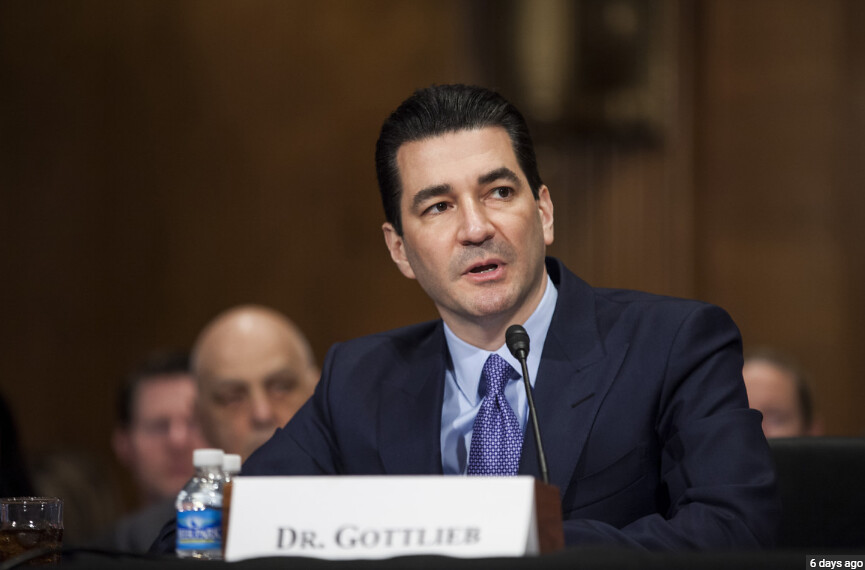
Currently, these changes are under consideration by federal agencies.  Recently, FDA Commissioner Scott Gottlieb gave an outgoing interview with the journal 'Politico' -- which is embedded below:


Ultimately, the new landscape brought about by changes in medicine along with the collection of medical data (All of Us - NIH trial) will result in better medical practices for the public.  Stay tuned, the future is exciting.


Related Blog Posts:


 How Much Do New Drugs Cost To Bring To The Pharmacy Counter?


How Do Chemists Discover New Drugs? A Brief Introduction!


Update: On FDA's Policy Agenda For Combatting Opioid Crisis


Have You Ever Heard A Song About Personalized Medicine? Here Is A Scientist Singing A Song.


The future: Making Medicines in your kitchen?


The Futuristic Visit To The Physician Is Here!


NIDA Director Nora Volkow: How Health Communicators and Journalists Can Help Replace Stigma with Science


NIAID Director Anthony Fauci: How Should We Communicate About Crises?


What is going on in the FDA for Fall 2018 - message from Director Scott Gottlieb


NIH Director Francis Collins Makes A Statement Regarding Sexual Harassment In Science


Tuesday, March 12, 2019

Update: On FDA's Policy Agenda For Combatting Opioid Crisis


Source: Politico


Last week, news broke that the current Commissioner of the Food and Drug Administration -- Commissioner Dr. Scott Gottlieb was leaving surprised everyone around Washington D.C.   Commissioner Scott Gottlieb has done wonderful work on very difficult problems facing our society, including Food Safety, Cosmetics Safety, expanding access to medication, and the largest plague of all -- Opioid epidemic facing the United States of America right now.  Under his command, the FDA has started to come up with an action plan on the opioid crisis -- which can be found here.  The web page on the FDA website for opioids is more informative and easier to navigate -- check it out here.


He also has given his perspective on the growing opioid problem through official outlets (Twitter, Facebook, etc.) along with official statements on the problem like that below.  The statement below represents the most recent -- Feb. 26th and his last before he leaves office.  Although, the statement gives the public a good future guide into the routes of a solution which the FDA will pursue into the next few years.


With that in mind, here is the update taken from the FDA website directly shown below:


The opioid crisis is one of the largest and most complex public health tragedies that our nation has ever faced. It remains the biggest public health crisis facing the FDA. The toll of addiction, in lost lives and broken families, touches every community in America. Sadly, the scope of the epidemic reflects many past mistakes and many parties who missed opportunities to stem the crisis, including the FDA.
At the FDA, we’ve worked to learn from past mistakes, and we intend to make sure that we’re acting forcefully enough to address new threats that could extend this crisis. Addressing the opioid crisis is a top priority of the Secretary of Health and Human Services and the entire Administration. The FDA is a key part of that effort.
We’re a deliberative, science-based agency. We calibrate our policy and regulatory actions carefully, based on rigorous evidence that can often take many months and even years to collect. This defines our gold standard for regulatory decisions. But given the scope of this crisis, and its human toll, we’ve committed to act more quickly as we confront new risks. We’ve changed our approach and are taking a much more aggressive approach to regulatory action. At the FDA, we’ve committed to taking more rapid action in the face of new threats, like the growing prevalence of illicit fentanyl that’s contributing to overdose deaths, or the continued prevalence of prescriptions being written for durations of use that are too long for the clinical circumstances for which they’re intended. We’ve changed the way we’re tackling these issues and stepped up our intervention when it comes to opioids. In this epidemic, waiting for the accumulation of definitive evidence of harm left us a step behind a crisis that was evolving quickly, and sometimes furtively, in vulnerable communities that were too often being tragically ignored.
To address this crisis differently, and more definitively, we’ve taken decisive steps in recent years, and have additional actions already underway for 2019, with more steps planned to begin this year.
We’re committed to getting ahead of this crisis. We don’t want to look back five years from now, at an even larger crisis, with regret that there were more aggressive steps that we could have taken sooner. All options are on the table. Addressing this crisis is one of the FDA’s top public health priorities. With this statement, I want to assess some of the steps we’ve taken and outline the new actions we’ll be pursuing.
FDA Actions in 2018
Prescribers have a critical role to play, and we must make sure they have essential information about opioids through drug labeling. In the fall, we expanded the extended-release and long-acting (ER/LA) opioid analgesics Risk Evaluation and Mitigation Strategy (REMS) requirements to the immediate-release (IR) opioid analgesics intended for use in an outpatient setting. We’ve also updated the boxed warnings in the labeling for these products to include information about the REMS.
The REMS program was also expanded to require, for the first time, that training be made available to all health care providers, including nurses and pharmacists, who are involved in the management of patients with pain (in addition to doctors who prescribe these products). The content of the education was also broadened to cover information about acute and chronic pain management, safe use of opioids or other non-opioid or non-drug treatments, and material on addiction medicine and opioid use disorders.
The FDA also developed new solutions to address the unique risks of opioids in conjunction with our request for the market withdrawal of Opana ER in 2017. We will, as needed, continue to take strong regulatory steps to seek to limit or curtail access to certain drugs, based on formally assessing the risks associated with illicit use, as we did in the case of Opana ER with the risk of intravenous abuse. As part of our effort to consider the risks associated with the illicit use of opioids as one component of how we assess the overall risk and benefit of these medicines, we also worked with Congress to secure explicit authority to take action, as needed, on the basis of a consideration of these risks. This authority was included in the Substance Use-Disorder Prevention that Promotes Opioid Recovery and Treatment (SUPPORT) for Patients and Communities Act. In 2018 we also opened a dialogue around the potential for evaluating the comparative benefits and risks of new opioids relative to other opioids already on the market. Going forward we’ve raised the question of whether there should be such a standard for new opioid approvals to offer some advantage over the existing armamentarium. We raised this question in the context of the approval of the sufentanil product Dsuvia. We plan continue to evaluate this concept in questions that we’ll ask as part of a public docket alongside a draft guidance document that we’ll be issuing to modernize the FDA’s framework for assessing the risks and benefits of opioid drugs.
To reduce the rate of new addiction we need to reduce exposure to opioids. This means rationalizing prescribing, which in turn means that not only must we take steps to make sure fewer prescriptions for opioids are written, but also that when these drugs are prescribed, it’s for a dose and duration of use that comports closely with the clinical circumstance and the medical need of the patient. This means no more 30 tablet prescriptions for a tooth extraction. To pursue these public health goals, we’re working with stakeholders like the National Academies of Science, Engineering, and Medicine to create a scientific framework for developing evidence-based prescribing guidelines that provide specific recommendations on the proper dosing and dispensing of opioids based on specific clinical indications (like outpatient surgeries).
This will help support evidence-based guidelines in areas where they do not currently exist. This report will be ready at the end of 2019. We’re also conducting a review of data from product applications, in collaboration with an academic partner, to identify where adequate evidence exists to inform new guidelines. We believe there are clinical circumstances where there’s already adequate evidence to create evidence-based prescribing recommendations, and we’ll pursue the development of these guidelines.
In 2018, the FDA also continued work with other federal and state partners on numerous other changes started over the past several years to achieve more appropriate prescribing. Rationalizing prescribing practices by providers remains a cornerstone of our effort to reduce the rate of new addiction. And reducing the rate of new addiction is a key element of our overall approach to address this crisis. These combined actions across many federal, state, and professional entities are having an impact. Since 2015, the estimated number of opioid analgesic prescriptions dispensed from U.S. outpatient retail pharmacies (which may be the most vulnerable to abuse or diversion of prescription products) have fallen by 24 percent. Notably, prescriptions of higher strength opioids (90+ morphine milligram equivalents/unit) have fallen even more steeply since 2015, accounting for less than 1 percent of all opioid analgesic units (e.g., tablets) dispensed in 2018.
Although the appropriate use of opioids from prescription claims data cannot be determined, the risk of overdose has been shown to be intertwined with increasing dose and duration of opioid analgesic use. Overall, the estimated total number of opioid analgesic prescriptions peaked in 2012, to 260 million prescriptions from 145 million in 1997. The estimated total morphine milligram equivalents (MMEs) per prescription peaked in 2010, at 950 MMEs, before falling to 905 MMEs in 2015. However, the rate of overdose death continues to increase. This is due in part to the increasing abuse of potent adulterated or illicitly manufactured fentanyl products purchased through online channels and sold as street drugs.
As the opioid crisis has evolved, so has the nature of the threat. Opioids are still too commonly prescribed and lawful prescriptions still contribute to the development of new cases of addiction. But illicit opioids are accounting for a sharply increasing fraction of the total exposure to these drugs, and fueling a growing addiction crisis. Within the scope of our work, we’re especially focused on illicit online purchases. The flow of drugs on the surface and dark web has become a significant part of the epidemic relative to prescription opioids. To address the evolving nature of this threat, since 2017, we’ve warned a total of 23 networks operating more than 450 websites for illegally marketing potentially dangerous, unapproved, and misbranded versions of opioid medications, including tramadol and oxycodone. Cutting off this illicit internet traffic is critical. We’ll continue to pursue all available means of enforcement to stop these online drug dealers.
In 2018 we also took actions to increase our interdiction work in the International Mail Facilities (IMFs). Specifically, as the nature of this epidemic has evolved to encompass greater flows and use of illicit opioid drugs, we’ve expanded our enforcement efforts to include increased interdiction work aimed at stopping the illegal flow of counterfeit and unapproved prescription drugs, which in numerous cases includes opioids.
The FDA expanded the capacity of import operations, made significant investments in our Office of Criminal Investigations, and our laboratories, including our Forensic Chemistry Center. These are important investments to help us identify and stop illegal drugs seeking to enter the U.S. including through the IMFs.
Over the last two months, the Office of Regulatory Affairs (ORA) and the Center for Drug Evaluation and Research (CDER) have made significant progress to stop the activities of sophisticated bad actors who attempt to evade FDA enforcement at the border.
Among these new steps, we’re pleased to report that we’re implementing one of the new authorities in Section 3022 of the SUPPORT Act related to restricting entrance of illicit articles containing active pharmaceutical ingredients (APIs). This new authority (new section 801(u) of the Federal Food, Drug and Cosmetic Act) allows the FDA to treat illegal imported articles as drugs when they meet certain requirements—and stop them as needed—even in the absence of certain evidence of intended use. ORA has updated its IMF procedures to support implementation of this new authority to help prevent illegal drugs from entering our country. We’re also working on new tools to identify analogues of APIs that present s significant public health concern, to make sure that this important new enforcement tool against illicit drugs has its intended effect. The FDA will begin applying the new 801(u) authority to any imported product entering the U.S. via international mail which is labeled to be or contains, or is found through laboratory analysis to be or contains, any of the ingredients identified as presenting a significant public health concern. These new steps will make our operations in the IMFs more efficient and allow us to improve our interdiction work.
By supporting appropriate opioid prescribing, education, and labeling we’re reducing excess quantities of opioid analgesics available for abuse or diversion and helping to reduce the rate of new addictions from prescribed opioids. By strengthening our enforcement and inspections of packages purchased online and entering the U.S. from abroad, we’re helping to staunch the trafficking of even more powerful and deadly drugs (like illegal Chinese fentanyl) and address the changing nature of this crisis. By increasing the accessibility of medication-assisted treatment (MAT), and reducing stigma associated with it, we’re helping those struggling with addiction to return to lives of sobriety in their communities with dignity.
These are just some of the domains that we’re working across as we address this crisis using all of our tools and authorities. We know we must treat opioids very differently than other drug classes, and Congress has supported us in that effort by granting us very specific new authorities related to opioids.
FDA Actions in 2019
These are just some of the steps that we took in 2018 to address this crisis. In 2019, we plan on taking new actions to build on these efforts, and also adapt our response to confront the changing nature of the threat. We’ll continue to aggressively and compassionately pursue new efforts to address this tragedy.
Reducing Misuse and Abuse of Opioid Drugs
The FDA continues to have a critical and unique role to play in preventing cases of new opioid addiction – helping to reduce avoidable exposure to opioid analgesics and thereby reduce the rate of new addiction.
We’re taking new steps to reduce exposure to opioid analgesics by helping to ensure that these drugs are appropriately prescribed, with dose, quantity and treatment durations that match the indication. Passage of the SUPPORT Act has provided the FDA with important new authorities to assist in our effort to reduce the risk of addiction and misuse associated with opioid analgesics. For example, the new law allows the FDA to require certain packaging be made available for opioids and other drugs that pose a serious risk of abuse or overdose if the FDA determines that such packaging may mitigate such risks. We plan to implement the initial steps to require unit of dose packaging in the first half of 2019. Specifically, the FDA is considering use of this new authority to mandate that certain solid, oral dosage forms of immediate-release formulations of opioid analgesics indicated for treatment of acute pain be made available in short-duration packaging for outpatient dispensing. Such packaging could reduce over-prescribing by giving providers a convenient option that contains only enough drug doses for up to a few days of opioid treatment at standard dosing. Our data suggests that for many acute pain indications where opioids are used, a day or two of dispensed drug is the appropriate quantity. Small quantities in blister packaging, that comport with evidence demonstrating that a day or two of medication is sufficient, could reduce the overall amount of dispensed drugs available for misuse, abuse, and diversion.
The SUPPORT Act also allows the FDA to require manufacturers to develop disposal technologies (such as a mail-back pouches) to get unused medications out of medicine cabinets. This is another new authority that we’re prioritizing for work in the first half of 2019.
We’re also taking new steps to consider a framework to allow us to formally evaluate each candidate opioid in the context of how a novel opioid might fit into the overall therapeutic armamentarium that’s available to patients and providers, and address the question we’re frequently asked as to whether new opioid drugs should offer some comparative benefit over existing drugs. This process could include seeking revisions to statutory authorities to allow us to change the weight we give to meaningful therapeutic differentiation for proposed new opioids, including relative safety or effectiveness advantages over existing treatments.
We also plan to pursue new efforts to continue to evaluate the effectiveness of REMS programs for opioid products, including methods for data collection and assessment tools. Recently, we’ve heard concerns around the REMS program associated with one class of opioid products, transmucosal immediate-release fentanyl (TIRF) medicines, and whether the REMS program is working as intended. This is a topic that was raised by the FDA as the focus of an August 2018 public advisory committee meeting.
These products are medically important for a specific group of patients experiencing breakthrough pain that may not be managed by their around-the-clock opioid pain medicine. But these medicines also pose serious risks. That’s why the agency has sought to ensure that the TIRF REMS program is achieving its public health goal of assuring safe use and mitigating the risks of misuse, abuse, addiction, overdose, and complications due to medication errors. The agency has been actively assessing the recommendations of our advisory committee on the effectiveness of the REMS and necessary changes. Based on these recommendations, and our analysis of our own data, the FDA will soon share next steps, including modifications intended to strengthen the current TIRF REMS. The prescribing of the TIRF products has decreased dramatically from peak years in 2014 and 2015. Nonetheless, substantial risks remain if these powerful drugs are not used properly and in appropriately indicated patients. The goal of the changes we will make to the TIRF REMS programs will be to make sure the program is working to mitigate the known risks of these medicines and that these drugs are being prescribed only to opioid-tolerant patients, and that those patients understand the risks and how to use TIRF medicines safely.
Support Addiction Recovery and Reduce Overdose Deaths
To help those suffering from opioid use disorder, the FDA is prioritizing new efforts to advance the development and use of safe and effective MAT. This includes new guidance aimed at supporting the development of novel medicines as well as novel medical devices such as digital health tools, advancing new policies to promote the adoption of safe and effective MAT, and working with partner organizations/stakeholders to reduce the stigma associated with MAT.
Reducing overdose deaths also requires broadening the availability of naloxone. One potential way to improve access to naloxone is to make it available for over-the-counter (OTC) sale. FDA-approved versions of naloxone currently require a prescription, which may be a barrier for people who aren’t under the care of a physician or may fear a stigma associated with seeking access to the medicine or are fearful of admitting to issues with substance abuse. Having naloxone widely available, for example as an FDA-approved OTC product, would be an important public health advance, and a need that we’ve been working on at the FDA.
To encourage naloxone manufacturers to enter the OTC market, the FDA took an unprecedented step of developing a model Drug Facts Labels (DFL) with easy-to-understand pictograms on how to use the drug. We proactively designed, tested and validated the key labeling requirements necessary to approve an OTC version of naloxone and make it available to patients. These steps put into the public domain much of the regulatory work needed to take naloxone OTC. One of the key components for OTC availability is now in place so that sponsors can use it to obtain approval for OTC naloxone and increase its access. These efforts should jumpstart development of OTC naloxone and promote wider access to this medicine. This year we are seeking to work with industry partners who are interested in developing these OTC naloxone products.
Research and Innovation in Non-Addictive Pain Treatments
Another critical part of our efforts for 2019 is new steps to promote the development of drugs to treat pain that are not addictive. To advance these goals, in 2019, we’ll be issuing updated guidance outlining the appropriate clinical endpoints and clinical trial approaches for the development of non-opioid drugs for use in the treatment of acute and chronic pain. We’ll also advance new steps to promote the development of abuse-deterrent formulations of opioids by exploring new methods for analyzing and evaluating abuse-deterrent features; further evaluating the nomenclature used to describe these abuse-deterrent features; and facilitating development of science for generic versions of these products.
Strengthen Enforcement Against Illicit Opioids
The FDA will continue to strengthen its enforcement activities that target those who unlawfully market or distribute illicit opioids and other unapproved drugs. We’ll step up our efforts aimed at the interdiction of opioids being illegally shipped into the United States and will continue to increase the number of investigators, both civil and criminal, in the IMFs.
Among other new steps we’ll take in 2019, the FDA is working in partnership with U.S. Customs and Border Protection (CBP) to expand information sharing and maximize each agency’s inspection and detection capabilities at the border to protect the public from illegal and potentially harmful products entering the U.S. This includes real-time sharing of data obtained by scientists using field-based screening tools to test samples that are seized at the IMFs and at the border. We’re working closely with our partners at CBP in this program.
Right now, seizures of opioids like fentanyl are typically reported in pounds of drug product seized. But that doesn’t give a full picture of the total amount of drugs that are being illegally shipped into the U.S. because these weight-based measures don’t account for potency. Some of the drugs being illegally brought into the U.S. may consist of fentanyl premixes ready for pressing into tablets, while others are super-potent formulations of compounds like fentanyl. By additional testing to develop a chemical profile of more seized samples, we can develop a better picture of the illicit drug trafficking landscape, which can better inform our policy work.
We’re also going to be expanding our collaboration with internet stakeholders to crack down on illicit drugs sold online. In April, we’re also planning our second Online Opioid Summit. The first Online Opioid Summit held last June initiated an open and candid dialogue with key internet stakeholders to discuss ways to take robust action to reduce the availability of opioids online. Since the initial Summit was announced, internet stakeholders have taken concrete steps to prevent the illegal sale of opioids through their platforms and services. Important actions came about as a result of this collaborative dialogue with key stakeholders.
For example, Google now deindexes websites based on our warning letters that cite the unlawful sale of opioids to U.S. consumers. Social media platforms such as Facebook and Instagram redirect users who are looking to buy opioids online to the Substance Abuse and Mental Health Service Administration National Helpline. We look forward to the second Online Opioid Summit to build on these efforts with additional, innovative steps to protect the public from opioids that are illegally being sold via the internet.
As part of the 2019 budget, the FDA also received $20 million to create a large-scale data warehouse to improve our analytic capabilities to better evaluate social and clinical trends that are affecting the trajectory of the opioid crisis. This warehouse can facilitate data analytics, including machine learning algorithms, to help better assess vulnerability points in the population through predictive analytics, identify early trends that may be contributing to the epidemic, and target early regulatory changes to address the changing opioid epidemic.
Finally, as part of our effort to clamp down on illicit sales of opioids – which includes our work to close down illegal portals on the internet and expand our presence in the IMFs – we’re also doing more to secure the legitimate supply chain. This means doing more to hold distributors responsible for securing the drug supply chain. As part of this effort, we recently announced that the FDA issued its first warning letter under the Drug Supply Chain Security Act (DSCSA) to McKesson Corp. for violations highlighted by a concerning tampering incident that involved opioid medications. Under the DSCSA, manufacturers, repackagers, wholesale distributors and dispensers – which are mainly pharmacies – are all required to have systems and processes in place to quarantine and investigate suspect and illegitimate medications. These systems must be in place to respond rapidly to notifications of illegitimate products and to notify trading partners and the FDA when illegitimate products are discovered. The warning letter to McKesson outlines violations observed during inspections that took place this past summer, including failing to: sufficiently respond to notifications that there was illegitimate product in their supply chain; quarantine and investigate suspect products; and maintain records of investigations of suspect product and disposition of illegitimate product as the law requires. This action is part of a broader policy effort to improve the security of the drug supply chain and prevent diversion of opioids. We’ll continue efforts to ensure manufacturers, repackagers, wholesale distributors, dispensers and others responsible for maintaining the supply chain are taking measurable steps under the law to appropriately track and trace opioid medications as these products move through the supply chain, and to respond to incidents involving illegitimate products to protect the public health.
These are just some of the new steps we’ll advance in 2019 as we continue to confront this crisis. Looking back across modern times, this is perhaps the biggest public health tragedy ever created through the deliberate actions of people. The opioid crisis took hold over the course of decades of action and inaction. Now, its scope is so large, and so devastating, its toll is self-evident. It will, unfortunately, take years of aggressive action to reverse its course for good. We won’t lose our focus on this fight.
The FDA, an agency within the U.S. Department of Health and Human Services, protects the public health by assuring the safety, effectiveness, and security of human and veterinary drugs, vaccines and other biological products for human use, and medical devices. The agency also is responsible for the safety and security of our nation’s food supply, cosmetics, dietary supplements, products that give off electronic radiation, and for regulating tobacco products.


The opioid problem has expanded in scope along with the multiple avenues by which to treat it.  There is no 'one size' fits all approach.  As stated above the statement, education needs to be done at all levels of an organization starting with the top and working down to the orderly on a given ward.  If everyone understands the problem from their perspective, then there will be that many more tests, examination/inspections done to ensure that the emerging problem is being dealt with at various levels in various manners.


The FDA is not the only soldier in the fight.  Other federal organizations like the National Institutes of Health are funding studies to learn how to better treat chronic pain while reducing addiction to pain treatment.  Specifically, the National Institute on Drug Abuse (NIDA) has a wonderful and easily navigable web page -- click here -- with descriptions of the problems facing society around opioids, types, and videos to give a comprehensive perspective on both the problem and possible solutions to the growing crisis.


Regardless of the organization, there will always exists bureaucratic obstacles toward implementing solutions quickly on the local level.  Therefore, the crucial soldiers in the fight are of three classes: (1) health care workers (2) family and (3) community.  When healthcare workers are involved in treating/finding a solution to the opioid crisis, usually that occurs after person or persons from their communities have landed in their care in the hospital.  But as we all know, the problem started way before this.  Which is why the last two classes of people are extremely important.  Community members can help take care of the community.


If drug use is an issue, then form community groups to watch out and combat the problem.  Don't accept that the problem has to be the normal condition.  Of course, that is easier said than done.  Retaliation is a big problem -- the drug trade pays well.  Family members can offer support/care by helping their respective family members suffering from opioid addiction.


Last but not least, even though the last effort is the healthcare staff -- when the overdose patient arrives at the hospital with a critical need for care.  How the healthcare staff responds to the needs to patients who have chronic pain will determine the long term consequence of the opioid crisis.  If there is a genuine need to treat chronic pain with powerful medications, then so be it.  But the chronic pain needs of patients lay across a wide spectrum of treatment.  Which still can be optimized with new medical techniques and technology which is being developed as we speak.


The FDA will miss Commissioner Scott Gottlieb's direction after he leaves.  He has pushed the needle of progress forward on a variety of issues thus far.  He should be commended for his service.  Hopefully the remaining staff at the FDA continue to push progress on the listed agenda items in the introductory paragraphs along with the issues mentioned in the statement above from the FDA website.  There is certainly enough that the FDA can do to protect society moving forward.


Related Blog Posts:


Have You Ever Heard A Song About Personalized Medicine? Here Is A Scientist Singing A Song.


The future: Making Medicines in your kitchen?


The Futuristic Visit To The Physician Is Here!


NIDA Director Nora Volkow: How Health Communicators and Journalists Can Help Replace Stigma with Science


NIAID Director Anthony Fauci: How Should We Communicate About Crises?


What is going on in the FDA for Fall 2018 - message from Director Scott Gottlieb


NIH Director Francis Collins Makes A Statement Regarding Sexual Harassment In Science


Friday, December 7, 2018

Congress Gets Involved In Beef Recall


Source: Cooking Light


Amid the beef recall hitting the United States, one cannot help but think about the post I wrote recently regarding the unkown fact that bacteria is not checked in meat/poultry products after the products leave the warehouse by the Food Safety Inspection Service.  As I alluded to, corporations left on their own to conduct inspections is a path toward outbreaks.  Not all corporations are offenders.  Although, the beef recall is indicative the lack of inspections on part of a corporation --


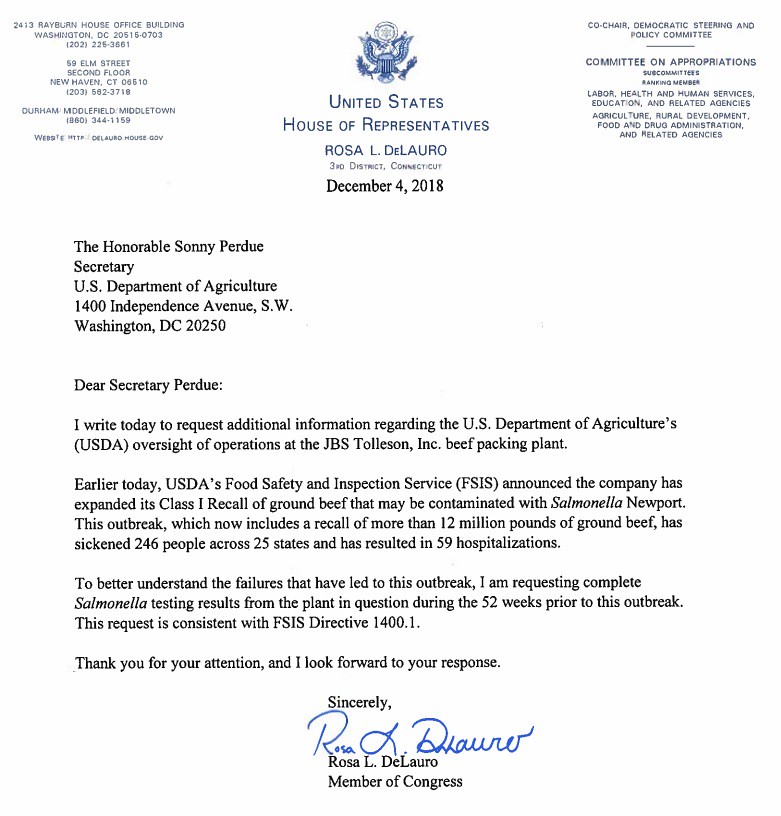
Congress has now been inserted into the recall based on the number of people affected by the tainted (salmonella tainted) beef.  Congresswomen Rosa DeLauro sent a letter of inquiry to Agricultural Secretary Sonny Purdue shown below:


Source: Congress


The following message is written on the letter shown above:


Dear Secretary Purdue:

I write today to request additional information regarding the U.S. Department of Agriculture's (USDA) oversight of operation at the JBS Tolleson, Inc. beef packing plant. 
Earlier today, USDA's Food Safety and Inspection Service (FSIS) announced the company has expanded its Class 1 Recall of ground beef that may be contaminated with Salmonella Newport.  This outbreak, which now includes a recall of more than 12 million pounds of ground beef, has sickened 246 people across 25 states and has resulted in 59 hospitalizations. 
To better understand the failures that have led to this outbreak, I am requesting complete Salmonella testing results from the plant in question during the 52 weeks prior to this outbreak.  This request is consistent with FSIS Directive 1400.1.  
Thank you for your attention, and I look forward to your response. 
Sincerely, 
Rosa L. DeLauro
Member of Congress


I am glad to see that congress has now been involved in the matter.  Especially since the inquiry comes against the backdrop of a recently released report by the Food Safety Inspection Service on the efficacy of poultry inspections in a variety of poultry plants around the United States.  The report shows that a sizable portion of the poultry plants have earned less than stellar (alarming) grades on their ability to inspect for Salmonella (along with other bacteria) in the outgoing products.


Conclusion...


The issue is a moving target -- an ongoing situation -- which is changing and will be updated on this site when news pops up.  Food safety from a contamination standpoint is just as alarming as food safety from ingredient safety is to me.  Each of us deserve to understand the regulations and checks (and balances) which exist in government (federal down through local) to provide a safety and healthy product to the consumer.


Stay vigilant and educate yourself on the safety of the world around yourself.  Education is the best weapon to combat any problem which plagues society.  Unfortunately, not enough education is accomplished on this matter at professional institutions.  Therefore, the responsibility lies within each of us to do the work.  Stay tuned.


Related Blog Posts:


One Unknown Fact Which Should Cause Consumers To Be Careful About Handling Meat Before Cooking!


How Effective Are Poultry Corporations At Reducing Salmonella In Their Products?


Ralph Nader: Post Election -- Next Step -- Open Up The Existing Secretive Congress


New trend in the Thanksgiving Holiday for 2018? Smaller Turkeys?


A Forecaster Predicts That Hurricane Florence Will Drop Enough Rain To Fill 18,400 Mercedes-Benz Superdomes

Hurricane Harvey Drops Enough Rain On Houston To Fill 560 Dallas Cowboy Stadiums


How Much Water Is Contained In All Oceans Around The Globe?


Storm Raises Water Level In Lake Cachuma By 31 feet, How Much Water Is That?


How To Make Sense Of Water Flowing At 100,000 Cubic Feet Per Second


Can 11 Trillion Gallons Of Water Fill 14,000 Dallas Cowboys Stadiums?


How Much Rain Did The East Coast Receive From Hurricane Matthew?


How Much Rain Did Haiti Really Receive?


How Much Rainfall Has Dropped On Louisiana?


How Big Was The "Water Bomb" Of Rainfall In Macedonia?


How Much Rain Did Huauchinango (Mexico) receive?


How Much Rain Did Elliot City (Maryland) Really Receive?


If The Mosul Dam Breaks, The City Of Mosul Would Be Under 65 Feet Of Water?


What is the volume of water in a few inches of rain?


Volume of Waste in the Mine Spill (in Brazil) Equivalent to 78 Deepwater Horizon Oil Spills


Wednesday, November 28, 2018

How Effective Are Poultry Corporations At Reducing Salmonella In Their Products?


Amid the growing concern of the Romaine Lettuce contaminated with E.Coli over the Thanksgiving weekend, there has been a heightened discussion surrounding bacteria -- Salmonella in general.  For up to date information on the Romaine Lettuce contamination, please visit the Center for Disease Control and Prevention (CDC) web page for the outbreak.  This discussion is not new.  In fact, behind the scenes, the Food Safety Inspection Service conducted inspections (audits) and found surprising results (not good) through the last year from October 2017 thru til October 2018.  Below are the results and grades for the corporations at controlling Salmonella contamination in their products.


Corporations are self-regulated?


As I wrote in a previous blog post, the Food Safety Inspection Service does not inspect each outgoing package of poultry/meat which is sold in the United States.  Instead, corporations are subject to stringent documentation processes along with frequent visits to sites by regulators to audit safety of work flow and poultry/meat processing.  Which leaves the responsibility to the consumer to ultimately handle the poultry/meat safely (removing bacteria) before serving the final dish to family and friends.


After Thanksgiving weekend, writers at Politico Agriculture followed up on the news of the Romaine lettuce contamination along with potential problems with certain poultry/meat products which are popular around the holidays:


GOOD NEWS/BAD NEWS ON FOOD SAFETY: After getting everyone's attention pre-Thanksgiving, the FDA thinks it has traced the E. coli outbreak in romaine lettuce to growing regions in northern and central California, Pro Ag's Helena Bottemiller Evich and Sarah Zimmerman report. To help better assess future problems, leafy green distributors have now voluntarily agreed to identify where and when their lettuce was grown and harvested (effective immediately).
Now for the bad news: The day after Thanksgiving, when few were paying attention, USDA's Food Safety and Inspection Service released data showing that dozens of poultry plants have failed Salmonella performance standards.
FSIS reviewed dozens of slaughterhouses from October 2017 through October 2018, after reports of major salmonella outbreaks in chicken and turkey that sickened hundreds around the country. (Each plant is given a category rating from 1 to 3, with "category 3" signifying the company failed performance standards.)
— Four Jennie-O plants were found to have high levels of salmonella. That includes the plant in Barron, Wis., that issued a voluntary recall of around 150,000 pounds of ground turkey after FSIS determined the company was one of many brands likely connected to an outbreak that sickened at least 164 people over the past year.
— Jennie-O said it has created a "salmonella task force," according to a company statement shared with MA, to "better understand salmonella, and more importantly, what actions we can take to prevent it." 
— Nearly three-fourths of slaughterhouses of Perdue Farms, one of the country's top poultry producers, failed to meet performance standards for chicken parts. A Perdue spokesperson said the rankings "don't necessarily reflect current plant salmonella levels."
Thomas Gremillion, director of the Consumer Federation of America's Food Policy Institute, told MA the number of failed performance standards was due in part to "weak incentives under federal rules for poultry companies to attend to the bacteria."
— Most major poultry companies have at least one "category 3" processing plant, with more than 15.4 percent of samples testing positive for salmonella, Gremillion noted.


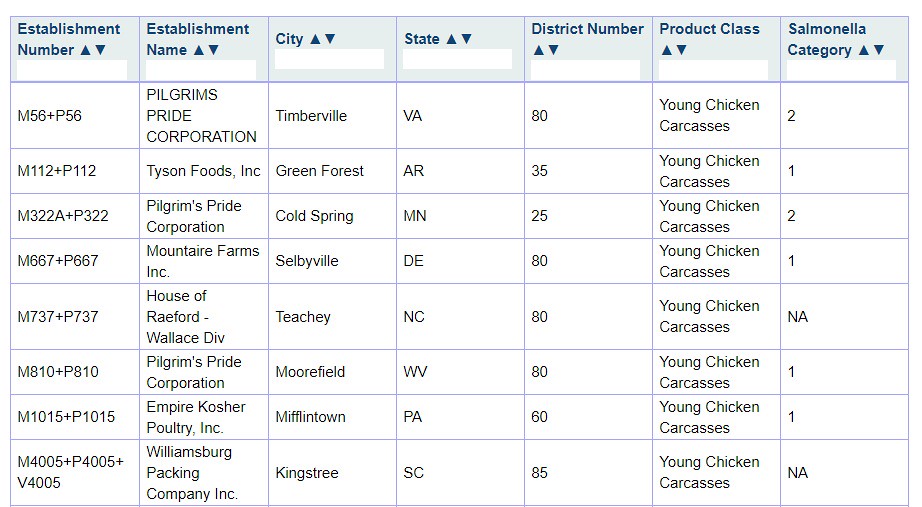
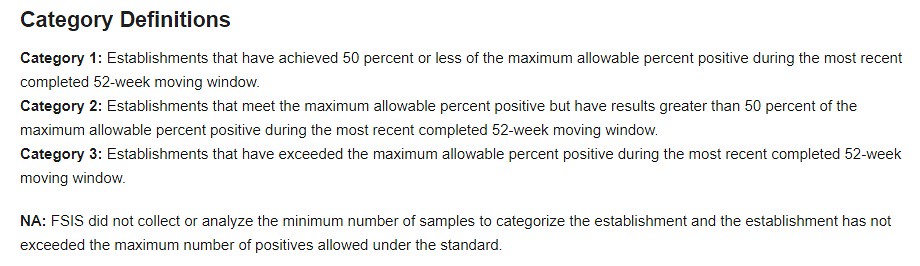
Wow.  Bad grades were found among poultry plants - which is concerning from a health and safety standpoint.  After reading the above news, the 'rating system' is probably sitting heavily on your mind (as it was for me last night).  The United States Department of Agriculture posted results of the survey with a glossary of terms shown below:


Source: USDA - FSIS


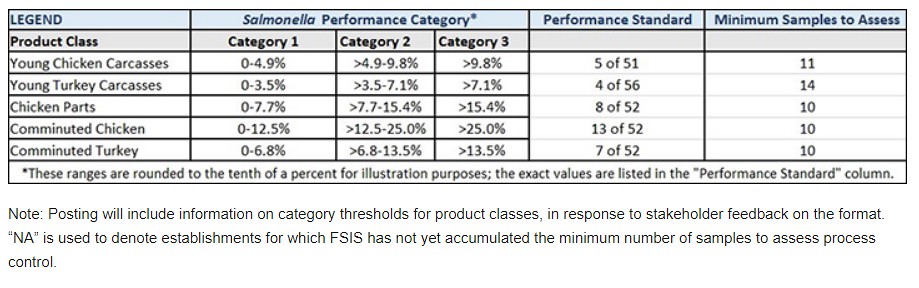
Note that the USDA posted the glossary at the end of the web page which piqued my curiosity.  Why not show the rating categories in the beginning?  Before the data rather than after.  Regardless, the results are concerning to say the least.  In order to interpret the results effectively as a reader/consumer, the following 'rules' which dictate the 'category' are shown below:


Source: USDA-FSIS


After posting the image of the categories for the inspectors to place grades into, I realized that the text is too small.  Below are the categories restated:


Category Definitions
Category 1: Establishments that have achieved 50 percent or less of the maximum allowable percent positive during the most recent completed 52-week moving window.
Category 2: Establishments that meet the maximum allowable percent positive but have results greater than 50 percent of the maximum allowable percent positive during the most recent completed 52-week moving window.
Category 3: Establishments that have exceeded the maximum allowable percent positive during the most recent completed 52-week moving window.

NA: FSIS did not collect or analyze the minimum number of samples to categorize the establishment and the establishment has not exceeded the maximum number of positives allowed under the standard.


The inspectors additionally broke down the inspections into specific parts of the chicken and different chickens as shown below:


Source: USDA-FSIS


Again, the image is rather small (the text in the image), therefore to view the results, click on the hyperlinked text "USDA-FSIS" and scroll down to the bottom of the web page (which is long).  The glossary and breakdown of results are worth viewing.  The overall message of the results is that the inspection uncovered the fact that major outbreaks of salmonella have occurred frequently and are of great concern.  I do not pretend to have the solution.  Although, I would offer that less regulation is not the answer.  More inspections and regulations are needed.


Conclusion...


According to a report from the news website 'Today' titled "FDA update on romaine lettuce: Safe to eat as long as lettuce is not from central CA" Romaine lettuce is good except from Central (California).  Still, I would suggest exercising great caution while handling lettuce before preparing it for a meal.  Recent research out of University of California at Riverside has unveiled the fact that "pre-rinsed" lettuce is not without bacteria.  Simply because of the shape of the pore inside the lettuce leaf, the thought is that bleach does not effectively reach into the pocket (pore) and appropriately kill the bacteria at 'regulated concentrations' of bleach used by corporations.  Professor Sharon Walker leads the research as shown in the video below:


As Professor Walker points out that there is very little scientific evidence behind the regulation which is involved in cleaning lettuce.  The work here will have impact in other areas of food research.  The poultry industry will undoubtedly be included in the new research.  According to the results shown above, there is plenty of room for improvement in developing new ways to remove/control the spread of bacteria (i.e. Salmonella) in the food industry.


Until those new innovative ways are translated into policy and regulations, please take appropriate steps to avoid the unwanted spread of bacteria among consumer products both inside and outside of your household. 


Related Blog Posts:


One Unknown Fact Which Should Cause Consumers To Be Careful About Handling Meat Before Cooking!


Natural Disasters Have Long Term Effects Which Are Quickly Forgotten?


What is the next big step in Mental Health Research?


A Forecaster Predicts That Hurricane Florence Will Drop Enough Rain To Fill 18,400 Mercedes-Benz Superdomes


Hurricane Harvey Drops Enough Rain On Houston To Fill 560 Dallas Cowboy Stadiums


How Much Water Is Contained In All Oceans Around The Globe?


Storm Raises Water Level In Lake Cachuma By 31 feet, How Much Water Is That?


How To Make Sense Of Water Flowing At 100,000 Cubic Feet Per Second


Can 11 Trillion Gallons Of Water Fill 14,000 Dallas Cowboys Stadiums?


How Much Rain Did The East Coast Receive From Hurricane Matthew?


How Much Rain Did Haiti Really Receive?


How Much Rainfall Has Dropped On Louisiana?


How Big Was The "Water Bomb" Of Rainfall In Macedonia?


How Much Rain Did Huauchinango (Mexico) receive?


How Much Rain Did Elliot City (Maryland) Really Receive?


If The Mosul Dam Breaks, The City Of Mosul Would Be Under 65 Feet Of Water?


What is the volume of water in a few inches of rain?


Volume of Waste in the Mine Spill (in Brazil) Equivalent to 78 Deepwater Horizon Oil Spills

Friday, July 20, 2018

Why is the Trump Administration Suppressing Science -- AGAIN???


Source: CNN


If there is one major disappointment with regard to the present administration, the suppression of science is ranked at the top of the list.  Why?  What has science done to the President or the administration officials in the past?  Gone against the desires of the oil and gas industry?  Well, the truth is that the era of fossil fuels is over or coming to an end in the distant future -- like it or not.  Anyways, suppressing scientific results is not good for the survival of mankind and has been implemented more than once in this administration.  People need to speak up and say "stop".  Although, that is besides the point of suppression.  Here is the latest example shown below.


US Geological Survey?


Yes, the United States Geological Survey is the latest federal agency to get reprimanded.  Down at the bottom of the blog post, a list of other blog posts previously written serve as prior examples.  According to a news article in the journal "The Scientist" titled " Trump Admin Restricts Federal Scientists Talking with Reporters" the USGS has been restricted from speaking to the media as shown below.  Here is the entire article which I thought was worth showing:


Scientists with the United States Geological Survey will need approval from the Department of the Interior before they agree to interviews with reporters, according to a new directive from President Donald Trump’s administration, The Los Angeles Times reported yesterday (June 21).
“The clamp down on scientists at USGS comes in an environment of increasing control of scientific information by the federal government,” deputy director of the Center for Science and Democracy at the Union of Concerned Scientists, Michael Halpern, tells CNBC.
Speaking on the condition of anonymity, USGS employees told The LA Times that the directive is a big shift from past media policy and will make it difficult for researchers to respond to reporters’ requests after earthquakes or other breaking news events. The Department of the Interior’s communications office can also refuse interview requests on scientific matters, according to the new directive.
“The characterization that there is any new policy or that it for some reason targets scientists is completely false,” Faith Vander Voort, a deputy press secretary for the Department of the Interior, tells The LA Times in an email. Instead, she says, the Department of the Interior’s communications office “simply asked” the USGS public affairs office to adhere to guidelines for media requests published in 2012. She did not say what forced the change in how USGS researchers interact with the media, The LA Times reports. 
The 2012 guidelines, according to The LA Times, ask that researchers notify the Department of the Interior’s communications office of media requests but don’t specify the need for approval to talk to reporters. Yet, an April 25 email from department’s press secretary, Heather Swift, says standard protocol is to get approval for interviews with major media outlets, to speak about controversial topics, or to talk with regional reporters on topics that might make national news.
“This is really quite troubling. . . . In the 44 years I was with the agency, I was never required to go through anyone for authorization to speak with a reporter,” William Ellsworth, former chief scientist of the USGS’s earthquake hazards team and now a professor of geophysics at Stanford University, tells The LA Times. “The USGS is a nonpolitical science agency. . . . These new roadblocks will not help them fulfill their mission.”
The change in protocol comes just days after media outlets reported that USGS scientists need approval from a political appointee to attend two major conferences to present their work.
In the CNBC article, Halpern notes that the Department of the Interior is not the only agency reining in scientists’ interactions with the media. Last year, the Centers for Disease Control and Prevention told its scientists they needed permission for interviews and even to share basic data. And, he says, at the US Environmental Protection Agency, public officials are not facilitating information flow, either.


Any attempt to suppress science which might shed a negative light on the government is an extremely disappointing action and should not be tolerated by the American people.  The cover photo (at the top of blog post) shows that there is an emerging momentum from the American people against such measures.  Which is great since as a nation, science should be incorporated more into policy making at the government level down to the local level.  This is terrible.


Conclusion...


The track record of this administration on environmental health and environmental justice is greatly lacking.  More now than ever does the public need to exert a vigilant eye toward the actions of the politicians in congress and the highest office of the land (i.e. the Presidency).  Unfortunately, each of cannot be trusting of the heads of states to have our backs in terms of safety.  Recent events which have started to have questionable consequences are emerging in the popular news.  Below are blog posts over the past year and a half which should cause each of us concern for the safety of our drinking water and other natural (and essential) resources. 


Don't be afraid to reach out to pick up your smartphone and call your elected politician and request that their future votes be in your best (and safe) interest with respect to the land on which you live.  Each of us should have access to safe resources provided by the government.  Especially, as each of us are 'tax-paying' citizens of the United States of America.  Taxes which pay the salaries of elected officials.  Just a thought to be aware of.


Related Blog Posts:


EPA Estimates Of Methane - GHG - are off by 60%


Chemical Safety Board's Future Uncertain as Hurricane Season Approaches


How Dangerous Are Cigarettes?


Update: EPA Throws Journalists Out Of PFAS Conference - Why?


Update: Congress asks Federal Agencies about Dangerous Chemicals -- PFOA and PFOS


Congress Asks Defense Department and Environmental Protection Agency about Dangerous Chemicals


Conservatives are calling on President Trump to fire EPA Administrator Scott Pruitt over Renewable Fuel Standards


Parameters: Oil vs. Corn based Ethanol - A Tug-Of-War between Trump Administration and Congressional Leaders


Parameters: Shells Oil Corporation Invests In Renewable Energy Infrastructure


Thoughts: Trump Administration Realizes Renewable Energy Is Here To Stay?


Do You Need Clean Air To Breathe? An Introduction To Environmental Justice


Environmental Entrepreneurs Weigh In On Repealing The Clean Power Plan


EPA Blatantly Suppresses Scientific Results Regarding Climate Change?


EPA Director Finally Realizes Reality Of Trying To Roll-Back Obama Era Clean Air Act Regulation


How Can The Paris Climate Agreement Be "More Favorable To The U.S."???


Paris Climate Agreement Is A Start Toward The Renewable Energy Future


Iraq Has Enough Oil To Support The World For 4 Years -- What?


Is 94 Million Barrels Of Oil A Large Amount? That Is The Global Daily Demand!


Tuesday, June 5, 2018

Scientists compare Misinformation In Mainstream News to a Viral Infection

Source: Wikipedia


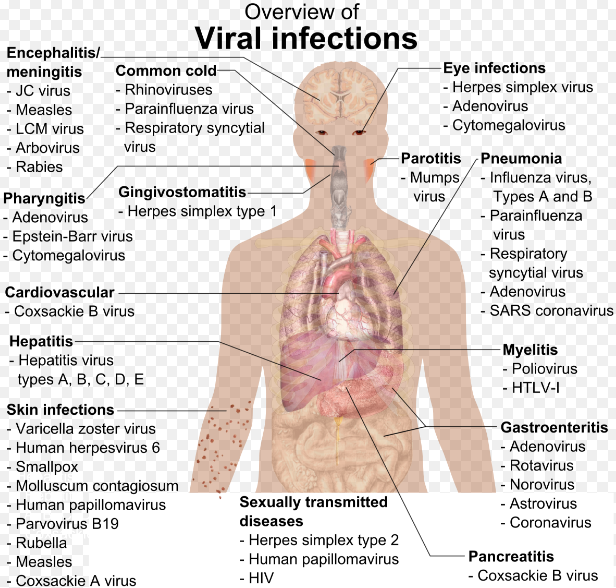
We are inundated with a variety of news from a large amount of sources everyday.  How do we make use of such information?  How do we verify the deluge of information?  In keeping with the tradition of educating the public on how scientists view various events portrayed in the media along with life in general (i.e. how do scientists think), a new piece of useful information has surfaced for readers to mull over.  Scientists compare the misinformation in the news cycle to a viral infection.


In a past issue (December of 2017) of 'Science' magazine the following "letters" were sent into the Journal.  The "letters" section is composed of chosen comments sent in by readers regarding earlier commentary/reporting from the science community which was published in an earlier issue.  In the particular issue mentioned in the comments section -- there were a couple articles about the circulation of 'misinformation' in the mainstream news.  The scientists drew parallels to the inoculation against an infection in biology:


The unprecedented spread of misinformation threatens citizens' ability to form evidence-based opinions on issues of societal importance, including public health, climate change, and national security. In his Editorial “Nip misinformation in the bud” (27 October, p. 427), R. Weiss argues that fact checking after misinformation has spread is often ineffective. Decades of research in cognitive science (1) have buttressed this concern by establishing the robust “continued influence effect”: Post-publication retractions and corrections often fail to eliminate the influence of misinformation. In some cases, they reinforce falsehoods simply by repeating them. The more exposure people have to a falsehood, the more truth-value they ascribe to it (2). The networked nature of online media enables misinformation to spread rapidly, much like a viral contagion (3). Accordingly, Weiss calls for a solution in which scientific facts reach the public before misinformation has a chance to spread and take hold.
A growing body of research suggests that this may be possible, but it must be done preemptively. This process of “inoculation” adheres to a biological analogy: Just as injections containing a weakened strain of a virus trigger antibodies in the immune system to help confer resistance against future infection, the same can be achieved with information. Recent studies find that misinformation can be used against itself: By preemptively warning people against misleading tactics and by exposing people to a weakened version of the misinformation, cognitive resistance can be conferred against a range of falsehoods in diverse domains such as climate change (4, 5), public health (6), and emerging technologies (7). In the battle against misinformation, it is better to prevent than cure. The benefit of inoculation is that it can spread, too, online and through word-of-mouth (8). News outlets and the public can help inoculate each other to achieve societal immunity against misinformation.


The concept of preemptively warning people will work in theory.  In fact, depending on the culture from which the person is from, preemptive action might work more effectively.  Different countries have different models of regulatory procedures - for instance - which make such actions work in much different ways.


Here in the United States, the regulatory system appears to be at the moment more of a 'reactionary' system rather than a 'proactive' system.  Which means that preemptive measures do not necessarily work very effectively.  That is, of course, not to say that in our country every resident believes this to be true.  There will be a sizable percentage on which preemptive knowledge might work quite well on informing.  Although, over the range of the entire population, this kind of warning appears not to work as well as in other countries.  Why?  I have no idea at the moment.


As an example, take the recent attempt by the White House (and government agencies) to cover up a health report on the potential dangers of the class of chemicals known as perfuorinated chemicals.  Recently, I wrote a blog post on the cover up.  Then I followed the initial blog post up with an update to the initial introduction of terrible news.  On top of the breaking news, during a supposed conference held to discuss solutions, the Environmental Protection Agency (EPA) staff attempted to throw journalists out of the conference.  The agency's actions were an obvious attempt at covering up important news.


The terrible aspect of the news is that there are inherent dangers associated with the class of chemicals -- which are well known.  This is a blatant example of a reactionary system.   Why not put in place measures to replace this class of compounds with another class of chemicals which are less harsh on humans along with the environment?  Another related 'reactionary' measure instituted in the United States is the Chemical Safety Board.  The Chemical Safety Board is charged with investigating the aftermaths of tragedies (chemical hazardous spills, fires, accidents, etc.).  Why not have a 'proactive' system in place?  Currently, the fate of the Chemical Safety Board is in jeopardy -- read about that here.


The regulatory system in other countries -- say Britain for example -- is built on the 'preemptive' system.  Instead of 'reacting' to a given tragedy, the British will put in place laws and regulation -- voted on by parliament - which are 'proactive' in nature rather than 'reactive'.  Therefore, a 'preemptive' strike would work quite well over in that part of the world.  Why there is such a large difference in different parts of the world is beyond my understanding at this time.  If you (the reader) has any inputs (ideas) on this difference, please feel free to contribute in the comments section below.


Conclusion...


The United States is made up of a regulatory system which is 'reactive' in nature rather than 'proactive'.  I would love to see the system change in the near future.  How to change the system exactly I do not have the solid idea?  Although, any change in the United States definitely has to build from the ground up through voting/speaking out to our respective political representatives who make/create law/regulations on our behalf.   Additionally, a better informed society is willing to take a risk and become 'proactive'.  That is not to say that we are a nation of 'dummies'.  I believe that each of us could educate ourselves on a range of matters which in turn would create a better country - that might resemble a proactive rather than a reactive system.


Of course, in order to do so takes time and effort on each of our parts.  What have you done to make the world a better place?  What steps are you taking to help inoculate the public against 'fake news'?  Rather than spend your time upset, take action to reduce the spread of fake news.  Here on this site, I try to bring to light news about issues in hope of communicating the importance of understanding the issue.  At least to provide a platform from which the reader (you) can further investigate the matter in greater depth.  The path is yours to pursue to educate yourself and others.  Inoculate yourself by educating yourself.


Related Blog Posts:


Chemical Safety Board's Future Uncertain as Hurricane Season Approaches


How Dangerous Are Cigarettes?


Thoughts: What Does National Institute of Health Director Francis Collins get asked in front of Congress?


Update: EPA Throws Journalists Out Of PFAS Conference - Why?


Update: Congress asks Federal Agencies about Dangerous Chemicals -- PFOA and PFOS


Congress Asks Defense Department and Environmental Protection Agency about Dangerous Chemicals


Saturday, June 2, 2018

Chemical Safety Board's Future Uncertain as Hurricane Season Approaches


Storms are inevitable in the world.  How various countries and nations prepare for them is a unique trait.  Here in the United States the main agency is Federal Emergency Management Agency (FEMA).  The United States is a 'reactionary' nation rather than a 'proactive' nation.  Instead of preparing for a disaster, the disaster occurs and then an evaluation happens after which a political sparring match occurs and finally funding arrives.  Yes, I am being negative.


On top of all of that negativity is that there are dangers posed by corporations which have chemicals that need to be regulated and inspected before a storm occurs.  That agency is is the Environmental Protection Agency which has been lacking to say the least.  Therefore, the 'reactionary' method will employ the Chemical Safety Board.   Recently, the head of which has resigned leaving the direction uncertain -- which is not good -- while entering storm season.


Chemical Safety Board


In order to understand the importance of the Chemical Safety Board, here is a short introduction from Wikipedia:


The U.S. Chemical Safety and Hazard Investigation Board, generally referred to[1] as the Chemical Safety Board or CSB, is an independent U.S. federal agency charged with investigating industrial chemical accidents. Headquartered in Washington, D.C., the agency's board members are appointed by the president and confirmed by the United States Senate. The CSB conducts root cause investigations of chemical accidents at fixed industrial facilities.[2] 
The U.S. Chemical Safety Board is authorized by the Clean Air Act Amendments of 1990 and became operational in January 1998. The Senate legislative history states: "The principal role of the new chemical safety board is to investigate accidents to determine the conditions and circumstances which led up to the event and to identify the cause or causes so that similar events might be prevented." Congress gave the CSB a unique statutory mission and provided in law that no other agency or executive branch official may direct the activities of the Board. Following the successful model of the National Transportation Safety Board and the Department of Transportation, Congress directed that the CSB's investigative function be completely independent of the rulemaking, inspection, and enforcement authorities of the Environmental Protection Agency and Occupational Safety and Health Administration. Congress recognized that Board investigations would identify chemical hazards that were not addressed by those agencies.[3]


As I mentioned above, the Chemical Safety Board is a 'reactionary' step in the process of solving problems.  The Environmental Protection Agency is charged with implementing regulations for keeping safe track (including storage) of chemicals used in industry.  Although, over the last year and a half, EPA director Scott Pruitt has carried out 'historical' cuts as discussed in a previous post on this site.  The dismissals at the EPA has put the safety of the citizens of this nation at greater risk due to the inability to regulate industries and their safe keeping of chemicals along with dangerous practices in the pursuit of saving money for shareholders.  This should be concerning.


Now, according to recent reporting by Politico Energy, heading into hurricane season (or storm season), the nation is in greater danger as shown below:


CSB FAULTS HURRICANE PREP AT CHEMICAL PLANTS: The U.S. Chemical Safety Board said Thursday that chemical plants need to better prepare for hurricanes and potential floods after releasing findings from its investigation into an explosion at the Arkema chemical plant during Hurricane Harvey last summer. "Our investigation found that there is a significant lack of guidance in planning for flooding or other severe weather events," CSB Chairperson Vanessa Allen Sutherland said. "... As we prepare for this year's hurricane season, it is critical that industry better understand the safety hazards posed by extreme weather events."
— Speaking of hurricane season: This year's hurricane season is not expected to be quite as bad as last year, Pro's Ben Lefebvre reports. NOAA forecast a 75 percent chance that this year's hurricane season will be at-or-above normal levels for major storms. The likelihood is that 10-16 named storms will form, with up to four of those liable to become major hurricanes. Read more.


That reporting was over a week ago.  Last Tuesday, reporting from "The Scientist" followed up with more bad news regarding the last safety net -- Chemical Safety Board:


Vanessa Allen Sutherland will resign next month as chair of the US Chemical Safety & Hazard Investigation Board. With the vacancy, the board will drop to having only three members—two short of the standard five, C&EN reported earlier this week (May 22).
“The remaining board members will be required to vote on an interim executive, unless and until the White House nominates and the Senate confirms a new Chairperson,” the board, usually referred to as the Chemical Safety Board (CSB), says in a statement. However, that nomination is in doubt, C&EN notes, as the Trump administration has twice tried to shut down the CSB altogether.


This is not great news for the fate of the Chemical Safety Board.  Especially, heading into hurricane season.  The Chemical Safety Board is an agency which each of us should watch closely since the fate of the organization directly impacts our well-being.  Below, a video and excerpt will serve as evidence of the importance of the last chance (reactionary) organization for ensuring safety among industries.


Hurricane Season Approaches


Hurricane season is upon us according to some accounts.  The question naturally arise as to whether we (as a nation) have improved our disaster preparedness from last Hurricane Season -- when Hurricane Harvey, Hurricane Irma, and Hurricane Maria ripped through some states.  According to Politico Energy, Hurricane season is not going to go well for FEMA as shown below:


THE STORY OF THE HURRICANES: With just days until the June 1st start to hurricane season, a POLITICO investigation into FEMA found numerous low-income families were denied funding from the agency because they lived within a flood zone and failed to carry flood insurance — a legal requirement that many of them were unaware of.

POLITICO’s Danny Vinik reports this morning from Texas’ Kashmere Gardens — a historically African-American neighborhood in Houston that is still trying to recover from Hurricane Harvey — and the hodgepodge of programs that help middle-class neighborhoods bounce back, but leave many poor and minority areas behind. He found that many families struggle with language issues and are inexperienced in dealing with the federal bureaucracy, leaving them to navigate a system that even FEMA officials agree is overly complicated.

And while more federal money is on the way to Texas, it may take a year or more after Harvey struck to reach communities like Kashmere Gardens, which are desperately trying to rebuild, Danny writes. Yet, the problems in Houston aren’t surprising to FEMA experts and others familiar with the complicated quilt of programs designed to help those in need of disaster assistance. “This is a recurring and systemic problem that we find with the delivery of federal recovery dollars,” said Fred Tombar, the senior adviser for disaster recovery at the Department of Housing and Urban Development from 2009 to 2013. Read more here.

AND IN PUERTO RICO: The mayor of one of the island's largest cities worried about the upcoming storm season and how another hit to its fragile power grid could throw the U.S. territory back into the dark. “I’m afraid we are not prepared to receive another [hurricane],” Ponce Mayor Maria MelĂ©ndez told Pro’s David Beavers during a visit to Washington last week. “The electricity system will fall down again if we don’t manage it more rapidly.” Read that story here.


Hurricane Harvey ripped through the Houston area to produce massive problems for the area.  People have the impression that the area has recovered completely - which is anything but the truth.  Although, even during a good economic time in Houston, problems were widespread within the real estate industry.  News accounts after the devastation caused by Hurricane Harvey detailed house buyers experience and the added costs of 'flood insurance.'  Here is the page (index) for the coverage of Hurricane Harvey by NPR.


On top of the damage done to the housing sector was damage done to the corporations.  In particular, a chemical corporation by the name of Arkama in Houston suffered catastrophic losses due to chemicals which were destroyed while being stored in unstable conditions.  This resulted in a giant explosion and the release of toxic chemicals into the air for the residents of the surrounding community to suffer health problems from breathing the air in their houses and communities.  The chemical Safety Board was charged to carry out an investigation.  Here is a 13 minute video produced to explain the findings of the investigation of Arkama in Houston (Texas):


Wow.  The video above drives home the importance of the Chemical Safety Board.  Investigating a disaster after the occurrence is super important for the prevention of future disasters.  If the government is short on resources, then who is going to investigate the problem?  Furthermore, who is going to make recommendations on future practices which can be funded by Congress and passed on to regulatory agencies for future prevention of such disasters?


The importance of chemical safety regulation cannot be overstated.  Chemical safety is saddled on each of us.  Which sounds rather discouraging.  Although, the safety of the public is at risk.  Therefore, if you encounter a dangerous situation in any industry which handles chemicals, say something.  Here is a minute long video which demonstrates the simplicity of chemical safety:


Chemical safety impacts all of us at some fundamental level.


Conclusion...


The uncertainty surrounding the Chemical Safety Board should be unsettling to each of us.  Any attempt to dismantle this extremely important organization is a threat to each of us.  Therefore, the status of the organization is important to track.  If the government attempts to shut this down, as the public, we should ensure that there is an equivalent resource in place to investigate disasters and generate future reports on prevention of future disasters.


Related Blog Posts:


Ralph Nader: Has Corruption Become Institutionalized?


Hurricane Harvey Drops Enough Rain On Houston To Fill 560 Dallas Cowboy Stadiums


Puerto Rico Crops Devastated By Hurricane Maria


Democrats Question EPA Adminstrator Scott Pruitt On Historical Job Cuts At EPA


Environmental Groups Question Environmental Protection Agency (EPA) Cuts


What Does An Official Letter From The White House Requesting Funds For Hurricane Harvey Look Like?


Wasteful Water Use Tied To 'Education and Poverty' - Really?


Dimensional Analysis Of Statistics And Large Numbers - Index Of Blog Posts


Science Topics, Thoughts, and Parameters Regarding Science, Politics, And The Environment!