Sunday, September 9, 2018

How many Olympic size swimming pools per day would be filled with 890,000 barrels of oil?


With the number of proposed pipelines throughout North America extending down into the United States, there has been additional concerns about the potential adverse impact on the environment (in the event of a oil spill).  One such example is the expansion of a pipeline in Canada.  According to an article in 'Yale Environment 360' titled "For Marine Life, New Threats from a Fast-Tracked Canadian Pipeline" the recent proposed expansion will more than double the daily capacity of oil moving through the pipeline:


Nearly everyone involved in the controversy over Canada’s troubled Trans Mountain Pipeline was surprised when Prime Minister Justin Trudeau announced in May that his government would take over the construction from a private company to ensure that additional tar sands crude oil can move from northern Alberta to a port in British Columbia.
The 715-mile Trans Mountain pipeline expansion would add a parallel pipeline to an existing one, increasing the route’s capacity from 300,000 to 890,000 barrels per day and helping producers sell crude and refined oil to Asian markets. Trudeau’s action means that a pipeline many thought might never be built is now on a fast track to completion by 2020. Construction is scheduled to begin this month.


Wow. Adding an additional pipeline would increase the amount per day by nearly tripling the current amount.  In order to understand (comprehend) the potential for disaster -- in the case of an oil spill -- the analysis carried out below will shed light onto the new daily amount of oil to be moved through both pipelines.


How Large Is An Olympic Size Pool?


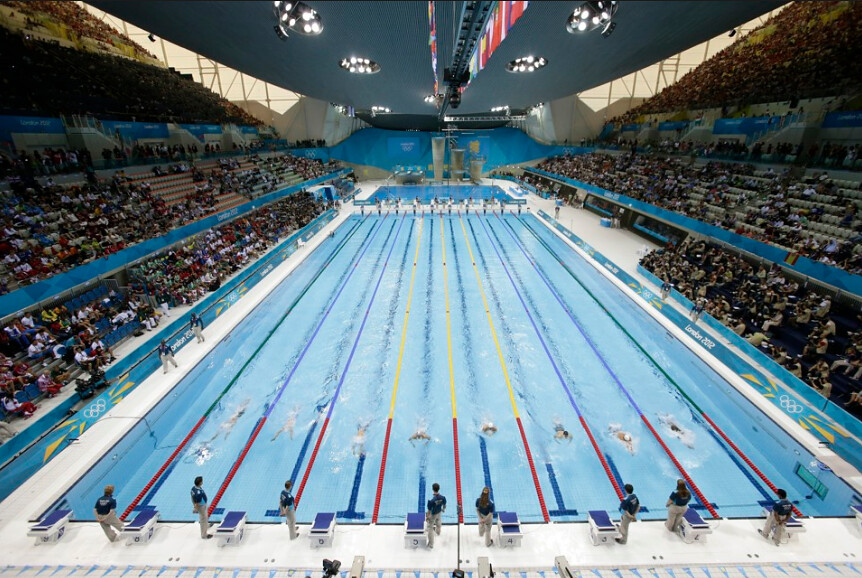
A metric which is commonly used on this blog site in order to cast or shed light onto large (enormous) numbers is an Olympic size swimming pool.   The picture at the beginning of the blog post above is that of an official Olympic size swimming pool.   In order to determine the volume of water that is needed to fill such a large pool, a search engine (i.e. Google) can be consulted with the following question: How many gallons are in an Olympic swimming pool?  The answer is shown below:
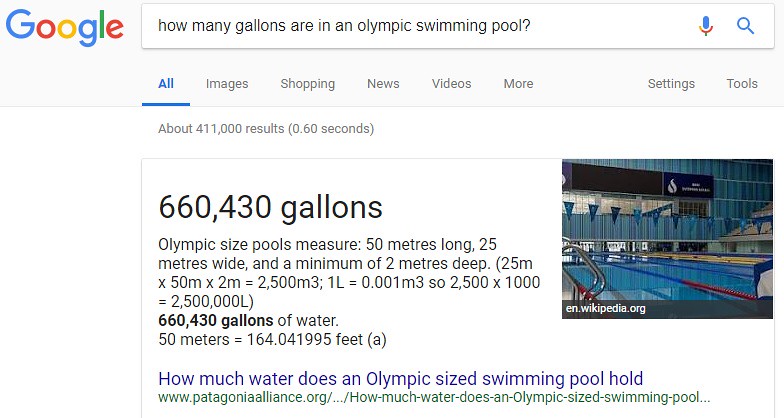


In a typical Olympic size swimming pool, there are 660,430 gallons of water.  Compared to an average pool (however that is defined?) the ranges of volumes (in gallons) range from 12,000 gallons to over 30,000 gallons.  Still, these are small compared to an Olympic size swimming pool.  Which also translates to the enormous volume in question in the blog post.


Now that the volume of an Olympic size swimming pool is known, the analysis can be carried out to determine the number of Olympic size swimming pools would be filled per day with a flow rate of 890,000 barrels of oil.


How Many Swimming Pools/Day?


To start an analysis of comparing volumes or flow rates, the initial (and very important) step is to determine the 'units' of measurement in which each value is presented at the beginning of the article.  The author above stated the flow rate of oil per day in the units of 'barrel per day' -- specifically 890,000 barrels per day of oil. 


The issue at hand is that a direct comparison of flow rate over time [(890,000 barrel/day) x (1 day) = 890,000 barrels (i.e. volume)].  Therefore, in order to compare the total amount of oil to the volume (a metric) of an Olympic size swimming pool, the volumes must be expressed in the same units -- i.e. 'gallon'.  In order to determine the amount of gallons in a barrel, we consult 'Google' again with the following question: How many gallons of oil in a barrel?  The answer is shown below:
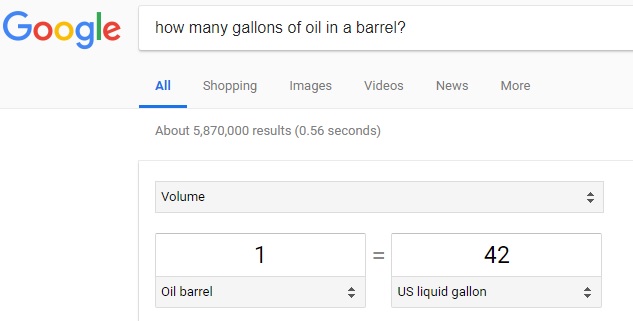


Now that both values are expressed in units of 'gallon', the total amount of oil which will flow per day with the current expansion (addition of a new pipeline) is shown below:



Notice that the flow rate is expressed in units of 'gallon' -- the same as a swimming pool.  The final step is to divide the flow rate by the volume of the swimming pool:



The answer indicates that with a flow rate of oil per day through an oil pipeline of 890,000 barrels per day, a total of 56 Olympic size swimming pools could be filled.   This is over a 24 hour period.  That would be the total amount of oil which would spill into the environment surrounding a break in the pipelines. 


Conclusion...


The analysis above indicates that over a 24 hour period, a total of 890,000 barrels of oil transported through the 715 mile pipeline would be equivalent to filling up 56 Olympic size swimming pools.  Which is also 37,380,000 gallons per day.  That is no small number.  Which makes the concern of environmental groups worth entertaining since the fall out of an oil spill would be not be trivial.


Related Blog Posts:


Reader Question: How far would 291 billion Goodyear Blimps reach end to end?


With 29 Trillion Cubic Feet of Natural Gas, How Many GoodYear Blimps Could Be filled?


Dimensional Analysis Of Statistics And Large Numbers - Index Of Blog Posts


What is dimensional analysis?


How many trash carts can be filled with 80 billion pounds of trash?


How many people would be killed if 1,485 pounds of Fentanyl were distributed onto the streets in the U.S.?


Was The Recent Oil Spill in China The Largest In History?


LimeBike Dockless Bikeshare Riders Travel A Distance Of 13,000 Miles In Just Over 3 Weeks?


How Many Cigarettes Can You Roll With 18,000 Pounds Of Marijuana?


How Many Turkey's Are Served On Thanksgiving Day? How Many People Served?


How Much Trash Would Be Required To Fill The Great Wall Of China?


How Many Birds Per Minute Can Be Processed On A Single Line At A Poultry Processing Plant?


Hurricane Harvey Drops Enough Rain On Houston To Fill 560 Dallas Cowboy Stadiums


If Technology Fails, Use Basic Math Skills - Count Manually!!


How Much Water Is Contained In All Oceans Around The Globe?


Thursday, September 6, 2018

Thoughts: Pause before reacting to news regarding 'Proposed Changes' to EPA and other Federal Agencies


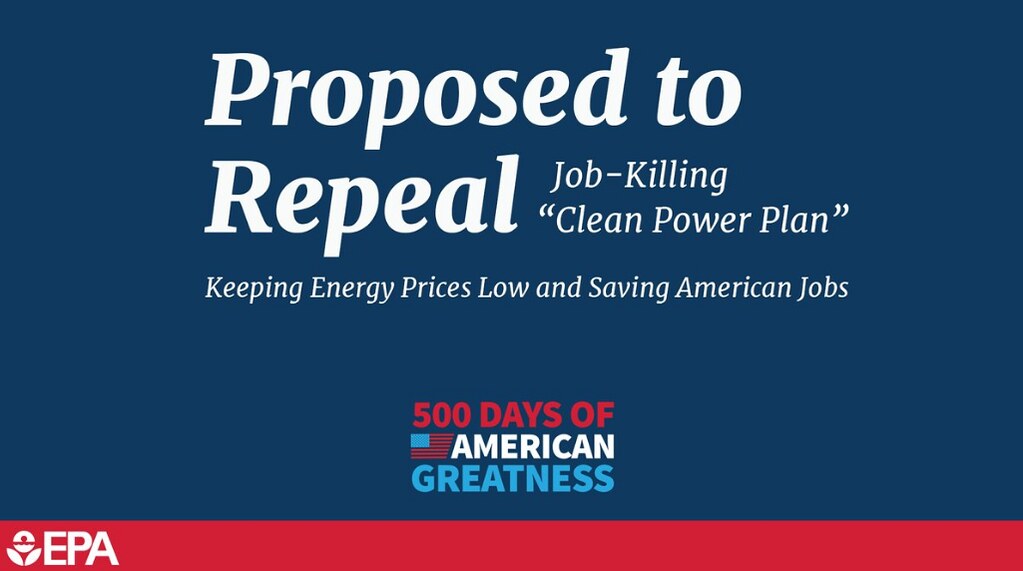
Source: EPA (Twitter)


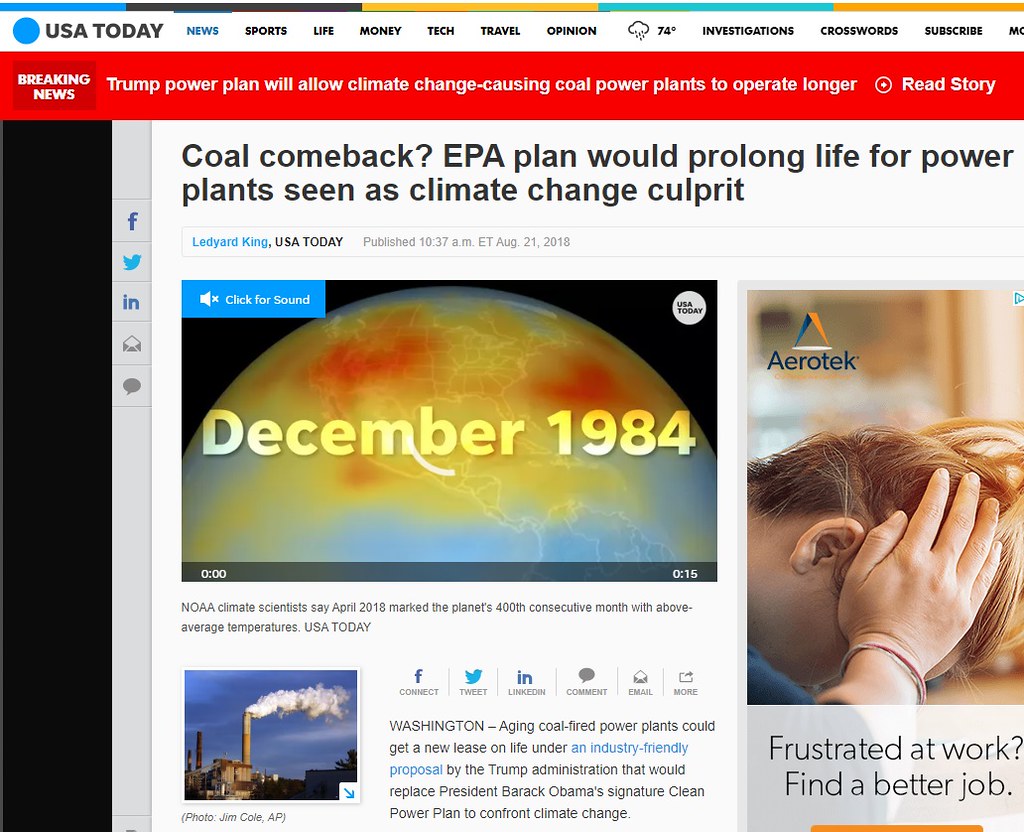
One model of the popular news is based on 'fear' -- propagating/inciting fear -- to get the most 'eyeballs' on a given story.  The thought is to produce news which is extremely controversial in nature and install fear into the story, while receiving the most 'eyeballs' from a given audience.  Don't forget to run ads on the sides of the articles to generate revenue.  Each of us react differently to news.  Take for instance the headline shown below of a recent news article from USA Today shown below:


Source: USA Today


Regardless of the degree of reaction (negative/positive), each of us would be well served to take a pause and consider the degree of threat each story poses to our daily life/safety or to our environment.   In the blog post below, I offer a video in which a former Administrator of the Environmental Protection Agency offers an opinion on the degree of truth behind news bites regarding 'Proposed' changes by either a federal agency (EPA, FDA, USDA, CDC, etc.) or a presidential administration (such as President Trump's administration currently).


Repeal or Not Repeal?


The news is good at producing eye-catching headlines like the one displayed above.  Further, at first sight the headline implies that the 'proposal' to 'repeal' or 'make changes' is absolute and without question.  In previous blog posts on this site, this is not the case at the outset.  More complications come into play when changing or repealing a law which has been enacted.  I came to the understanding of this reality last year while listening to a series of online webinars from the American Association of the Advancement of Science(AAAS).  The Facebook page for the AAAS has a series of webinars which can be viewed on demand.


Dr. Rush Holt, the current CEO of AAAS engaged in a discussion in which he described the reality of repealing or changing a current law enacted by a federal agency or congress -- which was extremely informative.  But why should we be listening to Dr. Rush Holt -- the CEO of AAAS?  The reason is that prior to a career spent in research at Princeton University, Dr. Rush Holt (who is a physicist) served as a U.S Representative for New Jersey's 12th congressional District from 1999 to 2015.  During his tenure in congress, Dr. Holt learned a tremendous amount regarding the processes which turn the wheels moving the country forward on a day to day basis.  Therefore, when Dr. Holt says that laws are in place which can only be replaced by laws which are "better" for the environment -- then I tend to believe him.


Although, what if people (readers) choose not to believe him.  Fair enough.  You may choose to believe the next source I have to provide.  Below is a video of a recent interview between veteran reporter Stephanie Ruhle and former EPA Administrator Christine


Wow.


In the video above, former EPA Administrator Christine Whitman points out the overall complications with the previous EPA Administrator - Scott Pruitt.  Namely, that on a day to day basis, Administrator Pruitt would announce publicly that he was going to 'repeal back an Obama administration regulation'.  Although, as pointed out by former congressman Rush Holt above, that statement is usually followed by legal action -- especially, if the new guidelines put the nation at greater risk of environmental damage.


Remember, to repeal or replace a regulation, the new proposed regulation cannot due more damage to the environment than the previous (or replaced) regulation did.


Additionally, former EPA Administrator Christine Whitman points out that the overall approach to changing (repealing or modifying) an existing regulation has to be done by the following approach: "This is why we think that the existing regulation is bad for the environment and here is the study to back up this assertion" -- along that avenue of reasoning.  Otherwise, the regulation will not be changed at all.


Example-Court Rules against Electric Companies?


Yes, the headline is written correctly.  For all of the news of 'roll-backs' or 'repeals' happening in the Trump Administration, the reality is the opposite.  An example is a lawsuit just ruled against by a panel of judges in Massachusetts.  Here is the news brief from 'Politico Energy' sent yesterday morning via e-mail to subscribers:


COURT SAYS MASSACHUSETTS CARBON CAP APPLIES TO UTILITIES: Massachusetts' top court on Tuesday ruled that electric utilities are indeed subject to the state's major climate change law, including a shrinking cap on carbon emissions imposed last year following an order from Republican Gov. Charlie Baker. The New England Power Generators Association and GenOn argued that the cap cannot apply to the electric sector because it is already regulated under another part of the state law. But the seven-member Massachusetts Supreme Judicial Court ruled that the two parts of the law "complement each other," adding: "Given that the electric sector is one of the largest in-state greenhouse gas emission sources, it would make little to no sense for the Legislature to have excluded it from the critical emission reduction requirements."


The case did not meet the criteria for a reversal or repeal on the ban.  Why would it?  As former EPA Administrator points out correctly, a large percentage of large (huge) corporations are actually falling in line with new environmental regulations (even those set in place by the Obama Administration).   Only the 'outliers' who are in jeopardy from not keeping up with the changing (sustainable) measures are crying out and lobbying the Trump Administration.  Which is attempting to 'roll back' or 'repeal' to protect these dying companies.


In fact, a critical statement made in the video above is that the 'route' or 'method' taken by the Trump Administration is not correct and often fails in courts (i.e. a legal battle) - which is not surprising. I have been saying all along over the past two years that the greatest threat to the Trump Administration is the lack toward attention to detail.  Which specific departments like the State Department and other federal agencies can greatly assist in creating legislation which will actually challenge existing regulations.  Although, the change has to be grounded in 'sound science'.


Speaking of regulations and emissions, in the same e-mail sent yesterday by Politico Energy, a short poll was taken on emission standards and pollution linked to higher adverse health incidences.  Here is the excerpt as reported by the journalist shown below:


HOW ACE IS PLAYING OUT: EPA's own estimates on its proposed Affordable Clean Energy plan to regulate carbon dioxide emissions from power plants is turning off voters, a new POLITICO/Morning Consult poll found. When asked whether EPA "estimates that the proposal could, in some scenarios, increase annual premature deaths from certain particulate emissions by up to 1,400 by 2030" would make voters more or less likely to support the plan, 30 percent of respondents said it would make them "much more likely to oppose" the plan. Fifteen percent said it would make them "somewhat more likely" to oppose the ACE plan, while 9 percent and 13 percent said it would make them "much more likely to support" or "somewhat more likely to support" the plan, respectively.

Asked a similar question about agency estimates that the proposal could reduce 2030 carbon dioxide emissions by as much as 1.5 percent from projected levels without the existing Clean Power Plan, 15 percent of voters said that knowledge would make them either "somewhat more" or "much more" likely to oppose the plan, while 45 percent said the opposite. The poll was conducted Aug. 28-31, with a margin of error of plus or minus 2 percentage points. It surveyed 1,964 registered voters.


Not surprising to say the least.


Conclusion...


The overall approach by the Trump Administration has met considerable opposition in courts.  Which is not surprising given the lack of evidence to support such repeals.  If the science was questionable, then a reasonable argument could be made.  But as I mentioned above and in previous blog posts which can be found here, the efforts have been largely unsuccessful -- especially since large corporations are already moving toward investing in sustainable energy technology Shell announced earlier this year such efforts.  Still, the Trump Administration chooses to argue with congress over science which is settled.


The world is composed of many parts moving at varying speeds.  Different nations move at different speeds with regard toward implementing more sustainable policies at various levels within their respective government.  The United States is one nation moving forward -- not necessarily leading the sustainability future.  Although, over the past few years, investments into a more sustainable world have been made and are continuing to be realized.  We should be investing in a green future.  With that being said, the next time that news is aired which is counter toward forward progress, take pause and think about the probability of the adverse impact actually becoming a reality.  There are certain steps in place in congress to ensure that forward progress is inevitable. That is where we should spend our focus and energy on.


Related Blog Posts:


EPA Estimates Of Methane - GHG - are off by 60%


French President Macron Organizes Climate Conference With Pledges Of Trillions Of Dollars For Climate Risk Management From World Organizations


Conservatives are calling on President Trump to fire EPA Administrator Scott Pruitt over Renewable Fuel Standards


Parameters: Oil vs. Corn based Ethanol - A Tug-Of-War between Trump Administration and Congressional Leaders


Parameters: Shells Oil Corporation Invests In Renewable Energy Infrastructure


Thoughts: Trump Administration Realizes Renewable Energy Is Here To Stay?


Do You Need Clean Air To Breathe? An Introduction To Environmental Justice


Environmental Entrepreneurs Weigh In On Repealing The Clean Power Plan


EPA Blatantly Suppresses Scientific Results Regarding Climate Change?


EPA Director Finally Realizes Reality Of Trying To Roll-Back Obama Era Clean Air Act Regulation


How Can The Paris Climate Agreement Be "More Favorable To The U.S."???


Paris Climate Agreement Is A Start Toward The Renewable Energy Future


Iraq Has Enough Oil To Support The World For 4 Years -- What?


Is 94 Million Barrels Of Oil A Large Amount? That Is The Global Daily Demand!


What Promises Did President Trump Make Science Research During His Campaign?


READ THIS BEFORE VOTING -- Presidential Science (WORLD) Issues!


Monday, September 3, 2018

Parameters: Why eating sugar or carbohydrates before bed is a bad idea?


Have you ever been awakened during the night to use the restroom?  How about after eating near bedtime?  How about eating/drinking sugary foods/liquids near bedtime?  Why do I even ask such questions?  The answer lies in my own disorder (or disease) -- Gastroesophageal Reflux Disorder (GERD).  In the blog post below, I will highlight new findings which might affect your sleep and be related to what you eat/drink before bedtime.


"Do not eat before bedtime"


Have you ever been told that you should eat at least 3-4 hours before bed?  Why?  Do you wake up with a burning sensation in your throat around 4 hours after going to sleep?  If you do and eat/drink sugary foods/liquids before bed, there is a reason why this is the case.


In a recent news brief by "Military Health System" titled "Healthy sleep for healing" certain factors were highlighted that negatively impacted the sleep of soldiers in the military.  Obviously, each of us need good sleep to feel rested and let our body heal throughout the night.  Though, for people like myself, that is not always possible with GERD.  I am not alone as it turns out.  Many other factors contribute to disruptive sleep which is necessary for healing the body.  Which means, my body might not be receiving the optimal amount of sleep necessary for repairing the damage I inflict during my waking hours.  What can I do?


For me, I take medication.  Additionally, I have found out that I cannot (or should not) eat any sugar or carbohydrate-rich food right before bedtime.  In fact, for me, eating any item might produce problems 3-4 hours later.  Waking up coughing -- due to GERD.  For years, I did not understand what caused this.  I would wake up systematically at 3-4 hours after sleep.  I do like to eat a small dessert (hostess cupcake) before sleeping.  Turns out that was part of the issue.


From the news article introduced above, the same problems occur for people who use beer or wine as a sleep sedative before bed.  For years, I drank and had the same problem.  Turns out, after not drinking for the last 5.5 years, I now find out the culprit.   In the article, a brief excerpt shown below explains the occurrence in short:


“The number one nonprescription drug people are taking to help them get to sleep at night is a beer or a glass of wine, or other kinds of alcohol,” said Dr. Julie Kinn, research psychologist at DHA. “But then, you’re putting a lot of sugar into your body, you’re going to metabolize it in a few hours and need to get up and go to the bathroom, and then you’re going to be wide awake. Plus drinking alcohol doesn’t help you learn other good ways of getting to sleep like meditating, purposefully relaxing or turning of all your screens, etc.”


I realize that the discussion in the article is centered around soldiers use of various sleep sedatives to attain a healthy night's sleep.  Further, I realize that the main take home message of the article is to find other -- i.e. healthy ways -- of encouraging our body's to have a restful night's sleep: meditation, yoga, exercise, etc.  Although, what I did not realize that for years, I would wake up in the middle of the night due to the sugar which had been metabolized from two sources: alcohol and sugary foods.


Conclusion...


Over the last few years, I have independently come to the same conclusion as the article above.  First, I stopped drinking which eliminated one possible source of sugar which would wake me up.  Next, I reduced the amount of foods (with sugar) which I eat late at night.  As a result, I have had less incidences of late night disruptions due surges of sugar hitting my bloodstream after being metabolized.  Which is great for someone like me who has gastric reflux disorder which is genetically inherited.  Still, exercising along with meditation and yoga can also provide numerous benefits in stress reduction which will lead to better sleep too.  The body's inner workings are complicated and often hard to untangle from one another.  Although, clearly, late night eating has been associated with gastric reflux.  The question which has been answered by the information above was why eating sugar or drinking alcohol before bed was a bad idea.  Knowledge is power and this knowledge is useful to people such as myself.


Friday, August 31, 2018

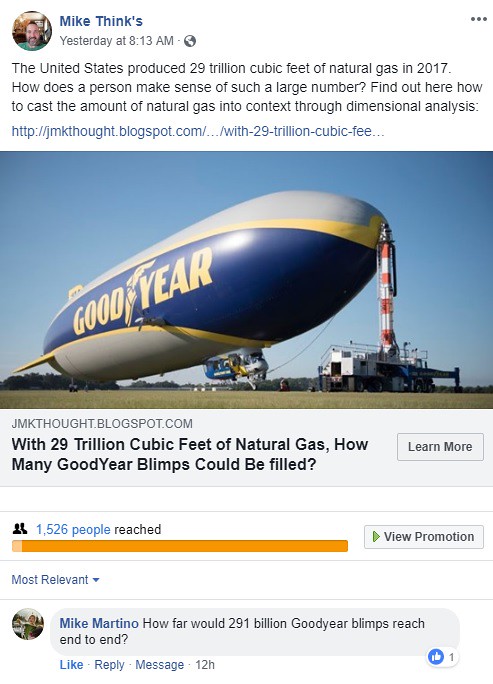
Reader Question: How far would 291 billion Goodyear Blimps reach end to end?


Recently, I had a reader respond on Facebook to a blog post titled: With 29 Trillion Cubic Feet of Natural Gas, How Many GoodYear Blimps Could Be filled? as shown below:


According to the image above, the reader asks the following question: How far would 291 billion Goodyear Blimps reach end to end?   In the blog post below, the answer will be revealed in comparison to three distances:


1) Would the distance be enough to travel around planet Earth?  

2) Would the distance reach from the Earth to the Moon?

3) Would the distance reach from the Earth to Mars?


The answers are outlined and solutions shown below.  Enjoy!


Line up 291 billion Goodyear blimps


In order to start the analysis above up, we need to refer to the 'data' page for the Goodyear Blimps which I provided from the last post -- which can be found here.  If the overall length is searched for on the web page, the answer is the length of a Goodyear Blimp is 264.4 feet long or 81% of the length of a football field.  Wow!  That is shown below:


With this number representing a single blimp, the total distance asked by the reader above can be found by simply multiplying two values together.  The first is the total amount of Goodyear Blimps by the length of a single Blimp (the second value) as shown below:


Obviously, the resulting distance is very long considering that a single blimp is around 80% of the length of a football field.  That is, the total length expressed in units of 'feet' is 71,300,000,000,000-feet.  Or 71.3 trillion feet long.  For distances that are expressed in units of feet that are so enormous, converting the unit into a larger unit (say a mile) makes sense for dimensional analysis.  Especially when the metric will most likely be expressed in units of 'mile'.


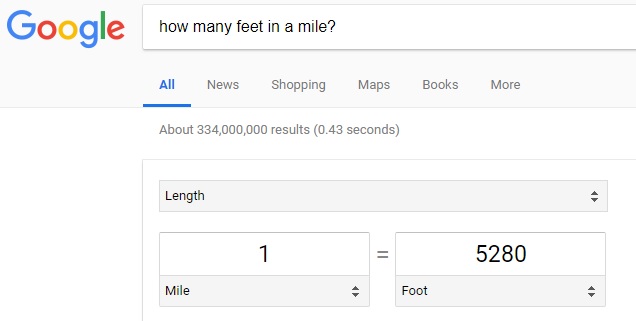
To do so, we need to know the amount of feet which are in a mile.  The answer can be found by asking a search engine like 'Google.com' the following question: How many feet are in a mile?  The answer is shown below:


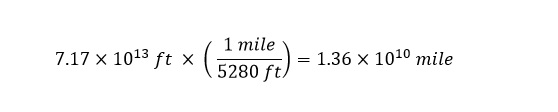
The answer indicates that for every mile, there are 5,280 feet.  With that conversion value in mind, the following unit conversion from feet to miles can be accomplished as shown below:


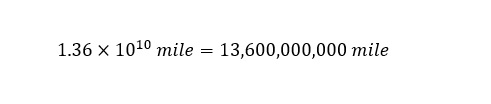
The number of total miles which would be reached if 291 billion Goodyear Blimps were lined up end to end would be around 13.6 billion miles in total distance.  That number is shown below:


The only remaining question is how to make sense of such a large number?  What is an appropriate metric to use for comparison?  How about if we choose the following three distances:


1) Trips around planet Earth

2) Trips from planet Earth to the Moon

3) Trips from planet Earth to the planet Mars


Lets see how these distances compare to 13.6 billion miles.


1) Trips around planet Earth:


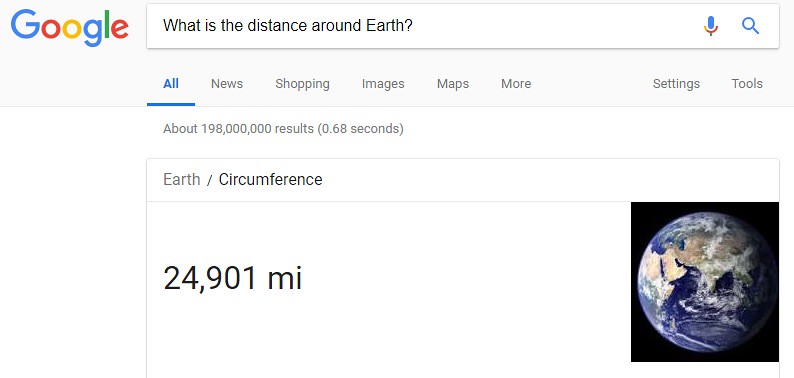
To find out how 13.6 billion miles compares to the number of possible trips around Earth, the circumference of Earth needs to be known.  The fastest way to obtain the circumference is to ask Google the following question:  What is the distance around Earth?   The answer is shown below:


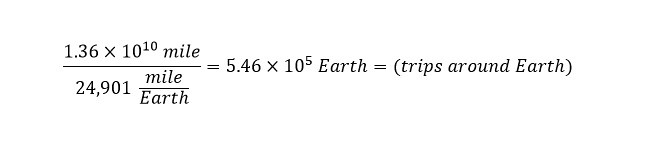
Once we have an answer -- which is 24,901 miles around Earth, a quick inspection is performed to make sure units of measurement are the same.  Yes, both values, 13.6 billion miles and 24,901 miles are both expressed in units of 'mile'.  Therefore, dividing the total number of miles which equates to lining up end to end 291 Goodyear Blimps by the distance around Earth will yield the number of trips that would be made possible as shown below:


Wow!  The answer indicates that with 13.6 billion miles, we could travel around Earth 546,000 times.  Wow!


2) Distance from Earth to the Moon:


The last analysis of distances -- using the circumference around the Earth -- gave us a large number: 546,000 trips around the Earth.  I do not know about you, but trying to imagine that number is too difficult for me.  Therefore, a new metric needs to be created in order to make sense of this enormous number -- 13.6  billion miles -- with which we are left with to untangle.


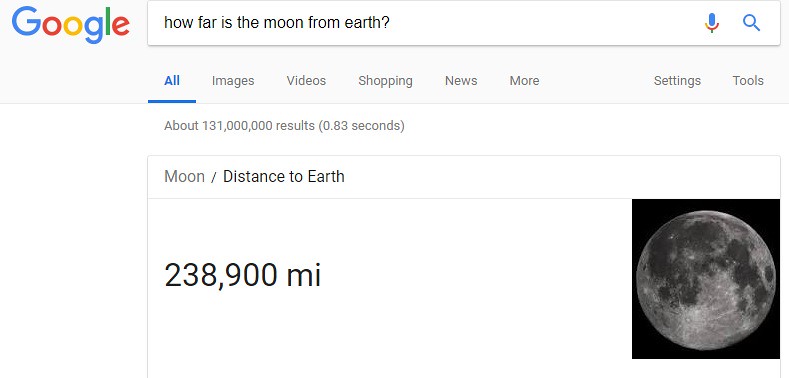
Another possible metric would be to use the distance between Earth and the moon.  If Google is consulted by asking the following question: How far is the moon from earth? -- then the answer below appears:


From the last analysis, the remainder of the calculation is straightforward as shown below:


According to the calculation above using the numbers mentioned, the total number of trips from Earth to the Moon would be approximately 56,900 one way trips.  Wow!  Looking at the answer, the number of trips is still quite large.  Lets consider a larger metric -- the distance to Mars for a final analysis.


3) Distance between Earth and Mars:


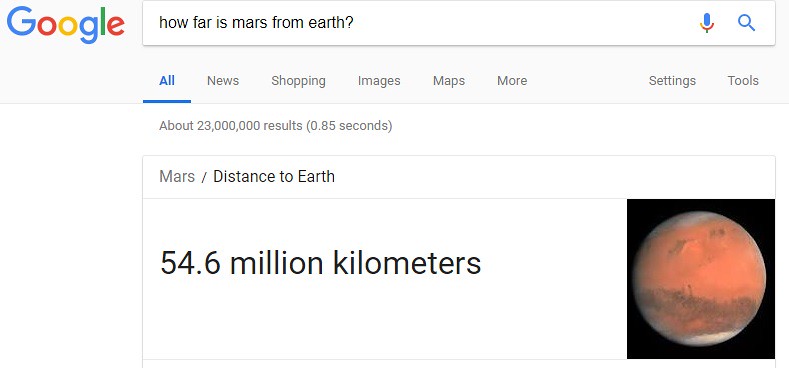
As a final analysis, a yet larger metric is chosen -- which is the distance between Earth and Mars -- to cast the enormous distance of 13.6 billion miles into perspective.  Again, to start the analysis, the distance from Earth to Mars needs to be obtained.  Using the handy search engine Google with the following question: How far is Mars from Earth? -- will yield an answer: 


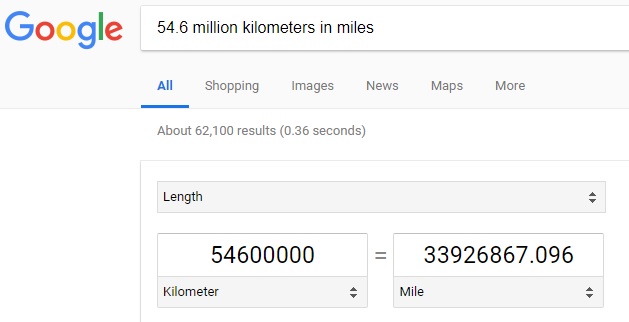
The answer gives us a slight problem.  Following a quick inspection of 'units of measurement', the answer is given in units of 'kilometers' whereas the distance which is used in the above analysis is expressed in units of 'miles'.  Therefore, Google needs to be consulted with the following question: 54.6 million kilometers in miles -- which yields the following conversion shown below:


Notice how usually the inquiry for unit conversion entails getting a conversion factor.  In this case, the distance of concern was in question to save time.  Now, the final analysis can be carried out -- which is to find the number of trips from Earth to Mars that would be made possible using the distance of 13.6 billion miles.  The analysis is shown below:


The calculation indicates that 401 trips would be possible between Earth and Mars.  Wow!


Conclusion...


In the analysis above, the question from a reader was entertained: how far would 291 billion Goodyear Blimps reach end to end?  The answer was astounding.  Much longer than I even imagined.  Although, using dimensional analysis allowed us to cast the value (i.e. total distance) into a manageable perspective.  The metrics chosen were distances within our galaxy.  If larger metrics were needed for an extremely larger number, the a 'light-year' could have been chosen to which compare astronomically large numbers too.  In the future post, there will be such large numbers which require truly long distances.


For the time being, I am thankful to the reader Mike Martino for asking such a great question.  I have had a wonderful time making sense of the distance calculated along with walking readers through the analysis.  Now, powered with the ability to perform similar analysis, choose different metric and arrive at different answers.  Use the numbers above to explore different analyses.  Feel free to comment on different analyses in the comment section below.


Related blog posts:


Dimensional Analysis Of Statistics And Large Numbers - Index Of Blog Posts


What is dimensional analysis?


How many trash carts can be filled with 80 billion pounds of trash?


How many people would be killed if 1,485 pounds of Fentanyl were distributed onto the streets in the U.S.?


What Is Dimensional Analysis?


Was The Recent Oil Spill in China The Largest In History?


LimeBike Dockless Bikeshare Riders Travel A Distance Of 13,000 Miles In Just Over 3 Weeks?


How Many Cigarettes Can You Roll With 18,000 Pounds Of Marijuana?


How Many Turkey's Are Served On Thanksgiving Day? How Many People Served?


How Much Trash Would Be Required To Fill The Great Wall Of China?


How Many Birds Per Minute Can Be Processed On A Single Line At A Poultry Processing Plant?


Hurricane Harvey Drops Enough Rain On Houston To Fill 560 Dallas Cowboy Stadiums


If Technology Fails, Use Basic Math Skills - Count Manually!!


How Much Water Is Contained In All Oceans Around The Globe?


Tuesday, August 28, 2018

Scientists should find similarities rather than focus on differences


Source: Kinsky-STEM


STEM education has become a hot topic over the last decade.  STEM stands for Science, Technology, Engineering, and Mathematics.  Just by inspecting each word in the acronym, the realization of the broadness of the interdisciplinary field becomes apparent.  Within this broad field, scientists tend to focus on differences rather than on similarities.  Which needs to change if STEM initiatives are going to be propelled forward in the future to center stage.


I am a chemist not a biologist!


In the pursuit of elevating STEM initiatives throughout the K-12 education along with the university setting, major differences in technique are starting to arise - which is of concern for the future.  For university professors, my colleagues are reporting that differences in starting to appear across a discipline like chemistry.  Typically, the area of Chem Ed covers all of chemistry.  Recently, our department hired a 'Chem Ed' faculty member for a tenure track position.  She has been with the department for an entire year so far getting her research group up and going.


Recently, she returned from a conference for 'Chem Ed' specialists.  She is a biochemist by education with an emphasis in 'Chem Ed' -- meaning the bulk of her PhD research was concerned with 'Chem Ed'.  For those not aware of what the field (or sub discipline) of 'Chem Ed' is, the emphasis is on researching different methods to improve the curriculum of chemistry in general which results in better retention rates (graduation), higher student engagement in classes, and overall student success throughout the undergraduate journey.  Basically, to improve education methods in the sciences -- 'best practices' in teaching.  This is an exploding field at the moment.


The conference she recently attended was called 'Biennial Conference Chemical Education.  Each year the conference is held in different locations.  If you are interested in reading the history of the conference series, click here to find out more about its origins.  Upon her return, I was speaking with her about the wide variety of presentations which were offered.  Later that same day, I was at an outreach event at a local park, when I ran across a biology professor from our same university who is deeply interested in STEM initiatives.  Without thinking more deeply about my question, I asked him the following question:  "Did you attend BCCE?"

He responded "What conference?"

I followed with "Li from our department went to BCCE  at Notre Dame?"

With that he asked "Isn't that for chemists?...Why would I go, I am a biologist?"


At that point, I was thinking to myself that he is correct and why would I ask such a question to someone in a completely different discipline?


Although, with time, I started to consider the question "Do best practices in Bio Ed translate over to Chem Ed and vice versa? Just out of curiosity.  Why are professors at the same institution attending conferences in completely different disciplines about improving best teaching practices?  Especially, when all of us are working together to elevate STEM initiatives?  This stumped me, so I asked the question on Twitter (social media).


I did a few interesting responses, but the response that most resonated with my curiosity was the following: "Professors do not talk with one another Mike."  This was from a biologist who has years of experience and is at our university.  With time, I reasoned that initiatives like "Faculty Development" on campus bring together professors from a wide variety of disciplines to tackle these matters.  Further, that during these sessions, each discipline could share 'best teaching practices'.  Case closed right?  Wrong...


Chemists do not talk to each other?


I let a couple of weeks pass and then one day, my wife (Kayla) who is a professor of chemistry and is involved in Faculty Development was debriefing me about her day.  I was semi interested to here about the pre-semester chatter in our department with classes starting.  I decided to engage and listen.  She said that during the particular afternoon, she visited the offices of new professors (in our department) just to find out what 'best practices' they were engaged in if any or trying new teaching techniques in the coming semester.  Which has since started (yesterday).  The results were astounding to say the least.


After talking with four professors, she realized that there had been a large amount of data collected over the last 2 years (already considering they were new) collectively.  Further, that a few of the techniques were 'redundant' in practice and could have been avoided.  Of course, for the redundancy to have been avoided, this would required professors sharing 'best practices' with one another.  This left me astounded after hearing the reality.   How can professors who work in the same building not share 'best practices' in teaching?  This left me disappointed and confused (still to this day).


Such a waste of energy.  This needs to change if there is going to be forward momentum.  To cap all of this off, my colleague (Li) who just returned from the conference - BCCE - said that the field of Chem Ed is headed for further splitting into sub-disciplines? What?  Which means that the will be a corresponding 'Ed' component to the following sub-disciplines in chemistry: Chemistry, Organic Chemistry, Inorganic Chemistry, Physical Chemistry, Analytical Chemistry, Biochemistry.


Why is this occurring?  This seems to be moving progress in the opposite direction rather than forward!


Why are people searching for differences rather than similarities?  After all, the goal is to improve on educational practices while elevating the fields - which span a wide variety of interests - in the eye of the public.  According to the 'Wikipedia' page for STEM, there are more variations of STEM shown below:


- STM (Scientific, Technical, and Mathematics;[5] or Science, Technology, and Medicine; or Scientific, Technical, and Medical)
- eSTEM (environmental STEM) [6][7]
- iSTEM (invigorating Science, Technology, Engineering, and Mathematics); identifies new ways to teach STEM-related fields.
- STEMLE (Science, Technology, Engineering, Mathematics, Law and Economics); identifies subjects focused on fields such as applied social sciences and anthropology, regulation, cybernetics, machine learning, social systems, computational economics and computational social sciences.
- STEMS^2 (Science, Technology, Engineering, Mathematics, Social Sciences and Sense of Place); integrates STEM with social sciences and sense of place.
- METALS (STEAM + Logic), introduced by Su Su at Teachers College, Columbia University.[citation needed]
- STREM (Science, Technology, Robotics, Engineering, and Mathematics); adds robotics as a field.
- STREM (Science, Technology, Robotics, Engineering, and Multimedia); adds robotics as a field and replaces mathematics with media.
- STREAM (Science, Technology, Robotics, Engineering, Arts, and Mathematics); adds robotics and arts as fields.
- STEAM (Science, Technology, Engineering, Arts, and Mathematics)[8]
- STEAM (Science, Technology, Engineering and Applied Mathematics); more focus on applied mathematics[9]
- GEMS (Girls in Engineering, Math, and Science); used for programs to encourage women to enter these fields.[10][11]
- STEMM (Science, Technology, Engineering, Mathematics, and Medicine)
- AMSEE (Applied Math, Science, Engineering, and Entrepreneurship)
- THAMES (Technology, Hands-On, Art, Mathematics, Engineering, Science)


What?  Again, look at what has transpired over time to find differences rather than similarities.  Why are professionals looking for differences rather than similarities?  To me, this makes little sense.  This is not to say that 'Best Practices' in biology translate over directly to chemistry.  Although, I would argue that each discipline could stand to learn from listening to the successes and failures of each discipline.  Further, this reduces the possibility of redundant efforts and saves time overall.


Conclusion....


What is the point of a university?  Besides education and research, why does a university exist?  One answer is that a university brings together a large number of very intelligent professors in the same geographical zone.  Further, to bring together bright minds together to provide a 'well-rounded' educational experience with the possibility of research experience too.  Aside from this mission, is the university a place to exchange ideas?  Yes, I believe so. 


In light of these questions and possibly answers, why then are professionals searching for differences rather than similarities.  University officials should be trying to bring together professors to share their best and worst teaching experiences. Included in this sharing should be best and worst practices of research too.  Additionally, research which focuses on elevating the percentage of different culture, ethnicity's, and genders who pursue STEM field for a profession.  Research such as this highlight the need to bring different people together into STEM disciplines rather than find differences.   Coordinating a collective amount of diverse opinions and results from various academic teaching pursuits provides a rich and meaningful way to push a diverse field in need forward.  Lets work on similarities and avoid finding differences.


Read about STEM initiatives winding their way through Congress - legislation!


Related Blog Posts:


Why Chemistry Matters from the mouths of Nobel Laureates!


President Trump finally fills the Office of Science and Technology Policy position - Yeah!


Teachers, Parents -- Students need to learn how to write and mail a physical letter


Does your brain move throughout the day?


"All Of Us" - The Best Medical Knowledge Update Effort - Please Join!


What Is Going On Inside That Cell?


How Do Scientists Think?


Science Topics, Thoughts, and Parameters Regarding Science, Politics, And The Environment!


Saturday, August 25, 2018

Ralph Nader: Warner Slack - Doctor for the People Forever


Have you ever been frustrated while trying to access your medical records?  Considering the abundance of medical records sitting in doctors' offices across the world, why has there not been a system (or systems) devised to give patients the access that is necessary to calm their minds.  Further, why have those same records not been 'anonymized' and made available to medical researchers to gather data across a greater patient population that could result in better medical care -- i.e. better medicine?  Surely, one of the many great physicians over the past few decades have conceived of such a system -- especially with the rise of technology is society.  In the blog post below, the iconic activist Ralph Nader introduces us to his good friend -- Dr. Warner Slack -- who passed away recently.  Dr. Warner Slack is one such physician who not only conceived of such a system, but worked tirelessly to advance the medical field to implement Electronic Health Records.


Electronic Health Records?


'Big Data' is a hot topic today.  The field of data mining with computers is taking on a new role from analyzing 'likes' on social media platforms to analyzing large data sets of pharmaceutical companies over the research and discovery of a new potential drug.  Which is why Electronic Health Records would be transformative for society and Dr. Warner Slack is honored for his ambitious pursuit over the decades as highlighted below in Ralph Nader's letter.  But first, let's take a step back and realize why having access to health records would make our lives better in the future.


In order to design a more effective drug, pharmaceutical companies need more information on the reactivity (i.e. efficacy, side-effects, costs, etc.) of a certain drug.  As I pointed out in the original post on drug discovery in an earlier post (over a year ago - here), the cost is tremendous -- around $1 billion dollars to bring the drug to market place over the course of 20 years.  Yes I said the process takes up to 20 years to get the drug from the university to the marketplace.  This covers the range of costs associated with discovery to patent through clinical trials -- which is no easy task.


Remember as I point out in an earlier post, the target (drug target) is discovered at the university level.  From there the drug target is tested against a wide variety of patented or proprietary test targets from a given pharmaceutical company. If a suitable match is found -- meaning a drug (or medicine) from a company is found to hit the target. Then the pharmaceutical company may be willing to take the drug to market - through clinical trials.  During clinical trials, the drug is tested on a specific population (limited but verifiable to U.S. standards).  Last but not least, the real 'data' on the drug comes from years of testing the drug in various doctors' offices across the world.  Which is why the data that is dispersed throughout the world could be fed back to the pharmaceutical company to optimize (refine or make a better) the drug which was brought to the market place.


People do not realize that as patients, they are testing the efficacy of the newly released medicine too.


Why are we still using a paper-based system of keeping track of patient's health rather than electronic health records?  At first sight, the answer might be related to the complexity with the whole process.  We are talking about hundreds of millions of patients just inside the United States -- not to mention other countries.  Or different countries might choose to use different file types which might not compatible across large populations to mine for researchers.


Global medicine is a topic among the upper echelons of the government and can be read about hereRace, ethnicity, culture, and gender are increasingly important considerations when looking for effective and reliable treatment options for a given disease.  The more information we have to work with, the better the outcome.  Dr. Warner Slack has made this realization an issue which society has been forced to deal with and embrace in the pursuit of personalized medicine.  Don't take my word for it, read the letter below along with the cited article at the end of the letter about the wide range of Dr. Warner Slack's accomplishment for people during his career in medicine.


Without further ado, here is the letter written by Ralph Nader about his good friend -- Dr. Warner Slack shown below:


Warner Slack was a humble, multi-faceted great American physician at Harvard Medical School’s affiliated hospitals. Yet after he passed away last month at age 85, Dr. Slack did not receive the news coverage accorded numerous late entertainers, athletes, writers and scoundrels. In fact, his life was ignored by the Boston Globe, New York Times and the Washington Post.
Dr. Slack, in his pioneering, brilliant humane work, always focused on the lives of the American people whom he served in the millions, directly and indirectly.
It has been said that in a celebrity culture, we honor whom we value. Along the way the most important human beings who give us the blessings of liberty, justice, health, safety, knowledge and overall well-being mostly are missed or slighted by the priorities of a commercially driven culture. These people lift up our society every day on their largely anonymous, selfless shoulders.
In his final days, struggling with pulmonary fibrosis, I called Dr. Slack to express my deepest admiration and said: “For all your adult life, Warner, you have been a physician’s physician, a patient’s physician, a student’s physician, a citizen’s physician, and a champion of peace and justice.” This gentle, many-splendored medical doctor achieved such excellence in an age of specialization and amorality.
Dr. Sidney Wolfe, the nationally known long time director of Public Citizen’s Health Research Group, called Warner “a hero of mine.”
Just what did Warner Slack do to receive such encomiums? First, he was an early vocal medical practitioner who supported universal health insurance, when few were urging such humanity. He was among the first physicians in the world to see and apply the potential of computers in healthcare delivery but declared that advances mattered only if they advanced patients’ wellbeing. He insisted on patients being informed, on being empowered, and he led the way from his clinical practice in ending the absurdity of prohibiting patients from accessing their own medical records. Over the opposition of most of his profession and hospitals, he pressed on until this basic patient right was enacted as part of the Health Insurance Portability and Accountability Act.
Dr. Slack founded the Division of Clinical Computing from which flowed many professional articles and studies including prescient warnings about how computers misused can invade patients’ privacy and waste a ton of taxpayer money. He also pointed out that mindless converting from paper records to digital records might ill-serve the patients.
Once in a rare while, we meet relentlessly honest and courageous people who instinctively and cognitively see through the ruses, the snares and the delusions, and the profiteering propaganda that harm innocent, trusting people in so many grave ways.
Unlike many innovators, who bask in the limelight of praise, Dr. Slack humbly kept at it pressing for how his breakthroughs could actually benefit patients and not be hijacked for the all-mighty dollar. Human beings were never to be reduced to numbers.
As his son, author Charlie Slack wrote:
[Warner Slack’s] article “The Patient’s Right to Decide,” published in the British journal The Lancet, put forth a then-radical idea of “patient power”—encouraging patients and physicians alike to overturn the traditionally paternalistic nature of healthcare. Patients, Dr. Slack believed, should play a crucial part in determining their own care. Their insight, he often said, was “the least utilized resource in healthcare.
As an original thinker, a visionary, and a rigorous conveyer of medical ethics and responsibility to the hundreds of young clinicians he mentored or trained, Dr. Slack, maintained his steadfastness with a remarkable congeniality and the human touch.
In pain and hospitalized for weeks, he never complained. His demeanor and continual regard for the orderlies, nurses, and physicians, who took loving care of him, revealed his authentic character.
An early inchoate defender of the underdog, he was among the first physicians to publically oppose the Vietnam War, to go down South to help injured civil rights marchers, even working to help ease the integration of the University of Wisconsin football team. While in his seventies, he twice went to Honduras to provide medical assistance to residents of remote, impoverished villages.
A Princeton classmate of mine, Warner and I got to know each other better in 1980 when he and our Center independently issued tough critiques of multiple-choice standardized testing (SATs, etc.). As the author or co-author of many articles, book chapters, newspaper op-eds and books, such as Cybermedicine: How Computing Empowers Doctors and Patients for Better Health Care, Warner was very aware of phony studies, deceptive statistics, and other technical ways to manipulate persons.
Together with his colleague, Douglas Porter, he authored, in the Harvard Educational Review, the myth-busting article, “The Scholastic Aptitude Test: A Critical Appraisal.” They demonstrated that, contrary to ETS’s defiant assertions, aptitude was not frozen and its test scores could be raised by study and training for the tests. They also showed that SAT scores are poor predictors of college academic performance compared with high school grades.
Our study, “Reign of ETS: The Corporation That Makes Up Minds,” added that non-quantifiable traits, such as diligence, creativity, stamina, and even motivational idealism, can be more important as predictors of college performance.
This year, Warner’s critiques were further vindicated by the news that, joining some other colleges, the University of Chicago, has dropped these standardized tests as a requirement for admission.
Warner managed his interests and professional activities and duties without sacrificing being with his wife, Carolyn, their three children, and seven grandchildren. He relished these gatherings where he expressed his limitless curiosity about the world and continued to be, in Charlie’s words, “a person defined mainly by his youthfulness.”
Someone once said that “the only true aging is the erosion of one’s ideals.” No one who knew and worked with Warner viewed him as “elderly.” He couldn’t have been more contemporary and forward-looking with his classmates whenever they gathered for meetings regarding their unique alumni class organization—Princeton Project 55, which placed Princeton undergraduates and graduates with systemic civic groups around the country.
Dr. Slack was as complete a brainy, humane, down-to-earth, big picture human being as you could ever meet.
He left this life in Carolyn’s arms on the morning of their 62nd wedding anniversary.
His legacy is strong, deeply rooted in his many students and colleagues, and is lastingly conveyed in his writings and exemplary career, under pressure and controversy.
A biography of Warner Slack and his times needs to be written.


Conclusion...


Dr. Warner Slack has been hailed by others as the 'pioneer' of electronic health records.  Read here about his envision of artificial intelligence and computers playing transformative role in medicine.  With the rise of technology coupled with Dr. Warner Slack's vision, we have arrived at pursuits toward precision medicine like "All of Us" trial being conducted by the National Institutes of Health.  In the future, we will thank heroes like Dr. Warner Slack who have paved the way toward a better understanding of health by giving access (and better care) to patients through making the data (medical records) available to both patients and researchers.  The future of medicine should be exciting through both participants eyes.  Thank you Dr. Warner Slack for your work.  And Thank you Ralph Nader for bringing our attention to lesser known heroes like Dr. Warner Slack.


Related Blog Posts:


NIH Director Updates Congress On Research Progress


Does your brain move throughout the day?


Parameters: Race, Ethnicity, and Gender Needed In Health Research


Ralph Nader: MAGA is really MADA?


Ralph Nader: Has Corruption Become Institutionalized?


Ralph Nader Says 10 Million People Could Change Healthcare Policy - That Few?


Ralph Nader Suggests To Consumers Reading 'Consumer Reports' Before Impulse Buying


Thoughts: Ralph Nader On A Cashless Economy


Ralph Nader Asks "Will the Federal Civil Service Defend Us?"


Activist Ralph Nader Gives Politicians Advice Post Hurricane Harvey


Activist Ralph Nader Calls To Each Pillar Of Society - A Call To Action.


Can One Community Organization Change Regional Transportation Habits?


Wednesday, August 22, 2018

What is a typical day like for a systems engineer at JPL?


Source: Phys.Org


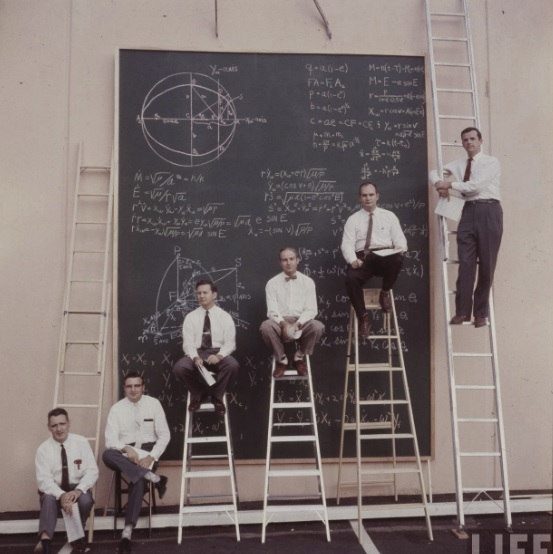
Hollywood gives us a picture (one example) of a typical day in the life of a systems engineer at the Jet Propulsion Laboratory.  What does that picture look like?  An example might be shown below:


Now compare that with the written description from an interview of a true systems engineer at the Jet Propulsion Laboratory in Pasadena as highlighted on the 'Science & Entertainment Exchange' website shown below:


What is a typical day like for a systems engineer at JPL?

The one thing I love about my job as a systems engineer is that there really is no such thing as a typical day. It changes dramatically over the lifecycle of a project, which goes like this. In the early phases of a project, the scientist community and NASA decide what it is that needs further study. Take Jupiter, for example. How was Jupiter really formed? Related to that question are things like: Does Jupiter have a core? How big is the core? What is the water vapor content of the atmosphere?
Next, a call for proposals is sent out and engineers work with scientists to figure out how to go about finding the answers. Can we use a telescope on Earth? Or do we need to send a spacecraft all the way to Jupiter? Can it just fly by the planet or does it need to go into orbit? Then, we come up with a specific design for the spacecraft and instruments. For the instruments: they are often selected through a parallel proposal process. For the spacecraft side: if a spacecraft is going all the way to Jupiter, we work through big design questions like: Does it need nuclear power? Or can we use solar power? If we use solar power, how big would the arrays need to be? Over time, we mature the design to a very high level of detail, then build parts, and assemble them. There are many points throughout the design process for testing things, performing analyses, etc., to ensure everything is going to come together smoothly and perform the way we expect. Eventually, we launch the spacecraft. Once we are in this operations phase, we are getting the data back from the instruments, but also managing the health of the spacecraft.
So far, I have worked on projects starting from the middle of the design phase through the final assembly, testing, launch, and operations phases. My job focuses a lot on troubleshooting and resolving design disconnects. For example, early in the design phase a telecom engineer might want 100 watts of power to make sure the signal back to Earth is very strong and easy to lock onto, but the power system may be providing only 500 watts for the entire spacecraft. The systems engineer’s job is to work with engineers from both of those areas (and the rest of the spacecraft too) to explore the trade space and figure out the best approach.


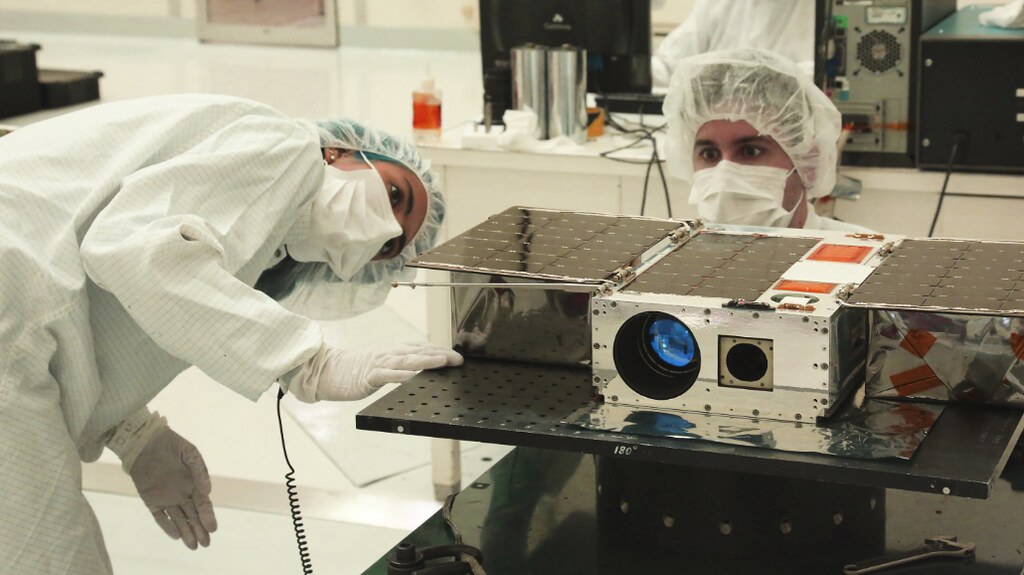
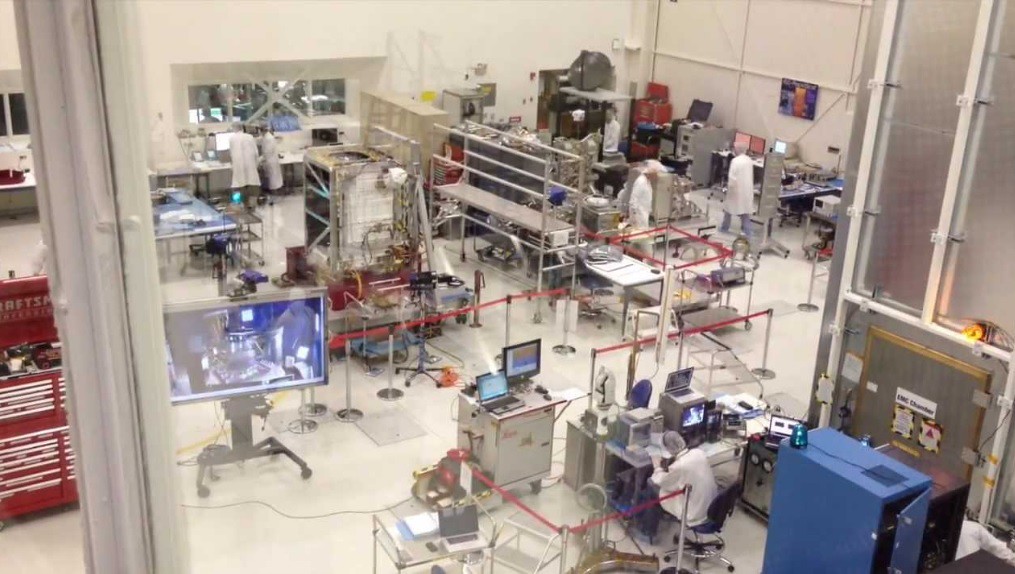
The description above implies the images below:


Source:JPL


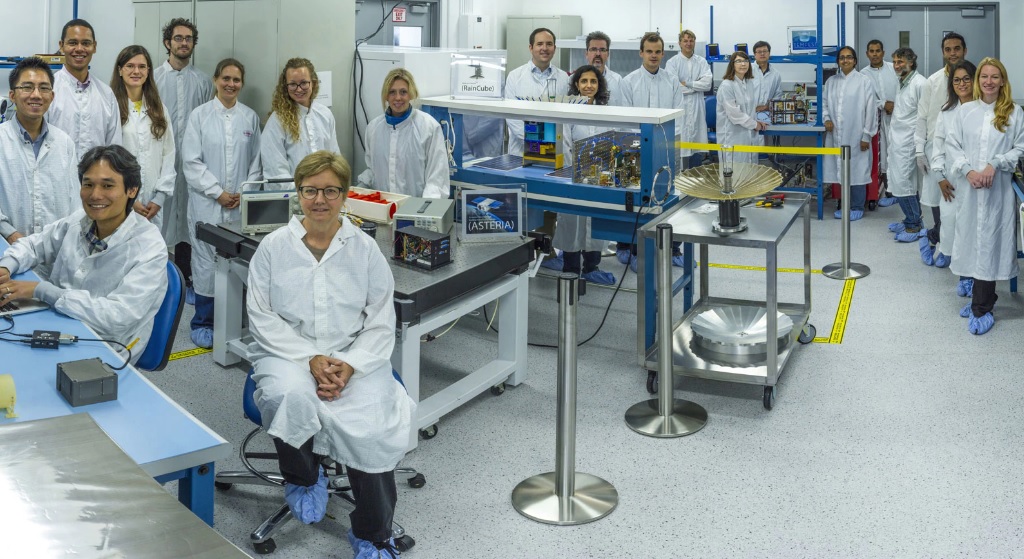
Laboratories like the one above and below house teams of scientists who work collaboratively to think about all of the considerations for a given mission.  A team which appears like the picture below:


Source: JPL/NASA


The laboratory above (spacecraft factory) is a result of years of work by NASA engineers.  Over the course of decades, space scientists have worked to optimize (perfect) the process of design, construction, testing, and launching/mission.  According to the description above by the systems engineer, a day can take on many different forms.  Which highlights a very important observation which frequently arises when non-scientists visit laboratories.  The scientific process has many components which range from constantly sourcing out funding for various research projects to solving unexpected problems encountered during research and development.


Conclusion...


The traditional (old image) of a scientist or systems engineer is one that is not only outdated but has changed over the last few decades.  What image do I speak of?  The image of men chalking up the boards with equations has been replaced largely by computational methods.  A scientist working alone in his/her laboratory day after day has been replaced by a more collaborative working environment -- diverse with different genders, race, and ethnic backgrounds.  Which spurs different angles of creativity and ideas in solving a project at hand.  Since funding is getting more hard to find, more consideration into each part of the process from planning to finalizing construction of a spacecraft is considered in more detail. The result is a more diverse and inclusive interdisciplinary research and design group of scientists who are more concerned about living in a better world and beyond. 


Related Blog Posts:


Why Chemistry Matters from the mouths of Nobel Laureates!


Scientists compare Misinformation In Mainstream News to a Viral Infection


What Is Going On Inside That Cell?


How Do Scientists Think?