Monday, January 21, 2019

Happy Martin Luther King Jr Day!!


Source: History


Today is Martin Luther King Jr. Day in the United States of America, the land of the free.  Martin Luther King is indescribable in certain ways for the outstanding and iconic influence which he had on our great nation during the 50's and 60's leading the civil rights movement.  Shown below are the first few paragraphs (introduction) of his 'Wikipedia' page to remind us of the unparalleled impact on our nation Martin Luther King Jr. exerted with his presence:


Martin Luther King Jr. (January 15, 1929 – April 4, 1968) was an American Baptist minister and activist who became the most visible spokesperson and leader in the civil rights movement from 1954 until his assassination in 1968. Born in Atlanta, King is best known for advancing civil rights through nonviolence and civil disobedience, tactics his Christian beliefs and the nonviolent activism of Mahatma Gandhi helped inspire.
King led the 1955 Montgomery bus boycott and in 1957 became the first president of the Southern Christian Leadership Conference (SCLC). With the SCLC, he led an unsuccessful 1962 struggle against segregation in Albany, Georgia, and helped organize the nonviolent 1963 protests in Birmingham, Alabama. He also helped organize the 1963 March on Washington, where he delivered his famous "I Have a Dream" speech.
On October 14, 1964, King won the Nobel Peace Prize for combating racial inequality through nonviolent resistance. In 1965, he helped organize the Selma to Montgomery marches. The following year, he and the SCLC took the movement north to Chicago to work on segregated housing. In his final years, he expanded his focus to include opposition towards poverty and the Vietnam War. He alienated many of his liberal allies with a 1967 speech titled "Beyond Vietnam". J. Edgar Hoover considered him a radical and made him an object of the FBI's COINTELPRO from 1963 on. FBI agents investigated him for possible communist ties, recorded his extramarital liaisons and reported on them to government officials, and on one occasion mailed King a threatening anonymous letter, which he interpreted as an attempt to make him commit suicide.
In 1968, King was planning a national occupation of Washington, D.C., to be called the Poor People's Campaign, when he was assassinated on April 4 in Memphis, Tennessee. His death was followed by riots in many U.S. cities. Allegations that James Earl Ray, the man convicted of killing King, and imprisoned, had been framed or acted in concert with government agents, persisted for decades after the shooting. Sentenced to 99 years in prison for King's murder, effectively a life sentence as Ray was 41 at the time of conviction, Ray served 29 years of his sentence and died from hepatitis in 1998 while in prison.
King was posthumously awarded the Presidential Medal of Freedom and the Congressional Gold Medal. Martin Luther King Jr. Day was established as a holiday in numerous cities and states beginning in 1971; the holiday was enacted at the federal level by legislation signed by President Ronald Reagan in 1986. Hundreds of streets in the U.S. have been renamed in his honor, and a county in Washington State was also rededicated for him. The Martin Luther King Jr. Memorial on the National Mall in Washington, D.C., was dedicated in 2011.


Mr. King was a master at leading civil and nonviolent marches with millions in attendance at times.  The sheer number of protesters should be a badge in of itself for his ability to gather such an enormous momentum of protesters in any given geographical location.  Especially, in comparison to today where we have the use of social media and the internet to reach out to people (protesters).


His ability to reach large numbers and teach the workings of the bible in times of tremendous segregation was astounding.   Any civil leader since aspires to be like him or learn from his workings.  I decided to honor him today would be to post a few of his iconic 'quotes' which are used in many activists speeches and movements still to this day.  A list of a few famous quotes are shown below:


Source: Google


Here are the ten quotes listed below which are listed in the image above:


(1) "Darkness cannot drive out darkness; only light can do that. Hate cannot drive out hate; only love can do that."


(2) "Injustice anywhere is a threat to justice everywhere."


(3) "Our lives begin to end the day we become silent about things that matter."


(4) "The time is always right to do what is right."


(5) "Free at last, Free at last, Thank God almighty we are free at last."


(6) "In the end, we will remember not the words of our enemies, but the silence of our friends."


(7) "Life's most persistent and urgent question is, 'What are you doing for others?"


(8) "The ultimate measure of a man is not where he stands in moments of comfort and convenience, but where he stands at times of challenge and controversy."


(9) "Faith is taking the first step even when you don't see the whole staircase."


(10) "Morality cannot be legislated, but behavior can be regulated. Judicial decrees may not change the heart, but they can restrain the heartless."


The profound effect on our great nation which Martin Luther King Jr. had cannot be overstated.  Without a doubt, a remarkable man he was and by laying a framework down with his life (included in that framework), he has gone down in history as one of our nation's greatest leaders (and teachers).  The world is not the same without great leaders like Martin Luther King Jr. -- as we see today.


Today, there is a large amount of divisiveness -- hatred, bigotry, racist behavior, etc. -- which should not be.   We, as a nation, learning from the teachings of Martin Luther King Jr. should be far advanced (in progress) than we are today.  Unfortunately, we are currently residing in a nation which is run by a president who wishes to reverse all of the great achievements that teachers like Martin Luther King Jr. fought so hard to advance.


In light of this reality, let us take the day to reflect on this great leaders achievements and draw inspiration to move forward as a nation and reach out to those who wish to reverse the great lessons of Martin Luther King Jr. and understand them, embrace them, and share love, respect, and compassion with them in hope of progressing into the future toward the goals set by leaders such as Martin Luther King Jr. 


Related Blog Posts:


Science Topics, Thoughts, and Parameters Regarding Science, Politics, And The Environment!


Thursday, January 17, 2019

Earthquake App Is Released Which Provides Seconds Of Warning Before Big One Hits!


Source: History.com


Today marks the 25th Anniversary to the Northridge Earthquake (in Northridge, California).  Natural disasters seem to be more frequent these days.  Climate change has been the usual culprit to claim.  Regardless of what your opinion on the matter is, anytime reliable information can come down various news / information outlets (which are respectable sources of information), residents enjoy having any (if little) warning to prepare for a disaster.  Mayor Eric Garcetti along with the United States Geological Services developed an app for a smartphone which would give a resident just a few seconds before an earthquake hits. How does the app work?  What does the app look like?  These questions are answered in brief below.


In a recent article in 'Wired' titled "LOS ANGELES GETS AMERICA'S FIRST EARTHQUAKE WARNING APP" the app is introduced as follows:


On January 3, Los Angeles Mayor Eric Garcetti announced the release of ShakeAlertLA, a new earthquake-warning app for residents of Los Angeles County. The app—the first of its kind in the United States—promises to “save lives by giving precious seconds to you and to your family to take action and to protect yourselves,” Garcetti told reporters at a launch event at City Hall.
Available to download in both English and Spanish in the Apple and Google Play stores, ShakeAlertLA is designed to give smartphone users a warning, with sound, of earthquakes of 5.0 magnitude or larger, a few seconds or more before the shaking begins. That’s not a lot of time, but even a brief window can be enough to gather family members and “drop, cover, and hold on,” as earthquake drills instruct.


According to the 'ShakeAlertLA' website, the purpose of the app is to give enough warning which would allow a whole host of organizations and utilities to be shutdown or slowed down to save lives and reduce cost of damages incurred:


 Studies of earthquake early warning methods in California have shown that the warning time would range from a few seconds to a few tens of seconds. ShakeAlert can give enough time to slow trains and taxiing planes, to prevent cars from entering bridges and tunnels, to move away from dangerous machines or chemicals in work environments and to take cover under a desk, or to automatically shut down and isolate industrial systems. Taking such actions before shaking starts can reduce damage and casualties during an earthquake. It can also prevent cascading failures in the aftermath of an event. For example, isolating utilities before shaking starts can reduce the number of fire initiations.


Wow.  Amazing.  Right about now you may be wondering how exactly the job is accomplished of measuring the threat and then conveying a threat of a geological disaster.


Source: ShakeAlertLA


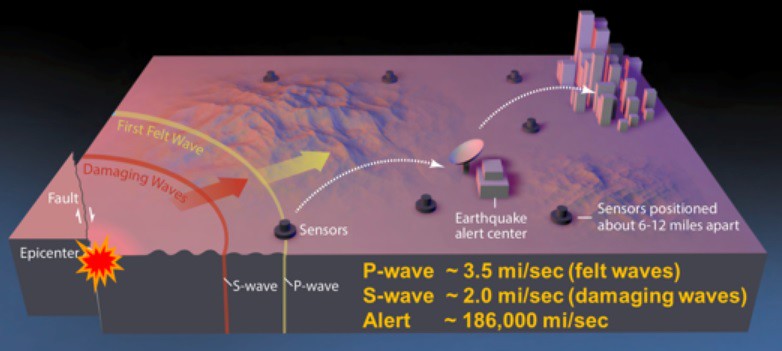
In the diagram above, the lower left hand corner shows the origin of the emerging earthquake or the 'epicenter' of the quake.  As the different waves (p-waves and s-waves) propagate outward at different speeds, the detectors sense the waves and send them throughout the notification/emergency network.


To see a more fluid (or action) based presentation of the ShakeAlert system, I consulted Google.  A search on YouTube turned up the video shown below produced by a host of organizations listed at the end of the short video (less than 5 minutes):


The major take home messages from the video are shown below in still photos taken from the video above.  To begin with, again, ShakeAlert is possible with a variety of 'sensors' embedded in the ground around the Southern California region which serve to notify the appropriate earthquake research centers of an emerging earthquake forming as shown below:


Source: ShakeAlert


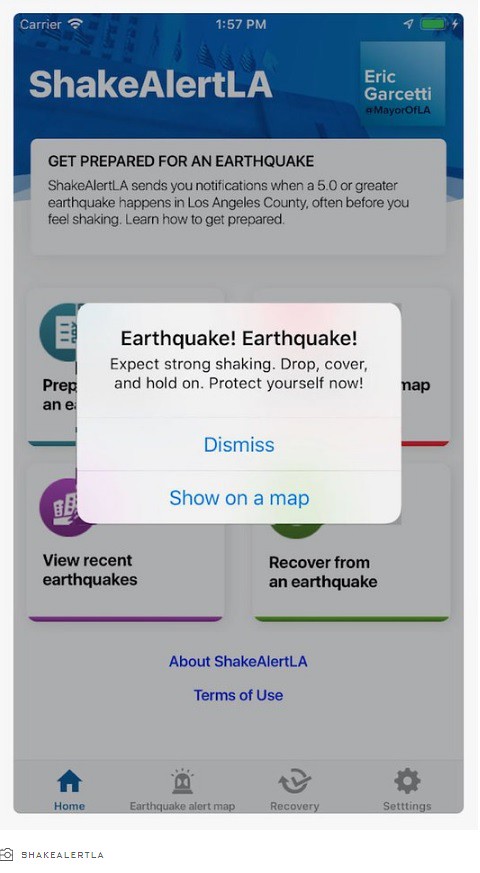
In the video screenshot above, the sensors which are embedded in the ground serve as the first indication of an emerging earthquake.  These sensors measure both types of wave shown above -- namely 'p-waves' and 's-waves' -- which differ in speed and magnitude.  Once the sensors detect a wave, the signal is transmitted to throughout the system which eventually arrives on your smartphone screen as shown below:


Source: ShakeAlertLA


The screen reads "Earthquake!  Earthquake!  Expect strong shaking.  Drop, cover, and hold on.  Protect yourself now!"  This message is followed by two options: "Dismiss" or "Show on a map."  At the very least, getting an initial warning can save lives - which I will touch upon shortly.  First, the map of the emerging earthquake and zones (with arrival times) are shown below:


Source: ShakeAlert


The radial zones with different times are useful in notifying different geographical areas of the emerging quake.  In some areas depending on the quality of the measurement, more than a minute of warning is possible.  The more time amounts to in certain cases a reduced number of accidents or deaths (in some cases).


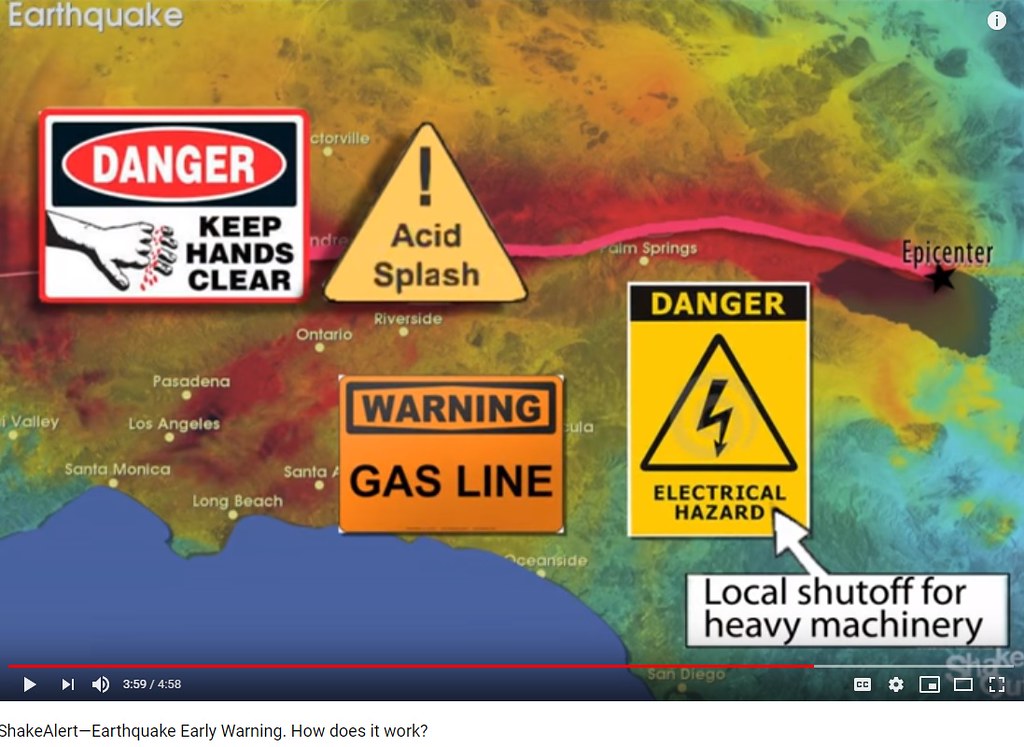
A wide range of industries could use a proper warning which are not usually considered by the average person.  Think of the industries such as chemical or processing industries which are working with dangerous chemicals.  Other industries which use heavy equipment could reduce harm by giving operators enough time to shut down equipment and take shelter.  Below is a screenshot indicating just a few industries are shown:


Source: ShakeAlert


Additionally, consider larger agencies such as transit agencies which operate buses and train systems on a city wide scale (or county).  The earlier warning could give operators enough time to shut down certain train lines which might have previously 'derailed' and caused large amounts of casualties.  What about airports?  Air traffic controllers who help navigate pilots flying large commercial aircraft might be operating systems which could potentially lose power and cause major flight disruptions.  The controllers could notify pilots of a potential (momentary) disruption which would help pilots have a greater ease of minds instead of presenting uncertainty about the exact events unfolding on the ground.  Safety is better when there is a greater amount of time and information surrounding a natural disaster.


Conclusion...


The technology above serves to reduce the fall-out of a given earthquake (natural disaster) by giving residents and corporations along with government agencies proper warning (a few seconds to minutes) to take safety precautions necessary.  What is the result?  Less disaster.  Less harm to environment and people.  The science behind this model have been built out and tested to produce an app which is worthy of use by civilians.


When I first heard about earthquake warning systems, I was thinking about climate change.  Climate change is also based on models.  The information used as input into the models might be as accurate or even more accurate than the information inputted into the app shown above.  Heading into the future, I would hope that as an earthquake occurs and the app serves as notification, each person comes to rely on the app to provide information which is reliable.  Further, a question will inevitably arise in each of our minds regarding the reliable information (and our trust of the app over time):  Why do we trust the app regarding earthquakes, but choose not accept the science behind climate change?  Why trust some science while disregarding other science?   These are questions to entertain as we move forward into the future and rely more on 'sensor technology' -- which in turn will provide greater accuracy of a measurement (hence, more reliable data).


Related Blog Posts:


Science Topics, Thoughts, and Parameters Regarding Science, Politics, And The Environment!





Monday, January 14, 2019

Over 600 Environmental Groups write letter to Congress to phase out fossil fuels


Last November, voters came to the polls in America and voted to change the House of Representatives from a republican majority to a democratic majority.  Over the last two years, the erosion of the federal agencies oversight to enforce regulations to protect Americans from harm by corporate entities has ensued without major obstacles.  Which is problematic for important issues such as climate change -- which spans over decades not just one election cycle.  Although, action needs to be continuously optimized by encouraging our elected leaders in Congress to have our best interest in mind and keep steering toward sustainable goals which have a positive effect on our planet looking into the future.


One such plan that has emerged with the change of the majority on Capitol Hill is the Green New Deal.  Over 600 environmental groups have written to express support for the Green New Deal and work toward finding solutions in general by forming committees along with passing legislation.  Negotiations are starting to happen which is encouraging to say the least.  Whenever I read about a large number of organizations sending letter to elected officials, I am alway curious about the content of such letters.  What do elected officials receive in letters in the form of information/persuasion toward their argument?  That is what this short blog post is about - persuasive content.


With that being said, the letter is shown below without the signatures:


January 10, 2019
Re: Legislation to Address the Urgent Threat of Climate Change
Dear Representative:
On behalf of our millions of members and supporters, we are writing today to urge you to consider the following principles as the 116th Congress debates climate change legislation and momentum around the country builds for a Green New Deal. As the Intergovernmental Panel on Climate Change recently warned, if we are to keep global warming below 1.5°C, we must act aggressively and quickly. At a minimum, reaching that target requires visionary and affirmative legislative action in the following areas:
Halt all fossil fuel leasing, phase out all fossil fuel extraction, and end fossil fuel and other dirty energy subsidies.
The science is clear that fossil fuels must be kept in the ground. Pursuing new fossil fuel projects at this moment in history is folly. Most immediately, the federal government must stop selling off or leasing publicly owned lands, water, and mineral rights for development to fossil fuel producers. The government must also stop approving fossil fuel power plants and infrastructure projects. We must reverse recent legislation that ended the 40-year ban on the export of crude oil, end the export of all other fossil fuels, and overhaul relevant statutes that govern fossil fuel extraction in order to pursue a managed decline of fossil fuel production. Further, the federal government must immediately end the massive, irrational subsidies and other financial support that fossil fuel, and other dirty energy companies (such as nuclear, waste incineration and biomass energy) continue to receive both domestically and overseas.
Transition power generation to 100% renewable energy.
As the United States shifts away from fossil fuels, we must simultaneously ramp up energy efficiency and transition to clean, renewable energy to power the nation’s economy where, in addition to excluding fossil fuels, any definition of renewable energy must also exclude all combustion-based power generation, nuclear, biomass energy, large scale hydro and waste-to-energy technologies. To achieve this, the United States must shift to 100 percent renewable power generation by 2035 or earlier. This shift will necessitate upgrading our electricity grid to be smart, efficient, and decentralized, with the ability to incorporate battery storage and distributed energy systems that are democratically governed. In addition, Congress must bring the outdated regulation of electricity into the twenty-first century, encouraging public and community ownership over power infrastructure and electricity choice, as well as permitting distributed energy sources, including rooftop and community solar programs to supply the grid.
Expand public transportation and phase out fossil fuel vehicles.
As the transition away from fossil fuels occurs, our transportation system must also undergo 100 percent decarbonization. To accomplish a fossil-fuel-free reality, Congress must require and fund greater investment in renewable-energy-powered public transportation that serves the people who need it most. The United States must also phase out the sale of automobiles and trucks with internal fossil fuel combustion engines as quickly as possible and phase out all existing fossil fuel mobile sources by 2040 or earlier. Federal credits for electric vehicles must be expanded.
Harness the full power of the Clean Air Act.
The Clean Air Act provides powerful tools that have proven successful in protecting the air we breathe and reducing greenhouse pollution. It can also serve as an important backstop to ensure climate targets are met. Congress should harness the full power of the statute by setting strict deadlines and providing adequate funding for EPA to carry out all its duties under all applicable sections of the Act, including implementing greenhouse pollution reduction requirements for cars, trucks, aircraft, ships, smokestacks and other sources, as well as a science-based national pollution cap. The Act has successfully reduced many air pollutants and can do the same for greenhouse pollution.
Ensure a Just Transition led by impacted communities and workers.
In effectuating this energy transformation, it is critical to prioritize support for communities who have historically been harmed first and most by the dirty energy economy and workers in the energy sector and related industries. We support a comprehensive economic plan to drive job growth and invest in a new green economy that is designed, built and governed by communities and workers. Building new energy, waste, transportation and housing infrastructure, designed to serve climate resilience and human needs; retrofitting millions of buildings to conserve energy and other resources; and, actively restoring natural ecosystems to protect communities from climate change, are but a few ways to build a sustainable, low carbon economy where no one is left behind during this change.
Uphold Indigenous Rights
The United Nations Declaration on the Rights of Indigenous Peoples (UNDRIP) must be upheld and implemented, along with treaties, instruments and decisions of international law that recognize that Indigenous Peoples have the right to give or withhold “free, prior and informed consent” to legislation and development of their lands, territories and/or natural resources, cultural properties and heritage, and other interests, and to receive remedies of losses and damages of property taken without consent. 
Further, we will vigorously oppose any legislation that: (1) rolls back existing environmental, health, and other protections, (2) protects fossil fuel and other dirty energy polluters from liability, or (3) promotes corporate schemes that place profits over community burdens and benefits, including market-based mechanisms and technology options such as carbon and emissions trading and offsets, carbon capture and storage, nuclear power, waste-to-energy and biomass energy. Fossil fuel companies should pay their fair share for damages caused by climate change, rather than shifting those costs to taxpayers.
We look forward to working with you to address the gravest environmental crisis humanity has ever faced, to protect all present and future generations around the world, while centering the rights of those communities and workers most impacted.
Sincerely,


The above letter was signed by over 600 environmental groups.  The names of which can be found at the end of the letter hyperlinked -- here.   There is no question that if various elected officials on both sides consider climate change to be a threat to our national security (to our planet on a much larger scale), then negotiation needs to start happening soon if change is going to follow in the future.


There are people who do not think that climate change is real or a major threat.  As a scientist, I can just defer to a non-scientist's reasoning.  Recently, I was listening to a podcast titled "Mike Drop" which was an interview between two former Navy Seals about all aspects of life.  Mike Ritland interviews Andy Stumpf about all aspects of life spanning from gun control to climate change.  When the topic of climate change came up, here is what was agreed upon (at 3:02:16 into podcast):


". . . I'm trying to close the loop on that yeah ... I mean I would say I'm probably similarly ignorant to it other than the fact that to me common sense would tell you you know basically what you said but then also just ... just take automobiles as an example is that you know if you can shut your garage door, turn your car on and be dead in a matter of minutes like chances are with (Andy Stumpf breaks in with "you know I think you need a hose for that too") ... but you know ... ya I got your fucking hose ... yeah you know chances are that having ... you know hundreds of millions of vehicles billions you know driving ... or if you know is probably not that great for us you know and that's one example"


That was a great example offered up from interviewer Mike Ritland.  Common sense would tell you that if you can close the door of your garage with the car still running, eventually, the fumes will kill you.  Therefore, having billions of tons of CO, CO2 spewing into your environment are probably not that good.


With that being said, the new change to the House of Representatives seems to be on the right track with the emerging Green New Deal in discussion.  A discussion is where change starts to happen.  And as has been highlighted in the last couple of years, changes are greatly needed in the direction toward sustainable energy while steering us clear of our dependence on fossil fuels.  Keep asking your elected officials to consider clean energy along with the environment when a vote is under consideration on capitol hill.


Related Blog Posts:


Senator Carper Blasts Environmental Protection Agency For Considering Relaxing 'Mercury and Air Toxics Standard'?


What does a Government Shutdown look like?


What is the difference between General Anxiety Disorder and Trump Anxiety Disorder?


Congress Gets Involved In Beef Recall


How Effective Are Poultry Corporations At Reducing Salmonella In Their Products?


NIDA Director Nora Volkow: How Health Communicators and Journalists Can Help Replace Stigma with Science


Governor Jerry Brown Leads The U.S. With Ambitious Calls For 100% Renewable By 2045 -- Wow!!!


Thoughts: An example letter of opposition to repealing the 2015 Clean Waters Rule


EPA Estimates Of Methane - GHG - are off by 60%


Chemical Safety Board's Future Uncertain as Hurricane Season Approaches


Update: Congress asks Federal Agencies about Dangerous Chemicals -- PFOA and PFOS


Congress Asks Defense Department and Environmental Protection Agency about Dangerous Chemicals


President Trump Just Allowed Greater Environmental Risk To Children's Health


Thoughts: Senator Bernie Sanders Asks Public To Get Involved In The Public Process At Any Level


Do You Need Clean Air To Breathe? An Introduction To Environmental Justice


French President Macron Organizes Climate Conference With Pledges Of Trillions Of Dollars For Climate Risk Management From World Organizations


Coal Magnate Murray Shames Fossil Fuel Industry For Being "Forward Thinkers" For Energy


Democrats Question EPA Adminstrator Scott Pruitt On Historical Job Cuts At EPA


There Is No Climate Debate -- Scientific Facts Have Settled The Issue?


Friday, January 11, 2019

How Many Women Are Needed To Form A Chain 400 miles Long?


Source: Mashable


Recently, in India, a couple of women decided to be the first two women to enter a Hindu Temple.  This did not go over very well with locals since women are traditionally prevented (barred) from entering such temples in India.  The result was protest as described in an article from the news paper 'Independent' titled "Protesters form 620km ‘women’s wall’ in India as female devotees pray at Hindu temple for first time" is shown below:


Millions of women have formed a human chain spanning 620km (400 miles) in support of women’s rights in India, as two female worshippers became the first to enter a Hindu temple that has traditionally banned them from entry.   
The ban on women “of menstruating age” from the Sabarimala temple in Kerala has become a flashpoint in a national argument over gender equality and religious freedoms. Despite a Supreme Court ruling in September to lift the ban, devotees have amassed in their thousands to keep women out by force.
In the most dramatic display of support yet for women’s right to worship wherever they choose, millions gathered to form a “women’s wall” stretching from Kasargod in the northern part of Kerala to Thiruvananthapuram, the southernmost city and the state capital.


The thought of millions of women forming a chain (of protest) immediately entered my mind.  For the two days after, I have not been able to actually get rid of the urge to confirm this through calculations -- using dimensional analysis.  Below are the results of my calculations.


What is the average width of a female?


The first step in the analysis is to determine the average width of a women.  Yes, for the purpose of 'approximation,' the search engine 'Google' will be consulted with the following question: What is the average shoulder width of a woman?  The answer is shown below:


Source: Google


The answer indicates that the average (shoulder to shoulder) distance is equal to 14 inches.  Measuring the distance shoulder to shoulder is shown below:


Source: WikiHow


Notice how the units of measurement are different for the values which we have obtained thus far.  The total distance of the line formed by women is expressed in units of 'miles', whereas, the average shoulder width of a woman is expressed in units of 'inches.'  Therefore, in order to use these two values to determine the total number of women needed to form the 400 mile long line, a unit conversion is needed.  Either convert 'miles' to 'inches' or 'inches' to 'miles.'


For the purposes of this  blog post, the latter conversion will be used to normalize the 'units' of measurement.  If Google is consulted with the following question: How many inches are in a mile?  The answer is shown below:


Source: Google


According to our search, there are 63,360 inches in a single mile.  This is a conversion factor.  With the conversion factor, the conversion from units of 'inches' to units of 'miles' is possible as shown below:


Converting 14 inches to units of 'mile' give us the equivalent distance (in miles) of 0.00022 mile.


With the units of measurement both expressed in units of 'mile', the total number of women can be determined as shown below:


Wow!  The calculation reveals that the total number of women needed to form a chain 400 miles long is equal to 1,818,181 women.


Conclusion...


The recent protest in India from women coming together to form a single chain spanning 400 miles is truly astonishing.  That is quite a feat to get that much of a presence for a given protest.  I have further questions regarding how a person might coordinate such a protest in the form of a single chain.  Amazing.  News accounts peg the number of women needed to form a chain of length 400 miles over a given range of 'millions' to '5 million'.  These are estimates based on a variety of sources - which remain to be questioned about their exact methodology in obtaining estimates of this size.  The analysis above sheds light on a method which might get a reader close to an actual number to rest assure that there is logic behind the methodology (an approximation).


Related Blog Post:


Parameters: How many sticks of butter are contained in 7.5 million pounds of butter?


South Carolina Governor Henry McMaster asks lawmakers for $1,228,000,000 For Recovery from Hurricane Florence?


Boston Natural Gas Explosion Reveals Old Piping Needs Replacement - Enough To Travel To Colorado?


A Forecaster Predicts That Hurricane Florence Will Drop Enough Rain To Fill 18,400 Mercedes-Benz Superdomes

Hurricane Harvey Drops Enough Rain On Houston To Fill 560 Dallas Cowboy Stadiums


How Much Water Is Contained In All Oceans Around The Globe?


Storm Raises Water Level In Lake Cachuma By 31 feet, How Much Water Is That?


How To Make Sense Of Water Flowing At 100,000 Cubic Feet Per Second


Can 11 Trillion Gallons Of Water Fill 14,000 Dallas Cowboys Stadiums?


How Much Rain Did The East Coast Receive From Hurricane Matthew?


How Much Rain Did Haiti Really Receive?


How Much Rainfall Has Dropped On Louisiana?


How Big Was The "Water Bomb" Of Rainfall In Macedonia?


How Much Rain Did Huauchinango (Mexico) receive?


How Much Rain Did Elliot City (Maryland) Really Receive?


If The Mosul Dam Breaks, The City Of Mosul Would Be Under 65 Feet Of Water?


What is the volume of water in a few inches of rain?


Volume of Waste in the Mine Spill (in Brazil) Equivalent to 78 Deepwater Horizon Oil Spills


Tuesday, January 8, 2019

The Futuristic Visit To The Physician Is Here!


Source: IUVM TECH


The world is in the midst of a gigantic 'data revolution' right now.  What does that entail?  There is a massive collection of data going on around us at any given moment.  From the geographical location at which you are located to the subject matter which you are searching for using a search engine such as Google or Bing.  What benefits might arise out of such a revolution?  Many have been proposed.  The overall concept to understand why such benefits arise was written about in an article titled "The 7 Industries That Benefit Most From Big Data" on the website 'Smart Collective' in 2016:


Generally, the more data you have, the more specific and accurate insights you’ll be able to generate, which is why big data has become such a powerful tool (and buzzword) in recent years


More data points equals more accuracy.  Which promotes the largest benefit which serves as a feedback into all of the industries mentioned in the article above:  'artificial intelligence.' A pathway toward the benefits of artificial intelligence exists and is currently being taken by technology groups around the world.  On this pathway toward 'artificial intelligence' playing a larger role in our society has been the concept of 'deep learning':


Deep learning (also known as deep structured learning or hierarchical learning) is part of a broader family of machine learning methods based on learning data representations, as opposed to task-specific algorithms. Learning can be supervised, semi-supervised or unsupervised.[1][2][3]
Deep learning architectures such as deep neural networks, deep belief networks and recurrent neural networks have been applied to fields including computer vision, speech recognition, natural language processing, audio recognition, social network filtering, machine translation, bioinformatics, drug design, medical image analysis, material inspection and board game programs, where they have produced results comparable to and in some cases superior to human experts.[4][5][6]
Deep learning models are vaguely inspired by information processing and communication patterns in biological nervous systems yet have various differences from the structural and functional properties of biological brains (especially human brains), which make them incompatible with neuroscience evidences.[7][8][9]


Again, the amount of data which serves as an 'input' will greatly affect the accuracy of the 'output' the intelligent (computation) answer given to us after the algorithm is executed.


How does all of this play out in the immediate future?


One example is the field of medicine.  During a recent break, I was perusing through Facebook and found the following video by an organization called 'Forward'.  The video below gives us a glimpse into technology which has already been developed and is out on the market right now.  A glimpse of a 'future visit to the doctor' for a health check up.  The video is less than 10 minutes in length and worth watching.


Wow right?  For those who are uninterested in viewing the entire video here are the basics:


1) No receptionist to check in with.  Just an equivalent of an iPad.

2) A Body scan with infrared radiation.  While placing a single hand on a sensor, blood oxygen levels, heart rate, metabolic rate, and a body composition -- fat tissue, muscle and bone tissue.

3) Up to 3 visits normally to the center per month.  Although, a patient may come and get a body scan anytime.  Remember, more data more accuracy.

4) A Body scan creates a 3D model of your body.

5) The Information gathered in the body scan is synced with exam room digital display (i.e. monitor, tv screen) at which time the patient can view results with a physician.  Additionally, the information is also synced with the mobile app on your smartphone.

6) Patient goes into exam room and discusses data.

7) Patient and physician review body scan data and blood work (all on the same day) to come up with a plan to achieve health goals which lead to better health.

8) Planning is individual based.  No two plans are equal.


Having the ability to reduce time or redundancy with having an on site laboratory (for blood work), a visit to the 'futuristic physician' provided by 'Forward' is greatly enhanced.  Plus, as pointed out in the video above, the language which enters into the patient file is the patient's own language -- which is recorded on the screen during discussion with physician.  Additionally, all data and discussion is forwarded to your mobile app for your personal viewing and stay plugged into continuously.  Awesome.  This is the future of medicine.


Conclusion...


The data revolution has the ability to transform our daily lives in many ways.  As shown in the video above, the access of big data in real-time is effective in treating an individual patient with the patient's own needs based on the data collected.  Additionally, that data is compiled with the ability (upon patient approval) to be used in conjunction with other patients for research and discovery purposes.


One main obstacle with the deluge of big data are the different file types in which the data exists currently.  In order to make meaningful discoveries using the big data files, the processing/algorithms need to be able to read the file format.  With the collection of data in this forma (a single format), this represents a solution to an existing problem.


Of course, that means still processing old data from decades in the past.  Although, after processing old data and combining it with new data compiled in the new format, powerful advances will be able to be made by mining the data for medical research and drug discovery purposes (to name just two).  The future of medicine is truly exciting and should be embraced by each of us.


Related Blog Posts:


What is the difference between General Anxiety Disorder and Trump Anxiety Disorder?


NIDA Director Nora Volkow: How Health Communicators and Journalists Can Help Replace Stigma with Science


NIH Director Francis Collins Makes A Statement Regarding Sexual Harassment In Science


National Institutes of Health - Anti-Sexual Harassment Web site


National Science Foundation Sexual Harassment of Women Study


Thoughts: What Does National Institute of Health Director Francis Collins get asked in front of Congress?


Parameters: What is the 'mission' of the National Institute for Aging?


NIH Director Updates Congress On Research Progress


Dr. Francis Collins and Bill Gates Discuss Global Health And Genomics


How Much Do New Drugs Cost To Bring To The Pharmacy Counter?


Is Disease Or Treatment Different In Women?


Unraveling The Resistance Of Antibiotics!


How Do Chemists Discover New Drugs? A Brief Introduction!


Saturday, January 5, 2019

How has Apple been impacted by trade tensions with China?


Source: Wired


Anyone looking for positive news regarding trade with China might want to move onto another site.  Not that I intentionally want to sound negative regarding trade between the United States and China.  Quite the contrary, I would love to report great news regarding trade -- if there were some to report.  Unfortunately, the United States is in a period of 'stagnation' with China over trade tensions.   Which have caused adverse impacts on the Soybean industry and Cherry industry -- as highlighted on this site in the past few months.  Cherries and Soybeans are not the only industries which have started to feel the impact of trade tensions between China and the United States.  These tensions are highlighted in the anxieties noticeable in a recent 'letter' to investors by Apple CEO Tim Cook:


January 2, 2019
To Apple investors:
Today we are revising our guidance for Apple’s fiscal 2019 first quarter, which ended on December 29. We now expect the following:
 1) Revenue of approximately $84 billion
 2) Gross margin of approximately 38 percent
 3) Operating expenses of approximately $8.7 billion
 4) Other income/(expense) of approximately $550 million
 5) Tax rate of approximately 16.5 percent before discrete items
We expect the number of shares used in computing diluted EPS to be approximately 4.77 billion.
Based on these estimates, our revenue will be lower than our original guidance for the quarter, with other items remaining broadly in line with our guidance. 
While it will be a number of weeks before we complete and report our final results, we wanted to get some preliminary information to you now. Our final results may differ somewhat from these preliminary estimates. 
When we discussed our Q1 guidance with you about 60 days ago, we knew the first quarter would be impacted by both macroeconomic and Apple-specific factors. Based on our best estimates of how these would play out, we predicted that we would report slight revenue growth year-over-year for the quarter. As you may recall, we discussed four factors:
First, we knew the different timing of our iPhone launches would affect our year-over-year compares. Our top models, iPhone XS and iPhone XS Max, shipped in Q4’18—placing the channel fill and early sales in that quarter, whereas last year iPhone X shipped in Q1’18, placing the channel fill and early sales in the December quarter. We knew this would create a difficult compare for Q1’19, and this played out broadly in line with our expectations.
Second, we knew the strong US dollar would create foreign exchange headwinds and forecasted this would reduce our revenue growth by about 200 basis points as compared to the previous year. This also played out broadly in line with our expectations.
Third, we knew we had an unprecedented number of new products to ramp during the quarter and predicted that supply constraints would gate our sales of certain products during Q1. Again, this also played out broadly in line with our expectations. Sales of Apple Watch Series 4 and iPad Pro were constrained much or all of the quarter. AirPods and MacBook Air were also constrained.
Fourth, we expected economic weakness in some emerging markets. This turned out to have a significantly greater impact than we had projected. 
In addition, these and other factors resulted in fewer iPhone upgrades than we had anticipated. 
These last two points have led us to reduce our revenue guidance. I’d like to go a bit deeper on both. 
Emerging Market Challenges
While we anticipated some challenges in key emerging markets, we did not foresee the magnitude of the economic deceleration, particularly in Greater China. In fact, most of our revenue shortfall to our guidance, and over 100 percent of our year-over-year worldwide revenue decline, occurred in Greater China across iPhone, Mac and iPad.
China’s economy began to slow in the second half of 2018. The government-reported GDP growth during the September quarter was the second lowest in the last 25 years. We believe the economic environment in China has been further impacted by rising trade tensions with the United States. As the climate of mounting uncertainty weighed on financial markets, the effects appeared to reach consumers as well, with traffic to our retail stores and our channel partners in China declining as the quarter progressed. And market data has shown that the contraction in Greater China’s smartphone market has been particularly sharp.
Despite these challenges, we believe that our business in China has a bright future. The iOS developer community in China is among the most innovative, creative and vibrant in the world. Our products enjoy a strong following among customers, with a very high level of engagement and satisfaction. Our results in China include a new record for Services revenue, and our installed base of devices grew over the last year. We are proud to participate in the Chinese marketplace.
iPhone
Lower than anticipated iPhone revenue, primarily in Greater China, accounts for all of our revenue shortfall to our guidance and for much more than our entire year-over-year revenue decline. In fact, categories outside of iPhone (Services, Mac, iPad, Wearables/Home/Accessories) combined to grow almost 19 percent year-over-year. 
While Greater China and other emerging markets accounted for the vast majority of the year-over-year iPhone revenue decline, in some developed markets, iPhone upgrades also were not as strong as we thought they would be. While macroeconomic challenges in some markets were a key contributor to this trend, we believe there are other factors broadly impacting our iPhone performance, including consumers adapting to a world with fewer carrier subsidies, US dollar strength-related price increases, and some customers taking advantage of significantly reduced pricing for iPhone battery replacements. 
Many Positive Results in the December Quarter
While it’s disappointing to revise our guidance, our performance in many areas showed remarkable strength in spite of these challenges. 
Our installed base of active devices hit a new all-time high—growing by more than 100 million units in 12 months. There are more Apple devices being used than ever before, and it’s a testament to the ongoing loyalty, satisfaction and engagement of our customers. 
Also, as I mentioned earlier, revenue outside of our iPhone business grew by almost 19 percent year-over-year, including all-time record revenue from Services, Wearables and Mac. Our non-iPhone businesses have less exposure to emerging markets, and the vast majority of Services revenue is related to the size of the installed base, not current period sales. 
Services generated over $10.8 billion in revenue during the quarter, growing to a new quarterly record in every geographic segment, and we are on track to achieve our goal of doubling the size of this business from 2016 to 2020.
Wearables grew by almost 50 percent year-over-year, as Apple Watch and AirPods were wildly popular among holiday shoppers; launches of MacBook Air and Mac mini powered the Mac to year-over-year revenue growth and the launch of the new iPad Pro drove iPad to year-over-year double-digit revenue growth. 
We also expect to set all-time revenue records in several developed countries, including the United States, Canada, Germany, Italy, Spain, the Netherlands and Korea. And, while we saw challenges in some emerging markets, others set records, including Mexico, Poland, Malaysia and Vietnam.
Finally, we also expect to report a new all-time record for Apple’s earnings per share.
Looking Ahead
Our profitability and cash flow generation are strong, and we expect to exit the quarter with approximately $130 billion in net cash. As we have stated before, we plan to become net-cash neutral over time.
As we exit a challenging quarter, we are as confident as ever in the fundamental strength of our business. We manage Apple for the long term, and Apple has always used periods of adversity to re-examine our approach, to take advantage of our culture of flexibility, adaptability and creativity, and to emerge better as a result. 
Most importantly, we are confident and excited about our pipeline of future products and services. Apple innovates like no other company on earth, and we are not taking our foot off the gas.
We can’t change macroeconomic conditions, but we are undertaking and accelerating other initiatives to improve our results. One such initiative is making it simple to trade in a phone in our stores, finance the purchase over time, and get help transferring data from the current to the new phone. This is not only great for the environment, it is great for the customer, as their existing phone acts as a subsidy for their new phone, and it is great for developers, as it can help grow our installed base. 
This is one of a number of steps we are taking to respond. We can make these adjustments because Apple’s strength is in our resilience, the talent and creativity of our team, and the deeply held passion for the work we do every day.
Expectations are high for Apple because they should be. We are committed to exceeding those expectations every day.
That has always been the Apple way, and it always will be.
Tim


After Apple CEO Tim Cook released this letter to investors the stock took a hit of 10%.  Tim Cook still tries to stay optimistic despite parameters which directly impact his company are under the control of the Trump administration.  There has been buzz in the news lately regarding this potential problem.  Is a real solution in sight?  I am not one to speculate -- so the question remains open ended.


Conclusion...


Regardless, trade tensions cannot keep going on between China and the U.S. -- otherwise, more industries will start to feel real pain.  According to economists, the amount of money at stake is small compare to the rest of the economy.  Although, the few industries (sectors) which have had a negative impact on business cause a stir in important industries (smartphones being one?).  Additionally, China plays a huge role in the assembly of smartphones (and other smart devices) for the United States.  Precious metals are mined in the United States.  The unprocessed ore is sent to China to be processed for the  eventual incorporation into smartphones along with other digital devices (Apple, Samsung, etc.).  The United States does not have the capability (processing plants) set up to do the work here.  Nor are there any immediate plans (in congress) to build any back up into the system.  There was discussion last year on the sense of urgency of having our own (independent) processing plants as back up in the case of situations like the present (i.e. trade tensions).


Therefore, a healthy trade relationship with China is sought out for the United States.  And no, that does not mean that the U.S. closes trade deficits with China or other Countries.  Global trade is based on the fact that the United States will not necessarily have monetary gains but positive benefits in other areas.  Be those extra provisions which were previously built into the TPP (Trans Pacific Partnership) or NAFTA (North American Free Trade Agreement), or other agreements.  The inherent benefits are often far from direct financial gains.  Trade relations should be restored between the U.S. and other countries as soon as possible.  Holding out for a better deal is only looking to lose more -- as has been shown already with TPP.


Related Blog Posts:


How many Soy Latte coffee drinks can be made with 135,000 tons of Soybeans?


Soybean Farmers Are Storing Too Much Soybean, Although Chemical Industry Is Greenlighting Trade Deals?


White Blood Cells in action destroying Cancer Cells!


How many cows are needed to generate 50,000 tons of beef exports?


Parameters: How many sticks of butter are contained in 7.5 million pounds of butter?


Trade War Hurts Farmers -- From The Farmer's Mouth Directly


Wednesday, January 2, 2019

Parameters: "How widespread within NASA is the conviction that human activity is responsible for climate change?"


Climate change is a hot topic issue.  Different people fall onto different ends of the spectrum on the 'causes' of climate change.  Climate skeptics have held onto the notion that a component attributable to the daily operations of humans on Earth does not figure prominently into the overall equation which represents 'cause.'   Whereas, people who believe in the component of climate change attributable to 'man made' are on the other end.  In between lie people with varying percentages of the two dispositions.


To address the question listed in the title of the article, Astrophysicist Dr. Michelle Thaller, who works for NASA was interviewed by Big Think produced a video interview titled "Does NASA have any climate change skeptics?" gave the following answer:


Michelle Thaller: Hi Jay. So your question is how widespread is it within NASA that scientists are convinced that human activity is responsible for climate change? And this is something that is important to say very, very clearly. I have known and worked with hundreds of earth scientists at many different locations in NASA, all of them, all of them believe that human activity is responsible for the current climate change that we see going so fast it's almost unprecedented. I want you to think about that.

One thing that I take really seriously and I'm very proud of is that NASA is not a political organization. We are scientists that work for the American people. We're funded by taxpayer's money. And what we do is we make measurements. We have many, many different satellites that are orbiting the earth right now they're looking at things like ice on the oceans and at the poles, they're looking for things like vegetation growth and the change of that, ocean level, is the ocean level rising? Yeah it turns out that it is. So we have many scientists all over the planet studying all of the different ramifications of climate change. We understand the causes. There actually is no scientific controversy about that. Humans are releasing greenhouse gases into the atmosphere and this is warming our planet.

Now what scientists are researching currently, and they don't all agree about, is what are the most important components of driving climate change. Is it carbon dioxide? Could it be something else like methane? When methane gets released that's an even more powerful greenhouse gas. We don't agree on how quickly things like the ocean level will rise. People have different estimates for how quickly that will happen. So there still is scientific controversy about what the most important aspects of climate change are and how quickly it will go in the future, but there is no scientific disagreement within NASA that humans are causing climate change.

Now I started this off by saying that one of the things I'm very proud of is that NASA is not political. And what that means for me is that I cannot advocate for any specific solution to climate change. That's not my job. That's up to policymakers. People might suggest things like having more solar energy or cutting carbon emissions or things like that, but at NASA we really understand that's not us, that's up to the American people, our leaders and leaders around the world. What we do is provide the facts to everybody on the planet. All of our data is actually free to any government, any person, any scientist all over the world that wants to use it. So we all know what's causing climate change, we can't tell you what to do about it but we can say it's time to do something about it.


I particularly like the ending where Dr. Thaller states that her job is not to convince people of the human component (or any other for that matter) which contributes to climate change.  What is her job is to present the scientific data and let the chips fall where they may -- on the policy (and human) side.  Data speaks for itself.  The data shows an upward trend to the overall effects of global warming over the period.  That is what the data shows.


Regardless of where you lie on the spectrum, science should not be taken for granted.  Each of us should aspire to learn at the very least how science plays into our daily lives.  Further, we should be concerned when scientific data points in one direction while policy points in the other.  That is when the data should be presented again -- or we should revisit the data to remind ourselves of the future.  At the end of the day, each of us will show up to the poll or make our minds up regarding 'cause' and 'solutions' to grand issues facing life on Earth.  The best we can do is gather as much data on which to base our future decisions on.  Happy New Year!


Related Blog Posts:


Senator Carper Blasts Environmental Protection Agency For Considering Relaxing 'Mercury and Air Toxics Standard'?


What does a Government Shutdown look like?


What is the difference between General Anxiety Disorder and Trump Anxiety Disorder?


Congress Gets Involved In Beef Recall


How Effective Are Poultry Corporations At Reducing Salmonella In Their Products?


NIDA Director Nora Volkow: How Health Communicators and Journalists Can Help Replace Stigma with Science


Governor Jerry Brown Leads The U.S. With Ambitious Calls For 100% Renewable By 2045 -- Wow!!!


Thoughts: An example letter of opposition to repealing the 2015 Clean Waters Rule


EPA Estimates Of Methane - GHG - are off by 60%


Chemical Safety Board's Future Uncertain as Hurricane Season Approaches


Update: Congress asks Federal Agencies about Dangerous Chemicals -- PFOA and PFOS


Congress Asks Defense Department and Environmental Protection Agency about Dangerous Chemicals


President Trump Just Allowed Greater Environmental Risk To Children's Health


Thoughts: Senator Bernie Sanders Asks Public To Get Involved In The Public Process At Any Level


Do You Need Clean Air To Breathe? An Introduction To Environmental Justice


French President Macron Organizes Climate Conference With Pledges Of Trillions Of Dollars For Climate Risk Management From World Organizations


Coal Magnate Murray Shames Fossil Fuel Industry For Being "Forward Thinkers" For Energy


Democrats Question EPA Adminstrator Scott Pruitt On Historical Job Cuts At EPA


There Is No Climate Debate -- Scientific Facts Have Settled The Issue?