Last Sunday, I was catching up on reading a few old newspapers laying around my house as the rain fell down outside the house. As you know,
I wrote a blog post earlier in the year about the volume of rain in a given period (hours). An article caught my eye about the rationing of water (bottled water) in the town of Flint, Michigan, due to the polluted water supply.
Specifically, the amount given to a family wast 40 (16-oz) water bottles for a 24 hour period for a family of four. My mind started to wander and think about another blog post I wrote
about the excessive use of water by "Bel Air" residents (32,000 gallons per day) compared to the average Los Angeles resident. Of course, from there, my thoughts migrated to the amount of water required for space astronauts. In the paragraphs below, you will find the result of a short trip of mental wandering on my part.
What Is Your Daily Water Consumption?
How much water does a person use per day? Of course, the amount of water used per person on a daily basis differs greatly than the "true" amount that is needed. Not all of us cannot be such conservationalist. Just kidding, I am guilty of taking an occassional 30 minute show (if we are being honest here). In the case of the residents in the town of Flint, that luxury does not exist.
According to the
New York Times article titled "
For Families In Flint, A Daily Struggle To Avoid Tap Water," each family is on a rationing of water that is dispersed from the local fire station. The excerpt that caught my eye was the following:
Local fire stations stock the water, but residents have to pick it up and cart it home every day or every other day. Families go through prodigious amounts of bottled water: A family of four can easily use up a case of 40 half-liter (16.9-fluid-ounce) bottles in a 24-hour-period — just for drinking and cooking. While health officials say the water is safe for bathing, laundry and dishwashing, many families don’t trust the advice.
Mrs. Ollie has trained her sons, 6-year-old Kingston and 4-year-old Jase, to take sponge baths using microwaved bottled water — no more playing in the tub. They must also use bottled water to brush their teeth. After dinner, she uncaps and empties dozens of pint-size bottles of water into a large pot that she heats on the stove to wash dishes. On weekends, she and her husband drive the kids and all the laundry to Mrs. Ollie’s parents’ home in Lansing, Mich., to shower and wash up.
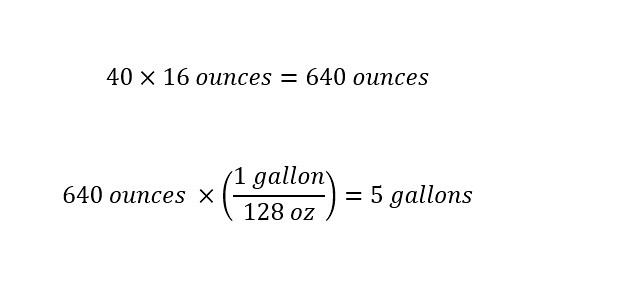
How much water is 40 - 16 oz. water bottle in total? Here is a conversion to gallons below:
A family of four is living on 5 gallons per day. Wow. Compare that to the 107 gallons that an average Los Angeles resident lives on per day. Further, the average Bel Air resident lives on 32,000 gallons per day -- Oh My Goodness -- what is this world coming to? From the description of the uses of the small amount of water, there might be another problem emerging.
Cooking a plastic water bottle to heat up water in a microwave is not good. Do not heat plastic up in the microwave -- whatever you do.
How much does that amount of water weigh?
Weight is an important parameter along with plastic when considering helping out residents in need. Below is the conversion of gallons to pounds for a 24 hour supply to a family of four:
Stocking the water takes resources (trucks, oil, emissions, etc.). When I read this article, the first thought that came to mind was why are the residents of Flint not just given a water dispenser and a large bottle of water -- like the setup below:
Source: Costco Water Delivery Service
Handing out 40 bottles (16 ounce) to resident on a daily basis will generate a large amount of plastic waste (plastic bottles). Do officials have a recycling plan for the plastic water bottles the residents are generating? Is there a central recycling center that residents can return plastic bottles? Using the 5 gallon jug above is reusable. Upon delivery of a set of 2 jugs (5 gallons each), the used jugs could be returned and refilled to give out more water. This would cut down on waste generation during a time of limited resources.
The water rationing (by authorities) does not include sewer (toilet) water -- which is still running in most areas. Still, surviving on that small amount of water per day with a family of four is probably pretty difficult. I started considering how much water is used per person per day in other cultures. After a couple of refined questions into google's search engine,
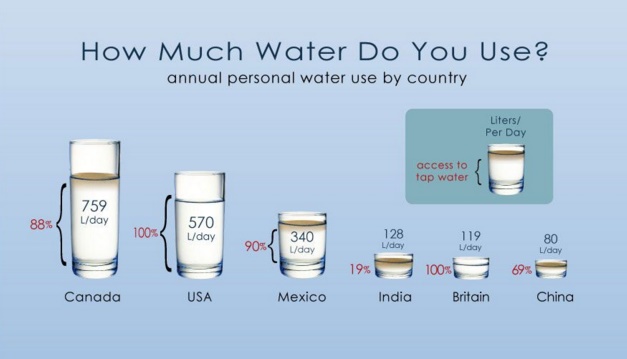
I found a website called 'CreditLoan.com' who offers a "visual economics" guide on the website. After cutting and altering the infographic, the results are shown below for a few countries:
Source: CreditLoan.com
The diagram is explained on the website as follows:
The annual personal water use by country varies widely. In Canada, 88 percent of people have access to tap water. Canadians use 759 liters per day. In the USA, 100 percent of the people have access to tap water, using 570 liters of water per day. In Mexico, 90 percent of the people have access to tap water, with each person using 340 liters of water per day. In India, 19 percent of the people have access to tap water, with each person using 128 liters of water per day. In the U.K., 100 percent of the people have access to tap water, using 119 liters of water per day. In China, 69 percent of the people have access to tap water, with each person using 80 liters of water per day.
Some people in the world do not have running water? Yes, that is correct. My colleague whose husband is from India tells me about the village where she visited to see her new family. Literally, there is no running water. I was blown away. Shows you how little I know. But, I am appreciative of the resources that we do have here in the U.S. and am learning how to conserve more by the month. I am a work in progress.
In the diagram above, there exists a spectrum of water usage listed in terms of most to least by country. Here within the U.S., could produce another spectrum of usage. On one end, users such as residents in "Bel Air" might be placed. Whereas on the other side of the spectrum, we would list disaster areas -- such as Flint, Michigan. Actually, if we are including all American establishments, we might not want to forget "Astronauts" who are living in space. Astronauts form the far end of the spectrum of water usage per day. Why, you might ask?
Astronauts Live In A Closed Water Loop?
In space, the concept about supplies can be stated: what goes up with the space shuttle, must come down with the space shuttle! Yep, the space station, space shuttle, space instrumentation form a "closed loop."
What do I mean by a "closed loop"? Well, everything is conserved to the highest degree. Really?
Based on a search on google, I found a website produced by
NASA -- which described the conditions of water usage in space.
"We have plenty of water on the Space Station now," says Jim Reuter, leader of the ECLSS group at the Marshall Space Flight Center. "The Russian module Zarya is packed with contingency water containers (CWCs) that were carried over from the Space Shuttle during assembly missions earlier this year. They look like duffle bags and each one holds about 90 lbs."
"But it's expensive to ferry water from Earth," he added. "We have to recycle. There's already a Russian-built water processor in orbit that collects humidity from the air. Here at Marshall we're building a regenerative system that will be able to recycle almost every drop of water on the station and support a crew of seven with minimal resupplies."
Right: Shuttle pilot Terry Wilcutt with 7 contingency water containers destined for the space station Mir.
The ECLSS Water Recycling System (WRS), developed at the MSFC, will reclaim waste waters from the Space Shuttle's fuel cells, from urine, from oral hygiene and hand washing, and by condensing humidity from the air. Without such careful recycling 40,000 pounds per year of water from Earth would be required to resupply a minimum of four crewmembers for the life of the station.
Here is the corresponding picture of the pilot with the "contingency bags" of water shown below:
Every drop of water imaginable is recycled. Even animals used in research? Yes. In the article, the statistic of about 72 rats can urinate and sweat the equivalent of one human being. That is a pleasant thought. And here I thought I was thinking deeply about water conservation -- not even close.
The astronauts are trained to conserve water to the extreme compared to our usage on Earth. NASA has designed recycling systems that mimic the water cycle found on planet Earth. Here is an excerpt to describe the rationale during designing the system used in space:
"The water that we generate is much cleaner than anything you'll ever get out of any tap in the United States," says Carter. "We certainly do a much more aggressive treatment process (than municipal waste water treatment plants). We have practically ultra-pure water by the time our water's finished."
Mimicking Mother Earth
On Earth, water that passes through animals' bodies is made fresh again by natural processes. Microbes in the soil break down urea and convert it to a form that plants can absorb and use to build new plant tissue. The granular soil also acts as a physical filter. Bits of clay cling to nutrients in urine electrostatically, purifying the water and providing nutrients for plants.
Water excreted by animals also evaporates into the atmosphere and rains back down to the Earth as fresh water -- a natural form of distillation.
Water purification machines on the ISS partly mimic these processes, but they do not rely on microbes or any other living things.
"While you try to mimic what's happening on Earth -- which is so complicated if you really think about it -- we have to use systems that we can control 100 percent," said Monsi Roman, chief microbiologist for the ECLSS project at MSFC. ECLSS depends on machines -- not microbes -- because, "if a machine breaks, you can fix it."
The water purification machines on the ISS will cleanse wastewater in a three-step process.
The first step is a filter that removes particles and debris. Then the water passes through the "multi-filtration beds," which contain substances that remove organic and inorganic impurities. And finally, the "catalytic oxidation reactor" removes volatile organic compounds and kills bacteria and viruses.
Every Drop Counts
Once the water is purified, astronauts will do everything possible to use it efficiently. "On the ground, people flick on the faucet and they probably waste a couple of liters of water just because it's free and the water pressure is high," notes Carter.
Nature has solved a large amount of issues that scientists are only discovering as time goes on and technology improves. There are "mimics" that are not fully optimized and work quite well by today's standards. Imagine if scientists could one day really "mimic" natures ability to form filtration systems that work with a high degree of efficiency (removing debris, antimicrobial activity, high throughput, etc.)? Nevertheless, the work that NASA has done to optimize the filtration system aboard today's space stations is amazing...
Quite impressive to say the least. The amount of thought and design matches the large amount of "Research and Design" that is needed to fund the space program annually. Of course, out of this research, products emerge that hit the market and improve our lives daily. Yet, often, you will hear people who are not scientists or affiliated with science talk about the wasteful spending on space programs. We learn a tremendous amount from this research about limits and life in general (growing plants in space - last year!).
Conclusion...
How much water do you use on a daily basis? How can you optimize the amount of water that you consume and possibly waste? Do you care even to do so? These are questions that you might want to entertain. Even if a person does not plan to reduce their consumption, thinking deeply or critically about the use of water in one's household is important. The action alone will improve the lives of yourself and those around you. Of course, in the process, you might end up driving your friends and family a little stir crazy.
Thinking about the situation in Flint (Michigan) has caused me to rethink how I tanke for granted the resources around me. Although, one could argue that based on my post about water (which was brief), this has been on my mind. Every time I see a rain fall event here in Southern California, I cannot help to think of the total volume of rain that is washed into the ocean (and not reclaimed). Each time that I see a "broken water pipe" in the city and water running down the street, I think of the waste that is generated and how many of these 40 (16 ounce) bottles could be filled up and sent to remote areas.
In a future post, I will talk about a recent article that I have read discussing the amount of water that is actually reclaimed annually by various departments of water and power companies. As you will learn, the amount is not trivial. On the order of billions of gallons annually. Stay tuned until then. Until then, learn something new about water conservation in the world and leave the new found idea in the "comment section" below. I love to learn new knowledge. Have a great evening.