Showing posts with label tropical storms. Show all posts

Monday, September 17, 2018

Typhoon Mangkhut Drops Enough Rain On Philippines To Fill 25,000 Superdomes per hour?


Source: Time


As Americans were watching Hurricane Florence ravage the East Coast of the United States over the weekend, residents of the Philippine Islands were experiencing an equivalent destruction of their country from Typhoon Mangkhut.  According to the New York Times article titled "See Inside Typhoon Mangkhut in 3-D" at the height of maximum rainfall over the Philippines, the rate of rainfall reached 11.7 inches as shown in the excerpt below:


Rain tends to be heaviest near the center of a storm, in what is known as the eyewall, visible here in red. The highest rainfall rate for Typhoon Mangkhut reached 11.7 inches per hour inside the southern wall on Friday.


With this astounding rate of rainfall in mind, regular readers of this site will naturally ask themselves the following question:


How many Superdomes were filled per hour by Typhoon Mangkhut?


In the paragraphs below, the amount of Superdomes are calculated using dimensional analysis.  The result as indicated (potentially 25,000 Superdomes per hour) is astonishing.  Following the analysis is a video confirming the astounding number which should blow your mind.


How Many Superdomes Per Hour?


Basically, for the current blog post, the same methodology which was used to calculate the number of Superdomes which could be filled with the predicted rainfall due to Hurricane Florence - which I posted last Friday.  The Mercedes-Benz Superdome is located in Louisianna and has an interior volume of 125,000,000 cubic feet.  Shown below is a picture of the Mercedes-Benz Superdome:



Source: The Advocate


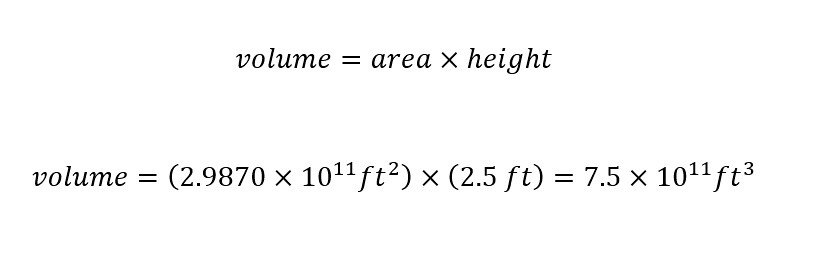
Superdomes can be a 'metric' which are commonly used to cast large (enormous) values of volumes or statistics popularly reported in the news.  The maximum rate of rainfall reported in the New York Times article above is a perfect candidate along with the landmass of the Philippine Islands -- which makes a volume -- to be used in an analysis with the metric above used.  The volume of rainfall can be expressed as an equation as shown below:
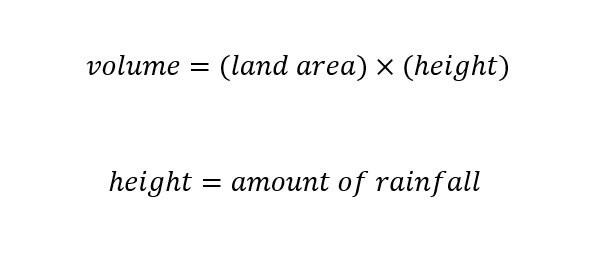


The volume for a geographic area is the land mass area multiplied by the amount of rainfall over the given land mass area.  If we consult Google with the following question: Rainfall?  The definition of the term 'rainfall' is shown below:
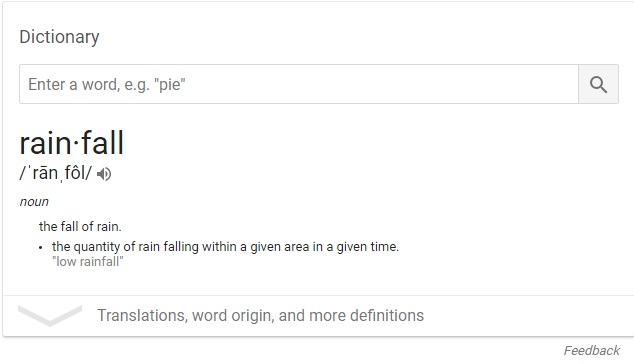


The definition of rainfall is 'the quantity of rainfall falling.'  To begin the analysis (with actual numbers) the land mass (total area) of the Philippine Islands needs to be determine.  As usual, Google is consulted with the following question: Philippine Area?   The answer is shown below:



Notice that the area (land mass) is expressed in units of measurement of 'square mile'.  When the maximum rainfall is reported in units of 'inches', a decision to convert one number to the other needs to be made.  For this analysis, 'inches' will be the unit of measurement for analysis -- at least the beginning of the analysis.  In order to convert the land mass area of Philippine Islands from units of 'inch' to 'mile' the following question needs to be asked in a search engine like Google: How many square inches in a square mile?  The answer is shown below:



For every single square mile, there are 4.014 billion square inches.  The conversion of units from 'square miles' to 'square inches' is shown below:
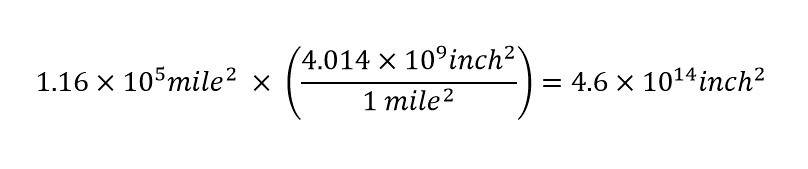


The answer above shows that Philippines is around 116 thousand square miles which when converted to square inches turns out to be 460 trillion square inches.  Now that the land mass area is converted to units of square inches, the volume of rain which fell at a maximum on Friday due to Typhoon Mangkhut can be calculated using the expression for volume from above:



Wait?  The above equation is 'rate of rainfall' -- whereas I stated that the volume was being computed above?  Why the difference?  As I stated above, the amount of rain falling over and hour was reported to be 11.7 inches/hour.  Which is a rate.  Therefore, the volume is actually the rate of volume of rainfall over a given time as shown below:
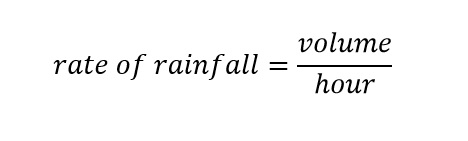


With 11.7 inches/hour of rainfall pouring down due to Typhoon Mangkhut, the total amount (volume) of rain would be 5,400 trillion cubic inches per hour of rain.  Wow!  Based on the calculations in the previous blog post regarding the total amount of rain predicted (by a forecaster) due to Hurricane Florence, lets cast the rate of rainfall into comprehensible units.  To do so, a unit conversion needs to be accomplished from units of 'cubic inches' to 'gallons'.  A conversion factor needs to be determined.


If the following question is typed into Google: How many cubic inches are in a gallon?  The answer is shown below:
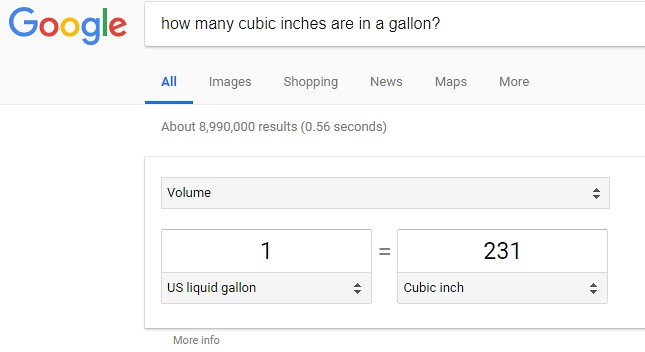


With the conversion factor known, the conversion is carried out by using the same methodology as above:



Therefore, the amount of rainfall over the Philippine Islands at maximum rainfall is shown below:
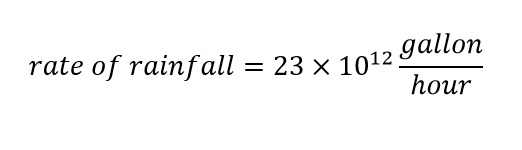


Wow!  23 trillion gallons in a single hour.  In my previous blog post about the predicted amount of rainfall over four states (in a few days) was expected to be 17 trillion.  The difference shows that Typhoon Mangkhut is larger than Hurricane Florence.  This is not to say that Hurricane Florence is not inflicting a large amount of damage in the United States over the weekend.  The East Coast is in terrible shape and we are keeping the residents there in our thoughts.  Be safe.


The metric which has been used to visualize large volumes of rain is the Mercedes-Benz Superdome as shown above.  With a volume of 125,000,000 cubic feet, the Superdome is a perfect metric to which compare the large volume of rain falling over a given region in a storm.  To calculate the number of Superdomes which could be filled with 23 trillion gallons/hour, first a unit conversion needs to be accomplished.  In order to compare the 23 trillion gallons/hour to 125,000,000 cubic feet, a unit conversion from 'gallon/hour' to 'cubic feet/hour' needs to be accomplished.


To determine the number of 'cubic inches' are in a 'cubic feet', we type into Google the following question: How many cubic inches are in a cubic foot?  The answer is shown below:



The conversion of units between 'cubic inch' and 'cubic feet' is shown below:



Next, to determine the number of Superdomes which could be filled with the amount of rain falling over an hour over the Philippine Islands is shown below:



Wow!  The total amount of Superdomes which would be filled at the rate of rainfall equal to 3.1 trillion cubic feet per hour is a whopping 25,000 Superdomes per hour.


The final question is the following:


Does the amount of rainfall -- 3.1 trillion cubic feet per hour over the Philippine Islands make sense?


To answer the question above, lets view the video from YouTube below taken over the weekend during the storm - Typhoon Mangkhut:


Wow!   I am left speechless by the video above.


Conclusion...


Oh my goodness?  The amount of rain is enormous and unparalleled.  Between the total number of storms hitting the globe over the weekend, the amount of rainfall is historic and unparalleled in volume.  The rainfall must be surging into the hundreds of trillions of gallons of water falling on land masses like Philippine Islands and the East Coast of the United States of America.  Destruction is inevitable.  Just think of the amount of time and effort which will be required to restore basic resources like power and water?  The destruction is huge and should not be understated.  Keep the residents experiencing these terrible storms in our thoughts and prayers.


Related Blog Posts:


A Forecaster Predicts That Hurricane Florence Will Drop Enough Rain To Fill 18,400 Mercedes-Benz Superdomes

Hurricane Harvey Drops Enough Rain On Houston To Fill 560 Dallas Cowboy Stadiums


How Much Water Is Contained In All Oceans Around The Globe?


Storm Raises Water Level In Lake Cachuma By 31 feet, How Much Water Is That?


How To Make Sense Of Water Flowing At 100,000 Cubic Feet Per Second


Can 11 Trillion Gallons Of Water Fill 14,000 Dallas Cowboys Stadiums?


How Much Rain Did The East Coast Receive From Hurricane Matthew?


How Much Rain Did Haiti Really Receive?


How Much Rainfall Has Dropped On Louisiana?


How Big Was The "Water Bomb" Of Rainfall In Macedonia?


How Much Rain Did Huauchinango (Mexico) receive?


How Much Rain Did Elliot City (Maryland) Really Receive?


If The Mosul Dam Breaks, The City Of Mosul Would Be Under 65 Feet Of Water?


What is the volume of water in a few inches of rain?


Volume of Waste in the Mine Spill (in Brazil) Equivalent to 78 Deepwater Horizon Oil Spills


Friday, September 14, 2018

A Forecaster Predicts That Hurricane Florence Will Drop Enough Rain To Fill 18,400 Mercedes-Benz Superdomes


Source: Axios


Hurricane Florence has arrived on the East Coast of the United States with a force which seems unparalleled compared to previous storms.  The category has changed with time, though, without dispute, hurricane Florence is present and causing damage which will take years to recover from.  To comprehend the predictions from weather forecasters, dimensional analysis is necessary to cast the enormous predictions into light.  How much rain is going to fall on the East Coast from hurricane Florence?  Here is an excerpt from a weather forecaster interviewed by 'Mashable' in an article titled "Hurricane Florence is forecast to dump a historic amount of rain. Here's how much" which states the huge amount of potential rain to be dropped:


Meteorologist Ryan Maue of WeatherModels tweeted some projections on Thursday morning. 
Maue's models suggest that around 17 trillion gallons of rain will fall across North Carolina, South Carolina, Virginia, and Georgia with some spots receiving as much as 30 inches of rain before Florence is finished. 


According to the excerpt shown above, 17 trillion gallons is predicted to fall on North Carolina, South Carolina, Virginia, and Georgia over the next few days.  This will cause terrible damage to the infrastructure in cities lining the coast and displace many thousands of residents from services (which are much needed) such as electricity, emergency services, and make returning to work nearly impossible.  In order to understand the terrible destruction of the storm, the amount of rain (17 trillion) should be placed into context.  In the paragraphs below, dimensional analysis is used to compare the amount of rain to the number of Mercedes-Benz Superdomes which could be filled with 17 trillion gallons.


How Much Space Occupies The Mercedes-Benz Superdome?


The metric which has been chosen to compare the enormous amount of rain that is expected to fall over the 4 states mentioned above on the East Coast over the next few days is the Mercedes-Benz Superdome.  The Superdome is located in Louisianna and has an interior space (volume) equal to 125,000,000 cubic feet of space.  Yes, I said 125,000,000 cubic feet of space as shown below:


Which fills the Superdome shown below:


Source: The Advocate


That is an large space indeed.  Football games are played in the Superdome and at max capacity will hold a total of 73,000 people.  Although, during a super bowl, the capacity has expanded beyond capacity to hold upwards of 79,000 people.  Needless to say, when an HUGE volume is reported of liquid such as the amount of rain which will fall over the next few days, a perfect metric to compare is that of the Mercedes-Benz Superdome.


According to the excerpt taken from the news, the amount of rain expected to fall is 17 trillion gallons.  First, lets look at the amount of zero's after 17 -- trillion.  If 'Wikipedia' is consulted for the page defining 'trillion', the following definition is shown below:


Trillion (short scale) (1,000,000,000,000; one million million; 1012; SI prefix: tera-), the current meaning in both American and British English.


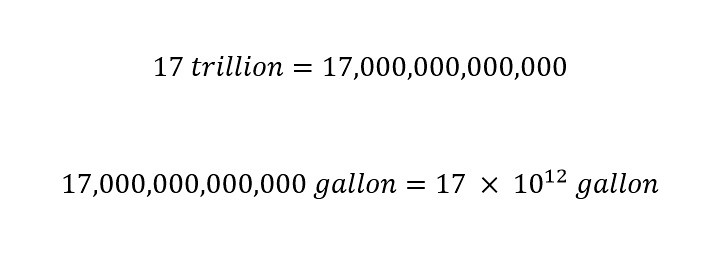
Therefore, if the number 17 trillion is written out in entirety, the number would appear as follows:


The first line above shows 17 trillion in long form.  For the purpose of shortening up a number to move around in calculations used in dimensional analysis, the value 17 trillion could be expressed in 'Scientific Notation' as shown in the second line above.  Which makes writing and expressing the number much easier.  Compared to writing out all of the unnecessary zero's involved.


Notice that the unit of measurement in which the amount of rain projected to fall are expressed in units of 'gallons'.   Remember that the interior space of the Superdome is expressed in units of 'cubic feet'.  Therefore, if the two numbers are going to be used in the same analysis (the purpose of the blog post), then a 'unit' conversion is necessary.  For this blog post, I will arbitrarily use the units of 'cubic feet' as a comparison.  We just as well could have converted over the units of 'cubic feet' to 'gallon's in order to compare the two values of interest (i.e. volume of Superdome and volume of rain).


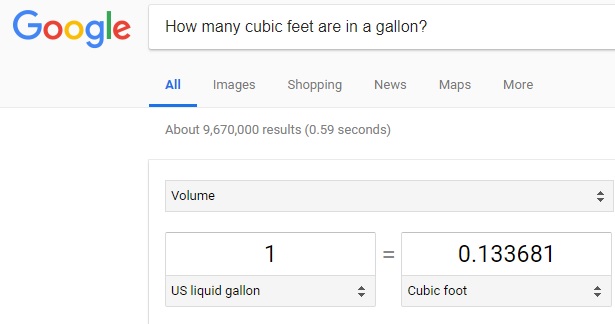
In order to convert the units of measurement from 'gallon' to 'cubic feet', a conversion factor is needed.  To simplify the search for a conversion factor, consult Google with the following question: How many cubic feet are in a gallon?  The answer is shown below:


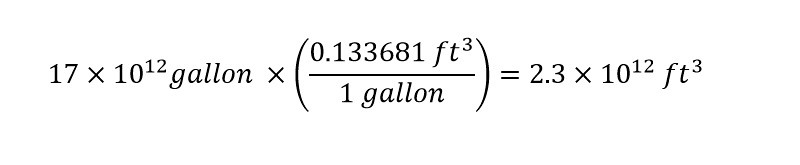
For every gallon, there are 0.133681 cubic feet.  Written as a conversion factor, the unit conversion from gallon to cubic feet is shown below:


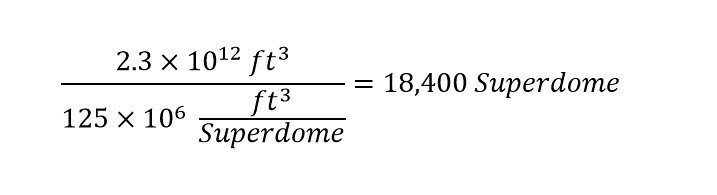
The answer to the conversion shows that 17 trillion gallons is equivalent to 2.3 trillion cubic feet.  Which means that 17 trillion gallons of water is equivalent to 2.3 trillion cubic feet of water.  Same volume, different units of measurement. Now that both values are in the same units of measurement -- 'cubic feet' -- a simple division of two values (total volume of rain divided by total volume of a single Superdome) yields the total number of Mercedes-Benz Superdomes which would be filled with 17 trillion gallons of rain:


The answer indicates that if 17 trillion gallons were poured into 18,400 Superdomes, there would be no water remaining.  Wow.  With this enormous amount of Superdomes as a result, there should be no wonder why residents should be concerned about their health and safety.  That enormous amount of rain will inevitably wreak havoc on the four states listed above.


Conclusion...


In the blog post above, the number of Mercedes-Benz Superdomes were calculated which would be needed to hold a total volume of rain of 17 trillion gallons.  At this moment, you may be wondering how 17 trillion gallons compares to the amount of rain that Hurricane Harvey dropped on Houston (Texas).  Hurricane Harvey dropped 58.3 billion cubic feet of rain.  That is enough to fill 560 Dallas Cowboy Stadiums.  Note that the total amount of rain is distributed across very different amounts of land masses.  Different amounts of rain across different proportions of land.  Still, these hurricanes are dropping enormous amounts of water (in the form of rain) which is wreaking havoc on the surrounding land.


Hopefully, the blog post above along with other dimensional analysis blogs on this site shed light on the severity of storms hitting the world over the past two years.  In the index of blogs below, other storms have been analyzed in a similar fashion.  Regardless of the size of the storm, any loss of life is tragic and unacceptable.  Please keep the residents of hurricane Florence in your thoughts over the next few days (and months).  If you are in the path of hurricane Florence, stay safe please.


Related Blog Posts:


Hurricane Harvey Drops Enough Rain On Houston To Fill 560 Dallas Cowboy Stadiums


How Much Water Is Contained In All Oceans Around The Globe?


Storm Raises Water Level In Lake Cachuma By 31 feet, How Much Water Is That?


How To Make Sense Of Water Flowing At 100,000 Cubic Feet Per Second


Can 11 Trillion Gallons Of Water Fill 14,000 Dallas Cowboys Stadiums?


How Much Rain Did The East Coast Receive From Hurricane Matthew?


How Much Rain Did Haiti Really Receive?


How Much Rainfall Has Dropped On Louisiana?


How Big Was The "Water Bomb" Of Rainfall In Macedonia?


How Much Rain Did Huauchinango (Mexico) receive?


How Much Rain Did Elliot City (Maryland) Really Receive?


If The Mosul Dam Breaks, The City Of Mosul Would Be Under 65 Feet Of Water?


What is the volume of water in a few inches of rain?


Volume of Waste in the Mine Spill (in Brazil) Equivalent to 78 Deepwater Horizon Oil Spills




Sunday, October 9, 2016

How Much Rain Did The East Coast Receive From Hurricane Matthew?

News reports are surfacing everywhere on Twitter (and other social media outlets) discussing the devastation that Hurricane Matthew has brought to the East Coast.  Below is one example from the news site 'NBC News':


The devastation is without question.  What is questionable is the preparation of emergency agencies based on knowledge a few days (weeks) earlier with the disaster that unfolded in Haiti.  Haiti received an enormous amount rain -- which I wrote a blog about last week.  The amount of rain was so large that the summer storm in China which received a whopping 580 billion cubic feet was eclipsed by 750 cubic feet of rain.


Using the same approximations (land area, average rainfall, etc.), lets calculate the amount of rain that the East Coast has received to get a better grasp on the terrible Hurricane Matthew that has ripped apart and drenched parts of the world.


East Coast Receives Rain


As if the devastation to Haiti was not enough to contend with.  But Hurricane Matthew continued to drive up into the United States.  Various news accounts have given numbers which allow us to approximate and estimate through dimensional analysis the terrible amount of rain that have plagued regions.


To accurately assess the total volume of rain that has dropped on the entire East Coast as a result of Hurricane Matthew, each of the weather stations would have to report an average amount of rainfall across their respective region.  Not every region has the capability or funding to do so unfortunately.  Therefore, we have to rely and approximate based on whatever values are reported.  Hopefully, in the future, this disparity will change and weather prediction and storm forecasting will benefit to a large extent from such positive change.   The example I will use below is of the tremendous amount of rainfall that has hit the state of North Carolina in the last few days.


According to the news site 'NBC News' in an article titled "U.S. Death Toll From Hurricane Matthew Rises to 17 Across Four States" reports were given of amounts of rain (listed in inches) fall to various regions:


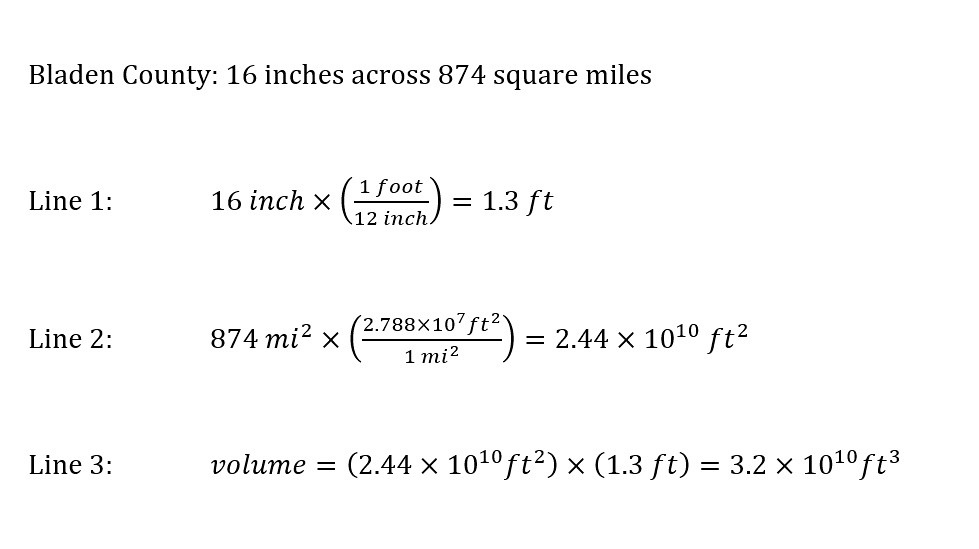
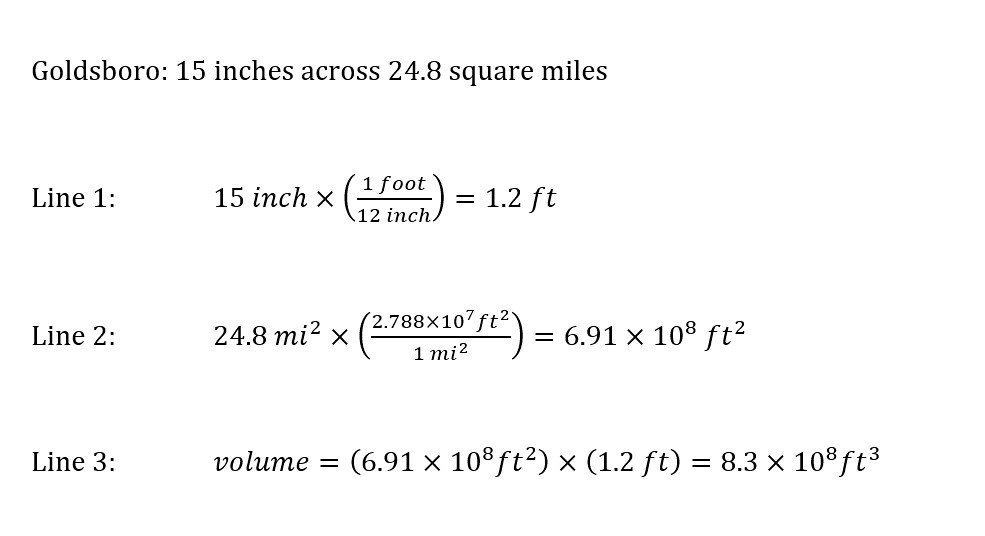
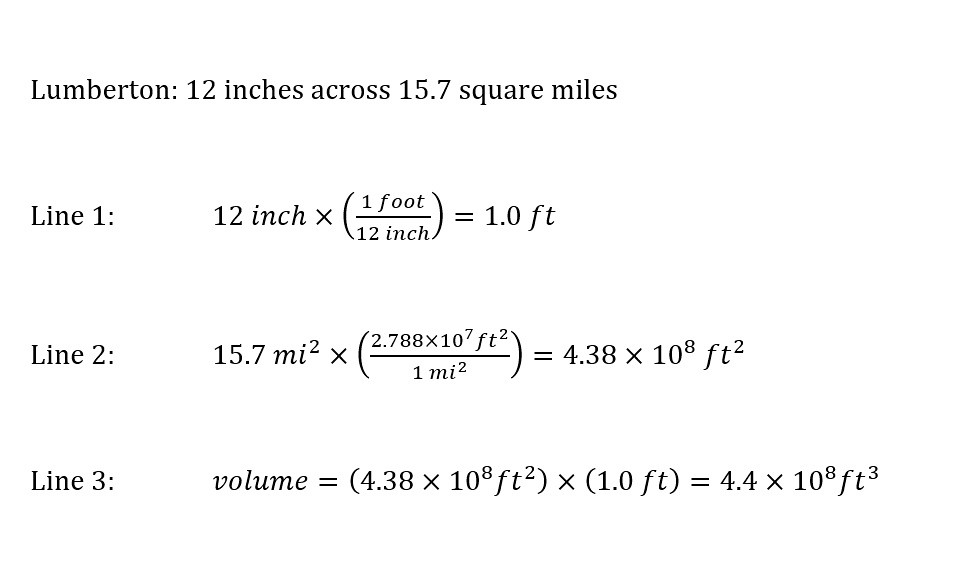
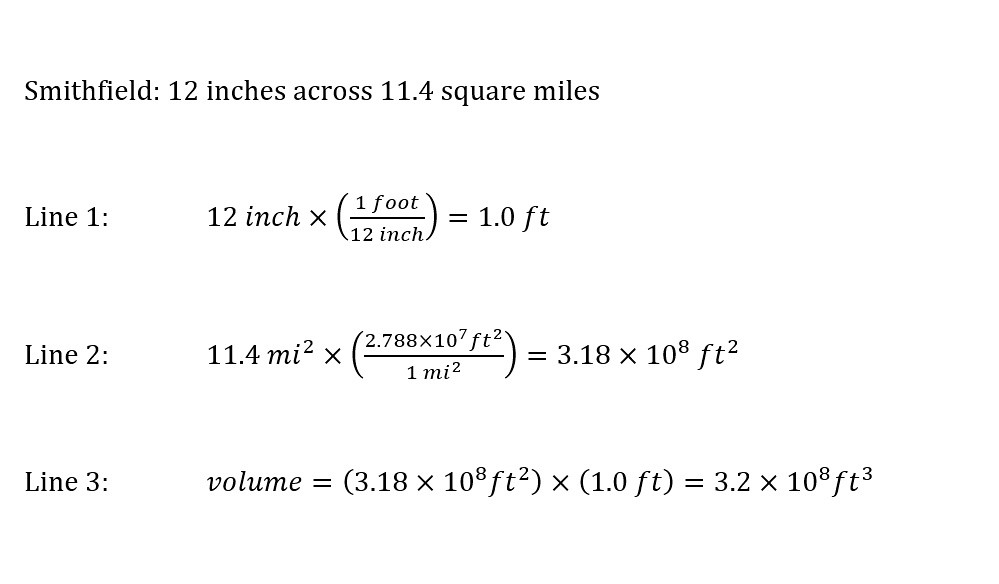
By Saturday night, rainfall totals were 16 inches in Bladen County, 15 inches in Goldsboro, 12 inches in Lumberton and Smithfield, and 9 inches in Raleigh and Rocky Mount, McCrory said in a statement.


After reading the above statement regarding the amount of rain that fell on various counties in North Carolina, you might not be shocked.  Picture says thousands of words.  Remember that rain was not the only component that made up the devastating impact of Hurricane Matthew.  The other destructive component was the wind factor with speeds reaching into a hundred miles per hour in some places.


Compounding the destruction from rainfall alone, the wind can add to the destruction by imposing a force to be reckoned with.  Below is a video (just over a minute) from 'YouTube' to illustrate my point:


Watching the video above really drives home the destructive power of wind.  Too often, people watching the storm from a television cannot comprehend the effect of wind in a given storm.  Although, after rain has fallen or in combination with, wind can have very devastating and destructive effects on a given geographic area.  Especially, if the area is not built to receive that much rain.  This was the case with a storm in Elliot City (Maryland) earlier this year.


In order to understand the extent of the damage, a few calculations can be performed.  As I mentioned above, we can use the logic and approximations that we have assumed in earlier posts on this site.  First, we can find out the geographic area by looking in the 'Wikipedia' sites for the counties and regions listed in the excerpt above.  Using the same methodology as in previous blog posts of calculating a volume from the product of the area (geographic land mass area) and the height (of rain fall), a total volume will result from our efforts using the expression below:


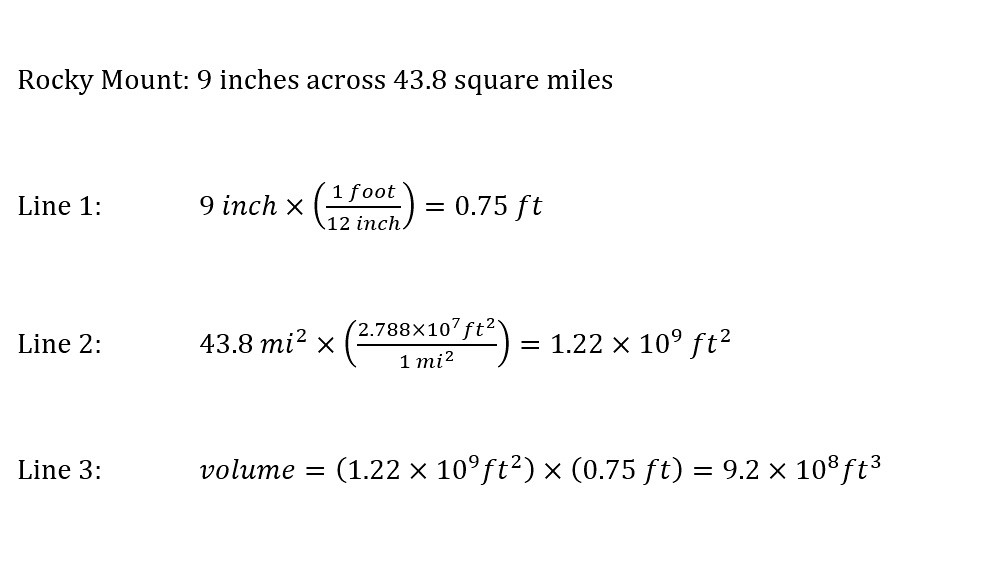
I will list the area (in square miles) and height (in inches of rainfall).  After performing the conversion of square miles to square feet along with converting inches into feet, a final calculation can be performed. We can plug the values directly into the expression to obtain a volume.


Six regions were listed in the excerpt above: Bladen County (874 square miles), Goldsboro (24.8 square miles), Lumberton (15.7 square miles), Smithfield (11.4 square miles), Raleigh (142.8 square miles), and Rocky Mount (43.8 square miles).  It is important to note that each of these regions have a water component that was not included in the geographical area calculation.  This would increase the area of each region.  Additionally, the water component exacerbates the effects of a Hurricane like Hurricane Matthews.


Again, the outline of the calculations below will be as follows:


1) Line 1: Conversion of units of rainfall - from inches to feet.


2) Line 2: Conversion of units of land area - from square miles to square feet.


3) Line 3: Volume of rainfall - land Area multiplied by Height of rainfall.


With the values and order of calculations/conversions listed above, we can now calculate a volume for each region as shown below:


The volumes listed above are enormous in magnitude which are based on the reporting of the devastating effect of Hurricane Matthew in North Carolina.  As I mentioned above, the state of North Carolina has waterways dispersed throughout the state as illustrated below from 'Wikipedia':


Source: Alexrk2


The East Coast has received an amount of rain that has so far claimed the lives of 18 people (in North Carolina).  Understanding the magnitude of such disasters gives the reader an idea of the force of destruction that such disasters bring with them.  The news cycle is short compared with the long-term recovery process of natural disasters.  The need for accurate reporting and transparency is critical to convey the need for greater infrastructure for future disasters.  Disaster preparation is achieved through transparency and education.


Just in the last six months, the world has seen rainfall that is beyond comprehension in various areas of the US and beyond.  In the paragraphs below, I decided to illustrate the natural disasters in a different light.  The metric I have chosen is appropriate to some degree to illustrate the large volume of rain that has so far fallen on the East Coast.


How Many 'World Largest Pools' Could Be Filled?


The values reported above are enormous.  Well into the billions of cubic feet of rain have dropped onto North Carolina.  If the volume of rain that has dropped onto the six regions is accurately representative of the total rainfall that has dropped onto the entire East Coast, then the total amount is just simply incomprehensible -- to say the least.


When such enormous amounts of volumes are encountered, an appropriate metric is the "World's Largest Pool."  This giant structure has been used frequently on this site -- starting with the first time last year.  Two pictures are shown below for a reference from the website 'Huffington Post':


And ...


Source: Huffington Post


The total volume of this mega structure that has the title of the "World's Largest Pool" is a whopping 60 million gallons.  Yes, you read correctly.  In the image above, a sail boat is shown in the middle.  Alternatively, there are hotel structures in the first image to give a reference to the size of amazing feat.


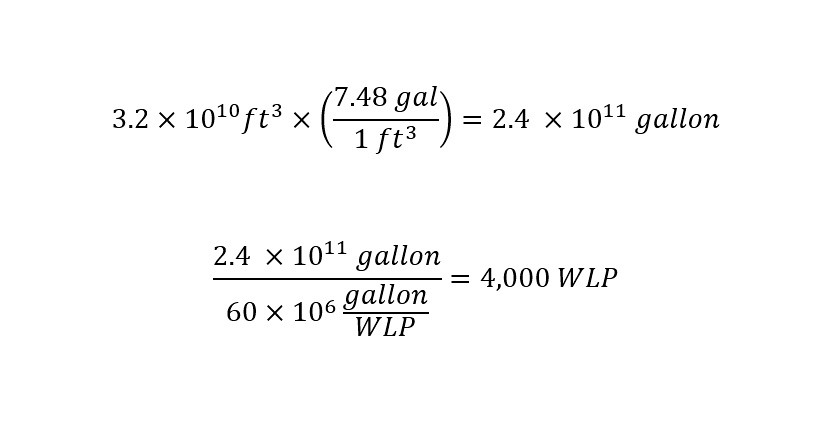
If we wanted to calculate the amount of rain in each region mentioned above in North Carolina during Hurricane Matthew, we could easily.  First, each volume would have to be converted from cubic feet to gallons.  The conversion would allow us to directly compare each volume as an integer value.  That is the ratio would be expressed as an integer value of the "World's Largest Pool."  From here on out, the "World's Largest Pool" will be abbreviated to "WLP".


Without further ado, lets figure out how many of the WLP could be filled with the respective volumes of rain.  One example calculation will be shown for the region of Bladen County in North Carolina.  All other volumes will be displayed in a table after.


Just when you think that the numbers cannot get any larger, casting the values in different units (in this case US gallons) does just that.  Furthermore, as the result suggests, the amount of rain that fell onto Bladen County is enough water to fill 4,000 of the "World's Largest Swimming Pool".  WOW.


Using the "World's Largest Pool" or WLP as a metric really changes the volume of water.  Before the calculation, all that we were left with from the calculations in the first section were enormous amounts of rainfall expressed in units of cubic feet.  With the calculation above, one can easily view the pictures of the WLP and try to make sense of the number.  Furthermore, if that amount of water fell on any geographical region, there would be damage.


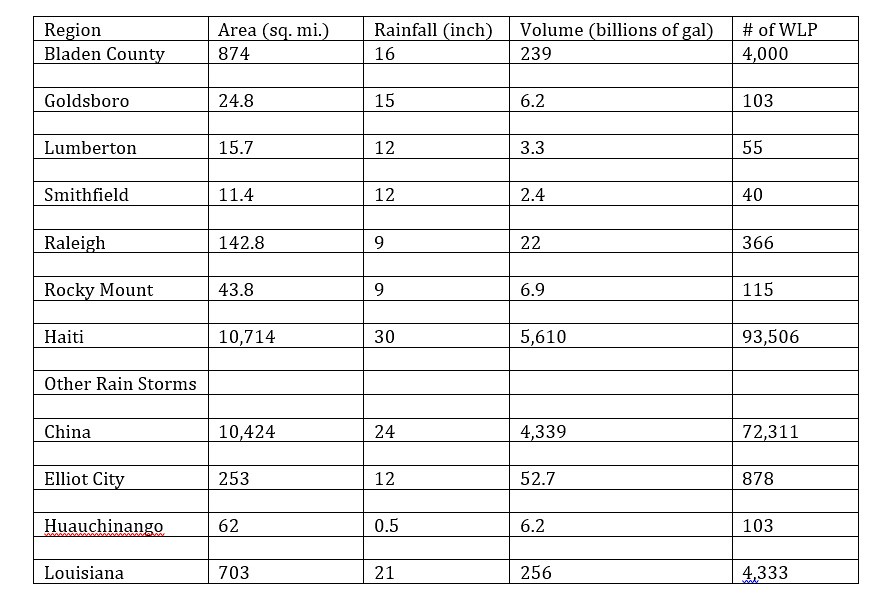
As I promised above, I would provide a table with the equivalent information as calculated above for other recent storms.  Think about the following storms which have been covered on this blog site: China, Elliot City (Maryland, USA), Huauchinango (Mexico), Louisiana (USA), and Haiti.


Here is the table with the values as promised above for comparison:


The importance of showing all of the data on the storms is to illustrate the damage caused by different amounts of rain.  Each storm is different.  Which is why the  continual update of weather models needs to be sought after.  Similarly, more money needs to be devoted toward improving storm calculation programs.  Additionally, more technology (sensors, stations, drones, etc.) need to be deployed to pick up data and feed the data back into the models to improve accuracy.


The tragedy caused by the storms this year so far are enormous and incomprehensible.


How do we move forward as a Nation?  


As a World?  


What about Climate Change?  


Are these linked in some manner?


These questions remain open ended along with others.  Although, as long as we move forward as a world thirsty for knowledge and thoughtful/mindful about the magnitude of such disasters, change can proceed in the correct direction.  Too often each of us proceed throughout our day with large amounts of stress and anxiety.  We do this without considering another force, the force of nature.  The force of nature can compound our stress and anxiety by hundreds of orders of magnitude.  Think of those put out of their homes by the storms recently as you stress at work.  Take a minute to think of those without power or water or a house.  Have a great day!


Tuesday, October 4, 2016

How Much Rain Did Haiti Really Receive?

Tonight, as I was writing the blog I just finished on autonomous cars, I was scrolling through Twitter to find the original post and ran across the following tweet shown below:


Immediately, I clicked on the article to find out that Haiti received a significant amount of rain from Hurricane Matthew.  How much in comparison to other torrential rain storms this year?  Read onto find out.


How Much Rain Did Haiti Receive?


According to the news site "NBC News" which posted an article titled "Hurricane Matthew: Relief Groups Mobilize for Haiti After 'Catastrophic' Damage" an enormous amount of rain is expected to hit Haiti.  Here is an excerpt describing the magnitude of the storm:


The storm was expected to dump up to 20 inches of rain on parts of southern Haiti and southwestern Dominican Republic. Isolated areas could get up to 40 inches, the hurricane center said.


Instantly, after reading this, I stopped what I was doing and looked for an old post I wrote a few months ago on the massive torrential rain that China received.  Alright, I published the blog post that I was working on first -- in order to focus on the massive amount of rain that is expected to hit Haiti.


In order to compare the amount of rain that is expected to hit Haiti, I needed to calculate a total volume.  I will walk you through the calculations and logic in the following paragraphs.  Some of the values are approximations which I will try to clarify as we go.  If you have any questions regarding approximations or assumptions, just leave a comment.


With this in mind, first, we need to know how large (area in square miles) Haiti is in order to calculate a total volume.  According to the "Wikipedia" page, the total area of Haiti is 10,714-square miles.   The volume of rain was not reported in the news.  Although, a height was reported. According to the excerpt above, between 20 inches of rain in the Southern part of Haiti and 40 inches in other parts -- which could be approximated (grossly) to an average of 30 inches across all of Haiti.


Over the course of the next few days, news reports will refine their values and we can do a follow up comparison.  Specifically, we can then evaluate how far off our approximation was in this post.  For now, lets proceed with the calculation of the total volume of rain.


In order to calculate a volume, three numbers will need to be known.  Or in this case, two numbers will need to be obtained.  All of them have been specified already in this post.  We will need an "area" and a "height" to determine the total volume.  What's missing then?


The values are all reported in different units.  What?  Yes, we have an area of Haiti that is reported as 10,714-square miles.  Further, we have a height of rain that has or is estimated to fall to be 30 inches.  In order to compare and calculate, the units have to be uniform.  In this case, lets choose units of feet.  Our total volume will be reported in cubic feet of rain.


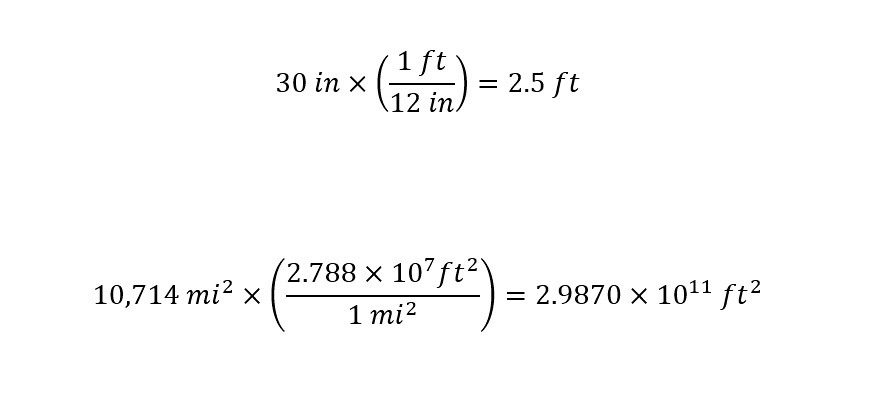
To convert the reported values, we will need the conversion factors from inches to feet and from square miles to square feet.  From the previous blog on rainfall in China, the value is listed below in the conversion shown below:


Next, the equation for the volume is equal to the area (geographic area) multiplied by the height of the rainfall.  The equation for volume is shown below with the above values filled in appropriately:


Wow!  What does the above result mean?


How Does The Value Compare To Other Recent Storms?


As I mentioned earlier, I wrote a blog post on the torrential rain fall in China a few months ago.  Turns out that 12 provinces received around a couple of feet of rain over a geographical area of 10,000 square miles.  Wow!  The total cubic feet of rain was 580 billion cubic feet.


According to our calculations above, the total rain fall expected to hit Haiti as a result of Hurricane Matthews is 750 billion cubic feet of rain.  That is nearly 1.3 times the amount of rain that hit China earlier this year.  These two storms are huge in comparison to the four other storms that I have wrote blogs about: Maryland (USA), Louisiana (USA), Mexico, and Macedonia.


Still, the fact that Haiti is receiving so much rain over its entire land mass is life threatening.  More so than in China, although the populations and land masses are quite different.  Nonetheless, we should be sending humanitarian aid to the victims of these terrible storms.  By calculating the amount of rain fall each storm drops on a given geographic area, the realization of the threat becomes more real.  Dimensional analysis allows us to visualize the magnitude of such disasters by comparing them to our own geographic area.


How does the geographic area of Haiti relate to the geographic area that you live in?


Think about the magnitude of this devastating event.  How would you be impacted by the same volume of rain?  Remember, the magnitudes and values reported/calculated above, neglect the wind speed of 145 miles per hour that blew across the region.  That speed of wind would produce and life threatening force that would level houses and buildings (if not properly built).


Until next time, have a good night.