How many square feet of shelter would be required to house the entire homeless population in Los Angeles County? You might be wondering why I ask? Or, maybe you are just interested in the answer. The reason why I ask the question can be attributed to an article I read in the Los Angeles Times last week about the expanding home additions occurring in the Los Angeles area -- which is of concern to a large amount of residents. As a result, I thought of comparing the square footage to that required to house the total homeless population in Los Angeles County. The results are below.
How Many Square Feet Are Being Added Downtown?
The article that spurred my attention was titled "
Op-Ed L.A. has a growing mansionization problem" and written about the expansion of homes in the Los Angeles area. Popularly known as "mansionizatin" or "McMansion," these home owners are pushing the limits to squeeze every inch of house onto their property without being in violation of city code. Here is an excerpt from the article describing the situation:
My neighborhood is called either Fairfax Village or Mid-City West or Melrose or maybe all three. It is just north of the Grove and Park LaBrea, just south of West Hollywood. Since I work from home I often take walks nearby to unwind, and they’re usually pleasant, though lately I’ve had to take stock of new construction, new homes coming to market, a new shape and character of the place I live.
Not quite half a block north, I come to the first of several two-story fortresses of solitude, all blocky and bland, with minimal plantings, maximal space, rising high above the surrounding cottages. We call them McMansions, but to me that designation brings to mind something far friendlier, if equally cookie cutter. These structures (I have trouble conceiving of them as homes) are drab, impersonal follies, as ugly as they are obtrusive.
Expanding a neighborhood in this fashion tends to remove the character of the neighborhood at the expense of having extra space (baby room, living room, home gym, spare bedroom - to rent out, etc.). Whatever the reason for the expansion is beside the point in my mind. I have resigned to the following mantra: let people be people. If you want to expand the house out to the curb -- go for it. Of course, I am not a homeowner at the moment. If I were, I would probably feel quite differently.
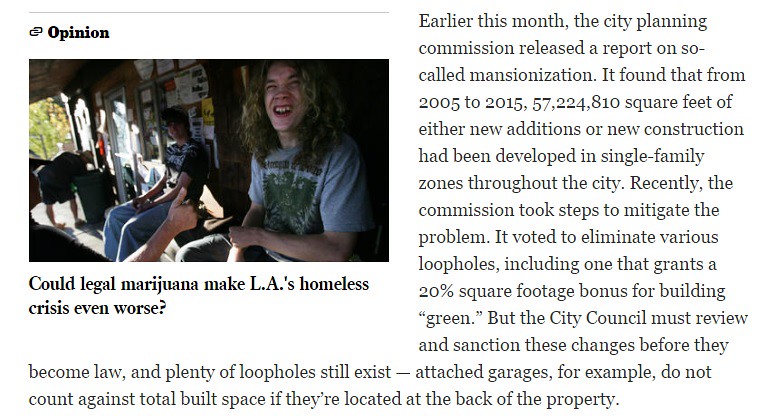
Regardless, in the same article, the author discusses current statistics that were recently released by the county commissioner's office. Here is an image of the article taken as a screenshot shown below:
I chose to add the image because the caption of the article being advertised was "
Could Legal Marijuana Make L.A.'s Homeless Crisis Even Worse?" -- which probably was stewing in the back of my mind. I imagine a part of my brain was processing this image in the back with the following sub-thought:
Could the additional space be used to house homeless people -- people actually in need?
After I read the shocking number of 57,224,810-square feet which represents either new construction or additions, my mind started racing. A disclaimer: My wife and I live in a 350-square foot house in Glendale built in 1929 (with the washer and dryer on the back porch). Therefore, the question of how much space people need is natural for residents like us.
In light of the revealing statistic regarding the space added to the Los Angeles area over the last few years, lets return to the question in the title:
How many square feet would be required to house the total homeless population in Los Angeles County?
How Many Homeless People Live In L.A.?
To calculate the space required to provide shelter to the total population of homeless in L.A. county, the number must be known.
How does on go about finding such a mysterious number?
I typed into google the following question:
How many homeless people are there in Los Angeles County?
After scrolling down through most of the page -- which were filled with 'ads' -- I found a few sites that seem to offer accurate numbers. One of the 'hits' was to the website '
Los Angeles Almanac' with the following information in the excerpt below regarding the fluctuating numbers throughout the year:
According to the Institute for the Study of Homelessness and Poverty at the Weingart Center, an estimated 254,000 men, women and children experience homelessness in Los Angeles County during some part of the year and approximately 82,000 people are homeless on any given night. Unaccompanied youth, especially in the Hollywood area, are estimated to make up from 4,800 to 10,000 of these.
Although homeless people may be found throughout the county, the largest percentages are in South Los Angeles and Metro Los Angeles. Most are from the Los Angeles area and stay in or near the communities from which they came. About 14 to 18 percent of homeless adults in Los Angeles County are not U.S. citizens compared with 29% of adults overall. A high percentage - as high as 20 percent - are veterans. African Americans make up approximately half of the Los Angeles County homeless population - disproportionately high compared to the percentage of African Americans in the county overall (about 9 percent).
The numbers seem to reflect the complexity in obtaining the statistics throughout the year. After all, trying to get a "true" number might be extremely difficult.
Why? Try to be everywhere at once with a clipboard to count! Organizations come up with numbers which differ as do the
news organizations which report them.
To start any reasonable calculation, a value must be known. According to the values cited above, the number is a range from 82,000-250,000 homeless residents. I say this because the calculations will reveal the range of space needed to compare to the number of square feet (over years) in new construction going up in the Los Angeles area as each can differ greatly.
How Much Space Is Required To House 82,000 Residents?
In order to calculate the space needed, the space per person needs to be known. How much space do we allocate (in our calculation) for each homeless person and still be somewhat accurate? I searched the internet looking for the average space allotted to each resident in a homeless shelter.
What did I find out?
I found an article on the website '
BusinessInsider.com' titled "
I Spent The Night In A Homeless Shelter—Here's What It Was Like" providing a first hand account of spending the night in a homeless shelter. The shelter that the reporter stayed at was located in Atlantic City, New Jersey.
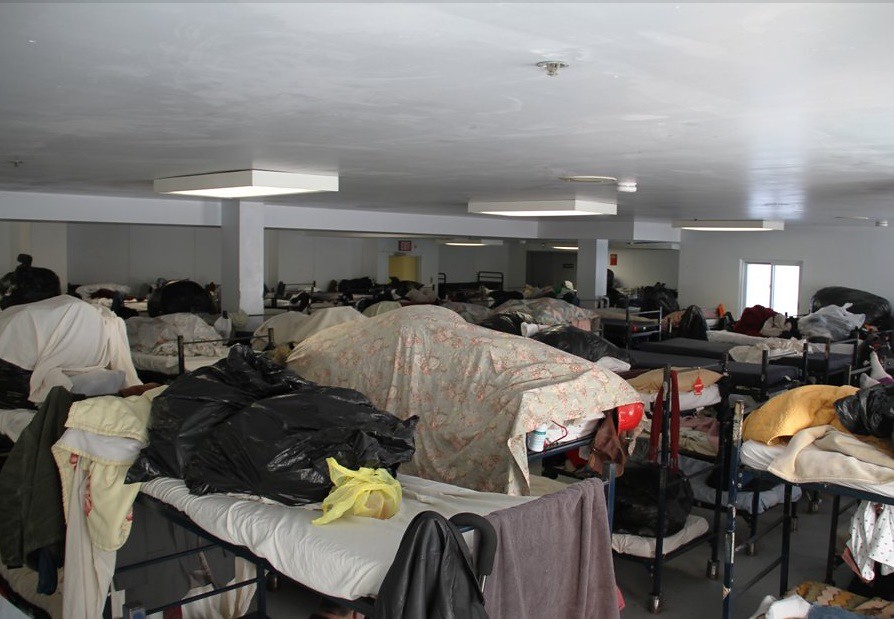
Here is a picture tour of his stay. In one picture shown below is an open-room concept with a series of "bunk-beds."
If you keep on scrolling through the pictures, you will arrive at a picture of the oldest resident. The reason why I mentioned this photo was that he was given his own "dormitory" room with a single roommate. Since I could not determine the size of the room (from the picture) that housed two people, I searched again on google to find out the average size of a 'college dormitory' room with two students.
The answer I found was that of a college were each room was 12X19 feet.
To start the calculation, an expression (or equation) needs to be set up to represent the calculated value to be determined. Shown below is an equality that relates the value given 228 square feet (per two people) in a dormitory to the desired number of square feet needed to house 82,000 homeless people:
Let me walk you through the expression that is given above. On the left, in the numerator (top left) is the variable 'y' which we are assigning to be the calculated square feet needed to house 82,000 homeless people. In the denominator is the proportion 82,000 people representing the weighted ratio to be used. On the right hand side, the number 228 square feet is located in the numerator representing the square feet (in a college dorm room = 12 feet X 19 feet) that houses 2 students.
In order to solve the equation above, the number 82,000 people is moved over to be multiplied by the right-hand side of the equation as shown below:
The result of the calculation is on the right hand side of the expression above. Which is to say, that in order to house 82,000 homeless people using the same metric (proportion) for a college dorm room, the equivalent space required would be around 9 million square feet as shown below in scientific notation:
Now that the space needed is calculated, a direct comparison can be made to the statistic reported regarding the new construction in the Los Angeles area in the 'Los Angeles Times' article above. In the article, the author cited a value of 57,224,810-square feet of new additions or construction space to the home market.
Clearly, there is enough space to house the lower limit of the range discussed above of homeless people in Los Angeles County!!!
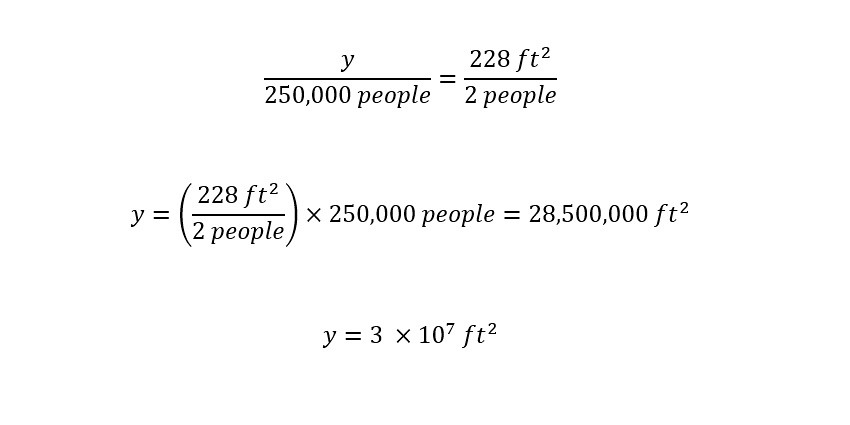
What about the upper limit of the range of homeless residents in Los Angeles County - 250,000?
Is there enough space to house them using the statistic listed in the article?
In order to find out, we can just repeat the same procedure with an equivalent equation shown below. This is easily accomplished by simply changing the homeless population variable in the denominator on the left-hand side of the expression:
Again, if we compare the result of the above calculation, we find that number needed is around half of the statistic of 57 million square feet. That is to say, in order to house 250,000 homeless residents in Los Angeles County, the amount of space (using a college dorm as a metric) is 28 million square feet. Much less that the total number of square feet of space either added or newly constructed.
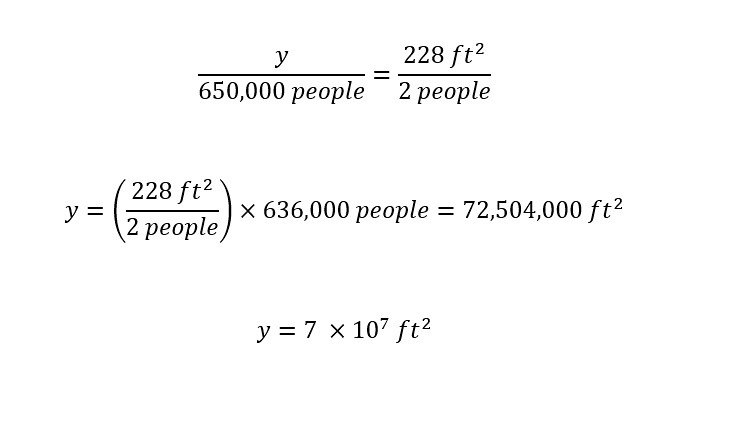
What about the statistic cited in the article from 'BusinessInsider' for the national statistic for homeless people?
How does that number compare to the value calculated using an equivalent equation as above?
Here is the result below:
The result has exceeded the capacity. Which is to say, 57 million square feet (cited as new construction) is not enough to house the entire 'U.S.' homeless population. Still, that is a large amount of newly added space (materials, eye-sores, injuries, jobs, etc.) to the County. Performing the above calculations now casts the homeless population's numbers into perspective.
Are they astronomical? No person should have to live on the street.
Conclusion...
The results of our analysis show that the space provided to residents in the Los Angeles area is an ample amount to house the entire homeless population of Los Angeles County. Homelessness is a terrible state of living that should be avoided by citizens of a given region. Which is to say, we as residents should contact our lawmakers and demand that action be taken. As you can see, the amount of space that is being granted is much larger than the amount of space needed to house the entire population. In the article from the 'Times' the author states clearly that the total square footage represents both newly constructed and additions to existing homes. This means that not all of the money that is going into the construction comes back in the form of taxes to our cities. At the same time though, there is a cost of time and effort on part of the agencies and politicians time to grant this new space.
With the last couple of sentences in mind, wouldn't the time used to approve such additions be better spent on dealing with the actual residents that have no home? I think so.
I hope that you visualize these calculations the next time you encounter a homeless person on the street. I certainly know that I will. Until next time, have a great day!