Showing posts with label tariffs. Show all posts

Wednesday, October 17, 2018

Soybean Farmers Are Storing Too Much Soybean, Although Chemical Industry Is Greenlighting Trade Deals?


Source: Post Bulletin


Depending on your exporting destination or importing origin along with the industry type, the response to the Trump Administration's tariffs program and emerging trade war is different.  For the chemical industry which heavily relies on good relations with local (North and South) neighboring countries, life is acceptable - as reported recently in the chemical news.  At the same time, if you are a soybean farmer or a farmer who relies on storing product in elevators for an extended period of time, trouble is approaching quickly due to trade coming to a 'stand still'.   The two different scenarios are listed below - briefly.


Soybean Storage?


Early on after trade tariffs were set to take effect, I wrote a blog post discussing (briefly) the benefits of global free trade.  In which, I highlighted the obvious fact that all commodities are connected to each other in some manner. Recently, the news site 'Politico Agriculture' has shed light on the connectivity which the trade industry relies on:


HIDDEN TRADE WAR IMPACT: CROP STORAGE SHORTAGE: Retaliatory tariffs have weighed down commodity prices for months. With the harvest well underway, the trade dispute with China is dealing another blow to U.S. soybean producers: a shortage of space in grain elevators that's causing major backups in states like North Dakota, Minnesota and Louisiana — and driving down prices even more.
China, the biggest market for U.S. soybeans, slapped 25 percent duties on the crop in retaliation for President Donald Trump's tariffs on Chinese high-tech products. Now it's effectively closed for business to American soy growers. Some farmers are gathering more soybeans than they can sell or store, jam-packed silos are running out of room, and the trains that usually carry soybeans to the Pacific Northwest for shipping to China aren't moving.
"In Southwest Minnesota and the Dakotas, you now have elevators that are storing all their beans because there's no market to the West. There is absolutely no bid," said Bill Gordon, a farmer in Worthington, Minn., and member of the American Soybean Association board of directors.
Gordon said some storage sites are piling corn outside to make room for soybeans, and that his local grain elevator is expected to be full after just one week of the month-long harvest.
Cash prices falling: The demand for storage space is also widening the gap between the market commodity price for soybeans and the cash price farmers receive for their crops at the elevator. Grant Kimberley, director of market development for the Iowa Soybean Association, said the drop-off — or "basis" — is normally 30 to 50 cents per bushel in central Iowa. Now it's about $1 per bushel.
Downstream problems: There's also a surge of Midwestern crops being shipped down the Mississippi River to New Orleans, where they're sold to Europe, South America and elsewhere. That's putting extra strain on growers and exporters in Louisiana.
"Everything is choking up right here on the Mississippi River on the barges and the elevators," Abraham said. "Every elevator that we have is full of soybeans right now and can literally take no more on."


Soybeans are taking up space which might be used for other crops which need to be stored too.  The states being affected - North Dakota, Minnesota, and Louisiana - have around 130,000 farms (combined in 3 states).  Not all of those farms serve the soybean industry.  Although, that enormous number of farms could be impacted by the connectivity to other crops which need to use the same storage space used temporarily for soybean crops held up by trade tariffs.


On top of the elevators being filled up are the barges (storage boats) which are filled up with soybeans being transported to other states to be stored.  Shown below is an example of a barge filled with soybean being filled.  Just think of all the transportation, space, and time -- which equates to money burned -- waiting to be moved, stored, or shipped.  All of the jobs which are on hold due to trade tariffs.  Not cool.
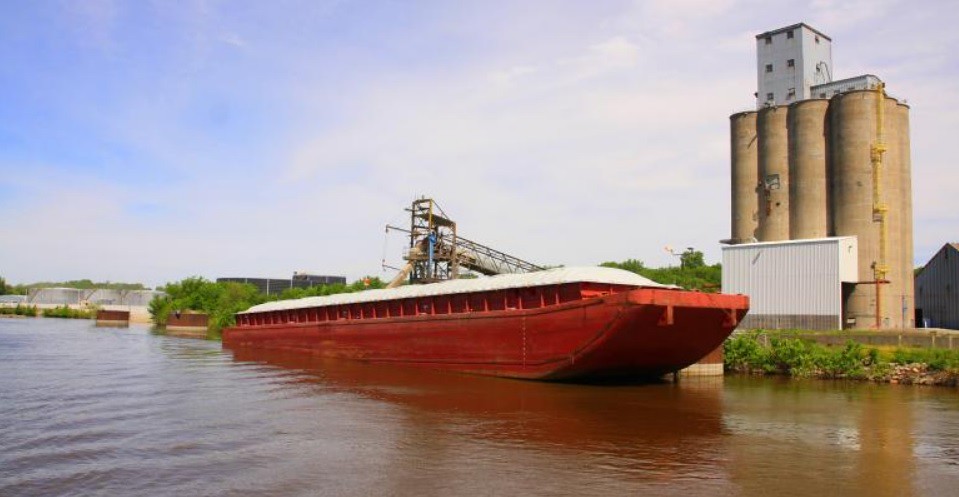


Source: Feed Stuffs


Additionally, the mere fact that China can just shut down and refuse any crops from the United States shows how reliant the United States is on other countries.  Which is dangerous to say the least.  Our reliance to other countries for crop sales or technology processing is becoming a major issue which going forward into the future will have be heavily weighed by those in elected office who make the large decisions in Washington D.C.


Although, they are elected positions therefore, your input is imperative in driving their respective vote.  With that being said, keeping up with the status of trade talks and disenfranchised farmers is important in moving forward participating in democracy.  Below, the conversation shifts from grave concern now to the chemical industry.  The chemical industry is quite pleased with the changes - which is strange.


Chemical Industry Is Good!


As I mentioned in the introductory paragraph, the chemical industry is one which has flourished since a deal has been arrived at between Canada, Mexico and the United States.  According to the Chemistry trade journal 'C&E News' titled "U.S. chemical industry reacts positively to revised trade pact with Canada, Mexico" the deal is being cast in a positive light:


The U.S.-Mexico-Canada Agreement (USMCA) is an overhaul of the 24-year-old North American Free Trade Agreement (NAFTA), which underpins $1.2 trillion in total trade between the three countries.
The trilateral accord is critically important to U.S. chemical manufacturers because Canada and Mexico are the industry’s two largest export markets. Approximately 46,000 chemical industry jobs in the U.S. now depend on trade between the North American neighbors.
Although ACC and its member companies are still reviewing the provisions of the updated trade pact, the industry group says the agreement “appears to include several enhancements long sought-after by the U.S. chemical sector,” including greater regulatory cooperation.


That is not to say that other industries reliant on chemicals and pharmaceuticals are not hurting with the trade war emerging with other international countries.  Noted in the article above that 46,000 jobs depend on trade.  That is just one single industry - chemical industry.  Imagine all other industries across the board which contribute to global trade which are being negatively impacted.  The total amount of jobs which are tied to the trade of those industries.  When all is considered, the numbers are enormous and difficult to comprehend.


Conclusion...


Just today in 'Politico Agriculture' was the following news:


TRADE DISPUTES LOOM OVER GLOBAL FOOD SECURITY: Trade protectionism and climate change are among the factors weighing on international food security, according to the Economist Intelligence Unit's Global Food Security Index, a benchmark used to measure individual countries' level of food security.
The report, released Tuesday by EIU and DowDuPont's Corteva Agriscience, cited China's retaliatory tariffs on U.S. soybeans as an example of trade turmoil that can raise prices for consumers and hit low-income families the hardest.
"Protectionist trade policies can contribute to world food price increases and limit agricultural competitiveness," EIU wrote.
The benchmark has the U.S. tied for third place with the United Kingdom — and down in the rankings for the second year in a row. The result doesn't indicate a worsening situation in the U.S. but, rather, slower progress on food issues than other nations. Singapore ranks No. 1, followed by Ireland in second. The Netherlands rounds out the top five.


In light of the news above, get ready for prices to change due to changing demand both internationally and within our nation.  As highlighted, each of these avenues of export are tied to one another in some manner.   Typically, the thought of total impact never crosses each of our minds.  That needs to change with the changing times.


Instead of thinking in terms of an 'isolationist' country, the United States needs to again open up trade avenues to disseminate the crops which are stored and hindering profit margins of families (farm families) along with all of the other players in the trade game: tractor drivers, truckers, dock workers, mariners - captains of ships, ship manufacturers, shipping companies, traders, diplomats, local store owners, foreign store owners, Chinese supply chain.  All of these players have families to support.   Not to mention the amount of energy needed to move goods across supply routes nationally and internationally. 


Related Blog Posts:


"Trade Not Aid" -- The Answer For Trade War!


Trade War Hurts Farmers -- From The Farmer's Mouth Directly


Parameters: How many sticks of butter are contained in 7.5 million pounds of butter?


How many cows are needed to generate 50,000 tons of beef exports?


How Many Cherries Are In 1.5 Million Shipping Boxes?


Parameters: Trade Tariffs Will Affect International Science


Parameters: Steel And Aluminum Tariffs Are Not Isolated - They Are Tied To Trading Of Other Vital Goods


Parameters: Tariffs Affect Trade In Both Directions -- In And Out Of The USA


Wednesday, August 1, 2018

"Trade Not Aid" -- The Answer For Trade War!


Source: Malulu


Last week, President Trump announced the financial bail out of $12 billion for farmers who are losing large profits to the trade war.  At first pass, a majority of Americans were expecting such a measure at the very least.  Especially, since the President himself is to blame for the new trade war between countries who used to have agreements prior to the inauguration of the President.  Not everyone is happy with the aid offered to the farmers negatively impacted by tariff set by President Trump.  In fact, the recipients of the trade relief have been chanting along with sending the message "Trade not Aid."


This slogan should come as no surprise to anyone who has received a large payout.  The money is great in the short run - until the money runs out.  That is, if all of the aid is spent on keeping up the farm output with no money coming in, then the money will run out quickly.  Which brings us to the current state of affairs highlighted in an excerpt by Politico Agriculture sent out via e-mail on Monday shown below:


TRUE TARIFF BAILOUT WOULD COST $39 BILLION: The full cost of a government aid package to help U.S. all manufacturers, farmers and fishermen negatively affected by President Donald Trump's new tariffs on steel and aluminum from around the world and a host of products from China could reach $39 billion, the U.S. Chamber of Commerce reports this morning. That works out to be another $27 billion on top of the $12 billion the Trump administration announced last week to help U.S. farmers.
"While America's agricultural industry has been hit extremely hard by escalating tariffs, it's not alone," Neil Bradley, U.S. Chamber executive vice president and chief policy officer, wrote in a blog post. "Thousands of U.S. companies - including manufacturers, input suppliers, fisherman, and businesses from numerous other industries - are finding it more difficult to sell American made products abroad amid the growing trade war."
Other sectors are feeling the pain: The business group estimates that U.S. automobile, motorcycle and parts manufacturers would need up to $7.6 billion in federal aid if the assistance promised for farmers is extended to other sectors. Chemical manufacturers would need $960 million; prepared food manufacturers, $884 million; fishermen and crabbers, $811 million; soap manufacturers, $725 million; beverage manufacturers, $765 million; shipbuilders, $632 million; and furniture makers, $567 million.
Last week, U.S. Trade Representative Robert Lighthizer told lawmakers at a Senate Appropriations subcommittee hearing the administration had no plans "at this time" to extend its farmer aid package to other sectors.
Bradley, in the Chamber's blog post, made clear what the business group would really wants is for Trump to remove the tariffs and back off from the threat of imposing more. "The best way to protect American industries from the damaging consequences of a trade war is to avoid entering into a trade war in the first place," he said.
Steel needs help ... because of the steel tariffs?: Ironically, some of the biggest recipients of an expanded aid package could be two sectors, steel and aluminum, Trump set out to help with his tariffs. A number of countries have retaliated against U.S. steel and aluminum exports, so companies that produce steel and/or manufacture steel products could need $6.4 billion in federal aid and U.S. aluminum companies could need $2.4 billion, the Chamber said.
... AND MORE ON THE TARIFFS: USDA Secretary Sonny Perdue had been in Argentina since Friday, meeting with his fellow ag ministers from the Group of 20 nations. While there, he told Reuters that farmers shouldn't expect to be completely compensated for their losses. "Obviously this is not going to make farmers whole," Perdue said. He also said that about $7 billion to $8 billion of the aid will be in direct cash relief, while other money will go toward export promotion and buying up excess crops.
War of words, and worlds: Officials of the influential Koch network warned that President Donald Trump's tariffs could result in "long-term damage" to the country.
"When in order to win on an issue someone else has to lose, it makes it very difficult to unite people and solve the problems in this country. You see that on trade: In order to get to a good place on trade, convince the American people that trade is bad, " Brian Hooks, one of Charles Koch's top deputies, said this weekend during a briefing for reporters at the network's gathering in Colorado Springs, Colo., POLITICO's Maggie Severns reported.
Those comments prompted former White House chief strategist Steve Bannon to attack the network in turn. In an interview with POLITICO on Sunday, Bannon called the comments unhelpful. "We can have a theoretical discussion later, OK? This is why they don't know what it means to win, OK?"


The excerpt shown above illustrates the loss or potential loss to the deficit of either $12 billion or $39 billion regardless of who is correct.  Either way, the United States of America has officially opened an unlimited credit card account to "Make America Great Again" -- at least that is what is supposed to be happening.  The opposite seems to be unveiling in reality though.


What is surprising about the situation America finds itself in -- in regards to the 'trade war' is that even if the United States could recover or agree on trade agreements with countries based on the previous tariffs, our country would still lose out.  The trade agreements which the United States previously had with other countries had 'special provisions' attached to them.  The possibility of regaining these 'special provisions' is out the door heading into the future.


Which means that even if similar relations were recovered, the 'special provisions' would be gone.  "Free Trade" is based on certain deficits incurred by various countries.  While the United States appears to be 'a loser' on trade deals, as a country the United States has been a 'winner' in a large amount of situations.  I discussed briefly 'global free trade' in a previous post.  The United States is considered the 'major player' on the world stage -- at least as of 2 years ago.


This position has quite possibly changed over the last 2 years.  The current trade war has not helped us on the international stage.  As the excerpt above states: "When in order to win on an issue someone else has to lose, it makes it very difficult to unite people and solve the problems in this country. You see that on trade: In order to get to a good place on trade, convince the American people that trade is bad" -- The American people are now being convinced by politicians that being taken advantage of is a terrible cost of doing business on the world stage.  That is not necessarily the case.


Conclusion...


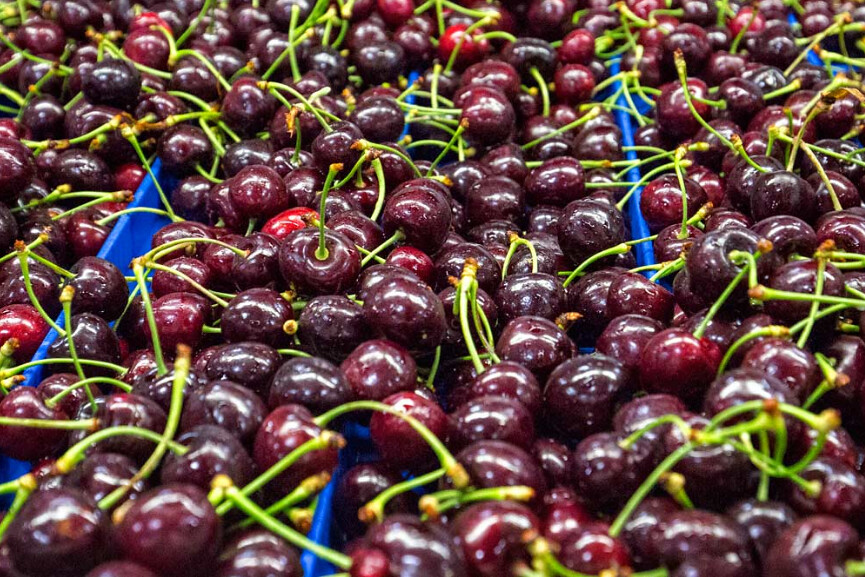
Bad news consists of recent events such as China telling shipping boats carrying up to 1.5 million shipping boxes of cherries to turn around.  Which is to say, over night, the demand for cherries all over China dropped to zero.  This results to a HUGE SURPLUS of cherries being dumped onto the United States produce market -- which will drive prices down.  In the short term, cost reduction seems great.  Although, in the long term, profits suffer -- farmers suffer -- then in return -- consumers suffer.  Not great.


Other commodities (products) will face similar fates.  Look for increases in prices for consumer goods as a result.  The Trump Administration has been handing out 'exemptions' to certain corporations which make them 'exempt' toward trade tariffs.  How does that help the United States in a trade war?  The answer appears to be that the exemptions amount to setting us further back as a trade negotiator on the world stage.  Which means in certain cases, the United States looks 'uncertain' or 'unstable' in trade negotiations.  Call your elected congressional leaders and demand that trade agreements be elevated to a top position for our nation.  Follow the farmers lead "Trade not Aid".


Related Blog Posts: 


How Many Cherries Are In 1.5 Million Shipping Boxes?


Parameters: Trade Tariffs Will Affect International Science


Parameters: Tariffs Affect Trade In Both Directions -- In And Out Of The USA


Parameters: Steel And Aluminum Tariffs Are Not Isolated - They Are Tied To Trading Of Other Vital Goods


Parameters: One Parameter Change In The Trade Machine Leads To A 'Re-Adjustment' Of Another


Saturday, July 14, 2018

How Many Cherries Are In 1.5 Million Shipping Boxes?


Shipping fruit around the world is a major business.  Much larger than one can comprehend.  Why do countries ship fruit along with other 'edible commodities' around the world?  As a first approximation, demand meets supply.  Second, certain countries do not have the correct environment to grow such plants in their respective regions.  Consequently, there is a large amount of importing/exporting of goods moving around the world at a given instant.  How large is such an amount?  Take cherries for example.  Recently, I wrote a post about the trade tariffs -- which are causing significant disruptions various ports - such as the one described in the excerpt below:


Warnings about economic harm: Sen. Ron Wyden (D-Ore.) cited complaints from Oregon potato growers and Pacific Northwest cherry growers "who have got nearly 1.5 million boxes of cherries ready to ship to China. They're worried those cherries are going to end up stuck on the dock or rotting in a warehouse due to China's retaliation,"


After writing that post, the thought of 1.5 million boxes of cherries sitting on the docks at the port waiting to be shipped would not leave my mind.  I was having difficulty wrapping my head around that number.  Especially, since the cherries would require refrigeration while waiting to be shipped.  In the paragraphs below, the method of dimensional analysis is used to shed light (or make sense) of this staggering amount of cherries 'in limbo'.


How Many Cherries Fit On A Pallet?


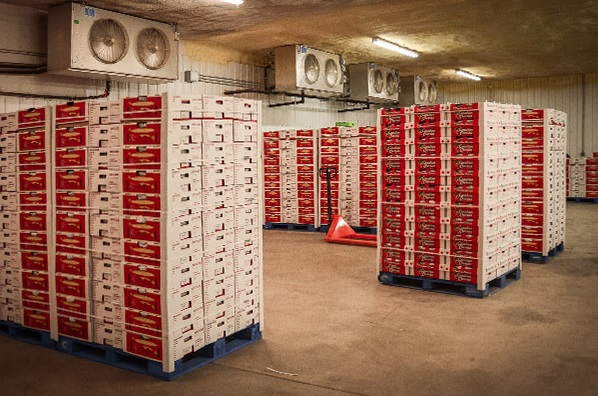
To begin the analysis, the first picture below is where I choose to start.  I wanted to visualize the cherries which will be shipped as packed on a pallet -- which is a common 'unit' of measurement in the shipping industry.  In order to find out how many cherries fit on a pallet, I started by typing into Google the following question: "Pallet of Cherries".  Next, I chose the option of 'Image' from the heading underneath the search engine entry.  After searching for a picture of cherry boxes stacked on a pallet, I settled with the picture below.


In the picture below a few pallets are shown which are stored in a refrigerated warehouse waiting to be shipped.


Source: Global Fruit


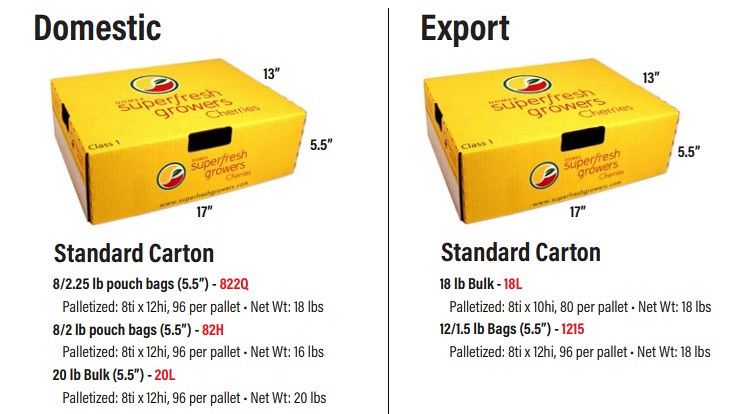
For this analysis, the number of shipping boxes per pallet is not important.  What is important is to determine the number of cherries which fit into a shipping box.  To determine the quantity of cherries in a shipping box, Google was consulted again by typing into the search engine space: "how many cherries in a shipping box?"  The box (answer) is shown below -- a shipping box used ship cherries:


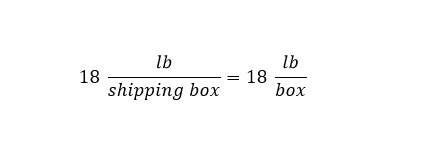
Each box can hold around 18 pounds of cherries as shown in the picture above.  With the answers above to the two queries into Google, the amount of cherries are known for a single shipping box -- which turns out to be 18 pounds of cherries.  In order to move forward, the amount of cherries in a single pound needs to be determined.


How Many Cherries In A Pound?


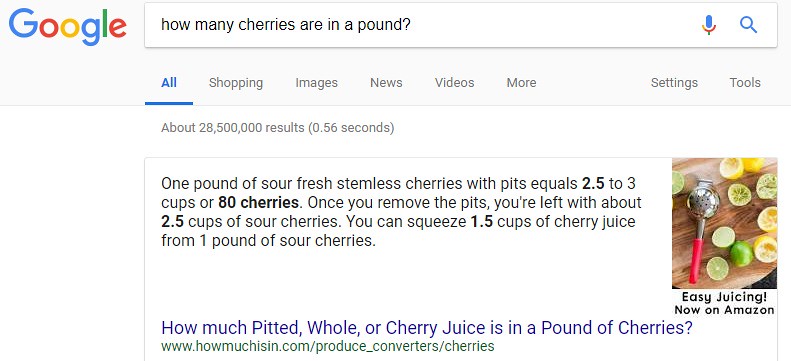
With the information obtained from Google, the analysis can be completed by using a few basic calculations.  First, a conversion factor needs to be determined.  The amount of cherries for a given weight.  How is that determined?  The easiest method is to ask Google the following question: "How Many Cherries Are In a Pound?"  To which the answer is shown below:


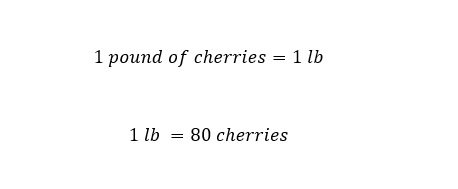
According to the results above, there are 2.5 to 3 cups of cherries in a pound.  Which is equivalent to 80 cherries (without stems).  With this information, a series of calculations are necessary to arrive at the end point -- How many cherries are contained in 1.5 million shipping boxes?


To start, take the number 1.5 million shipping boxes and convert that number to scientific notation as shown below:


Which makes the number easier to show in calculations rather than writing out a large numbers of '0' after a number to express a huge number.  Next, the two answers from above are expressed as shown below for calculation purposes:


1) The number of cherries per shipping box:


2) The number of cherries in a pound:


Taking the three values from above and combining them together, the amount of cherries in 1.5 million shipping boxes can be determined as follows:


The answer is shown below after rounding up with significant numbers:


Wow!  There are 2.2 billion cherries in 1.5 million boxes.


Conclusion...


In the analysis above, the amount of cherries which are contained in 1.5 million shipping boxes were determined.  This is an approximation based on the numbers ascertained in the queries (questions) entered into Google.  Any reader may come up with different values based on different initial inputs (i.e. numbers used in the calculations).  This in of itself makes calculations fun and interesting.   The major objective in the analysis above is two-fold.  First, to highlight the enormity of the number reported.  That is, 1.5 million shipping boxes is no small amount of cherries - which are being held at port waiting to be shipped.  If lost, that is a fair amount of revenue to cherry growers.  Not to mention, the amount of energy needed (used in refrigeration) to keep the cherries at a safe temperature to avoid spoiling.


Second, the analysis above shows the utility of math in highlighting various numbers which are popularly reported in the news and often overlooked by the public.  By understanding the magnitude of the numbers, we as the public are given the potential fall-out (consequences) of having such a large number of cherries sitting at port.  Cherries are just one product waiting to be shipped at port.  With this being understood, let your mind wander to imagine the amount of money waiting to be shipped as exports overseas.  Cherries is just one item.  The amount of money stored in 'traded goods' is potentially mind blowing.


Related blogs can be found here:


Dimensional Analysis Of Statistics And Large Numbers - Index Of Blog Posts


What is dimensional analysis?


How many trash carts can be filled with 80 billion pounds of trash?


How many people would be killed if 1,485 pounds of Fentanyl were distributed onto the streets in the U.S.?


What Is Dimensional Analysis?


Was The Recent Oil Spill in China The Largest In History?


LimeBike Dockless Bikeshare Riders Travel A Distance Of 13,000 Miles In Just Over 3 Weeks?


How Many Cigarettes Can You Roll With 18,000 Pounds Of Marijuana?


How Many Turkey's Are Served On Thanksgiving Day? How Many People Served?


How Much Trash Would Be Required To Fill The Great Wall Of China?


How Many Birds Per Minute Can Be Processed On A Single Line At A Poultry Processing Plant?


Hurricane Harvey Drops Enough Rain On Houston To Fill 560 Dallas Cowboy Stadiums


If Technology Fails, Use Basic Math Skills - Count Manually!!


How Much Water Is Contained In All Oceans Around The Globe?