Wednesday, February 24, 2016

How Much Paint Is Required To Cover A 'Movie Screen' In A Theater?

Have you ever considered the amount of paint required to paint the entire side of a movie screen in a theater?  Are you sure that you have not had such a thought?  I will not laugh -- I promise.  As a very interested person in science, I have had such a thought.  Does that make me a 'nerd'? Or weird?  Regardless, I have thought that at times.  Recently, my wife came home and was grading a stack of quizzes from her lecture -- College Freshman Chemistry Course.   One of the questions was asking the student to calculate the amount of paint needed to cover a given area (she defined an area).  Why is the skill of having the ability to calculate such a value important?  How do you calculate the amount of paint needed?  Below are the answers.


The technique that is used to solve for the amount of paint needed to cover a given surface is called 'Dimensional Analysis'.  Dimensional Analysis is extremely useful in viewing the world.  I know, I know that the statement is too general.  Understanding the usefulness of using dimensional analysis is beneficial in a variety of situations.  Don't believe me?  One of the goals of the blog (Mike Thinks) is to liberate the reader by teaching them to use the method to bring clarity to difficult problems.  We can use a rather simple example to illustrate my point.


How Much Paint Is Needed To Paint A Wall?


How about using dimensional analysis to decide the amount of paint needed to cover an area (893 square feet area) with paint.  How would we determine the amount of paint to purchase in advance to accomplish the task?  This is an example given in a college chemistry course by my wife.


Right about now, you are probably wondering how the question was stated on the quiz given by Dr. Kayla Kaiser.  Shown below is the question regarding the amount of paint required to paint a given surface:


As you can see that an answer is given to the problem.  The answer is written out in a conversion format.  That is starting from the area required to paint and ending with the amount of paint required to paint that area -- in this case the answer is 28,400 gallons.  That is a huge amount of paint.  When I first heard the amount of paint, I had to ask the amount of area that was required to paint.  Of course, I am a chemist and am curious.  The amount of paint is excessive for the required area.  How do I know this?  Let me explain.


First, in the question, the conversion factor is given for a given volume of paint to a 2 Dimensional surface.  Do you see?   Here: a gallon (volume) of paint covers a square yard (2 dimensional surface). Second, the area that is needed to be painted is given = 843 square feet.  Additionally, a conversion factor 3ft = 1 yd (3 feet equals 1 yard).  What is left?  In science lingo - - just plug and chug dude -- with a calculator.


But seriously, how do we approach the problem without a calculator -- an estimation?


Without a calculator, we can come close to an answer to the entire problem.  Or at least we can determine what 'order of magnitude' the answer should reside within.  How?  The answer lies in looking at each of the given numbers in the question.  First, lets look at the two conversion factors given.  Both are shown below:


First, looking at the conversion from feet to yards (1yard = 3 feet), there is an ample amount of useful information within this statement.  With a little bit of mathematical manipulation to each side, we can arrive at the amount of square feet equal to a square yard.


To walk the reader through the above manipulations, first list in an equality the desired conversion.  In this case, 3 feet is equal to 1 yard.  Second, to get to 'squared' units -- squared feet -- this is an area (two dimensional) with units to the second power or squared.  Next, if we square the unit (feet or ft, yard or yd), we need to also square the magnitude (the number in front of unit) -- in this case the number 3.  We are left with the conversion that in a square yard, there are 9 square feet -- as shown above in the last line.


Next, we can manipulate the conversion factor of volume to an area given in the question.  How much paint (a volume) covers a given surface (two dimensional area).  Below I show the conversion given in the question -- which is 1 gallon of paint is required to paint 15 square yards:


The second line is shown to convert the units of area to feet from yards.  In the previous calculation the conversion was from yards to feet.  This conversion is needed since the desired area to be painted is expressed in units of 'square feet or sq. ft'.  Converting any area to square feet will help our analysis.  As you can see, no calculator has been needed so far.  Lets review what has been shown.


Since 15 square yards can be painted with a single gallon, we need to know the equivalent square feet.  A one-step calculation (multiplication) reveals that 9 multiplied by 15 equals 135.  With a single gallon of paint, we can paint 135 square feet.  If we were to multiply both sides by 10, we get the following: 10 gallons of paint will adequately cover 1,350 square feet.  Again, all this without a calculator thus far.


Why is this analysis important without a calculator?


If we recall the initial image that contained the question and a student's answer (the wrong answer), we can compare the two answers.  The student got an answer of 28,400 gallons are needed to cover 843 square feet.  Is this correct based on the few calculations that we have carried out thus far.  I hope that you said -- NO WAY.  Why?


With a single (1) gallon of paint, we can cover 135 square feet.  Do you agree?  With 10 gallons of paint, we can paint 1,350 square feet -- Right?  Well, the value we were asked in the initial question falls into the range of the two values (1 and 10 gallons).


Therefore, without a calculator, we can estimate that the correct amount is less than 10 gallons and more than a single gallon.  Now, how much paint is required?


Using the same two conversions above, we can calculate the amount of paint required to cover an area of 843 square feet.  My calculation is shown below:


Is that calculation not simple or what?  Take 843 and divide the number by 9 and then follow with another division by 15 to arrive at the final answer of 6.2 gallons.  The amount of paint needed to paint an area equal to 843 square feet is 6.2 gallons of paint.  Imagine that, our value falls within our range of estimation (previous mathematical manipulations).


Remember how I started the blog post asking about the amount of paint required to cover an iMAX movie screen.  Based on the calculation, how hard would that calculation be?  Not hard at all should be your answer -- Right?


How Much Paint Is Required To Paint An IMAX Screen?


The process by which to calculate the amount of paint required is given above.  At the moment, the only unknown is the size of an IMAX movie screen.  Where does one find the answer?  I know how about asking google?  I asked google and was given an assortment of links to various answers.  The answer I liked most was the simplest.  A website called "LFexaminer.com" gave me the two values that I asked for and in a simple manner.  According to the website, the average area in square feet for an IMAX screen is 1,884 square feet.    Now that we have the average area, we can just repeat the calculations above, which I show below -- substituting a new value for area:


Does the answer make sense based on the above calculations?  Of course!  The area of the screen is 1,884 square feet.  Remember, for 10 gallons of paint, an area of 1,350 square feet could be covered.  Therefore, the value (gallons of paint required) has to be greater than 10 gallons.   And the answer is greater than 10 gallons.  How about if we look at the largest IMAX screen in the world.  How large is that screen?  Again, according to the website 'LFexaminer.com' the dimensions of the largest IMAX screen in the world (which is located in Australia) are (97 feet X 117 feet) -- WOW!  That is a screen area of 11,310 square feet.  Again, using the method above, the calculation is shown below:


Oh my goodness, 84 gallons of paint.  Does that make sense based on the values above?  Yes, based on the above calculations for 843 square feet, a screen the size of 11,310 square feet should be over 10 times the amount required for the original area.  The number is 14 times the amount required and the area is just over 13 times the original area.  This illustrates the power of comparing various numbers to validate range or order of magnitude in which the value should lie within.


Conclusion


The calculations above illustrate the power of using dimensional analysis to reason out numbers.  What do I mean by this?  How could dimensional analysis be useful in real life?  According to the example above, dimensional analysis could save a person money the next time you plan to paint a surface (wall of a house, wall of a building, etc.)  The next time that you look at a movie screen or the wall of a building, try to guess the amount of paint that would be required to paint the surface.


Just think, you will never be bored again.  You now have the ability to guess the amount of paint required to paint a given sized surface.  All that you need to remember are the three conversion factors (3 ft = 1 yd  & 1 gallon = 15 square yard & 1 square yard = 9 square feet).  Whatever the square feet just divide by 9 and follow by 15 to get the amount of gallons required.


Numbers are very important.  Units give numbers meaning.  When numbers are reported, using dimensional analysis can give you a better understanding of the magnitude of the reported number.  Just last week, I wrote a blog post on the amount of gas stored at Aliso Canyon Gas Facility.  I was gracious to have a reader comment and ask me to clarify the assumptions.  In the comment section, you will find a reader's comments.  Why do I bring this example up?


In the above example (with paint), a reader might ask for clarifications.  What type?  Such as how is the conversion factor of 1 gallon required to cover 15 square yards.  How is that determined?  There are light coats of paint and then heavy (perceived as a double coat).  I believe that my wife got that value from a paint store.  But that is not really important.  What is important is the an answer is reached based on the information provided.  Then, the reader can evaluate the answer.


The largest mistake that chemistry students make is not paying attention to the values of the parameters along with the wording of the problem.  If a person maps out the problem correctly, an answer can be reached without a calculation.  At least an estimation can be reached which will give the student some insight.  Too often, students and people in life are looking for answers or validation to problems in the form of answers.  Given a set of skills (logical thinking and reasoning), a person has the power to arrive at a reasonable solution without a large amount of effort.


Try to calculate the amount of paint required for a given surface.  Or compare the numbers in the blog post.  Play around with a calculator a little (for 10 minutes or so) and you might find a little confidence to tackle an issue that has been bothering you through this indirect form of empowerment.


Have a good evening!


Thursday, February 18, 2016

More Gas Is Stored At Aliso Canyon (Porter Ranch) Than Previously Thought?

I chose the title of this blog post as a question for the following reason: state agencies, SoCalGas, and elected officials seem to be dodging the true magnitude of the gas leak at Aliso Canyon Gas Storage Facility.  Sure, the number on total methane leaked is being reported.  But why are the values of the true amount of methane stored underneath ground not being reported properly? Why would this be the case?  Why did the well take so long to shut down?  Seems easier said than done.  Recent information has surfaced that has caused me to question (again) the true magnitude of the problem at hand.  As Porter Ranch residents return to their homes, questions should still be answered by regulatory authorities and politicians before residing in their homes.


Again, How Much Gas Is Stored Underground?


I thought the answer was simple but inconceivable and answered already.  The reported amount available to be stored at the Aliso Canyon Gas Storage Facility has been reported to be around 87 billion cubic feet of methane gas.  The space underground -- around 8000 feet -- is an old oil well that was drained.  Sound about right?  According to new information, there may be a lot more gas.  Read on to find out.


In my earlier blog post (a little over a week ago), I had an estimate of the amount of gas that is stored underground at the Aliso Canyon Gas Storage Facility -- based on accounts from the SoCalGas facility webpage.  These estimates were shown through dimensional analysis to be inconceivable to say the least.  Here were the results in summary:


1) 87 billion cubic feet of gas amounted to the equivalent space inside 696 Super Domes or 2351 Empire State Buildings.


2) The reservoir is 8000 feet below ground which is the equivalent to stacking 5 and 1/2 Empire State Buildings on top of one another.


Initially, when I calculated the above values I was blown away.  Since then, I have been spreading the message of the results on every 'Facebook' page that tagged 'PorterRanchGasLeak' or 'MethaneGasLeak'.  For what reason?  If I were a resident near the storage facility, I would be asking the following questions of all responsible parties:


1) Why did the well shut down take such a long time?


2) Is the reason related to a resulting pressure change on the other 114 wells?


3) How much gas is left underground?


4) If the wells were shutdown, how high is the chance of a leak (in the event of an earthquake)?


5) How probable are leaks from the other 114 wells on the Aliso Canyon Site?


These are just a few questions that come to mind based on my earlier calculations.  As I mentioned, I started spreading the message via 'Facebook' and 'Twitter' over the last week with the following posts -- which many of the readers have seen.  I think the inconceivable results of dimensional analysis would drive any resident to push hard for answers.  Here is an example post from me:


I did not know what type of responses to expect (if any) from posting the link to my post.  Interestingly enough, a reporter from KPCC (Radio in Pasadena, California) -- Sharon McNary -- responded to my post.  I am grateful for the information that she provided to me.   One of the wonderful aspects of using social media is the ability to interact with reporters.  She clarified the present situation at Porter Ranch as she is collecting information to report on to the public.


On top of that clarification, she provided a great example of the situation by analogy with a 'bagpipe' and the air required on part of the player to drive the instrument.  Driving gas out of an previous oil well/reservoir is handled similarly.  Her analogy is shown below:


According to Sharon McNary, the well still holds a tremendous amount of gas.  How can we visualize the volume of the stored gas?   We can use the volume of the Mercedez Benz Super Dome in Louisiana -- which is shown below and has an interior volume of 125 million cubic feet:


As you can see, the dome is no small structure.  Therefore, using the interior space as a volume to compare to an astronomical (huge) number -- volume of spill -- is completely appropriate.  First, lets take the value initially conveyed to me from Sharon McNary to be 184 billion cubic feet.  This would include the cushion gas, the interior storage capacity of the reservoir and the remaining 15 billion cubic feet.  I performed the calculation and the numbers below are what we get:


Wow!  And I thought that the previous number of 696 super domes from 87 billion cubic feet was large (the result of the last post).  The number keeps drifting away from us.  Inconceivable to say the least.  The number should not just be alarming in magnitude.  If the amount of gas still underground is anywhere near that value then -- the current leak is nothing in comparison.  Why?  


I expressed the current leak as a percentage of the total 184 billion cubic feet below:


Now do you see why I am so concerned?  The amount that has already leaking in a few months -- 5.2 billion cubic feet is nothing compared to the amount being reported by Sharon McNary.  Of course, later, on February 10th, she posted an update is reported with figures that might bring more ease or not depending on the angle from which you view the numbers.  The last calculation involving 15 billion cubic feet of methane above will become clearer below.


What Is The Potential Of A Full Blown Leak?


According to an article released on KPCC by Sharon Mcnary titled "Sorting Out Porter Ranch Fact vs. Fiction" there is still around 15 billion cubic feet of 'purchasable' gas in the storage facility.  That amount is on top of the 'cushion gas' of 82 billion cubic feet.  Again, the 'cushion gas' ensures that the well is pressurized and the gas company can retrieve gas from any of the 115 wells.  Therefore, a constant pressure is provided by 82 billion cubic feet.  Here is an excerpt from the article:


Aliso Canyon's operations are near-stalled right now. It has been barred from injecting more gas since the leak began, and it won't be able to resume until a time-consuming set of safety tests is completed on the other 114 or so active gas wells there. The California Public Utilities Commission estimates it could be months before it starts operating normally. So, will we run out of gas?
Let's look at the numbers.
Normally the gas field can hold 86 billion cubic feet available for delivery to customers. The gas is  held underground at very high pressure by these wells, which act like valves. Today, the field holds  only 15 billion cubic feet of gas that could be shipped to customers, so the pressure is much lower. That's the lowest amount of gas that the CPUC estimates the gas company can keep underground and still serve the L.A. basin enough gas to heat on a streak of very cold days or serve L.A. Department of Water and Power's electric generating plants this summer on the hottest days.


I should clarify that the excerpt above is an answer to the following question stated in the article by the author:


Will the region run out of gas or power this summer if Aliso Canyon is closes?


More important is the integrity of the remaining wells (114 of them) and SoCalGas's ability to manage them.  With the calculated amount of gas 82 bcf + 15 bcf = 97 bcf -- 97 billion cubic feet of gas, the gas company should be calming concerns of the residents around the storage facility.  I would be super skeptical if I were a resident.


There is no doubt that the amount of gas leaked thus far is inconceivable and not acceptable.  If these large companies are able to get away with not accurately reporting numbers along with their ability to control such leaks, why should the public trust them?  If we look at the numbers that were tallied or counted on by the Environment Defense Fund's 'automatic counter,' here are the results shown below:


(1) Equivalent amount of gasoline burned:


(2) Equivalent amount of Carbon Dioxide Gas:


(3) Equivalent amount of money lost in methane sales:


Now, remember that the remaining amount of gas minus the 'cushion gas' is 15 billion cubic feet, what if another well (or multiple wells) were to bust?  The current tallied numbers by the Environmental Protection Agency is shown below in a table:


This is an updated table from that posted in my earlier blog post.  Data from mid February was not present -- because February was not here at the time.  Further, the data contained in the table above is the final data -- considering that the 'well' was shut down on the 11th of February.


As the reader can see by inspection of the table, the final amount (estimated of course) of methane that was leaked since the beginning of the leak (back in October of 2014) was estimated to be around 5.2 billion cubic feet (bcf).


I mentioned above that there should be caution on part of the resident that lives in Porter Ranch with the proclamation that homes are safe to return to now with the 'plugging' of the well.  I would be skeptical of that statement.  Not that the homes are dangerous themselves (although, there might be residual methane and additive gases absorbed on surfaces), but because of the remaining amount of gas still stored in the Aliso Canyon Facility.


Lets use the two values that might be of interest that are taken from the excerpt of the updated report (fact vs. rumor) by Sharon McNary.  The two values of interest are 15 billion cubic feet (that can be sold to the public) and 82 billion cubic feet (amount of cushion gas).  We can start by asking the following question:


What if another 'well' broke or multiple 'wells' broke down and caused a further leak?  How much gas could escape?


Or stated differently,


How much gas is still underground (updated by Sharon McNary)?


Below are the results of the calculated amount of super domes that could be filled.  The first calculation uses the 15 billion cubic feet that can be sold is shown below:


As you can see, the amount is not 'insignificant' and should give the reader a certain amount of skepticism toward regulators, gas company employees, etc.  What about the cushion gas?  What about if a portion of the cushion gas were to escape into the atmosphere?  I calculated the 'upper amount' of methane (cushion + purchasable) that would be possible to escape into the atmosphere.  the results are shown below:


Basically, the amount of gas that could potentially leak into the atmosphere is could fill anywhere between 120 to 776 Mercedez Benz Super Domes.  OMG.  That should cause the reader (and resident of Porter Ranch) to take a step back and think about the types of questions that need to be answered by the regulators and gas company employees before returning to their homes.


Since we have the range of volume that the gas would fill up if any leaked out of the well, we can go back and look at the data collected by the Environmental Defense Fund in more detail.  We know that according to the 'counter' that was set up, there was 96,000 metric tons of methane emitted into the atmosphere.  Furthermore, we know from their estimations that the following amounts were calculated: (1) Equivalent to burning 900,000,000 gallons of fuel (gasoline), (2) Equivalent amount of Carbon Dioxide gas 8,000,000 metric tons released into the atmosphere, and (3) Amount of money lost in sales of the methane gas at market value $15,000,000.  That is alot no matter which way you view the amount leaked from the Aliso Canyon Storage Facility.


Last, but not least, how about if we extend out these values to obtain a range of leaked gas had the well continued to spew gas.  Meaning, with the reported amount left in the 'reservoir' what is the largest value of leaked gas.  In order to calculate the range, we must set up a the calculation based on ratios.  The ratio of leaked gas to that of what is left over.  That is the ratio of 5.2 to 15 billion cubic feet of gas along with the leaked amount of 96,000 tons from October 23, 2015 to February 11, 2016.   The calculation can be set up and executed as follows below:


This means that if the remaining 15 billion cubic feet of methane were to escape into the atmosphere, the Environmental Defense Counter would read that roughly 276, 923 tons of Methane had escaped.  If the 'cushion' gas of methane is included, the number increases as shown below:


Each of these values would be obtainable by simply multiplying the current values at 5.2 billion cubic feet by a factor of 3.  The ratio gives a little more accurate estimation.  But since, the numbers vary with such a high degree of variance that are reported, the rough approximation is sufficient for the non-scientist.


Conclusion


Having the ability to carry out the calculations is a useful tool.  Especially as the Porter Ranch residents are now in a phase of preparing 'legal battles' against SoCalGas.  Understanding the magnitude of the leak is very important when trying to figure out the exact damages that should be awarded.  But first and foremost, as residents, people should ask the company further questions to really get to the bottom of the remaining amounts of gas.  After all, they are the remaining residents on the land.  The real people who suffer are those who have been displaced.  They should at least have some 'ammo' when discussing the current status of their neighborhood with regulation agencies.


These numbers are enormous.  The companies and regulation agencies should be trying their hardest to show the largest amount of transparency and listen with concern to the public surrounding the Aliso Canyon Storage Facility.  Hopefully, the magnitude of the disaster will stay at current levels.  Have a great day!!


Saturday, February 13, 2016

Let 'Kids Be Kids' And Explore Appropriate Science Projects For Their Grade Level -Please!

I had a chance to volunteer recently at a local science fair as a 'judge' at an elementary school.  The opportunity was somewhat of a shock for me to be honest.  No I do not have any children - yet.  No I am not totally 'out of the loop' with interacting with children.  My nephews are 14 years of age and 11 years of age -- both going on 40 years of age.  The level of sophistication of the science fair projects matched the age of a high school student or college age student.  Why can't we just let 'kids be kids'?  How do the last few sentences all tie together?  That is the subject of the discussion below.


As I mentioned above, the opportunity to be a 'judge' for a science fair at an elementary school a couple weeks ago was an enlightening experience to say the least.  In this 'hyper-competitive' environment we live in, the elementary school kids seem NOT to be immune to the plague.  What plague do I speak of?  I use the word 'plague' to emphasize the prevalence and speed with which the 'hyper-competitive' nature of our society has spread to lower levels of education (i.e., elementary school).  This news or observation was a complete surprise and disappointment to me.  At the same time, there is always a positive aspect to every realization.  Let me explain.


Kids Have Simple Ideas For Science Projects


One disappointment at the outset of serving as a judge in the local science fair was the realization that the projects were thought up by the parents.  Not only were the projects subject matter thought up by the parents, the parents themselves had to execute the experiment themselves.  I was completely blown away by the realization.  This was very disappointing to a professional in science.


The kids that we were to judge came from the 3rd grade.  I don't know about you, but when I was in the 3rd grade -- I was not thinking whether breakfast cereal was 'magnetic' -- due to the iron content in the food.  I just wanted to play on the play ground and have fun.  Maybe you (the reader) were the curious little scientist at that point?  If so, leave a comment and tell me about your fascination at that age.  Chances are that the comments will be centered around playing and talking with other children.  I could be wrong.  Why do I have such a strong feeling about this line of reasoning?  Here is an example from my experience judging.


I was given 11 posters to judge.  All together for the entire 3rd grade class there were 111 posters with 10 volunteer judges.  The judges were composed of parents of children from other school districts with experience in such events along with other science teachers from junior high and high schools in the area and me (the odd ball -- from a different city and works at a university).  I was asked to help out by a colleague (a fellow chemist, a good friend who has children that attend the school).  She could not participate since one of her children was in the 3rd grade class.


During our judging session, a child from one of the 3rd grade classes came in accidentally.  His father must have gotten the days mixed up.  The following night, there was to be a celebration held at the gym and the winner would be announced.  All of the judges were surprised, but not nearly as surprised as the child and the father.  The father was surprised that he misread the flyer and was embarrassed to say the least.  Since the two were standing there -- the teacher/coordinator asked if the child wanted to show the his poster to his dad.  I happened to be the judge of his poster.  He was studying the curvature of light with a flashlight and a mirror as his experimental setup.


His (the child's) response to the teacher really made an impression on me.  He said, "I just want to see my friends and started crying."  His father thanked all of us and apologized for screwing up the times and left with the boy.  This experience was a huge indicator as to the level of sophistication of ideas for projects I should be looking for to judge as a winner.


Most of the posters were extremely complicated.  One poster was of an experiment where the girl made a 'dimmer switch' with a graphite pencil serving at a 'potentiometer'.  I work on instruments all day long.  And I worked on F-16 fighter jets when I was in my early twenties.  I can honestly say that the level of sophistication with which the experiment was performed was much greater than a 3rd grade level.


The way that a pencil 'dimmer switch' would work would be to expose the inner part of the pencil -- graphite.  Hook up a power source with electrical leads at either end of the graphite -- that would complete a circuit to drive a lamp (light bulb).  As you move the electrical leads (electrical clamps) closer together the light bulb would be brighter.  This is due to the current being directed toward the lamp rather than being 'dissipated' across the graphite due to resistance.


I am sure that you knew that in 3rd grade right?


Another project (one of the top three contenders) compared the strength of baseball bats made out of different materials.  Cork, wood, metal.  The experimenter hit a large number of trial bats with each bat (on the order of 40 swings).  Interesting idea.  What was not interesting was that all of the data was compiled into a spread sheet.  How many 3rd grade children do you see filling out excel sheets of batting results (on the order of 100 bats)?  Furthermore, there was a 'data set' that was deemed 'an outlier' -- so the experimenter 'threw out' the data.  The third grader determined a set of be an 'outlier'?


Again, were you thinking about throwing data sets that were considered "outliers" in 3rd grade?


I am not trying to knock down any of the ideas.  In fact, the ideas were quite interesting.  If the level of participation was around the high school level, the ideas would match the grade-level.  But these were 3rd graders?  Remember the crying child just wanting to be with his friends?  Let kids be kids and come up with ideas that fit their age.  Right about now, you are probably wondering what poster won?  What was the winning topic about? Well....


The winner was a poster that had the results of an interesting and age-related experiment.  The question was to determine whether plants would grow in different soils.  Wow.  Awesome.  Different soils with different chemicals.  The experimenter used different soils but did not try to answer/explain different soil composition.  Just purely observational.  He took pictures with a ruler beside the potted plant to show the growth (a true little experimenter).  His results were purely qualitative (observational) and presented on a poster which he wrote with a pen and pencil every line.  The entire poster was done with a ruler, tape, pencils, and pictures.  That is a 3rd grade poster.


The voting revealed mixed results.  Each of us had our own ideas as to which should win.  I was amazed at the level of expectation of the parents and teachers.  After, I asked my friend by phone why her child did not compete in the competition.  She said "Tiam could not come up with an idea for a science project.  Why should I do a project for her?"  My thoughts exactly.


What benefit comes out of these science projects?


Science fair projects are important.  I think that the interaction of students in a setting of presenting their projects to one another and the rest of the school is important.  In fact, professional scientists do this when they attend professional conferences.  At conferences, there are usually a few time slots allotted for poster sessions.


During the poster sessions, all of the posters are in one room and the entire conference audience is invited to circulate and discuss with the respective authors the content (research) present on a poster.  This is possibly the most important period of time during the conference.  The ability to be able to discuss the results of a research project is crucial to the long term success of the project.  Developing the skill to communicate your science to your audience is very important.  Plus, the interaction leads to networking, collaborations, and exchange of ideas that is critical to the overall success of the field of science.  Starting at a young age is a good idea.


One Benefit Of 'Hyper-Competitive' Science Fairs


There are benefits to having a competitive science fair starting in elementary school.  Even if the projects are a little too complicated for the age-group of the participants.  The development of a science project allows the interaction (participation) to be distributed over the family.  These interactions are important.  In the world we live in, the educational process seems to be on 'warp-speed'.  We blow through school at an incomprehensible speed trying to satisfy unattainable expectations of society.  The process of helping your child or relative to develop a science project is important for all participants.


During this process, each member gets to participate based on their comfort level.  Maybe Mom or Dad now has the chance to devote serious thought and participation to execute a science project.  Or maybe Mom or Dad are scientists (like my colleagues) and are trying to ensure that their child's education is 'done right.'  Maybe the interested parties just enjoy performing science experiments and are participating out of sheer curiosity.  Regardless, the ability to have multiple people interested in performing science experiments is great -- why?


Getting people interested in science is great.  During the experiment, all participants get to learn the overall purpose of the experiment.  Each member might start the project with different experience levels.  By the end, each member is generally more aware of the purpose behind and experiment and the direction of future inquiry into such research.  The investigation process is reveals more about the process than the actual results -- which is one of the main ingredients of the scientific method.


Conclusion


As I have been rambling on in the above paragraphs, science fair projects are important for many reasons.  The ability to get people (of all ages) interested in science is critical to the future of our society.  Having a basic understanding of the scientific method will become more important as time progresses.  Already, the issues facing society require us to think critically about what each of us on a local level are doing to the environment.  Furthermore, the critical evaluation of corporations, governments only gets more complicated as we move up the scale.


What scale do I speak of?


The scale I refer to in the last sentence is describing viewing different levels of governance.  Starting from the local level (city, towns, etc.) and moving on up through the regional (Southern California) up to state and federal level.  From there, a national perspective is required to move onto a world perspective.  Cast any issue as a science project to the appropriate scale.  The process of participation and evaluating outcomes becomes difficult depending on the level we are looking at.  Although, the fundamental aspect of the 'scientific method' is still the same regardless of scale.


The fundamental aspect of the scientific method is the same regardless of scale.  This is a critical concept to grasp -- especially when deciding what project to pursue in an elementary school science fair.  The level of sophistication needs to match the level of the child's participation. Upon announcing that the 'hand-written' poster won, the president of the local PTA (Parent Teacher Association) was completely surprised.  Why?  She would have thought that the organization of the poster was not as good as compared to other posters presented.


This statement was what really concerned me.  The parent obviously did not have any idea of the level of participation that is involved in science.  Presentation of data should match the age.  Furthermore, when I suggested that the child whose poster won did research that was similar in practice to my wife's research in graduate school the response was hilarious: "Did your wife use tax payer money to take pictures of plants?  Oh my."  Yes, because that is how research is done.  The type of research that large agricultural companies like Monsanto and BASF are clawing to get their hands on the results.


In closing, I have rambled on for quite a while.  Hopefully, out of the rambling, the reader has taken away the message that science research needs to fit the age.  If we give awards to projects that could not be completed by the age level of the student, then we are risking portraying science unrealistically.  This will only exacerbate the deficiency in understanding of basic science research.  Lets fix the problem not propagate the problem.  Think simple.


Participation in performing the scientific method by a family is great and recommended.  Although, we must strive to have the child participate to the maximum amount in the process.  That way, when the child reaches a more advanced level of education, the level of sophistication and understanding will match appropriately.  Just some thoughts from a concerned 'outsider' judge who is surrounded by college students on a daily basis.  Have a wonderful weekend!


Wednesday, February 10, 2016

Pro Bono Tutoring Can Equate To Paying It Forward!

What is your time worth?  Each of us could come up with an answer if pressed for an answer.  Of course, defining the task at hand might greatly simplify the process.  What job needs to be done?  Am I qualified (eliminating question)?  Regardless, the post below gives an account of a recent interaction that I had with a student -- whom I tutored last semester 'pro bono' -- for free.  Surprisingly enough, the tutoring payed off (as you will see) by equating to paying it forward for other students in the chemistry department at Cal State University at Northridge.  I am super proud and felt compelled to spread the message.


You tutor for free?


No I do not tutor for free.  At least this was my initial thought on the matter.  I charge a small amount -- $60 per hour.  You might be thinking how is that a 'small amount'?  I thought the same thought 5 years ago when I started working at my current job.  I figured since my main job is to help students/faculty in the Department of Chemistry with instrumentation during the day that I would have no extra time to tutor anyone.  Especially since the tutoring would have to occur outside my work hours.


Then I over heard students -- two undergraduate students who recently graduated and were considering moving onto graduate school -- talking in the hall in our department one afternoon.  One of the students was charging $60 per hour and basically not even helping the student in need out at all.  I was disappointed in that student to say the least.  The other student charged an hourly rate of $40.  He would often laugh at the amount of 'clients' that he was getting.  He was surprised that the students were willing to pay for help.  Why?


The chemistry department at California State University at Northridge (CSUN) offers students groups tutoring by students who attend classes at the university.  Here is an example of a schedule available to the chemistry students in our department:


Because, more and more universities and colleges are offering 'tutoring' centers 'in house' to help students in need.  Of course these services have two caveats associated with them:


1) Students are taught by former students (upper division students -- juniors/seniors).


2) Students are offered help in a group setting. Typically, no 'one-on-one' help.


These services should suffice for most students.  In fact, the services are quite good since the students interact with other students who have taken the classes before them.  And, the students get to interact with fellow students who are enrolled in their same courses.  Of course, one of the most popular argument is that the best student in the group ends up helping other students and does not get help themselves while waiting for the tutor to help them.  That is a potential draw back and motivation to get 'private tutoring.'


Each department has a list of recommended tutors that is available on request.  I would suggest that anybody reading this post tell anyone in need who is enrolled in a college course to seek out these services (find the 'learning center' on campus or 'learning resources') before hiring a 'private tutor'.  Or at the very least, again, ask the subject department for services (chemistry, physics, biology, humanities, etc.).  Don't get ripped off for sub-standard help.


After hearing the students chatting in the hall, I decided to offer my services outside of my work hours.  I decide to charge the same amount and see what happened.  I gave my department my name to give out.  From there, I just sat back and waited for the phone to "ring off the hook" with customers --- based on what I heard from the students chatting in the hall.  What I experienced was completely different.


Lets negotiate -- can you solve this for me please?


After my first client came in, I realized that the business of charging students for help was quite different than what I had initially imagined.  Initially, I had thought that I would get all sorts of calls for help -- I did not.  Further, the calls that I did get were either one of two types: 1) could I lower my costs, and 2) could I solve homework and specific test questions.


First, yes, I can lower my fee.  The questions I usually ask in response is the following: Do you really need help?  Are you ready to work for help? This was based on experience.  I was helping a student (a female) and she was in need of tutoring for sure.  She stated that she could only afford one hour of help.  In actuality, she needed around 20 hours -- like most students.  Why am I so hard on students?


Because, I state at the outset the following rules:


1) Give me the material from your professor ahead of time.


2) State what you would like to cover -- specific information.


3) Have an open mind.


4) Keep in mind that you will want to cover way too much material.


These are typically good questions to couple with a healthy hourly fee.  Usually, students will either shy away from these rules or step up and accept the challenge.  The above rules might sound rough.  Although, if you want to learn science, you have to be willing to put in the time.  I cannot put the time in for you.  Furthermore, I cannot show up and take the test/quiz for you.  Therefore, you gotta convince yourself that you are capable of getting the job done.  Sound difficult?  Not really.


Every once in a while - A rockstar emerges!


I do not mean to sound negative in any manner.  I am actually a very positive person by nature.  Further, I love to help students and professors accomplish a given task at hand.  In this case, students need help.  The majority of students like to watch 'other people' do their homework or exam.  The idea behind this strategy is that if a student watches the solution being written out enough times, the solution will be transmitted into their heads.  Of course, this idea stems from the idea of 'the path of least resistance'.  The problem with this line of reasoning with respect to the subject of chemistry is that the strategy fails (99%) most of the time.  I promise that this does not work.  Keep trying though if you are not convinced.


When a student does come along and request your help, you feel like you have been lifted up extremely high.  I can help.  But first, see what the student's real intentions are in seeking help before offering your services.  Here is why in the form of an experience.  Remember that your time is important.


Rockstar #1: Joe


I was approached a couple of years ago by a student who I will call Joe.  Joe was interested in getting a tutor for a consistent amount of time (on a weekly basis).  At the time, I decided to help Joe out.  I met with him for an evaluation session -- to see what his intentions were.  He stated that he needed help and had no issue at all paying my rate of $60 per hour.  I agreed.  We had a deal that he would follow my two step rule of presenting the information from his course and give me the problems in advance.


Throughout our tutoring sessions, I will admit that he challenged me quite a bit -- in a great way.  Sometimes, he left a little disappointed, and other times left super happy with obtaining validation of his solutions.  Tutoring is a two-way street.  Most tutors will stick to subject material that they have mastered and can only answer a 'narrow margin' of questions.  If you were to ask them other information outside of the course material, they would literally (in some cases) shut down and walk away.


Joe did great on his first midterm -- he rocked the test with a 97%.  What Joe did not realize over the course of our sessions was that he was performing all of the work.  I held my ground and did not baby him at all.  In the end, I walked by the tutoring center and saw him helping other students out.  He just graduated and is moving onto graduate school.  That guy rocks -- he is going places.


There was only one instance of question during sessions with him.  One weekend, he needed help and was desperate.  I said that I could not make it (I like to enjoy) my weekends.  He offered to triple the pay.  No go dude.  Not here.  In the end, he did just fine.  After that, I decided to take some time off from offering my services.


Rockstar #2: Tim


The second testimonial (for the purpose of the blog post) was from a student who approached me last semester.  He was enrolled in upper division Physical Chemistry.  Not an easy course.  If anyone has ever taken a 'P-Chem' course, they know that there is definitely work involved.  I was approached by Tim and he asked whether I would help him.  I was reluctant to help -- because usually the problems take around a couple of hours just to 'set up' before solving.


The level of difficulty emerges from the process of evaluating what variables are needed in a problem and which are not.  Furthermore, assumptions can be made based on the wording of the problem.  I did not feel like charging him a lot of money for help that he might feel is not helpful in the end.  I decided to help him by clarifying his solutions or the problems being tackled.  Further, I decided not to charge him.  I took a large chance and decided that 'what the hell' I will revisit some great 'P-Chem' problems.  I am after all a Physical Chemist by training.  At that moment, I had no idea of what the future held for our sessions.


Tim was a good student.  He seemed to be on top of his studies.  Some of the concepts were difficult to comprehend.  But every physical chemist will agree to this fact.    I gave Tim a few pointers for strategic purposes when approaching a typical problem.  He took right to the information and knocked out the problems.  As with Joe, when Tim had a question I could count on really being stumped.  I had to spend more time at night thinking about how to get the concept across to both of them.  Luckily for me (I am joking) the two of them would get stumped on very difficult problems and concepts.  I grew as a result of these interactions.  Normally, tutoring is a 'one-way' street -- from the tutor to the student.


Conclusion:


Both of these students (Tim and Joe) were able to go the distance.  The two of them have definitely 'payed it forward'.  How?  Well, as I mentioned Joe offered his services free at the tutoring center as a sincere gesture to help students.  As for Tim, a couple of weeks ago my wife approached me after work with a question.  She teaches college chemistry at CSUN and was approached by Tim.  Tim asked her to offer his services as a tutor.  She hesitated and asked him his qualifications to which he replied "Ask your husband."


I backed him up and suggested that she refer her students to him.  She wondered whether he would be charging.  I asked him this in the hallway.  He said, "no, I am on campus and have time, why not knock out some problems and pay back for the help that I received from you."  WOW.  Is that not what any tutor or teacher would like to hear.


Tutoring can be an exhilarating experience.  Sadly, some people reduce the experience to a financial transaction/expectation.  Next time that you are asked to help a friend or family member with their studies, think about this blog.  Pay it forward.  Have a great day!


Saturday, February 6, 2016

If The Mosul Dam Breaks, The City Of Mosul Would Be Under 65 Feet Of Water?

No dam should ever contain as much water which would put an entire city in danger of being under 65 feet of water.  Unfortunately, this is the case for a city named Mosul in present day Iraq.  Based on history of dams busting (one of which I wrote regarding the mining spill in Brazil), having any body of water with such a huge amount of 'potential energy' above habitats is very dangerous.  I decided to verify a statistic in the blog below regarding the dam in Mosul.  Let me explain.


How Large Is The Mosul Dam?


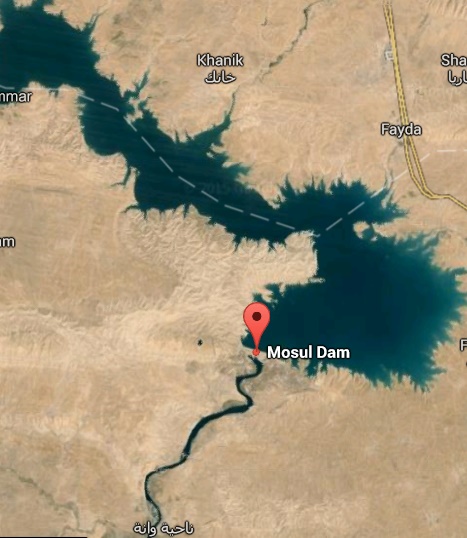
Below is a picture taken from a satellite of the Mosul dam along with the surrounding water that is contained within the reservoir.


Source: GoogleMaps


The Mosul dam is located in northern Iraq as shown on the map taken from the 'Wikipedia' page about the Mosul dam below:


The city of Mosul can be seen in the picture below taken from the 'Wikipedia' page about Mosul:


According to the 'Wikipedia' page for the city of Mosul, the Tigris River is adjacent to the city (on the west bank).  The population of Mosul is approximately 2.5 million people.  The city is the second largest in Iraq and considered to be one of the largest northern commercial cities.  Over the course of history, problems have been emerging with the wall of the Mosul dam as highlighted in the excerpt below:


The earthen embankment dam is located on top of gypsum, a soft mineral which dissolves in contact with water. Continuous maintenance is required to plug, or "grout", new leaks with a liquefied slurry of cement and other additives.[8] More than 50,000 tonnes (49,000 long tons; 55,000 short tons) of material have been injected into the dam since leaks began forming shortly after the reservoir was filled in 1986, and 24 machines currently continuously pump grout into the dam base. A September 2006 report by the United States Army Corps of Engineers noted, "In terms of internal erosion potential of the foundation, Mosul Dam is the most dangerous dam in the world." The report further outlined a worst-case scenario, in which a sudden collapse of the dam would flood Mosul under 65 feet (20 m) of water and Baghdad, a city of 7 million, to 15 feet (4.6 m), with an estimated death toll of 500,000.[9] 


In an article written in 2014 on the website 'The Guardian' titled "Water Supply Key To Outcome Of Conflicts In Iraq and Syria, Experts Warn" the importance of having control over the Mosul dam cannot be overstated.  If an extremist group such as ISIS were to take control over the Mosul dam, that would be strategic in controlling resources:


 “It is already being used as an instrument of war by all sides. One could claim that controlling water resources in Iraq is even more important than controlling the oil refineries, especially in summer. Control of the water supply is fundamentally important. Cut it off and you create great sanitation and health crises,” he said
Isis now controls the Samarra barrage west of Baghdad on the River Tigris and areas around the giant Mosul Dam, higher up on the same river. Because much of Kurdistan depends on the dam, it is strongly defended by Kurdish peshmerga forces and is unlikely to fall without a fierce fight, says Machowski.


A 'bust' or 'break' in the dam wall would be catastrophic.  The Iraqi people have been working against such a happening.  Although, now, according to news sources, the situation is becoming worse.  Furthermore, the threat to the city of Mosul and the surrounding area (Iraqi citizens who live outside of Mosul) who depend on the water for various purposes, should be concerned.


How much water is in the Mosul Dam?


In the excerpt taken from the 'Wikipedia' page for the Mosul dam, the estimates of a break would be a huge disaster.  Nearly 500,000 people would be dead.   The city of Mosul is estimated to be under 65 feet of water.  Another article that was recently sent to me from the website 'Lab Equipment' confirmed the same statistic (65 feet under water) from the 2006 study.  Reading this statistic, one cannot help but wonder the following question:


How much water does the Mosul dam hold?


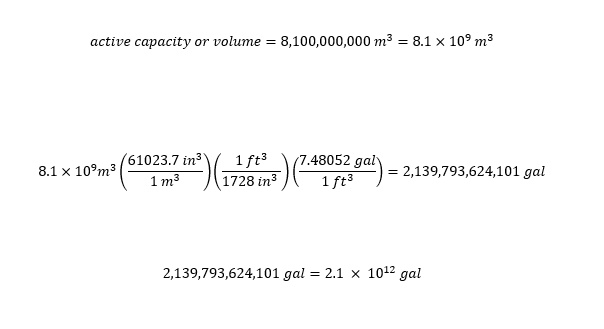
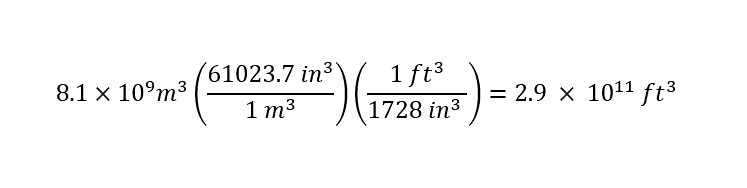
According to 'Wikipedia' the answer is around 11,100,000,000 cubic meters -- when full.  WOW.  That is a large amount of water.  Do you believe me (the reader -- you)?  How about if the number is converted to be expressed in gallons?  Lets find out through dimensional analysis.  First, we should adjust that value to be more representative of the actual 'active capacity.'  According the the 'Wikipedia page' for the Mosul dam above, the 'active capacity' for the dam is closer to 8,100,000,000 cubic meters -- even though the 'total capacity is 11,100,000,000 cubic meters.  Below I show the conversion from units expressed in cubic meters to units expressed in gallons:


Wow!  Can you imagine taking part of the job of building the dam?  Must have been quite an amazing job to be part of.  That amount of water is enormous.  Of course, entertaining large numbers on this blog post is getting to somewhat 'routine' -- which is good.  Think of the volume of water in the Brazil mining spill.  The amount of water stored in the Mosul dam is 132 times the amount stored in the mine dam in Brazil.  Wow!  Now that we have the enormous amount of water stored in the reservoir for water and/or utility generation purposes, the next question can be asked which is the subject of the blog post:


If the Mosul dam were to break, would the amount of water stored be enough to cover the city of Mosul in 65 feet of water?


In order to answer the question, the following values need to be calculated: 1) Area (length multiplied by width) of Mosul and 2) the volume of such a rectangular box that contains the amount of water in question.  I was amazed when I first heard the statistic for the following reason.  The reason is simply that between the city of Mosul and the dam -- their is a distance of 35 miles.


Depending on the geography and topology, the water might go different directs rather than just accumulate downstream in the city of Mosul.  Therefore, the missing (among others) piece of information in the above article describing the break and the fallout calculated by the U.S. Army Core of Engineers must include the topology of the area.  The water must accumulate in the city (downstream) of Mosul in the event of a break.


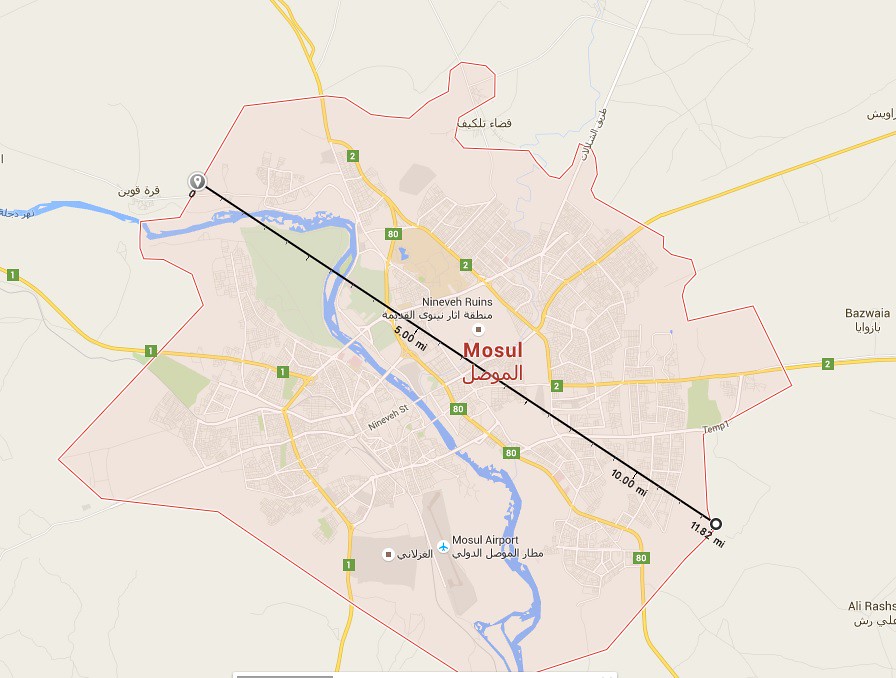
With these two 'pieces' of information unknown, we can still proceed with the calculation in question by a couple of approximations.  First, the geography needs to be assessed to gather the area of the city of Mosul.  According to GoogleMaps, the city of Mosul is shown below:


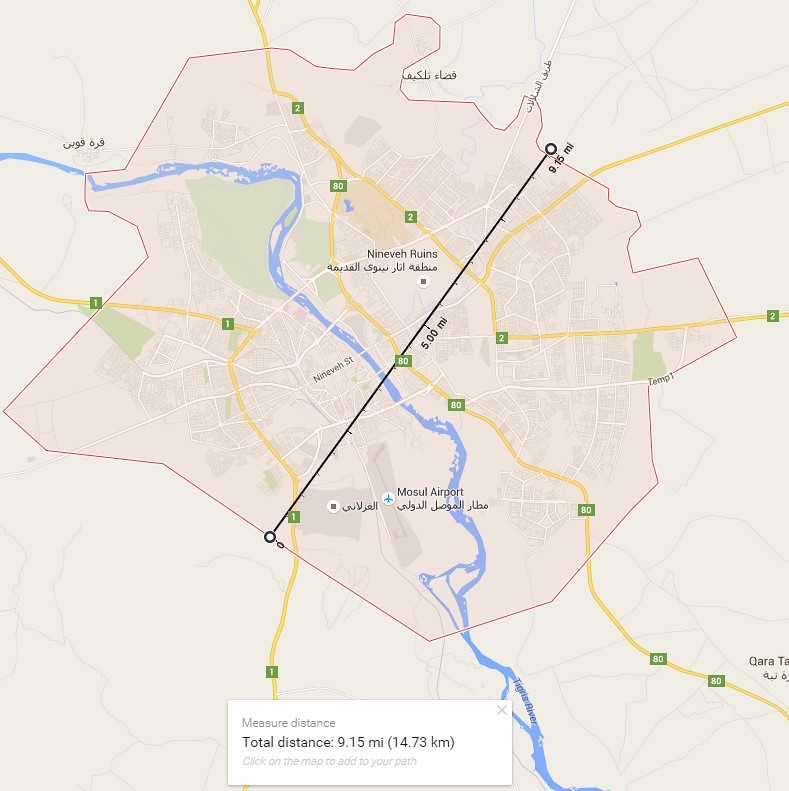
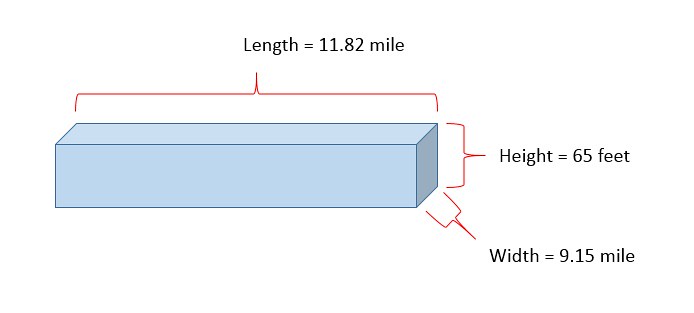
As you can see, I took the liberty to overlay a marker through the length of the city of Mosul -- which turns out to be 11.82 miles in magnitude.  The shaded area of the city can be ROUGHLY approximated to be a rectangle.  That is, in order to calculate an area of rectangle, the length and width must be known.  The width is shown in another picture of the city of Mosul below by GoogleMaps:


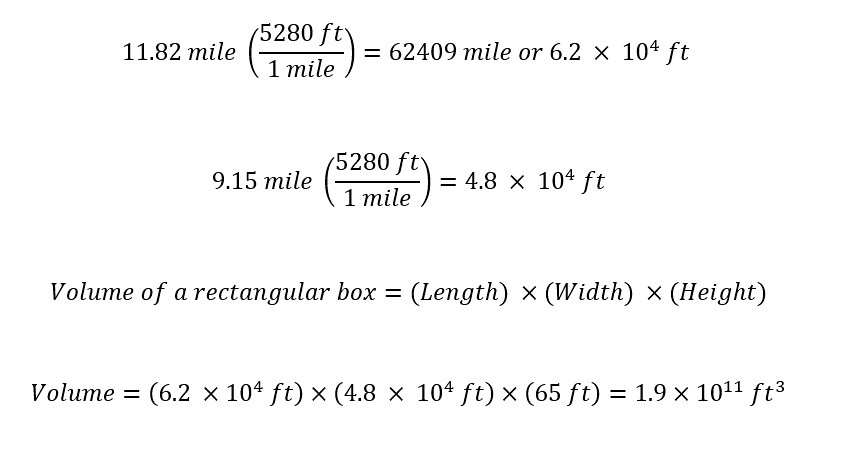
The width of the city of Mosul (according to my picture above) is 9.15 miles.  With these two values in hand, there is only one value needed to figure out the volume of a rectangular box -- the height.  From the article above, the height is the amount of water that the city of Mosul is proposed to be under (speculation) in the event of a dam break.  That height is equal to 65 feet.  The volume can be viewed below:


The rectangular coordinates given above match those from the GoogleMaps above for the city of Mosul.  To determine the volume of a rectangular box, the equation for the volume is needed -- which is shown below:


In order to determine the volume, we just need to 'plug and chug'.  'Plug and chug' is a phrase used to execute the calculation by plugging in the values and being persistent (chugging) to determine the solution to the problem.  In the current example, the equation is quite simple.  Although, when you keep pursuing science -- sometimes the equations can get very complex.  Further, sometimes so complex that a computer is needed to arrive at a solution.


Lets finish determining the volume with the values above:


With the volume of the city of Mosul determined, we can determine if the volume of water contained in the Mosul dam is enough to fill the solution (volume of city of Mosul).  First, we need to convert the volume of water in the Mosul dam to a value expressed in units of 'cubic feet'.  The calculation is shown below:


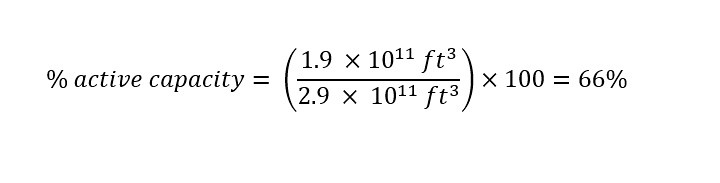
We can directly compare the two volumes now as shown below:


The volume of water required to fill the city of Mosul to a depth of 65 feet is only 66% of the total 'active capacity' (active volume) held in the Mosul dam.  Wow!  That is mind blowing.  Each of the potential parameters (sewage, water, power, etc.) cited above in the 'Guardian' make sense.  Especially, after performing the above calculations which cast the reported statistics into perspective.  The Mosul dam is an important player in the current conflict in Iraq.   The stakes are high and the fall out is extremely huge.


Conclusion


The real destruction comes as a result of the years without proper water, sewage, and the ability to desalinate the water from the Tigris River.  Further, the destruction of the infrastructure as has been shown in Brazil where a massive amount of water rushes through a city or town and literally wipes out all of the infrastructure.  The ability to rebuild would be diminished without proper resources, some of which are derived from the utility of having running or access to water resources.


That being said, the amount of destruction has been estimated and agreed upon by the United States of America and Iraq.  Next needed is the ability to produce a solution that is viable and worth pursuing that is quick and sustainable -- two words which generally do not belong in the same sentence (quick, sustainable).


With all of the discussion surround the rain here in California and the drought, I would hope that a plan emerges in Iraq that is sustainable and attainable.  Because, once the dam breaks, the water will flood Mosul and run off into the Persian Gulf.  Which at that point, the water is no longer of use to the communities -- upstream or upriver from the ocean.  The amount of resources needed to bring the water back into the city to rebuild would be insurmountable.  The city might just languish -- pure speculation there (which equates to no value).


The amount of water involved in the discussion above is similar to other statistics seen on this blog post over the last couple of months.  Lets make a change and make use of the water with the intention of writing a future post (in the form of a success of use) story with regard to its use.  Until then, have a great day!

Tuesday, February 2, 2016

How does a nation elevate STEM education by showcasing celebrations of science backstage?

Note: This blog was written in 2014 and appeared on the website "voicesinecho.com" Stay tuned for more on the subject of STEM.


There is no doubt that there is an educational ‘war’ occurring in the United States at the present moment. Advocates for and against educational reform are striking on every ‘medium’ at a moments notice. I am not here to argue or express my opinion over the ideology or implementation of ‘common core.’ In fact, as I have said to my family time and time again, I have not really sat down and read the current reform that goes along with the implementation of ‘common core.’ Partly, because I work at a University and am concerned with the students at that educational level. This is no excuse and in light of that, I can say that I will eventually get around to investigating the issues that are surrounding the contested reform.


What I am here to state in a rather succinct manner and with an example is the lack of elevation in the press that science gets. Particularly with respect to K-12 science education. Recently, I observed a blatant example of setting a celebration of science for K-12 educational outreach ‘backstage’ which contributes to our misguided values with respect toward science education as a society and world. There is no doubt that we are falling behind with STEM (Science, Technology, Engineering, and Mathematics) education with consequences that are growing by the year. The consequences of not improving the education that has direct ties to the generation of technology can be devastating to the United States national security and competitiveness in the ‘workforce development.’ Considering the timeline involved with a successful change in the educational system, there needs to be greater attention and dissemination of the value and importance of science through popular platforms (government, social media, news media, private industry, etc.). Below I elaborate on the last few sentences.


An Example of a STEM Celebration Failure


Recently, I was reading ‘the New York Times’ newspaper and realized that I had just observed a failure in highlighting the celebration of STEM education which was disappointing to say the least. I was flipping through the first section of the newspaper. Generally, the news is displayed in sections with the larges reaching news being reported in the “A section” followed by the subsections that are concentrated such as “B section”–Business and Sports, “C section”–movie and art, and “D section”–more art and entertainment, etc.. The last few sections after “C section” can vary in content in such discussions as the paper chooses depending on the day of the week. For instance on Tuesday, a “science section” appears which I enjoy and his hidden in the last of 4 sections of the newspaper and can easily be thrown out if the reader is either hurried or just interested in the first two sections which covers General News, Business, and Sports.


Anyways, I was flipping through the “A section” which usually has around 20-22 pages depending on the amount of stories in the news. I noticed in the back on page A16 down in the lower left corner was an article that took up around 1/6 of the page. The title of this small article was “Obama Meets Scientists, One Age 6″. In hindsight, I would say that the value matches the size of the allotted space on the page. In addition, in that small space was a large picture of the President holding a demonstration with a potential young scientist. At this point you might be wondering why I am dragging on about the layout of the page. Read on!! On the other half of the page was an “obituary” of the famous architect Massimo Vignelli . The other one-third of the page was on the top left and was dedicated to a story titled “Red Sox Announcer’s Son Gets Life Term After Admitting to Girlfriend’s Murder”. If one examined the page, the direct observation of the importance of the article in relation to the others would be completely apparent. In no way am I stating that the other two topics were not relevant and needed attention. I was just surprised at the layout of the page–one could easily just skip over the little article that should be highlighted.


Here is a picture of a child dressed up gazing up at the President holding up a model.


Source: LA Times


The excitement of the child is very apparent and this moment could make or break that kid–meaning, here is a young mind that potentially change the world with an invention or a cure that was derived from his enthusiasm in science as a young scientist and fueled by meeting Our President. Here is an excerpt from the article in which the President himself discusses the importance of the celebratory event at the White House:


“As a society, we have to celebrate outstanding work by young people in science at least as much as we do Super Bowl winners,” the president said in the East Room, just a week after he met with the current Super Bowl champions, the Seattle Seahawks, at the White House. “Because superstar biologists and engineers and rocket scientists and robot builders, they don’t always get the attention that they deserve, but they’re what’s going to transform our society.”


This excerpt should be on the front page of the ‘New York Times’–not day after day–Donald Sterling’s (the ‘soon to be ousted’ owner of the LA Clippers basketball team). That story has merit as well, but not any more than this story I would argue. Further, last Friday, the ‘New York Times’ had a front page picture of a helicopter in a dark neighborhood in Puerto Rico that was barely visible with the caption “A police helicopter during a drug raid in Puerto Rico, where traffickers are routing cocaine headed for the Eastern Seaboard.” Where are the values being placed in this Country? Undoubtedly, the drug war is an issue along with racism in this Country. Did anyone ever think that possibly if these young kids were steered toward STEM education in hope that they might possibly be dissuaded from using drugs or engaging in nefarious behavior? If more parents and children were exposed to the words coming out of Our President’s mouth, I believe that this would definitely plant the idea in their minds of the value of STEM education that needs to be improved. With this being said, all is not bad on the educational front with regard to science being dispersed to a broader audience. There are efforts within the academic institutional setting seeking to broaden the awareness and importance of science in relation to profit margins in the business world–which is a good start. Listed below is an example of such expanding awareness of science outside the STEM community.


An Example of Incorporating STEM Education into the Business World


Last week, I was pleased to find out that a professor from Babson College–a small private college for business majors in Boston has integrated a course into their curriculum to draw awareness of the environmental issues that are of increasing importance to the planet. The article was out of the ‘Journal of College Science Teaching’ and is titled “Pitching Environmental Science to Business Majors: Engaging Students in Renewable Energy Choices”. Here is an excerpt highlighting the motivation of incorporating an exposure to science and environmental issues into the educational curriculum:


To be effective and innovative leaders today, business students must clearly understand and become engaged in science and, in particular, environmental science issues (Laprise, Winrich, & Sharpe, 2008; Lester & Rodgers, 2012). Historically, undergraduate business majors have been disconnected from science education; however, many business schools are now realizing the value of incorporating science, and especially environmental science (Charski, 2008; Laprise et al., 2008). A foundation in science is viewed as important for all career paths (Heindel, 1996), and inquiry is a necessary skill that often comes specifically from the language of science (Smith, 2003). Employers are beginning to recognize the importance of coupling managerial skills with scientific proficiency to succeed in a hightech world where misunderstanding the science behind a business model can result in a steep decline in profits (Hubbard, 2005). Within the business world at large, there is growing evidence and increasing acceptance that implementing environmental technology and sustainability practices are now the main drivers for current innovation and business success (Nidumolu, Prahalad, & Rangaswami, 2009).


Wonderful, there is now a growing awareness that understanding the importance of science in relation to sustainability has a direct tie toward profit margins. At least the message is being communicated in some manner. As a chemist, I look at the issue coming from the science standpoint. But, my brother-in-law, who is in business sees the issues at large from this standpoint. Therefore, we need institutions such as Babson College to play an instrumental role to bridge the gap between two opposing views of the issue at hand–Sustainability through greater awareness of science. The reader might be wondering how exactly is awareness implemented in the above described statement from Babson College. Here is another excerpt describing the class:


Designing active learning experiences that are both content driven and appealing for nonmajor science students often proves to be challenging. To address this within the first module of the course, I created a modified rocket pitch (similar to an elevator pitch), which is a short (2-3 minute) presentation designed to clearly explain a new business idea to a room full of investors. Instead of presenting a business idea, students were asked to “sell” the renewable energy choice they selected as the best option for the future to their peers with a goal of convincing the audience to switch to their energy type. In creating this activity, I combined two methods that have been proposed specifically for engaging business students in learning science. The first is to focus on scientific research that is specifically relevant for business opportunities, and the second is to teach scientific concepts using common business approaches, such as the development of a business plan (Lester & Rodgers, 2012; Letovská & Banschbach, 2011; Levin & Montvilo, 1998). Renewable energy was chosen as the subject for this activity for two reasons: (a) green technologies provide a clear space for future entrepreneurial innovation and investment and (b) renewable energy has polled as the #1 topic of interest for students in this Environmental Technology course for the past 2 years.


This is brilliant!! Forcing students in business to become aware of the ability to sell science is great. When my wife first read over this paragraph, she was disappointed in the available time given to the students to present their work. This highlights that she is a scientist. She believes as I do that a scientist should have ample amount of time to explain his/her work to policy makers. Unfortunately though, if anyone has ever had any interaction with a business person, you have around 2-3 minutes of attention span. That is not to say that the person cannot focus. Scientists need to improve their skills of delivering the importance of their work in a succinct and brief amount of time. Too often a scientist will relish in the importance and drag on and on and on and on about their work–Big deal-Right! From what I have heard from professors who have been in the field for a while and have gone to talk to policy makers — Senators, Governors, local Politicians–the time frame for ‘pitching’ an idea is around 1-2 minutes. That is being gracious.


Understanding the above highlights the need to elevate the Scientist to be more descriptive to a general audience along with elevating the business person to be able to incorporate science into his/her ‘pitch’ of a proposal. In addition, the media and other avenues of dissemination of science knowledge need to join in and elevate the press attention to science. As a World, not just as a Nation, all of us need a greater exposure to the importance of the environmental issues that confront us along with the role that science plays in providing solutions. There is no solution that will solve the problem overnight. Each of us should feel motivated to contribute by becoming more aware of STEM education and the importance of science toward combating global environmental issues. Science should have an equal priority to any other issue that occupies the front page of the Nations most frequented Newspapers