As the water season began (at least that is what is reported by the news) in early October of this year, news accounts will be arising discussing various rainfalls. Certain accounts will detail the much needed rainfall while others might even scare readers of the excess rain and the damage that might follow. Regardless, the way the news agencies reports rainfall is often misleading and uneventful. Below, I discuss one example from the "Los Angeles Times."
How Is Rainfall Reported?
Over the course of the last year, I have started to write about the reporting of rainfall. I am constantly amazed at the subtlety with which large volumes of rain are reported after a given storm. This problem of mine started back near the end of 2015 -- after reading a report of a storm.
Before I get into the initial motivation to investigate news reports about volumes of rain fall, I would like to say that I am still baffled why the news reports "inches" of rainfall while total volumes in units of "cubic feet." I would prefer the units of total rainfall reported in units of "gallons" -- personally. The reason is that I can visualize using a few metrics (large volumes -- pools, stadiums, etc.) to compare the reported values to. Although, one could argue that my request is just unique to me and I could just as easily perform dimensional analysis to get the units that I feel comfortable with. Fair enough!
During the end of the month of December of 2015, large volumes were reported and I wrote an initial blog post about this rainfall in following month. Accuracy was not the first and foremost during this storm -- which concerned me. The reason why is in the numbers. Let's take a look briefly at the reported numbers which in some cases were skewed or miscalculated.
In that blog post, the news reported a number based on the weather service of 65 billion gallons of water from a single storm -- which is an enormous amount of rain. One of my family members told me this factoid and stated that 65 billion gallons of water equated to increasing the water level of Lake Tahoe by 6 inches. Meaning, that enormous amount of rain if collected and poured into Lake Tahoe would result in an increase of 6 inches of height to the lake.
After hearing that number, I sat back and thought -- Wow -- that means that Lake Tahoe is larger than I thought. This factoid bothered me for a few days. As a result, I decided to carry out a few calculations which are shown in the blog post. I will get to the point. The result of the calculation gave a volume that was very different than the volume reported by the news.
What was I to make of this disparity in volumes?
Did I make a mistake in my calculation?
Did my approximation not make sense?
Check out the blog to understand my full thought process in calculating using a simple approximation -- that of a cylinder. The result of the calculations revealed that the total volume of rainfall in that particular storm was 6.5 billion gallons NOT 65 billion gallons. A factor of 10 different in the reported statistic.
Should we be concerned by the lack of accuracy in reporting?
Yes.
Two major results came from that practice:
1) The volume I calculated was correct.
2) The weather station corrected their reported volume after checking their calculation.
3) I learned a better method by which to perform dimensional analysis of rainfall using reported volumes.
Out of this exercise came the correction of the weather station. Again, all of this is in the blog post. Additionally, I learned that method by which the weather stations use (one of the methods) to calculate the volume of rainfall in a given storm.
After carrying out the exercise and writing the blog, I decided that from that point on forward, I would watch news accounts of rainfall volume in the future. Further, I would look out for reported statistics and try to put them into perspective for the reader using dimensional analysis. The result has been the blog posts that make up this site.
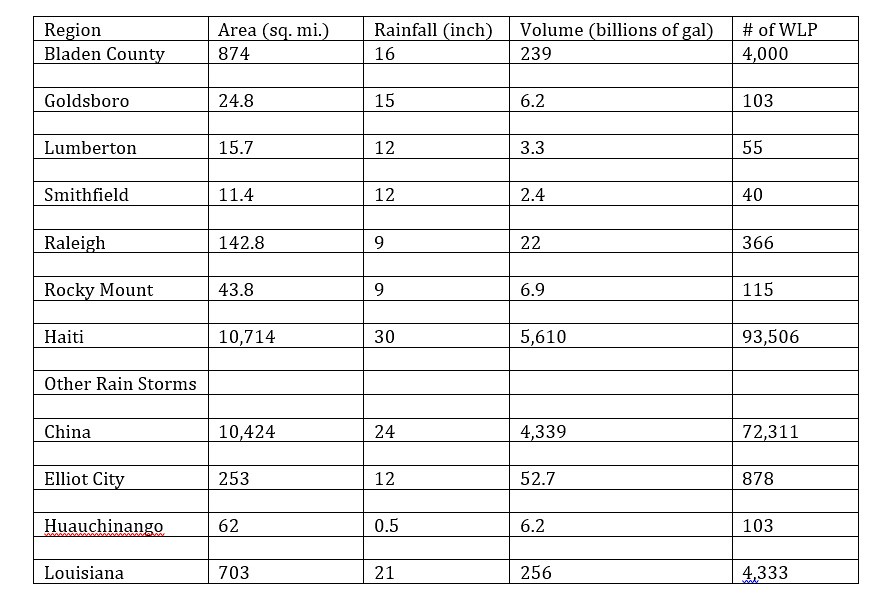
The results of previous blog posts this year so far regarding the total volume of rainfall have been collected into a table shown below:
The first seven storms listed in the notes above are a result of Hurricane Matthew which ripped through the Eastern part of the USA originating from Haiti. The last five storms listed are storms that have occurred due to unusual rainfall this year. Recently, the Associated Press covered this in a story about the National Oceanic and Atmospheric Administration released report on rainfall this year around the world with implications toward Climate Change.
Regardless, the enormity of the storms are worth writing about. With that in mind, let's move onto the reported value of rainfall over the season thus far in Folsom (California) of 55 billion gallons so far.
The recent rains were enough to force federal officials to begin releasing water from Folsom Lake to protect against flooding for the first time since March, said Louis Moore, a spokesman for the Bureau of Reclamation, which manages the reservoir. Since the beginning of December, Folsom has risen more than 20 feet — an increase of about 55 billion gallons.
Now, if you are a reader of this blog, then the number 55 billion gallons should stick out of the excerpt above along with the number 20 feet. Further, with the previous blog posts on this site, you will understand my need to understand the magnitude of large numbers like this. Numbers that are truly incomprehensible. I believe that the value of 55 billion gallons of rainfall qualify for the analysis typically found on the site.
To start such an analysis to put the enormous number into perspective, a metric is needed. A metric serves as a 'ruler' of measurement. Metric's specifically take away all ambiguity when defined. What? I know that is confusing. Basically, we need a measurement to compare the volume too.
Let's choose 3 volumes and see how the statistic of 55 billion gallons compare. The 2 volumes will be: 1) World's largest pool 2) Lake Tahoe.
1) World's largest swimming pool:
To start an analysis of the volumes is to ensure that the 'units' of measurement are the same. That is, for the example at hand, the volume of the World's Largest Swimming Pool needs to be expressed in units of 'gallons' to be directly compared to the volume reported above of 55 billion gallons.
Remember, if the volume were written out in long form, the value would appear as follows: 55,000,000,000 gallons! Expressing the number in scientific notation allows us to express the number in a compact form. The volume of the World's Largest Pool can be expressed similarly in a compact scientific notation.
Since the units are of the volume are expressed in 'gallons' -- the number of swimming pools that could be filled with 55 billion gallons of rainfall can be directly determined by dividing the two volumes as shown below:
Wow! The result can be interpreted as the following:
55 billion gallons of rainfall would fill 830 - World's Largest Swimming Pools!!!!!!!!!
How does one visualize that number of swimming pools?
Note:Since my last blog post using swimming pool in San Alfonso del Mar -- another pool built by the same company has built the new "world's largest swimming pool" -- Crystal Lagoon located in Sharm-el-Sheikh, Egypt.
Can you visualize a total volume of 830 of the above pools?
I cannot. Maybe another metric is needed to better grasp the enormous volume of rainfall.
Sometimes our choice of a metric does not necessarily cast the volume in a graspable light. For instance, trying to visualize the total volume of 830 World's Largest Pool combined is too difficult. Maybe another analysis is useful with a larger metric to cast the volume is needed.
In order to get a better grasp of the volume, a larger volume is needed to serve as a 'metric' to compare enormous volumes too. 55 billion gallons is not a typical volume. Therefore, a larger volume is needed. On a previous blog post on this site, Lake Tahoe has been used as a metric for extremely large volumes -- which this qualifies as that category.
Upon inspection of the photo above, Lake Tahoe is a huge lake. The total square area of the Lake is 191 square miles. In order to use this value as a reference to cast 55 billion gallons of rainfall into perspective, a little math will have to be performed. But, we will take the process slow. If at any point, you (the reader) need clarification, please leave a comment in the blog post below.
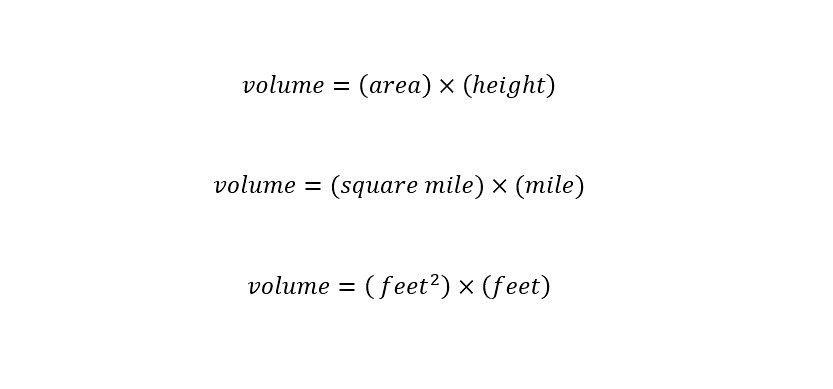
To start with, an equation for the volume of Lake Tahoe is needed. Above, the surface area of Lake Tahoe is given as 191 square miles. An expression (or equation) for the volume of an irregular shape like a lake is the following:
According to the expression above, the volume can rainfall can be determined by knowing the amount of rainfall that a storm delivered across a surface. Meaning, if a circle is the two-dimensional surface, then by understanding how much water fell on the circular surface, the determination of the volume of a cylinder is possible. By the way, the units of volume are 'cubic feet' or 'cubic mile' - etc. Cubic feet is most likely easier to visualize -- since most of us have an idea of the dimension of a foot is in comparison to inches of rain.
Since in the present case, a volume is known, then in order to understand the magnitude of 55 billion gallons the question becomes the following:
How many feet would Lake Tahoe rise if 55 billion gallons were dumped into the Lake?
In order to start the calculation, a unit conversion is required to move on. The second line of the volume expression states volume in terms of 'units of miles'. This is not useful when discussing rainfall -- which is usually reported in units of 'inches'. If the calculation is carried out with units of 'miles,' then the results of the calculation would be expressed in 'miles' -- which would be difficult to interpret.
Rather than get an answer that is difficult to interpret, a conversion can be performed to units of feet from miles. There are 27,880,000,000-square feet in a square mile. With this conversion factor available, the units conversion is easy and shown below from square miles to square feet:
Next, take the answer (in square feet) and plug the value into the original volume above:
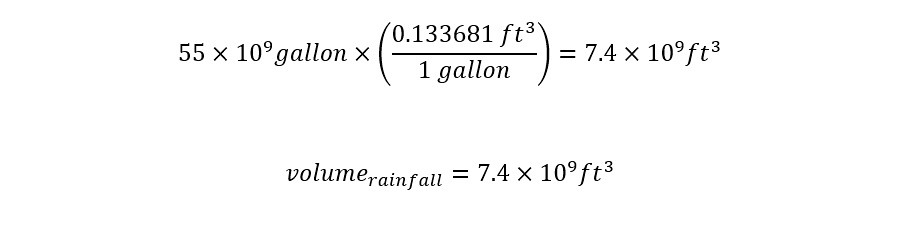
Shown above is an expression for volume with a value for the area (191 square miles) inserted. There are still two unknowns left -- volume of rainfall and height. In order to plug a volume into the above expression, a 'unit' conversion is necessary from 'gallons' to 'cubic feet'. There is 0.133681 cubic feet in 1 gallon. With the conversion factor in hand, the conversion is simple as shown below:
Next, if the volume of rainfall is plugged into volume equation above, we are left with one equation with one unknown (height) as shown below:
If we rearrange the above expression to solve for height from the total volume, we get the following:
Wow. The following result states that if 55 billion gallons of water was dumped into Lake Tahoe, the water level would rise 1.4 feet in total. That is just under 18 inches (1.5 feet).
Can you visualize the change in height?
Of course - why? Because, I am 5 feet 7 inches tall. I could stand next to the Lake (shown below) and visualize roughly the water level rising to my knees. I can easily imagine Lake Tahoe filling up by 1.5 feet. What I did not realize is that Lake Tahoe is enormous.
Further, take that measurement and look out onto the Lake and the visualization of 55 billion gallons comes into focus. The choice of Lake Tahoe as a metric fits the dimensional analysis much better. Half the battle in performing dimensional analysis problems is choosing the correct 'units' and 'metric' by which to compare the stated (reported) value in the popular news to.
Again, here is another picture of Lake Tahoe shown below (not from space):
In the paragraphs above, a couple of metrics (world's largest pool and Lake Tahoe) to cast the enormous volume of 55 billion gallons of rainfall into perspective. Both volumes represent two extremes of the entire spectrum. Using the process of dimensional analysis, we were able to compare the volumes to the reported volume of 55 billion gallons. Prior to this analysis, any attempt toward understanding the true magnitude of the statistic.
Too often, reading the news results in a lack of understanding of the true magnitude of large numbers. Whether these numbers represent volumes, heights, miles traveled, electricity generated, there is a need to try to understanding them. The avenue by which to do so is through 'dimensional analysis'. The process is rewarding when you arrive at a result. Regardless of the result. Often times, more thought and analysis is needed to make further sense of the statistics.
Of the many unanswered questions that exist around the current election cycle, very few are as important than questions surrounding current scientific research and the funding for the future.
Why should the public vote/influence an increase in science funding?
Why do I suggest the importance of such research is so high?
The range of issues that are tied to science funding is enormous. Most people do not realize what issues are encompassed by science funding. If you (the reader) are one that ties research funding only to important issues like - space or defense - then I ask you to please read everything below. The reason is that the range of issues affected by science include climate science (flooding from Hurricane Matthew) to research into better treatments for eradicating the Zika Virus or Ebola Virus.
Additionally, what about the homeless problem that plagues the United States which includes many victims to serious mental health issues and impact the veterans among others roaming the streets without help. Before you go to the voting polls tomorrow, please read the information below which might or might not influence your vote. Either way, after reading the blog post below, you will definitely be better informed. Last but not least, I will provide direct evidence of the wonderful job that artists such as Beyonce, Jay Z, and Leonardo DiCaprio are doing to elevate science and the need to get out and vote -- which is super inspirational.
Note: various words or phrases are hyperlinked to earlier posts on the subject or other research articles. Please read widely and inform yourself on Science Issues.
Pending Issues Which Need To Be Addressed
Just look at the current state of affairs around the nation and the world along with the issues raised in the blog post below. Then we can talk about the importance of such issues. Currently, the entire East Coast of the United States is recovering from the dramatic flooding and winds which struck when Hurricane Matthew swept through and wreaked havoc on the region.
Any discussion of the funding for the destruction and the recovery?
Has the East Coast rebuilt all of the damaged structures?
Not in the least. Why not? If the same lack of attention toward science research into the issues exist today, where will we be as a nation in 4 or 8 years? This is why the issues of science are serious and need to be entertained before we head to the voting polls next week. At this point, you might be wondering the following question:
What are the most critical issues at hand that are associated with science for the candidates to express their views toward?
A recent article from the website "BioscienceTechnology" titled "Coalition Presses US Presidential Candidates to Address Science Issues" offered commentary on the "Top 20 Questions" from the nonprofit organization "ScienceDebate." The author chose to offer up six of the 20 questions as necessary to provide an example. The six sample questions are shown below:
1) Many scientific advances require long-term investment to fund research over a period of longer than the two, four, or six year terms that govern political cycles. In the current climate of budgetary constraints, what are your science and engineering research priorities and how will you balance short-term versus long-term funding?
2) Mental illness is among the most painful and stigmatized diseases, and the National Institute of Mental Health estimates it costs America more than $300 billion per year. What will you do to reduce the human and economic costs of mental illness?
3) Strategic management of the US energy portfolio can have powerful economic, environmental and foreign policy impacts. How do you see the energy landscape evolving over the next 4 to 8 years, and, as President, what will your energy strategy be?
4) Public health efforts like smoking cessation, drunk driving laws, vaccination, and water fluoridation have improved health and productivity and save millions of lives. How would you improve federal research and our public health system to better protect Americans from emerging diseases and other public health threats, such as antibiotic resistant superbugs?
5) Science is essential to many of the laws and policies that keep Americans safe and secure. How would science inform your administration’s decisions to add, modify, or remove federal regulations, and how would you encourage a thriving business sector while protecting Americans vulnerable to public health and environmental threats?
6) Evidence from science is the surest basis for fair and just public policy, but that is predicated on the integrity of the evidence and of the scientific process used to produce it, which must be both transparent and free from political bias and pressure. How will you foster a culture of scientific transparency and accountability in government, while protecting scientists and federal agencies from political interference in their work?
The author seem to want to suggest that the above issues just did not impact science funding, but were of significance to the public at large. I found the paragraph below fascinating:
“Some politicians think science issues are limited to simply things like the budget for NASA or NIH, and they fail to realize that a President’s attitude toward and decisions about science and research affect the public wellbeing, from the growth of our economy, to education, to public health,” Rush Hold, CEO of the American Association for the Advancement of Science, said in a prepared statement. He said that Americans should have the opportunity to know where Presidential candidates stand on these issues.
All issues that are researched from a scientific standpoint are important. Just because the public does not see the ramifications of such research does not disqualify funding. Of course, there are certain areas that are of immediate importance than others.
Science Lessons For Next President
According to a recent article in the Journal "Science" titled "Science lessons for the next president" there are certain issues that need definite support. Here is a short video of the issues stated succinctly (less than 4 minutes in length):
Below are the critical science lessons that are of upmost importance for the next President:
1) "Pathogens Change Faster Than Our Defenses"
Our ability to stay ahead of deadly pathogens relies on our ability to understand how to dismantle a virus or deadly bacteria. I wrote a blog about new research that recently was uncovered in which scientists discovered a site (a part of the molecule) that is responsible for disabling the effectiveness of the antibiotic. Meaning, if a target molecule hits this site, then the antibiotic is rendered ineffective (useless) and will not work.
More money should be devoted toward understanding and developing ways to counter that pathway toward disabling the antibiotic -- which is commonly termed as "Antibiotic Resistance." Additionally, this relies on funding to develop drugs that will be effective and can be tuned to treat evolving pathogens. In a blog post that I wrote recently, there was a short video outlining with an explanation the drug development process which is worth looking at and reading. If you are still not convinced after reading the blogs, then read below the excerpt from the Journal 'Science' on critical issues which offers an alternative explanation of the importance of such research:
Importance:
Why it matters: Evolving pathogens can threaten our food and water supplies, natural resources, and health. In the United States, 2 million people develop antibiotic-resistant infections each year, and 23,000 die. Globally, the World Health Organization estimates that in 2015 there were 580,000 new cases of tuberculosis resistant to the two most powerful drugs used against this disease. Increasing drug resistance in malaria, HIV, and other major diseases threatens to undermine control efforts. And recently emerged threats, such as the Zika and Ebola viruses, are certain to evolve in ways that can be hard to predict. To develop treatments, scientists often must work with the most dangerous pathogens in laboratories, and sometimes even engineer new strains; this creates the possibility of accidental or intentional releases that could have dire consequences.
With the emergence of stories surrounding the spread of diseases throughout the world, research into these diseases is critical. The issues above are due to evolving chemical systems that are natural and are constantly challenging us to keep ahead of the game to fight new pathogens. If we switch gears and look at issues that are brought on by our own actions, we find challenges that definitely need to be addressed immediately. One such issue is 'genetic engineering.' The question is raised below:
What about potential problems brought by our own actions?
2) "CRISPR Raises Tough Ethical Issues"
Recently, the field of 'genetic modification' has been getting alot of attention and rightly so. The prospect of changing an organisms "genetic code" seems strange and straight out of a science fiction book. Although, if I were to tell you that certain foods you eat have been genetically modified and you still love them -- what would you do? Furthermore, if the so called 'genetic modification' was to help the crop avoid destruction -- i.e., preserve a given crop in order to provide you food, would your opinion change? The current benchmark (among other methods) is the rising CRISPR-Cas9 method. You can read more about the method on the 'Wikipedia' page if you wish. In order to understand the importance of funding such research along with the potential implications, lets turn to the same article from the Journal 'Science' with the following explanation shown below:
Importance:
Why it matters: A powerful tool for basic research, CRISPR could also lead to new treatments for genetic disease in humans, pest-resistant crops with higher yields, and disease-resistant livestock. But uses of CRISPR could also raise profound ethical and regulatory concerns. It could allow the creation of human embryos with modified genes in their germ line—eggs and sperm—meaning the changes would be passed on to future generations. And, in an approach known as gene drive, CRISPR could be used to permanently alter the genome of an entire species in ways that could shift its evolutionary path and ecological role, or even wipe it off Earth. In principle, gene drive could give an endangered species a boost, wreck the genetic defenses that allow some weeds to resist herbicides, or drive a disease-carrying mosquito to extinction.
The promises are huge as well as the payoffs if the CRISPR method is perfected. And I say "perfected" -- why? Because, according to a certain part of the science community, the method does not work "perfectly." Professor Karmella Haynes at Arizona State University is performing research that investigates which environments where the CRISPR method works well. The method does not work well in human embryo cells. The DNA is coiled differently (slightly as a defense mechanism) which presents a large challenge. Of course, in the popular science news, positive results are published rather than discouraging results. Nonetheless, the method is still a strong method.
As an example, here is a short video of a reporter trying to perform the CRISPR method and failing shown below:
The above video shows the extent to which science is a profession of tireless effort. Time is put into get results and verify the methodology of a given experiment. Often, people think that scientists have an easy job -- but in fact, the development of research that is reproducible and clear to the public is a difficult task which takes time and money.
Certain areas require more time than others to delve into a given research inquiry. How about the atmosphere? The time scale of global warming is seemingly long. Although, according to current reports, action is needed immediately. The danger associated with the lack of immediate action is catastrophic. I find the fact that certain politicians are in denial a terrible observation and can only exacerbate the problem and solution.
3) "Sea Levels Rising"
As a nation, the United States public has been engulfed by the current chatter on the television along with the myriad devices that each of us carry around. Not too long ago, their were three presidential debates. Did you watch the debates? Were you able to watch the debates? Why do I ask such questions?
Because, while some were watching the debates, other East Coast residents were in the midst of cleaning up their lives which were ripped apart by Hurricane Matthew. The depth of the destruction along with the cost of the damage to the U.S. has not yet been realized. What is realized is that there have been some crazy weather patterns lately. Further, the seas have been rising. Both situations are not good indicators for the future. The amount of rain that dropped during Hurricane Matthew was insane compared to other large storms around the globe. You can read about the comparison here.
In order to fully understand the importance of such rising sea levels, lets turn to the article (series) we have been citing about the six lessons for the next president. Here is the "importance" stated below:
Importance:
Why it matters: Nearly 40% of the U.S. population lives near the coast, and shorelines host extensive infrastructure—including roads, rail lines, ports, military bases, and energy, water, and sewer plants—that will cost billions of dollars to protect or replace. Already, shorefront communities in hot spots of sea level rise, such as Hampton Roads, Virginia, and Miami Beach, Florida, are seeing tidal floods—even on sunny days—that clog traffic, poison lawns, and corrode utilities. Key ecosystems are also at risk of inundation, such as wetlands and aquatic grass beds that help protect coastlines from storms and provide important nursery grounds for economically important fish. This rising stage also allows stormwaters to surge deeper and higher inland, exacerbating their damage.
Based on the destruction that we have seen this year in the United States as a result of a rising sea level (flooding rain), there is no question that the above research is vitally important. One candidate (Donald Trump) would like to take funds away from research concerning global warming and fight ISIS. Ask yourself if this is a good idea? Is that where you want your money spent? Money is already available for the Department of Defense for such adventures. If any money should be diverted toward research in defense, then how about toward mental health for veterans returning from war with invisible wounds?
4) "Brain Health Should Be Top Of Mind"
Dr. James Watson once posed the following question regarding the human brain:
Can the brain understand itself?
The above question at first sight appears to be quite simple. Yet, over the decades that have past coupled with the advancing digital age, science still appears to be in the dark age to an extent. At the other end of this logic, the computational power needed to understand the brain is said to not yet exist. If the second statement is correct, then we need not stop funding research just yet.
Each and every one of us has either experienced or been touched by a person with a mental health issue. Even if we did not realize it at the time. Mental health is an extremely complicated issue that plagues parts of the entire population from the homeless to the ultra rich. Mental Illness is blind to income and wealth. With the new initiative to study the brain put forth by President Obama, we are headed in the correct direction. He has the BRAIN initiative - which can be understood in greater detail by reading more about here. Why is the health of the brain so important? Here is an excerpt from the article in 'Science' below:
Importance:
Why it matters: Brain health touches us from cradle to grave, and when brain disease strikes, the costs—personal and budgetary—are staggering. By 2025, at least 7 million Americans are expected to suffer from Alzheimer's disease, which causes memory loss, personality changes, impaired reasoning, and, eventually, death. This year alone, treating and caring for Americans with Alzheimer's and other less common dementias cost $236 billion, with government health programs shouldering two-thirds of the cost. At the other end of life, the prevalence of autism, a disorder of language and social communication, rose by 123% between 2002 and 2012. That year, one in 68 U.S. children was affected; costs to each affected family are estimated at about $60,000 annually.
Other brain health issues abound. Learning disabilities are a big issue in classrooms; mental illness is common in the homeless, in addicts, and in prison inmates; and concussions have become a major concern in sports. The military faces the burden of treating traumatic brain injuries and the psychological aftereffects of combat. Effective diagnostics and treatments could make a huge difference.
As I mentioned above, the amount of computational power needed to fully understand the brain is just being realized. Think about current research just published which shed light on the way proteins behave in their natural environment -- inside a human cell. If research carried out at the current level sheds light on the onset of diseases, then imagine the requirement to understand diseases inside the entire brain (different parts of the brain acting together). The point is that research into the disease causing aspects of the brain as well as our ability to comprehend the world around us is extremely important.
With the rise of the machine in understanding the world around us come other advances of the same technology. Artificial intelligence has been speculated to be around and supposedly proposed to play a large role in our lives in the coming decades. For now, what about simple machines -- drones? self driving cars, etc?
5) "Machines Are Getting Much, Much Smarter"
Elon Musk has been in the news lately for a variety of reasons. His space initiative has cost the private sector of the space industry a pretty penny. He has shown a complete lack of regard for the loss of life in his Tesla cars while operating on autopilot. How? He cannot admit that his technology is not nearly where technology needs to be at in order to let everyone have an autonomous car. I write about this here. In order to have completely autonomous cars, advancements in artificial intelligence will have to be taken toward a whole new level. Currently, we are not there yet. Science can shed light on potential issues that prevent us from proceeding to 'go' just yet -- which are shown below:
Importance:
Why it matters: Although experts say we are still decades away from machines that truly think like humans, narrower applications of AI are already having an impact on society. Products and services from self-driving cars to systems that guide medical care and treatment could bring major benefits, including increased labor productivity, lucrative new markets, and fewer deaths from traffic accidents and medical mistakes. But AI brings worries, too. It will enable employers to automate more tasks and displace workers, and economists predict that some low-wage jobs will be among the first to be eliminated, possibly increasing economic inequality. Letting machines make their own decisions also raises profound ethical, legal, and regulatory questions. Who is responsible if an autonomous car crashes, a piece of software wrecks an investment portfolio, or a sensor switches a stoplight to green at the wrong time? The stakes are even higher on the battlefield, where the military is exploring the possibility of fielding autonomous lethal weapons that would make their own decisions about when to fire.
Advancing forward, a fair amount of research needs to be conducted. From the machine programming and execution standpoint, current research is quite advanced. Just this week, research about a world record was set for NASA surrounding the precision of a satellite with GPS technology. A satellite traveling at a distance of 43,500 miles travels the slowest, whereas at a distance of just under 5 miles from Planet Earth -- the satellite can travel at speeds of 22,000 miles per hour. The precision offered in orbit has allowed very precise 3-dimensional images of different aspects of Earth. This is just one of many reasons why space funding is extremely important. Better precision, better time, new technologies.
Although, with space research comes risk. Over the decades, risk has been studied and worked on by scientists over various scales within various problems. From the small scale - quantum error correction to the enormous scale of space flight - risk remains a crucial area of need to study in greater detail.
6) "We Aren't So Great At Assessing Risk"
Communicating risk to the public without posing great fear is extremely complicated. In many areas of research, communication of results is equated with great fear surrounding the research which leads to reductions in funding and possible cancellations of investigations all together. This highlights the demand to understand how to greater understand risk and the ability to convey risk to the greater public. Two areas seem to be polarized with regard to risk: 'genetic engineering' and 'climate change'. These two areas stand at opposite ends of the spectrum, but are equally important. In the area of 'genetic engineering' - the scare lies in the unknown product and effect toward civilization. Whereas in the other area -- climate science, the scare lies in the incomprehensible. Thinking on the global scale couple with temperatures rising to the point of civilization not being able to occupy the Earth is unfathomable and science fiction -- as far as some are concerned.
Therefore, understanding how to communicate and assess risk is crucial. Science says:
Importance:
Why it matters: Misperception of risk can push a president to overreact to lesser threats and underreact to greater problems, or to embrace policies that may make people feel good but end up being costly and ineffective—or even counterproductive. And how a president communicates with the public about risk can mean the difference between sowing panic and maintaining calm. Talking realistically about risks in advance—as opposed to promising absolute protection—may help prepare people for the inevitable disasters and minimize calls for a policy response that's out of proportion to the actual threat. To do this effectively, the president will have to maintain the public's trust, which is much harder to earn than it is to lose. Understanding the basic psychology of risk can help avoid missteps.
Again, transmitting the unfathomable to the public is complicated. The best hope is that the communicator is a good communicator (patient, humble, and intelligent) with a great audience (patient, humble, and intelligent). Yes, each of us need to do our part to achieve transmission of information (i.e. communication) between one another. Hollywood does this quite well. Science is a work in progress.
Celebrities Elevate STEM and Voting!
Beyonce (the singer) recently promoted the presidential candidate Hillary Clinton along with her husband Jay Z. With good reason. It has taken over a hundred years to achieve equality (and we are still fighting for it) - a work in progress. Having the first female president would be a major step in the right direction. Furthermore, this would reinforce the idea that any woman can go as far as she is willing to work to go. My wife is a scientist and I encourage her to be the best she can be -- break all barriers.
Although, the fields -- Science Technology, Engineering, and Mathematics (STEM) still need more women and minorities engaging in them for careers. Each of us is smart in our own unique way. There are plenty of women and minorities out there to help take science and society to the next advanced level. Having celebrities elevate science is critical. Science usually gets a bad rap. Why? Movie portrayals (such as "The Accountant") portray scientists as strange with disorders but super smart. Not all are strange. I promise.
Recently, the actor Leonardo DiCaprio became the 'Messenger of Peace' for the United Nations -- an honor he holds dearly and sincerely. He speaks about the role in a documentary he recently released investigating the state of global warming and explored all possible solutions. We need more people like him with the unparalleled ability to communicate to a large audience the importance of research and world problems. Here is the video below (just over an hour and a half in length) - but worth watching before or after the election:
I think that I have provided you (the reader) with an eyeball full of information to think about before you hit the voting polls. Get out and vote. Listen to the stars, listen to your family, just be sure to vote. Exercise your place in our democratic society. Yes, your vote does count.
Conclusion ...
Science funding impacts all areas of our lives. If you do not believe me, just try to think of an area which has nothing to do with science. Leave the answer in the comments below and I will try to provide a rebuttal to your answer. There is no rebuttal for the issues that can be solved with science but lack funding. We need all of the help that is possible to educate the public about the importance of science. How do you help?
The most important learning begins at home. What about science do you not understand? Why don't you care? What kind of world are you leaving to your children? These questions do have answers. The unknown is centered around how those answers will surface in the days and years to come. Whether we find out the answers through your vote, your children, your family, the answers will become apparent. Why not educate yourself and others on critical issues for a better society?
I hope that each of you go out and vote tomorrow. Further, I hope that each of you are inspired to educate yourself more after reading this post. Until next time, Have a great day!!!
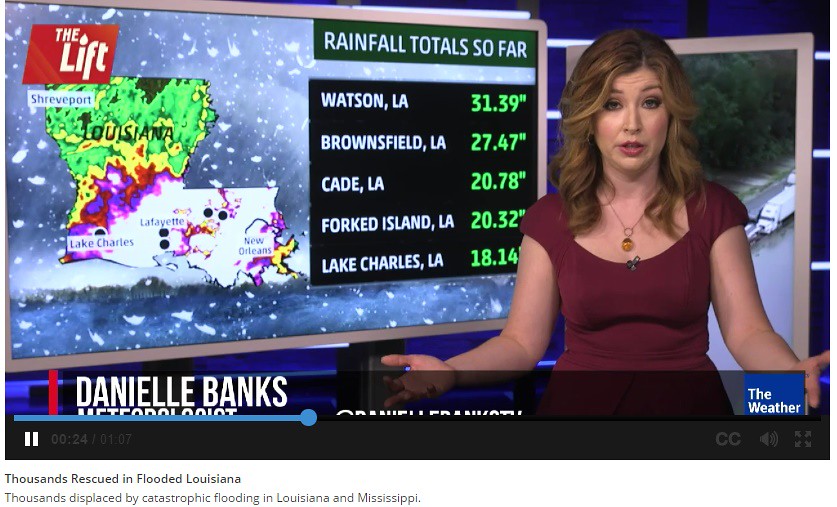
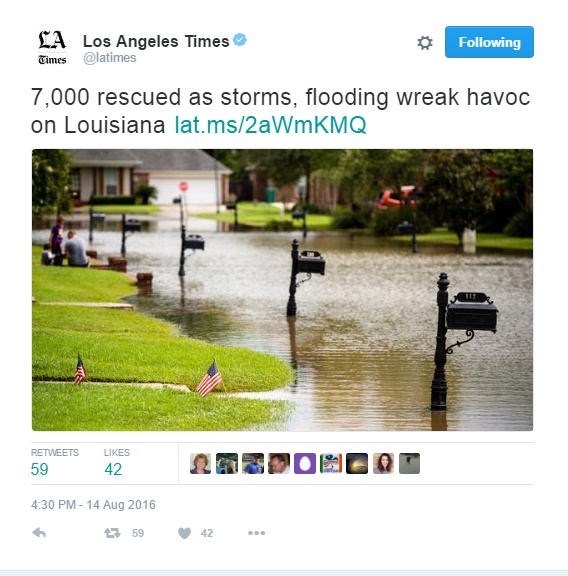
In certain parts of the state of Louisiana, there have been reports of up to 30 inches of rainfall. Here is a still photo taken from a broadcast on the website 'Weather.com' shown below:
In the picture above, the heaviest hit city is Watson with 31.39 inches of rain while the least hit city is still covered in 18.14 inches of rain. Quite a distribution of volume over a large region. Couple the distribution of rainfall shown above to the video taken from the news website 'NBC' titled "Louisiana Flood Displaces Thousands" shown below (less than a minute in length):
How do viewers process the destruction that is caused by such heavy rainfall?
Below are a few calculations to determine the extent of volume of rainfall hit in certain parts of Louisiana. By understanding the magnitude of rainfall in certain regions, a perspective can be drawn to understand the tragic amount of rain that has hit the state and displaced thousands of residents.
How Large Is Livingston Parish Louisiana?
Recently, an enormous amount of rainfall has fallen in various parts of the world in the last month. On this blog site, I have covered a few with calculations to provide a perspective: China, Mexico, Macedonia, and Elliot City (Maryland, USA). Along the same line of reasoning, the amount of water should be determined that fell on the geographic region -- Livingston Parish, Louisiana. With a volume of rainfall calculated, a direct comparison with other storms could be possible.
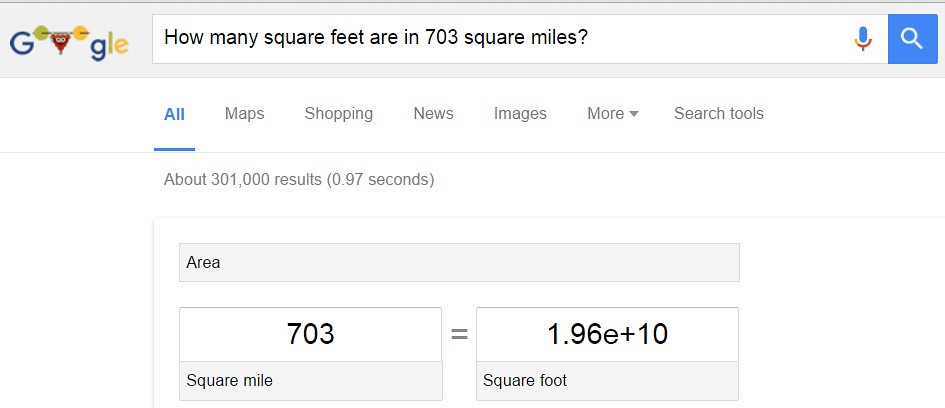
7000 people displaced? Oh my goodness. The amount of water must be significant. In order to calculate the volume of water, the dimensions of the geographic region of Livingston must be determined. Following along the same methodology of past posts on this site, let's ask Google.com. Here is the results shown below:
How about square feet?
Just by inspection of the magnitude of square feet -- 19.6 billion square feet -- immediately, you can reason that this storm is going to be large in comparison to previous storms mentioned. Not to mention the video shown above. With the area of Livingston expressed in square feet, the volume of rainfall can be calculated according to the expression shown below:
But wait, the reported amount of rain in Livingston was 21 inches of rain. How many feet is that? Just divide 21 inches/(12 inches/ft) = 1.75 ft. With the height now expressed in feet = 1.75 ft, the volume can be calculated as follows:
Wow! 34.3 billion cubic feet of water? No wonder the news accounts show cars floating down the streets in certain parts of the state. As usual, the number becomes a reality when expressed as a integer of a metric. Based on the past blog posts written about floods along with the enormity of the number above, the Mercedez Benz Superdome should suffice as a metric.
How Many Superdomes Could Be Filled With Rainfall?
How many Superdomes could be filled with 34.3 billion cubic feet of water?
In order to directly compare the volume of the Superdome to the volume of rainfall, the Superdome volume needs to be known. The volume taken from the 'Wikipedia' site is listed at 37 million cubic feet of interior volume. Now, that we have two numbers expressed in the same units (cubic feet), a simple division of the two numbers will yield the number of Superdomes which could be filled as shown below:
Oh my. The results of the calculations indicate that the total number of Superdomes which could be filled with the volume of rainfall = 34.3 billion cubic feet would be 274 Superdomes. Naturally, the number is large with such a enormous value of cubic feet of rain. In case you (the reader) view large volumes in units of gallons with a better perspective, the conversion of units from 'cubic feet' to 'gallons' is shown below:
The total number of gallons of rainfall in the region of Livingston Parish over the course of a few days is equivalent to 256 billion gallons. Amazing. Again, how much water is in the sky? Looking at this large number, a person has to view the atmosphere above them in a different light. How much more water is in the air in 'humid' conditions?
To put the volume of rain into perspective, a direct comparison can be made with other storms. Here are the following storms with the number of Superdomes in parentheses: China (4,640), Huauchinango Mexico (6.7), Macedonia(82), and Elliot City-Maryland-USA(56).
Conclusion...
Looking at volume alone for the storm that has hit Louisiana is astonishing. Next, directly comparing the number of Superdomes which could be filled provides a perspective of volume that is still difficult to grasp. I have trouble visualizing 274 Superdomes. Although, casting the volume in comparison to other recent storms helps slightly. That, of course, is a relative comparison.
Forecasting the amount of rain is a relative number too. But through the calculations shown above, the reader can gain a better perspective to match to the tragedy that is shown in the video above. It is difficult to imagine a car floating down the street or a boat rescuing people from their houses. Although, when you think of the volume of 274 Superdomes releasing all of the water contained in them and spreading that water over the area, the pictures from news accounts a cast into a perspective. Until next time, have a great day!
Lately, water is falling like crazy out of the sky in various parts of the world. If you are a regular reader of this blog site, you will remember the torrential rainfall in China a couple of weeks ago, followed by Elliot City (Maryland, USA) the weekend before last. Continuing on, the storm season has hit India and last weekend parts of Mexico (city of Huaunchinango). Click on highlighted regions to be directed to their respective blog posts filled with calculations of their respective rainfall. What is going on in the world with the excessive rainfall? Seems like each time I check social media, another disaster has struck the world and wreaked havoc. Recently, I found out about a torrential storm in Macedonia that hit parts with rainfall described as a "water bomb". Below are the calculations to provide you with perspective using metrics as to the scale and size of these tragedies.
How Large Is Skopje?
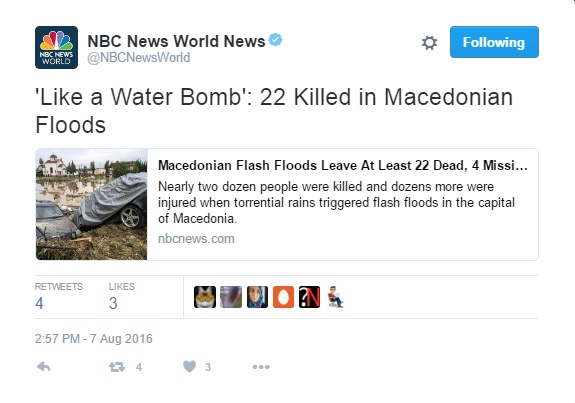
According to the news site "ABC.com", the capital of Macedonia -- Skopje received an enormous amount of rainfall over the last few days. Here is the picture taken from Twitter to describe the story:
Nearly two dozen people were killed and dozens more were injured when torrential rains triggered flash floods in the capital of Macedonia, the Red Cross said Sunday.
Government spokesman Aleksandar Gjorgiev told The Associated Press a state of emergency had been declared for two weeks in the most affected areas, which included the capital of Skopje, the city of Tetovo and surrounding suburbs.
The Red Cross reported that 22 people were killed, more than 60 people were injured and four were still missing after the floods destroyed hundreds of homes and wiped out electricity. More than 1,000 people were evacuated from their houses, according to the Red Cross.
Any loss of life is tragic and unfortunate. The article goes onto report a total of 20 inches falling in parts of the city of Skopje. That seems like a large amount of rain, but the size of the region should be known in order to put the volume of rain into perspective. If "Wikipedia" is consulted, the city of Skopje is reported to be around 220.64 square miles in size. Wow. Considering the size of the rainfall the disaster due to the volume of rainfall is slowly coming into perspective. Why do I say this? If you have followed the previous calculations, these numbers will add up to an enormous volume.
Recent floods in regions like China and Mexico have produced extraordinary volumes of rainfall that have caused considerable damage. Although, in China, the rainfall was spread out over a larger geographical area -- which resulted in a larger amount of damage to the country's overall GDP.
In order to really compare the volumes, a few calculations need to be carried out. Typically, I like to calculate the total volume of rainfall in cubic feet. The reason I choose to express the total volume in in cubic feet is that the height can easily be calculated from inches. Furthermore, having he volume expressed in units of gallons expands the direct comparisons that are possible -- since the majority of volumes that are reported in the news are either reported in units of 'gallons' or 'cubic feet.'
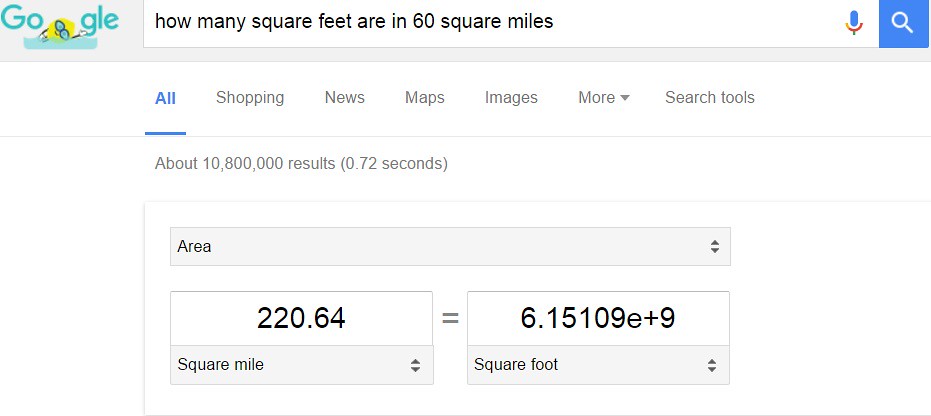
With that in mind, the area of Skopje which is expressed in units of 'square miles' needs to be converted to 'square feet.' I decided to use Google.com to convert for me. This entails typing in a question like: "How many square feet are in a square mile?"
If you do that for 220 square miles, the result is shown below in an image:
What do the numbers in the image above mean?
For every 220.64 square miles, there are 6.15 billion square feet. That is a conversion factor.
If you were to replace the 220.64 square mile by 1 square mile, the answer on the right hand side of the equal sign would be the conversion factor. This would be the number to multiply to get to square feet.
Now that the amount of square feet of Skopje is known, the remaining parameter is the height along with an expression to calculate the volume of the rainfall. To begin with, the expression for the volume of rain across a given square foot area with a certain height is shown below:
From the information reported coupled with the results of the calculations, the expression for the volume of the rainfall can be calculated as shown below:
Note: the value of 1.67 ft is the converted reported value of 20 inches into units of feet. The above calculation states that across the city of Skopje a total volume of 10.3 billion cubic feet of rain was reported -- Wow. The volumes keep getting larger compared to Mexico with 836 million cubic feet. Although, the value is small compared to 580 billion cubic feet for China. Still, the amount of rainfall has caused considerable damage across the region and therefore cannot be understated. The same can be said for the torrential rain in Huauchinango (Mexico) with loss of life too.
Next, in order to compare with values of volumes expressed in units of 'gallons', the volume needs to be converted as shown below:
The result of the conversion states that in 10.3 billion cubic feet of water, there is a corresponding 76.8 billion gallons of water. These two values are enormous and incomprehensible. As with other blog posts on this site, a little dimensional analysis is necessary to put the volumes into perspective.
First, in light of the Olympic Games taking place in Rio over the next few weeks, why don't we use the volume of an Olympic Size Swimming pool as a metric?
Hopefully, this will allow us to more easily visualize the volume of water produced in the calculations above.
How Many Olympic Pools Could Be Filled?
The question that needs to be answered in this section is the following:
How many Olympic Size Swimming pools can be filled with 76.8 billion gallons of water?
In order to start the calculation, the volume of an Olympic Size Swimming pool needs to be known. If you are a returning reader of the blog, you are probably thinking the following: "Mike, as we know, the volume used in previous calculations is 660,000-gallons" You (the reader) are correct. We know this from previous blogs and the first blog (which can be found here).
There is nothing magical about the volume -- which can be found on "Wikipedia" along with the reference to the image of an Olympic Size Swimming pool shown below:
With the volume expressed in units of 'gallons' and the total volume (76.8 billion gallons) expressed in units of 'gallons' -- a simple dividing of the two values yield the number of swimming pools which would be filled with the rainfall:
The result indicates that a total of 116,363-Olympic Size Swimming pools could be filled with the volume of 76.8 billion gallons of water.
Does that seem reasonable to you?
Don't worry, unless you have been reading previous blog posts on the site that deal with large volumes of liquids, the guess might not come naturally.
Is there another volume that be used to visualize the enormous number? How about the Mercedez Benz Superdome in Louisiana?
Below are the calculations for the superdome.
How Many Superdomes Would Be Filled?
The Mercedez Benz Superdome is an indoor football stadium located in Louisiana and is shown below:
As you can see, the structure is huge and seems like a reasonable metric to use in dimensional analysis calculations. According to the 'Wikipedia' page, the interior volume of the superdome is 125 million cubic feet. Since the calculation above for the volume was initially expressed in units of 'cubic feet' (10.3 billion cubic feet), the two numbers simply need to be divided as shown below:
Wow! Wow! Wow! Unbelievable. When you stop to consider that the amount of water that fell from the sky could fill 82 superdome structures, your mind should be blown away. At least mine was. I am still in disbelief.
Where does all the water come from?
This highlights the amount of water in the atmosphere.
Conclusion...
The amount of water that has fallen in the form of rainfall over the past few months is truly mind boggling to say the least. Unparalleled is the devastation through the disaster that is caused to infrastructure, life (loss of life), government, etc. The situation is without explanation by science -- except to say that climate is changing throughout the world. If this is a sign then, Wow -- we had better start thinking about solutions very quickly. The harm done to society is getting worse. Most of the fallout of the destruction from all of the rainfall remains to be seen. I am not just talking about Macedonia, but of the following recent floods: China, Mexico, and Maryland (USA). Not to mention the man made disasters that are caused by the unwillingness of our members of the world to engage with science and start offering solutions through policy changes.
One of the over arching goals of this site is to demystify science for everyone. Teach others how to perform calculations -- just in case you were wondering how to calculate the amount of rainfall that a storm dropped on a given region. The solution may not be exact, but is with approximations that are given in the underlying assumptions. The steps of defining a problem, give values to parameters, then evaluate the solution is a large part of science. A crucial one indeed. I hope that you have enjoyed the posts on the volume of rainfall along with other dimensional analysis posts.
I truly believe that an educated society is a society that will inhabit a healthier environment and community. Lets work together to make the world a better place through educating ourselves. Have a great day.
Hurricane Earl ripped through the mountainous region of Mexico dropping a large amount of rain across an inclined terrain. How much rain did the town of Huauchinango receive to impart such deadly results? Below are the results that have thus far contributed to the unfortunate deaths of 39 innocent people.
How Large Is Huauchinango?
In order to understand the devastating impact that rain can have across a given region, there are parameters that need to be known: population, size of city, and amount of rainfall. When rainfall imparts itself on a given region, the volume is usually the most critical aspect aside from the infrastructure in place by the city officials.
Unfortunately, when the rainfall is accompanied by thrashing winds with speeds in the tens to hundreds of miles per hour, then the destruction is amplified. These events are tragic and leave a lasting disastrous effect on a region. Let us hope that the destruction is minimized as much as possible.
According to a twitter post shown below, Hurricane Earl has already taken 39 lives and caused major flooding across Mexico.
Upon clicking on the story, the reader is directed to the website "CBS.com" to the story titled "Tropical Storm Javier forms off Mexico as Hurricane Earl death toll rises" that provided further details regarding the destructive effects of Hurricane Earl -- which include the tropical storm Javier. Here is an excerpt describing the rain fall:
At least 28 people died in multiple mudslides in the mountainous north of Puebla state, National Civil Protection Coordinator Luis Felipe Puente said in an interview with ForoTV. He said 25 of the dead were in various parts of the township of Huaucinango and three were in Tlaola.
Rains also set off mudslides in the Gulf coast state of Veracruz that killed 10 people, officials reported. Gov. Javier Duarte said the landslides were in the towns of Cocomatepec, Tequila and Huayacocotla.
Heavy rain continued in the area, leading officials to close a section of the main federal highway connecting Mexico City to the region. Crews spent the day clearing a number of landslides from the road, but authorities said mud was continuing to slide with the new rain.
The website went on to report rainfall between 4-8 inches of rain with winds up to 45 miles per hour. In order to get a grasp on the amount of rainfall that dropped onto the mountainous region, a few calculations need to be done. I have to admit that I have been busy over the last couple of weeks writing similar blog posts. The disaster due to irregular climate has caused an enormous amount of rain to fall in different regions of the world.
Over the last month, two blog posts have been written about heavy rainfall in different regions -- China and last weekend -- Elliot City (Maryland, USA). Click on the links to read about the respective rainfall in those regions. Additionally, I was planning on writing about India last week, but was too busy.
What is going on with the weather lately?
Too much rainfall and destruction.
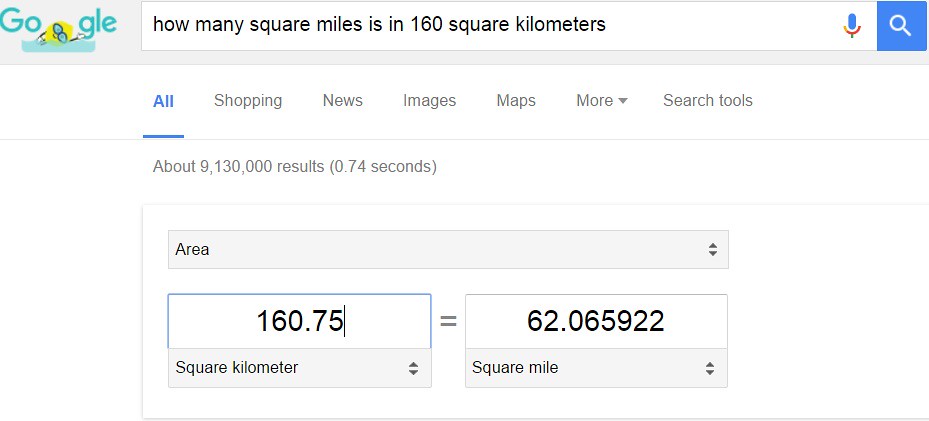
In order to start the calculations -- which are similar in methodology, the size of the city (region) of Huauchinango needs to be known. According to the "Wikipedia" page for Huauchinango, the size of the region is roughly 160 square kilometers. Lets take a short cut and ask Google.com to convert square kilometers into square miles to save us one step as shown below in the image:
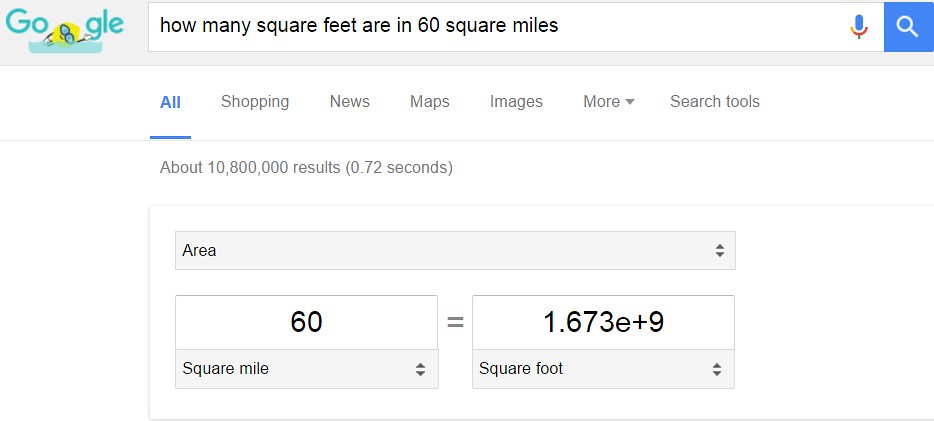
Next, in order to determine the volume of rain that poured down in the city, another conversion of units is necessary. The conversion from square miles to square feet needs to be done. Of course, Google.com seems to be a good search inquiry to use (since I am being lazy at the moment). Below is an image of the conversion factor:
I must point out a slight mistake. In the first image of the conversion factor from square kilometers to square miles, the number of square miles is equal to 62 sq. miles. On the next image, I transferred over the wrong number -- slightly less to 60 square miles. Although, since the point of the post is to approximate a value, I think that I can let this mistake slide. Forgive me.
According to the news account, the amount of rain that fell was between 4-8 inches. For the purposes of getting a rough idea, I will use the average of the two numbers -- 6 inches. In order to calculate the volume of rain, an equation is needed which is shown below:
In the expression (or equation) above for the volume of rain, there are two parameters. The first is an area -- which has been determined to be 1.67 billion cubic feet of water over an area of 60 square miles. Whereas the second parameter needed to determine the volume is the height. The number chosen out of the range was 6 inches of rain -- which is equal to 0.5 feet. If we plug those numbers into the expression above, the equation is shown below:
The answer is in scientific notation. Basically, the total volume rain that fell over an area of 60 square miles is equal to 836 million cubic feet. Oh my. Add to that calculation winds approaching 45 miles per hour and destruction is easily seen. What a terrible situation?
As usual, these large numbers are too astronomical for me to wrap my head around. Therefore, usually, I try to think of a metric (a known volume) that I can use to cast the result into for me to visualize. Below are the results of that analysis.
How Many Olympic Size Pools Could Be Filled?
Naturally, when such a large number (actually an enormous number) is the result of a calculation, further dimensional analysis is needed to put the volume into perspective. What type of metric is appropriate for the volume? The number is huge. In order to find a proper metric, a couple of guesses need to be made.
To start with, since the world is fascinated by the Olympics and the world teams competing in the summer events, how about using the Olympic Size Swimming Pool as a metric?
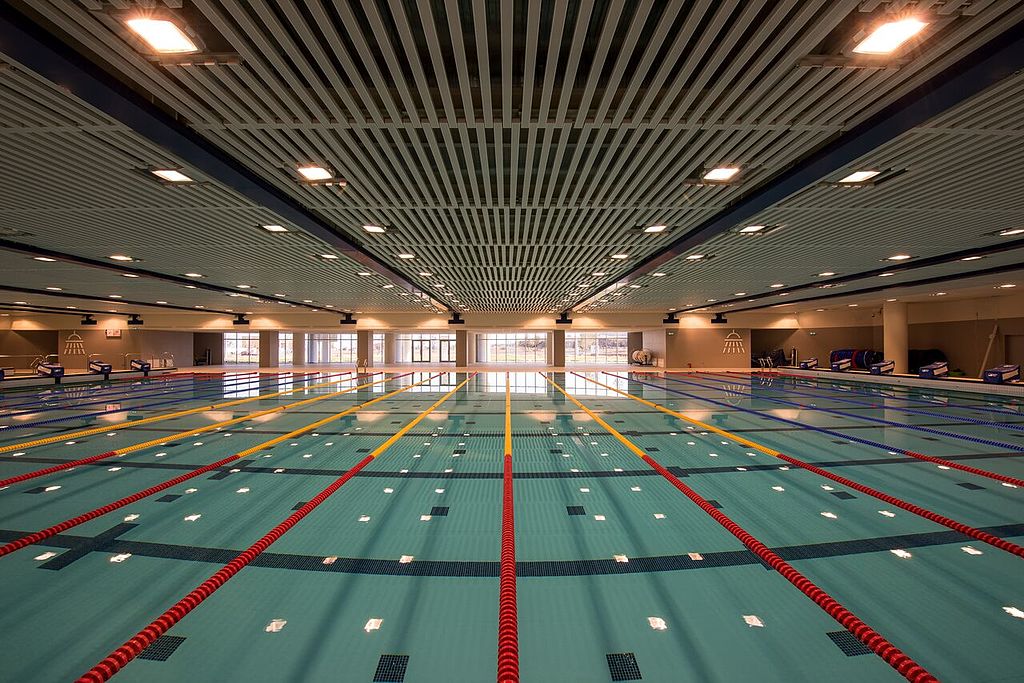
In order to do so, the volume of an average Olympic Size Swimming Pool needs to be known. Recently, the volume of the pool has been used in another blog post where large volumes of liquid was the center subject of the post. A couple of weeks ago, I wrote a post regarding a sewage spill that dumped nearly 2.4 million gallons into the Los Angeles River. In that post, the metric of a Olympic Size Swimming pool was used to cast the large volume into perspective. According to that post, the volume of water needed to occupy an Olympic Size Swimming pool is 660,000-gallons. A picture of an Olympic Size Swimming pool is shown below taken from the "Wikipedia" page:
For those readers who have been engaged in watching the games at Rio -- does this look familiar? As I mentioned the total volume is 660,000-gallons in total to fill up an Olympic Size Swimming pool. Since, the volume of the total amount of rainfall is known from the calculations above, the two numbers simply are divided by one another.
But wait -- the units are not the same....the Olympic Size Swimming Pool is expressed in units of gallons. Whereas the volume of rainfall is expressed in units of cubic feet. In order to perform a direct comparison, a conversion into the same units is needed. The volume of rainfall is converted into units of gallons as shown below:
Now, with the units both expressed in gallons of the two volumes (Olympic Pool and Rainfall), the two numbers can be divided by each other to yield the number of Olympic Size Swimming pools that could be filled with the total rainfall that the city of Huauchinango experienced over the weekend. The calculation is shown below:
Wow! The total amount of rainfall that the city of Huauchinango experienced over the weekend would fill 9,484 Olympic Size Swimming pools -- Wow!
Can you really wrap your head around this?
I have trouble visualizing that amount of swimming pools.
How about using a larger space as a metric?
Mercedez Benz Superdome?
In the past blog posts, a larger volume that has proved handy when enormous numbers are the result of calculations, is the Mercedez Benz Superdome (located in Louisiana) and is shown below:
Since the volume is extremely large as indicated by the number of Olympic Size Swimming pools, a larger volume is needed to use in carrying out dimensional analysis of the storm in Mexico. According to the "Wikipedia" page, the interior space (volume) of the superdome is approximated to be around 125,000,000 cubic feet. In the initial calculation of the volume of rainfall, the answer was expressed in units of cubic feet. With the values expressed in the same units, a simple division is needed as shown below to determine how many superdome's could be filled:
That is still a large number of superdomes to imagine. According to the calculation, nearly 7 superdomes could be filled with the total amount of water that fell on 60 square miles in Huauchinango over the weekend. Wow!
Add into the result the 45 mile per hour wind and the destruction is clearly understandable. On top of all of this, the region sits on a slope of a hill. An additional factor of gravity sending the rainfall down a slope would give the storm additional power (destructive power).
Conclusion...
After calculating the total volume of rainfall that Huauchinango received over the weekend, the amount of destruction is more understandable. Still, the destruction which includes the loss of life is never really understandable. Storms like tropical storm Javier remind us of the sheer power of nature and that we are a very small part of a larger world. Additionally, the importance of having the proper infrastructure (buildings, disaster plans, government, etc.) to help out is of the most critical importance.
Looking a the numbers as a result of the calculations. 9,484 Olympic Swimming Pools, nearly 7 Mercedez Benz Superdomes -- these volumes are not trivial or small. As you watch the games try to imagine the volumes and their relation to the natural disaster.
In the near future, I will write a summarized post of the recent rainstorms that have hit the world and their relative values. Until next time, have a great day!