Saturday, October 20, 2018

White Blood Cells in action destroying Cancer Cells!


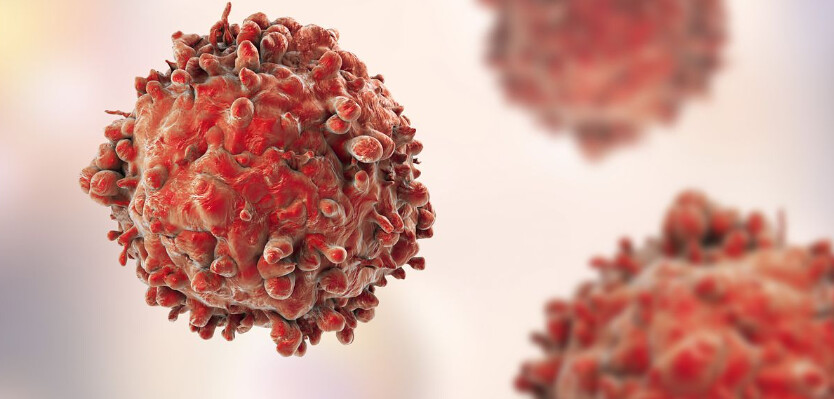
Cancer is a nasty disease.  Cells which have been hijacked are out of control of the human system and are under the control of the cancer.  If a single cell were out of control, then the body's natural immune system would kill the cancerous cell.  The cells in the body responsible for doing so are the white blood cells.  Specifically, the cytotoxic T cells as introduced by Wikipedia page as follows:


A cytotoxic T cell (also known as TC, cytotoxic T lymphocyte, CTL, T-killer cell, cytolytic T cell, CD8+ T-cell or killer T cell) is a T lymphocyte (a type of white blood cell) that kills cancer cells, cells that are infected (particularly with viruses), or cells that are damaged in other ways.
Most cytotoxic T cells express T-cell receptors (TCRs) that can recognize a specific antigen. An antigen is a molecule capable of stimulating an immune response, and is often produced by cancer cells or viruses. Antigens inside a cell are bound to class I MHC molecules, and brought to the surface of the cell by the class I MHC molecule, where they can be recognized by the T cell. If the TCR is specific for that antigen, it binds to the complex of the class I MHC molecule and the antigen, and the T cell destroys the cell.
In order for the TCR to bind to the class I MHC molecule, the former must be accompanied by a glycoprotein called CD8, which binds to the constant portion of the class I MHC molecule. Therefore, these T cells are called CD8+ T cells.


What does this recognition and destroying process look like in real time?  Here is a short video (less than a minute in length) outlining the process with animation:


Nice - right?  With the progress that has been made, one would naturally wonder why cancer has not been eradicated all together.  The short answer is that there are many different forms of cancer.  Cancer is dynamic and constantly changing up to overcome destruction and prevention.  Although, some cancers have been successfully eliminated.


This is a short stop (brief post) in a complicated disease and topic to cover.  In future posts, more will be said of research being conducted to eliminate cancers and successful efforts along with failures.  Failures are really not failures, but learning steps in the path of understanding how different cancers arise, take over cells, and successfully evolve to avoid destruction.  That is a broad overview of the problem.  Of course, when we consider that each person is unique in their genetic make up, then the consideration of cancer (as a disease) becomes even more exponentially more complicated.  With that being said, the work toward understanding and overcoming the disease is worth every step taken in science -- research and discovery.  More to come on this fascinating and terrible disease.


Related Blog Posts:


A Virtual Tour Of A Human Cell?


A Virtual Tour Of A Plant Cell? Really?


NIAID Director Anthony Fauci: How Should We Communicate About Crises?


NIH Director Francis Collins Makes A Statement Regarding Sexual Harassment In Science


National Institutes of Health - Anti-Sexual Harassment Web site


National Science Foundation Sexual Harassment of Women Study


Thoughts: What Does National Institute of Health Director Francis Collins get asked in front of Congress?


Parameters: What is the 'mission' of the National Institute for Aging?


NIH Director Updates Congress On Research Progress


Dr. Francis Collins and Bill Gates Discuss Global Health And Genomics


How Much Do New Drugs Cost To Bring To The Pharmacy Counter?


Is Disease Or Treatment Different In Women?


Unraveling The Resistance Of Antibiotics!


How Do Chemists Discover New Drugs? A Brief Introduction!


Wednesday, October 17, 2018

Soybean Farmers Are Storing Too Much Soybean, Although Chemical Industry Is Greenlighting Trade Deals?


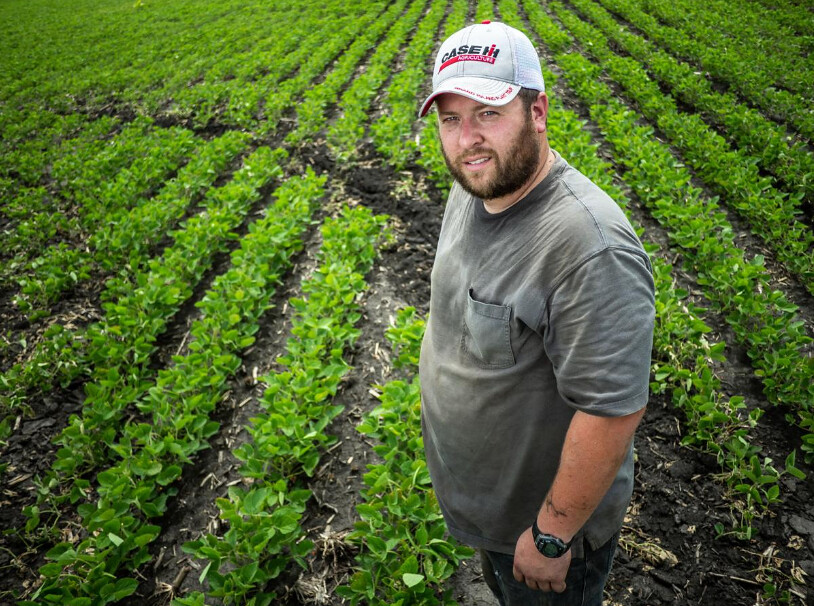
Source: Post Bulletin


Depending on your exporting destination or importing origin along with the industry type, the response to the Trump Administration's tariffs program and emerging trade war is different.  For the chemical industry which heavily relies on good relations with local (North and South) neighboring countries, life is acceptable - as reported recently in the chemical news.  At the same time, if you are a soybean farmer or a farmer who relies on storing product in elevators for an extended period of time, trouble is approaching quickly due to trade coming to a 'stand still'.   The two different scenarios are listed below - briefly.


Soybean Storage?


Early on after trade tariffs were set to take effect, I wrote a blog post discussing (briefly) the benefits of global free trade.  In which, I highlighted the obvious fact that all commodities are connected to each other in some manner. Recently, the news site 'Politico Agriculture' has shed light on the connectivity which the trade industry relies on:


HIDDEN TRADE WAR IMPACT: CROP STORAGE SHORTAGE: Retaliatory tariffs have weighed down commodity prices for months. With the harvest well underway, the trade dispute with China is dealing another blow to U.S. soybean producers: a shortage of space in grain elevators that's causing major backups in states like North Dakota, Minnesota and Louisiana — and driving down prices even more.
China, the biggest market for U.S. soybeans, slapped 25 percent duties on the crop in retaliation for President Donald Trump's tariffs on Chinese high-tech products. Now it's effectively closed for business to American soy growers. Some farmers are gathering more soybeans than they can sell or store, jam-packed silos are running out of room, and the trains that usually carry soybeans to the Pacific Northwest for shipping to China aren't moving.
"In Southwest Minnesota and the Dakotas, you now have elevators that are storing all their beans because there's no market to the West. There is absolutely no bid," said Bill Gordon, a farmer in Worthington, Minn., and member of the American Soybean Association board of directors.
Gordon said some storage sites are piling corn outside to make room for soybeans, and that his local grain elevator is expected to be full after just one week of the month-long harvest.
Cash prices falling: The demand for storage space is also widening the gap between the market commodity price for soybeans and the cash price farmers receive for their crops at the elevator. Grant Kimberley, director of market development for the Iowa Soybean Association, said the drop-off — or "basis" — is normally 30 to 50 cents per bushel in central Iowa. Now it's about $1 per bushel.
Downstream problems: There's also a surge of Midwestern crops being shipped down the Mississippi River to New Orleans, where they're sold to Europe, South America and elsewhere. That's putting extra strain on growers and exporters in Louisiana.
"Everything is choking up right here on the Mississippi River on the barges and the elevators," Abraham said. "Every elevator that we have is full of soybeans right now and can literally take no more on."


Soybeans are taking up space which might be used for other crops which need to be stored too.  The states being affected - North Dakota, Minnesota, and Louisiana - have around 130,000 farms (combined in 3 states).  Not all of those farms serve the soybean industry.  Although, that enormous number of farms could be impacted by the connectivity to other crops which need to use the same storage space used temporarily for soybean crops held up by trade tariffs.


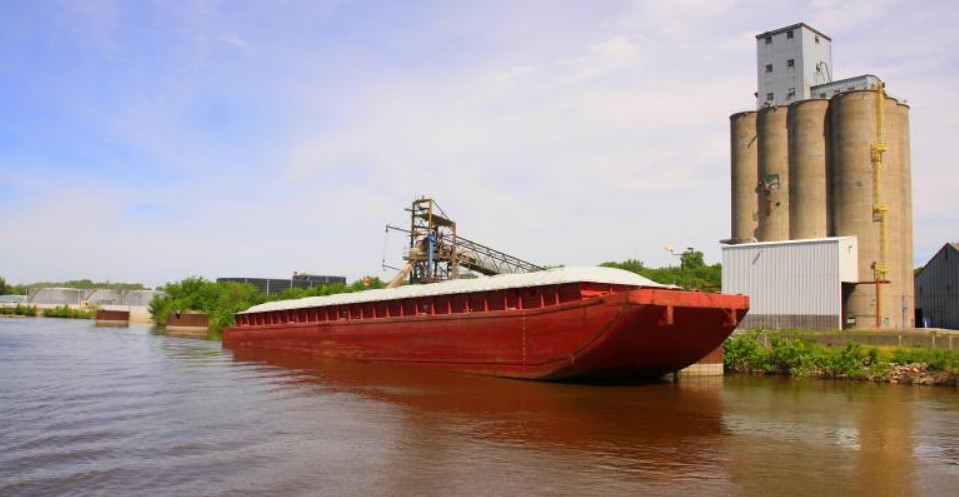
On top of the elevators being filled up are the barges (storage boats) which are filled up with soybeans being transported to other states to be stored.  Shown below is an example of a barge filled with soybean being filled.  Just think of all the transportation, space, and time -- which equates to money burned -- waiting to be moved, stored, or shipped.  All of the jobs which are on hold due to trade tariffs.  Not cool.


Source: Feed Stuffs


Additionally, the mere fact that China can just shut down and refuse any crops from the United States shows how reliant the United States is on other countries.  Which is dangerous to say the least.  Our reliance to other countries for crop sales or technology processing is becoming a major issue which going forward into the future will have be heavily weighed by those in elected office who make the large decisions in Washington D.C.


Although, they are elected positions therefore, your input is imperative in driving their respective vote.  With that being said, keeping up with the status of trade talks and disenfranchised farmers is important in moving forward participating in democracy.  Below, the conversation shifts from grave concern now to the chemical industry.  The chemical industry is quite pleased with the changes - which is strange.


Chemical Industry Is Good!


As I mentioned in the introductory paragraph, the chemical industry is one which has flourished since a deal has been arrived at between Canada, Mexico and the United States.  According to the Chemistry trade journal 'C&E News' titled "U.S. chemical industry reacts positively to revised trade pact with Canada, Mexico" the deal is being cast in a positive light:


The U.S.-Mexico-Canada Agreement (USMCA) is an overhaul of the 24-year-old North American Free Trade Agreement (NAFTA), which underpins $1.2 trillion in total trade between the three countries.
The trilateral accord is critically important to U.S. chemical manufacturers because Canada and Mexico are the industry’s two largest export markets. Approximately 46,000 chemical industry jobs in the U.S. now depend on trade between the North American neighbors.
Although ACC and its member companies are still reviewing the provisions of the updated trade pact, the industry group says the agreement “appears to include several enhancements long sought-after by the U.S. chemical sector,” including greater regulatory cooperation.


That is not to say that other industries reliant on chemicals and pharmaceuticals are not hurting with the trade war emerging with other international countries.  Noted in the article above that 46,000 jobs depend on trade.  That is just one single industry - chemical industry.  Imagine all other industries across the board which contribute to global trade which are being negatively impacted.  The total amount of jobs which are tied to the trade of those industries.  When all is considered, the numbers are enormous and difficult to comprehend.


Conclusion...


Just today in 'Politico Agriculture' was the following news:


TRADE DISPUTES LOOM OVER GLOBAL FOOD SECURITY: Trade protectionism and climate change are among the factors weighing on international food security, according to the Economist Intelligence Unit's Global Food Security Index, a benchmark used to measure individual countries' level of food security.
The report, released Tuesday by EIU and DowDuPont's Corteva Agriscience, cited China's retaliatory tariffs on U.S. soybeans as an example of trade turmoil that can raise prices for consumers and hit low-income families the hardest.
"Protectionist trade policies can contribute to world food price increases and limit agricultural competitiveness," EIU wrote.
The benchmark has the U.S. tied for third place with the United Kingdom — and down in the rankings for the second year in a row. The result doesn't indicate a worsening situation in the U.S. but, rather, slower progress on food issues than other nations. Singapore ranks No. 1, followed by Ireland in second. The Netherlands rounds out the top five.


In light of the news above, get ready for prices to change due to changing demand both internationally and within our nation.  As highlighted, each of these avenues of export are tied to one another in some manner.   Typically, the thought of total impact never crosses each of our minds.  That needs to change with the changing times.


Instead of thinking in terms of an 'isolationist' country, the United States needs to again open up trade avenues to disseminate the crops which are stored and hindering profit margins of families (farm families) along with all of the other players in the trade game: tractor drivers, truckers, dock workers, mariners - captains of ships, ship manufacturers, shipping companies, traders, diplomats, local store owners, foreign store owners, Chinese supply chain.  All of these players have families to support.   Not to mention the amount of energy needed to move goods across supply routes nationally and internationally. 


Related Blog Posts:


"Trade Not Aid" -- The Answer For Trade War!


Trade War Hurts Farmers -- From The Farmer's Mouth Directly


Parameters: How many sticks of butter are contained in 7.5 million pounds of butter?


How many cows are needed to generate 50,000 tons of beef exports?


How Many Cherries Are In 1.5 Million Shipping Boxes?


Parameters: Trade Tariffs Will Affect International Science


Parameters: Steel And Aluminum Tariffs Are Not Isolated - They Are Tied To Trading Of Other Vital Goods


Parameters: Tariffs Affect Trade In Both Directions -- In And Out Of The USA


Sunday, October 14, 2018

Predatory Lending/For Profit Colleges Need To Be Stopped


Over the past few years, stories have been emerging which portray 'for profit' colleges who encourage students to sign up for student loans and then provide a substandard education.  Which results in fraudulent use of student loans.  The Obama Administration tried to combat these colleges from scamming students out of financial aid in light of providing a fraudulent education.  This week reporting from Politico Education unveiled a deadline for the Trump Administration to either uphold or change the Obama Administration's regulation as shown below:


KEY DEADLINE TODAY FOR 'BORROWER DEFENSE' RULES: A federal judge's ruling that struck down the Trump administration's delay of Obama-era student loan regulations known as "borrower defense to repayment" is set to take effect at 5 p.m. today. But the Trump administration hasn't yet said how it plans to respond to that deadline — or whether it plans to move ahead with implementing the 2016 regulations.
— The rules govern loan forgiveness for defrauded students and prohibit colleges from requiring students to resolve disputes through arbitration rather than in court.
— Education Secretary Betsy DeVos has criticized the rules as unfair to colleges and too expensive for taxpayers and has moved to rewrite them. But it's now possible that her agency could be forced to carry out the Obama-era policies in the meantime.
— All eyes are on a potential decision from U.S. District Judge Randolph Moss, who set today's deadline and is also overseeing a bid by for-profit colleges to stop the Obama-era rules from taking effect. Moss expressed skepticism about whether the for-profit colleges had met the standard needed for him to issue a preliminary injunction against the rules, but it's possible he could block some provisions while allowing others to take effect.
— The Education Department has not announced plans to seek a further postponement of the Obama-era regulations. The department did not respond to requests for comment on whether it planned to implement the rules or otherwise provide guidance to colleges.


Why isn't the Consumer Financial Protection Bureau investigating and taking action against such fraudulent institutions?  One has to wonder why these institutions are supported or allowed to continuously defraud students out of loan money.  According to ABC7 News, the problem is widespread here in California:


California Attorney General Xavier Becerra had strong words for Education Secretary Betsy DeVos in his fight for student debt relief.
"We have seen her turn back the clock and we have seen her turn her back on our students," said Becerra.
Becerra announced California and seven other states will support a lawsuit against DeVos, alleging students are being denied debt relief after being defrauded by Corinthian Colleges.
"Companies loaded up these students with debts they knew never could be repaid with the ultimate goal of driving large bonuses to executives and profits to shareholders," said Seth Fotman, from the Consumer Financial Protection Bureau.
The now-defunct, for-profit Corinthian Colleges and its subsidiaries left thousands of students with major debt.
The Obama administration reached a deal to provide full relief, but under the new administration, only partial refunds are being granted.
"You borrow $40,000, which isn't uncommon, they're telling you maybe you'll get $4,000 of that $40,000 relieved," said Becerra.
Becerra said more than 50,000 students are still waiting on their claims. He said more than 8,000 claims were denied between December and May.


Remember that a portion of these unfortunate students are veterans who are returning to school and using their 'G.I. bill' to pay for these fraudulent loans.  This in of itself should be a crime which is prosecuted in a court of law.  Defrauding veterans is a federal crime.   Additionally, 50K (50,000) students is no small amount.  Again, why did the government or local officials allow these institutions to continuously engage in fraudulent behavior.


The Department of Education owes the students who have been defrauded the courtesy of dealing with this unethical behavior.  Hopefully, the Trump Administration stands up to these fraudulent institutions and deals with the negative outcomes which have been produced as a result of their actions.  Keep an eye out on the emerging story in the months to come.


Thursday, October 11, 2018

How many cows are needed to generate 50,000 tons of beef exports?


Recently, I wrote a post on the import of butter into the United States in a given month.  According to the excerpt that I cited, the amount in a single month was significant (as an import).  Continuing along this path, the media/news outlet 'Politico' recently reported about the negotiations surrounding the export of beef to Europe.  As indicated in the excerpt below, European nations want to cap the amount of 'hormone-free' beef arriving from outside nations:


How the quota works: The policy stems from a long-running World Trade Organization dispute over the EU's refusal to import U.S. beef treated with hormones. In 2009, the U.S. and EU agreed to set an annual quota of 45,000 metric tonnes (nearly 50,000 in U.S. tons) for hormone-free-beef imports to Europe, which was open to the U.S. and other nations.


After reading the ceiling of 50,000 tons for the import limit from outside nations, I wondered how many cows are needed to generate that amount of beef.  Below is the analysis with the answer.


How much beef for a single cow?


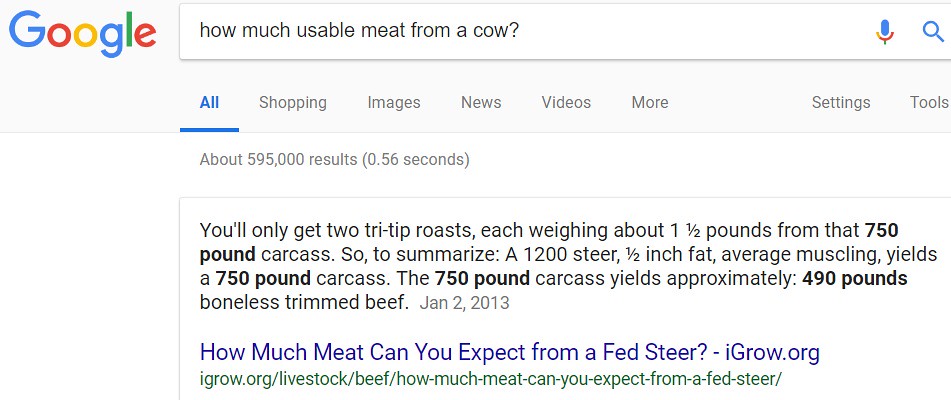
To  begin the analysis, the first question is searchable by using a search engine such as Google with the following question: How much usable meat from a cow?  The answer is shown below:


Source: Google


Note: At first sight, the way that the question is stated might seem strange.  Although, as a user enters words, the Google algorithm starts to guess what the final question is.  Which I use to assemble the question.  That statement was put into the blog post to cover the readers who will read the question and wonder if I know how to ask questions.  Yes, the answer is in short.  I am not beyond the use of assembled questions though too.


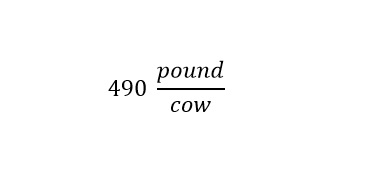
The answer indicates that from a 750 pound carcass (remains of a single cow), there will be roughly 490 pounds of 'steak'.  This answer is the conversion factor which we will use to convert the total amount of meat (hormone-free beef) into cows.  The conversion factor is shown below:


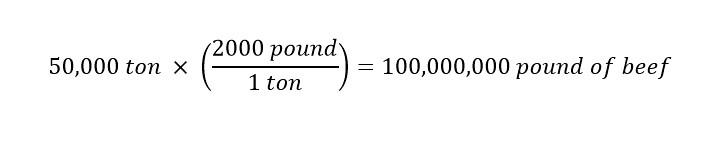
The total amount of usage (edible) amount of beef from a single cow is shown above to be 490 pounds of meat.  Before that conversion factor can be useful in our analysis, another unit conversion must take place.  The statistic cited in the introduction of 50,000 tons is expressed in units of 'ton'.  In order to divide by the number above, a unit conversion needs to be accomplished from units of 'ton' to units of 'pound' as shown below:


Our unit conversion revealed that 50,000 tons of beef corresponds to 100 million pounds of beef.  How many cattle does that represent?  The question of interest can be answered by dividing the answer above by 490 pounds/cow as shown below:


100 million pounds of beef -- the total amount of 'hormone-free' beef allowed to be imported into Europe from outside nations requires 204,082 cows to be processed for beef!


How do 204,082 cattle as exports compare to the total amount of cattle processed for beef annually in the United States?


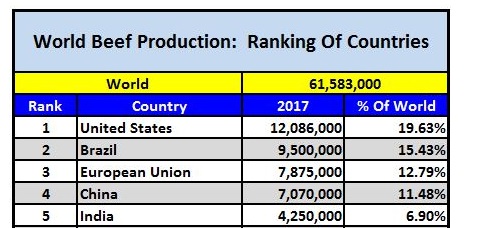
A quick search using Google will reveal a few answers.  One of which is from a website called "Beef2Live" with the following annual world beef production statistics shown below:


Source: Beef2Live.com


I restricted the image size only to include the top 5 beef producers in the world.  As you can see, the United States is the largest.  The annual production of beef in the United States is around 12 million tons of beef.  In comparison, 50,000 tons represents around 0.41% of Annual Beef production in the United States.


Conclusion


Wow!  That really shows the restriction of imported beef into nations under the European Union from outside nations.  At first sight the number might seem significant.  Although, after performing an analysis and casting the statistic into perspective of annual beef production in the United States, the statistic is rather small.  Further, the United States is the world's largest beef producer on an annual basis.  Analyses like the one above really help a reader understand the news in relation to other reported values.  The cited statistic is not really that significant as reported in the excerpt above.  Although, with the status of today's global trade negotiations, every cow counts.


Related Blog Posts:


Parameters: How many sticks of butter are contained in 7.5 million pounds of butter?


South Carolina Governor Henry McMaster asks lawmakers for $1,228,000,000 For Recovery from Hurricane Florence?


Boston Natural Gas Explosion Reveals Old Piping Needs Replacement - Enough To Travel To Colorado?


A Forecaster Predicts That Hurricane Florence Will Drop Enough Rain To Fill 18,400 Mercedes-Benz Superdomes

Hurricane Harvey Drops Enough Rain On Houston To Fill 560 Dallas Cowboy Stadiums


How Much Water Is Contained In All Oceans Around The Globe?


Storm Raises Water Level In Lake Cachuma By 31 feet, How Much Water Is That?


How To Make Sense Of Water Flowing At 100,000 Cubic Feet Per Second


Can 11 Trillion Gallons Of Water Fill 14,000 Dallas Cowboys Stadiums?


How Much Rain Did The East Coast Receive From Hurricane Matthew?


How Much Rain Did Haiti Really Receive?


How Much Rainfall Has Dropped On Louisiana?


How Big Was The "Water Bomb" Of Rainfall In Macedonia?


How Much Rain Did Huauchinango (Mexico) receive?


How Much Rain Did Elliot City (Maryland) Really Receive?


If The Mosul Dam Breaks, The City Of Mosul Would Be Under 65 Feet Of Water?


What is the volume of water in a few inches of rain?


Volume of Waste in the Mine Spill (in Brazil) Equivalent to 78 Deepwater Horizon Oil Spills


Monday, October 8, 2018

NIAID Director Anthony Fauci: How Should We Communicate About Crises?


The news capitalizes off of spreading fear -- which gathers 'eyeballs' and clicks.  A few years ago, Author David Altheide wrote a book titled "Creating Fear" - about the news and the control which is created by the atmosphere of fear surrounding society.  With that being known, how does the public receive a 'fear' or 'crisis'?  What is the correct course of action (for the public) given that the media (news) organizations are living off of perpetuating the notion of 'fear' or 'crisis'?  These are all credible questions.


There are more than a single side to each issue.  In the current issue of perpetuating "fear" or "crisis," those in positions (government, state, and local officials) can actually make a large difference by being more open and transparent into the state of a situation.  An 'disease' or 'outbreak' is a perfect example to use as shown below.  A few years ago, Director Anthony Fauci of the National Institute of Allergy and Infectious Diseases (NIAID) wrote a short piece 'Op-Ed' titled : Zika and Beyond: Communicating about Crises  for the NIH website.  The piece is shown below in full:


During the Ebola outbreak, we admitted two patients infected with the virus to the NIH Clinical Center. People would ask me, “My goodness, are you putting us at great risk?” So I would ask them, “How did you get to work this morning?” They would answer by saying something to the effect of, “Well, I got on the Beltway and drove to the NIH.” This is a high-speed road that encircles Washington, DC, and carries more than 200,000 vehicles per day. I would point out, “Well, your commute posed a greater risk to you than an Ebola patient at the Clinical Center.”
We live in a world where we take risks every day. When you have been taking a risk every day, for the last 20 or 30 years, you may be fully aware of the risk, but you have learned to live with it and it does not bother you.
However, it is very interesting to me how people react when they are confronted with a new risk. When a new risk emerges, especially if it is highly publicized, people often start to consider the new risk to be more significant than others that, in reality, pose a greater threat. This is human nature. We saw it with Ebola, we saw it here in Washington, D.C., with the anthrax attacks, and we are starting to see it now with Zika.
Zika virus is not actually new. It was first recognized in 1947 in a monkey in the Zika forest of Uganda. It was not known to infect humans until 1952, and it stayed under the radar screen for a long time. That was understandable. The virus circulated relatively unnoticed in areas of Africa and Southeast Asia until 2007, when it caused an outbreak on the Yap Islands in Micronesia. In 2013, the virus caused a much larger outbreak in French Polynesia. Despite this spread, few people paid much attention to the virus because the disease it caused was thought to be mild.
Now, of course, the situation has changed. The current outbreak that started in Brazil last year has provided new evidence that Zika virus can also cause a serious birth defect called microcephaly in babies born to infected mothers. Zika virus also has now been associated with Guillain-Barré syndrome. Now, Zika has our attention.
Many people are now hearing or reading that Zika is in their state. By the end of April, the CDC had identified Zika cases in 43 states. Some people are starting to ask whether they should travel to certain states that have reported cases of Zika. In that regard, it is important to note that none of these infections was acquired locally through infected mosquitoes.* So far, all of these cases have been acquired through travel (or sexual contact with someone who has traveled) to countries or territories where Zika is circulating locally.
While we have not yet seen locally acquired cases of Zika in the continental United States, this almost certainly will occur. It is unlikely that these locally acquired cases will become sustained and widespread. However, we must be prepared to deal with them. Certainly, there is no reason to panic. We are going to have to do a lot to educate the public about what the risk is and what the risk is not, and to help people keep the risk in perspective. We should all recall what happened in the United States not so long ago, when an individual came from Liberia and was hospitalized with Ebola in Texas, and then two nurses became infected when caring for him. This sad situation sparked a panic that there was going to be a major outbreak of Ebola in the United States. In reality, there was virtually no chance that would happen.
As concerning as the Zika virus is, we must remember and remind people that it is just the latest disease in a perpetual series of emerging and reemerging infectious disease threats. The timeless threat of new diseases—or old diseases that start to appear in new places or new ways—is now amplified by factors such as urban crowding, international travel, and other human behaviors.
An evolving situation such as the current Zika outbreak, in which there are still unknowns, will create a lot of concern and even panic on the part of some people. We in the public health sector must be crystal clear in articulating exactly what we know and what we still need to know about the threat, and in helping people understand how this new risk compares to risks they willingly assume every day. With that perspective, people will be better able to understand what rational steps they can take to protect themselves.


For more information about Zika Virus, please visit: http://syndication.nih.gov/zika.htm


As I mentioned above, there are more than a single side to every story.  Further, in the introductory paragraph, I asked the question regarding what the public could do to receive a 'fear' or 'crisis' story.  Yes, I am asking what the responsibility is of the public.  That might seem counter intuitive to the normal flow of information.  Although, to a sizable percentage of the U.S. citizens, the question is not out of the ordinary.


We, as Americans need to to change -- when reading or hearing news from either media organizations or government (including state, regional, and local) -- the way that the news permeates our minds and further travels into our lives.  Fact checking on all of our parts could clarify a large amount of controversy and lead to less emotion and more logical conclusions.  Last but not least, reading can serve as a wonderful conduit through which to educate ourselves about issues.  Too few of us read.  Which is concerning.  I understand that not all of American citizens' are 'readers', but reading different forms of news could help clarify misunderstandings.  Additionally, coherent discussions can go a long way to resolve differences.  Mediation is an important field which is fueled by our inability to sit or stand in each others' presence and have coherent discussions.


Regardless of where any one of us stand on an issue, each of us could be served well to put 'crisis' or 'fear' in society into perspective.  In the future, watch to see how these organizations create 'fear' or 'crisis' and come up with your own solutions.  Feel free to share those solutions below.  Have a great day!


Related Blog Posts:


NIH Director Francis Collins Makes A Statement Regarding Sexual Harassment In Science


National Institutes of Health - Anti-Sexual Harassment Web site


National Science Foundation Sexual Harassment of Women Study


Thoughts: What Does National Institute of Health Director Francis Collins get asked in front of Congress?


Parameters: What is the 'mission' of the National Institute for Aging?


NIH Director Updates Congress On Research Progress


Dr. Francis Collins and Bill Gates Discuss Global Health And Genomics


How Much Do New Drugs Cost To Bring To The Pharmacy Counter?


Is Disease Or Treatment Different In Women?


Unraveling The Resistance Of Antibiotics!


How Do Chemists Discover New Drugs? A Brief Introduction!


Friday, October 5, 2018

Parameters: How many sticks of butter are contained in 7.5 million pounds of butter?


According to an e-mail from 'Politico Agriculture' yesterday, July was a record month for Butter imports to the United States of America:


In other dairy news, July butter imports hit all-time high: The U.S. imported a record 7.5 million pounds of butter that month, supplanting the previous record from May 2004. Most of it — 5.8 million pounds — came from Ireland, according to September data from USDA's Economic Research Service.


After reading that statistic, I wondered whether that was a large amount or not relative to the amount produced in a month here in the United States?  First, we need to cast the number into perspective in order to make sense of the number.  Second, we can compare the large weight to that produced here in the U.S. on a monthly scale by an online search.


How many butter sticks in 7.5 million pounds of butter?


To start the analysis, a metric has to be chose to which compare the enormous weight of butter toward.  The metric of choice for this case is a 'stick of butter'.  How does a person find out the weight of a single stick of butter?  If you have read past blog posts on this site, the answer would start with asking a search engine such as Google the following question: How much does a stick of butter weigh in grams?  The answer is shown below:


Notice that the units of measurement are expressed in units of 'grams' whereas the total weight of butter imported into the United States was expressed in units of 'pounds'.   Therefore, one of two actions needs to be taken toward straightening the situation out: either the units on the butter change from 'pound' or the units of the weight of a single stick of butter remain in 'grams'.  Since the weight of a stick of butter is easily understood in units of 'grams', the unit of choice will be 'grams' for this blog post.


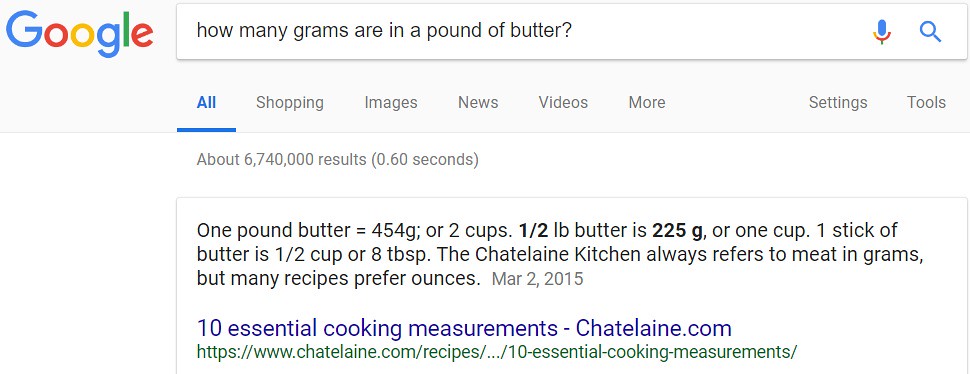
Next, the total amount of butter is expressed in units of 'pound' which needs to be converted to units of 'grams'.  In order to achieve the conversion, the conversion factor needs to be determined.  Consulting Google with the following question is the path of choice: How many grams are in a pound of butter?  The answer is shown below:


The answer yielded that in a single pound of butter, there are 454 grams of butter.  With the conversion factor in hand, now the conversion from units of 'pounds' to units of 'grams' is possible as shown below:


The answer indicates that there are 3.4 billion grams of butter in 7.5 million pounds of butter.  In order to understand the magnitude of the number, the quantity of butter sticks needs to be determined as shown below:


The calculation reveals that in 7.5 million pounds of butter (a record high import) there are an equivalent 30.1 million butter sticks.  Considering that the current population of the United States of America is around 325.7 million people, that is roughly 1 stick of butter for 11 people.  That is not a large amount of butter.  In order to understand the number as an import into the United States in a single month, the following questions can be asked and researched online:


1) How many pounds of butter are produced in a month in the United States?


2) How much butter does the United States consume each year?


How Much Butter Is Consumed In The U.S. Annually?


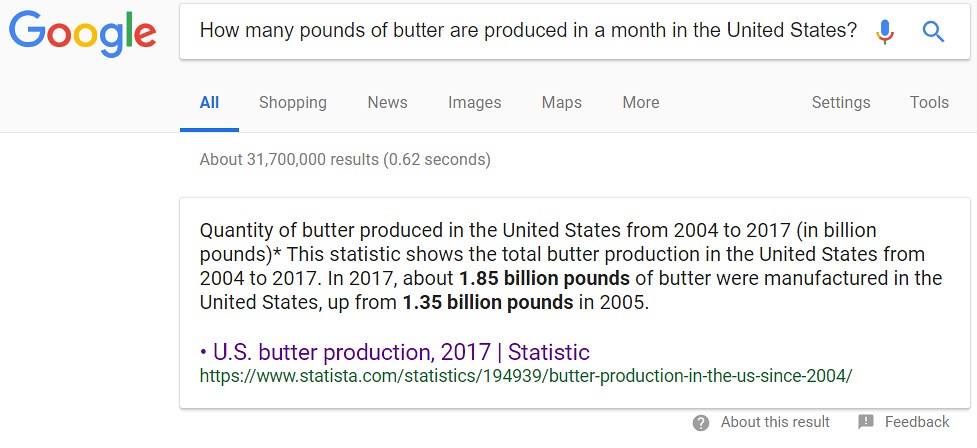
In order to make further sense of the statistic that was reported by 'Politico Agriculture', we can start by asking Google the following question: How many pounds of butter are produced in a month in the United States?  The answer which popped up first is shown below:


The image is rather fuzzy.  But the answer is that per year, the United States produces around 1.85 billion pounds of butter.  Which if divided by 12 to give an approximation would indicate a monthly production of just over 154 million pounds of butter.  Given that statistic, why would the United States import butter?  Especially, on the order of 7.5 million pounds of butter?


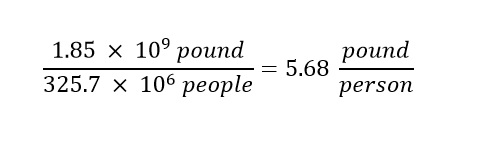
If the total amount of butter produced in the United States each year is divided by the total population of the United States -- 325.7 million people, the answer is shown below:


According to the result of the calculation, the amount of butter (in pounds) per year per U.S. resident is around 5.68 pounds (per person per year).  How much butter does the United States consume each year?  The answer provided by Google is shown below:


Source: Google


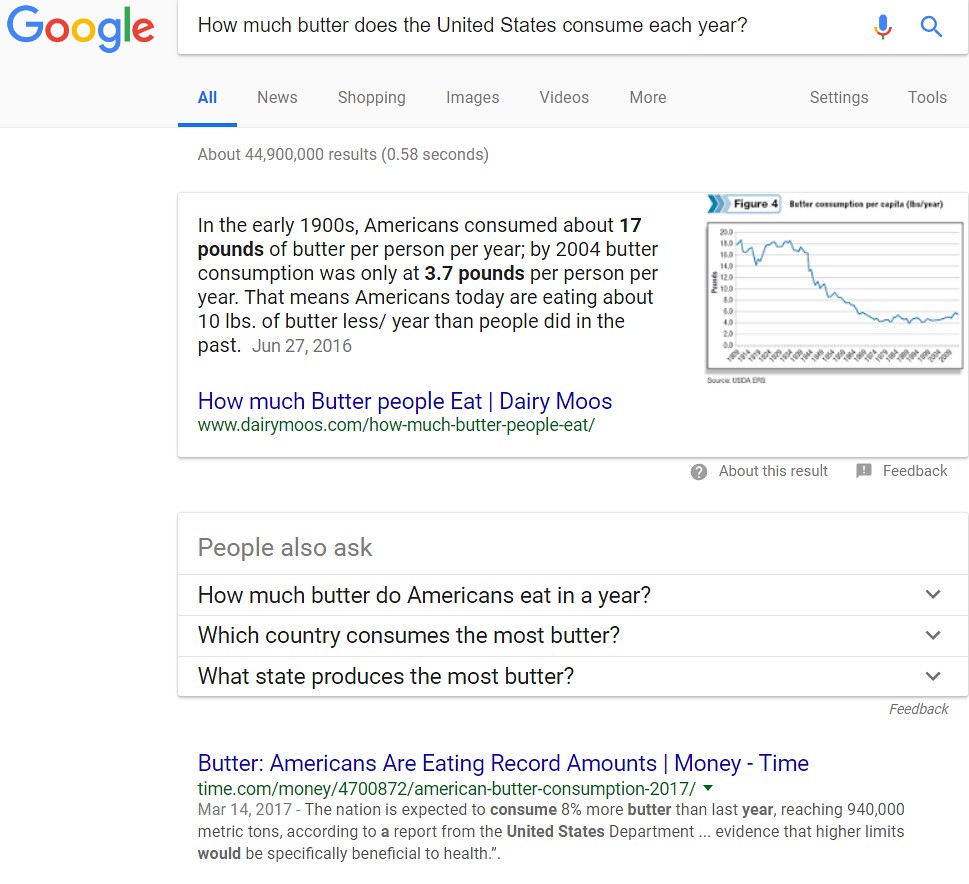
The image (result of our search) taken from a screenshot has three main points to observe:


First, the amount of butter stated in the 'boxed' region on the web page states that each American (on average) consumes about 3.7 pounds of butter per year.  I would have thought that the number was much greater.  Of course, that is down from 1900's when the average consumer was at 10 pounds per year.


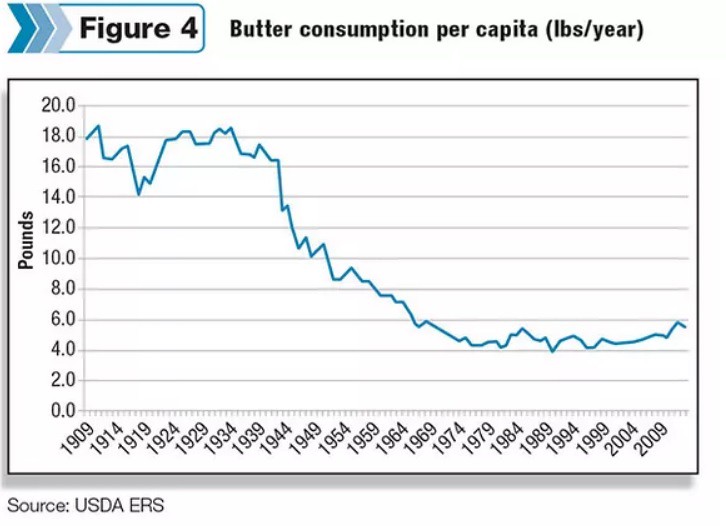
Secondly, the graph shown at the side of the paragraph is shown below:


Source: DairyMoos


Which shows after 2009 - the annual consumption rising to reach a local maximum of just under 6 pounds of butter per person per year.  How do we make sense of all of the numbers presented to us so far?  Here are the numbers so far in this post from calculations and searches:


1) In July, a record import to the U.S. of butter reached 7.5 million pounds of butter.

2) The annual production (as of 2017) reached around 1.85 billion pounds of butter.

3) If the annual production is averaged over 12 months gives just over 154 million pounds of butter produced each month.

4) Dividing total butter production by U.S. population gives 5.68 pounds of butter per person per year.


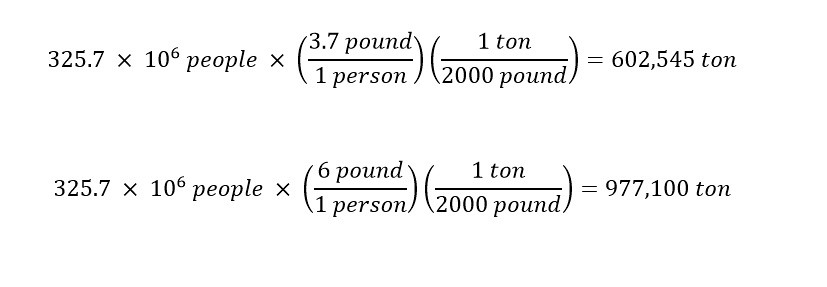
And third -- last but not least, the paragraph below the boxed number in our last search for the total annual consumption of the U.S. of butter is said to be around 940,000 tons of butter.  A ton is around 2000 pounds.  If that is the consumption annually, do all of the numbers reported or searched make sense?  Here is the last calculation shown below to verify the numbers based solely on the total U.S. population being reported as 325.7 million residents:


Conclusion...


The calculations reveal above that the amount of butter imported per year does not seem large in comparison to the demand annually by the residents of the United States.  At 1.85 billion pounds of butter produced annually in the United States, there should be no need for further importing of butter to feed demand.  Because the total demand per person is less than what is made?  According to our calculations?  Although, reported is the fact that the amount consumed per person per year is actually much higher than 3.7 pounds per person per year.   It is closer to 6 pounds per person per year.


Not to mention that the United States does export butter out of the Country on an annual basis.  That needs further exploration into how that value (number) fits into the total argument for butter supply and demand.  As of now, you can perform an analysis to answer certain questions about the amount of butter imported or exported.


Related blog posts:


South Carolina Governor Henry McMaster asks lawmakers for $1,228,000,000 For Recovery from Hurricane Florence?


Boston Natural Gas Explosion Reveals Old Piping Needs Replacement - Enough To Travel To Colorado?


A Forecaster Predicts That Hurricane Florence Will Drop Enough Rain To Fill 18,400 Mercedes-Benz Superdomes

Hurricane Harvey Drops Enough Rain On Houston To Fill 560 Dallas Cowboy Stadiums


How Much Water Is Contained In All Oceans Around The Globe?


Storm Raises Water Level In Lake Cachuma By 31 feet, How Much Water Is That?


How To Make Sense Of Water Flowing At 100,000 Cubic Feet Per Second


Can 11 Trillion Gallons Of Water Fill 14,000 Dallas Cowboys Stadiums?


How Much Rain Did The East Coast Receive From Hurricane Matthew?


How Much Rain Did Haiti Really Receive?


How Much Rainfall Has Dropped On Louisiana?


How Big Was The "Water Bomb" Of Rainfall In Macedonia?


How Much Rain Did Huauchinango (Mexico) receive?


How Much Rain Did Elliot City (Maryland) Really Receive?


If The Mosul Dam Breaks, The City Of Mosul Would Be Under 65 Feet Of Water?


What is the volume of water in a few inches of rain?


Volume of Waste in the Mine Spill (in Brazil) Equivalent to 78 Deepwater Horizon Oil Spills




Tuesday, October 2, 2018

NIH Director Francis Collins Makes A Statement Regarding Sexual Harassment In Science


If there is one overarching reality that has been unveiled over the last two years, that is the reality of sexual harassment is still very real and alive in our 'male dominated' society.  Why have we not made more progress toward equality over the last few decades is beyond me.  I do not pretend to have answers or thoughts on the matter -- except to say -- equality should be a present reality rather one we are working toward.  Progress should be made immediately without regret.  Scientific research is not immune to such 'male dominance' and needs to change too.  Due to the #MeToo movement which has taken over the last two years, the Director of National Institutes of Health has released a statement regarding the changing culture to eliminate sexual harassment.


Shown below is the statement in full from the "Director's Page" of the National Institutes of Health web site:


Changing the culture of science to end sexual harassment

Sexual harassment is about power. The goal of the perpetrator, most commonly but not exclusively a man, is to objectify, exclude, demoralize, diminish, and coerce the victim, most commonly a woman, to exert power over her.  It’s morally indefensible, it’s unacceptable, and it presents a major obstacle that is keeping women from achieving their rightful place in science — as trainees representing the next generation of innovators, as researchers making important scientific discoveries, and as senior personnel on NIH-supported grants.  I was disheartened to read the conclusions of the recent National Academies report (link is external), which NIH funded along with other government science agencies, finding no evidence that current policies, procedures, and approaches have significantly reduced sexual harassment in academic sciences, engineering, and medicine. It is clear we must do more to change the fundamental culture of our organizations. 

NIH recognizes that we need to increase our transparency on this issue. Today we launched an anti-sexual harassment website that comprehensively outlines our policies, practices, and initiatives to address sexual harassment at NIH, at the institutions we support, and anywhere where NIH research activities take place.

In our intramural program, we hold ourselves accountable as employers, and have been intensively working to strengthen our systems for NIH employees to address, report, and prevent sexual harassment. These efforts have been guided by the NIH Anti-Sexual Harassment Steering Committee within my office.  New initiatives, which also will be summarized in a Federal Register Notice in a few days, include an updated policy on harassment; a new centralized process for managing reports of harassment, including making it easier to report; launching a robust communication, training, and education campaign; and administering a survey this winter to all NIH staff, including contractors, to assess NIH workplace climate and harassment. Results of this survey will be used to design initiatives targeting sexual harassment in the workplace.  Our goal is to create a paradigm shift in the scientific culture wherever NIH research activities take place to eliminate sexual harassment and enhance women’s contributions to scientific advancements.  In the future, we will encourage NIH-funded institutions to administer the survey to their researchers to gather a systematic national assessment that will inform data-driven, coordinated initiatives to prevent sexual harassment across the biomedical research enterprise.

We also wish to highlight policies that apply to the thousands of research institutions that receive funding from NIH.  A question we often hear from the community is why NIH doesn’t automatically terminate funding to all investigators who are accused or found guilty of sexual harassment at the institutions we fund. This is a complex issue.  NIH funding is awarded to institutions, not to individuals.  As a term and condition of a grant award, institutions are required to develop and implement policies and practices that foster a harassment-free environment.   If a principal investigator on an NIH grant is removed from their position or placed on administrative leave, we require the institution to notify NIH before replacing that investigator.  We then have the option to suspend or terminate the grant if the proposed alternative arrangements are not acceptable to NIH. However, we often find in those difficult circumstances that working with the institution and approving an alternative principal investigator preserves the science, and allows other personnel working on the grant, including in some cases the victim of harassment, to continue their research.  Depending on the circumstances, we also can consider enforcement actions such as disallowing costs or suspending the grant.  We also can coordinate with other offices including law enforcement and/or the HHS Office of Inspector General to consider a referral for debarment or suspension.  These policies are highlighted on the anti-sexual harassment webpage. 

Our colleagues at the National Science Foundation (NSF) also are engaged in clarifying their own approach to this issue. Ultimately, these policies should be harmonized across the government.  As co-chair of the National Science and Technology Council Committee on Science, along with NSF Director Dr. France Córdova, I plan to ask the Committee to consider uniform measures that would be most effective in changing the pervasive culture of sexual harassment in science, and fostering a culture of respect for all.  I personally consider addressing this matter to be a high priority for NIH. 

Francis S. Collins, M.D., Ph.D.
Director, National Institutes of Health


The content of the letter above is reassuring if Director Francis Collins is ready to back up his words in the statement.  Women deserve to be elevated to an equal status in academia along with any other profession across the United States of America.  Anything less is seen as being complicit with those committing such undesirable/unacceptable behavior.  What will be fascinating to watch is how the funding issue plays out in Academia.  As stated in the letter above, universities are responsible to have sexual harassment policies and investigative procedures in place.  Although, as history (recent news updates) have suggested that sexual harassment of women is still pervasive at Universities around the U.S. and still needs to be reigned in by university administrators.


Director Francis Collins is making progress by releasing an explicit letter containing policies/thoughts about the present unacceptable situation facing society as a whole.  The expanding number of avenues through which a victim has to be able to report abuses are extremely encouraging.  What remains to be seen is actual action -- removing habitual offenders in academia who are well known to offend.


Society is dealing with this very issue on a National level with the current Supreme Court nomination of Judge Brett Kavanaugh.  As the news is reporting, the country is still nowhere near where we as a society need to be.  Judge Kavanaugh is portraying himself as a 'good boy' - which is increasingly under fire - with contradictions from other classmates.  Until we as a society start to listen to a greater number of people and remove these offenders, then we will be stuck in an endless cycle of waiting for change.


Related Links and Blog Posts:


National Institutes of Health - Anti-Sexual Harassment Web site


National Science Foundation Sexual Harassment of Women Study


Thoughts: What Does National Institute of Health Director Francis Collins get asked in front of Congress?


Parameters: What is the 'mission' of the National Institute for Aging?


NIH Director Updates Congress On Research Progress


Dr. Francis Collins and Bill Gates Discuss Global Health And Genomics


How Much Do New Drugs Cost To Bring To The Pharmacy Counter?


Is Disease Or Treatment Different In Women?


Unraveling The Resistance Of Antibiotics!


How Do Chemists Discover New Drugs? A Brief Introduction!