Showing posts with label Active Transportation. Show all posts

Thursday, March 8, 2018

LimeBike Dockless Bikeshare Riders Travel A Distance Of 13,000 Miles In Just Over 3 Weeks?

Source: LimeBike


Dockless BikeShare Programs are emerging in a number of areas across the United States.  Especially, around university campuses for obvious reasons.  Around California State University at Northridge, over 50% of the students live within a radius of 5 miles.  This makes a BikeShare program thrive instead of using cars to travel to and from campus.  Residents may engage in use of BikeShare bicycles too and have done so in the Northridge area.  Below is a dimensional analysis of the total distance traveled (13,000 miles) in just over 3 weeks.  Wow!


Today, I wrote a guest post on for the wonderful website 'BikingInLA' titled "Guest Post: Open letter opposing Englander motion to halt dockless bikeshare and CSUN LimeBike system" which focuses on a recent 'emergency moratorium through a motion' to regulate (basically shut down) the use of LimeBike Dockless Bikeshare bicycles around campus.  The obvious reasons for using alternative modes of transportation can be found in the link to the post along with staggering statistics and testimonials of riders.


For the purpose of the following post, I would like to show the calculations of the stated statistics in the article on 'BikingInLA' written by myself.  To start with the two statistics in question need to be stated below:


1) 13,000 miles -- a person could ride a bicycle 2 round trips from Northridge (California) to New York City (New York).

2) 13,000 miles -- a person could make 17 round trips from Northridge (California) to San Francisco (California).


In order to verify those calculations, a few steps need to be taken.  In the following two sections, each devoted to a single statement above, the steps will be displayed clearly to arrive at the statements above.  Lets start with explaining through dimensional analysis the first statement regarding 2 round trips from Northridge to New York city.


Northridge to New York City?


To start the dimensional analysis of casting the distance of 13,000 miles into perspective, a 'metric' needs to be stated.  In the first statement above, the 'metric' is the distance traveled from Northridge (California) to New York City (New York).


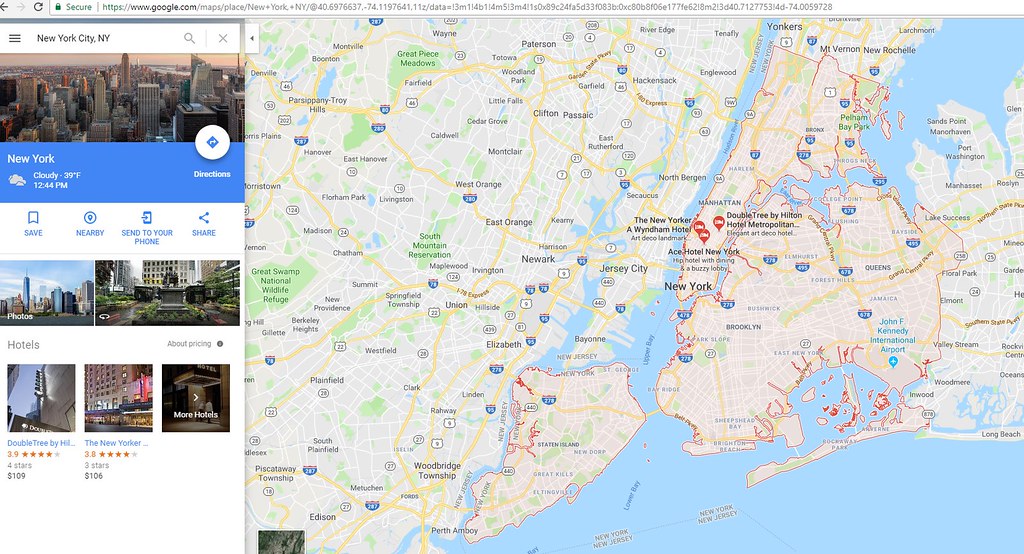
The first step is to find the distance, consult a 'map program' such as 'GoogleMaps' and type in the following destination: New York City.  The map should appear as follows below:


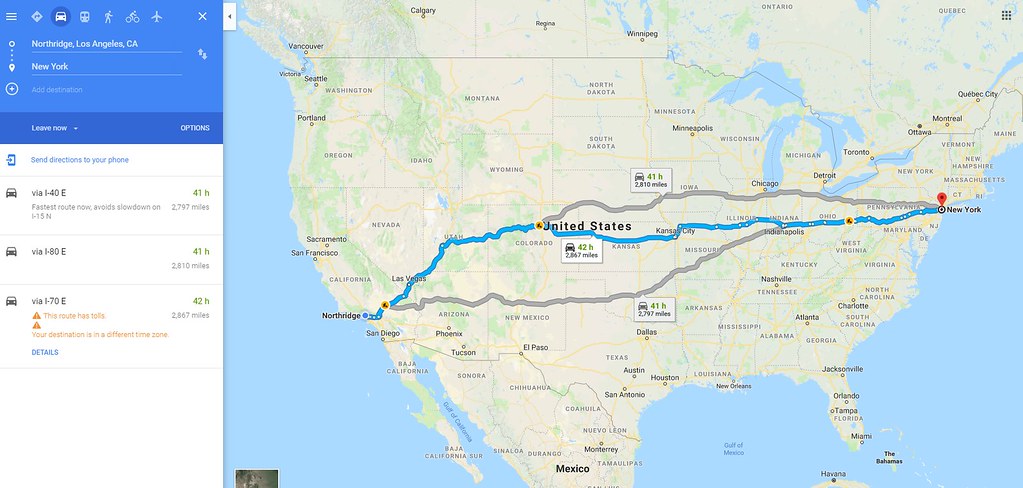
Next, click on the 'directions' button and then a "From" and "To" entry spaces should appear on the upper left hand corner as shown below:


Upon choosing a "car" as a choice of transportation, the following possible set of directions appear like those shown above.  The total distance from Northridge (California) to New York City (New York) is 2,867 miles.


Remember that the distance stated above is a 'One Way Trip'.  Which means that when a final total number of trips is reached through analysis below, the total number of trips will be divided by 2 in order to determine the number of round trips


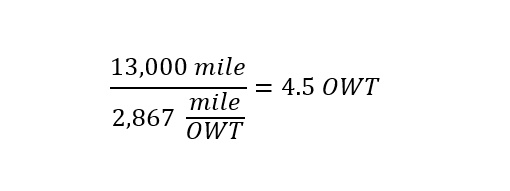
"OWT" represents 'One Way Trip'.  To calculate the total number of 'One Way Trips' possible by traveling 13,000 miles, a division of the distance traveled by the distance of a 'One Way Trip' as shown below:


The result of the calculation is interpreted as the following: If a person were to travel by bicycle (BikeShare) 13,000 miles, they could complete 4 One Way Trips or 2 Round Trips from Northridge (California) to New York City (New York).  The analysis above matches up with the statistic stated in my guest post on 'BikingInLA' today.


Next, the same analysis is carried out to verify the second statement above using a metric of 'One Way Trips' to San Francisco from Northridge.


Northridge to San Francisco


The analysis above was carried out to verify the distance traveled by LimeBike users in less than a month around the CSUN campus - 13,000 miles using the metric of 'One Way Trips' from Northridge to New York City across the U.S.  In the current analysis below, a smaller metric is used.  The metric is 'One Way Trips' from Northridge (California) to San Francisco (California).


To start the analysis, the website 'www.maps.google.com' is consulted with the following statement: San Francisco, CA and the following result is shown below:


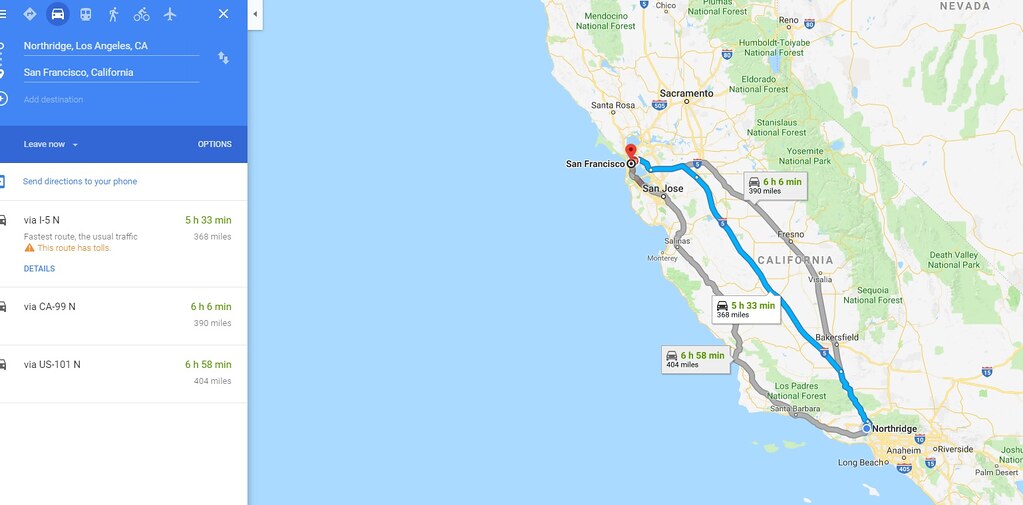
If the current analysis is carried out in the same manner as above, then click on the 'Directions' in the upper left hand corner and two entry spaces will appear.  If the top entry space is filled with 'Northridge, CA' while the second entry space is filled with 'San Francisco, CA' - the following result is shown below:


The result is shown above which shows the total distance for a single trip from Northridge (California) to San Francisco (California) is 368 miles.  The is shown below:


Expressed as 'One Way Trips' the following total distance for a single trip is shown below:


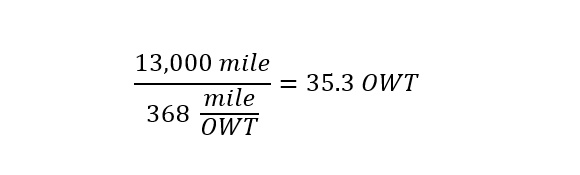
With the metric of a single trip known to be 368 miles, to determine the total number of 'One Way Trips' possible is carried out by dividing the total distance in question (13,000 miles) by 368 miles as shown below:


The result above indicates that a total of 35 'One Way Trips' are possible given a person with the ability to travel 13,000 miles by bicycle (BikeShare).  This can be interpreted as a total number of round trips to be 17 from Northridge (California) to San Francisco (California).


Conclusion...


Above, two different analyses were carried out using the same methodologies.  These analyses verified the number of  'Round Trips' possible by the total distance of 13,000 miles.  Additionally, the above dimensional analysis allows us to visualize the magnitude of the number cited in the guest post written on 'BikingInLA' today.  The number of miles -- 13,000 miles represent the number of miles traveled in 40,000 trips by LimeBike users around Northridge in less than a month.  These numbers are extremely encouraging toward moving to alternative modes of transportation.  Incorporating active transportation into our lives will result in a healthier community, less congested (with traffic) and boost local economy.


Related Blogs using dimensional analysis can be found here.


Thursday, July 28, 2016

'Wayfinding' Signs Are For Everyone Not Just Tourists!

The concept of a 'wayfinding' sign is typically thought of to assist tourists in a city or a region to get around.  Why do we restrict our thinking to such narrow benefits for a select population?  According to a recent news article, the typical thinking was reported on and struck me as dull -- not really exciting.  Why?  Read on below to find out why.


Wayfinding Signage?


What is 'wayfinding' signage?  What is the utility of such signage?  What does that signage look like?  All of these questions are acceptable in this day and age.  Especially as different urban areas try to transition toward designing downtown regions which motivate residents and tourists to engage in greater active modes of transportation -- when moving around.


Here is an example of a 'wayfinding' sign in Glendale (California, USA) shown below:


Source: Roger Wilson/LA Times


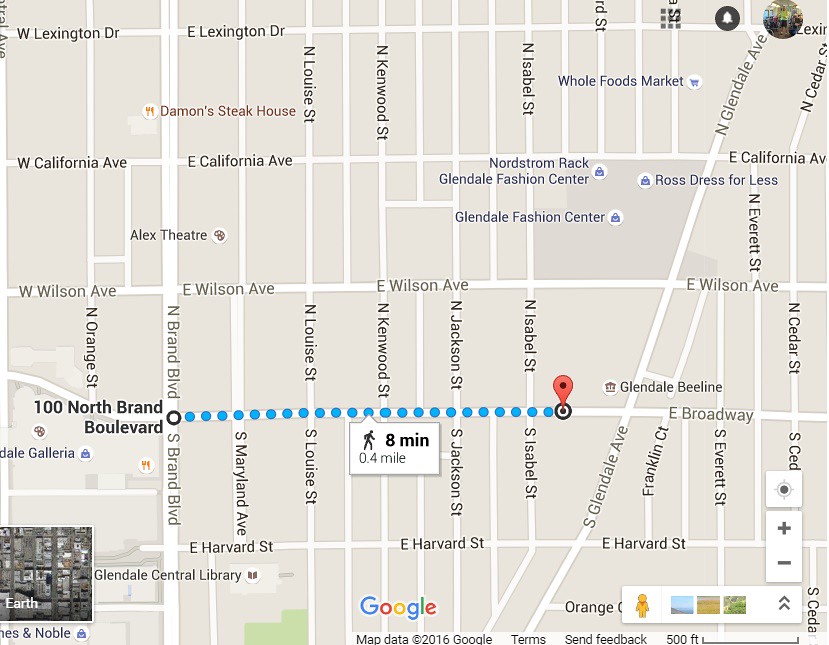
Upon inspection of the sign in the picture above, there is a time printed on the sign and a destination.  In this case, the time that a person would have to walk (7 minutes) from this point to the shops on Brand Blvd.  Here is an image of a map taken from GoogleMaps outlining the distance stated on the sign below:


The sign shown in the picture above was taken from an article in the Sunday 'LA Times' titled "New 'wayfinding signs' encourage pedestrians to take a stroll around Glendale."   Among the paragraphs in the story, three stood out in particular.  The first excerpt highlights the reason for the signs as shown below:


Dubbed "wayfinding signs," the signage along local sidewalks serves two purposes: they contain health tips and point in the direction of local landmarks such as the Glendale Galleria and the Americana at Brand.

"We're thinking they'd be helpful for visitors, people who may not necessarily be familiar with all the sights and attractions here in town, and residents may find a hidden jewel in their neighborhood," said Juan Gonzalez, neighborhood services supervisor for the city.


The City of Glendale has the correct intentions for tourists.  Although, tourists should not be the only audience that transportation experts are targeting.  The overall mission of transportation authorities should be to target everyone living within walking/biking distance (<3 miles) of the downtown area.  Especially, as this mission is aligned with the mission of Measure R2 and with Governor Jerry Brown's vision of engaging a greater population in using active modes of transportation (i.e., motivating active transportation).  For those who are unfamiliar with Measure R2, the measure is a huge transportation bill to be added to November's ballot -- which will supply billions of dollars over the next few decades (read more here).


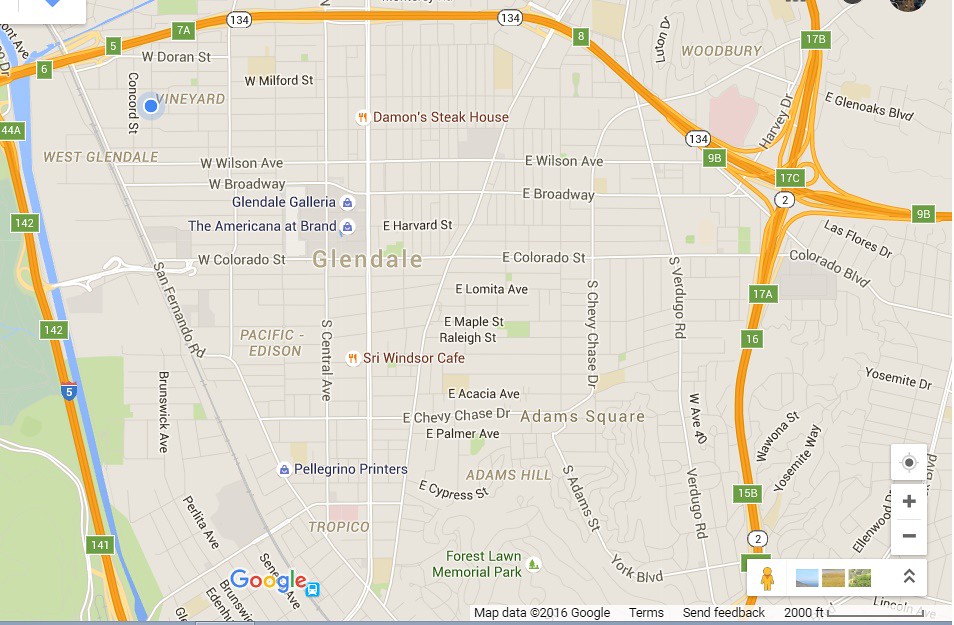
These distances can easily be traveled safely and quickly by bicycle - but remain unknown to the average resident who mainly relies on their vehicle to travel short distances (which is astounding).  Additionally, the city should be emphasizing the relative distances associated with traveling within the "downtown area" of Glendale.  Here is a map of South Glendale (that is below the 134 Fwy) shown below:


The scale is  located at the bottom right.  As the reader can see, the entire "downtown" area (including residential areas surrounding downtown) spans may 2 miles wide by 3 miles in length (running North to South).  Residents could easily walk and bike around the area where all of the major business is conducted if they had a better grasp of the relative dimensions of the city.


One of the main motivations of writing for this blog site is to demystify reported statistics in the popular news using dimensional analysis.  Viewing a map in context to scale and relative distances, should motivate residents of the area -- not just tourists to walk and bike rather than drive.


In the first map shown above, the time that a person needs to travel from City Hall to Brand Blvd is only 8 minutes.  I wonder how many of the public employees who work at City Hall (Council members and Mayor) walk to Brand Blvd for lunch?  Furthermore, how many of the politicians walk the city rather than drive?  Maybe that is a question that needs to asked of the city in the near future.


The lack of participation in active transportation seems to be mainly centered around awareness.  Residents in the city have not the awareness of the relative times that is required of them to travel the relative distances.  As usual, I try not to bring any subject up if I am unwilling to help in increasing the awareness -- which I have in the past.


How Long Does It Take To Walk Downtown?


Understanding the relative times that is required to travel a certain distance is critical in motivating the use of active modes of transportation.  I have written on this site previously about eliminating the separation of commuting and leisurely trips when it comes to active transportation.   Every trip should be an active transportation trip!


What is our part in the process?


We started the nonprofit organization 'Bikecar101' -- with a mission of the following: to advocate for and educate the public about bicycle on public transit trains.  How does this correlate to the subject at hand -- wayfinding?


and the other video:


In each video, we started the experiments from the West side of town.  From our house, we traveled to the center (to the Americana) and to the East side (to the fountain - second video).  Which means that if residents are willing to walk around a mile each way, there is no need to use a car.


Of course, if the purpose of the trip is to buy groceries (in large quantities) or heavy objects from the mall, that is an exception to the rule.  Think about how much healthier the residents of Glendale would be if there was a higher participation in active transportation.  In the article above, the distance highlighted by the 8 minute walk drove home the point that anyone living in the vicinity of City Hall does not need to drive (every time) to get to Brand.  Plus, here is an excerpt from the article highlighting the health benefits:


As for health tips, one of the signs states that doctors recommend walking 6,000 steps a day to improve one's health and 10,000 a day to lose weight.
There's also a social-media campaign as part of the program. Pedestrians are encouraged to snap selfies of themselves with a wayfinding sign in the shot and share the pictures on social media with the hashtag #GlendaleWalks.


Any person can easily achieve 10,000 steps by traveling using active transportation in a given day.  There is no excuse.  The information is present in the article.  You might ask then the following question:


What is wrong with the article?


Conclusion...


Again, the 'wayfinding' signs are a wonderful addition to the City of Glendale.  I hope that as the transportation experts around the Southern California area move forward in motivating voters to go out and support Measure R2 this November, we remember the overall mission.  It is imperative that the all active modes of transportation be emphasized.  Walking, biking, along with the use of light rail, bus rapid transit affords the opportunity to travel over a wide range of distances here in Southern California.  In order to drive home the concept, each of us advocates need to demystify the distances that are available to walk/bike in our respective cities.


'Wayfinding' signs contribute greatly to this effort.  Although, if each of us do not contribute and explain to our fellow citizen the purpose of these additions (signage), then they will go unnoticed.  Walking/biking is demystified by various exercise groups on the weekends along with local bicycle coalitions (the Los Angeles County Bicycle Coalition hosts a Sunday "Fun day" ride each month).  Working together, come November, Measure R2 will become a reality.  Then the real work continues to be our duty -- spread the word by education to produce a better society.  Each City needs to work together to become a region promoting healthy and sustainable transportation.  Infrastructure and tourism is just one part of a larger solution.


To stay informed on transportation, infrastructure, and advocacy issues in the region read the vast coverage (while up to date) at StreetsblogLA.org.


Wednesday, April 6, 2016

Active Transportation Implies That Every Bicycle Trip Is Considered "Commuting"!

I know -- at this point -- after reading the title you are confused.  In fact, you might be wondering what the blog will be about.  Especially, if you have been keeping up with the blogs written so far this year.  That is an acceptable "state of mind" to have at this moment.  Aside from doing science, I am interested in advocating for greater engagement of active modes of transportation (bicycle, walking, running, etc.) coupled with public transit (buses, but more specifically trains).  To some extent, this process too requires a change of "mindset" toward everyday choices.


As the description implies, engaging in active transportation means elevating ones health invariably while typically reducing the amount of time spent in a car.  Replacing car time with physical activity couple with public transit (trains for our cause) is a viable solution for transportation here in Southern California.  In fact, as will be highlighted, most of the residents are pre-programmed and do not even know it. Additionally, teaching our young to engage in active modes will direct future generations down the line to make policy decisions that involve greater use of active transportation (i.e., public transit infrastructure to accompany greater bicycle storage).  Let me explain a little more to clarify a topic that has been on my mind lately.


What Constitutes A Bicycle Trip?


Recently, the 'Alliance for Biking and Walking' released the 'Benchmark report for 2016' citing the newest bicycle statistics.  I have yet to get through the comprehensive document.  Although, I am looking forward to reading through and seeing the new exciting statistics that have been measured and reported. Regardless of how we display/state the statistics showing increases in bicycle commuters, we need to include those shown in the picture below:


The slide which contains a few bullet points was taken from a slide presentation that I gave last year at the California Bicycle Summit in San Diego (California).  The take home point is that conditioning the mindset of potential bicycle commuters starts at a very young age.  In fact, engaging the young early in choosing active modes of transportation results in better/healthier choices for society and the environment down the line.  Having more people engage in active modes of transportation can elevate the health of the population at large (see American Heart Association statistics in the diagram above -- staggering).


Why are these images important in the picture above?  Read on to find out...


I found out about the report from an article in 'Momentum Magazine' titled "State Of The Bike Walk Union: Here Are The Statistics".  Without going into the details of the report, I want to highlight an excerpt from the article that discussed a couple of statistics contained within the report.  Here is an excerpt that caught my eye:


School-aged children biking to school dropped slightly between 2007 and 2009, but has since been increasing incrementally each year to land at a rate of 2.2% in 2013. However, youth under 16 account for 39% of all US biking trips, while making up only 21% of the US population, suggesting that youth use bikes more often for non-commuting purposes. Which, if any of us were to look back at our childhoods, would have been a pretty easy hypothesis.

Adults 65 and over are underrepresented in biking and walking, which the report suggests could be the fault of community design which doesn’t prioritize biking and walking. While one study cited noted that 58% of seniors would prefer to live in a walkable community, the reality is that 58% (coincidence) of American adults 60 and over live in a suburban community where walking isn’t feasible.


After reading these statistics, my mind drifted off toward a point that I emphasize within my own bicycle advocacy.  Which is that "commuting" needs to be rethought in terms of a reported statistic.  This might not be something new.  But, I think that the above paragraph highlights the need to include other trips in bicycle statistics in order to more accurately represent the motivation toward increasing the funding for bicycle infrastructure within a geographic region and active transportation in general.   Wow, that was long right?


I understand.  At this point, you probably are really scratching your head saying to yourself:


"Where is he going with this thinking?  Where did this thinking or reasoning come from?"


Fair enough, let me explain a little with some background.  Over the last year, my wife and I along with other bicycle (plus train) commuters have been advocating for greater storage space "on board" public transit trains in Southern California.  More about our advocacy can be found at www.bikecar101.com.  Part of the reasoning/motivation was to motivate greater use of an underused train system with the addition of a bicycle to extend the reach beyond the station.  In transportation circles, the problem of extending the reach beyond a "transit" station is called "First and Last Mile."


We tend to think of the majority of trips in Southern California as "First and Last Several Miles" which is more appropriate.  The transit system is underused, which offers a huge potential for growth.  As any person who has visited Southern California knows, the region is filled with "car-centric" drivers (crazy drivers).  Although, with congestion rising on the freeways along with the environmental impacts and health effects, one solution is to motivate greater engagement in using active modes of transportation, hence, "Active Transportation."


This is great -- but -- who cares?  To answer that question, we need to answer another question:


What constitutes a bicycle commuting trip?


I am sure that if I were to ask a bunch of people through a survey, the results would be skewed toward -- "going to and from work."  Although, there are many times other than those only devoted to traveling to and from work where a bicycle could be used?  Why not?  The real question can be stated in the following manner:


When did we lose the sense to choose a bicycle over a car?


If you were to ask an average person how to get around the region (Southern California), generally, the car would be the preferred solution.  What about in a city such as Los Angeles? Still, a car.  Although, the percentages of transit users will invariably vary between different "urban sprawls."  Regardless, lets return to my question above -- when did the typical Southern California resident decide to drive a car rather than ride a bicycle?  When we were given a car?  To get far away from Mom and Dad?


Here are two interesting examples of reasons why every bicycle trip is a commute.


Example 1: A Metro Employee Sees The Light?


When I was young I used to travel to and from the playground by bicycle with friends.  The distance to the playground was around a mile away.   Or, we would ride our bicycles to a field in order to "hit the jumps" in the field -- followed by a two mile ride back.  You could say that I did a lot of bicycle riding in my child hood.  I grew up in Corona (California).  As the town was expanding, the sprawl was increasing.  Still, we rode our bicycles around to play.


I brought this point up in motivating greater storage space (on board trains) at transportation meeting in downtown LA.  Here was the response I got (in the form of dialogue):


Metro Employee: "Do you remember a time when bicycles were not allowed on the train?"


Mike: "Yes."


Metro Employee: "Then you should be happy with the ability to bring a couple of bicycles aboard the train."


Well, that shut me down with the implication: we have done a lot already -- respect.  The problem with that response was that the response did not fit a progressive transit system looking 30 years into the future.  The response was more fitting to that of driving while looking in the "rearview mirror."  I highly discourage trying this while driving for extended periods of time.  Furthermore, this response was an indication of the need for Metro Employees change their mindsets.


All throughout the year, I have been telling this story and the need for change.  Finally, at a transportation summit earlier last month, I asked a question regarding increasing the "on board" storage space aboard Metro trains.  Additionally, I added in the story (the same story) that I had been telling.  Suddenly, the speakers/moderators changed.  I looked up and saw the same Metro employee (who had the previous dialogue) prepare to answer the question.  I thought: "Oh crap, here we go.  Another round of the 'I should be happy to bring my bicycle aboard already.'"  Instead, I was floored with the answer that I received.


She started off with saying the following: "I see that we (Metro) are going to have to change our mindset... the way we view needs of the transit riders."  Whoa!  Oh My Goodness -- great.


She continued on -- with a quick story that contained answers to our questions.  Her son who is turning 11 years old is riding a bicycle around the neighborhood.  She can already notice that his "requests to ride" his bicycle are getting further and further from home.  Now, the pressure has risen for her to consider how to provide safe routes and transportation (bicycle infrastructure on transit) to accompany his bicycle needs.  Each person has a different path of "realization" and this lady had one dealing with her son's new love for biking.  Brilliant.


As I mentioned above, I was much younger when my parents let me venture out onto a bicycle long distances.  In fact, when we were pre-second grade, we rode our little bicycles 2 miles each direction to school -- my sister and I -- crazy!  That would probably not happen today.  The take home message from the first example was the following:


Any bicycle trip can be considered commuting!  Any bicycle trip is important!


Every trip on a bicycle is important and should be considered in a survey offered by bicycle coalitions.  Plus, kids need to realize that their "commute" to the playground is just as important as their "commute" to school by bicycle!


Next example....


For the next example, I would like to be more brief and to the point: stress the importance of bicycling in life to your children.


Example 2: Teach Kids Young To Use Bicycles To Get Around!


I cannot stress this point enough.  Most children do ride bicycles when they are young.  Adults are in control of how that perception lasts through to adulthood.  If a family stresses the need to drive, then driving will reign over all other forms of transport.  Driving will be the default choice compared to biking/walking.  Which is sad -- I think.  Recently (as in a 1/2 year ago) I ran across the picture below on twitter of a small girl walking shown below:
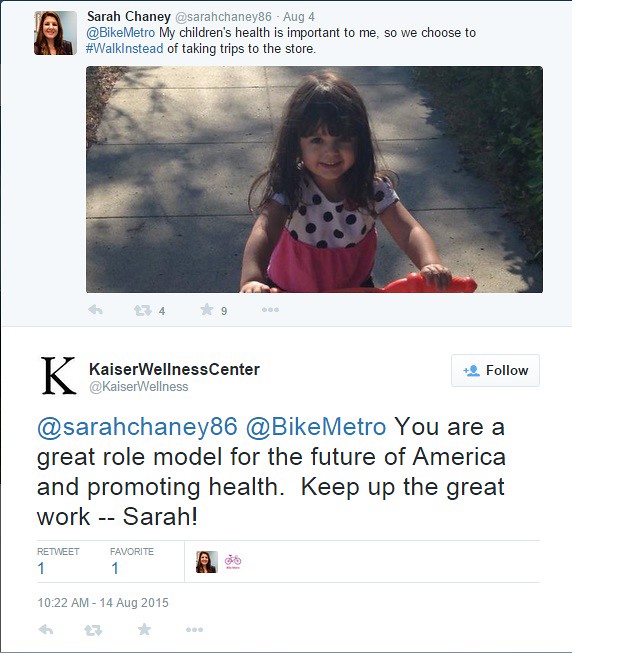


The response below is from myself through another venture that my wife and I are working on which is a wellness center (open sourced practices).  More about that in the future.  As you can see, the mother is a very progressive thinker.  She is integrating health into a commute to the local store and back.  I use the word commute to emphasize that every bike trip is a commute to a given destination and back.  This allows us to integrate a commute to school with a commute to work with a commute to the athletic facility to swim.  Each of these involves deciding to use an 'active mode' of transportation rather than driving.


Can you imagine the mindset of the child above in the future?  Given the task of going to the store, her first choice being to walk.  What a healthy way to live?  Each of us should try to implement this decision making into our own lives?  You might be thinking that the mother above is in the 'minority' instead of the majority of cases.  Here is the last story to drive home the point.


In the picture below, I show a bicycle instructor at a local bicycle event that we participated in back in October of last year:


The workshop was to teach kids how to maneuver through an obstacle course while displaying the proper hand signaling.  Additionally, each child was able to bring their own bicycle to the event and have the bicycle inspected/adjusted by a bicycle mechanic.


Why do I bring this workshop up in relation to the present blog post?


I was standing watching the children and a mother standing nearby looked over at me and said "Thank you for putting this workshop on."  Surprised, I said "Oh, your welcome, our pleasure."  She went on to convey the importance of bicycling in her life.  She stated that both her husband and herself do not ride bicycles much (barely) and are afraid to go out onto the street.  Furthermore, she wanted her children to have two basic skills to grow up with.  These two skills were critical to survival.  The first is that her children must know how to swim.  Second, she wanted her children to be able to ride bicycles.  Wow!  Awesome, but why?


She said that she looks around herself and sees that as traffic gets worse, there will be a greater need to be able to get around by bicycle.  Additionally, she wanted her children to stay active.  At the very least, she could make them ride their bicycles to school to get exercise.  Plus, she said that active transportation was good for the environment.  At that moment, I stood there amazed.  I almost did not believe her.  But she was genuine.


Conclusion...


If the bicycle culture is going to grow enough to support active transportation on a level that will reach a national level, there definitely needs to be a change of mindset among each of us.  Even growth within a region requires attention that is devoted toward changing the mindsets of its residents.  Every trip is a possibility to engage in an active mode of transportation.  Choose to be active rather than passive in deciding your next mode of transportation.  Incorporate health and wellness into your decision.  Break down the barrier of categorizing trips (i.e., "we ride your bicycle to the park but we drive to school!").  There are a few different ways to achieve this.  Similar to the education system in the US, there has to be a component that emerges out of the household.  Education on part of parents toward youth is critical toward growing a society of healthy and responsible while at the same time being environmentally responsible citizens.  This education starts early.


Second, the education lies on each of us to teach our fellow friend, family member, neighbor, boss.  Spread the word regarding the benefits of engaging in active modes of transportation.  The dissemination of knowledge among the region will transcend cultural boundaries too.  Choose to be an example of engaging in active modes of transportation.  Over time, your elevated health and wellness coupled to the reduction of stress  will be contagious and be acted upon by your fellow friend, family member, or colleague.


Overall, the result is better choices that are more environmentally friendly, and ultimately are more sustainable for future generations to carry on.  The next time that you have to go to the store or on an errand, take a bicycle or walk.