Friday, November 11, 2016

What Do The Election Results Have To Do With Veterans Day?

The election results have been tallied and the President Elect has been determined to be the Republican Nominee Donald Trump.  During his campaign, Donald Trump promised to restore dignity for our veterans by re-working the Veterans Administration System and take care of our soldiers.  These promises sound wonderful to a soldier in uniform.  As a result, this might have raised the amount of votes tallied from military soldiers.


After processing the election results, today -- which is Veterans Day in the United States allows us a day to reflect on the future with the election behind us.  Specifically, the state of the nation while paying respect to the soldiers who have given the ultimate sacrifice and those who have served our country -- of which I am one (US Air Force 1996-2000).  The following question can be entertained:


Where are we headed as a country with the current military?


I would like to make a few comments on the matter based on the information which has surfaced over the last few months -- in addition to the months ahead.


Happy Veterans Day!


I am a veteran.  I served my country proudly in the US Air Force from 1996-2000.  I often think of that time of service.  Especially, when I interact with my brothers and my sisters (military friends).  My tour of service was very good.  I worked hard and played hard.  I had the opportunity to visit areas of the world that most Americans will never get a chance to visit.  Examples include military bases in the Middle East in the middle of nowhere.  The primary mission was to generate F-16 jets for "peace-keeping missions" -- i.e., enforcing the no fly zone on either end of Iraq.


Why am I telling you all of this information?


Especially when I just wrote a blog post about the second suicide attempt of Pfc. Chelsea Manning leaking information?


In that post, I mentioned that each service member agrees not to talk about their specific jobs during a given tour.  Well, so far, nothing of importance has been said on my behalf.  The reason why I speak about general tours/deployments/trips on which I was sent was to convey the importance about the current and past military members serving our country with distinction and honor.  There are a whole lot of prior military brother and sisters walking this great country who have contributed to the security and present day status of the country.


To them (Veterans) we each owe respect!


Travelling around and congregating today to think about veterans can be good and meaningful.  Typically, this involves hanging out at a family members house (watching a holiday game) on TV and periodically mentioning veterans.  Please if this is the case, do not be too lazy to stand up during the performance of the national anthem before a game (and yes even if the game is on TV or at a distance).  Or maybe the day involves hitting the shopping mall to participate in purchasing a new consumer product with astronomical savings in the name of Veterans Day Sales.


What is not typically highlighted and noticed by the general public are the large number of veterans that are walking/roaming the streets with mental illness.  Furthermore, not a whole lot of attention is being paid to the failed Veterans Administration System -- whose responsibilities include offering treatment to visible and non-visible diseases (physical and psychological).  Many veterans will be travelling around today unnoticed and without help with their disease that plagues them.  If you know of any veteran who is struggling - please let them know that help is available.  There are organizations across the United States whose mission is to restore dignity and hope to their lives.


Last night I was listening to the podcast "Unbeatable Mind."  Commander Mark Divine interviewed Nathan Fletcher who is the director of the "Three Wise Men Foundation". Here is a quote from the interview that leaped out of the speakers at me regarding veterans and suicide:


"Over 70% of the veterans who commit suicide never asked for help from anybody..."


WOW.  Unbelievable.  Nathan Fletcher attributed a large part of that was due to the pride and mindset of Veterans that do not ask for help.  They just power through the problem or self-medicate.  Through his foundation of working with veterans, he is changing the mindset of veterans who suffer with Post Traumatic Stress Disorder (PTSD).  The common problem associated with seeking treatment for problems such as PTSD are the potential stigmas that go along with the diagnosis.


Although, I would argue that as more and more people (military and non-military) are seeking treatment for traumatic events in their lives, the stigma is disappearing while the frequency is increasing.  Therefore, thinking of the traumatic event as a starting point from which to grow from is removing any stigma associated with the term altogether (which is both admirable and genius too).  He is coining the term "Post Traumatic Growth" -- awesome.


The work of foundations such as "Three Wise Men Foundation" and other veterans groups: "Ride 2 Recover", "Wounded Warrior Project" are superstars and extremely successful at rehabilitating veterans through injecting exercise and changing the mindset and practices.  If you are having trouble finding an organization for getting a veteran help, type into a search engine like Google the phrase "Veteran Support Groups" and numerous support groups will appear after scrolling past the advertisements.


What emerges from this work are soldiers who are given a purpose in life.


This is great.  Although, more work needs to be done in total to help veterans around the US.


President Elect Donald Trump Promises To Help


Returning to the introduction of the blog post, we now have President Elect Donald Trump who will have to deal with the issues that I described above.  Recently, I wrote a post about the top 20 science issues that the next president will have to entertain.  Actually, in that post, I 'copied and referenced (reformatted) the original questions from the nonprofit foundation "ScienceDebate" which represents 56 organizations.  The 56 organizations are made up of 12 million scientists.  


Why do I bring these questions up?


A couple of the top 20 questions has direct connection to the veterans suffering from mental illnesses and/or are homeless.  The first question has to do with mental illness:


Question:


Mental illness is among the most painful and stigmatized diseases, and the National Institute of Mental Health estimates it costs America more than $300 billion per year. What will you do to reduce the human and economic costs of mental illness?


President Elect Donald Trump's Answer:


This is one of the great unfolding tragedies in America today.  States are reducing their commitments to mental health treatment and our jails are filled with those who need mental health care.  Any mental health reforms must be included in our efforts to reform healthcare in general in the country.  We must make the investment in treating our fellow citizens who suffer from severe mental illness.  This includes making sure that we allow family members to be more involved in the total care of those who are severely mentally ill.  We must ensure that the national government provides the support to state and local governments to bring mental health care to the people at the local level.  This entire field of interest must be examined and a comprehensive solution set must be developed so that we can keep people safe and productive.


I will be the first to admit that I did not vote for Donald Trump.  With that being said, I believe very strongly in democracy and in the electorate.  Therefore, the majority of this great nation have stood up and decided that he is our best candidate.  In light of this, lets look forward at where the future takes us -- especially with this critical question of mental health care and our veterans.


By the sounds of the answer that President Elect Donald Trump has given, there will be support to our veterans who have mental health issues along with other non-veterans who suffer too.  I truly hope that this is the case in the near future.  Any support that he can throw (in terms of funding, motivation, etc.) will truly help the country re-prioritize our values toward taking care of ourselves first -- which seems to have been lost.


There are such a large amount of  veterans who have not received any help.  The statistic of 70% is one such example which needs dire attention.  Additionally, transitioning a veteran back into society is importance too. These two factors alone probably contribute greatly toward the ability to have an operational veteran who has been "of service to our country" and continues in the civilian world to be of service to our country.


One devastating point to mention in the podcast "Unbeatable Mind" which I forgot to highlight is that untreated illnesses also result in "self-medication".   Whether that be with the use of alcohol or drugs is of a major concern for our veterans and other citizens of this nation.  Currently, a major problem exists with an 'opioid' addiction hitting the United States in extremely large numbers.  This brings us to the second of the 'top 20 science issues' above which deals calls into question a solution for this growing epidemic:


Question:


There is a growing opioid problem in the United States, with tragic costs to lives, families and society. How would your administration enlist researchers, medical doctors and pharmaceutical companies in addressing this issue?


President Elect Donald Trump's Answer:


We first should stop the inflow of opioids into the United States.  We can do that and we will in the Trump administration.  As this is a national problem that costs America billions of dollars in productivity, we should apply the resources necessary to mitigate this problem.  Dollars invested in taking care of this problem will be more than paid for with recovered lives and productivity that adds to the wealth and health of the nation.


The answer above causes concern to me.  Actually, next week I will write a post about part of the reason why there is an issue with opioid use.  Part of the problem lies on the side of the pharmaceutical industry.  Stay tuned.  Regardless, there is a major issue that needs to be addressed as a nation.  This problem can be couple to mental health issues.  Funding needs to be available address treatment and prevention.


Conclusion...


Part of the problems plaguing veterans is the inability to transition back into civilian life.  The solution to this lies within all of us.  Some lies within the families (in comprehensive care) to motivate getting help and seeking out resources for transitioning back into civilian life.  As I mentioned above, there are many useful and successful resources available to veterans in order to lead a healthy and productive life.


President Elect Donald Trump can do some great if he can stimulate the economy and get jobs going again.  Veterans need work to do to feel useful -- just like every other American citizen.  Although, veterans are highly motivated workers who have a unique perspective about the world which can be extremely useful to a team.  Industries across the board should welcome them to the workforce and utilize their strength and build upon their weaknesses.


Industries across the board suffer from the inability to tell the public what experience that they are looking for.  I work in a university and often I will hear outsiders say "Colleges and Universities are not producing a quality worker for us."  The solution is simple: Just tell us what you want!


As for the veteran leaving the service and transitioning back into civilian life, I am reminded of the news from an article titled "Veterans: Silicon Valley's most overlooked talent" that states:


Green, who eventually landed a project manager role at San Jose-based Cisco, said tech companies aren't doing enough to help the thousands of service members who are entering the civilian workforce every day.

“Tech companies have all these veterans initiatives. But often, they’re just sound bites and spin," Green said. “I went to Apple just to meet with someone and they said the same thing — just apply online. A lot of doors were closed in my face.”

Green said he faced a common problem experienced by veterans re-entering the civilian job market: the difficulty of relating his Army experience to the business world.

Tech companies like Cisco, Google and LinkedIn all have veteran-focused initiatives, from hackdays for veterans to workshops and training events aimed to help veterans transition to civilian life.

But these efforts are still not enough to help veterans compete on an even playing field in uber-competitive Silicon Valley, said Green.

Green believes that while individual companies’ veterans initiatives are important, they are not very effective on their own. He encourages companies to come together to better explain to veterans what they are looking for in terms of talent and how to best translate skills from the military world to civilian jobs.

“Companies need to join together to explain to veterans how to translate their skills, what training is needed and what the options are,” Green said. “That will help vets be more competitive in Silicon Valley.”

Mike Dougherty, another Army veteran, said hiring managers often did not see the value of his military experience to the business world.

Dougherty, who most recently served in Iraq as a lieutenant colonel, is the director of North American manufacturing and operations for Cisco. He also went on two combat deployments to Bosnia in the 1990s.

“I told them about being a platoon leader going into Bosnia with the 1st Armored Division across the Sava River,” Dougherty said. “And the hiring managers just said, ‘What does this have to do with this job?’"


After reading this excerpt along with the anecdotal account which I give regarding students leaving the university setting, the blame seems to be on the side of industry.  Today's spectrum of available jobs requires more specificity in the job description.  Further, industry should come together with both academia and the military to explain how to better recruit a worker from either setting.


Regardless of who is to blame, hopefully the next President Elect Donald Trump can bring back jobs and bridge this ever widening gap in the job force.  He is the first truly business minded President without political experience.  I sincerely hope that he makes good on his words regarding veterans and making America great again.


I hope that everyone has a great Veterans Day celebration.  Be safe and think about the issues at hand.  Above all, be thankful and grateful that you are not in a war zone or hostile area today.  There exists a soldier who is thinking of you peacefully celebrating.  Take a moment to thank them -- even if it is in spirit of mind.


Until next time, Have a great day!


Tuesday, November 8, 2016

What Happened To Being Yourself Instead Of Ivanka Trump?

Living just outside Los Angeles (California), I am well aware of the cost of image.  Hollywood is adjacent to my community and I get a full 'whiff' of the need to conform to an unattainable image.  Furthermore, a majority of residents in my city drive to the mall just over a mile away (sometimes just a block away).  I ride my bicycle to the train station and take the train to work.  This lifestyle is counter intuitive to the majority of residents surrounding me.  Enough said.


What ever happened to being yourself?


In the brief post below, I talk about one of the most strangest revelations of the current election cycle.  The revelation revolves around a growing trend of women seeking out to look like one of the Presidential Candidate's Daughter.  A few women have been spending quite a bit of money to look like Ivanka Trump.  First, I will start with an experience close to home and then move onto Ivanka.


Face Lift?


I use the scientific term "against entropy" for a good reason.  Over the course of our lives, the shape of the human face becomes round.  For this reason, many people consult a plastic surgeon to alter the shape for a few years at most.


How do I know this?


A few years ago, my mother decided to get a face lift.  All of her life, she has wanted to get a face lift to remove the "turkey neck" -- the excess skin underneath a person's neck along with the sagging skin in her cheeks.  At least that is the reasoning that she gave me to have the procedure done.  On top of these reasons, my parents are divorced and both happily remarried.  My father is a surgeon -- who is very opposed to cosmetic surgery -- unless certain circumstances arise (burn victim, disfigurement, etc.).  Given his opinion on the matter, I could see why she had never had the procedure done before.


Upon getting the procedure done, there is a process of healing from having the muscles cut and stretched to be sewn back together.  The healing process requires lots of rest and recovery checkups with the plastic surgeon to ensure the healing process is going well.  Watching my mother go through this process left a sour taste in my mouth toward the procedure.   Overall, the process appears to be extremely painful for results that are eventually going to be reversed.  What?


Yes, eventually, the process will be reversed.  On top of the direction of aging dictated by the genes that each of us are given, I mentioned that each of our faces turn round -- as we age.  Remember, the first paragraph?  Therefore, the process is not good forever.  That is why plastic surgeons are wealthy on top of first time clients.   The length of time is years in between though -- not to worry.


Ironically, before finishing up this section, I must tell a short story.  During one of the follow-up check ups with my mother's plastic surgeon, I learned quite a bit.  First, that as we age our faces turn round.  Second, that my mother's plastic surgeon was trained by my father -- what?  Yes, after my mother's check up was finished, the physician, Dr. Robert Hardesty asked me how my father was doing?  I was taken back.


Turns out that my father trained him how to operate to perfection while working at the Veterans Administration Hospital in Loma Linda, California.  That was the reason why my mother trusted him so much.  He was trained by the best.  I guess he went onto do what my father did not want to do.  A year after my mother's surgery, I was engaged and had an engagement party.  Time had past since my parents divorce.  The party was at my mother's house.


Late to arrive as usual, my father greeted my mother -- but before my mother said to him "Hello, I am Mike's Mother, How do you know Mike?"  He replied, "Hello, I am Mike's father..." and suddenly, they both broke into laughter -- embarrassing to say the least.  My father had gained a few pounds along with obtaining a "rounded face" while my mother had had the "face lift".  They were married for 25 years before divorcing.


What does this have to do with women seeking to look like Ivanka Trump?


Hang on, I am getting to that part of the post.


I Want To Look Like Ivanka Trump!


Out of all of the outrageous news bites that have surfaced during this current election cycle, none is more strange than the following piece of news.  In a recent video, I found while surfing social media, a story on the YouTube channel for 'ABC News' titled "Women Get Surgery To Look Like Ivanka Trump" -- introducing the new trend of a few women seeking to look like Ivanka Trump.  Here is the video below (which is less than 7 minutes in length and definitely worth watching):


While watching the video in amazement, I am dumbfounded that the look these women are seeking is of Donald Trump's daughter.  She has a "rounded face" which is one of the most sought after 'attributes' after her breasts and lips.  Amazing.  If that is what makes them happy then so be it.


Why can't we be happy with ourselves?


Our genes are programmed to deliver what our ancestors had?


These are your origins?


Would you want to look like someone else's daughter?


Strange to say the least.  In fact, each of the women above will have the same features as Ivanka in a few years as they age -- according the advice from my mother's plastic surgeon.  Why speed up the process? 


I am amazed at the length that a person will go to seek the approval and looks of another person.  After seeing the video, I thought of another amazing story of a husband who sued his wife for $100,000 dollars for deceiving him and having ugly children.  What?  Yes, you heard it correctly.  The man then filed for divorce and won everything after the wife admitted to undergoing over a $120,000 worth of plastic surgery.  Here is the video below:


What a terrible man he is.  Although, one must ask themselves if they would have been honest with their husband in the same situation.


Should a male or female feel compelled to reveal any plastic surgery done prior to marriage?


One would think that each of them would have seen childhood pictures or high school pictures prior to marriage.  Maybe not.  Maybe they just rushed into marriage without inquiry.  Who knows?  Strange, isn't it?


Conclusion...


What can be learned from the stories so far?


How about following the advice of my father (a surgeon who trained a plastic surgeon):


Just be yourself and let your genes lead you to a happy life!


Being yourself will be cheaper, last longer because you are not fighting your genetic code and more refreshing.  Why?  Because being yourself is like being no other person.  You are unique -- promise!


Until next time, Have a great day!


Monday, November 7, 2016

READ THIS BEFORE VOTING -- Presidential Science (WORLD) Issues!

Of the many unanswered questions that exist around the current election cycle, very few are as important than questions surrounding current scientific research and the funding for the future.


Why should the public vote/influence an increase in science funding?


Why do I suggest the importance of such research is so high?  


The range of issues that are tied to science funding is enormous.  Most people do not realize what issues are encompassed by science funding.  If you (the reader) are one that ties research funding only to important issues like - space or defense - then I ask you to please read everything below.  The reason is that the range of issues affected by science include climate science (flooding from Hurricane Matthew) to research into better treatments for eradicating the Zika Virus or Ebola Virus.


Additionally, what about the homeless problem that plagues the United States which includes many victims to serious mental health issues and impact the veterans among others roaming the streets without help.  Before you go to the voting polls tomorrow, please read the information below which might or might not influence your vote.  Either way, after reading the blog post below, you will definitely be better informed.  Last but not least, I will provide direct evidence of the wonderful job that artists such as Beyonce, Jay Z, and Leonardo DiCaprio are doing to elevate science and the need to get out and vote -- which is super inspirational.


Note: various words or phrases are hyperlinked to earlier posts on the subject or other research articles.  Please read widely and inform yourself on Science Issues.


Pending Issues Which Need To Be Addressed


Just look at the current state of affairs around the nation and the world along with the issues raised in the blog post below.  Then we can talk about the importance of such issues.  Currently, the entire East Coast of the United States is recovering from the dramatic flooding and winds which struck when Hurricane Matthew swept through and wreaked havoc on the region.


Any discussion of the funding for the destruction and the recovery?  


Has the East Coast rebuilt all of the damaged structures?  


Not in the least.  Why not?  If the same lack of attention toward science research into the issues exist today, where will we be as a nation in 4 or 8 years?  This is why the issues of science are serious and need to be entertained before we head to the voting polls next week.  At this point, you might be wondering the following question:


What are the most critical issues at hand that are associated with science for the candidates to express their views toward?


In a recent post, I simply cut and pasted the "Top 20 Questions from Science Debate" with the answers from the candidates.  The purpose was to give you (the reader) a sense of what the critical issues were through questions offered up by millions of scientist.  Those questions raised commentary within the scientific commentary within the community.  Below I offer a few articles which highlight the commentary from those questions.


A recent article from the website "BioscienceTechnology" titled "Coalition Presses US Presidential Candidates to Address Science Issues" offered commentary on the "Top 20 Questions" from the nonprofit organization "ScienceDebate."  The author chose to offer up six of the 20 questions as necessary to provide an example.  The six sample questions are shown below:


1) Many scientific advances require long-term investment to fund research over a period of longer than the two, four, or six year terms that govern political cycles. In the current climate of budgetary constraints, what are your science and engineering research priorities and how will you balance short-term versus long-term funding?
2) Mental illness is among the most painful and stigmatized diseases, and the National Institute of Mental Health estimates it costs America more than $300 billion per year. What will you do to reduce the human and economic costs of mental illness?
3) Strategic management of the US energy portfolio can have powerful economic, environmental and foreign policy impacts. How do you see the energy landscape evolving over the next 4 to 8 years, and, as President, what will your energy strategy be?
4) Public health efforts like smoking cessation, drunk driving laws, vaccination, and water fluoridation have improved health and productivity and save millions of lives. How would you improve federal research and our public health system to better protect Americans from emerging diseases and other public health threats, such as antibiotic resistant superbugs?
5) Science is essential to many of the laws and policies that keep Americans safe and secure. How would science inform your administration’s decisions to add, modify, or remove federal regulations, and how would you encourage a thriving business sector while protecting Americans vulnerable to public health and environmental threats?
6) Evidence from science is the surest basis for fair and just public policy, but that is predicated on the integrity of the evidence and of the scientific process used to produce it, which must be both transparent and free from political bias and pressure. How will you foster a culture of scientific transparency and accountability in government, while protecting scientists and federal agencies from political interference in their work?


The author seem to want to suggest that the above issues just did not impact science funding, but were of significance to the public at large.  I found the paragraph below fascinating:


“Some politicians think science issues are limited to simply things like the budget for NASA or NIH, and they fail to realize that a President’s attitude toward and decisions about science and research affect the public wellbeing, from the growth of our economy, to education, to public health,” Rush Hold, CEO of the American Association for the Advancement of Science, said in a prepared statement. He said that Americans should have the opportunity to know where Presidential candidates stand on these issues. 


All issues that are researched from a scientific standpoint are important.  Just because the public does not see the ramifications of such research does not disqualify funding.  Of course, there are certain areas that are of immediate importance than others.


Science Lessons For Next President


According to a recent article in the Journal "Science" titled "Science lessons for the next president" there are certain issues that need definite support.  Here is a short video of the issues stated succinctly (less than 4 minutes in length):


Below are the critical science lessons that are of upmost importance for the next President:


1) "Pathogens Change Faster Than Our Defenses"


Our ability to stay ahead of deadly pathogens relies on our ability to understand how to dismantle a virus or deadly bacteria.  I wrote a blog about new research that recently was uncovered in which scientists discovered a site (a part of the molecule) that is responsible for disabling the effectiveness of the antibiotic.  Meaning, if a target molecule hits this site, then the antibiotic is rendered ineffective (useless) and will not work.


More money should be devoted toward understanding and developing ways to counter that pathway toward disabling the antibiotic -- which is commonly termed as "Antibiotic Resistance."  Additionally, this relies on funding to develop drugs that will be effective and can be tuned to treat evolving pathogens.  In a blog post that I wrote recently, there was a short video outlining with an explanation the drug development process which is worth looking at and reading.  If you are still not convinced after reading the blogs, then read below the excerpt from the Journal 'Science' on critical issues which offers an alternative explanation of the importance of such research:


Importance:


Why it matters: Evolving pathogens can threaten our food and water supplies, natural resources, and health. In the United States, 2 million people develop antibiotic-resistant infections each year, and 23,000 die. Globally, the World Health Organization estimates that in 2015 there were 580,000 new cases of tuberculosis resistant to the two most powerful drugs used against this disease. Increasing drug resistance in malaria, HIV, and other major diseases threatens to undermine control efforts. And recently emerged threats, such as the Zika and Ebola viruses, are certain to evolve in ways that can be hard to predict. To develop treatments, scientists often must work with the most dangerous pathogens in laboratories, and sometimes even engineer new strains; this creates the possibility of accidental or intentional releases that could have dire consequences.


With the emergence of stories surrounding the spread of diseases throughout the world, research into these diseases is critical.  The issues above are due to evolving chemical systems that are natural and are constantly challenging us to keep ahead of the game to fight new pathogens.  If we switch gears and look at issues that are brought on by our own actions, we find challenges that definitely need to be addressed immediately.  One such issue is 'genetic engineering.'  The question is raised below:


What about potential problems brought by our own actions?


2)  "CRISPR Raises Tough Ethical Issues"


Recently, the field of 'genetic modification' has been getting alot of attention and rightly so.  The prospect of changing an organisms "genetic code" seems strange and straight out of a science fiction book.  Although, if I were to tell you that certain foods you eat have been genetically modified and you still love them -- what would you do?  Furthermore, if the so called 'genetic modification' was to help the crop avoid destruction -- i.e., preserve a given crop in order to provide you food, would your opinion change?  The current benchmark (among other methods) is the rising CRISPR-Cas9 method.  You can read more about the method on the 'Wikipedia' page if you wish.  In order to understand the importance of funding such research along with the potential implications, lets turn to the same article from the Journal 'Science' with the following explanation shown below:


Importance:


Why it matters: A powerful tool for basic research, CRISPR could also lead to new treatments for genetic disease in humans, pest-resistant crops with higher yields, and disease-resistant livestock. But uses of CRISPR could also raise profound ethical and regulatory concerns. It could allow the creation of human embryos with modified genes in their germ line—eggs and sperm—meaning the changes would be passed on to future generations. And, in an approach known as gene drive, CRISPR could be used to permanently alter the genome of an entire species in ways that could shift its evolutionary path and ecological role, or even wipe it off Earth. In principle, gene drive could give an endangered species a boost, wreck the genetic defenses that allow some weeds to resist herbicides, or drive a disease-carrying mosquito to extinction.


The promises are huge as well as the payoffs if the CRISPR method is perfected.  And I say "perfected" -- why?  Because, according to a certain part of the science community, the method does not work "perfectly."  Professor Karmella Haynes at Arizona State University is performing research that investigates which environments where the CRISPR method works well.  The method does not work well in human embryo cells.  The DNA is coiled differently (slightly as a defense mechanism) which presents a large challenge.  Of course, in the popular science news, positive results are published rather than discouraging results.  Nonetheless, the method is still a strong method.


As an example, here is a short video of a reporter trying to perform the CRISPR method and failing shown below:


The above video shows the extent to which science is a profession of tireless effort.  Time is put into get results and verify the methodology of a given experiment.  Often, people think that scientists have an easy job -- but in fact, the development of research that is reproducible and clear to the public is a difficult task which takes time and money.


Certain areas require more time than others to delve into a given research inquiry.  How about the atmosphere?  The time scale of global warming is seemingly long.  Although, according to current reports, action is needed immediately.  The danger associated with the lack of immediate action is catastrophic.  I find the fact that certain politicians are in denial a terrible observation and can only exacerbate the problem and solution.


3)  "Sea Levels Rising"


As a nation, the United States public has been engulfed by the current chatter on the television along with the myriad devices that each of us carry around.  Not too long ago, their were three presidential debates.  Did you watch the debates?  Were you able to watch the debates?  Why do I ask such questions?


Because, while some were watching the debates, other East Coast residents were in the midst of cleaning up their lives which were ripped apart by Hurricane Matthew.  The depth of the destruction along with the cost of the damage to the U.S. has not yet been realized.  What is realized is that there have been some crazy weather patterns lately.  Further, the seas have been rising.  Both situations are not good indicators for the future.   The amount of rain that dropped during Hurricane Matthew was insane compared to other large storms around the globe.  You can read about the comparison here.


In order to fully understand the importance of such rising sea levels, lets turn to the article (series) we have been citing about the six lessons for the next president.  Here is the "importance" stated below:


Importance:


Why it matters: Nearly 40% of the U.S. population lives near the coast, and shorelines host extensive infrastructure—including roads, rail lines, ports, military bases, and energy, water, and sewer plants—that will cost billions of dollars to protect or replace. Already, shorefront communities in hot spots of sea level rise, such as Hampton Roads, Virginia, and Miami Beach, Florida, are seeing tidal floods—even on sunny days—that clog traffic, poison lawns, and corrode utilities. Key ecosystems are also at risk of inundation, such as wetlands and aquatic grass beds that help protect coastlines from storms and provide important nursery grounds for economically important fish. This rising stage also allows stormwaters to surge deeper and higher inland, exacerbating their damage.


Based on the destruction that we have seen this year in the United States as a result of a rising sea level (flooding rain), there is no question that the above research is vitally important.  One candidate (Donald Trump) would like to take funds away from research concerning global warming and fight ISIS.  Ask yourself if this is a good idea?  Is that where you want your money spent?  Money is already available for the Department of Defense for such adventures.  If any money should be diverted toward research in defense, then how about toward mental health for veterans returning from war with invisible wounds?


4)  "Brain Health Should Be Top Of Mind"


Dr. James Watson once posed the following question regarding the human brain:


Can the brain understand itself?


The above question at first sight appears to be quite simple.  Yet, over the decades that have past coupled with the advancing digital age, science still appears to be in the dark age to an extent.  At the other end of this logic, the computational power needed to understand the brain is said to not yet exist.  If the second statement is correct, then we need not stop funding research just yet.


Each and every one of us has either experienced or been touched by a person with a mental health issue.  Even if we did not realize it at the time.  Mental health is an extremely complicated issue that plagues parts of the entire population from the homeless to the ultra rich.  Mental Illness is blind to income and wealth.  With the new initiative to study the brain put forth by President Obama, we are headed in the correct direction.  He has the BRAIN initiative - which can be understood in greater detail by reading more about here.  Why is the health of the brain so important?  Here is an excerpt from the article in 'Science' below:


Importance:


Why it matters: Brain health touches us from cradle to grave, and when brain disease strikes, the costs—personal and budgetary—are staggering. By 2025, at least 7 million Americans are expected to suffer from Alzheimer's disease, which causes memory loss, personality changes, impaired reasoning, and, eventually, death. This year alone, treating and caring for Americans with Alzheimer's and other less common dementias cost $236 billion, with government health programs shouldering two-thirds of the cost. At the other end of life, the prevalence of autism, a disorder of language and social communication, rose by 123% between 2002 and 2012. That year, one in 68 U.S. children was affected; costs to each affected family are estimated at about $60,000 annually.

Other brain health issues abound. Learning disabilities are a big issue in classrooms; mental illness is common in the homeless, in addicts, and in prison inmates; and concussions have become a major concern in sports. The military faces the burden of treating traumatic brain injuries and the psychological aftereffects of combat. Effective diagnostics and treatments could make a huge difference.


As I mentioned above, the amount of computational power needed to fully understand the brain is just being realized.  Think about current research just published which shed light on the way proteins behave in their natural environment -- inside a human cell.  If research carried out at the current level sheds light on the onset of diseases, then imagine the requirement to understand diseases inside the entire brain (different parts of the brain acting together).  The point is that research into the disease causing aspects of the brain as well as our ability to comprehend the world around us is extremely important.


With the rise of the machine in understanding the world around us come other advances of the same technology.  Artificial intelligence has been speculated to be around and supposedly proposed to play a large role in our lives in the coming decades.  For now, what about simple machines -- drones? self driving cars, etc?


5) "Machines Are Getting Much, Much Smarter"


Elon Musk has been in the news lately for a variety of reasons.  His space initiative has cost the private sector of the space industry a pretty penny.  He has shown a complete lack of regard for the loss of life in his Tesla cars while operating on autopilot.  How?  He cannot admit that his technology is not nearly where technology needs to be at in order to let everyone have an autonomous car.  I write about this here.   In order to have completely autonomous cars, advancements in artificial intelligence will have to be taken toward a whole new level.  Currently, we are not there yet.  Science can shed light on potential issues that prevent us from proceeding to 'go' just yet -- which are shown below:


Importance:


Why it matters: Although experts say we are still decades away from machines that truly think like humans, narrower applications of AI are already having an impact on society. Products and services from self-driving cars to systems that guide medical care and treatment could bring major benefits, including increased labor productivity, lucrative new markets, and fewer deaths from traffic accidents and medical mistakes. But AI brings worries, too. It will enable employers to automate more tasks and displace workers, and economists predict that some low-wage jobs will be among the first to be eliminated, possibly increasing economic inequality. Letting machines make their own decisions also raises profound ethical, legal, and regulatory questions. Who is responsible if an autonomous car crashes, a piece of software wrecks an investment portfolio, or a sensor switches a stoplight to green at the wrong time? The stakes are even higher on the battlefield, where the military is exploring the possibility of fielding autonomous lethal weapons that would make their own decisions about when to fire.


Advancing forward, a fair amount of research needs to be conducted.  From the machine programming and execution standpoint, current research is quite advanced.  Just this week, research about a world record was set for NASA surrounding the precision of a satellite with GPS technology.  A satellite traveling at a distance of 43,500 miles travels the slowest, whereas at a distance of just under 5 miles from Planet Earth -- the satellite can travel at speeds of 22,000 miles per hour.  The precision offered in orbit has allowed very precise 3-dimensional images of different aspects of Earth.  This is just one of many reasons why space funding is extremely important.  Better precision, better time, new technologies.


Although, with space research comes risk.  Over the decades, risk has been studied and worked on by scientists over various scales within various problems.  From the small scale - quantum error correction to the enormous scale of space flight - risk remains a crucial area of need to study in greater detail.


6) "We Aren't So Great At Assessing Risk"


Communicating risk to the public without posing great fear is extremely complicated.  In many areas of research, communication of results is equated with great fear surrounding the research which leads to reductions in funding and possible cancellations of investigations all together.  This highlights the demand to understand how to greater understand risk and the ability to convey risk to the greater public.  Two areas seem to be polarized with regard to risk: 'genetic engineering' and 'climate change'.  These two areas stand at opposite ends of the spectrum, but are equally important.  In the area of 'genetic engineering' - the scare lies in the unknown product and effect toward civilization.  Whereas in the other area -- climate science, the scare lies in the incomprehensible.  Thinking on the global scale couple with temperatures rising to the point of civilization not being able to occupy the Earth is unfathomable and science fiction -- as far as some are concerned.


Therefore, understanding how to communicate and assess risk is crucial.  Science says:


Importance:


Why it matters: Misperception of risk can push a president to overreact to lesser threats and underreact to greater problems, or to embrace policies that may make people feel good but end up being costly and ineffective—or even counterproductive. And how a president communicates with the public about risk can mean the difference between sowing panic and maintaining calm. Talking realistically about risks in advance—as opposed to promising absolute protection—may help prepare people for the inevitable disasters and minimize calls for a policy response that's out of proportion to the actual threat. To do this effectively, the president will have to maintain the public's trust, which is much harder to earn than it is to lose. Understanding the basic psychology of risk can help avoid missteps.


Again, transmitting the unfathomable to the public is complicated.  The best hope is that the communicator is a good communicator (patient, humble, and intelligent) with a great audience (patient, humble, and intelligent).  Yes, each of us need to do our part to achieve transmission of information (i.e. communication) between one another.  Hollywood does this quite well.  Science is a work in progress.


Celebrities Elevate STEM and Voting!


Beyonce (the singer) recently promoted the presidential candidate Hillary Clinton along with her husband Jay Z.  With good reason.  It has taken over a hundred years to achieve equality (and we are still fighting for it) - a work in progress.  Having the first female president would be a major step in the right direction.  Furthermore, this would reinforce the idea that any woman can go as far as she is willing to work to go.  My wife is a scientist and I encourage her to be the best she can be -- break all barriers.


Although, the fields -- Science Technology, Engineering, and Mathematics (STEM) still need more women and minorities engaging in them for careers.  Each of us is smart in our own unique way.  There are plenty of women and minorities out there to help take science and society to the next advanced level.  Having celebrities elevate science is critical.  Science usually gets a bad rap.  Why?  Movie portrayals (such as "The Accountant") portray scientists as strange with disorders but super smart.  Not all are strange.  I promise.


Recently, the actor Leonardo DiCaprio became the 'Messenger of Peace' for the United Nations -- an honor he holds dearly and sincerely.  He speaks about the role in a documentary he recently released investigating the state of global warming and explored all possible solutions.  We need more people like him with the unparalleled ability to communicate to a large audience the importance of research and world problems.  Here is the video below (just over an hour and a half in length) - but worth watching before or after the election:


I think that I have provided you (the reader) with an eyeball full of information to think about before you hit the voting polls. Get out and vote. Listen to the stars, listen to your family, just be sure to vote. Exercise your place in our democratic society. Yes, your vote does count.


Conclusion ...


Science funding impacts all areas of our lives.  If you do not believe me, just try to think of an area which has nothing to do with science.  Leave the answer in the comments below and I will try to provide a rebuttal to your answer.  There is no rebuttal for the issues that can be solved with science but lack funding.  We need all of the help that is possible to educate the public about the importance of science.  How do you help?


The most important learning begins at home.  What about science do you not understand?  Why don't you care?  What kind of world are you leaving to your children?  These questions do have answers.  The unknown is centered around how those answers will surface in the days and years to come.  Whether we find out the answers through your vote, your children, your family, the answers will become apparent.  Why not educate yourself and others on critical issues for a better society?


I hope that each of you go out and vote tomorrow. Further, I hope that each of you are inspired to educate yourself more after reading this post.  Until next time, Have a great day!!!


Saturday, November 5, 2016

Why Did Pfc. Chelsea Manning Divulge Classified Information?

Normally, I am reserved about my military experience.  I did serve my country (U.S.A) for a brief time 1996-2000.  I allude to different parts of my service in posts for education and contrails.  Recently, I ran across the following Tweet on Twitter shown below:


Below, I will give a brief commentary (and I mean brief) to state my view of the contents of the original article.  Despite the tragedy of Pfc. Manning second attempt at suicide, a couple of remarks regarding her prior behavior are in order.


There Is No "i" In The Word "Team"


Anyone who has served their country in the military knows that the teams mission is essential.  Therefore, the team is super important to keep in mind when seeking out to complete a given mission.  The team concept is unparalleled in any other organization.  The effectiveness of the military is unparalleled too.


Each of us who has served our country in this capacity is therefore greatly aware of the tragedy that the case of Pfc. Manning presents.  Similar to the case of Sgt. Bowe Bergdahl, soldiers around the world are asking themselves the following question:


Why did Pfc. Manning decide to release (illegally) classified information (videos, documents, etc.)?


Especially, when such a release would put the lives of soldiers and diplomats in great harm?


The overarching concept of a team is that no individual exists.  Each is an important member of the team.  Each wears the same uniform with the same insignia that identifies a member of the organization.  From a distance, an individual member ("i" - mike) should not be able to be pointed out.  I am a member of a team.  Not an individual.  None of this is to say that each member is not important.  The most important asset in a team are the members.  Why do I carry on?


Because, individuals are important to a team and deserve respect.  But there is no "i" in the word team.  Therefore, each action of a team member is to either forward the mission of the team or ensure that the team is fit to complete the mission.


With this in mind, when the action of an individual calls unwanted attention to the individual and compromises the mission of the team, then there is trouble on hand.  That individual needs to be removed or trained to understand the importance of the mission of the team.   Do I sound brain washed?  I am a team member of the United States Air Force (at least I was in active service from 1996-2000).


Furthermore, when a "hate crime" is committed to any individual, then the crime is unacceptable and must be prosecuted.  Therefore, the move to accept greater participation from the LGBT community is essential to diversity in the military.  No one should live an undercover life.  Although, no individual shall stand out to compromise the mission too.  There is a delicate balance that is worked at to be successful by every member.


The over arching point is that each action of an individual affects the entire team and mission.  Therefore, each service have multiple avenues by which to report misconduct.  Furthermore, a soldier must use the proper channels to avoid compromising the mission.  Unfortunately, Pfc. Manning chose to use no proper avenue and chose her own and compromised the mission and the entire region (terrible).  This is baffling to each member who has served in the military.


Releasing Classified information?


At the outset, every person in the United States should understand that each member (every soldier discharged) from the US Military signs a form that states the following information in different ways:


I will not release or disclose any information that is associated with my job or service in the US Air Force.  This includes both unclassified and classified information.


My interpretation of the above statement is that no soldier should discuss the missions or contents of missions or jobs completed in the service.  This says nothing about the obvious fact that each member should not discuss any of their mission (or jobs) while in the service.  Therefore, the act of PFC Manning is baffling and incomprehensible.


Of course, in all fairness to Pfc. Manning, the above statement applies to those soldiers who have completed their Military service -- honorably.  General discharges and dishonorable are included.  As far as Pfc. Manning was concerned, she was doing a service to her country.  But in fact, she was doing a terrible disservice to her country.


Now, she must live with the actions.  The lives that were put in jeopardy because of her actions were not discussed in the popular news -- why?  As you saw above, the mission and support of the service is not discussed publicly.  No questions.


In closing, if a soldier compromises the mission by committing a crime (any crime including a hate crime), the mission is in jeopardy.  Each of us should uphold the tradition of proud service to ensure the safety of future soldiers.  Complaints (such a sexual harassment) should go through the proper channels.  I have seen the actions (negative actions) of soldiers be complained about by civilians and follow through by the military.  We do not need any more soldiers acting like Pfc. Manning or civilians acting like Edward Snowden.


Until next time, Have a great day!



Does Oil Demand Restrict The Amount Of Safety Regulation On Big Oil Companies?

If the last few decades are used as a litmus test, the following questions can be raised regarding large oil operations inside the United States:


Does our demand out strip our ability to provide safe oil/gas to various parts of the U.S.?


Have regulators lost control of the ability to regulate large oil companies?


How many more oil/gas spills must occur before meaningful change can occur?


The above questions are real and meaningful to each of us.  Below is evidence that these statements might be true or stand to be questioned.


Man-Made Disasters


There is no question that the world demand for oil is out of control.  By out of control, I mean that our dependence on oil is so large that the flow of oil around the world is imperative and not an option.  With the rise of research and development into renewable fuels/energy, the options could change depending on the magnitude of the output of such emerging technologies.


How big is our dependence on oil?


What is the daily dependence of oil on the world scale?


How about a developed nation like the U.S.?


I wrote a blog about the magnitude of the world daily usage of oil a few months ago.  The estimated number of barrels required to fuel the world is around 94 million barrels of oil per day.  In the blog post, I point out by using dimensional analysis that 94 million barrels of oil is equivalent to 4.23 billion gallons of oil per day.  A metric that is commonly used on this blog site is the Mercedez Benz Super Dome shown below:


Source: Nwill21


Which has interior space of 125,000,000 cubic feet of interior space which looks like the picture below taken from 'Wikipedia':


Source: David Reber


Just imagine, nearly 5 Super Domes (4.6) could be filled with the daily Global demand of oil.  WOW.  That puts the global daily demand of oil into perspective.  If you are interested in viewing the calculations, click here to access the post.


What about the U.S.?


The daily oil demand for the US is estimated to be around 19.4 million barrels per day.  With a conversion factor of 42 gallons of oil per barrel, the calculation of the conversion is possible as shown below:


The daily U.S. demand of oil is 814 million gallons a day. Wow.  Further, the oil demand is dispersed throughout the entire U.S. for consumption.  This begs the question:


How does the oil get distributed throughout the U.S. to meet the daily demand?


The three major avenues of distribution are shown below:


Truck:


Rail Car:


And finally, the most popular form of transport is the 'pipeline' shown below:


Source: Greenbiz


There is no doubt that each form of transportation involves an inherent risk associated.  Over the last couple of years, the oil pipelines have become a hot topic of dispute.  Just recently, a protest has been brewing in North Dakota over the proposed pipeline.  The energy company 'Energy Transfer' wants to run a pipeline through North Dakota underneath a water supply for the Standing Rock Sioux Tribe.


In a blog I wrote last week, I discussed the battle that has erupted over the pipeline.  An article I quoted from 'The New York Times' cited the two following statements regarding pipelines and the safety surrounding them:


Amount of pipeline in the U.S.:


The United States has a web of 2.5 million miles of pipelines that carry products like oil and natural gas, pumping them to processing and treatment plants, power plants, homes and businesses. Most of the lines are buried, but some run above ground.


Safety of pipelines:
Energy companies and their federal overseer, the Pipeline and Hazardous Materials Safety Administration, promote the safety record of pipelines. Pipeline companies say it is far safer to move oil and natural gas in an underground pipe than in rail cars or trucks, which can crash and create huge fires.

But pipeline spills and ruptures occur regularly. Sometimes the leaks are small, and sometimes they are catastrophic gushers. In 2013, a Tesoro Logistics pipeline in North Dakota broke open and spilled 865,000 gallons of oil onto a farm. In 2010, an Enbridge Energy pipeline dumped more than 843,000 gallons of oil into the Kalamazoo River in Michigan, resulting in a cleanup that lasted years and cost more than a billion dollars, according to Inside Climate News.

In a 2012 examination of pipeline safety, ProPublica reported that more than half of the country’s pipelines were at least 50 years old. Critics cited aging pipelines and scant federal oversight as factors that put public health and the environment at risk.


In the same post, I pointed out that the amount of oil is far less in a given accident by fuel truck compared to a break in the oil pipeline.  A typical fuel truck carries (less than 4,000 gallons) along with a rail car (train car capacity is around 33,000 gallons per car).  The article out of 'The Times' used in the post cited a daily volume of around 470,000 barrels would be moved throughout the pipeline.  That equals around 19.7 million gallons per day being pumped through the pipeline per day.  See post for calculations!


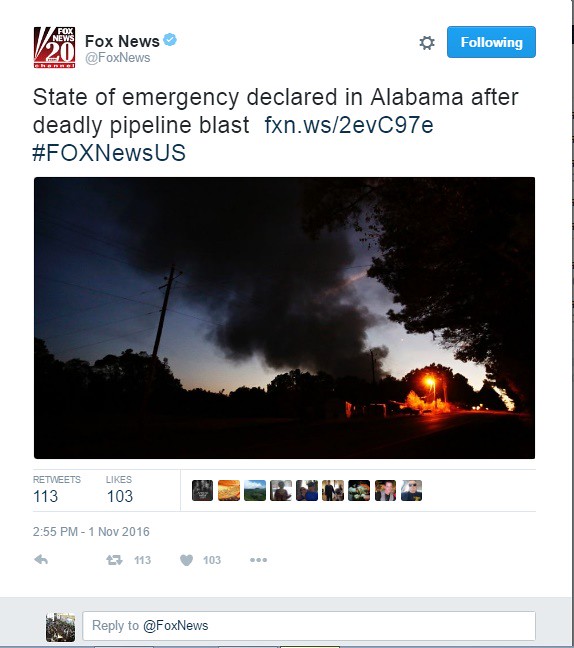
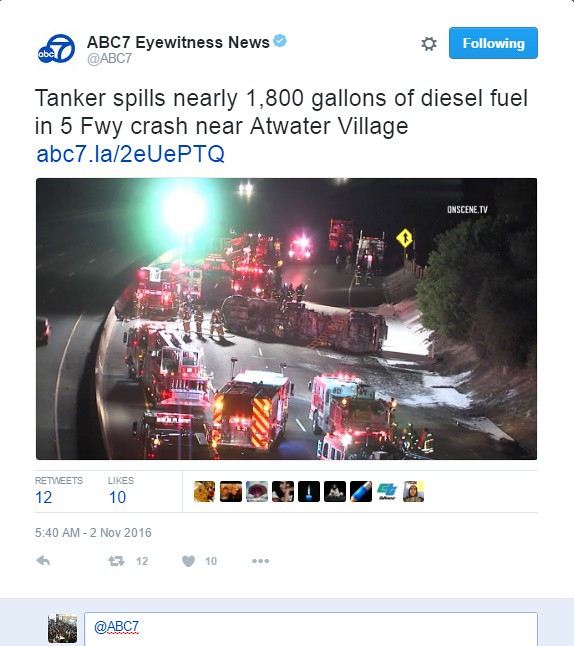
Now, compare the relative volumes being transported by each method.  Here are two images of 'Tweets' that appeared within 24 hours of me publishing the previous post shown below regarding disasters brought on by transporting oil/gas:


Tweet 1:


Tweet 2:


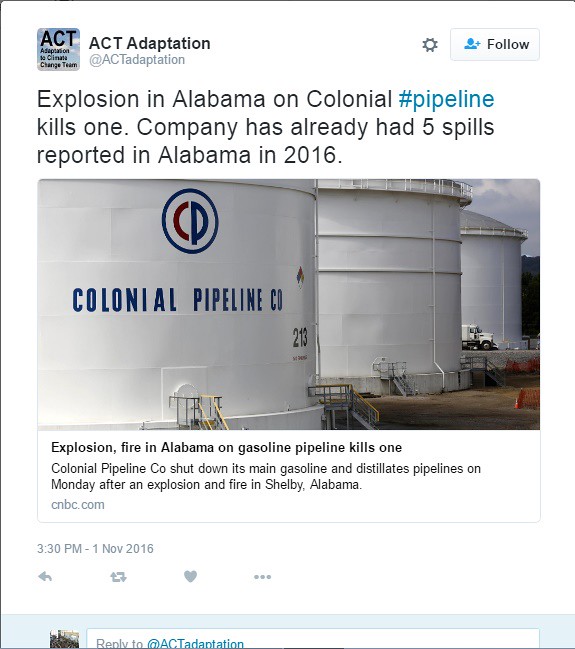
In the first tweet, a pipeline exploded and caused great damage to the surrounding area.  Whereas in the second tweet, a local fuel truck tanker overturned and caused a spill of 1,800 gallons.  Further, a couple of years ago, the company whose pipeline broke due to an explosion has had multiple (5 violations) so far in 2016 as shown by the tweet below:


The energy company 'Colonial' just had a pipeline burst a couple of months ago which spewed around 6,000 - 8,000 barrels of fuel spilled into the forest.  I wrote a blog post about the spill.  According to the company, the spill was small (supposedly) in comparison to others in recent history.  You don't say?


In comparison to the volumes listed in the excerpts above from 'The Times' article which I used in a previous post, Colonial would like you to think the spills are small.  As I calculated in the blog post, the range of 6,000 - 8,000 barrels corresponds to 250,000-330,000 gallons of fuel does not compare well (Really?) with the respective volumes 865,000 and 843,000 gallons of oil.


With all of the oil being dumped and not necessarily reported, one cannot help but wonder where are all of the regulators at?


Are they being paid off by the energy companies to remain silent of overlook disasters?


Have we as a nation reach a point with 2.4 million miles of oi pipelines throughout the U.S. at which regulation becomes impossible?


Do we have enough regulators to handle the job needed to maintain safe oil pipelines?


These questions remain unanswered.  In the United States this coming Tuesday, a national election is going to take place.  If the answer lies anywhere, the answer that involves change will be held with a future President of the United States.  In the next section, each candidates views on regulation, climate change, and business relations will be presented.


Regulation Is Needed!


As I just mentioned, a national election is going to take place this Tuesday.  If an answer to the above questions is possible, the next President should be able to shed light on the matter based on the platform on which they are running for office.  I wrote a blog a couple of days ago which just listed 20 questions that Presidential candidates should answer.  These questions are important in providing any guidance as to the next four years of funding and support for reform and regulation will look like.  See the previous post for all of the 20 questions - only those pertaining to the subject of the post will be displayed below.


The questions and answers below were directly taken (cut and pasted) from the nonprofit's "Science Debate" website under "20 Questions" for candidates about science issues.  Over 56 organizations signed on to make these questions which represent 12 million scientist around the country.


Without further ado, here are the questions and answers:


Climate Change:


Question 3:


The Earth’s climate is changing and political discussion has become divided over both the science and the best response. What are your views on climate change, and how would your administration act on those views?


Answers:


Hillary Clinton:


When it comes to climate change, the science is crystal clear. Climate change is an urgent threat and a defining challenge of our time and its impacts are already being felt at home and around the world. That’s why as President, I will work both domestically and internationally to ensure that we build on recent progress and continue to slash greenhouse gas pollution over the coming years as the science clearly tells us we must. 
I will set three goals that we will achieve within ten years of taking office and which will make America the clean energy superpower of the 21st century: 
1) Generate half of our electricity from clean sources, with half a billion solar panels installed by the end of my first term. 
2) Cut energy waste in American homes, schools, hospitals and offices by a third and make American manufacturing the cleanest and most efficient in the world. 
3) Reduce American oil consumption by a third through cleaner fuels and more efficient cars, boilers, ships, and trucks. 
To get there, my administration will implement and build on the range of pollution and efficiency standards and clean energy tax incentives that have made the United States a global leader in the battle against climate change. These standards are also essential for protecting the health of our children, saving American households and businesses billions of dollars in energy costs, and creating thousands of good paying jobs. 

These standards set the floor, not the ceiling. As President, I will launch a $60 billion Clean Energy Challenge to partner with those states, cities, and rural communities across the country that are ready to take the lead on clean energy and energy efficiency, giving them the flexibility, tools and resources they need to succeed. 


Donald Trump:


There is still much that needs to be investigated in the field of “climate change.”  Perhaps the best use of our limited financial resources should be in dealing with making sure that every person in the world has clean water.  Perhaps we should focus on eliminating lingering diseases around the world like malaria.  Perhaps we should focus on efforts to increase food production to keep pace with an ever-growing world population.  Perhaps we should be focused on developing energy sources and power production that alleviates the need for dependence on fossil fuels.  We must decide on how best to proceed so that we can make lives better, safer and more prosperous.


Energy:


Question 7:


Strategic management of the US energy portfolio can have powerful economic, environmental, and foreign policy impacts. How do you see the energy landscape evolving over the next 4 to 8 years, and, as President, what will your energy strategy be?


Answers:


Hillary Clinton:


The next decade is not only critical to meeting the climate challenge, but offers a tremendous opportunity to ensure America becomes a 21st century clean energy superpower. I reject the notion that we as a country are forced to choose between our economy, our environment, and our security. The truth is that with a smart energy policy we can advance all three simultaneously. I will set the following bold, national goals – and get to work on Day 1, implementing my plan to achieve them within ten years of taking office: 
1) Generate half of our electricity from clean sources, with half a billion solar panels installed by the end of my first term. 
2) Cut energy waste in American homes, schools, hospitals and offices by a third and make American manufacturing the cleanest and most efficient in the world. 
3) Reduce American oil consumption by a third through cleaner fuels and more efficient cars, boilers, ships, and trucks. 
My plan will deliver on the pledge President Obama made at the Paris climate conference—without relying on climate deniers in Congress to pass new legislation. This includes: 
1) Defending, implementing, and extending smart pollution and efficiency standards, including the Clean Power Plan and standards for cars, trucks, and appliances that are already helping clean our air, save families money, and fight climate change. 
2) Launching a $60 billion Clean Energy Challenge to partner with states, cities, and rural communities to cut carbon pollution and expand clean energy, including for low-income families.  
3) Investing in clean energy infrastructure, innovation, manufacturing and workforce development to make the U.S. economy more competitive and create good-paying jobs and careers. 
4) Ensuring the fossil fuel production taking place today is safe and responsible and that areas too sensitive for energy production are taken off the table. 
5) Reforming leasing and expand clean energy production on public lands and waters tenfold within a decade. 
6) Cutting the billions of wasteful tax subsidies oil and gas companies have enjoyed for too long and invest in clean energy. 
7) Cutting methane emissions across the economy and put in place strong standards for reducing leaks from both new and existing sources. 
8) Revitalizing coal communities by supporting locally driven priorities and make them an engine of U.S. economic growth in the 21st century, as they have been for generations. 


Donald Trump:


It should be the goal of the American people and their government to achieve energy independence as soon as possible.  Energy independence means exploring and developing every possible energy source including wind, solar, nuclear and bio-fuels.  A thriving market system will allow consumers to determine the best sources of energy for future consumption.  Further, with the United States, Canada and Mexico as the key energy producers in the world, we will live in a safer, more productive and more prosperous world.


Water:


Question 10:


The long-term security of fresh water supplies is threatened by a dizzying array of aging infrastructure, aquifer depletion, pollution, and climate variability. Some American communities have lost access to water, affecting their viability and destroying home values.  If you are elected, what steps will you take to ensure access to clean water for all Americans?


Answers:


Hillary Clinton:


Chronic underinvestment in our nation’s drinking and wastewater systems has sickened and endangered Americans from Flint, Michigan, to Ohio and West Virginia. Outdated and inadequate wastewater systems discharge more than 900 billion gallons of untreated sewage a year, posing health risks to humans and wildlife life, disrupting ecosystems, and disproportionately impacting communities of color. In addition, many struggling communities around the United States have limited or no access to clean, safe water.

We will invest in infrastructure and work with states, municipalities, and the private sector to bring our water systems into the 21st century and provide all Americans access to clean, safe drinking water.

Climate change is also triggering changes in weather patterns, including the increased prevalence of long, hard droughts that pose a dire risk to the health and prosperity of American communities, particularly in the West. The federal government must become a better partner in supporting state and locally-led efforts to improve water security. To that end, we will create a coordinated, multi-agency Western Water Partnership to help fund water efficiency, consideration, and infrastructure modernization projects across the region, including significant new investments in water reuse and reclamation. 

We will also work to bring cutting edge efficiency, treatment and reuse solutions to our nation’s water challenges by establishing a new Water Innovation Lab. The Lab will bring urban water managers, farmers and tribes together with engineers, entrepreneurs, conservationists and other stakeholders to develop practical and usable technologies and strategies that can be deployed by local water utilities, agricultural and industrial water users, and environmental restoration projects across the country.


Donald Trump:


This may be the most important issue we face as a nation for the next generation.  Therefore, we must make the investment in our fresh water infrastructure to ensure access to affordable fresh water solutions for everyone.  We must explore all options to include making desalinization more affordable and working to build the distribution infrastructure to bring this scarce resource to where it is needed for our citizens and those who produce the food of the world.  This must be a top priority for my administration.


Nuclear Power:


Question 11:


Nuclear power can meet electricity demand without producing greenhouse gases, but it raises national security and environmental concerns. What is your plan for the use, expansion, or phasing out of nuclear power, and what steps will you take to monitor, manage and secure nuclear materials over their life cycle?


Answers:


Hillary Clinton:


Meeting the climate challenge is too important to limit the tools available in this fight. Nuclear power – which accounts for more than 60 percent of our zero carbon power generation today – is one of those tools. I will work to ensure that the climate benefits of our existing nuclear power plants that are safe to operate are appropriately valued and increase investment in the research, development and deployment of advanced nuclear power. At the same time, we must continue to invest in the security of our nuclear materials at home, and improve coordination between federal, state, and local authorities. We must also seek to reduce the amount of nuclear material worldwide – working with other countries so minimize the use of weapons-grade material for civil nuclear programs.


Donald Trump:


Nuclear power is a valuable source of energy and should be part of an all-the-above program for providing power for America long into the future.  We can make nuclear power safer, and its outputs are extraordinary given the investment we should make.  Nuclear power must be an integral part of energy independence for America.


Global Challenges:


Question 13:


We now live in a global economy with a large and growing human population. These factors create economic, public health, and environmental challenges that do not respect national borders. How would your administration balance national interests with global cooperation when tackling threats made clear by science, such as pandemic diseases and climate change, that cross national borders?


Answers:


Hillary Clinton:


Many of the greatest - and hardest - challenges facing our country extend beyond our borders and can only be ultimately addressed through global solutions. Climate change is a case in point. And that is why as Secretary of State I elevated the role of climate policy in our diplomacy, appointing our country’s first Special Envoy for Climate Change, making climate policy a key part of our broader relationship with China and other key countries, and helping to create and launch the global Climate and Clean Air Coalition to reduce potent non-carbon climate pollution.

As the world’s biggest and most powerful economy—and as the second-biggest emitter of greenhouse gases and the biggest historical emitter—the United States has a responsibility to lead the global response to the climate challenge. By making strong progress to reduce greenhouse gas emissions at home, President Obama was able to persuade and pressure other major emitters, including China and India, to step up. This dual process, where domestic policy changes helped spur international action, led tot the historic 195-nation Paris climate agreement, the first in our history where every country agreed to be part of the solution to climate change. 

The Paris agreement is critical, but it is not sufficient on its own. To keep global warming below the two degrees Celsius threshold and avoid the worst consequences of climate change, we need to cut emissions by at least 80 percent below 2005 levels by mid-century. To get there, we will need to continually work to improve upon the goals set in Paris, both in the United States and around the world. That’s why we must work to support more clean energy investment in emerging economies, help developing nations build resilience to the climate impacts that can’t be avoided, and continue to drive clean energy innovation here at home. And we will continue to work on a bilateral and multilateral basis with our partners, with key countries like China, and with the UNFCCC to protect our nation, our planet, and our children’s future. 

When dealing with the outbreak of diseases, we must be sure to act with caution, and rely on science to inform our decisions around trade, travel, and treatment. We are privileged to live in a country that individuals around the world aspire to visit and even immigrate to. It is within our national interest to think beyond our borders, and through our leadership, do everything we can to foster peace, health, and security around the world. In the United States, we need to break the cycle in which our own public health system is beholden to emergency appropriations for specific epidemics. We can do this by creating a dedicated Rapid Response Fund to help shore up our defenses, accelerate development of vaccines and new treatments, and respond more effectively to crises. We will also create a comprehensive global health strategy that moves beyond the disease-by-disease emergency model and seeks to build a robust, resilient global health system capable of quickly responding to and ending pandemics. 


Donald Trump:


Our best input to helping with global issues is to make sure that the United States is on the proper trajectory economically.  For the past decade we have seen Gross Domestic Product growth that has not provided adequate resources to fix our infrastructure, recapitalize our military, invest in our education system or secure energy independence.   We cannot take our place as world leader if we are not healthy enough to take care of ourselves.  This means we must make sure that we achieve our goals in tax reform, trade reform, immigration reform and energy independence.  A prosperous America is a much better partner in tackling global problems that affect this nation achieving its national objectives. 


Regulation:


Question 14:


Science is essential to many of the laws and policies that keep Americans safe and secure. How would science inform your administration's decisions to add, modify, or remove federal regulations, and how would you encourage a thriving business sector while protecting Americans vulnerable to public health and environmental threats?


Answers:


Hillary Clinton:


It is essential that environmental, health, and energy regulations, among other areas, use the best available science to guide decision-making, and I am committed to making sure that continues. For instance, we will have science guide us as we make important investments around health care. We will continue to invest in research to further our understanding of disease, including ramping up our investment in Alzheimer’s and related dementias to $2 billion per year, continuing Vice President Biden’s Cancer Moonshot, and scaling up our broader investment in the National Institutes of Health’s budget to combat all of the diseases of our day. 

My opponent in this race has consistently discounted scientific findings, from his comments about vaccines to his claim that climate change is a hoax. These dangerous positions not only put Americans at risk, but can have long term impacts on our country’s growth and productivity. Science will ensure our country continues to progress, and will help our government use its resources to provide the best possible life for all Americans.  


Donald Trump:


This is about balance.  We must balance a thriving economy with conserving our resources and protecting our citizens from threats.  Science will inform our decisions on what regulations to keep, rescind or add. A vibrant, robust free market system will regulate the private sector.


The above responses give us a starting point on which to form our opinion when we head to the voting polls next Tuesday.  At this point, you might ask the following question:


Mike, there are more than two Presidential Candidates?


What about Gary Johnson or Dr. Jill Stein?


For brevity, I chose to only include the two major candidates responses.  In order to view the remaining two candidates answers to the above questions, please visit my previous blog post with the questions and answers.


Conclusion


Regardless of who wins next Tuesday at the national election for the next seat as President of the United States, the issues at hand will still remain the same.  Although, armed with the answers to the questions above along with the remaining questions, each of us can get a sense of where the support lies in protecting us and the environment.  Our transition toward renewable energy is not just a "must happen" but a "when will it happen" statement.  With a more educated voting population, the process can move forward more easily.  Each of us should consider the above questions and answers seriously and plan for the future.


Until next time, Have a wonderful day!