Photo: Super Kids Nutrition
Food date labels are more confusing — and less definitive — than most consumers realize.
Every week, Americans throw away food because a date printed on the package has passed. Sometimes that is the right decision. Often, however, the date is not an expiration date at all.
Labels such as “sell by,” “use by,” and “best by” can refer to different things: store inventory, product quality, nutritional value, or — in a few cases — food safety.
Understanding the difference can help consumers avoid both foodborne illness and unnecessary food waste.
Which government agency regulates food dates?
No single federal agency regulates every food product.
The Food and Drug Administration regulates most foods sold in the United States, including packaged foods, beverages, seafood, produce, and dairy products.
The U.S. Department of Agriculture’s Food Safety and Inspection Service regulates meat, poultry, and processed egg products.
State and local health departments also regulate grocery stores, restaurants, and retail food operations, usually through state laws and versions of the FDA Food Code.
One important exception is infant formula. The FDA requires infant formula containers to display a “use by” date, and you should not use the formula after that date.
What does “sell by” mean?
A “sell by” date is primarily intended for retailers.
It tells a store how long to display a product for sale or how to manage its inventory. It is generally not a food-safety deadline for consumers.
For example, meat or dairy may still be usable after its “sell by” date if it was purchased promptly, kept refrigerated, and handled properly. USDA guidance emphasizes that “sell by” dates are not safety dates.
That does not mean the product will remain good indefinitely. It means the date alone does not tell you whether the food is safe to eat.
What does “best by” mean?
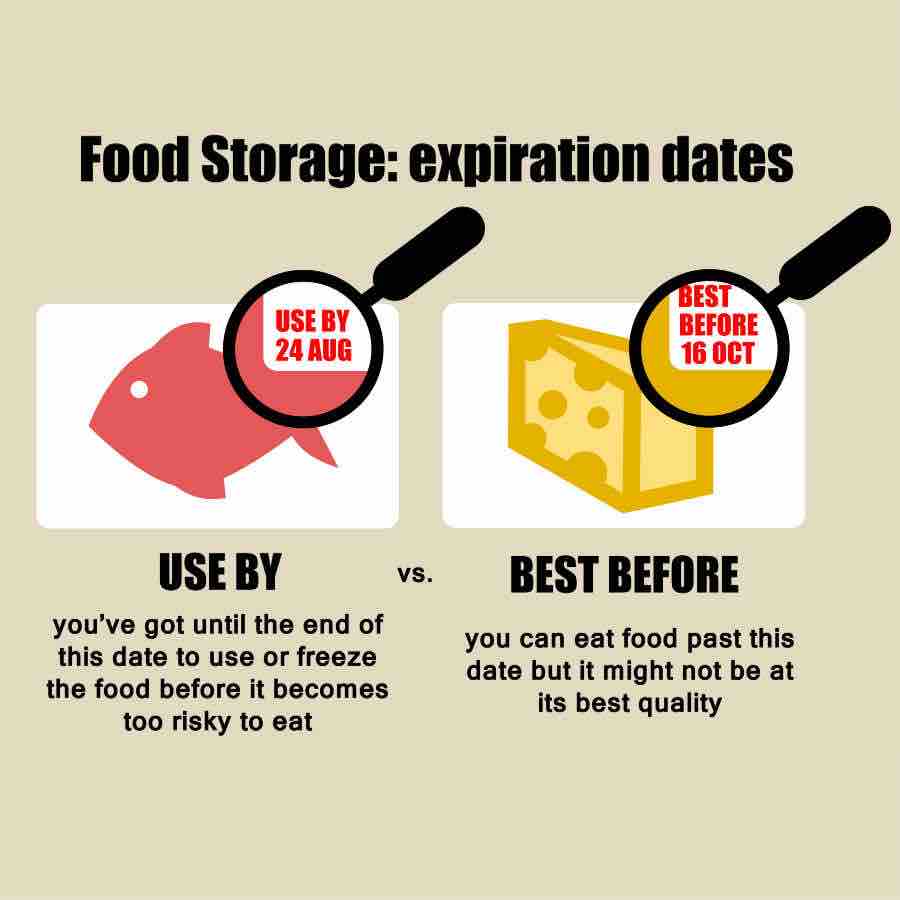
“Best by,” or “best if used by,” is generally a quality date.
It indicates when the manufacturer expects the product to have its best flavor, texture, color, or performance. After that date, the product may taste stale or perform differently, but it may still be safe if stored properly.
A box of cereal may lose crispness. A jar of sauce may lose some flavor. Frozen food may develop freezer burn. Those are quality concerns, not necessarily safety problems.
The FDA and USDA encourage manufacturers to use “Best if Used By” because it more clearly communicates that the date concerns quality rather than safety.
What does “use by” mean?
“Use by” is the most confusing label because its meaning depends on the product and the manufacturer.
For most packaged foods, a “use by” date is still a voluntary quality date. Federal law generally does not require manufacturers to place quality-based date labels on packaged foods, with important exceptions such as infant formula.
However, consumers should take “use by” dates more seriously on highly perishable refrigerated foods. And for infant formula, the date is mandatory: the FDA says not to use formula after the printed “use by” date because the manufacturer guarantees its nutrient content and quality only through that date.
Are foods always safe before the date?
No.
A printed date is not a guarantee that food is safe until midnight on that day. Food can become unsafe before the date if it was improperly transported, refrigerated, handled, or prepared.
For example, refrigerated food can become hazardous if it sits in a warm car or on a kitchen counter for too long. Perishable food should generally be refrigerated at 40°F or below and should not remain at room temperature for more than two hours — or more than one hour when the temperature is above 90°F.
Foodborne pathogens also don’t always change a food’s smell, appearance, or taste. That means “it smells fine” is not a perfect safety test.
When in doubt, consumers should follow storage instructions, observe signs of spoilage, and avoid tasting questionable food.
Is food safe after the date?
Often, yes — if it has been properly stored and handled.
USDA explains that, except for infant formula, food may remain safe and wholesome after the date on the package. The date generally indicates expected quality rather than a strict safety deadline.
Some foods are more forgiving than others. Shelf-stable canned goods, dry pasta, rice, and many frozen foods may remain usable after a quality date. Fresh meat, poultry, seafood, deli foods, and prepared refrigerated meals require much more caution.
Freezing also changes the calculation. Food kept continuously at 0°F remains safe indefinitely, although its quality may decline over time.
Can manufacturers manipulate dates to keep food on store shelves?
There is some truth behind this concern, but the situation is more complicated than simply saying that companies invent dates to sell old food.
Manufacturers generally set their own food dates. The federal government does not pre-approve every date printed on every package. Companies may base their dates on product testing, expected quality, distribution conditions, packaging, and consumer expectations.
At the same time, manufacturers must ensure their labels are truthful and not misleading. FDA and USDA can inspect facilities, investigate complaints, enforce labeling laws, and coordinate recalls when food is adulterated, misbranded, or unsafe.
So the dates are not meaningless — but they are not all government-certified expiration deadlines either.
How should consumers use food dates?
A practical approach is to treat the date as one piece of information, not the entire safety decision.
- Treat “sell by” as a retailer’s inventory date.
- Treat “best by” as a quality recommendation.
- Treat “use by” cautiously, especially for highly perishable foods.
- Never use infant formula after its “use by” date.
- Follow refrigeration and storage instructions.
- Discard food with mold, leaking or swollen packaging, unusual odor, or evidence of temperature abuse.
- Do not taste food to determine whether it is safe.
- Check FDA and USDA recall notices when you have concerns.
The most important point is this: a date printed on food is not a substitute for safe handling.
Food can be unsafe before the date and perfectly usable afterward. The right decision depends on the type of food, its storage history, the condition of the packaging, and whether it shows signs of spoilage.
Understanding these distinctions can protect consumers from foodborne illness while also preventing perfectly good food from ending up in the trash.

No comments:
Post a Comment