Wednesday, April 3, 2019

My Husband Has Parkinson's Disease; I Can Smell It On Him!


Photo: Image by LawrenceLeeArt from Pixabay


A wife and her husband enter the doctor's examining room and sit quietly waiting for the doctor to arrive. Upon arrival, the physician asks nicely: "What can I help you with today?" To that the wife responds "Doctor, my husband has Parkinson's Disease; I can smell it on him" and stops talking abruptly after that. How is that for a self-diagnosis or diagnosis by Spouse?


The story did not precisely follow that flow, but researchers were able to confirm a wife's suspicion of being able to smell the presence of Parkinson's disease on her husband. Having that ability landed her in the study labeled as "super smeller." Researchers describe her ability in the study, published in ACS Central Science, as "Joy has an extremely sensitive sense of smell, and this enables her to detect and discriminate odors not normally detected by those of average olfactory ability." When the sebaceous glands in the upper back and forehead overproduce sebum (a waxy, lipid-rich) biofluid, a process known as seborrhea, the overproduction is associated with the non-motor symptom of Parkinson's Disorder.


Who would have known had Joy not been born and honed in on a very particular smell on emanating on her husband? Joy started realizing that the 'musky' odor was not unique to just her husband while attending Parkinson's Disease patient support groups. That is when she made the connection between the smell and Parkinson's Disease.


The study was conducted with 64 participants: 42 Parkinson's Disease Patients and 21 Control Patients. The patients were chosen from across 23 different geographical areas across the UK. The analysis went as follows: Patients were swabbed across their backs and foreheads to collect the sebum. The sample (sebum in gauze) was introduced into a Gas Chromatography-Mass Spectrometer (GC-MS). The GC-MS in our chemistry department is shown below:


Photo: Kayla Kaiser - FLCKR


The Gas Chromatography-Mass Spectrometer has two main components to the instrument. First is an oven in which a long column around 100 meters in length as shown below:


Photo: Kayla Kaiser - Flickr


In the images above, the column which is around 100 meters in length sits inside of an oven.  A sample (of a chemical mixture or single chemical) is injected into the column shown in the image above.  As the substances travel down the column, the mixture starts to separate into individual compounds based on their weights.  The heavier chemicals tend to fall behind, whereas the lighter chemicals start to progress ahead.  Time spent inside of the column allows separation of a chemical mixture based on properties such as mass.


As the mixture heads toward the end of the column, the next (second component) to the GC-MS is encountered, which is the Mass Analyzer.  The Mass Analyzer portion is to the left of the oven in the first image and is shown below:


The second component of the GC-MS instrument is the Mass Analyzer as shown above.   The GC-MS instrument has a Mass Analyzer which detects different masses of chemicals by breaking them down into ion fragments. The instrument software can then determine the molecular weight of a given chemical structure by analyzing the pieces which flow off of the separating column.  A typical chromatogram of a mixture of chemicals is shown below:


An example chromatogram generated by a CSUN student for the blog post.  Photo: Kayla Kaiser - Flickr


The study revealed the molecules present in Parkinson's Disease patients from the use of a similar GC-MS instrument.  From this instrument, the researchers were able to detect, identify, and quantify the following chemicals associated with Parkinson's Disease: eicosane, hippuric acid, and octodecanal were present in significant concentrations.


Whereas, other chemicals, such as perillic aldehyde were present in smaller amounts in patients with Parkinson's Disease. Joy was able to detect the differences in concentrations which led her to believe that these differences in odor were associated with the onset of Parkinson's Disease.


The study highlights the use of biomarkers (chemicals) as a non-invasive detection method of diseases such as Parkinson's Disease.  Joy has challenged scientific researchers to expand their arsenal of detection methods with her unique ability to act as a "Super Smeller."  Future plans include the use of canines as additional detectors of disease.  The present research has opened up new mechanisms by which Parkinson's Disease afflicts the human body. 


Related Blog Posts:


Dimensional Analysis Of Statistics And Large Numbers - Index Of Blog Posts


Science Topics, Thoughts, and Parameters Regarding Science, Politics, And The Environment!


Monday, April 1, 2019

IVF from a husband’s point of view (Part 1): Should we do it?


                        Image by Elena Έλενα Kontogianni Κοντογιάννη from Pixabay


The flow of the conversation usually would start with: “Mike, you know the beginning for a man is easy…just give a semen sample.  Your part is easy compared to the beginning for a female.”  To which I would pose zero opposition toward doing.  The entire conversation was not long,  with an ending along the lines of “I have no problem with starting, I am just waiting for Kayla to want to start IVF.  When she is ready, I am too.”


That was partly true, except for two intervening hopes on Kayla and my part: (1) After Kayla was ready (mentally and physically) along with (2) the place where we were financially stable – we both hoped that we would naturally get pregnant.  The reality was, any day now, we just needed to bite the bullet and start the In Vitro Fertilization (IVF) process.   Let’s back up a bit and give a little context up to this point for clarity.


Wait Until You Start Your Career


Kayla (my partner) and I met in graduate school at the University of California at Riverside.  Both of us were in the doctorate program in chemistry.  I was 34 years old at the time while Kayla was 27 years old.  I had been in the doctorate program for 4 years already when Kayla joined the department to become an analytical chemist.


Life was easy at the time for two graduate students without children living a life of studying and working in a laboratory while hitting the clubs at night.  Not a healthy life, but a busy life and living at full throttle.  The thought of undergoing an IVF treatment was the furthest outside of my mental orbit.


Any person who has enrolled in a graduate program to obtain a degree understands that a substantial amount of time is required on a student's part to earn a degree (i.e., a Ph.D.).  That being said, there are many ways to live a life worth living as a graduate student.  Just like there are many ways to live a good life.   Getting a higher education degree is one way to do so.  Although, obtaining a degree is not required to live a good life.


While Kayla and I were in graduate school, the advice from both her advisors along with mine landed squarely on the following line: Wait Until You Start Your Career To Have Children.  Many students take that advice to heart.  Including women such as Kayla who are under the added pressure women feel as opposed to men.  I will say very bluntly -- academic (research) advisors do not necessarily have your best interest in mind.  Yes.  I did just say be careful how you process the advice that your advisor disseminates to you regarding the path leading to your career.


Spoiler Alert: Now would be a great time to have a discussion with your partner about starting the IVF treatment process.  At least considering pursuing the process of harvesting eggs and retrieving them to freeze for later.  In part 2, the reason will be revealed.  The drawback is the cost, although, loans are possible to get -- specialty loans for the IVF treatment exclusively.  Back to the story.


Our take away at the time was that research advisors are treated on the same level as "God" -- which would result in using contraception instead of having children while in graduate school.  That is not to say having children will be easy or allow a person to graduate on time.  Again, there are a variety of ways to get through graduate school successfully.


I will say at the time, Kayla and I were living a life which was intertwined with alcohol addiction which is not necessarily the perfect atmosphere to have children. Basically, during the years of graduate school, the thought of having children was a big NO.  For us, the decision to have children was not on the table during graduate school.


Photo by Charles DeLoye on Unsplash


Career Starts Now!


I was ahead in my graduate time-line than Kayla which would make my graduation happen two years sooner.   As a result, I found a temporary position as a Post Doctoral Fellow conducting research down at the University of California at San Diego.  Living in La Jolla is excellent.  Although, under the stress of having dual households along with a Post Doctoral research position is not.  I was stressed out along with Kayla.  Money was tight.  We were still trying to party like rockstars -- which was now at full throttle.  Life was fast - career was beginning.  No time for babies yet.


At the same time, my colleagues (fellow PostDocs as they are called) were having children.  But with a dual household (one in La Jolla and one in Riverside), there was zero chance at having a child.  Another excuse right?  Yep.   This lasted a year and a half until Kayla was near graduating and found a job for me at the California State University at Northridge.  I currently work here along with Kayla.


I managed (with the help of my wonderful wife) to start a career as a full-time position as an instrument manager at a university in the North Los Angeles area (California State University at Northridge).  Whereas Kayla initially bounced around trying to build up a teaching career by teaching part-time at various colleges.  Again, she was holding out on having children until she found a 'full time' position.  When were we going to have children?


Just around 6 years ago, Kayla and I decided to give up alcohol and other vices.  Which was great if we were planning on having children right?  The process has been more straightforward with the assistance of Alcoholics Anonymous (AA).  Which is not for everyone.  AA has helped us tremendously in keeping sobriety and preparing our lives for having children.  Sounds crazy right?  In actuality, the process has been an educational journey which has opened our eyes toward progress which extends beyond child rearing.  Success in life in general -- maintaining peace from within.


Right about now, you may be thinking ... "Who are these crazy AA people?"  That is the furthest from the case. The program (and its success) of Alcoholics Anonymous speaks for itself.  That is all that will be said on the matter moving forward.  This change was part of a more significant difference -- one toward having children.


Throughout the process of getting sober, Kayla and I made changes to make our lives much more straightforward.  One realization of Kayla's part was that driving around Southern California to many community colleges teaching part-time was not the desirable lifestyle she had wished for herself.  She came to the realization that both of us working at the same institution (university) would be much simpler.  And it was indeed.


Therefore, she started teaching part-time at CSUN in the same department as me.  This allowed us to move closer to our work (across the street) and have a more sustainable lifestyle.   At the same time, she seemed to be settling down into a career mindset.  Over the last few years, she has definitely arrived at a more relaxed state of mind and become much more secure with herself.  All indications that the next move would be to try to start a family.


We definitely thought that having unprotected sex for a couple of years would do the trick.  Nothing happened.  Recently, Kayla downloaded the app called "Clue" to help her realize when the most 'Fertile' day would be -- still nothing.  We went to the doctor to get a referral to see a fertility physician.  Throughout the process, we were told to lose weight and try naturally.


There is a point at which this advice does not work anymore.  To all of the men out there pay attention to the history of your relationship and take note.  Eventually, you may be the person deciding to start the IVF treatment.  Having to step up and spearhead the operation is not fun, but finally needed to be done.


Late last year, we never went to see the fertility specialist.  On top of that, Kayla suddenly said to me out of the blue ... "Mike, we need to get pregnant now to align the delivery with summer?"  This turned into a massive conversation which ended with a decision -- to have IVF - In Vitro Fertilization.  What was the timeline going to look like?  How long would the process take to see the right physician?  What was the next step?  Oh My Goodness.  What do I do?  How did I (as the husband) miss the prominent notice -- time to have children - NOW.


Go To A Baby Shower For Advice?


As a husband, the goal is to respect and help my wife have as great of a life as possible.  Of course, we both need to be happy.  Both are possible.  I am 46 years old and thinking about when a potential baby would be born and turning 20 years old.  That would make me 66 years old.
Meanwhile, my friends have grandchildren.  Oh My Goodness.  I made choices - none of which I regret.  Now, where do we go from here?  How to get started?


Luckily, an old friend from graduate school reached out on Facebook and informed Kayla about an upcoming baby shower.  This particular friend had married my former roommate.  Perfect.  Let's catch up on old times.  She recently went through IVF (over the past year and a half).  Wow.  This interaction at the party was a godsend.  My old roommate informed me of the difficulty and challenges which were stated as minimal.  Both mentioned the most challenging aspect were the many doctor visits.  Yes, there are many.  As I will tell about in part 2 of the series.


The result of attending the baby shower was a definite decision to go to the same reproductive center as they had used.  Why wouldn't we try the same place?  This party happened last July.  We just started the process in January.  I had to put my foot down and say: "The time has come to try IVF"  That is if we were going to try at all.  To all of the husbands out there, do not be afraid of starting to initiating the conversation.  Many men would like to stay as far away as possible from the discussion.


Unfortunately, the longer that you wait to begin, the more risk that you have toward not having (harvesting) enough eggs to make embryos which turn into children.  I will talk about that in part 2.  I hope that men will read this and be strong enough to have a conversation about children, further, about the process of IVF.  There is a financial aspect, but the central part is the decision to commit to the process.  The two of you are experimenting with your partner’s body to produce a beautiful child.


Therefore, if the conversation has not begun, have it.  The reality is that (as you will see), there are more people in a similar dilemma like yourself.  And that you may regret not dealing with this sooner.  Above all else, men are not alone.  Other men are going through the same experience and having similar or worse thoughts.  Women, I cannot speak for you.  Nor do I wish to.  I will say this about the process; thus far...this has been the right decision to just jump into it and not wait.  Part two will cover the first part of IVF from a husband's perspective -- up to the embryo testing.


Related Blog Posts:


Science Topics, Thoughts, and Parameters Regarding Science, Politics, And The Environment!

Saturday, March 30, 2019

President Trump Tries To Open Up Arctic For Oil Drilling, Judge Says No


Breaking news -- not really.  Read all about it...President Trump tries to open up the Arctic Ocean for oil drilling and is met in court with a response of 'No':


 In a major legal blow to President Trump’s push to expand offshore oil and gas development, a federal judge ruled that an executive order by Mr. Trump that lifted an Obama-era ban on oil and gas drilling in the Arctic Ocean was unlawful.
The decision, by Judge Sharon L. Gleason of the United States District Court for the District of Alaska, concluded late Friday that President Barack Obama’s 2015 and 2016 withdrawal of about 1120 million acres of Arctic Ocean from drilling “will remain in full force and effect unless and until revoked by Congress.” She wrote that an April 2017 executive order by Mr. Trump revoking the drilling ban “is unlawful, as it exceeded the president’s authority.”
The decision, which is expected to be appealed in the Ninth Circuit Court of Appeals, immediately reinstates the drilling ban on most of the Arctic Ocean off the coast of Alaska, a pristine region home to endangered species including polar bears and bowhead whales where oil companies have long sought to drill. It also has broader implications for Mr. Trump’s effort to push drilling across the American coastline and on public lands.
Specifically, the Arctic Ocean drilling case could give legal ammunition to opponents of Mr. Trump’s efforts to roll back protections for two million acres of national monuments created by Mr. Obama and President Bill Clinton.


With each passing day, the news is filled with updates on the success of the transition toward a renewable energy future.  Some may detail certain obstacles while others break the news regarding either a private entity or government moving (or making a commitment) toward achieving a non-zero percentage of their energy economy on clean (renewable) energy.  This reality is not new.


Neither is President Trump's inability to realize that 'rolling back' environmental laws put in place by the Obama Administration takes skill (and reason/logic) to reverse.  Congress will have to act at the very least.  Within that act will have to be a good reason to repeal the law put into place.  I have previously stated on this blog site the fact that if a rule is to be changed, the replacement has to be better than the previous law.


Which is to say that the law needs to be even more environmentally friendly than the previous proposal to be passed.  Otherwise, the existing law stays in place and is continuously challenged in courts -- as has been the case for the Trump Administration over the last two years.   I try hard to explain that rule to everyone with whom I meet and discuss the 'rollbacks' that supposedly have been accomplished by the Trump Administration.


The reality is stated in the article above that the Trump Administration has failed miserably on at least 40 accounts to persuade courts to reverse or 'rollback' a given environmental rule put in place by the Trump Administration.  These decisions have been in line with the current standards set in place by Congress.  Which should surprise no one including the President of the United States.  We will next have to see what Congress says about the issue at hand.


So far Congress has been willing to hold bipartisan hearings this year on the critical issue of climate change.  Furthermore, Congress recently wrote a letter to the Director of the Department of the Interior, asking him to not drill for oil off the coast of Florida.  That should be a significant indicator to President Trump that his attempts to 'rollback' any Obama Administration's environmental regulations (at least the majority of them) is not an accessible route to go down.


Of course, we are dealing with a non-traditional President of the United States currently.  The newspapers should keep up the great work at reporting on such failures.  Otherwise, a person might be led to think that a 'rollback' is possible without Congress.  The reality is that even Congress is batting for a renewable energy future.  Although the timeline might be debatable.  Nonetheless, a clean, renewable energy future is coming.  Stay tuned.


Related Blog Posts:


Congress Intervenes And Asks For No More Oil Drilling Off Of Florida


President Trump Is Out Of Touch With The Transition Toward Renewable Energy


EPA Director Finally Realizes Reality Of Trying To Roll-Back Obama Era Clean Air Act Regulation


Environmental Groups Question Environmental Protection Agency (EPA) Cuts


President Trump's Immigration Rhetoric Damages International Science Student Enrollment


What Promises Did President Trump Make Science Research During His Campaign?


Can The President Prevent The Public From Learning About Scientific Research???


President Trump's Understanding of the Paris Agreement


World Goes Left, While Trump Leads Right - On Climate - Why?


Is This Behavior Presidential - President Trump?


Paris Climate Agreement Is A Start Toward The Renewable Energy Future


READ THIS BEFORE VOTING -- Presidential Science (WORLD) Issues!


Brings Jobs Back By Promoting Renewable Energy!

Thursday, March 28, 2019

Tax Payer Funded Research Should Made Accessible To All United States Citizens For Free


Source: Sara Greene


Tax-payer money is used to fund a variety of entitlement programs along with other government initiatives.  How the money is spent is determined through both Houses of Congress.  Anyone with a reasonable internet connection can access a wide range of Congressional hearings on YouTube, by just searching for the respective Congressional committee's channel.  While this is known, Americans (in the majority) still do not understand the types of programs which are funded by tax-payer money.  Why not? The results of spending tax-payer money are hidden behind "pay-walls" of publishing companies -- that is until recently.


Over the past few years, European countries have been stepping up pressure through negotiations to move the results of scientific research (which is tax-payer funded) to an open-access form.  Publishers are adamantly against such endeavors because they stand to lose out on large amounts of money.  Further, the American public is not allowed to read about exciting scientific results along with the rest of the world.  No wonder that there is such a wide gap between the public and scientists knowledge of science -- to start with?


Make Scientific Results Open-Access


They are making the research that is funded by tax-payer money public would be a first step in closing the gap between knowledge held by scientists and the public.  Although to do so would take quite a move on the part of the major players in the field of science.  Who are such players?  Universities, government laboratories to name two.  Private industry would play a role too -- although, not as large as that of the entire university system across the world.


As I mentioned up top, a couple of European countries (Sweden) have been debating canceling subscriptions with high impact publishers who hold scientific research behind paywalls.  An entire consortium of universities and research institutions in Sweden recently announced that subscriptions would be canceled soon.  Earlier this month, the university system in the United States -- University of Californi -- announced to follow suit:


The University of California has ended its subscription to journals published by Elsevier, citing a failure to reach an agreement that would lower fees and prioritize open access to its scholars’ work, the UC system announced yesterday (February 28). The decision to stop paying for access to Elsevier’s journals came after eight months of contract negotiations. 
The university system’s previous contract with the publishing giant expired on December 31, and the research heavyweight, accounting for nearly 10 percent of research output in the US, aimed to secure a deal to pay a one-time fee that covered both journal subscriptions and the processing fees to make UC researchers’ articles open access for all readers. 
The break with Elsevier is part of UC’s push for free access to publicly funded research. “I fully support our faculty, staff and students in breaking down paywalls that hinder the sharing of groundbreaking research,” says UC President Janet Napolitano in a statement. “This issue does not just impact UC, but also countless scholars, researchers and scientists across the globe — and we stand with them in their push for full, unfettered access.”
Last year, groups of research labs and universities in Sweden and Germany canceled their subscriptions with Elsevier over open access. This stand by UC makes it one of the first and largest US institutions to do so. 


The move is ambitious and bold on behalf of the university system in the United States.  Hopefully, the remainder of the universities in the United States possesses the courage to follow suit.  Some steps are needed to raise public awareness of science. The first step would be to have access to tax-payer funded research results.  Followed by an increased dialogue between scientists and the public at community forums.  The ability to be able to read about science without having to pay twice is imperative for society.  American citizens who pay taxes own the results of scientific research.  The time has come to make them available to the public.


Related Blog Posts:


"Just Make A Generic (Cheaper Version) Of The Drug"? Not So Easy...


Have You Ever Heard A Song About Personalized Medicine? Here Is A Scientist Singing A Song.


The future: Making Medicines in your kitchen?


The Futuristic Visit To The Physician Is Here!


NIDA Director Nora Volkow: How Health Communicators and Journalists Can Help Replace Stigma with Science


NIAID Director Anthony Fauci: How Should We Communicate About Crises?


What is going on in the FDA for Fall 2018 - message from Director Scott Gottlieb


NIH Director Francis Collins Makes A Statement Regarding Sexual Harassment In Science


Tuesday, March 26, 2019

Can A Plant Pathogen Be Transported By Wind During A Rain Storm?


Source: WuzupNigeria


The spread of seeds, particles and pathogens over considerable distances is of great concern.  Especially given the current trend of converting crops from tradition crops to GMO (genetically modified crops).  Proprietary seeds are held tightly among farmers who pay to plant special seeds.  The ability to protect the spreading of seeds under storm conditions is nearly impossible.  That is during normal conditions -- i.e. normal weather: sunny, average temperature, humidity level for a given geographical area -- seeds are controlled by the human distribution of seeds.  What happens to this phenomena (spreading of spores, seeds, particles, dust, pathogens, etc.) during a rain storm?


Rain falls to the ground and forms puddles over time.  Water which gathers on the ground contains dirt, particles, pathogens, seeds, etc.  When a rain drops out of the sky and hits the ground during a wind storm, what happens to those pathogens (and other particles) in the water?  What about the surface of a leaf?  Do these pathogens (and particles) travel over distances during a rain/wind storm?  What is the mechanism by which pathogens (and particles) travel over large distances?


How do particles (and pathogens) get into the air?


Past research has shown that rust (build up on metal or other surfaces) can spread in a wind storm a considerable distance -- on the order of kilometers (1 mile = 1.60934 kilometers).  Research published last November in the Journal 'Proceedings of the National Academy of Sciences' revealed the mechanisms by which pathogens (and other particles) travel over large distances.  The study revealed the exact mechanisms broken down into parameters such as overcoming cohesive force between spores clustered together on a surface, the ejection mechanism (how to get off the ground into the air), and the traveling of the pathogen over large distances.   Next, add into the mix a rain storm with wind.


To break this down further.  Imagine a pathogen (or seed, particle, etc.) sitting on the ground.  The wind is rushing by above the surface on which the pathogen sits.  How does the pathogen acquire enough energy (kinetic energy) to be ejected into the air rushing by above?  That is where the researchers use high-speed cameras (as shown in the videos below) to tease out the exact mechanisms.  High-speed cameras show that a falling rain drop contains enough energy to eject a pathogen (and other particles) into the laminar air flow which can potentially travel over large distances.


Upon impact with the ground, the energy of the rain drop is distributed unevenly into a series of droplets which splash up and outward.  The kinetic energy of the outward water distributed creates enough of a vortex (as shown in the video below) to eject a pathogen from the ground up into the rushing air above the surface.  From there, the pathogen has sufficient energy to travel large distances given that the wind maintain a constant energy to push the pathogen along.


Also contained in the research paper are the simulations which were used along with the calculations (and equations) on which the phenomena was modeled.  The data was in agreement with the evidence obtained in the high-speed camera videos.  Here are two videos to show how the spores (plant pathogens) are elevated into the air once the drop hits the surface:


The second video shows the formation of a vortex by the rain drop which is one of a few critical parameters for pathogens ejecting off of a surface and joining a laminar flow to travel large distances:


The videos show above that there is sufficient energy in a rainwater drop to eject a pathogen (or other particles) up into the air.  Ejecting the pathogen is sufficient enough to catch a larger airflow of laminar air which could potentially carry the pathogen over large distances -- i.e. kilometers, miles, etc.   The research represents a good model by which pathogens can travel over large distances.  Previous research did not provide exact detail of vortex formation which would be sufficient to lift a pathogen into larger vortexes.


The research represents a quantification of dynamics of pathogen (disease) spreading among the plant community.  Rain drops are one pathway by which pathogens could acquire enough energy to be ejected into the air to travel large distances.  More studies will help optimize the conditions under which pathogens travel and possibly shed light into new avenues of mechanisms of ejection.  The ejection mechanisms uncovered in the research above add to the existing contribution from insects residing on leaf surfaces, leaf vibration, along with other kinetic energy contributions. Overall, the research represents yet another parameter revealed in disease propagation in the agricultural community.


Related Blog Posts:


How Do Scientists Track Bees Inside BeeHives? Use QR Codes?


Want To Improve Science Communication: Add Artists!


Should you consider science while before voting next Tuesday?


The Executive Director Of The American Meteorological Society Educates President Trump On Climate Change


White Blood Cells in action destroying Cancer Cells!


Why Chemistry Matters from the mouths of Nobel Laureates!


Bacteria communicating in communities -- quorum sensing


What Is Going On Inside That Cell?


How Dangerous Are Cigarettes?


What Is Dimensional Analysis?


Chemistry Videos Unveil Problems With Battery Technology


A Virtual Tour Of A Plant Cell? Really?


A Virtual Tour Of A Human Cell?


Richard Branson's Son Produces Short Films To Illustrate The Devastation By Hurricane Irma


Sunday, March 24, 2019

Reduce Ignorance, Increase Intelligence? It’s That Simple People


People commonly believe that the there is some secret to learning a given subject. Similar to many writers who express the same solution toward becoming a better writer, learning a given subject requires time spent — it is that simple. Of course, other components exist which contribute to the individual rate at which each of us learn any subject, but generally, time spent is the dominant component (and most important).

Slow Down, Take Fewer Classes, Study More

The academic semester in college can be a stressful time for students trying to learn new subjects. Students are often confounded when I suggest that more time spent is a good solution to their current dilemma during any given semester. Usually, juggling too many courses and work outside of school prevents them from sitting down and putting in the time. Additionally, curiosity is suppressed under stress of having to juggle a difficult schedule.
The solution would be to slow down and take less courses which would allow more time spent on each class. Although, in the hyper competitive world in which we live, that appears to not be a solution possible. I am currently tutoring a student in a Physical Chemistry course (usually taken in 3rd year of college). Physical Chemistry is often referred to as “General Chemistry on steroids.”
It is true, Physical Chemistry requires math which is generally more difficult for the average student taking General Chemistry. Although, it could be argued that the content covered in Physical Chemistry is not anything too new (at least first semester). The Calculus which is part of the math required to solve Physical Chemistry problems is not too demanding.
Typically, Chemistry and Biochemistry majors take the first three semesters of Calculus which is required. The most critical component toward achieving an “A” in Physical Chemistry is no different than any other course — take time (a lot of time) to solve homework problems. Which in a larger picture is really no different than for success in any other college course taken during an undergraduate experience.
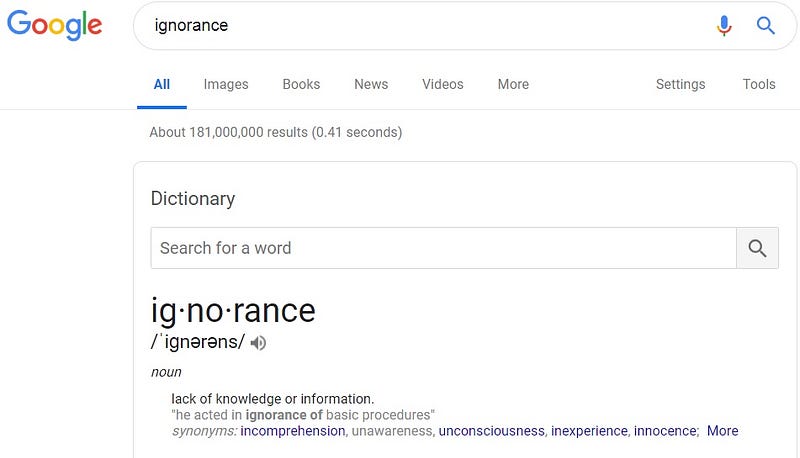
Relating back to the equation in the picture above for “intelligence,” each student aims to become less “ignorant” about the world — in turn becoming more “intelligent”. If the two words are separately searched in a search engine (such as Google), the results are shown below (in terms of definitions of the words):


Credit: Google
Credit: Google

The definitions line up quite clearly with the discussion at hand:
Intelligence: “the ability to acquire and apply knowledge and skills”
Ignorance: “lack of knowledge or information”
Students who spend time writing out equations and reading the accompanying material outside of lecture will find the class rather on the simple side. Why? Because they are used to manipulating (through derivation, etc.) mathematical equations. Their minds have processed the information confronted in lecture and reprocessed outside of class while studying at home or the library. Is that a new realization?

Malcolm Gladwell Suggests 10,000 hours To Master?

Malcolm Gladwell, author and frequent contributor to ‘The New Yorker’, wrote a compelling book titled “Outliers” — for anyone who wants to unpack the recipe for success in any field. In the book, he argues that there are in fact correlations to successful people and success. Some of which are out of our control — i.e. birth month, birth year, family background, etc. We cannot control when we are born or into which family we are born into. Those types of parameters are out of our control. Although, success is not entirely based on those parameters.
A dominant theme throughout his book is that ‘hard work’ plays a large role into success. Yes, being in the right place at the right time does help. Plus, having the family support (emotional, financial, etc.) does contribute greatly to success too. But ultimately, time spent is a dominant contribution.
He shows through three completely different examples (First — the Beatles, Second — Bill Gates, and third — professional athletes)that if you want to succeed, you must spend around 10,000 hours at a given task. What? This may seem outrageous at first sight. Although, if you read through his well written examples — you will arrive at the same conclusion. Which is in line with my equation toward success. In order to become more intelligent about a given subject, one must reduce his/her ignorance on that subject.
Some people may have difficulty entertaining/including the word “ignorance” into the description toward their success. First, it is just a word. Second, if you have such a difficult time, then just use another word which is synonymous with “ignorance”. I personally love the word.
When I think that I am ignorant about a given subject, I find myself at a crossed roads — where a decision has to be made. Will I become less “ignorant” about the subject — i.e. spend time studying the subject? Or do I move on and store in my memory that I will have to eventually come back and tackle at a later point in time — especially if I place a high mark of importance of the subject.
When I see students come to me for tutoring or learning a new scientific instrument, frustration is usually the first sign that more time spent is the solution to their problem. Yes, there are exceptions who just need subject clarifications (on concepts, problem solving steps, etc.). But the majority of students have the same issue at hand. They are not doing so or are unwilling to spend time to become less “ignorant” about the subject at hand. If they were willing to spend time to reduce their “ignorance” on the subject, not only would they see the relevance in learning the subject in the global scheme of their undergraduate education. But they would feel less stressed and a better sense of self due to mastering/completing a successful course due to their hard work (i.e. journey to become “less ignorant” — more “intelligent”). Each of us should encourage everyone around us to aspire to become less “ignorant” about a subject of interest thereby becoming more “intelligent.” Learning is that simple people!


Related Blog Posts:


President Trump Is Out Of Touch With The Transition Toward Renewable Energy


EPA Director Finally Realizes Reality Of Trying To Roll-Back Obama Era Clean Air Act Regulation


Environmental Groups Question Environmental Protection Agency (EPA) Cuts


President Trump's Immigration Rhetoric Damages International Science Student Enrollment


What Promises Did President Trump Make Science Research During His Campaign?


Can The President Prevent The Public From Learning About Scientific Research???


President Trump's Understanding of the Paris Agreement


World Goes Left, While Trump Leads Right - On Climate - Why?


Is This Behavior Presidential - President Trump?


Paris Climate Agreement Is A Start Toward The Renewable Energy Future


READ THIS BEFORE VOTING -- Presidential Science (WORLD) Issues!


Brings Jobs Back By Promoting Renewable Energy!

Friday, March 22, 2019

"Just Make A Generic (Cheaper Version) Of The Drug"? Not So Easy...


The cost of prescription medications is among the most contested political issues right up there with the associated cost of health insurance.  Anytime health insurance is mentioned, just wait -- a discussion is about to unfold linking that to the cost of prescription medications.  Why are medicines so expensive?  Simple answer: the cost of bringing a new drug to market is around $1 billion along with around 20 years of research/approval process.  What?  Yes.  If you happen to have $1 billion laying around, then you too can create a new medication.  Well, not really.  But in theory (based only on cost).


With this being known, why are generic medications cheaper?  Further, why are generic medications not sought out sooner (i.e. released to marketplace sooner)?  The answer to the second question is that the first medication (the expensive) one has 'ownership rights' -- patent rights -- for a given number of years.  As to why after the patent expires, the generic medication cannot be rolled out sooner -- ask the Food and Drug Administration commissioner.  FDA Commissioner just resigned.  Although, before he resigned, he managed among other many changes to leave a public statement regarding the status of expanding access to generic medications.  Included in the statement are the reasons/parameters which are considered or serve as obstacles to the roll-out of generic medications.  These considerations might clarify for the public the complicated generic drug landscape.


Below is the statement taken from the FDA website on expansion of 'generic medications' into the marketplace:


As part of the FDA’s efforts to promote drug competition and patient access, we’ve advanced many policies aimed at making it more efficient to bring generic competition to the market. We’ve been especially focused on a category of medicines known as complex drugs. These are drugs that, by nature of their formulation, delivery systems or the complexity of their active ingredients, for example, are harder to “genericize” under traditional approaches. As a result, these complex drugs often face less competition.
As a category, there are a number of complex drugs that are no longer protected by patents or exclusivities that would forestall generic approval, yet they continue to face no generic competition owing to the difficulty of developing generics. The agency has advanced many new policies to help promote generic competition to complex medicines once patents and exclusivities have lapsed, and we’re planning additional policy steps in 2019.
To understand the challenges posed by complex generics, we need to go back to the pathway developed in 1984 under the Hatch-Waxman Amendments. This legislation put into place the framework for generic drug review at a time when brand drugs were often simple small molecules requiring straightforward and reproducible manufacturing processes. They were generally easy to characterize and evaluate through traditional methods, including human bioequivalence studies. In many cases, a drug’s activity correlated directly with how quickly it got into the bloodstream and how long the drug stayed in the body, so it could have its intended effect on the anticipated site of action.
In contrast, complex drugs involve cases where the drug is often harder to develop and manufacture because it has a complex formulation or complex active ingredient. In other cases, the drug acts locally on the tissue rather than through the concentration in the blood. This includes, for example, inhaled drugs that act directly on the lungs, a topical patch that is activated directly on the skin, or eye drops that act on the surface of the eyes. The therapeutic effect of these types of drugs does not necessarily correlate directly to the amount of drug in the blood, or it can be difficult to measure through the blood. They can raise other issues that make the traditional, metrics generally used to develop generic drugs harder to employ. In other words, it can be more difficult to meet the standards for generic approval.
In 2019, we’ll advance additional policies to promote generic competition for complex drugs. Among other steps, we intend to issue additional guidance documents for developing specific complex generic drugs, as well as address categories of complex drugs that are hard to copy because of their complex formulation or mode of delivery. This will include the publication of a series of guidances to address regulatory and scientific challenges that make it generally more difficult to develop complex generics. As part of this, we intend to issue draft guidance with recommendations on establishing active ingredient sameness. In addition, we’re going to help advance the development of new analytical tools and in vitro tests that may provide additional accurate, sensitive and reproducible tools to support approval of complex generic drugs. Better tools can reduce complex generic drug development time and cost and can inform regulatory decisions.
These are just some of the new steps that we’re going to be taking in 2019 to promote access to complex generic medicines.
These new policy efforts are aimed at ensuring that we provide as much scientific and regulatory clarity as possible with respect to complex generic drugs. This focus is critical because, first and foremost, these drug products provide important therapies to patients. We believe that they’re also becoming increasingly important to the economic stability of the generic drug industry. Being able to “genericize” a complex medicine can be a high-value opportunity for a generic drug developer.
Addressing the challenges related to complex generics, and promoting more generic competition to these medicines, is a key part of our Drug Competition Action Plan, and the agency’s efforts to promote patient access and more affordable medicines.
The FDA, an agency within the U.S. Department of Health and Human Services, protects the public health by assuring the safety, effectiveness, and security of human and veterinary drugs, vaccines and other biological products for human use, and medical devices. The agency also is responsible for the safety and security of our nation’s food supply, cosmetics, dietary supplements, products that give off electronic radiation, and for regulating tobacco products.


The generic drug approval process seems to have changed over the last few decades with the development of new types of medications.  Traditional routes of administration have changed.  Which is to say, become much more specific (precision medicine).  This change has caused an uproar among approval authority.  Old medicines use old approval processes.  New medicines require new approval processes.  Precision medicine will ultimately speed up the approval process by causing federal agencies such as the Food and Drug Administration (FDA) along with the National Institutes of Health (NIH) and the Department of Health and Human Services (HHS) to update review/approval/funding processes.


Currently, these changes are under consideration by federal agencies.  Recently, FDA Commissioner Scott Gottlieb gave an outgoing interview with the journal 'Politico' -- which is embedded below:


Ultimately, the new landscape brought about by changes in medicine along with the collection of medical data (All of Us - NIH trial) will result in better medical practices for the public.  Stay tuned, the future is exciting.


Related Blog Posts:


 How Much Do New Drugs Cost To Bring To The Pharmacy Counter?


How Do Chemists Discover New Drugs? A Brief Introduction!


Update: On FDA's Policy Agenda For Combatting Opioid Crisis


Have You Ever Heard A Song About Personalized Medicine? Here Is A Scientist Singing A Song.


The future: Making Medicines in your kitchen?


The Futuristic Visit To The Physician Is Here!


NIDA Director Nora Volkow: How Health Communicators and Journalists Can Help Replace Stigma with Science


NIAID Director Anthony Fauci: How Should We Communicate About Crises?


What is going on in the FDA for Fall 2018 - message from Director Scott Gottlieb


NIH Director Francis Collins Makes A Statement Regarding Sexual Harassment In Science