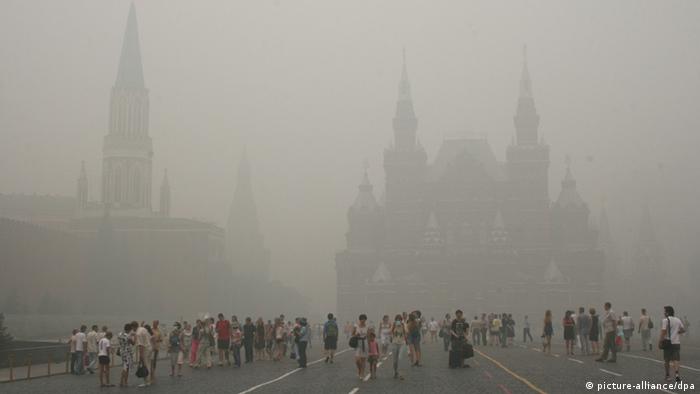
Friday, February 17, 2017

President's Favorite News Agency Promotes "Fake News"

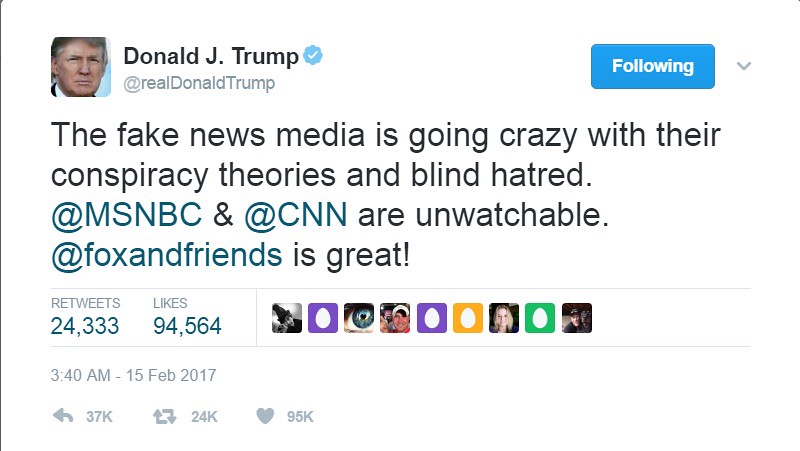
The other day, I was scrolling through President Trump's twitter page for 'Donald Trump' and found the following tweet shown below:


President Trump seems to be at war with the most popular news agencies with exception of the Fox news agencies.  He adores Fox News -- which is understandable based on the letter that journalists sent him pre-inauguration about promoting 'fake news'.  I wrote a blog post with the letter recently about the warning.  Furthermore, Fox News promotes any news which makes the President look better.  Right about now you are probably wondering the following questions:


1) What is wrong with this pattern?


2) What happens when Fox news promotes 'fake news'?


In the following paragraphs, I briefly show an example of a social media post which shows news which is out-dated and can be a promotion of 'fake news.'  Enjoy.


Fox News-Fake News


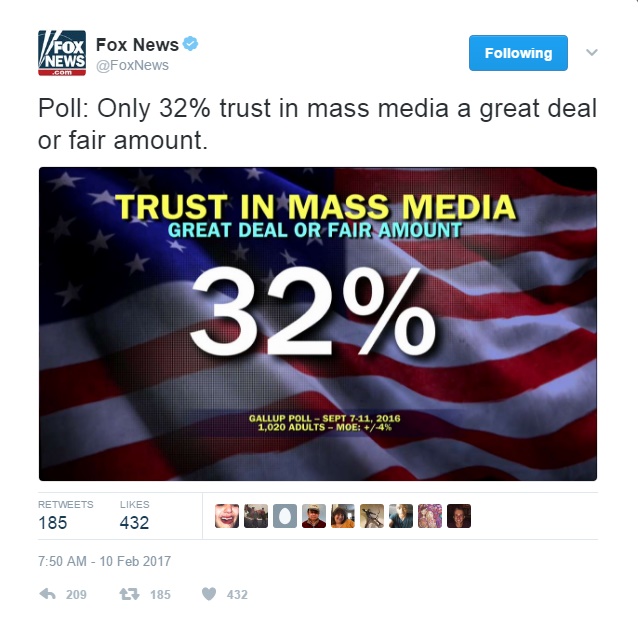
If any news agencies qualify for the title of promoting 'fake news' -- Fox News stands among the top offenders.  Here is an example below of a tweet from Fox News last week:


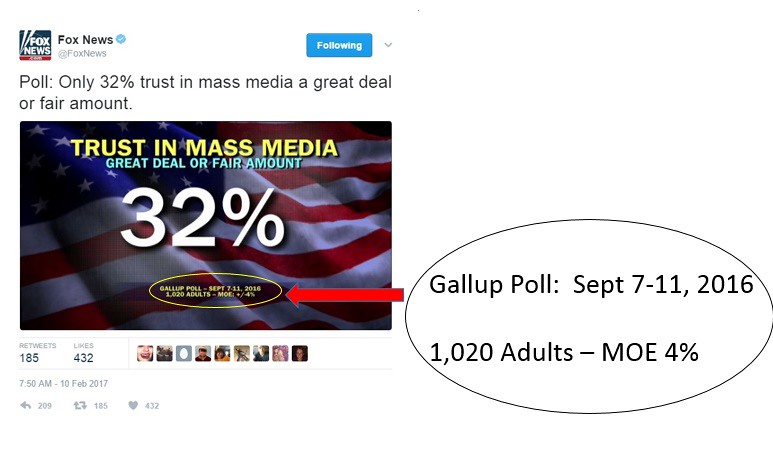
At first sight, the image is of the result of a recent poll stating that public's trust of the media is around 32%.  The tweet was followed by the next two tweets shown below:


and ...


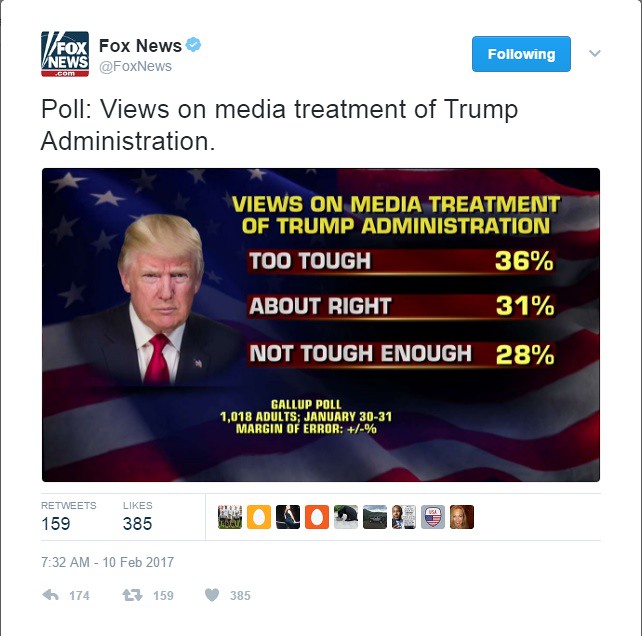
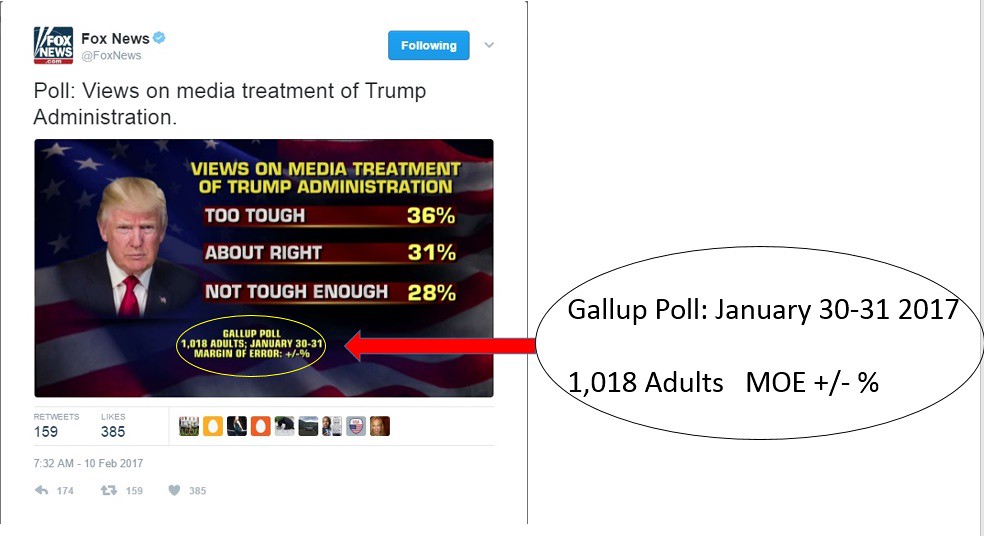
The first tweet above states that the views of Americans of the media treatment of President Trump are:


1) Too tough (36%)

2) About right (31%)

3) Not tough enough (28%)


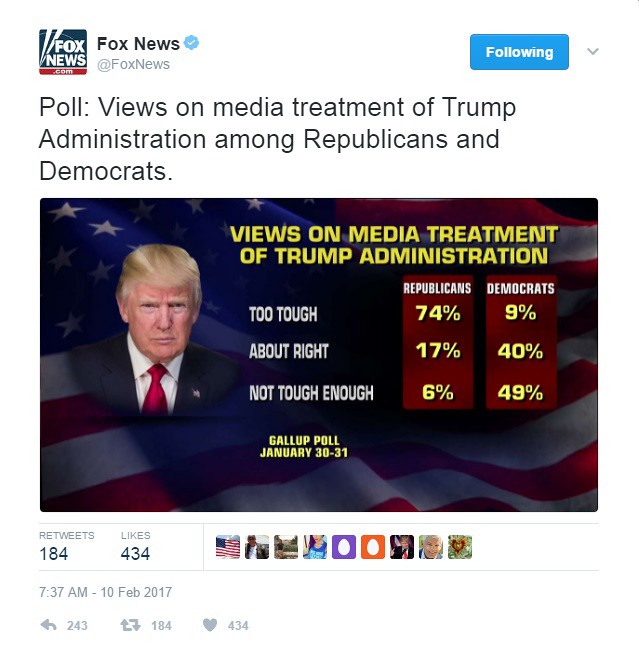
While the second tweet above breaks the first question down into partisan side as shown below:


1) Too tough:  Republican (74%) and Democrat (9%)

2) About right: Republican (17%) and Democrat (40%)

3) Not tough enough: Republican (6%) and Democrat (49%)


A person could conclude that the overall impression of the media with a 32% trust aspect is not so confident in their ability to report.  Furthermore, from the data above, clearly republicans tend to think that the news is too tough on the Trump administration.   Right about now, you might be thinking the following question:


That is collectively what the data states -- so what is the issue Mike?


Further what is your issue with Fox News?


Here are the troubling facts surrounding those three tweets shown below:


The question used for the Poll by Gallup was the following:


In general, how much trust and confidence do you have in the mass media -- such as newspapers, T.V. and radio -- when it comes to reporting the news fully, accurately, and fairly -- a great deal, a fair amount, not very much, or none at all?


Whenever I read the results of a poll, I always have the following questions in mind:


1) What was the date on the Poll?

2) How many people were Polled?

3) What is the 'Margin Of Error' - MOE?


In the image above, the date of the Poll was from last year -- September 7-11, 2016.  I would think that Gallup has taken a more recent Poll since then.  The Margin Of Error on the Poll was plus/minus 4% - which is standard and the sampling size of 1,020 adults surveyed is also standard for Gallup.  The results taken together with the two tweets below which show the 'fine print' make-up 'fake news.'


and...


Where is the 'Margin Of Error' for the two Polls above?


Clearly, Fox News is taking data that supports the stance that the network would like to take and displaying 'fake news' on social media.  Furthermore, some of these networks rely on your ignorance.  Yes, your ignorance.  That is to not read the 'fine print'.  In the above cases, the fine print uncovered the falseness of the results.  I was left wondering:


Where were the results from the January 30-31, 2017 Poll asking about the Public's "trust" in the Media?


There was no Poll conducted at that time.  The three tweets above really ask two fundamentally different questions which Fox News tries to tie together.  Trust in media is different that "toughness".  In fact, when the media is "tough" on President Trump, he refuses to answer questions and defaults to "your fake news".  That strategy has not proven good for him since he has taken an oath in the Presidential Office.


Upon seeing the results above, I decided to look up the methodology of Gallup which I discuss briefly below in the next section.


Gallup Polling


Gallup Polling has been around for quite awhile.  George Gallup founded the company in 1935.  Over the years, the Gallup Company has expanded to conducting an enormous amount of surveys on a daily basis.  Here is the methodology from the 'Wikipedia' page for 'Gallup Poll':


Gallup conducts 1,000 interviews per day, 350 days out of the year, among both landline and cell phones across the U.S. for its health and well-being survey[11] and political and economic survey. Gallup Daily tracking methodology relies on live interviewers, dual-frame random-digit-dial sampling (which includes landline as well as cellular telephone phone sampling to reach those in cell phone-only households), and uses a multi-call design to reach respondents not contacted on the initial attempt.
Gallup completes 500 cellphone surveys and 500 landline surveys daily, divided evenly between the two topical questionnaires.[12] The population of the U.S. that relies only on cell phones makes 34% of the population.[13]
The findings from Gallup's U.S. surveys are based on the organization's standard national telephone samples, consisting of list-assisted random-digit-dial (RDD) telephone samples using a proportionate, stratified sampling design. A computer randomly generates the phone numbers Gallup calls from all working phone exchanges (the first three numbers of your local phone number) and not-listed phone numbers; thus, Gallup is as likely to call unlisted phone numbers as well as listed phone numbers.
Within each contacted household reached via landline, an interview is sought with an adult 18 years of age or older living in the household who will have the next birthday. Gallup does not use the same respondent selection procedure when making calls to cell phones because they are typically associated with one individual rather than shared among several members of a household. Gallup Daily tracking includes Spanish-language interviews for Spanish-speaking respondents and interviews in Alaska and Hawaii.
When respondents to be interviewed are selected at random, every adult has an equal probability of falling into the sample. The typical sample size for a Gallup poll, either a traditional stand-alone poll or one night's interviewing from Gallup's Daily tracking, is 1,000 national adults with a margin of error of ±4 percentage points. Gallup's Daily tracking process now allows Gallup analysts to aggregate larger groups of interviews for more detailed subgroup analysis. But the accuracy of the estimates derived only marginally improves with larger sample sizes.
After Gallup collects and processes survey data, each respondent is assigned a weight so that the demographic characteristics of the total weighted sample of respondents match the latest estimates of the demographic characteristics of the adult population available from the U.S. Census Bureau. Gallup weights data to census estimates for gender, race, age, educational attainment, and region.[14]
The data are weighted daily by number of adults in the household and the respondents' reliance on cell phones, to adjust for any disproportion in selection probabilities. The data are then weighted to compensate for nonrandom nonresponse, using targets from the U.S. Census Bureau for age, region, gender, education, Hispanic ethnicity, and race. The resulting sample represents an estimated 95% of all U.S. households.[15][16]


The list of various questions can be downloaded here.  Returning to the initial tweet regarding the trust in media by the Public, the Gallup Poll conducted back in September revealed more interesting data that is shown below taken from the original Poll article found here:


Along with the following reasons for the percentages found offered by Gallup below by Party:


Republican:


Republicans Fuel Drop in Media Trust
While it is clear Americans' trust in the media has been eroding over time, the election campaign may be the reason that it has fallen so sharply this year. With many Republican leaders and conservative pundits saying Hillary Clinton has received overly positive media attention, while Donald Trump has been receiving unfair or negative attention, this may be the prime reason their relatively low trust in the media has evaporated even more. It is also possible that Republicans think less of the media as a result of Trump's sharp criticisms of the press. Republicans who say they have trust in the media has plummeted to 14% from 32% a year ago. This is easily the lowest confidence among Republicans in 20 years.


Democrats:


 Democrats' and independents' trust in the media has declined only marginally, with 51% of Democrats (compared with 55% last year) and 30% of independents (versus 33% last year) expressing trust. Over the past 20 years, Democrats have generally expressed more trust than Republicans in the media, although in 2000, the two parties were most closely aligned, with 53% of Democrats and 47% of Republicans professing trust.


It is important to offer all of the details of the Poll conducted by Gallup.  Otherwise, the results could be construed as 'fake news'.   As for the 'treatment' of the President and his administration by the media, the original results are contained in the original article offered by Gallup on their website - here.


Conclusion...


There is no doubt that the Nation is split on the treatment of President Trump in the news.  That is to be expected given the results of the election.  The country is split down the middle.  Whenever a Poll is conducted, read the 'fine print' at the bottom.  News agencies should be forthright in their dissemination of news on social media.  I do not argue that each news agency has a mission to be slightly biased in their reporting.  I would expect no different.  Although, when presenting Polling data, the facts (the numbers) speak for themselves.


Presenting old data along with new data to fit a story or them is disingenuous.  Fox News has disseminated 'fake news' before.  What is baffling to me is how the President believes that one news agency is more honest that the others.  Regardless, each of us have the tools (iPad, iPhone, PC's, etc) to get down and investigate the truth from reporting.  Keep on exploring widely.  Read widely.  Think critically about the news that you are reading on a daily basis.  Does the news that you are reading align with the reality you are experiencing on the street or in school?  Make note of the differences and similarities.  Don't believe any one news agency at first sight.


Until next time, have a great day!


Tuesday, February 14, 2017

How To Make Sense Of Water Flowing At 100,000 Cubic Feet Per Second

When I opened my twitter account yesterday morning, I checked a few news sites, among them was the "Los Angeles Times" which prompted me with the following photo shown below:


The original tweet can be found here.  Considering that much water flowing from the overflow, the following two questions emerge in my mind:


What is the total capacity of the dam (for Lake Oroville) and the flow rate?


Furthermore, to understand the magnitude of the evacuation, how can a person make sense of the flow rate?


In the post below, I answer the questions stated above and shed light on this terrible disaster.


Total Volume Of Lake Oroville


Lake Oroville was designed to originally serve as a water storage facility.  The lake impedes the Feather river with the Oroville Dam as shown below:


Source: California Department of Water Resources


The total capacity of the lake is 3.5 million acre-feet of water -- Wow!  Lake Oroville has a surface area of 25 square miles.  The following question arises:


How does a person grasp an enormous volume of water like Lake Oroville?


In order to put that large of a volume into perspective, a 'metric' must be used for comparison.  In the past posts on this site, I have used the "World's Largest Swimming Pool" located in Chile.  According to the "Wikipedia" page, the total volume of the swimming pool shown below is 66 million gallons of water.


To start an analysis of placing a large volume like Lake Oroville into perspective, the 'units' must be the same.  The units of measurement for the volume of the Lake Oroville were 'acre-feet'.  Whereas the volume of the "World's Largest Swimming Pool" are in 'gallons.'  In order to divide the two, a decision needs to be made.


Either, a unit conversion is done on the total volume of the lake from units of 'acre-feet' to 'gallons' or vice versa.  In this case, the former route is easiest.  The conversion factor from 'acre-feet' to 'gallons' will need to be determined.  I decided to type into the Google search engine the following: How many gallons are in an acre-feet?   The result is shown below:


Using the conversion factor above, the unit conversion from 'acre-foot' to 'gallon' is possible as shown below:


In the first line above, the total water volume of the Lake Oroville is converted from shorthand notation (3.5 million acre-foot) to scientific notation.  The second line shows the unit conversion from units of 'acre-foot' to 'gallon'.  Now, the units in each value are the same.  That is, both the value of the total capacity of water held in Lake Oroville and the value of the "World's Largest Swimming Pool" are both expressed in units of 'gallon'.


The next step to determine the number of swimming pools ("World's Largest Swimming Pool") that can be filled with the total volume of water in Lake Oroville.  Last, take the total volume of water (held in Lake Oroville) and divide by the metric -- swimming pool volume to yield the total number of swimming pools which could be filled as shown below:


The total number of swimming pools ("World's Largest Swimming Pool") which could be filled with the total volume of Lake Oroville is 17,000.  Wow!  That is a large amount of water.


Running through the dimensional analysis above is helpful in casting the volume of water held in Lake Oroville into a perspective which can be extended to the current disaster.  The spillway which serves as a relief for the Oroville Dam has a broken wall (30 feet high) which busted and released an enormous wall of water out of the side.  The disaster is shown in the picture above.


The result of the break was a release of an enormous amount of water which flowed into the surrounding community and resulted in the displacement of over 180,000 residents.  In order to contain the Oroville Dam, engineers would like to lower the reservoir by nearly 50 feet of water.


In the section below, I take you through the calculation to figure out the amount of water contained in 50 feet of the Oroville reservoir.  The result is surprising given such a large flow rate.  This analysis shows the depth and enormity of the disaster to the community surrounding the Oroville reservoir.


Overflow Of The Dam


As I showed above, recently, there was a recent overflow of the Oroville dam.  In a recent article by the "Los Angeles Times" titled "Biggest fear at Oroville Dam: A 30-foot wall of water barreling downstream" the catastrophe was laid out in the following way:


A new storm system forecast for later this week put water officials on a race against time. Bill Croyle, the acting director of the state Department of Water Resources, said they planned to continue discharging flows at a rate of 100,000 cubic feet per second, with the hope of lowering the reservoir level by 50 feet.

The biggest concern was that a hillside that keeps water in Lake Oroville — California’s second largest reservoir — would suddenly crumble Sunday afternoon, threatening the lives of thousands of people by flooding communities downstream.


Wow!  That discharge rate is enormous -- 100,000 cubic feet per second.  When I first read the number, I thought that there might be an error in the reporting.  In order to visualize the flow rate of a hundred thousand cubic feet of water per second, lets choose a metric to compare the volume to.


In past posts, I have used the Mercedez Benz Superdome as a metric for large oil spills (and large volumes of water).  According to the "Wikipedia" page for the Mercedez Benz Superdome, the interior volume of the space is 125,000,000 cubic feet -- 125 million cubic feet.  The Superdome is shown below which was taken from the "Wikipedia" page:


Source: Nwill21


If the units of the flow rate are the same as the volume of the interior space of the Superdome, then the calculation would be a simple division of two values.  Both values are expressed in 'units' of 'cubic feet'.  If the total volume of the Superdome is divided by the flow rate (expressed in cubic feet per second), then the answer will be the amount of time (in seconds) needed to fill a single Superdome as shown below:


The result is that in 1,250-seconds, a single Superdome is filled!!!  Wow!!  That is the calculation in the first line of the image above.  For those of us who do not think in terms of 'seconds' -- a unit conversion can be performed from 'second' to 'minute' as shown in the second line of the calculation above.  In order to fill a single Superdome with a flow rate of 100,000 cubic feet per second, the time required is 21 minutes!!


In the article above, the author reported that the engineers working on the Oroville Dam were working to release 50 feet worth of water.  When I read that sentence, the two questions came to mind:


1) How much water is contained within 50 feet (height) of the Oroville reservoir?


2) At a flow rate of 100,000 cubic feet per second, how long would the emergency spillway have to be open to drain 50 feet of water?


To start answering the questions above, first, the total volume in 50 feet (height) needs to be calculated.  From the information above, the surface area of Lake Oroville is stated to be 25 square miles.  In order to calculate a volume in cubic feet, a unit conversion from 'square mile' to 'square feet' is required as shown below:


Now, with the surface area of Lake Oroville expressed in units of 'square feet', an expression is needed to calculate the volume contained in 50 feet (height).  The expression below is for the volume with a 'surface area' and 'height':


The can be taken from above and plugged into the expression to yield the total volume in 50 feet (height) of water across Lake Oroville:


Wow!  That is an enormous amount of water -- 35,000,000,000 cubic feet of water.  From the calculations above, the number of Superdomes which could be filled with that volume is possible and shown below:


Wow!  In order to figure out the time required to fill all 280 Superdomes or drain 35,000,000,000 cubic feet of water at a flow rate of 100,000 cubic feet per second the following step is needed.  Take the time required to fill a single Superdome (which was calculated to be 21 minutes) and multiply that number by 280 as shown below:


The first line of the calculations above shows the time required to fill 280 Superdomes -- which is 5,880 minutes.  How many hours is that?  In the second line, a unit conversion was performed to yield the total number of hours required to fill 280 Superdomes -- a total of 98 hours.


Calculating the total volumes and flow rates might not really drive home the point of the blog post which is to make sense of the extremely high flow rate.  If more convincing is needed, the another metric (volume) can be chosen by yourself to put the values reported into perspective.


Although, if you view the video embedded in a "Washington Post" article titled "The Lake Oroville dam stress test isn’t over — more rain this week, then spring thaw" the results from above could make sense.  The video is shown below and is less than 2 minutes in length:


Between the video above and the calculations, the point should be apparent that this is a large disaster.  Time will be needed to drain the appropriate amount of water out of the Oroville reservoir to return toward a safe water level.


Conclusion...


In the blog post above, the calculations revealed that an enormous amount of water (overflow) was released in the last few days.  This is validated in the images in the above video.  The values that have been calculated shed light on the extent of the issue.  Furthermore, as pointed out by the current administration, there is an enormous potential for disaster if the Oroville Dam is compromised.  Safety in dealing with the release of millions of gallons over a short amount of time is of the up most importance.   Infrastructure design, preventative maintenance, and the repairing of current issues should dominate the discussion from the federal and state emergency agencies responding to this crisis.  The amount of lives which could be threatened by the release of the entire reservoir is a calculation that does not need to be accomplished.  Instead, repairing and investing in infrastructure is a better path forward.


Until next time, have a great day!


Should Pollution Concern Us?

The title is simple right?


Easy question, should the amount of pollution over major cities concern the citizens of this planet?


Depending on who you ask, the answer might differ.  Why does this have to be the case?


Recently, I found a great short video by California's previous Governor Arnold Schwarzenegger on the adverse effects of pollution.  I thought that I would bring the contents of the video to your attention just in case you were too busy to take out a minute and a half to watch the video below:


If you did not watch the video, here are the highlights of the important video:


1) 7 million people die world-wide because of pollution related illnesses


2) That is more than the following combined: suicides, traffic fatalities, and war casualties!


3) Politicians take the stand that the problem is "too costly to fix" -- imagine that politicians love to spend money to get results which promote votes from their constituents.


4) Politicians are trying to shut down the EPA's ability to regulate carbon.


5)  Arnold's Solution: strap their mouths (politicians) to the tailpipe of a truck exhaust pipe and then turn on the engine and see how long it takes for them to "tap out".


6) In California, politicians have shown that the possibility exists to protect the environment and the economy at the same time.


7) After California passed strict climate change laws, the economy grew by 12.4%


8) If the biggest economy in the country can thrive under the strictest environmental laws, that means the same is possible all over the country as a whole.


9) California has outpaced Texas in GDP growth since 2011.


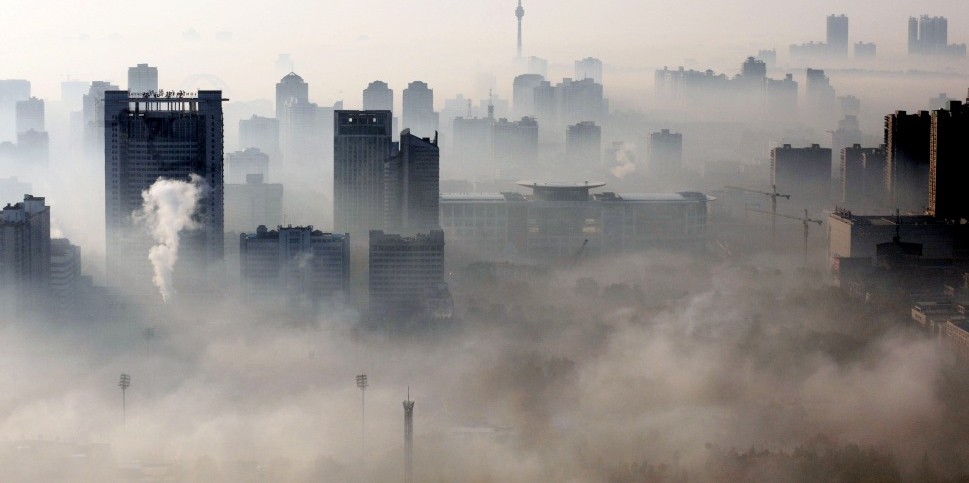
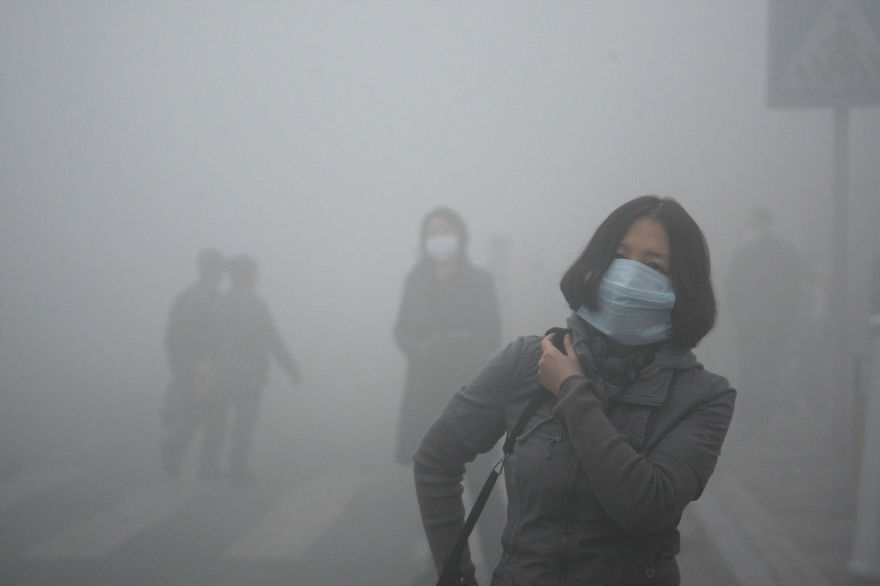
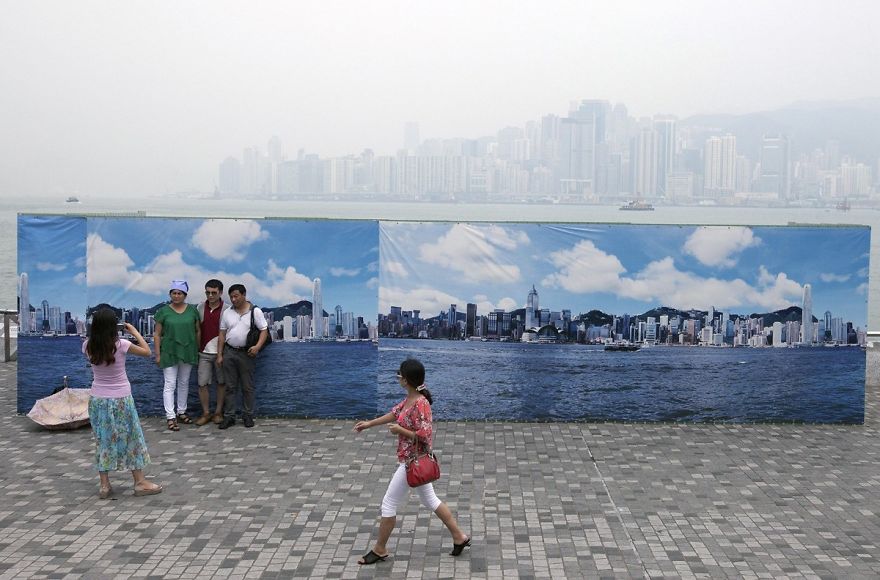
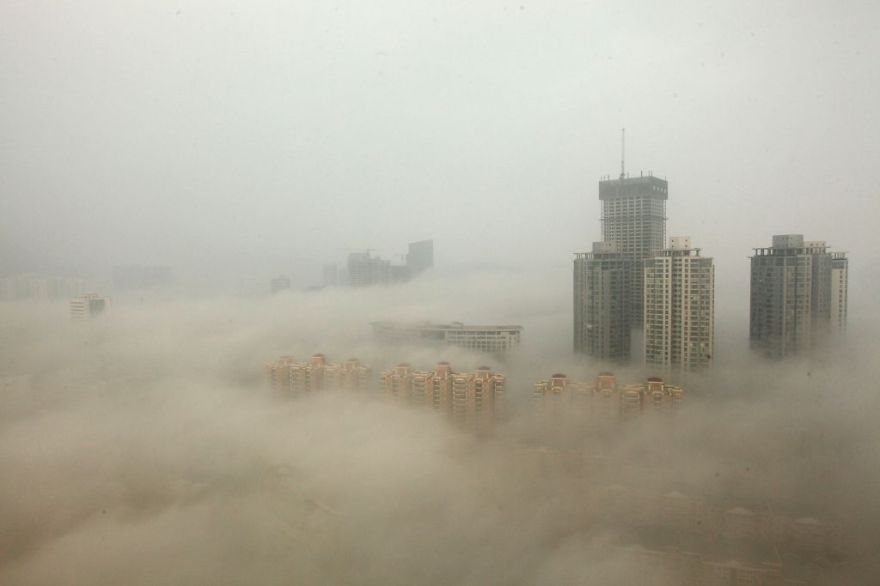
Pictures of Air Pollution Around The World:


1) United States of America (USA):


Source: RT.com


Source: Wikipedia


Source: USAtoday.com


2) India:


Source: Map of India


3) China


Source: SoftPedia


Source: Bored Panda


Source: Bored Panda


Source: Bored Panda


5) Russia:


Source: TESteach


Source: DW.com


There are many more pictures available for your viewing online with a search of the topic: "air pollution in .... images" where "..." stands for the country of interest (Russia, USA, China, India, etc.).


Below is a satellite image of the particulate matter (of size 2.5 micrometer) distribution across of the globe.  USA is quite blue -- meaning relatively lower levels compared to other parts of the world.


 Source: NASA


As the pictures still portray above of air pollution around the world, there is still work to be done.  The overarching take home message to all residents of the world should be the following:


Each of us breathe the same air in the world.  Working together, the world would be a healthier place to live.  As it stands now, we are on a deadly trajectory for the future.


Action is needed!


Until next time, Have a great day!


Sunday, February 12, 2017

Journalists Collectively Sent President-Elect Trump A Warning Regarding Fake News?

I admit that I am a news junky.  I love reading the news.  I try to read as widely as possible across party lines in regards to various news organizations.  My family always argues that certain news sites are biased more than others which I strongly disagree with.  I hold the position that each organization has a mission (which forms their biases) and that is their own business.  If you do not like the reporting, do not read the paper!  Over the last three weeks, the following question has emerged:


How do news organizations deal with a President who disseminates fake news?


It is no surprise that in light of the news organizations combating a sitting President who is supposedly reporting the truth, a restructuring of various news agencies is bound to occur.


Without further ado, here is the open letter which was sent to President-elect Trump prior to his inauguration stating their side of the future:


DEAR MR. PRESIDENT ELECT:

In these final days before your inauguration, we thought it might be helpful to clarify how we see the relationship between your administration and the American press corps.

It will come as no surprise to you that we see the relationship as strained. Reports over the last few days that your press secretary is considering pulling news media offices out of the White House are the latest in a pattern of behavior that has persisted throughout the campaign: You’ve banned news organizations from covering you. You’ve taken to Twitter to taunt and threaten individual reporters and encouraged your supporters to do the same. You’ve advocated for looser libel laws and threatened numerous lawsuits of your own, none of which has materialized. You’ve avoided the press when you could and flouted the norms of pool reporting and regular press conferences. You’ve ridiculed a reporter who wrote something you didn’t like because he has a disability.

All of this, of course, is your choice and, in a way, your right. While the Constitution protects the freedom of the press, it doesn’t dictate how the president must honor that; regular press conferences aren’t enshrined in the document.

But while you have every right to decide your ground rules for engaging with the press, we have some, too. It is, after all, our airtime and column inches that you are seeking to influence. We, not you, decide how best to serve our readers, listeners, and viewers. So think of what follows as a backgrounder on what to expect from us over the next four years.

Related: Former Obama staffers launch Crooked Media

Access is preferable, but not critical. You may decide that giving reporters access to your administration has no upside. We think that would be a mistake on your part, but again, it’s your choice. We are very good at finding alternative ways to get information; indeed, some of the best reporting during the campaign came from news organizations that were banned from your rallies. Telling reporters that they won’t get access to something isn’t what we’d prefer, but it’s a challenge we relish.

Off the record and other ground rules are ours–not yours–to set. We may agree to speak to some of your officials off the record, or we may not. We may attend background briefings or off-the-record social events, or we may skip them. That’s our choice. If you think reporters who don’t agree to the rules, and are shut out, won’t get the story, see above.

We decide how much airtime to give your spokespeople and surrogates. We will strive to get your point of view across, even if you seek to shut us out. But that does not mean we are required to turn our airwaves or column inches over to people who repeatedly distort or bend the truth. We will call them out when they do, and we reserve the right, in the most egregious cases, to ban them from our outlets.

We believe there is an objective truth, and we will hold you to that. When you or your surrogates say or tweet something that is demonstrably wrong, we will say so, repeatedly. Facts are what we do, and we have no obligation to repeat false assertions; the fact that you or someone on your team said them is newsworthy, but so is the fact that they don’t stand up to scrutiny. Both aspects should receive equal weight.

We’ll obsess over the details of government. You and your staff sit in the White House, but the American government is a sprawling thing. We will fan reporters out across the government, embed them in your agencies, source up those bureaucrats. The result will be that while you may seek to control what comes out of the West Wing, we’ll have the upper hand in covering how your policies are carried out.

We will set higher standards for ourselves than ever before. We credit you with highlighting serious and widespread distrust in the media across the political spectrum. Your campaign tapped into that, and it was a bracing wake-up call for us. We have to regain that trust. And we’ll do it through accurate, fearless reporting, by acknowledging our errors and abiding by the most stringent ethical standards we set for ourselves.

We’re going to work together. You have tried to divide us and use reporters’ deep competitive streaks to cause family fights. Those days are ending. We now recognize that the challenge of covering you requires that we cooperate and help one another whenever possible. So, when you shout down or ignore a reporter at a press conference who has said something you don’t like, you’re going to face a unified front. We’ll work together on stories when it makes sense, and make sure the world hears when our colleagues write stories of importance. We will, of course, still have disagreements, and even important debates, about ethics or taste or fair comment. But those debates will be ours to begin and end.

We’re playing the long game. Best-case scenario, you’re going to be in this job for eight years. We’ve been around since the founding of the republic, and our role in this great democracy has been ratified and reinforced again and again and again. You have forced us to rethink the most fundamental questions about who we are and what we are here for. For that we are most grateful.

Enjoy your inauguration.

–The Press Corps


The letter above illustrates many points of transition within the news.  The first, is that the news organizations are under a huge transition toward cleaning up their act.  With the growing use of digital devices of all sorts, the public is able to verify a story within minutes from a variety of sources.


Second, the President of the United States has waged war on the news press for covering his campaign and the last three weeks of his time in office as truthfully as possible.  As mentioned above in the letter, the President received this letter prior to his inauguration.  He has had plenty of time to clean up his act.


Instead of acting like a President, he has chosen avenues such as Twitter and Facebook to disseminate news -- which is problematic in a couple ways.  The first being that the language that is used in a 140 characters (a Tweet on Twitter) is not always translated correctly by other nations around the world.  This was highlighted in a recent article in the Los Angeles Times titled "How do you say 'lowlife' in another language? Trump's tweets lose much in translation" where translators of different languages were interviewed regarding the President's use of social media in communicating with the world.  Here is an excerpt describing the problem:


If native English speakers are having trouble processing Trump-speak, think of the challenges facing foreign translators and interpreters, who must grapple with the president’s verbal idiosyncrasies and make them understandable in another language.
“There are several things that make an interpreter’s life easy,” said Christiane Abel, who teaches French translation and interpretation at the Middlebury Institute of International Studies at Monterey and is on the U.S. State Department’s roster of contract interpreters. “When people finish their sentences … when the syntax is well-structured … when the speaker starts speaking and you kind of understand where the person is going, you can kind of decode the underlying thought.”
Not so with Trump. The new leader of the free world is driving translators crazy.
“He has the ‘Apprentice’ personality thing going on,” said Alessandro Duranti, former dean of the division of social sciences in the UCLA College of Letters and Science, whose expertise includes language as a cultural practice, and political discourse. “He has a certain use of hyperbole. He actually insults people. He calls people ‘dummy,’ ‘lowlife,’ ‘fraud.’ He talks in a way that is not the typical political speech. When there’s a choice, he goes for whatever is the most colloquial.”
All of those attributes create minefields for those translating his words.
Chinese interpreters struggle with Trump’s inclination toward hyperbole, according to Mandarin speakers. For example, “huge,” “enormous” and “tremendous” all translate into the same word in Chinese: da, or “big.”
“Sometimes the translation is much more restrained than the original because the words he chooses are very ostentatious,” said Yin Hao, a graduate student at the South China University of Technology in Guangzhou, who has made a hobby of translating comments by U.S. politicians and posting them online.


Here are a couple of examples of issues with translating the President's words into different languages. The first example is from the Mandarin language:


Trump’s sarcasm can also pose a challenge for Mandarin speakers, Yin said. A Taiwanese news agency misunderstood a tweet about the controversial phone call between Trump and Taiwan’s leader after Trump’s election victory, Yin said.
“Interesting how the U.S. sells Taiwan billions of dollars of military equipment but I should not accept a congratulatory call,” Trump wrote.
The tone was one of sarcasm and indignation, but the news agency thought he was expressing regret, Yin said.


This could pose a national security issue with other nations if the words are translated incorrectly.  The second example is from the American Sign Language community:


David Quinto-Pozos, who directs the American Sign Language program at the University of Texas and is president of Mano a Mano, a national organization for Spanish-English-ASL interpreters, said Trump’s use of terms such as “bad dudes” ("We have some protesters who are bad dudes, they have done bad things”) can cause challenges for signers.
“ASL doesn’t have a sign for ‘dude,’ and Spanish doesn’t have a good word either,” Quinto-Pozos said.
“What is particularly challenging … is sometimes you get these words that you would not expect from someone who was running for president, was president-elect and is now president.”
An example is Trump’s comments that surfaced in the outtakes of the television show “Access Hollywood,” in which he crudely spoke about making advances on a woman without her consent and about women allowing him to grab them by the genitals (and that, of course, is a translation from more vulgar English) because of his celebrity status.
“It’s a little jarring for interpreters and translators, not knowing how to find the equivalent in another language that matches the same register,” Quinto-Pozos said.


The last problem we (as a nation) need to have is an issue with communication with other nations.  What if a war is started over language that is misinterpreted?  What if we continue to offend other nations?  There might be real-world consequences.


There is a reason why that the White House usually uses "official lines of communications" like the "White House Press Secretary" or other key positions to disseminate news to the world.  The message is supposed to be well thought out and regarded as official for the world -- not just social media followers.


In the weeks to come, hopefully President Trump realizes this emerging problem.  Otherwise, as noted in the letter above, the President will find himself having an issue not just with the citizens of this nation.  Further, President Trump should aspire to be presidential.  The news has covered issues like Ivanka's loss of a contract with Nordstrom (the clothing store chain) in an honest manner.


The bottom line is this: President Trump does not like news that makes him look bad.  None of us do.  Although, the truth is hard to realize when you are the leader of the "free world".  The news agencies have an obligation to report the news as they see the news and facts are verified by sources.  If this conflicts with the President's view of the report, that is not the news agencies issue -- that is President Trump's issue.


Until next time, have a great day!


Friday, February 10, 2017

What Promises Did President Trump Make Science Research During His Campaign?

In a post that predated last years election, I listed questions that were compiled by scientists which were sent out to politicians campaigning for the 2016 election for the Presidency.  Now that a candidate has been elected and assumed the office of the Presidency, I thought a review of the answers (and questions) which represented President Trump's view on funding science research is worth while.  Especially, since President Trump has already limited the ability of federal agencies to disseminate tax-payer dollar funded research last week.  I wrote a blog post regarding the executive decision to limit science during the first week.  Without further ado, lets review the questions and answers from scientists to President Trump prior to his assuming office.


Questions & Answers Regarding Science Research


I list below the questions that were sent to President Trump when he was a candidate running for office last year.  After each question, his response is listed.


Question #1


Science and engineering have been responsible for over half of the growth of the U.S. economy since WWII. But some reports question America’s continued leadership in these areas. What policies will best ensure that America remains at the forefront of innovation?


Answer #1


Innovation has always been one of the great by-products of free market systems.  Entrepreneurs have always found entries into markets by giving consumers more options for the products they desire.  The government should do all it can to reduce barriers to entry into markets and should work at creating a business environment where fair trade is as important as free trade.  Similarly, the federal government should encourage innovation in the areas of space exploration and investment in research and development across the broad landscape of academia.  Though there are increasing demands to curtail spending and to balance the federal budget, we must make the commitment to invest in science, engineering, healthcare and other areas that will make the lives of Americans better, safer and more prosperous. 


Question #2


Many scientific advances require long-term investment to fund research over a period of longer than the two, four, or six year terms that govern political cycles. In the current climate of budgetary constraints, what are your science and engineering research priorities and how will you balance short-term versus long-term funding?


Answer #2


The premise of this question is exactly correct—scientific advances do require long term investment.  This is why we must have programs such as a viable space program and institutional research that serve as incubators to innovation and the advancement of science and engineering in a number of fields.  We should also bring together stakeholders and examine what the priorities ought to be for the nation.  Conservation of resources and finding ways to feed the world beg our strong commitment as do dedicated investment in making the world a healthier place.  The nation is best served by a President and administration that have a vision for a greater, better America.  


Question #3


The Earth’s climate is changing and political discussion has become divided over both the science and the best response. What are your views on climate change, and how would your administration act on those views?


Answer #3


There is still much that needs to be investigated in the field of “climate change.”  Perhaps the best use of our limited financial resources should be in dealing with making sure that every person in the world has clean water.  Perhaps we should focus on eliminating lingering diseases around the world like malaria.  Perhaps we should focus on efforts to increase food production to keep pace with an ever-growing world population.  Perhaps we should be focused on developing energy sources and power production that alleviates the need for dependence on fossil fuels.  We must decide on how best to proceed so that we can make lives better, safer and more prosperous.


Question #4


Biological diversity provides food, fiber, medicines, clean water and many other products and services on which we depend every day. Scientists are finding that the variety and variability of life is diminishing at an alarming rate as a result of human activity. What steps will you take to protect biological diversity?


Answer #4


For too long, Presidents and the executive branch of our federal government have continued to expand their reach and impact.  Today, we have agencies filled with unelected officials who have been writing rules and regulations that cater to special interests and that undermine the foundational notion of our government that should be responsive to the people.  Our elected representatives have done little to uphold their oaths of office and have abrogated their responsibilities.  When these circumstances occur, there is an imbalance that rewards special interests and punishes the people who should benefit the most from the protection of species and habitat in the United States.  In a Trump administration, there will be shared governance of our public lands and we will empower state and local governments to protect our wildlife and fisheries.  Laws that tilt the scales toward special interests must be modified to balance the needs of society with the preservation of our valuable living resources.  My administration will strike that balance by bringing all stakeholders to the table to determine the best approach to seeking and setting that balance.


Question #5


The Internet has become a foundation of economic, social, law enforcement, and military activity. What steps will you take to protect vulnerable infrastructure and institutions from cyber attack, and to provide for national security while protecting personal privacy on electronic devices and the internet?


Answer #5


The United States government should not spy on its own citizens.  That will not happen in a Trump administration.  As for protecting the Internet, any attack on the Internet should be considered a provocative act that requires the utmost in protection and, at a minimum, a proportional response that identifies and then eliminates threats to our Internet infrastructure. 


Question #6


Mental illness is among the most painful and stigmatized diseases, and the National Institute of Mental Health estimates it costs America more than $300 billion per year. What will you do to reduce the human and economic costs of mental illness?


Answer #6


This is one of the great unfolding tragedies in America today.  States are reducing their commitments to mental health treatment and our jails are filled with those who need mental health care.  Any mental health reforms must be included in our efforts to reform healthcare in general in the country.  We must make the investment in treating our fellow citizens who suffer from severe mental illness.  This includes making sure that we allow family members to be more involved in the total care of those who are severely mentally ill.  We must ensure that the national government provides the support to state and local governments to bring mental health care to the people at the local level.  This entire field of interest must be examined and a comprehensive solution set must be developed so that we can keep people safe and productive.


Question #7


Strategic management of the US energy portfolio can have powerful economic, environmental, and foreign policy impacts. How do you see the energy landscape evolving over the next 4 to 8 years, and, as President, what will your energy strategy be?


Answer#7


It should be the goal of the American people and their government to achieve energy independence as soon as possible.  Energy independence means exploring and developing every possible energy source including wind, solar, nuclear and bio-fuels.  A thriving market system will allow consumers to determine the best sources of energy for future consumption.  Further, with the United States, Canada and Mexico as the key energy producers in the world, we will live in a safer, more productive and more prosperous world.


Question #8


American students have fallen in many international rankings of science and math performance, and the public in general is being faced with an expanding array of major policy challenges that are heavily influenced by complex science. How would your administration work to ensure all students including women and minorities are prepared to address 21st century challenges and, further, that the public has an adequate level of STEM literacy in an age dominated by complex science and technology?


Answer #8


There are a host of STEM programs already in existence.  What the federal government should do is to make sure that educational opportunities are available for everyone.  This means we must allow market influences to bring better, higher quality educational circumstances to more children.  Our cities are a case-study in what not to do in that we do not have choice options for those who need access to better educational situations.  Our top-down-one-size-fits-all approach to education is failing and is actually damaging educational outcomes for our children.  If we are serious about changing the direction of our educational standing, we must change our educational models and allow the greatest possible number of options for educating our children.  The management of our public education institutions should be done at the state and local level, not at the Department of Education.  Until more choices are provided in our cities, those who tout their concern about educational outcomes cannot be taken seriously.


Question #9


Public health efforts like smoking cessation, drunk driving laws, vaccination, and water fluoridation have improved health and productivity and save millions of lives. How would you improve federal research and our public health system to better protect Americans from emerging diseases and other public health threats, such as antibiotic resistant superbugs?


Answer #9


The implication of the question is that one must provide more resources to research and public health enterprises to make sure we stay ahead of potential health risks.  In a time of limited resources, one must ensure that the nation is getting the greatest bang for the buck.  We cannot simply throw money at these institutions and assume that the nation will be well served.  What we ought to focus on is assessing where we need to be as a nation and then applying resources to those areas where we need the most work.  Our efforts to support research and public health initiatives will have to be balanced with other demands for scarce resources.  Working with Congress—the people’s representatives—my administration will work to establish national priorities and then we will work to make sure that adequate resources are assigned to achieve our goals.


Question #10


The long-term security of fresh water supplies is threatened by a dizzying array of aging infrastructure, aquifer depletion, pollution, and climate variability. Some American communities have lost access to water, affecting their viability and destroying home values.  If you are elected, what steps will you take to ensure access to clean water for all Americans?


Answer #10


This may be the most important issue we face as a nation for the next generation.  Therefore, we must make the investment in our fresh water infrastructure to ensure access to affordable fresh water solutions for everyone.  We must explore all options to include making desalinization more affordable and working to build the distribution infrastructure to bring this scarce resource to where it is needed for our citizens and those who produce the food of the world.  This must be a top priority for my administration.


Question #11


Nuclear power can meet electricity demand without producing greenhouse gases, but it raises national security and environmental concerns. What is your plan for the use, expansion, or phasing out of nuclear power, and what steps will you take to monitor, manage and secure nuclear materials over their life cycle?


Answer #11


Nuclear power is a valuable source of energy and should be part of an all-the-above program for providing power for America long into the future.  We can make nuclear power safer, and its outputs are extraordinary given the investment we should make.  Nuclear power must be an integral part of energy independence for America.


Question #12


Agriculture involves a complex balance of land and energy use, worker health and safety, water use and quality, and access to healthy and affordable food, all of which have inputs of objective knowledge from science. How would you manage the US agricultural enterprise to our highest benefit in the most sustainable way?


Answer #12


The implication of your question is that there should be central control of American agriculture by the federal government.  That is totally inappropriate.  The agriculture industry should be free to seek its best solutions through the market system.  That said, the production of food is a national security issue and should receive the attention of the federal government when it comes to providing security for our farmers and ranchers against losses to nature.


Question #13


We now live in a global economy with a large and growing human population. These factors create economic, public health, and environmental challenges that do not respect national borders. How would your administration balance national interests with global cooperation when tackling threats made clear by science, such as pandemic diseases and climate change, that cross national borders?


Answer #13


Our best input to helping with global issues is to make sure that the United States is on the proper trajectory economically.  For the past decade we have seen Gross Domestic Product growth that has not provided adequate resources to fix our infrastructure, recapitalize our military, invest in our education system or secure energy independence.   We cannot take our place as world leader if we are not healthy enough to take care of ourselves.  This means we must make sure that we achieve our goals in tax reform, trade reform, immigration reform and energy independence.  A prosperous America is a much better partner in tackling global problems that affect this nation achieving its national objectives. 


Question #14


Science is essential to many of the laws and policies that keep Americans safe and secure. How would science inform your administration's decisions to add, modify, or remove federal regulations, and how would you encourage a thriving business sector while protecting Americans vulnerable to public health and environmental threats?


Answer #14


This is about balance.  We must balance a thriving economy with conserving our resources and protecting our citizens from threats.  Science will inform our decisions on what regulations to keep, rescind or add. A vibrant, robust free market system will regulate the private sector.


Question #15


Public health officials warn that we need to take more steps to prevent international epidemics from viruses such as Ebola and Zika. Meanwhile, measles is resurgent due to decreasing vaccination rates. How will your administration support vaccine science?


Answer #15


We should educate the public on the values of a comprehensive vaccination program.  We have been successful with other public service programs and this seems to be of enough importance that we should put resources against this task.


Question #16


There is a political debate over America’s national approach to space exploration and use. What should America's national goals be for space exploration and earth observation from space, and what steps would your administration take to achieve them?


Answer #16


Space exploration has given so much to America, including tremendous pride in our scientific and engineering prowess.  A strong space program will encourage our children to seek STEM educational outcomes and will bring millions of jobs and trillions of dollars in investment to this country.  The cascading effects of a vibrant space program are legion and can have a positive, constructive impact on the pride and direction of this country.  Observation from space and exploring beyond our own space neighborhood should be priorities.  We should also seek global partners, because space is not the sole property of America.  All humankind benefits from reaching into the stars.


Question #17


There is a growing opioid problem in the United States, with tragic costs to lives, families and society. How would your administration enlist researchers, medical doctors and pharmaceutical companies in addressing this issue?


Answer #17


We first should stop the inflow of opioids into the United States.  We can do that and we will in the Trump administration.  As this is a national problem that costs America billions of dollars in productivity, we should apply the resources necessary to mitigate this problem.  Dollars invested in taking care of this problem will be more than paid for with recovered lives and productivity that adds to the wealth and health of the nation.


Question #18


There is growing concern over the decline of fisheries and the overall health of the ocean: scientists estimate that 90% of stocks are fished at or beyond sustainable limits, habitats like coral reefs are threatened by ocean acidification, and large areas of ocean and coastlines are polluted. What efforts would your administration make to improve the health of our ocean and coastlines and increase the long-term sustainability of ocean fisheries?


Answer #18


My administration will work with Congress to establish priorities for our government and how we will allocate our limited fiscal resources.  This approach will assure that the people’s voices will be heard on this topic and others.


Question #19


There is much current political discussion about immigration policy and border controls. Would you support any changes in immigration policy regarding scientists and engineers who receive their graduate degree at an American university? Conversely, what is your opinion of recent controversy over employment and the H1-B Visa program?


Answer #19


Immigration has been one of the cornerstones of my campaign.  The issues brought up in your question are exactly what we should be addressing in immigration reform.  If we allow individuals in this country legally to get their educations, we should let them stay if they want to contribute to our economy.  It makes no sense to kick them out of the country right after they achieve such extraordinary goals.  As for the H1-B program, we cannot allow companies to abuse this system.  When we have American citizens and those living in the United States legally being pushed out of high paying jobs so that they can be replaced with “cheaper” labor, something is wrong.  The H1-B system should be employed only when jobs cannot be filled with qualified Americans and legal residents.


Question #20


Evidence from science is the surest basis for fair and just public policy, but that is predicated on the integrity of that evidence and of the scientific process used to produce it, which must be both transparent and free from political bias and pressure. How will you foster a culture of scientific transparency and accountability in government, while protecting scientists and federal agencies from political interference in their work?


Answer #20


Science is science and facts are facts.  My administration will ensure that there will be total transparency and accountability without political bias.  The American people deserve this and I will make sure this is the culture of my administration.


Conclusion...


As you can see the range of questions above covers all of the major threats to our society.  From vaccinations through current epidemics to the development of renewable energy to reduce our impact on the climate today.  The above questions and answers were provided by the website "ScienceDebate.org" to ensure that the incoming administration ensured that science was of the upmost importance.


In the weeks to years to come, we will look back on the questions and answers to hold President Trump accountable to the promises he made while running for office.  Science plays a part in every facet of this universe.  We should not forget that or forget to fund the vital research which makes our world a better place.


Unfortunately, already, we have seen in the first couple of weeks a break with the answers above regarding immigration -- which is completely disappointing.  Although, according to some, that is not unusual given his demeanor.  The outcome of which is undetermined and potentially dangerous.  Coming up here soon, I will write a piece on this exact observation.


Until next time, Have a great day!


Wednesday, February 8, 2017

The Biotech Industry Takes A Stance Against Immigration Ban

For those who are unaware of the span of the field of "Biotechnology" look no further than the introduction on the "Wikipedia page" shown below:


Biotechnology is the use of living systems and organisms to develop or make products, or "any technological application that uses biological systems, living organisms, or derivatives thereof, to make or modify products or processes for specific use" (UN Convention on Biological Diversity, Art. 2).[1] Depending on the tools and applications, it often overlaps with the (related) fields of bioengineering, biomedical engineering, biomanufacturing, molecular engineering, etc.
For thousands of years, humankind has used biotechnology in agriculture, food production, and medicine.[2] The term is largely believed to have been coined in 1919 by Hungarian engineer Károly Ereky. In the late 20th and early 21st centuries, biotechnology has expanded to include new and diverse sciences such as genomics, recombinant gene techniques, applied immunology, and development of pharmaceutical therapies and diagnostic tests.[2]


As you can see, the span of the field of biotechnology touches almost every aspect of our lives.  Increasingly, developments in the field are transcending boundaries into extraordinary areas which were previously thought to be unrelated.  With the threat to the industry from President Trump's recent immigration ban (executive order -- travel ban) being in deliberation (under question), many professionals from the field have signed onto a letter for their voices to be collectively heard.


Below is the letter -- which hopefully will get spread throughout the United States to show how such a ban would threaten the industry which is responsible for our health and well-being.


Biotech Takes Collective Action


The biotech industry is currently being bombarded with multiple threats.  First and foremost is the possible restructuring of prescription drug prices by the Trump Administration.  Additionally, the industry received a break from the Trump administration when the announcement was made that the US Food & Drug Administration would be "deregulated" with regard to certain prescription drugs for terminally-ill cancer patients and other diseases.


There is no doubt that the costs of drug prices have gone through the roof.  Although, as I wrote in a previous post, there is a good reason for that cost (research, clinical trials, regulatory procedures, etc.).  For a brief introduction into the process of designing drugs, see the following post from last year.


A different threat which looms large at the doorstep of various industries in the biotechnology sector is the problem of the recent immigration ban (executive order -- travel ban) recently implemented by President Trump.  As various news outlets have reported on over the last week, there are many problems with the language in the ban.  Some feel like the ban was not written properly and is unconstitutional.  Currently, there is a hold on the 'implementation of the ban' while the 9th Circuit Court of Appeals (in California) is deliberating on the constitutionality of the ban.


To the point of this blog, the biotech industry feels threatened by the ban.  In the letter below, one paragraph stands out (among others) in my mind which is true of all science with regard to effect of the ban on science research:


Though the ban from the Trump administration is aimed at seven countries, our global employees interpret the underlying message as, “America is no longer welcoming of any immigrants, whatsoever.” They fear similar orders could be issued for other countries at a moment’s notice. They fear being stigmatized and discriminated against, simply because of their religion, irrespective of the nation they come from. Several among us have heard from employees about their deportation fears, how they do not feel comfortable leaving the country on business or how they now feel cut off from their family abroad.


If the feeling is true for immigrants in this country, then the entire country should be ashamed.  We should be ashamed at ourselves for thinking that such a ban would be good for the nation.  No person should feel like they do not belong in this country if they are here legally.  Even if they are here seeking asylum, they should have the same opportunities that each American has been born with.  We are a nation of immigrants.  And every citizen improves science with their unique experience.


We are a global nation.  The concept of a country is rather outdated.  Since home can be spread throughout the world.  A scientist who works at Jet Propulsion Laboratory in Pasadena (California, USA) may call Pasadena a "local home".  Although, their country of birth might have been one of the seven banned countries.  Home has a new meaning in this global world.


Below is the full letter which is signed by over 166 leaders in the field of biotechnology.  The names and affiliations can be found at the very end of the blog post.  Without further ado, here is the full letter from leaders in the biotech industry:


To the Editor:

We the undersigned, founders and leaders of biotech companies, write to express our deep concern and opposition to the executive order signed by President Donald Trump on January 27, 2017, barring the entry of citizens from seven countries into the United States1.
The United States is the world’s greatest developer of medicines and new inventions to ameliorate and cure intractable diseases, a status achieved through massive investment in private and public companies, academia and R&D. Most importantly, our success has been founded on the creativity and dedication of our most precious resource—our people.
Our people include researchers, clinicians, entrepreneurs and business executives from all over the world. They are colleagues in our laboratories, management teams and boardrooms. They discover and develop therapies that drive US biomedical innovation and deliver new medicines to patients, not only in America, but also across the globe. And they start companies that drive the economic growth and employment provided by biotech. Many of our colleagues from abroad ultimately become Americans, all to the great benefit of the United States. Indeed, a study found that in 2014, 52% of the 69,000 biomedical researchers in the United States were foreign-born2.
The biopharma industry originated in America and is dominated by American companies. US companies employ tenfold more people than European companies. Over the past decade, a total of $98.4 billion was invested in US emerging therapeutic companies through venture capital, follow-on public offerings and initial public offerings. US companies spent over $138 billion on upfront payments for in-licensing assets or acquiring global R&D-stage emerging companies. Larger US biopharma companies spent $161.7 billion over the past ten years on market-stage acquisitions.
The United States has led the world in medicine production for decades, not only because of its ability to finance drug discovery, but also because, more than any other country, the United States represents opportunity regardless of borders, gender, race, sexual orientation or political cast. This has enabled our industry to attract the best talent, wherever it is found. This aspect of our industry is a core reason the United States has built its unique strength in biopharmaceuticals.
At a stroke, the new administration has compromised years of investment in this national treasure. Our colleagues who are here on visas or are in global outposts are now fearful and uncertain of their status. Scientists based in other countries and employed by our companies are afraid to come to the United States or are canceling trips. The parents and families of immigrants who live and work in the United States are reluctant to attempt to travel to and from the United States.
Though the ban from the Trump administration is aimed at seven countries, our global employees interpret the underlying message as, “America is no longer welcoming of any immigrants, whatsoever.” They fear similar orders could be issued for other countries at a moment’s notice. They fear being stigmatized and discriminated against, simply because of their religion, irrespective of the nation they come from. Several among us have heard from employees about their deportation fears, how they do not feel comfortable leaving the country on business or how they now feel cut off from their family abroad.
Every nation has the right to determine who comes across its borders. Every nation needs to be vigilant in defending itself against and hunting down terrorists. The actions taken by the Trump administration, however, were poorly conceived and implemented; they have raised deep fears and concerns across the biotech industry, in which diversity and the free flow of ideas and people have created an American powerhouse of medicine.
If this misguided policy is not reversed, America is at risk of losing its leadership position in one of its most important sectors, one that will shape the world in the twenty-first century. Indeed, it will harm an industry dominated by smaller companies and startups, the very kind of industry the administration has said it wants to support. It will slow the fight against the many diseases that afflict us, as well as carry negative economic consequences for the United States.
America must remain the world’s greatest engine of innovation, as well as the beacon of liberty it has been for more than 200 years. The two are inextricably intertwined.
(On February 2, 2017, the United States District Court Western District of Washington at Seattle issued a temporary restraining order against the executive order that suspends its enforcement nationwide. The President has stated he will seek to overturn the ruling, but the restraining order remains in force while under appeal to the US Court of Appeals for the 9th Circuit by the Department of Justice. As of 7pm on February 6, the federal appeals court has not yet ruled3.)


The leaders felt so strong that the letter was drafted.  Other scientific organizations have paused for concern about speaking out about science in the current administration.  I believe that any leader in any field of science should speak up.  In fact, the disparity associated with the lack of funding for scientific research is directly linked to scientists across the globe remaining silent about science.


Conclusion...


The public needs to hear about the importance of science in the community, state, federal level, and the world at large.  Only then will the citizens of the Earth understand the implications of defunding science.  Defunding science is taking away money that is meant to find cures for diseases, new forms of energy, research new materials which can be renewable.  Our daily lives cannot go on without science.


Everything that we do depends on science.  Scientists are constantly changing (updating their knowledge) and learning new strategies about which the world operates.  The results of which belong to you -- the tax-payer.  Each of us, regardless of being affiliated with science or not professionally should want to be more engaged in the scientific research which is emerging on a daily basis.


Below is a list of the leaders of the biotech industry which attached their name and affiliation to the letter above.  Take some time and look over the span of names of organizations which believe this executive order to be a threat to their companies well-being.  Without them, think about how research into various sectors would progress forward.


Maybe its time to listen to the experts!


Until next time, Have a great day!


References:


1) The White House. Executive Order: Protecting the Nation from Foreign Terrorist Entry into the United States, Jan. 27, 2017.

2) Heggeness, M.L., Gunsalus, K.T.W., Pacas, J. & McDowell , G. Nature 541, 21–23 (2017).


3) 17-35105 State of Washington & State of Minnesota v. Trump. WD Wash. 2:17-cv-141, Judge Robart.


Leaders of biotech industry who signed the petition:


Jeremy M Levin11Ovid Therapeutics Inc., New York, New York, USA. 
Steven H Holtzman22Decibel Therapeutics, Cambridge, Massachusetts, USA.
John Maraganore3 3Alnylam Pharmaceuticals, Cambridge, Massachusetts, USA.
Paul J Hastings4 4OncoMed Pharmaceuticals, Redwood City, California, USA. 
Ron Cohen55Acorda Therapeutics Inc., Ardsley, New York, USA. 
Bassil I Dahiyat66Xencor, Monrovia, California, USA.
Julian Adams7 7Clal Biotechnology Industries, Cambridge, Massachusetts, USA. 
Chris Adams88Cydan Development Inc., Cambridge, Massachusetts, USA. 
Brett Ahrens99Caanan Partners, Menlo Park, California,USA.
Jeff Albers1010Blueprint Medicines, Cambridge, Massachusetts, USA.
Mara G Aspinall1111Health Catalysts, Tuscon, Arizona, USA. 
James Audia1212Constellation Pharmaceuticals, Inc., Cambridge, Massachusetts, USA. 
Martin Babler1313Principia Biopharma, South San Francisco, California, USA.
Peter Barrett14 14Atlas Venture, Cambridge, Massachusetts, USA.
Zoe Barry15 15ZappRx, Boston, Massachusetts, USA. 
Nessan Bermingham1616Intellia Therapeutics, Cambridge, Massachusetts, USA. 
Stephen Bloch17,17Caanan Partners, Westport, Connecticut, USA. 
Robert I Blum1818Cytokinetics, Inc., South San Francisco, California, USA. 
Paul B Bolono1919Wave Life Sciences, Cambridge, Massachusetts, USA. 
Michael W Bonney2020Alnylam Pharmaceuticals, Cambridge, Massachusetts, USA.
Bruce Booth21 21Atlas Venture, Cambridge, Massachusetts, USA.
Daniel M Bradbury22 22Amylin Pharmaceuticals, San Diego, California, USA. 
Steven K Brauer2323Salus Discovery LLC, San Diego, California, USA. 
Brook Byers24 24Investor, Menlo Park, California, USA.
Pablo J Cagnoni25, 25Tizona Therapeutics, Inc., South San Francisco, California, USA. 
Brian M Cali26 26Ironwood Pharmaceuticals, Cambridge, Massachusetts, USA.
Isaac Ciechanover2727Atara Bio, South San Francisco, California, USA.
Chip Clark28, 28Genocea Biosciences, Inc., Cambridge, Massachusetts, USA.
Michael D Clayman29 29Flexion Therapeutics, Burlington, Massachusetts, USA. 
Jeff L Cleland3030Graybug Vision, Redwood City, California, USA.
Paula Cobb31 31Decibel Therapeutics, Cambridge, Massachusetts, USA.
Ron Cooper32 32Albireo Pharma Inc., Boston, Massachusetts, USA. 
Mark G Currie3333Ironwood Pharmaceuticals, Cambridge, Massachusetts, USA. 
John Diekman34 345AM Ventures, San Francisco, California, USA.
Eric l Dobmeier35 35Seattle Genetics, Bothell, Washington, USA. 
Doug Doerfler3636MaxCyte, Inc., Gaithersburg, Maryland, USA. 
Deborah Dunsire3737Southern Cross Biotech Consulting, Waltham, Massachusetts, USA.
Matthew During38 38Ovid Therapeutics Inc., New York, New York, USA.
Jens W Eckstein39 39SR One, Conshohocken, Pennsylvania, USA.
Eric Elenko40 40PureTech Health, Boston, Massachusetts, USA. 
Neil A Exter4141Third Rock Ventures, Boston, Massachusetts, USA. 
Jonathan J Fleming4242Q-State Biosciences, Cambridge, Massachusetts, USA.
Gregory J Flesher43 43OticPharma Inc., Irvine, California, USA. 
Jean-Francois Formela4444Atlas Venture, Cambridge, Massachusetts, USA.
Robert Forrester45 45Verastem Inc., Needham, Massachusetts, USA. 
Cedric Francois4646Apellis Pharmaceuticals, Crestwood, Kentucky, USA. 
Heather Franklin4747Blaze Bioscience Inc., Seattle, Washington, USA.
Mason W Freeman48 485AM Ventures, Boston, Massachusetts, 
Leonard Patrick Gage49USA.49Tetraphase, Watertown, Massachusetts, USA. 
Nicolas Galakatos5050Clarus, Cambridge, Massachusetts, USA.
James A Geraghty5151Juniper Pharmaceuticals, Boston, Massachusetts, USA.
Simba Gill52 52Evelo Biosciences, Cambridge, Massachusetts, USA.
David V Goeddel53 53The Column Group, San Francisco, California, USA.
Mark A Goldsmith5454Revolution Medicines, Inc., Redwood City, California, USA.
Maxine Gowen55 55Trevena Inc., King of Prussia, Pennsylvania, USA.
Tom Graney5656 Ironwood Pharmaceuticals, Cambridge, Massachusetts, USA. 
David Grayzel5757Atlas Venture, Cambridge, Massachusetts, USA.
Barry Greene58 58Alnylam Pharmaceuticals, Cambridge, Massachusetts, USA. 
Paul Grint5959Regulus Therapeutics, San Diego, California, USA.
J C Gutierrez-Ramos60 60Synlogic, Cambridge, Massachusetts, USA.
Tuan Ha-Ngoc61 61KEW, Inc., Cambridge, Massachusetts, USA.
Bill Haney62 62Dragonfly Therapeutics, Inc., Cambridge, Massachusetts, USA.
Faheem Hasnain63 63FSG Biotech, San Diego, California, USA.
Yujiro Steve Hata64 64IDEAYA Biosciences, South San Francisco, California, USA.
Peter Hecht6565Ironwood Pharmaceuticals, Cambridge, Massachusetts, USA. 
Rich Heyman6666Metacrine, Inc., San Diego, California, USA. 
Herve Hoppenot6767Incyte, Wilmington, Delaware, USA. 
H Robert Horvitz68 68Massachusetts Institute of Technology, Cambridge, Massachusetts, USA. 
Thomas E Hughes69 69Zafgen, Inc., Boston, Massachusetts, USA. 
Wende S Hutton7070Caanan Partners, Menlo Park, California, USA.
Annalisa Jenkins71 71Dimension Therapeutics, Cambridge, Massachusetts, USA. 
Rachel King7272GlycoMimetics, Inc., Rockville, Maryland, USA.
Vanessa King73 73Luc Therapeutics, Inc., Cambridge, Massachusetts, USA. 
Nina Kjellson7474Caanan Partners, Menlo Park, California, USA. 
Gerhard Koenig75,75Quartet Medicine, Cambridge, Massachusetts, USA.
Scott Koenig7676MacroGenics, Inc., Rockville, Maryland, USA. 
Peter Kolchinsky7777RA Capital Management, LLC, Boston, Massachusetts, USA.
Paul Laikind78 78ViaCyte, Inc., San Diego, California, USA. 
Robert (Bob) Langer7979Massachusetts Institute of Technology, Cambridge, Massachusetts, USA.
John J Lee8080Decibel Therapeutics, Cambridge, Massachusetts, USA.
Jonathan S Leff81 81Deerfield Management, New York, New York, USA..
Nick Leschly82 82Bluebird Bio, Cambridge, Massachusetts, USA.
Mark Levin83 83Third Rock Ventures, Boston, Massachusetts, USA.
Arnold Levine84 84Institute for Advanced Study, Princeton, New Jersey, USA.
Alan Levy85 85Chrono Therapeutics, Hayward, California, USA.
David Liu86 86Editas Medicine, Cambridge, Massachusetts, USA.
Harvey F Lodish87, 87Whitehead Institute MIT, Cambridge, Massachusetts, USA.
Uri Lopatin88 88Assembly Biosciences, Carmel, Indiana, USA.
Ted W Love89 89Global Blood Therapeutics, South San Francisco, California, USA. 
Guy Macdonald9090Tetraphase, Watertown, Massachusetts, USA.
Gail J Maderis9191Antiva Biosciences, Inc., South San Francisco, California, USA.
Ankit Mahadevia92 92Spero Therapeutics, Cambridge, Massachusetts, USA. 
Nagesh K Mahanthappa9393Scholar Rock, Cambridge, Massachusetts, USA. 

Joel F Martin9494Dauntless Pharmaceuticals, Inc., San Diego, California, USA.

W Eddie Martucci95 95Akili Interactive, Boston, Massachusetts, USA.

James McArthur96 96Imara, Cambridge, Massachusetts, USA. 

Corey M McCann9797Pear Therapeutics, Boston, Massachusetts, USA. 

Sean A McCarthy9898CytomX, South San Francisco, California, USA. 

C Geoffrey McDonough9999Sobi, Waltham, Massachusetts, USA.

John Mendlein100100aTyr Pharma, San Diego, California, USA

Diego Miralles101101Adaptive Biotechnologies, Seattle, Washington, USA. 

Kenneth I Moch102102Cognition Therapeutics, Inc., Pittsburgh, Pennsylvania, USA. 

Bob Moore103103Alta Partners, San Francisco, California, USA.

Andrew G Myers104 104Harvard University, Cambridge, Massachusetts, USA.

Michael A Narachi105 105Orexigen Therapeutics, La Jolla, California, USA.

Amir Nashat106 106Polaris Partners, Boston, Massachusetts, USA. 

William J Newell107107Sutro Biopharma, Inc., South San Francisco, California, USA. 

Bernat Olle108108Vedanta Biosciences, Inc., Cambridge, Massachusetts, USA. 

John E Osborn109109Egalet, Wayne, Pannsylvania, USA. 

Julia C Owens110110Millendo Therapeutics, Inc., Ann Arbor, Michigan, USA.

Atul Pande111 111Verity BioConsulting, San Diego, California, USA.

H Stewart Parker112112Parker BioConsulting, Seattle, Washington, USA. 

Kush M Parmar113,1135AM Ventures, Boston, Massachusetts, USA.

Matthew R Patterson114114Audentes Therapeutics, Inc., San Francisco, California, USA.

Steve M Paul115 115Voyager Therapeutics, Inc., Cambridge, Massachusetts, USA.

Rob Perez116 116Life Science Cares, Boston, Massachusetts, USA. 

Matthew Perry117117BVF Partners, LP, San Francisco, California, USA.
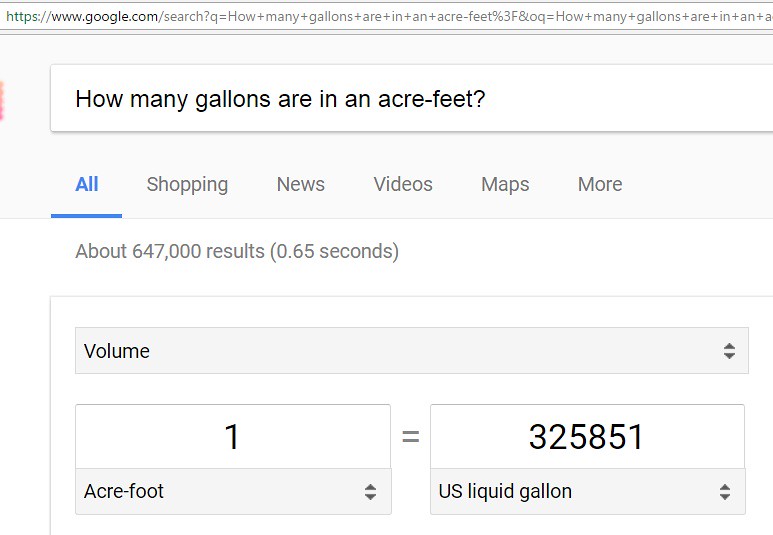
Cary G Pfeffer118 118Third Rock Ventures, Boston, Massachusetts, USA. 

Mike Powell119119Sofinnova Ventures, Menlo Park, California, USA. 

Dennis J Purcell120120Aisling Capital LLC, New York, New York, USA.

Amit Rakhit121 121Ovid Therapeutics Inc., New York, New York, USA. 

Kartick Ramamoorthi122122Encoded Genomics, South San Francisco, California, USA.
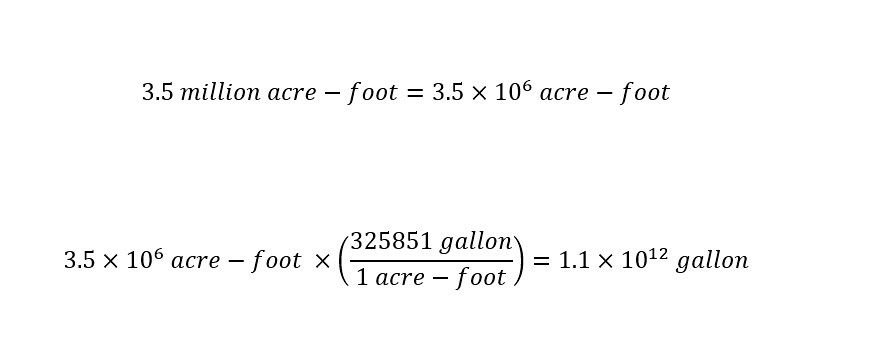
William Rastetter123 123Neurocrine Biosciences Inc., San Diego, California, USA. 

Adrian (Ad) Rawcliffe124124Adaptimmune, Philadelphia, Pennsylvania, USA. 

Laurence E Reid125125Warp Drive Bio, Cambridge, Massachusetts, USA.

Jason P Rhodes126 126Atlas Venture, Cambridge, Massachusetts, USA.

William J Rieflin127 127NGM Biopharmaceuticals, Inc., South San Francisco, California, USA.

Chad Robins128, 128Adaptive Biotechnologies, Seattle, Washington, USA. 

Scott M Rocklage1291295AM Ventures, San Francisco, California, USA.

Michael Rosenblatt130 130Flagship Pioneering, Cambridge, Massachusetts, USA. 

Jonathan G Rosin131131Ironwood Pharmaceuticals, Cambridge, Massachusetts, USA.

William J Rutter132 132Synergenics, LLC, San Francisco, California, USA. 
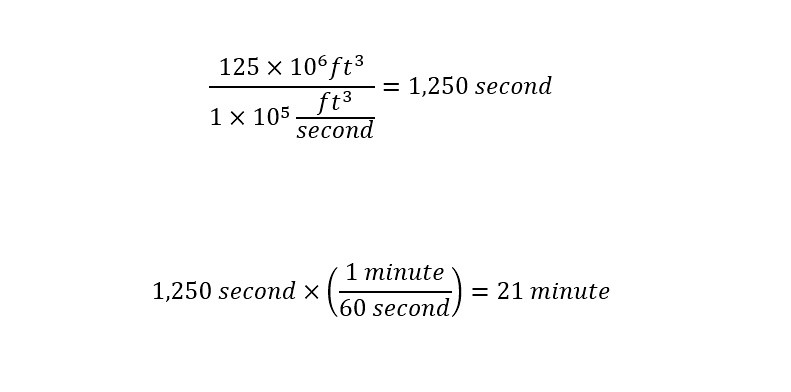
Saurabh Saha133133Delinia, Cambridge, Massachusetts, USA.

Camille Samuels134 134Venrock, Palo Alto, California, USA.

Vicki L Sato135 135Harvard Business School, Cambridge, Massachusetts, USA.

George Scangos136 136Vir Bio, San Francisco, California, USA. 
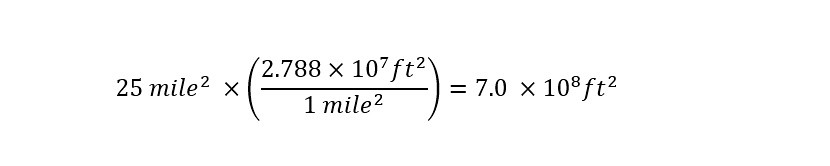
John A Scarlett137137Geron Corporation, Menlo Park, California, USA.

Stuart L Schreiber138 138Broad Institute, Cambridge, Massachusetts, USA. 

Andrew Schwab1391395AM Ventures, San Francisco, California, USA.

Paul Sekhri140 140Lycera Corporation, New York, New York, USA.

Thomas Shenk141 141Lewis Thomas Laboratory, Princeton University, Princeton, New Jersey, USA. 

Clay B Siegall142142Seattle Genetics, Inc., Bothell, Washington, USA.

Nick J Simon143 143Clarus Ventures LLC, South San Francisco, California, USA.

Nancy Simonian144144Syros Pharmaceuticals, Cambridge, Massachusetts, USA. 

Jeff Stein145145Cidara Therapeutics, San Diego, California, USA.

Michael Su146 146Decibel Therapeutics, Cambridge, Massachusetts, USA.

Mary T Szela147 147Novelion Therapeutics, Vancouver, British Columbia, Canada.

Henri Termeer148 148Formerly of Genzyme, Cambridge, Massachusetts, USA.

Nancy A Thornberry149149Kallyope, New York, New York, USA.

Martin Tolar150 150Alzheon, Framingham, Massachusetts, USA.

Richard Ulevitch151 1515AM Ventures, La Jolla, California, USA.

Akshay K Vaishnaw152 152Alnylam Pharmaceuticals, Cambridge, Massachusetts, USA.

Anne VanLent153 153AMV Advisors, Princeton, New Jersey, USA.

George P Vlasuk154 154Navitor Pharmaceuticals, Inc., Cambridge, Massachusetts, USA. 

Michel Vounatsos155155Biogen, Cambridge, Massachusetts, USA

Samuel G Waksal156.156MeiraGTx, New York, New York, USA.

Neil Warma157157Opexa Therapeutics, Inc., The Woodlands, Texas, USA. 

Ryan J Watts158,158Denali Therapeutics, Inc., South San Francisco, California, USA. 

Yaron Werber159159Ovid Therapeutics, Inc., New York, New York, USA. 

Christoph Westphal160160Flex Pharma, Boston, Massachusetts, USA.

Wendell Wierenga161 161Crinetics Pharmaceuticals, San Diego, California, USA.

Doug E Williams162 162Codiak BioSciences, Cambridge, Massachusetts, USA.

Lewis (Rusty) Williams163163Five Prime Therapeutics, Inc., South San Francisco, California, USA.

Kleanthis G Xanthopoulos164 164Cerus, La Jolla, California, USA.

Daphne Zohar165  165PureTech Health, Boston, Massachusetts, USA. 

Sandford (Sandy) Zweifach166166Nuvelution Pharmaceuticals, Inc., South San Francisco, California, USA.